Get in Touch with Liehuang Company

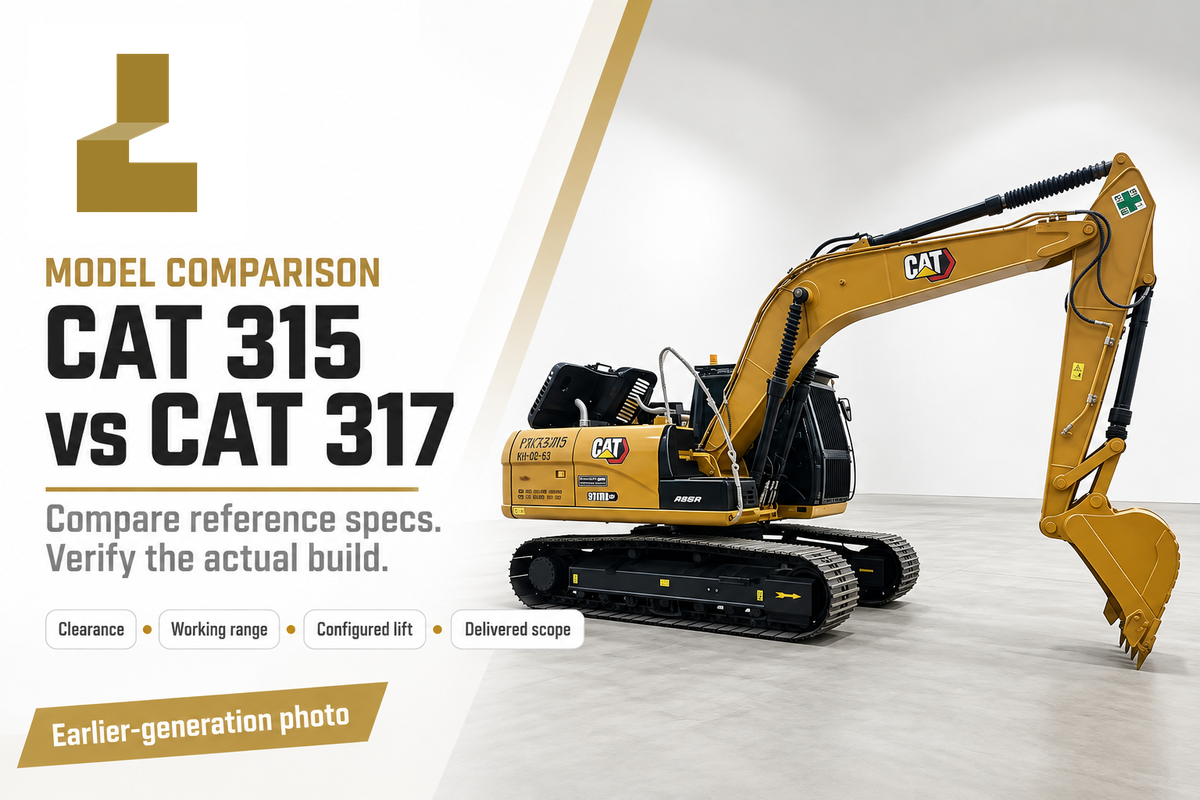
CAT 315 vs CAT 317: Which Excavator Fits Your Work?

CAT 315 vs CAT 317 is mainly a choice between compact tail swing and a heavier platform with more listed power and digging reach. Pick the 315 if space is a constraint; look to the 317 if the job requires it.
By GW · Reference information checked October 21, 2026
Quick Specs, comparison scope
- Models: standard Cat 315 and standard Cat 317 crawler excavators.
- Power basis: ISO 9249 net power.
- Listed working-range builds: 315 with 4.65 m boom and 3.0 m stick, 317 with 5.1 m boom and 2.9 m stick.
- Buying decision: match the actual build, fitted tool, condition and job before comparing the quote.
CAT 315 vs CAT 317: specs at a glance
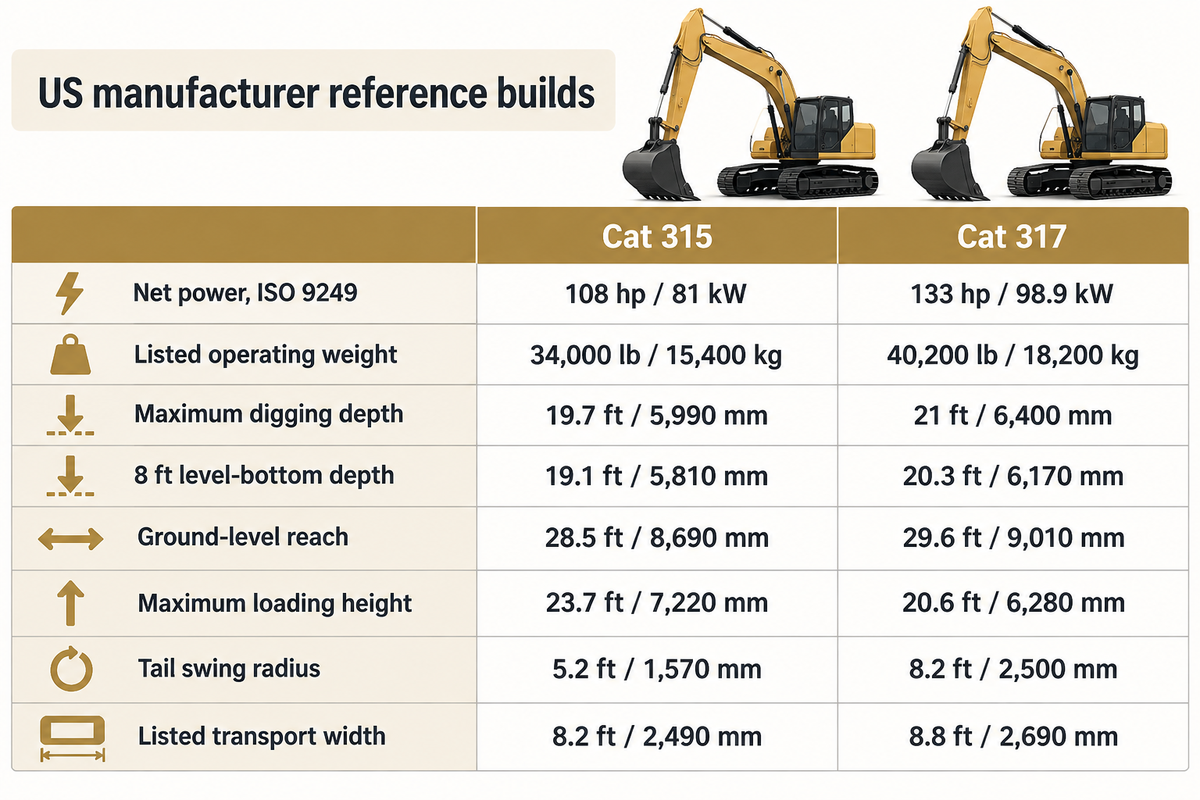
The standard 315 has smaller tail swing and lower listed operating weight. The standard 317 has more listed net power and deeper maximum digging range. The small excavators can be used to argue either way, but each point needs its own basis of comparison: the table is a comparison of published reference values.
| Parameter | Cat 315 | Cat 317 |
|---|---|---|
| Net power, ISO 9249 | 108 hp / 81 kW | 133 hp / 98.9 kW |
| Listed operating weight | 34,000 lb / 15,400 kg | 40,200 lb / 18,200 kg |
| Maximum digging depth | 19.7 ft / 5,990 mm | 21 ft / 6,400 mm |
| Depth for a 2,440 mm (8 ft) level bottom | 19.1 ft / 5,810 mm | 20.3 ft / 6,170 mm |
| Maximum reach at ground level | 28.5 ft / 8,690 mm | 29.6 ft / 9,010 mm |
| Maximum loading height | 23.7 ft / 7,220 mm | 20.6 ft / 6,280 mm |
| Tail swing radius | 5.2 ft / 1,570 mm | 8.2 ft / 2,500 mm |
| Listed transport width | 8.2 ft / 2,490 mm | 8.8 ft / 2,690 mm |
Sources: Caterpillar’s US 315 specifications and US 317 specifications. Equipment World’s 315/317 technical comparison corroborates the main imperial figures. The reporting relies on Caterpillar data; these are catalogue specifications as opposed to a production test.
Keep rows in the table separate when specifying used equipment. The 315 operating-weight note includes a 0.53 m³ bucket, while its working-range table uses a 0.68 m³ bucket. The 317 working range chart uses a 0.76 m³ bucket. Shoes, counterweight and attachments can change the offered machine, so a row of published figures is not a complete shipping or lift specification.
The four differences that most affect the decision are rear clearance, working envelope, available power and the platform you must move. Start with the constraint that prevents the machine from doing the job you require.
Cat 315F, GC and Next Gen: separate the generations
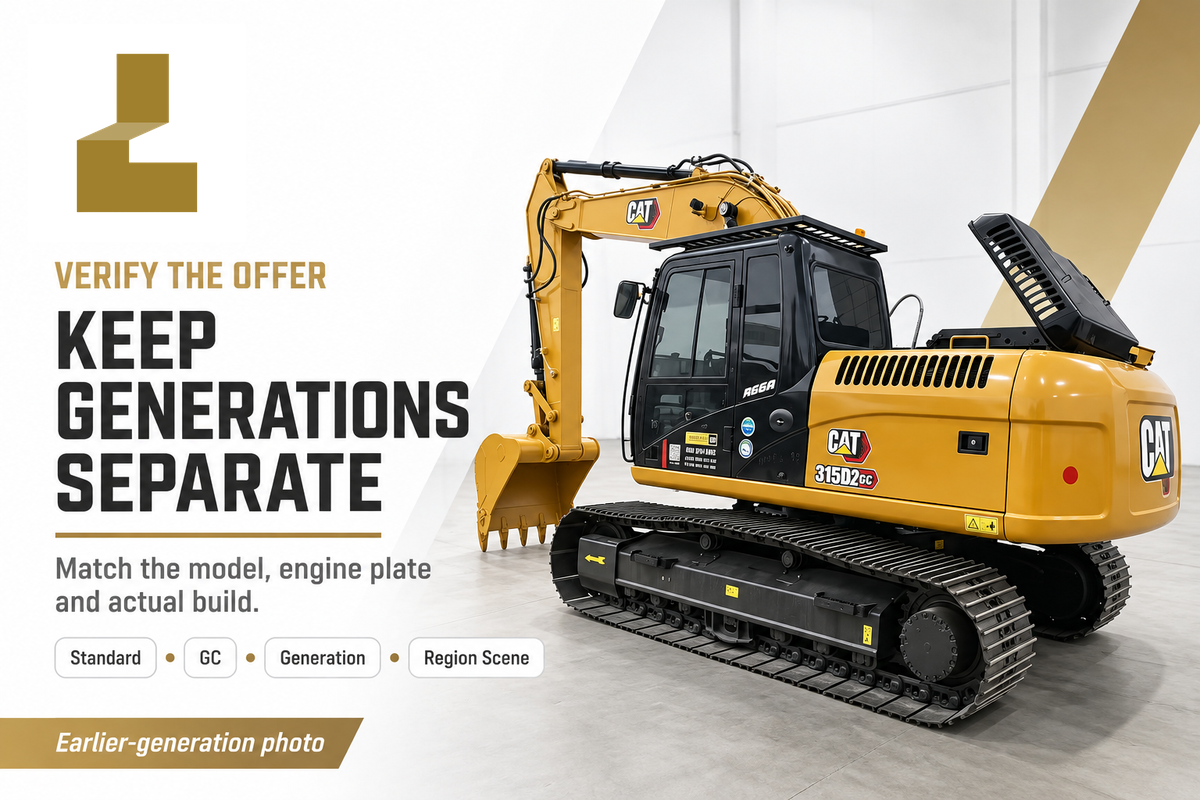
Cat 315F, 315 GC, and the standard Next Gen 315 belong in different comparisons. The same holds true for the standard 317 and 317 GC. A used listing may shorten the model name, so generation, region and build matter when comparing engine details, controls, cab equipment and the fitted working tools.
Use the used Caterpillar excavator buying guide to position the offered model. A standard machine’s published technology package shouldn’t appear in a GC quote. Likewise, an older machine that has beneficial installed options should be compared on those options and its condition.
For the 317 the machine’s engine identity should be taken into account regardless of age or technology level. The current US specification table shows a C3.6 engine, while the same page’s standard equipment shows a C4.4. Verify the actual engine plate and machine build for parts and purchase decisions; the fitted engine of a machine is determined by that machine’s build.
Regional builds can also change the comparison. The current Australian Tier 3 315 page shows a shorter stick than the US Tier 4/Stage V page. Comparing one region’s weight to another region’s maximum reach results in a machine that isn’t actually offered in that configuration. Keep the complete machine build together.
Compact radius excavator clearance: where the 315 fits
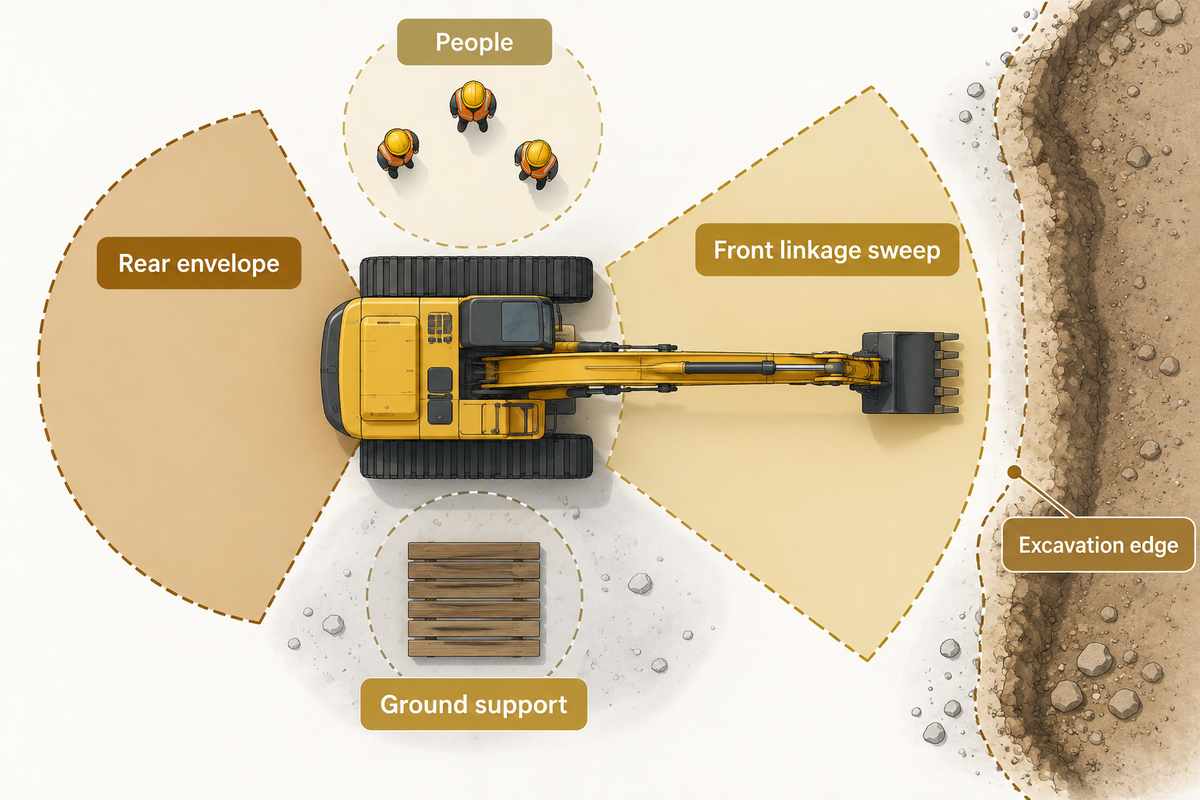
The 315’s compact radius is most helpful where space restriction at the back of the machine limits positioning. Transport width describes the machine moving through an opening. The front linkage or sweeping boom, people, ground support and the excavation edge remain separate constraints even if the rear of the machine fits.
Measure the available jobsite space from the planned machine position. Include the bucket and attachment paths, truck or spoil areas, nearby obstructions, and the space needed to transit to the next location. The currently available Cat 315 excavator offers a compact design, but a narrow rear envelope doesn’t necessarily clear all of the operating area.
Consider a utility crew working along a fully occupied street. The work requires the crew to cut a trench along the street boundary while keeping a route for traffic and a space for spoil. The 315 would be the first machine to assess, as it may provide the crew better positioning options due to its compact rear geometry. The site lead would still need to assess front sweep of the bucket, the operator’s view, ground support, and excavation edge. If a ramp or nearby wall is the limiting issue, changing to a compact-radius machine does not resolve it. The overall work plan and the fit of the machine to the planned position are the key decision factors.
OSHA’s excavation requirements, 29 CFR 1926.651, address equipment ramps, obscured views near excavation edges and adjacent structures. A competent person qualified in structural design must design equipment structural ramps. Continue to make site checks against dimensional comparisons. NIOSH’s excavator attachment guidance also keeps workers away from elevated loads and both arm and superstructure swing zones.
Cat 315 weight vs Cat 317: plan the move
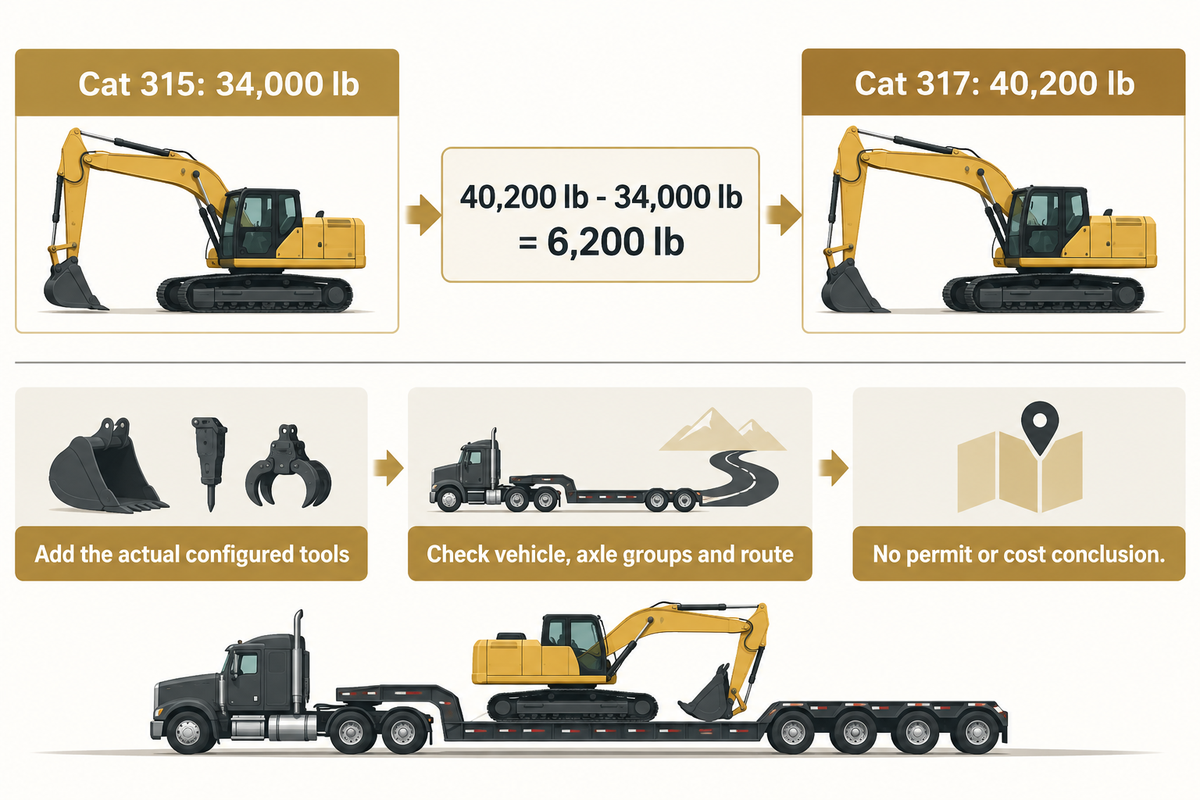
Higher listed operating weight of the 317 becomes more significant when the machine is moved between jobs. The difference in the reference weight is useful for initial fleet planning, but the carrier must evaluate the actual configured load, the entire vehicle, trailer and axle groups. Trailer capacity, axle-group loads, loading position and the route can each become the limiting condition.
Worked example: the listed machine-weight difference is 40,200 lb − 34,000 lb = 6,200 lb. This subtraction compares the two catalogue entries. Comparing the catalog entries, this difference does not consider a particular thumb, coupler, spare bucket, or other equipment carried on the trailer, and it does not establish a permit requirement or transport-cost saving.
For an illustrative contractor moving between dispersed utility jobs, this difference is a reason to engage the carrier early. The transport planner first identifies the actual machine, plus anything else traveling with it. The carrier then checks the tractor and trailer, load position and axle groups, against the planned route. It isn’t sufficient to consider a trailer’s nominal capacity to reach the same conclusion. If a different movement arrangement is required of the 317, the owner can compare the actual quote to the additional work the machine will be doing. The result is a fleet decision based on known inputs, rather than a transport assumption based on the purchase price.
ISO 6016’s public mass-measurement scope describes measuring whole machines and attachments using weighbridges or force transducers. 23 CFR 658.17 on Interstate vehicle weights treats gross weight, axle loads and the bridge formula separately, with specified exceptions. For an overseas purchase, align the carrier’s plan with the excavator shipping arrangements before accepting the delivered-price comparison.
Cat 315 reach and lifting capacity vs Cat 317
The 317 has the deepest maximum digging in the listed US builds, but other factors like loading height and lifting capacity need to be taken into account as well. The working envelope needs to be matched to the trench and truck, and the exact lift chart needs to be verified for material handling. A larger machine doesn’t always offer more geometric advantages.
How deep will a Cat 315 dig?
The current US 315 reference build lists a maximum digging depth of 19.7 ft, or 5,990 mm, with its 3.0 m reach stick. Its depth for an 8 ft level bottom is 19.1 ft, or 5,810 mm. Use the second measure when the work requires a level bottom across that width.
Maximum digging depth doesn’t always mean a useful trench profile. Compare the trench width, side conditions and where the machine can stand, then use the working-range sheet for the fitted boom, stick and bucket. The 317’s dig limit for a level bottom is greater, but that doesn’t necessarily mean the access or material placement is better.
Truck loading can also reverse the headline ranking. The listed 315 maximum loading height exceeds the 317’s even though the 317 digs deeper. This is based on the linkage and bucket reference in each table. Check the truck-side height and the whole loading path; do not treat either published maximum as a promised clearance for your vehicle.
How much can a Cat 317 lift?
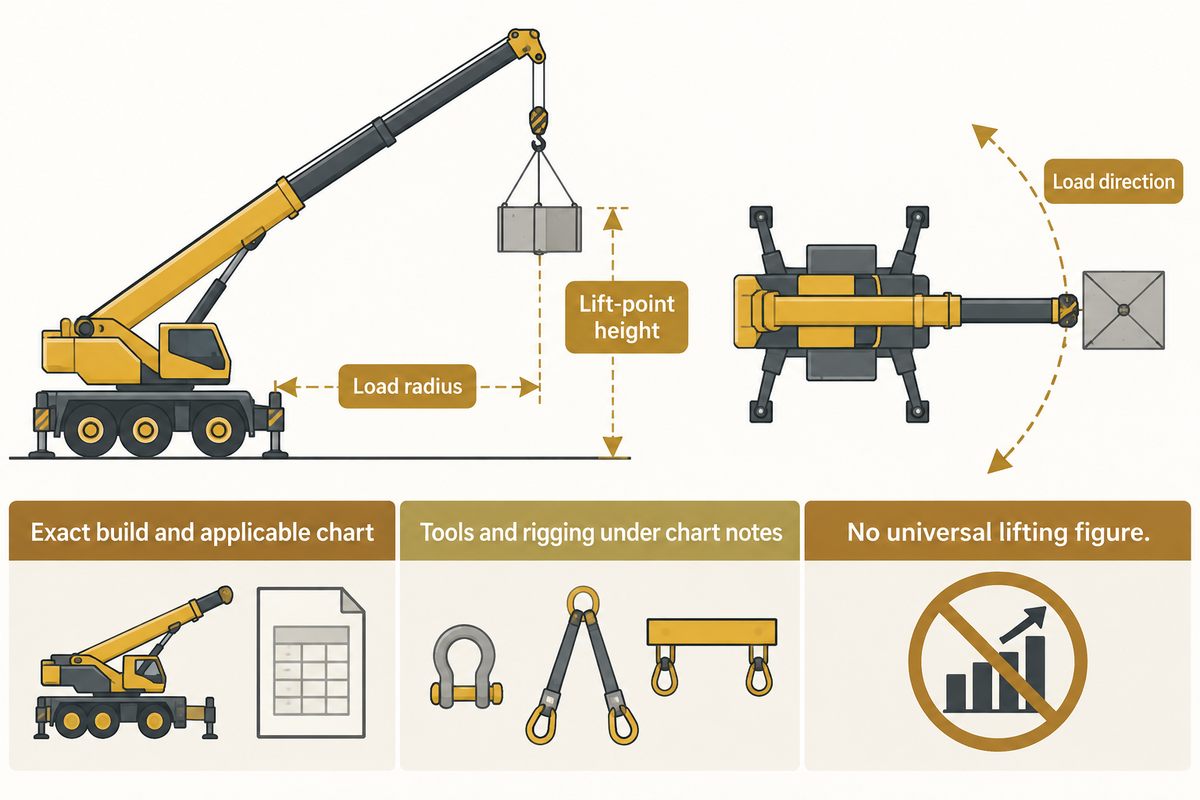
A Cat 317 can lift the load permitted by its applicable chart at the intended radius, height and direction, after accounting for the fitted tools and rigging under that chart’s notes. There isn’t a single number which describes all 317 lifts. Use the excavator’s own chart for the actual built machine.
Caterpillar’s explanation of lift capacity covers tipping, hydraulic and structural limits, and the reason the position of the load affects the rating. These limits are built into the rated chart. Do not apply an extra arbitrary percentage to a chart cell or substitute a hook marking, bucket force or operating weight for the permitted load.
ISO 10567:2007, Hydraulic excavators, Lift capacity, provides the calculation and verification framework for hydraulic and tipping limits. ISO confirmed that edition in 2025; it is still the 2007 edition. For a pipe-placement job, the deciding evidence is the correct chart and planned load path, including every relevant tool deduction.
Cat 315 engine, bucket capacity and cab vs Cat 317
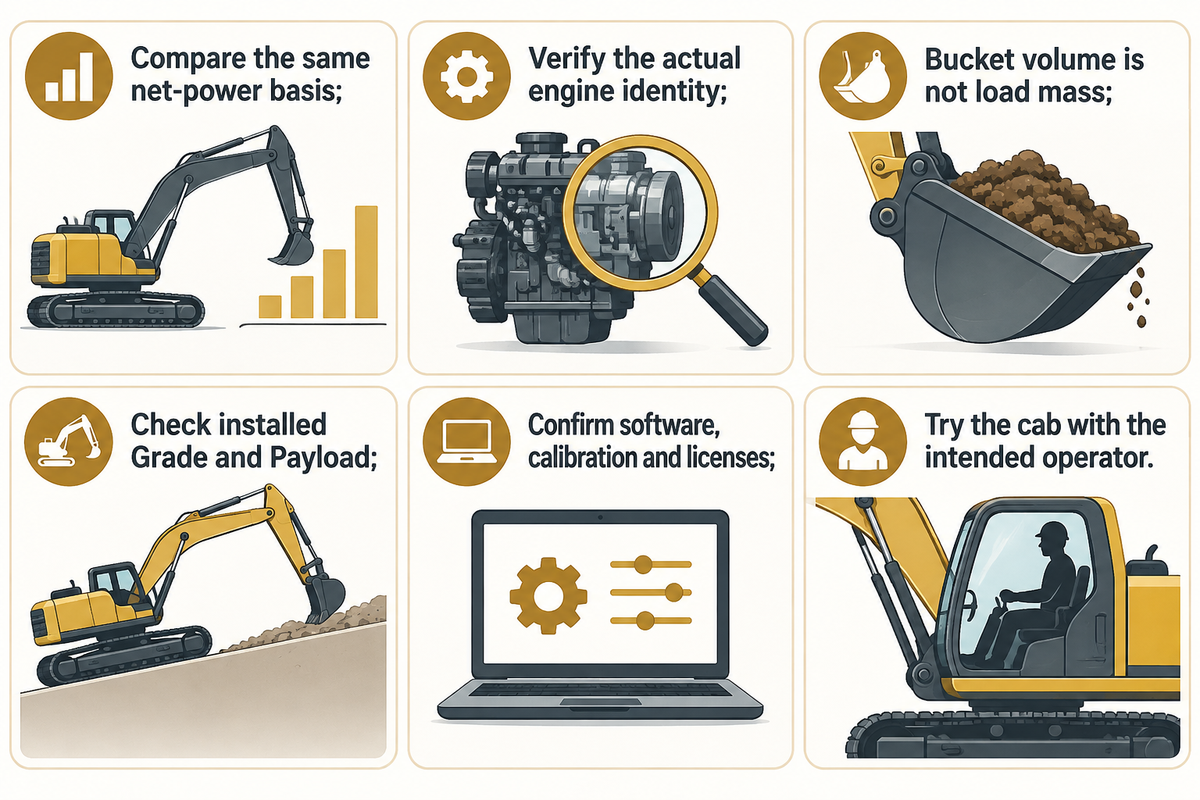
The reference 317 provides more net power, while both the standard models give useful control, guidance, and information systems. Compare the engine rating on the same test basis, match the bucket to the material and judge the cab with the intended operator. Power, bucket, and the comfort of the cab should each be considered in the decision process.
Compare diesel engines on ISO 9249 net power rather than mixing it with the ISO 14396 engine-power row. The Cat 315 excavator uses the C3.6 on the current US reference page; the 317 engine-table conflict makes its actual build identification essential. Extra rated power is not a measured percentage increase in output, because cycle layout, material, attachments and operator technique also affect productivity.
Cat says Smart mode matches engine and hydraulic power to working conditions. Power mode is for strenuous activities, while eco mode can minimize fuel consumption during less strenuous activities. These power mode choices help an operator manage engine use and efficiency; they do not create a fixed fuel-consumption advantage over the other model. The main listed hydraulic flow is 276 L/min for the 315 model and 296 L/min for the 317 model.
Bucket capacity is a volume, not a weight; material density, fill and the mass of the bucket itself change the load. The 0.68 m³ and 0.76 m³ buckets define the reference working range builds, not universal bucket sizes. When selecting a thumb or excavator quick coupler, assess attachment versatility in linkage, mass and auxiliary hydraulic requirements.
The standard Cat Grade with 2D package and Grade Assist can guide depth and slope; Assist automates boom, stick and bucket movements for the supported task. Cat Payload for excavators gives loading estimates. A Grade with 3D upgrade, Advanced Payload and some reporting functions may require additional hardware, software or subscriptions. 2D E-Fence sets operator-defined front-linkage boundaries; it does not replace the jobsite work-zone plan. A used Cat® excavator must be assessed with its working package installed.
Cab fit is specific as well. Comfort cab and Deluxe and Premium cab offerings vary by build and region. Have the operator try the seat, console, lever positions, and monitor while wearing normal work gear. Optional 360° visibility may help the operator review objects and personnel around the excavator. Cat Detect people detection and Cat Command remote control are build-specific offerings; buying the larger model doesn’t itself establish either feature.
Cat 315 price vs Cat 317: compare the same quote scope
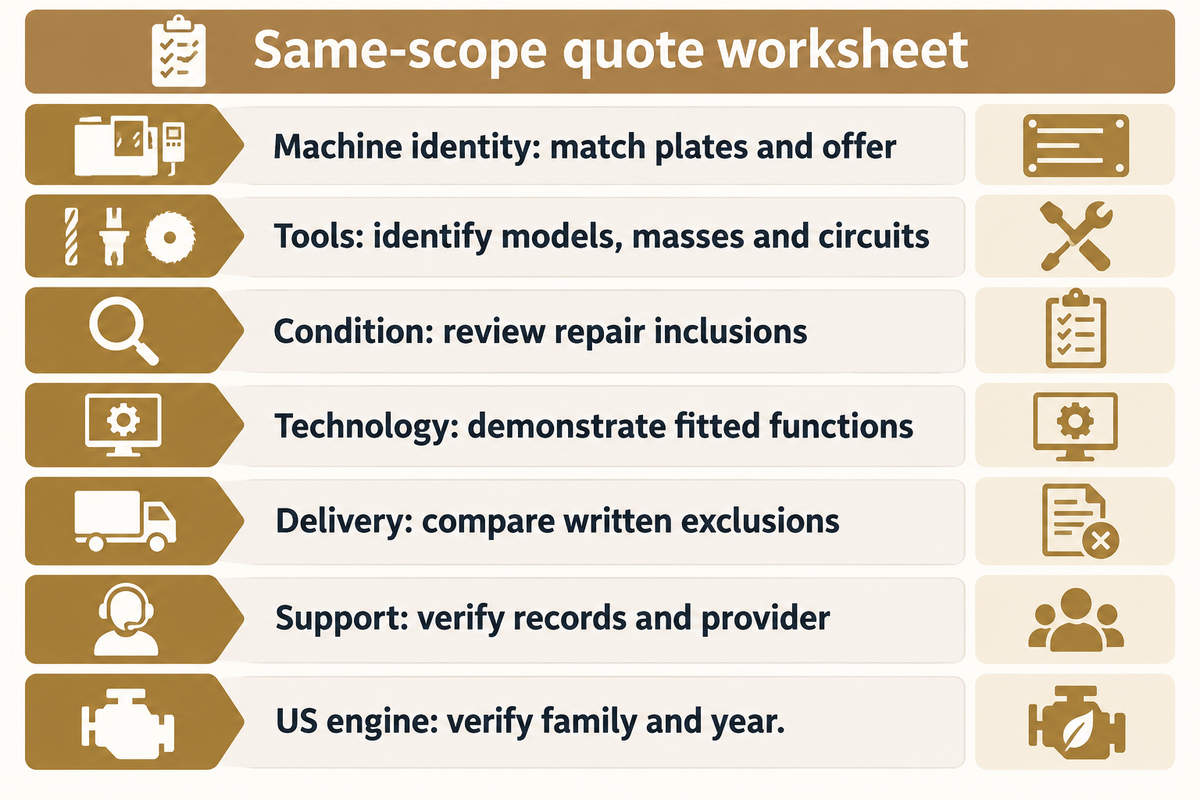
Machine prices should be compared for those machines that can fulfill the same job requirements, and have the same delivery and work-ready scope. There are many considerations that can outweigh a model-name comparison. These include, but aren’t limited to, age, hour-meter readings, condition, tools fitted, support and transport. Compare the purchase amount and operating costs separately; identify missing work and exclusions before treating the cheaper quote as the better value.
How much does a new Cat 317 cost?
A new Cat 317 is priced through a dealer quotation for its build and location. Caterpillar’s current US page asks buyers to request a price rather than publishing one universal new-machine figure. Used prices (and for that matter sold prices) generally reflect machine hours, condition, type and quality of equipment, and terms of sale.
Regional pricing doesn’t always assume a premium for the brand. In the specialist 317 discussion, one member asserts Cats are more expensive, but is contested by a member who describes competitive pricing in his region. This is more of an anecdote than a price survey. Comparing price quotes written for the same scope should be the focus.
Copy the same-scope quote worksheet into the purchase discussion and use the actual figures provided. If a quote is missing an attachment or delivery scope, it should be considered an exclusion and a written quote requested.
| Parameter | Recommended range | Why it matters | How to verify |
|---|---|---|---|
| Machine identity | The exact standard model, year, serial and build on each offer | A GC, older generation or regional build can change the comparison | Match machine and engine plates to the written offer |
| Working tools | The boom, stick, bucket, coupler and thumb required by the job | Capacity, reach, mass and hydraulic demand change with the fitted tool | Identify tool models, masses and compatible circuits |
| Condition and immediate work | A dated condition assessment and an itemized work-ready scope | A low purchase price can omit wear parts or repairs | Review inspection findings and written repair inclusions |
| Installed technology | The functioning Grade, Payload and other options you will use | Hardware, licenses and calibration are separate from a badge | Demonstrate the fitted functions and identify any extra charges |
| Delivered basis | One currency in USD and an equivalent named delivery point | Freight, unloading and other exclusions can change the total | Compare the actual written inclusion and exclusion lines |
| Support and maintenance | The stated support offer and the actual machine’s service requirements | A reference interval does not prove previous servicing | Identify service records, parts arrangements and support provider |
| US engine identity | Matching engine family, type and model year for the offered unit | A general model specification is not an engine-family record | Use the emission label and the official certificate lookup |
When quoting for equipment, the total should only be compared after all the work and delivery scope are aligned. Unknown costs shouldn’t be speculatively added. This method avoids inventing a standard 315-to-317 premium and gives procurement and the owner a clear list of items to resolve.
Which Cat excavator fits your job?
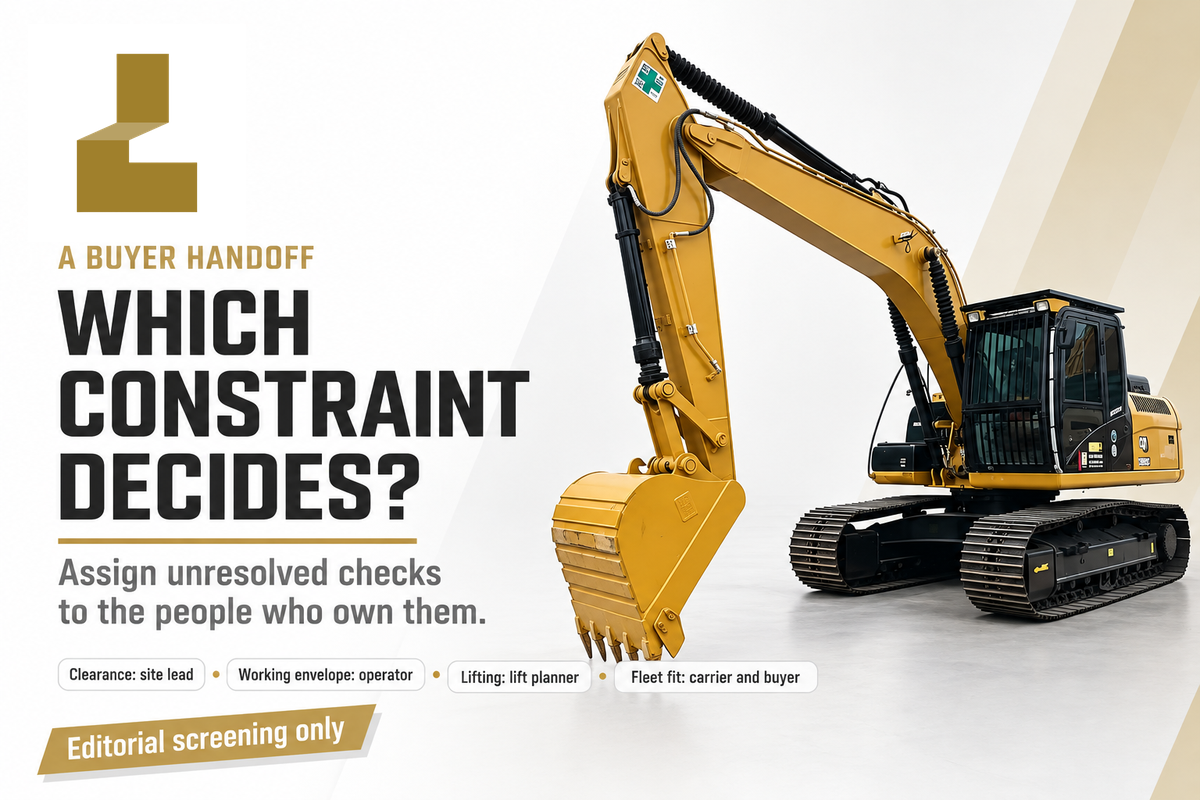
The 315 model is a good starting point for equipment with restricted rear clearance. Start with the 315 for constrained rear clearance; assess the 317 when its extra listed power and digging envelope solve a job requirement. Use the model that clears the job restriction before evaluating other features. Both need an appropriate attachment, condition assessment and a workable movement plan.
4-Factor Excavator Job-Fit Handoff
Use this table as a screening technique, placing actual job requirements next to the supplied build. The hidden bottleneck column makes a restriction apparent to the person that owns it. A row can prevent a purchase even when the machine appears attractive elsewhere; the table isn’t a validated performance measurement. For lifting, use the machine-specific chart following Caterpillar’s load-position guidance.
| Factor | Start with the 315 when… | Assess the 317 when… | Hidden bottleneck and owner |
|---|---|---|---|
| Clearance | Rear sweep limits the usable machine position | The larger rear envelope fits the complete work plan | Front sweep, ground, excavation edge and visibility: site lead |
| Working envelope | Its actual trench and loading range completes the task | Its deeper listed range solves a real trench constraint | Truck-side loading height may reverse the depth ranking: operator |
| Configured lifting and tools | The exact build’s chart and tool match the intended load path | Its exact chart offers a useful advantage at the required position | Load radius, height, direction, tools and rigging: lift planner |
| Fleet and ownership fit | Condition and movement fit the existing fleet plan | Its extra capability justifies the real delivered and movement scope | Configured mass, axle/route limits and omitted quote items: transport, procurement and owner |
An illustrative site prep buyer would start by favoring the 317 for trench depth. The next job, however, also involves loading a particular truck against a boundary. The operator compares working envelopes and checks the loading path rather than assuming the deeper digging machine also loads higher. Procurement checks the required bucket and controls, while the carrier confirms the configured transport plan. If the 315 completes the actual trench and loading tasks with fewer site restrictions, its smaller envelope may win the deal. If a deeper trench really requires the 317’s build, then that justifies the added capability.
315 — advantages and limitations
- Compact rear geometry gives more positioning options in constrained work.
- The lower listed mass is useful for early fleet and movement screening.
- Its actual reach and lift chart still have to complete the task.
317 — advantages and limitations
- More listed net power supports assessment for demanding work.
- The listed deeper digging envelope can answer a real trench requirement.
- The larger rear envelope and actual transport plan can limit its fit.
If neither offered build clears the matrix, widen the search within the 10 – 30 ton excavator range. Don’t buy a machine that misses a fixed job requirement to win the other requirements.
Cat 315 common problems: condition, maintenance and uptime
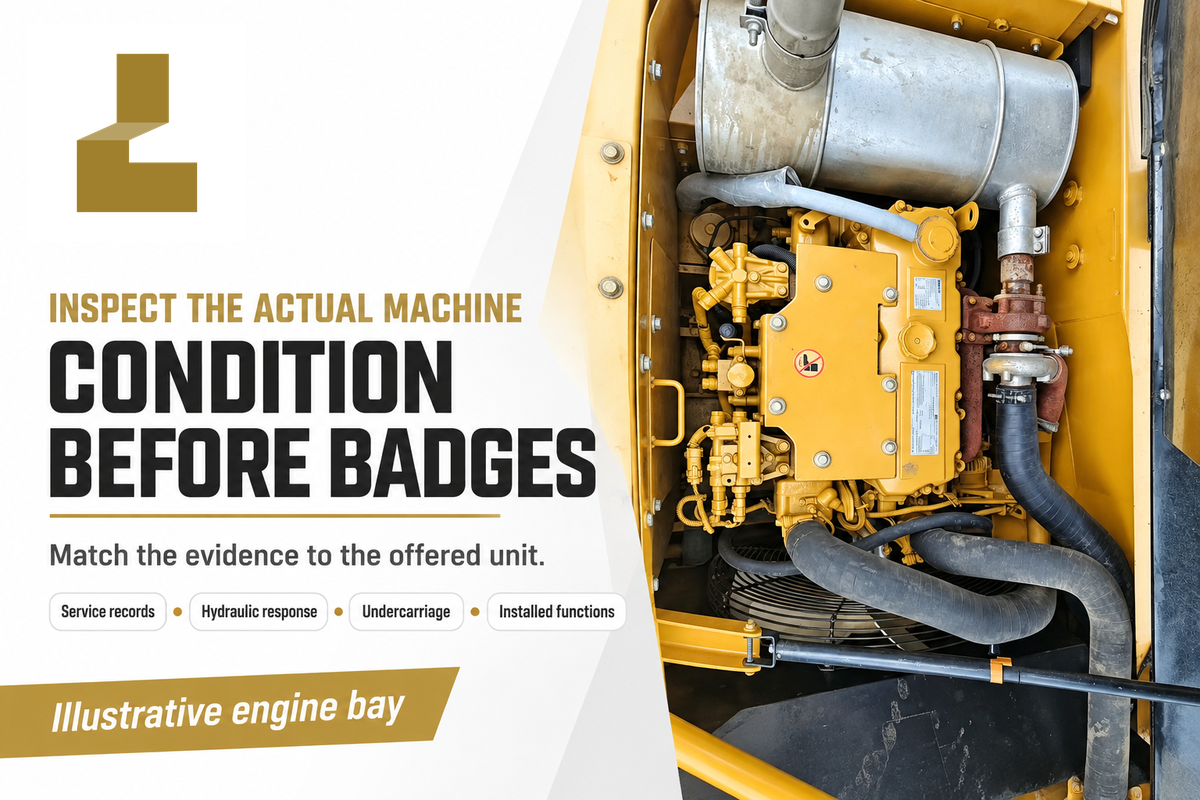
The condition of a used machine may reverse the preference suggested by a specification table. Inspect the undercarriage, structure, hydraulics and attachments and observe the functions needed for the job. A lower hour meter or a cleaner cab may be good context, but neither provides a guarantee of the service life remaining and the quality of previous maintenance.
Look at pins, bushings, bucket tips, tracks and rollers; check hoses, cylinders and signs of leaks. Compare the hour meter to service records and assess fault codes. A technician should assess an abnormal response, instead of having a buyer repeat forum adjustments or diagnose a pump from a short video.
The Heavy Equipment Forums 317 discussion gives a concrete reason to demonstrate the intended functions. One owner describes combined travel and implement response concerns, along with stability concerns after carrying over a cleanup bucket. Other comments discuss setup and cab fit. These accounts identify useful trial questions; they don’t establish a model-wide defect or failure rate.
Equipment World’s 317 maintenance report describes a 3,000-hour hydraulic oil filter change interval for the referenced generation. The current 315 page also describes long filter life. Follow the actual machine’s maintenance schedule and service evidence, rather than extending an interval because another build’s brochure lists it.
Ground-level checks allow a quick assessment, but access and service history are two different things. Check engine oil arrangements, service platform, and available sampling records. The in-cab monitor can show filter life and maintenance intervals; it can’t prove that all previous maintenance was performed.
Remote Troubleshoot can allow a supporting Cat dealer to perform diagnostic testing on a connected machine. Remote Flash handles supported software updates without a technician visiting for that update. Confirm the machine’s connection and support arrangements and separate these functions from a promise of immediate repair or maximum uptime.
Cat 315 suppliers and Cat 317 sourcing for the US
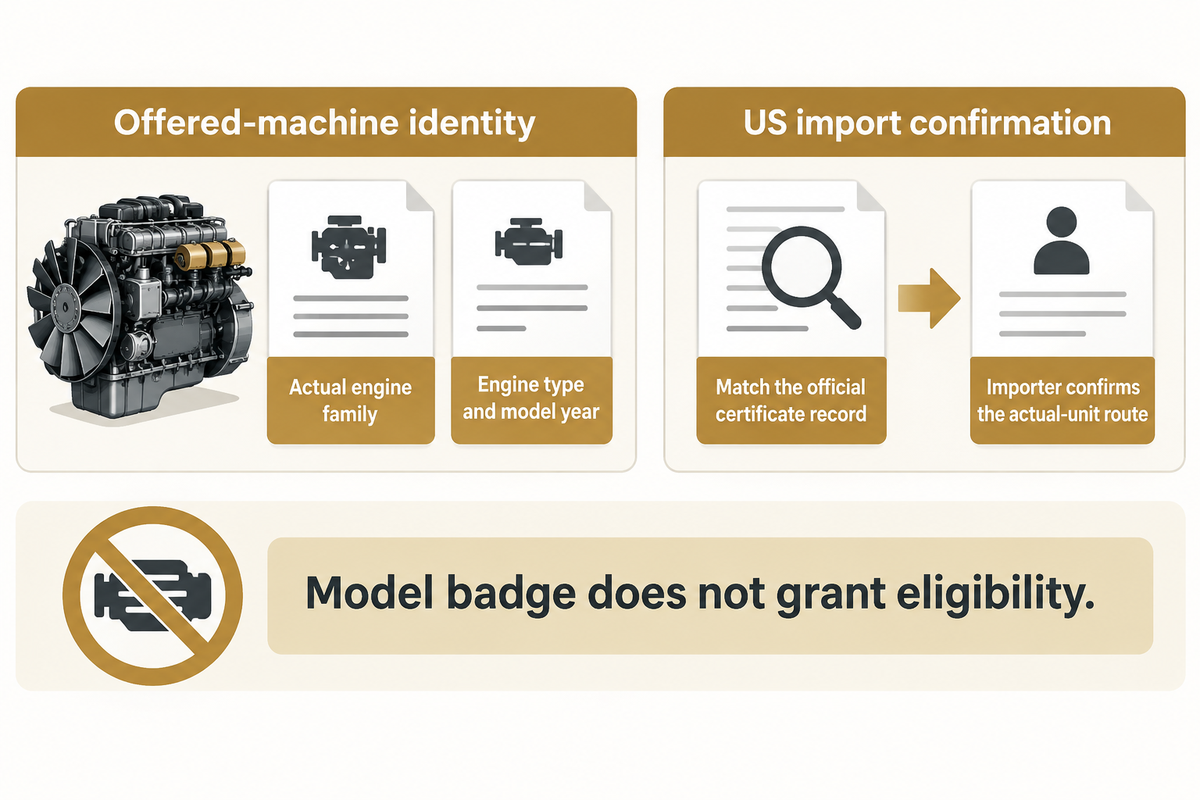
A useful supplier comparison includes the machine’s identity, condition, evidence, fitted equipment and delivery scope. For a US destination, include the actual engine identity in the package. A familiar model badge and a general emissions specification do not settle the engine-family record or the arrangements needed for a particular import.
Use of an engine family number from an emission label and engine type and model year is explained in EPA’s nonroad engine certificate lookup guidance. A Certificate of Conformity is for an engine class and a production model year. Put the matching record alongside the offered machine’s engine details instead of treating a seller’s broad description as the record itself.
EPA’s vehicle and engine import overview also includes nonroad engines and equipment. Have the importer confirm the appropriate route for the actual unit prior to shipping. Neither a factory reference page nor a job fit matrix grants eligibility to import a vehicle.
Review the Cat 315 product information at LH Used excavator against the same worksheet. Ask for a serial-specific offer and the condition, tool and delivery details needed for your job. Compare a 317 offer on the basis mentioned above with the support provider and all the exclusions identified in writing.
Transport and attachment integration requirements
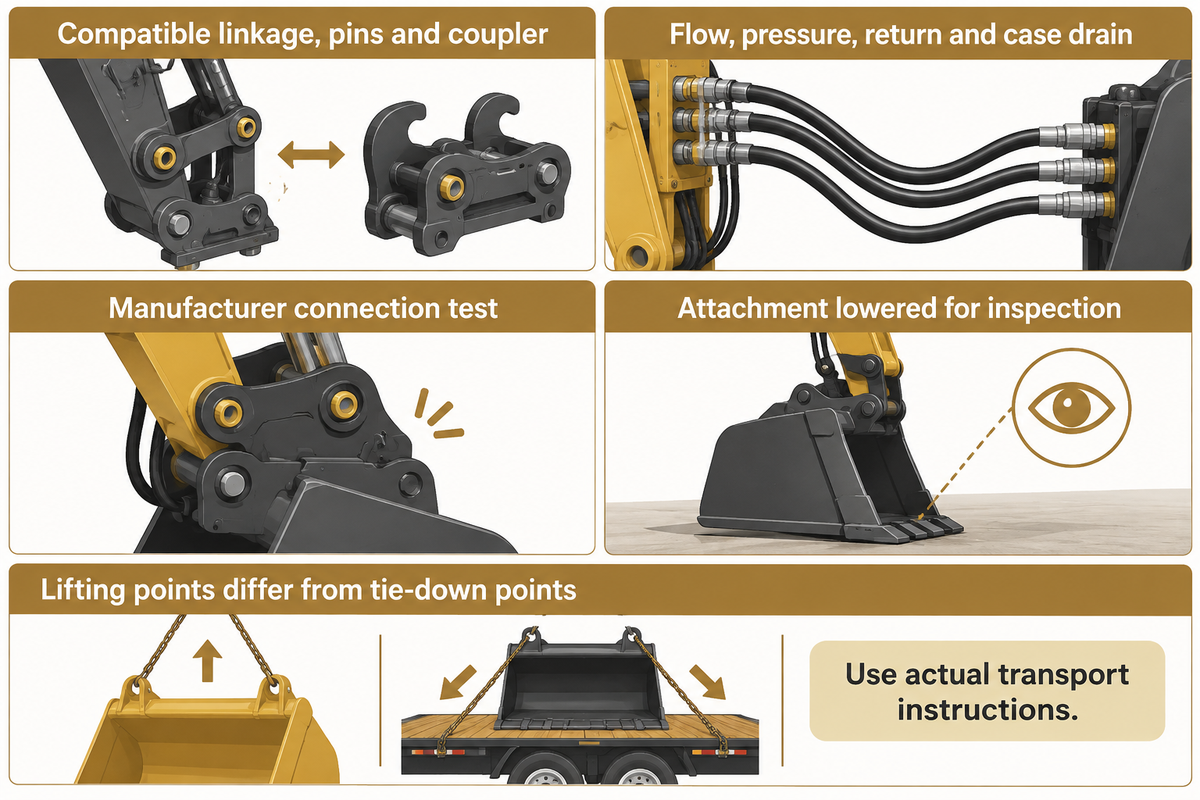
A machine is ready for the job when its fitted tools, hydraulics, controls and movements are integrated. Check the attachment’s mass and hydraulics demand against the offered build, and then incorporate its handling and transportation restrictions in the bid. An appropriate connection alone doesn’t establish an adequate working load or operating setup.
For a thumb, hammer or tiltrotator, compare flow, pressure, return and any case-drain requirements with the installed circuits. Also check the compatibility of the linkage, pins, and couplers. A tool selected for a different excavator can alter the reach, load position and response of the machine it’s fitted to.
“Use only manufacturer-approved and compatible attachments.”
Follow the connection test and inspection procedure of the coupler manufacturer with the attachment in the specified position. NIOSH suggests inspection with the attachment lowered and resting on the ground, and staying clear from elevated attachments. Doing a quick tool change shouldn’t be taken as evidence that the connection and/or the load is suitable.
Engineering Note: The machine’s lifting points, attachment lifting arrangement and transport tie-down points perform different jobs. ISO 15818:2017 addresses earth-moving machinery lifting and tying-down attachment points. Use the actual machine’s transport instructions and the carrier’s restraint plan; a bucket force or an excavator lift-chart rating does not specify a tie-down arrangement.
Before deciding on either the 315 or 317, bring together the condition assessment, the worksheet and the job-fit requirements. Choose the 315 if the actual build of the equipment, in its current configuration, meets the site and fleet requirements. Choose the 317 if the additional capability solves a requirement and the machine meets the same site and fleet requirements.
Ready to compare an offered machine? Send LH Used Excavator your job and quote requirements, including the intended tool, trench or loading task and destination.
FAQ
How much weight can a 315 cat excavator lift?
A Cat 315’s permissible lift is the load-chart rating for its exact build, lifting radius, lift-point height and direction.
Tools and rigging should be considered using the chart’s notes. Operating weight and bucket digging force aren’t permissible lifting loads; use the applicable lift chart. Determine the applicable chart and then decide on the 315 or 317 for pipework or load placement. A blank chart cell shouldn’t be considered as permission to lift at that location.
What is the weight of a Cat 315 excavator?
Caterpillar’s current US reference page lists the standard 315 at 34,000 lb, or 15,400 kg.
The page lists a particular undercarriage, stick, bucket, shoes, and counterweight for that figure. Different blades, tools and builds will change the machine being moved. Use the actual configured mass when the carrier checks the trailer and axle loads. Attachments carried separately still need to be considered in the carrier’s complete load assessment.
What are the specifications of the CAT 317 excavator?
The current US standard 317 reference table lists 133 hp of ISO 9249 net power, 40,200 lb operating weight and 21 ft maximum digging depth.
Its working-range table uses a 5.1 m boom and 2.9 m stick. Those figures describe published reference builds. Match the offered machine’s engine, counterweight, shoes and fitted tools before using them for a purchase. Check the separate level-bottom depth and loading-height entries against the actual work you intend to perform.
Is a Cat 317 GC the same as a standard 317?
The 317 GC is a separate value-focused variant, with a different equipment and technology package.
Keep its specification sheet and quote separate from the standard 317 comparison, especially when checking installed Grade, Payload and cab features.
What should I inspect before buying a used Cat excavator?
Inspect the actual machine’s structure, undercarriage, hydraulics, attachments and service history, then arrange a controlled demonstration.
Check for track and roller wear, pin movement, hose leaks, uneven travel and fault codes. Check the coupler with its attachment resting on the ground, following the manufacturer’s instructions. Have the intended operator assess the seat, controls and visibility. Compare the hour meter to service records, check the fitted technology and confirm the engine plate. A clean exterior can’t be substituted for these checks and an independent condition assessment.
Can I move a Cat 315 and Cat 317 with the same trailer?
Possibly, but the carrier must check the complete loaded vehicle.
The actual machine mass, attachments, trailer capacity, axle-group loads, loading position and the intended route will determine the answer.
Do Cat Grade and Payload make the 317 the better buy?
The better buy is the machine whose installed tools and technology solve the work you actually perform.
The standard reference 315 also includes Grade and Payload features, so those names alone do not justify choosing a 317. Make sure the software, calibration, sensors and any required licenses are included with the machine offered. Repetitive grade work may benefit from guidance; occasional digging may place more value on access, condition and support. Evaluate the complete package against your job-fit requirements and the price quotation.
References & Sources
- Equipment World, Similar But Very Different: The Four 315 and 317 excavator Models (2021; Updated 2026)
- Equipment World, Redesigned 317 and 317 GC: maintenance and cab features (2020; updated 2026)
- ISO 10567:2007, Hydraulic excavators: lift capacity; confirmed 2025
- BSI, BS ISO 6016:2008: measuring machine, equipment and component masses
- eCFR, 29 CFR 1926.651: specific excavation requirements
- eCFR, 23 CFR 658.17: Interstate vehicle weight requirements
- NIOSH, Excavator quick couplers, buckets and attachments (2022)
- ISO 15818:2017, Lifting and tying-down attachment points
- US EPA, Obtaining a heavy-duty or nonroad engine Certificate of Conformity
- US EPA, Importing vehicles and engines
Manufacturer reference tables are linked beside the comparison. Reference values and publication dates were checked on October 21, 2026; individual machines and written offers must be matched to their actual build and condition.
Author: GW. Published for LH Used excavator. This guide incorporates cited manufacturer specifications, technical tips and attributed operator discussion. It doesn’t describe a first-hand comparison production test.
Why We Write This
About Liehuang
Liehuang is a China-based used excavator supplier focused on verified machines, inspection records, and export-ready documentation. Our blog is written for buyers who need more than a model name and a low price before sending a deposit.
We publish practical guides on used excavator cost, machine hours, inspection points, import paperwork, attachments, and brand selection so contractors and equipment buyers can compare machines with fewer blind spots.
Inspection FirstEngine, hydraulics, undercarriage, serial-number photos, hour-meter photos, and machine video can be prepared before shipment.
9 Brands In StockCaterpillar, Komatsu, Volvo, Sany, Hyundai, Doosan, Kubota, Hitachi, and Kobelco excavators across common tonnage classes.
Export SupportContainer and RoRo shipping support with destination-focused quote details, Incoterm discussion, and paperwork coordination.
SYS.PROFILE
Contact Profile
NameLiehuang Used Excavators Team
CompanyHefei Liehuang Machinery Co., Ltd.
Product FocusUsed Excavators / Attachments / Export Supply
Buyer RequestInspection report, video, price, freight, and delivery timeline
Websitehttps://lhusedexcavator.com/

Payment protected by staged delivery proof
Pay the balance after machine proof, not on blind trust.
Used excavator buyers need more than a product photo. Liehuang uses a staged payment workflow: deposit to reserve the machine, inspection evidence before balance, and export documents plus shipment tracking before release.
Verified machine videoLoading and customs filesBalance paid after confirmation
Quote & machine selectionChoose the model, hours, attachments and export destination before we reserve stock.
Deposit to lock stockA deposit holds the exact machine while inspection media and documents are prepared.
Inspection proof sentReceive walkaround video, hour-meter photos, serial details and loading plan.
Balance after confirmationPay the remaining balance only after you confirm the machine condition and export evidence.
Shipment & customs trackingWe share loading photos, bill of lading progress and customs support until release.
For high-value used equipment, trust is built by evidence. Ask for the current stock list, payment schedule and export document sample before you decide.Request stock proof