Get in Touch with Liehuang Company
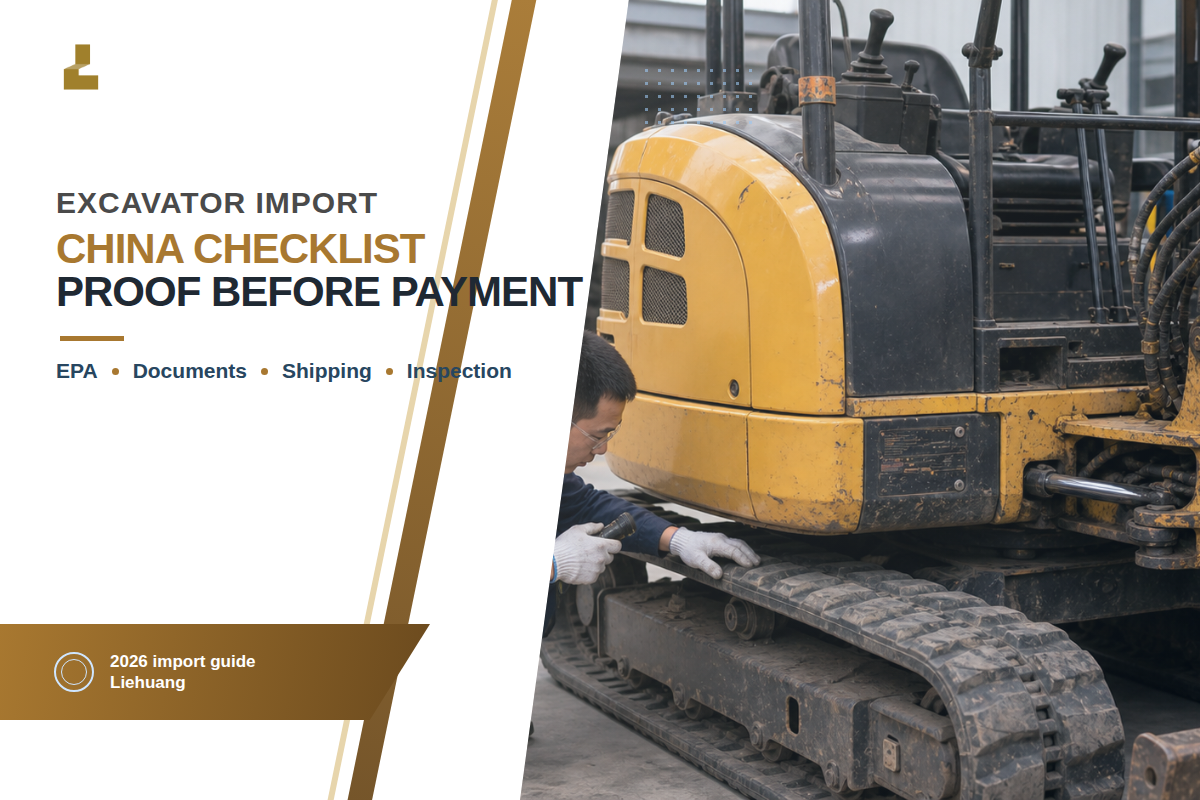

How to Import Excavator from China is the process of verifying the exact machine, engine, documents, shipping mode, landed cost, and payment controls before the excavator leaves China.
Updated July 2026
A low FOB price means nothing unless the buyer has confirmed EPA admissibility, checked the HTS number, reviewed inspection proof, and identified the transport and inland delivery costs.
Short answer: Import an excavator from China by verifying EPA admissibility first, confirming HTS and ISF data with a customs broker, inspecting the exact used machine before balance payment, choosing the shipping mode by tonnage, and budgeting from FOB to port, clearance, inland haulage, attachments, and repairs.
3,830-51,000 kgsampled operating weight span
US$13,000-95,000public FOB span across 5 Liehuang examples
24 hoursISF timing before vessel lading for many ocean shipments
Key takeaways before you request a quote
- EPA Form 3520-21 and engine conformity evidence should be checked before the excavator leaves China.
- FOB, CIF, FCA, DAP, and DDP change risk and control; they aren’t just quote labels.
- A used excavator inspection should tie serial number, photos, video, service records, undercarriage, hydraulics, and payment release together.
- Heavy units can add state oversize or overweight permit work after port release.
Buyer-risk check from real import questions
- Will customs reject it because of EPA paperwork?
- Is the FOB price the real total cost?
- Are the hours and condition believable before I send the balance?
- Which shipping mode fits my machine weight?
Three common assumptions fail here: cheap FOB is not always cheap landed cost; the cheapest FOB number is not the best offer if it hides proof and inland delivery; and a visible hour meter is not proof of machine condition.
Quick Specs: Importing an Excavator from China
Use EPA import-form guidance and FHWA oversize/overweight permit references as the baseline for separating engine paperwork from heavy-haul planning: EPA forms and FHWA permits.
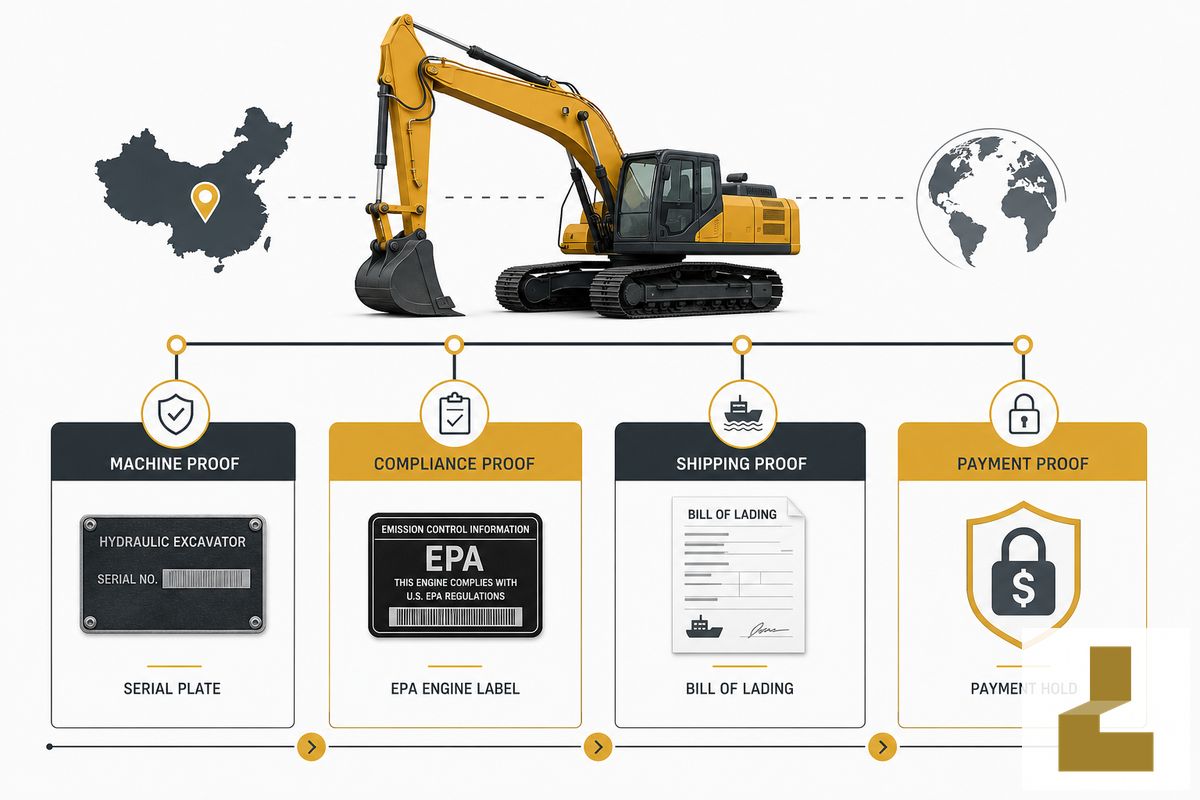
It works best to view the entire China excavator import as four integrated documents: Proof of Machine; Proof of Compliance; Proof of Shipping; Proof of Payment. If any document is missing, customs or delivery may be far more expensive than initially apparent.
| Sample machine | Weight / power | Public FOB range | Import planning use | Limitations / Not suitable for |
|---|---|---|---|---|
| Kubota U35 mini excavator | 3,830 kg / 18.2 kW | US$13,000-22,000 | Container and compact-project planning | Not a proxy for 20 ton or 50 ton freight cost |
| Komatsu PC200 | 20,010 kg / 110 kW | US$25,000-58,000 | Medium crawler inspection and flat-rack check | Actual year and hours still need unit report |
| CAT 320 | 21,900 kg / 121 kW | US$25,000-58,000 | 20-22 ton landed cost comparison | Freight and EPA proof are separate from FOB |
| Hitachi ZX210 | 21,900-23,900 kg / 128.4 kW | US$25,000-52,000 | Spec match and attachment fit planning | Not a condition guarantee without inspection |
| Volvo EC480 | 48,000-51,000 kg / 270 kW | US$55,000-95,000 | Heavy haul, port handling, permit review | Can exceed simple container planning |
That is why there is no single “cost to ship from China to the United States.” A 3.8-ton machine and a 51,000-kg heavy excavator may both be called excavators, but they have very different requirements for loading, lashing, trucking, permitting, and inspection. Think of each section as a gate; the next gate should not open until the responsible party has documented the previous element.
Step 1: Confirm Whether the Excavator Can Enter Your Market
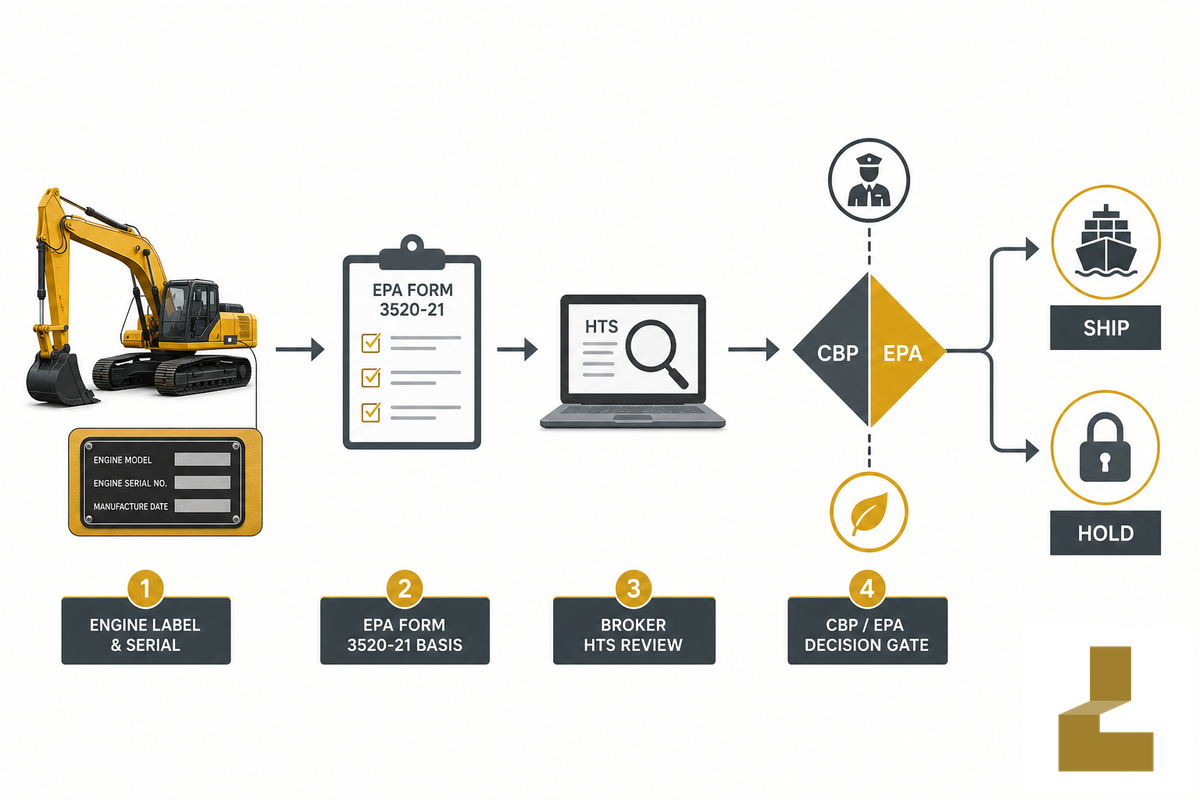
Admissibility review starts with EPA import rules and the customs regulation covering vehicles and engines subject to federal air-pollution control requirements: EPA import rules and 19 CFR 12.74.
U.S. buyers can reduce their risk considerably by having the engine confirmed EPA-ready prior to shipment because a used excavator equipped with a diesel engine is still classified as equipment with an engine and subject to EPA regulations. EPA regulations and a Form 3520-21 entry filing are no substitute for having been manufactured to or otherwise conforming to EPA emission standards, and while there are ICI exemptions available, they aren’t an “automatic entry” document.
EPA publishes EPA Standard Form 3520-21 for heavy-duty highway engines and EPA Standard Form 3520-21 for nonroad engines that are already installed in equipment or vehicles. For U.S. entry planning, ask the broker to align the EPA 3520-21 basis, entry summary data, commercial invoice or bill of sale, and bill of lading before the shipment leaves China. The exact packet should be confirmed against the current machine, engine, and port filing plan.
This isn’t merely a formality. EPA states that, in order to be lawfully imported into the United States, new vehicles and engines must comply with EPA emission standards, and any vehicle or engine that doesn’t comply with EPA regulations or that isn’t subject to a valid ICI or other exemption can be seized by CBP or ordered returned to the exporter. Always get EPA certificate, engine serial, engine family or label, exemption letter, and broker consultation as a prerequisite for releasing funds – don’t leave these for the steamship line to sort out after it sails!
For used excavators, the most expensive mistake is separating “machine condition” from “engine admissibility.” A clean paint job and a clear video do not prove the engine can be entered.
The 6-Gate Excavator Import Readiness Matrix
Use this matrix as a screening tool before submitting a deposit to move your China excavator purchase into verifiable evidence from all parties involved:
| Gate | Proof to request | Who checks it | Timing | Limitations / Not suitable for |
|---|---|---|---|---|
| EPA admissibility | EPA 3520-21 basis, engine label, engine family | Importer and broker | Before deposit or balance | Not solved by a generic “EPA compliant” invoice line |
| HTS classification | Broker HTS rationale, likely 8429.52 review | Customs broker and importer | Before ISF and entry filing | Not a fixed claim without current HTS/Chapter 99 check |
| ISF ocean timing | Seller, buyer, importer number, consignee, origin, HTS data | Forwarder and broker | Often 24 hours before foreign-port lading | Ocean cargo rule; bulk/breakbulk details differ |
| Supplier identity | Business license, export company, bank beneficiary match | Buyer | Before deposit | Not proven by a marketplace chat alone |
| Machine identity | Serial/PIN plate, model, engine serial, photos | Buyer or inspector | Before balance | Not proven by stock photos |
| Condition proof | Cold-start video, undercarriage photos, leak check, report | Buyer or third-party inspector | Before balance | Hour meter alone is not enough |
| Incoterms | FOB/CIF/FCA/DAP/DDP responsibilities in writing | Buyer, supplier, forwarder | Before quote approval | Not a price label; it shifts risk and control |
| Ocean mode | Container, flat rack, Ro-Ro, or breakbulk plan | Forwarder | Before booking | Tonnage is not the only limit; dimensions matter |
| Port-to-jobsite haul | Truck route, permits, escort needs, delivery appointment | Domestic carrier | Before arrival | Heavy units may need state-by-state permit review |
| Payment control | Deposit, inspection hold, balance trigger, refund terms | Buyer and supplier | Before proforma invoice | Not safe if balance is due before proof |
Step 2: Verify the Supplier and the Exact Machine Before Payment
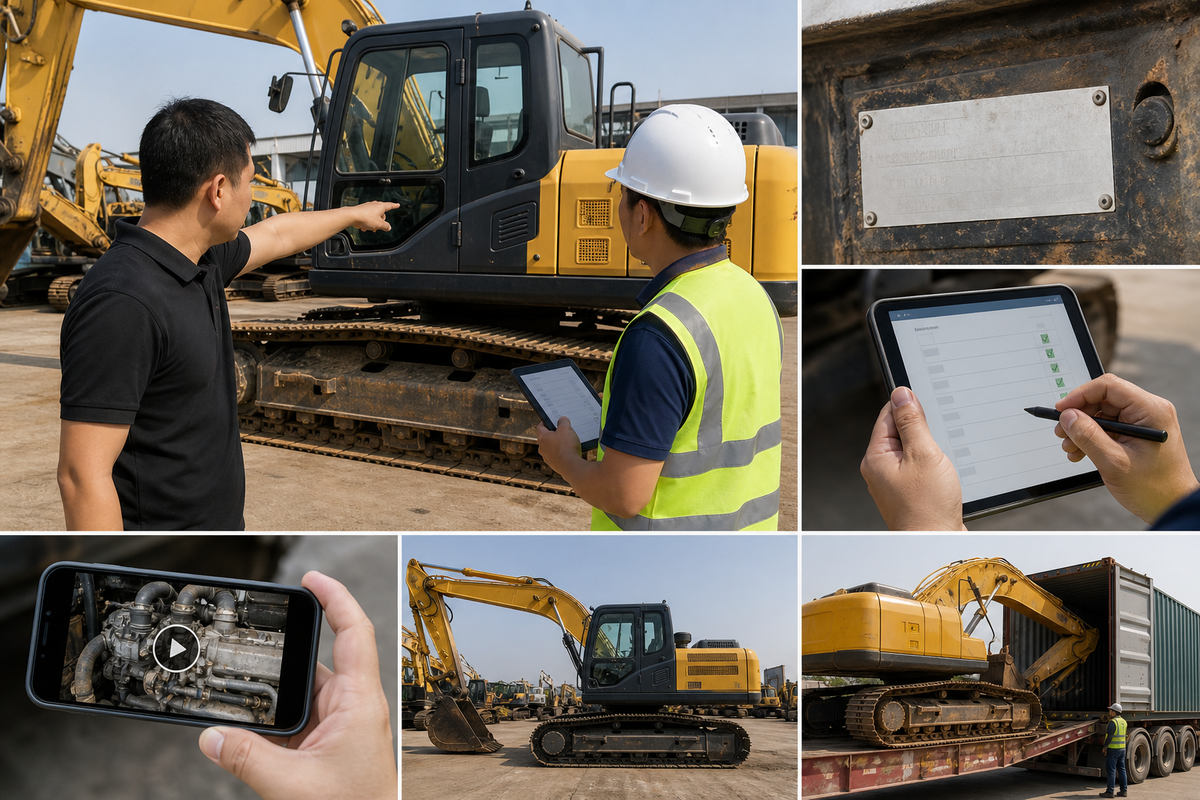
CBP’s reasonable-care guidance explains why supplier and machine proof should be documented before money moves, not after entry filing: CBP reasonable care.
Supplier verification should clearly confirm both the company exporting the machine and the exact model, year, and serial number. When importing a used machine, risk can take two forms: fraud, and being sold a visually identical machine that has significantly different operating hours, an engine, attachments, and condition.
Request a pro-forma invoice specifying the make, model, serial/product ID number, engine serial, year, bucket size, included attachments, delivery port, shipping terms (Incoterms), and the payment structure. Payment should go to the entity shown as the exporter, or a verifiable trading relationship should be clearly stated. Be alert for attempts by a salesperson to change the receiving account after a deposit has been paid, and halt operations immediately.
Forum discussions often show problems with Chinese imports, whether the topic is used Japanese excavators shipped from China or Chinese-built models. The concerns most often center on EPA certifications, customs paperwork, unknown hours, arrival condition, and delivery timing. A supplier’s assurance is a poor substitute for dated videos demonstrating cold start, travel, boom, swing, digging operations, shutdown, and the clearly visible serial plate.
Do
- Request serial/PIN photos beside the full machine photo.
- Match engine label photos to EPA or local admissibility evidence.
- Hold the balance until inspection evidence is delivered.
- Ask for a short video of travel motors, boom, arm, bucket, and swing.
Don’t
- Accept stock photos as proof of a used machine.
- Trust hour meter readings without wear evidence.
- Approve shipment before the document packet is checked.
- Treat attachments as included unless the quote lists each item.
Used excavator models and makers matter. Liehuang Used Excavators can supply used mini, medium, and heavy-duty excavators from major brands such as Caterpillar, Komatsu, Sany, Volvo, Hyundai, Doosan, Kubota, Hitachi, and Kobelco. This breadth helps if the buyer already knows the job requirement, but it does not reduce the need to verify the exact unit.
Step 3: Build the Document Packet Before the Machine Leaves China
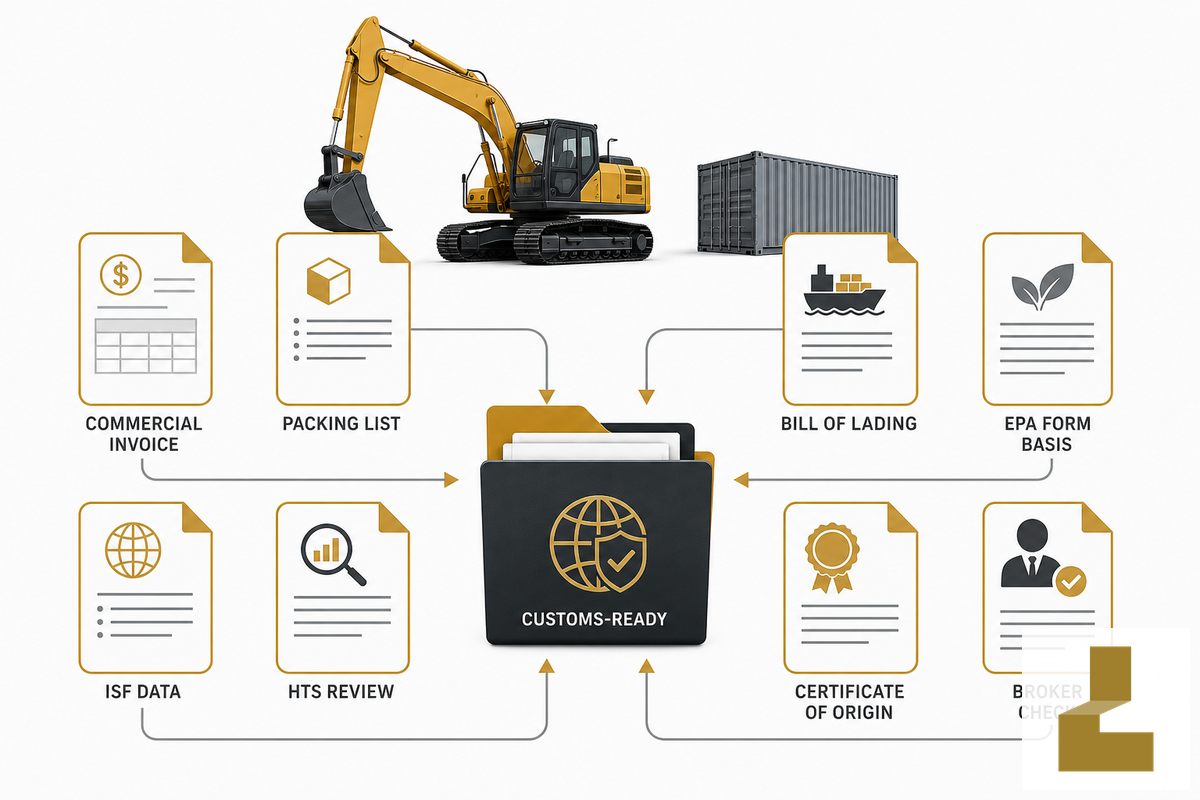
Review ISF timing against eCFR and CBP before booking an ocean shipment: 19 CFR 149.2 and CBP ISF 10+2.
Paperwork should be ready before loading. For most vessel shipments, many data points are time-sensitive before the vessel leaves the foreign port, and missing information can lead to storage, inspection, penalties, or release delays if it is not managed prior to lading.
19 CFR 149.2 establishes ISF for vessel shipments prior to lading. Additionally, CBP’s ISF 10+2 webpage notes that ISF for ocean shipments is also a security filing for the loading of cargo. Whether the excavator shipment is treated as bulk cargo, break bulk cargo, in containers, or handled in a different way will likely be addressed by the freight forwarder or broker.
| Document or data | Why it matters | Ask before | Owner | Limitations / Not suitable for |
|---|---|---|---|---|
| Commercial invoice | Value, seller, buyer, description | Balance payment | Supplier | “Equipment” is too vague for classification review |
| Packing list | Dimensions, packages, attachments | Booking | Supplier/forwarder | Does not prove condition |
| Bill of lading | Shipment control and release | Departure | Carrier/forwarder | Not a substitute for invoice or EPA form |
| EPA Form 3520-21 basis | Engine/equipment admissibility | Deposit or balance | Importer/broker | Generic claims can fail if label/certificate mismatch |
| CBP 7501 entry summary | Formal entry summary | Arrival | Broker | Filed by broker but importer should review |
| ISF 10+2 data | Ocean security filing | 24 hours before lading where applicable | Importer/broker | Timing differs for bulk and breakbulk treatment |
| HTS rationale | Classification and duty treatment | ISF and entry | Broker/importer | Must be current; do not rely on supplier code alone |
| Certificate of origin if needed | Origin and trade treatment | Entry | Supplier | Shipping port is not the same as origin |
| Power of attorney for broker | Broker authority to file | Before entry filing | Importer | Missing POA can hold an otherwise ready shipment |
Non-U.S. buyers need to substitute their local customs regulations, emissions rules, safety rules, and pre-shipment requirements for EPA/CBP items. Nevertheless, researching first and asking questions later is still the better approach.
For customs clearance, keep the invoice, packing list, bill of lading, engine evidence, broker notes, and payment records in one folder before the excavator is loaded.
Step 4: Calculate FOB-to-Landed Cost, Not Just the Machine Price
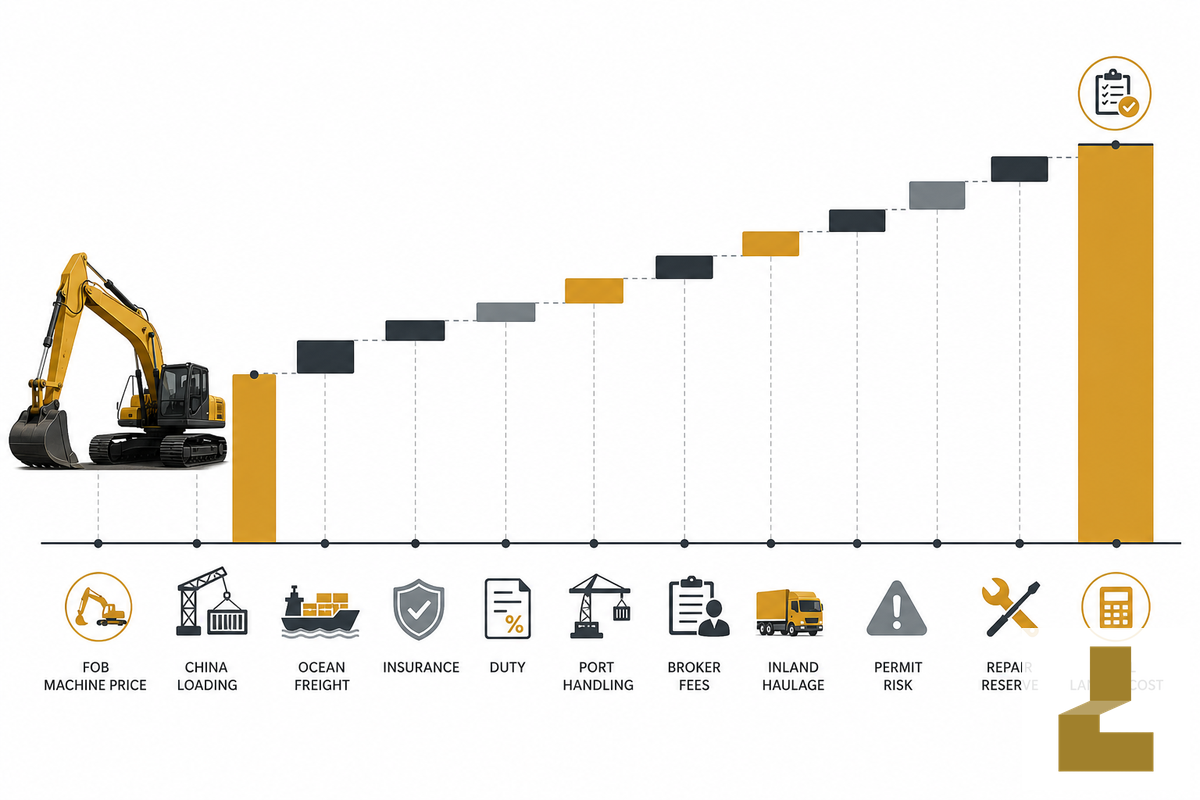
Current HTS review and importer guidance should come before treating any supplier duty estimate as final: USITC HTS 8429.52 search and CBP importer tips.
Landed cost vs. FOB. The FOB cost for an excavator is limited to the purchase price of the machine plus the cost of shipping it out of the country. Landed cost takes into account ocean freight, insurance, customs brokers, port charges, inspections, demurrage risks, permits, and the estimated cost of repairs on a used machine.
Incoterms 2020 are used to define buyer and seller responsibilities. For high value machines, control matters. Price labels shouldn’t dictate all decisions for purchasing an excavator; buyers still need to consider which risks, fees and control measures fall on which party.
FOB-to-Landed-Cost Worksheet
FOB-to-landed-cost worksheet – replace the blanks with your quote and broker numbers:
| Cost item | Mini example | 20-22 ton example | Heavy example | Limitations / Not suitable for |
|---|---|---|---|---|
| Machine FOB | US$13,000-22,000 | US$25,000-58,000 | US$55,000-95,000 | Public examples only; actual unit differs |
| Ocean freight | Get live quote | Get live quote | Get heavy-lift quote | Rates change by lane, season, and fuel |
| Insurance | Cargo value basis | Cargo value basis | Cargo value basis | Basic CIF insurance may be too narrow |
| Broker and entry | Broker quote | Broker quote | Broker quote | Broker filing does not remove importer review |
| Duty and fees | Verify HTS | Verify HTS | Verify HTS | Do not use stale duty screenshots |
| Port and terminal | Port tariff | Port tariff | Port/heavy handling | Demurrage can rise quickly after free time |
| Inland haulage | Local truck | Low-bed quote | Permit route quote | Port-to-jobsite can exceed the port-to-port surprise |
| Attachments | Bucket / coupler | Breaker / grapple | Special tools | Not included unless written into the quote |
| Inspection | Remote or local | Third-party advised | Third-party advised | Inspection cannot fix legal non-admissibility |
| Repair reserve | Hydraulic hoses, filters | Undercarriage, pins, bushings | Heavy wear parts | Reserve depends on age, hours, and work history |
| Working capital | Deposit plus balance | Deposit plus balance | Deposit plus balance | Cash tied up before the machine earns revenue |
Worked example: if a 20 ton machine is quoted at US$40,000 FOB, do not compare it with a local machine until freight, insurance, broker, verified duty/fees, port handling, inland haulage, inspection, attachments, and repair reserve are added. The winning quote is the lowest risk-adjusted landed cost, not the lowest FOB number.
For 20-30 ton import comparisons, match the worksheet against actual unit details from the medium excavators for sale 10-30 ton category before assuming one FOB range fits every machine.
Step 5: Choose Container, Flat Rack, Ro-Ro, or Breakbulk by Tonnage
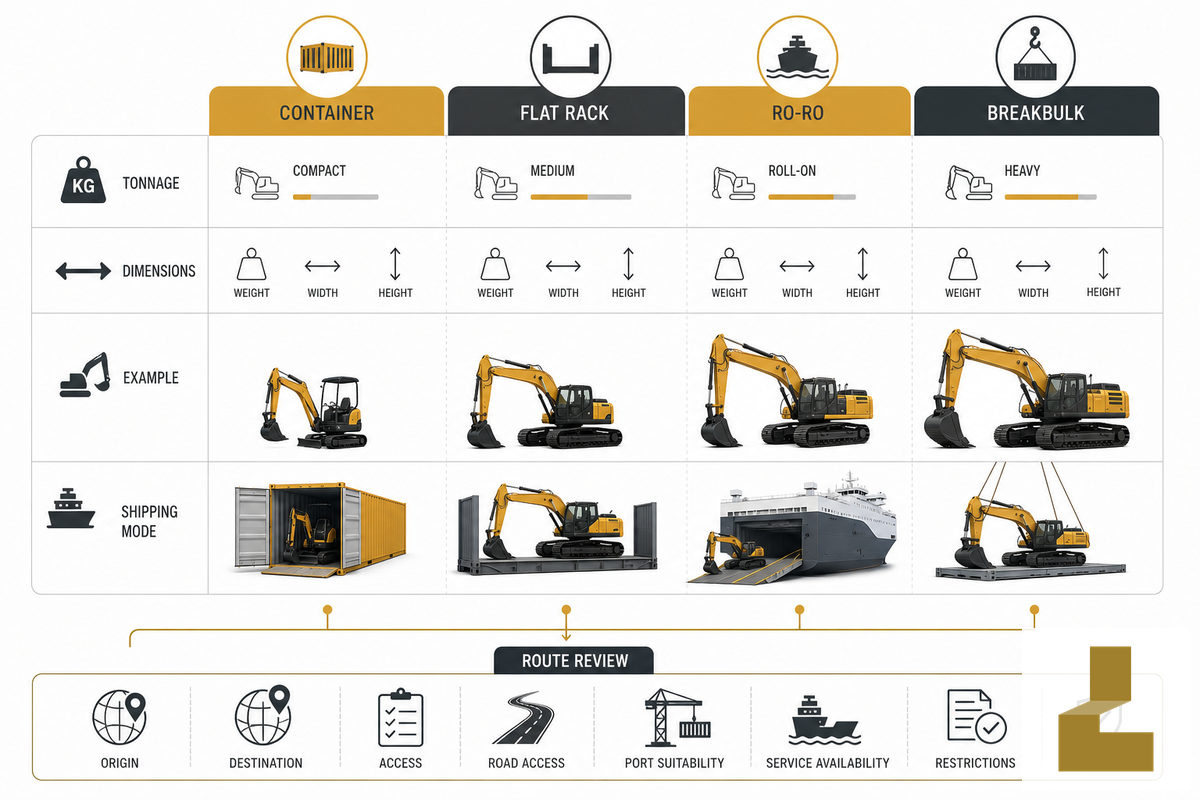
Heavy excavators need ocean-mode planning plus inland permit review; FHWA summarizes oversize/overweight permit issues by state: FHWA oversize/overweight permit report.
Shipping mode depends on equipment weight and dimensions. Those details determine whether the excavator can fit into a shipping container, flat rack, Ro-Ro vessel, breakbulk booking, or another freight method. Shipping routes, port equipment, lashing, insurance, and the inland transportation method are all important elements.
Transport after the port matters. It is important to have a post-arrival transport plan, including all applicable permits for oversize or overweight equipment. Even when gross weight does not exceed 80,000 pounds, an importer still needs to consider axle weight and route regulations. A heavy excavator may be able to be imported but may not fit along state or local roads without a permit.
| Type cluster | Typical planning question | Likely mode to quote | Proof to request | Limitations / Not suitable for |
|---|---|---|---|---|
| 0-4 ton mini | Can dimensions and attachments fit container plan? | Container or LCL/FCL variant | Overall dimensions, packing plan | Attachments may change fit |
| 4-8 ton mini | Can height/width be reduced safely? | Container or flat rack quote | Track width, canopy/cab height | Disassembly may add labor and risk |
| 10-14 ton compact crawler | Can it be loaded without damage? | Flat rack or Ro-Ro comparison | Lashing method, ramp access | Not always container-friendly |
| 15-18 ton crawler | Does port equipment handle the load? | Flat rack/Ro-Ro | Lift points, gross weight | Road-leg permits may apply |
| 20 ton PC200 class | What is the safest export packing plan? | Flat rack/Ro-Ro/breakbulk | Photos after loading and lashing | FOB excludes destination handling |
| 22 ton CAT 320 / ZX210 class | Can boom/bucket position reduce dimensions? | Flat rack/Ro-Ro | Transport drawing | Needs machine-specific drawing |
| 30 ton class | Does inland destination accept heavy delivery? | Ro-Ro/breakbulk/project cargo | Low-bed route quote | Not a simple container job |
| 48-50 ton EC480 class | What permits and route checks are needed? | Breakbulk/project cargo/heavy Ro-Ro | Permit and route plan | Port-to-jobsite cost can dominate |
| Attachments and spares | Ship with machine or separately? | Same container or separate freight | Packing list by item | Loose tools can create customs and damage issues |
Step 6: Inspect Used Excavator Condition Before the Balance Payment
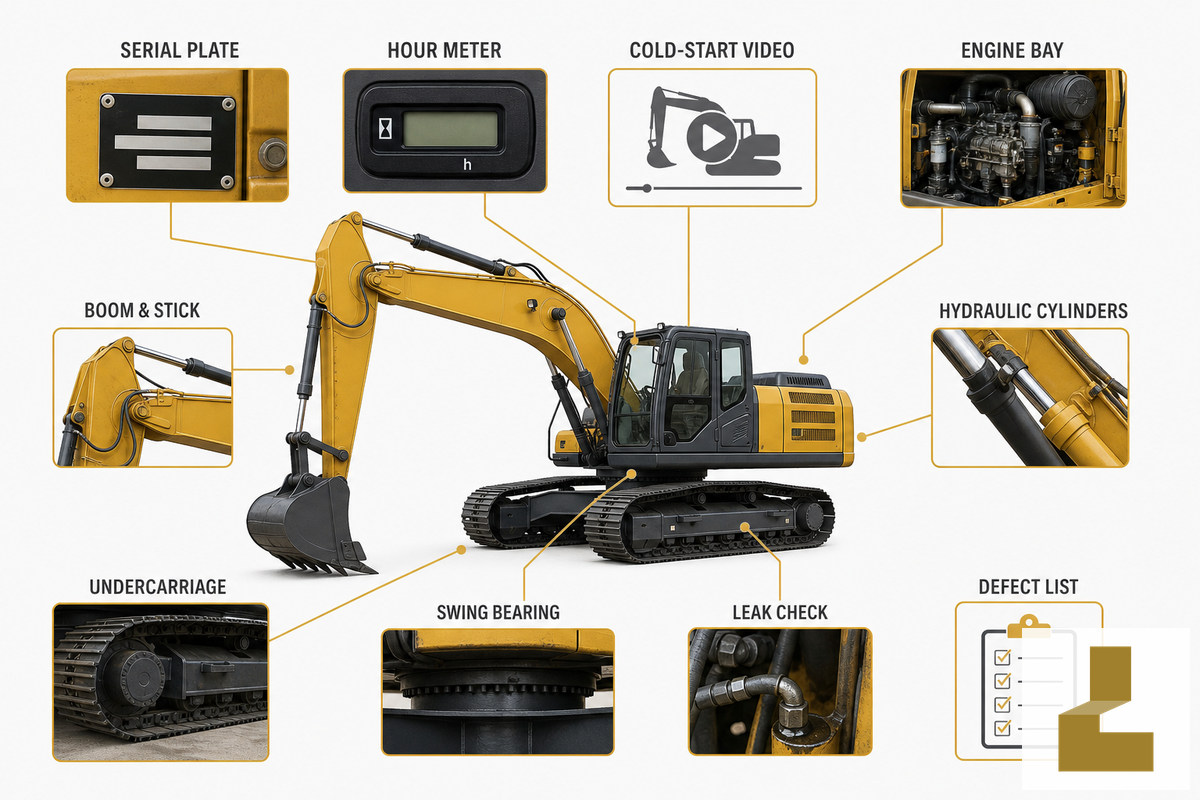
Condition inspection should be paired with engine/import evidence; EPA import forms and equipment-condition monitoring patents show why identity, engine data, and visual proof should stay tied together: EPA import forms and equipment condition monitoring patent.
Pre-shipment inspection matters because the buyer has the most control before the balance payment is released. An inspection that covers serial numbers, hydraulic system function, structural wear, cold starts, undercarriage condition, paperwork, and emissions evidence reduces the chance of expensive surprises.
What is involved in an excavator inspection? A detailed, two-hour examination should assess important parts of a used excavator, including the undercarriage, hydraulics, serial number, year, and engine. This level of care can save buyers significant time and money compared with a superficial examination.
5-Point Proof Packet Before Balance Payment
- Lock the identity – match model, serial/PIN, engine serial, and photos to the proforma invoice.
- Prove cold start – request a single video showing the cold start, exhaust, idle, movement, and shutdown.
- Check wear surfaces – ask for undercarriage, sprocket, roller, idler, bucket pin, bushing, and track photos.
- Test hydraulics – run boom, arm, bucket, swing, travel, auxiliary lines, and any breaker or grapple circuit.
- Hold payment – release balance only after inspection, document packet, and loading plan are accepted in writing.
Hire a third-party inspector for expensive excavators. An expensive used machine is often worth a third-party inspection because it can reveal repair risks before the machine travels overseas. Any inspection report should contain photos of any problems, along with any inspector notes, test results, and personal details. It should raise an alert if a seller is unwilling to supply photos of the serial plate, cold start video or photos of engine label details.
Here is a practical inspection order for Liehuang buyers. Find the model class, request unit proof, use the used excavator inspection checklist, choose accessories, approve the import/export documents, and then have the Liehuang team support loading and shipping. That process helps prevent proof from getting left behind.
Step 7: Send a Complete RFQ and Use Payment Control
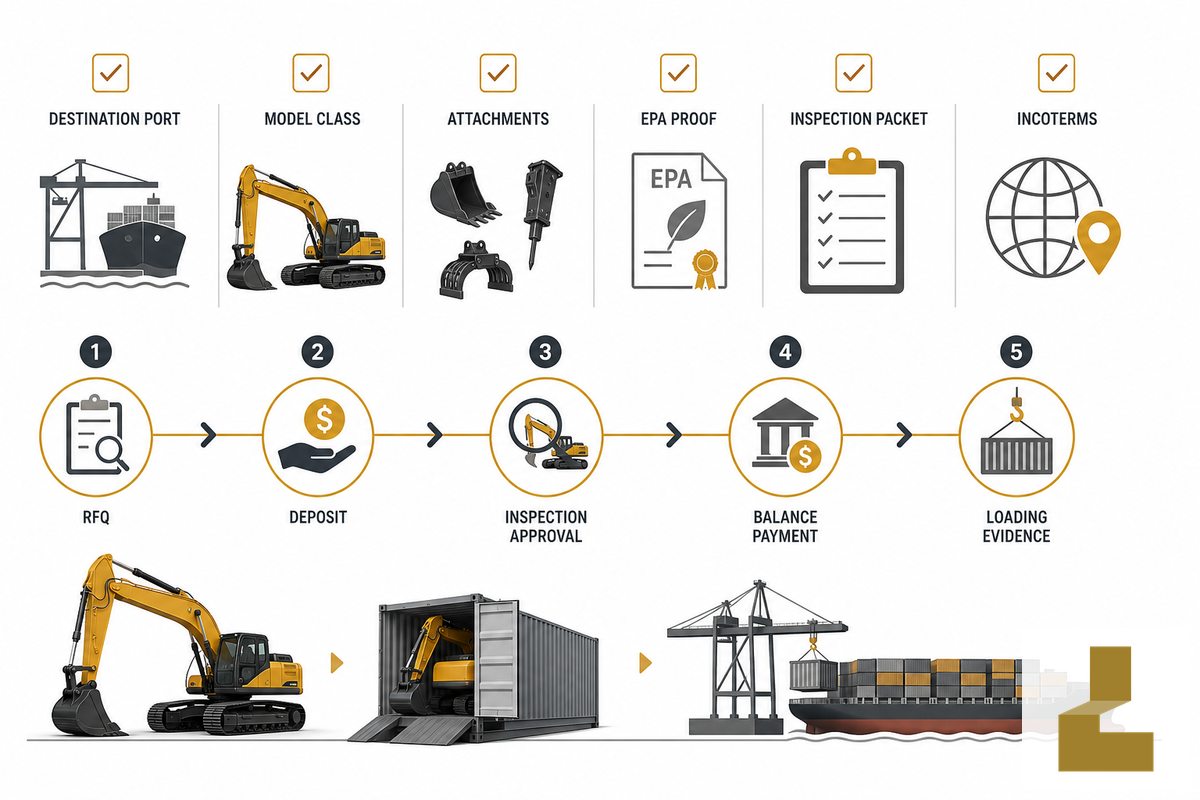
Payment control is strongest when classification, value, origin, and document proof remain under buyer review before final release of funds: CBP reasonable care.
A proper RFQ should ask the supplier for: which machine, which unit proof, which docs, which shipping terms, which attachments, and which payment controls. An unfocused, “what’s the best price?” query often results in an FOB number that deflects the critical import-related questions.
RFQ checklist – copy these into your quote request:
| Parameter | Recommended detail | Why it matters | How to verify |
|---|---|---|---|
| Model and tonnage | Example: 20 ton PC200 class | Controls freight and job fit | Spec sheet and serial photo |
| Destination | Port plus final delivery ZIP/postcode | Separates port cost from jobsite cost | Forwarder quote |
| Incoterms | FOB, FCA, CIF, DAP, or DDP in writing | Allocates control and risk | Proforma invoice text |
| EPA and engine proof | Engine label, 3520-21 basis, certificate/exemption | Prevents entry failure | Broker review |
| Condition packet | Cold-start video, wear photos, report | Controls used-machine risk | Inspector or buyer review |
| Attachments | Bucket, breaker, grapple, quick coupler list | Avoids missing tools | Packing list and photos |
| Spare parts | Filters, seals, wear parts | Reduces startup downtime | Line-item quote |
| Payment trigger | Deposit, inspection acceptance, loading evidence | Keeps proof before balance | Contract or proforma invoice |
If comparing offers, use the same RFQ. The lowest price with no EPA proof, fuzzy Incoterms, no inspection report, or an undocumented loading plan isn’t the best comparable offer.
Need a machine-specific import quote?
Share your model, tonnage class, destination port, attachments, and inspection requirements with Liehuang Used Excavators before you compare offers. The team can prepare unit details, FOB pricing, loading information, and export support that your broker and forwarder can review before shipment.
Request Machine DetailsWhat Importers Often Get Wrong
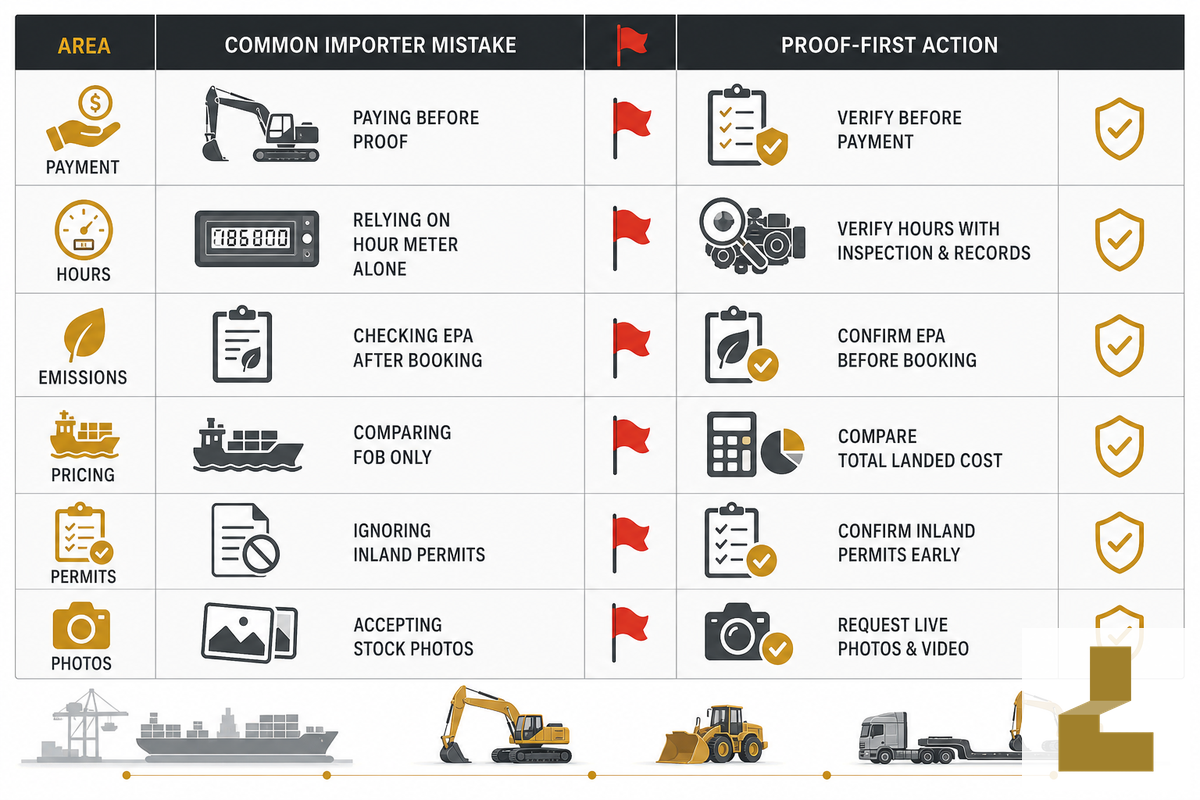
Late-stage cleanup is a weak strategy for broker filing or EPA paperwork; compare plans against CBP reasonable care and EPA import rules. If the buyer cannot explain classification, engine admissibility, value, origin, and record responsibility before loading, the shipment is not ready.
Most buyers make timing mistakes rather than money mistakes: checking machines after paying, asking the broker after booking, calculating inland delivery after arrival, or discovering EPA/HTS issues only when the shipment is on the way. The fix is to move proof review before deposit, balance payment, and loading.
When NOT to buy the excavator yet
Don’t buy until: seller shows serial/PIN, explains engine admissibility, emails inspection photos, isn’t swapping bank accounts, lists accessories, and isn’t providing just a bundled CIF/DDP figure while hiding what’s excluded. Don’t ship until: broker has reviewed EPA 3520-21, HTS, ISF timelines, and entry details. Don’t accept delivery arrangements until: inland carrier has reviewed weight/dimensions/route/permits for the final job site.
Buyer diligence rests on CBP’s “reasonable care” standard. While the broker may file, the importer of record remains responsible for accuracy and records management. Broker filing alone isn’t a sound strategy. A better benchmark is: unless you can articulate the classification, value, origin, engine basis, and the document package, you aren’t prepared to approve the shipment.
Key takeaway
A China used excavator import is ready only when the machine, engine, documents, Incoterms, shipping mode, inland delivery, and payment trigger are all proven before the balance payment.
FAQ: Importing Excavators from China
How much does it cost to ship an excavator from China to the USA?
Shipping cost depends on weight, dimensions, route, ocean mode, port handling, and inland delivery, so buyers should quote by machine class rather than using a single average.
A mini excavator may be quoted very differently from a 20 ton or 50 ton machine. Ask for separate lines for ocean freight, insurance, terminal handling, broker/entry, port storage risk, inland haulage, and permit costs. If the quote is CIF or DDP, ask exactly which destination-side charges are excluded and which party pays if the container, flat rack, or heavy unit misses free time at the port.
What documents do I need to import an excavator from China?
For U.S. imports, expect commercial invoice, packing list, bill of lading, EPA Form 3520-21 basis, CBP entry documents, ISF data for ocean cargo, and broker-reviewed HTS information.
Your broker may also ask for certificate of origin, power of attorney, engine label photos, EPA certificate or exemption evidence, machine technical details, and a clear product description for classification. Requirements differ by market, so non-U.S. buyers should replace EPA/CBP items with local emission, safety, pre-shipment, and customs requirements before approving shipment.
Can I import a used excavator from China to the United States?
Yes, if the specific machine and engine meet applicable import and emission rules, the importer files the right paperwork, and any missing proof is resolved before shipment.
Used status does not remove engine admissibility questions. Before payment, ask for engine label photos, serial/PIN details, inspection evidence, and broker review of EPA 3520-21, HTS, ISF, and entry data. If the engine cannot be documented, do not assume customs will solve it later. Resolve that question before the excavator is loaded in China.
Is FOB or CIF better for importing an excavator?
FOB can give the buyer more carrier control, while CIF can look simpler, but neither is automatically better because risk transfer, insurance, and destination charges can change the real cost.
A better rule depends on who controls the forwarder, who buys insurance, where risk transfers, and who pays destination charges. FOB often gives an experienced buyer more control over carrier selection and destination handling. CIF may be easier for first-time buyers, but it can hide weak insurance or destination-side charges. Ask your forwarder and broker to compare FOB, FCA, CIF, DAP, and DDP with the same destination and same excluded-cost list.
Why are excavators from China cheaper?
China has large used-equipment supply, export-focused dealers, and broad model availability, but a cheap quote can exclude proof, freight, attachments, repair risk, and destination-side costs.
Lower FOB can be real, but compare only after inspection, documents, freight, attachments, and repair reserve are priced.
Should I buy a used excavator sight unseen?
Only buy remotely if the inspection packet is strong enough to replace an in-person visit, including serial photos, engine labels, cold-start video, wear evidence, and payment hold terms.
At minimum, request serial/PIN photos, engine label photos, cold-start video, undercarriage and hydraulic evidence, attachment list, service notes if available, loading photos, and payment terms that hold the balance until proof is accepted. For higher-value machines, use a third-party inspector. Ask the inspector to show the same serial plate in the walkaround, cold-start, hydraulic test, and loading photos, because separate media files can hide a machine swap or an omitted defect. Also ask for a short defect list rather than only beauty photos; a seller willing to show worn pins, seepage, or track wear gives you better pricing data than a seller who hides all flaws.
How Liehuang Helps Import Buyers
Liehuang Used Excavators supplies inspected used excavators and attachments from China, including mini excavators, 10-30 ton medium machines, and 30 ton-plus heavy units. Buyers can request model details, photos, inspection support, attachment options, FOB quotation, and export coordination for their own broker and forwarder.
Discuss Your Excavator ImportTransparency Note: this guide focuses on import planning and supplier screening. EPA/HTS/ISF/duty/inland permit requirements may differ by machine, origin, routing, shipping method, and filing date. Finalize and consult a licensed customs broker, freight forwarder, and relevant foreign authorities prior to shipping.
References & Sources
- Publications and Forms for Importing Vehicles and Engines – U.S. Environmental Protection Agency
- Requirements for importing off-road engines, equipment, vehicles – U.S. Customs and Border Protection
- 19 CFR 141.5 Time limitations for entry – Electronic Code of Federal Regulations
- Learn About Importing Vehicles and Engines – U.S. Environmental Protection Agency
- 19 CFR 149.2 Importer Security Filing – Electronic Code of Federal Regulations
- Importer Security Filing 10+2 – U.S. Customs and Border Protection
- HTS Search 8429.52 – U.S. International Trade Commission
- Incoterms 2020 – International Chamber of Commerce
- Oversize/Overweight Load Permits – Federal Highway Administration
- Inspection Checkpoint: How to inspect a used excavator – Equipment World
- Trends in Used Excavators and 5 Tips to Successfully Buy One – For Construction Pros
- Excavator Buyer’s Guide – Construction Equipment Guide
- China’s excavator sales increase by 26.4 percent in January-June 2026 – SteelOrbis
![Excavator Bucket Manufacturers: Buyer Evidence [Guide]](https://lhusedexcavator.com/wp-content/uploads/2026/08/excavator-bucket-manufacturers-r2-featured-768x512.png)