Get in Touch with Liehuang Company

Updated July 2026. Reviewed by the Liehuang Used Excavators technical team.
The Used Excavator Buying Guide is a proof checklist for importers, dealers, contractors, and fleet buyers who need to buy a second-hand excavator without standing beside the machine. Start with serial/PIN proof, not paint, quotes, or a single hour-meter photo.
Quick Specs: Used Excavator Buying Decision
- Best opening question: Can the seller provide proof this is the exact machine including serial/PIN, inspection report and video?
- Top hidden-cost areas: undercarriage, hydraulics, final drives, swing bearing, pins and import documentation.
- Liehuang size range: mini 0-10 ton, medium 10-30 ton, and heavy 30-80+ ton excavators.
- Paperwork proof to request: cold-start video, hour meter reading, inspection sheet, serial/PIN plate, photos, attachment list, FOB/CIF price and destination documents.
Used Excavator Buying Guide answer: Buy only after hours, measured wear, and paperwork agree on the exact machine. Undercarriage and hydraulics can erase a low price, while import rules depend on destination, engine, and importer responsibility.
Key Takeaways
- Low hours aren’t automatically safer. A verified 6,000-hour machine with stable hydraulics, a well-maintained undercarriage, and traceable parts can be more reliable than a low-hour unit with no records.
- Second inspection priority: undercarriage rollers, track chains, sprockets, pads, and idlers.
- A US-bound purchase does not come with a default seller paperwork pack; the importer and broker must confirm the EPA and customs route before shipment.
- Strong import quotes will include the unit, documents, shipment terms and the assumptions in one file.
Used Excavator Buying Guide: Start With Proof, Not Photos

Start a safe used excavator purchase by establishing proof of the exact machine, because photos and text can hide the machine history that governs repair bill, import risk and resale value. Make the serial/PIN check, media and documents your first step before the quote.
Paint and repaint make tired used excavators appear younger but can’t reveal hydraulic pressure, the track-chain stretch, swing bearing gaps, engine blow-by or whether an engine configuration is approved for the planned destination. Think of every used excavator as a bundle of evidence: the machine identity, the state of wear, the documents and the shipment assumptions.
When importers view used excavators from abroad, the proof pack should produce answers to four questions before any balance payment: Is this the exact unit? Is the condition supported by the meter? Is the machine shippable and clearable? Can the unit work the job using the attachments?
Proof Pack Before Payment Rule: do not release the balance until the serial/PIN plate, hour display, cold-start video, undercarriage photos, hydraulic test notes, and shipment terms all point to the same machine.
3-Part Used Excavator Proof Score
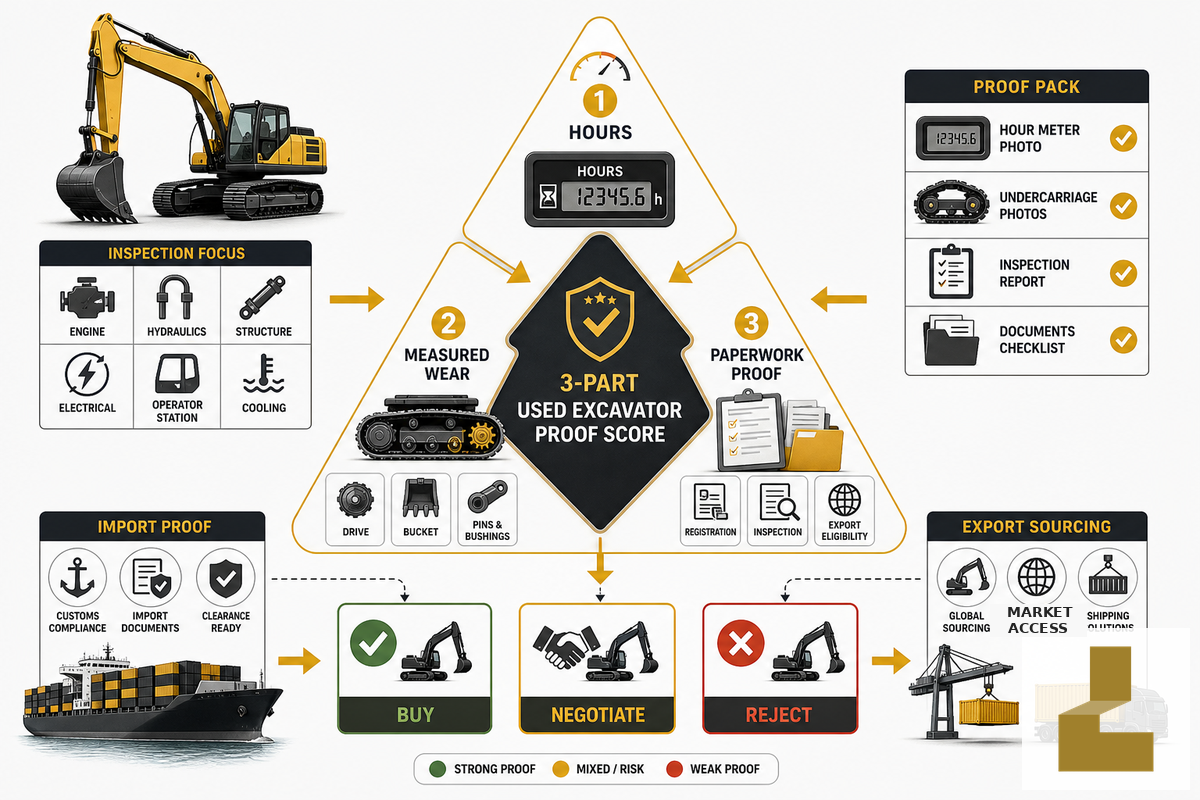
This 3-Part Used Excavator Proof Score compares the hours, physical wear and paperwork, so buyers never overvalue the meter. Acceptable hours should be assessed relative to the wear measurement, maintenance history and proof tying the meter to the serial/PIN. Well-rated proof should tie together the meter, the machine, and the paperwork.
Construction Equipment Guide’s used excavator buyer guide shows the machine’s value is determined by size class, hours, price, attachments, clearance and inspection questions. Use any market bracket as a frame of reference, not a justification to pay. A slightly higher-hour unit from a known owner can be worth far more than a lower-hour unit from a neglectful owner when the checklist evidence supports it.
Counter hours with physical evidence. A young-looking hour meter accompanied by wear on the rollers, pins, paint edges, pedal, and download data shows that the meter is just one element. “Service records, machine data, and downloaded information are more trustworthy than an hour meter,” cautions ConstructionSales.
While a crawler excavator may be called a trackhoe on a North American listing (use “trackhoe” as a search term), a savvy buyer should still investigate the engine hours, records, photos of the serial plate, how the hydraulics operate, and the grade.
| Score Item | Pass Signal | Warning Signal | Limitations / Not suitable for |
|---|---|---|---|
| Serial/PIN identity | Plate, invoice, video, and report match | Plate hidden, blurry, or inconsistent | Do not use for sight-unseen balance payment |
| Engine hours display | Engine hours, monitor, wear, and service files align | Hours look low against wear pattern | Cannot stand alone as purchase proof |
| Undercarriage | Track chain, rollers, idlers, sprockets measured | Seller gives a percentage with no measurement | Not enough for muddy or hidden lower frames |
| Hydraulic system function | Smooth cycle, no drift, no pump noise, no leaks | Jerky movement or slow track on one side | Needs pressure/flow test for breaker work |
| Engine cold start | Starts cold, smoke clears, stable idle | Warm-start video only | Not enough without oil/coolant checks |
| Pins and bushings | Limited play under bucket/load movement | Visible slop at bucket, stick, boom foot | Final trim work needs tighter tolerances |
| Swing bearing | No visible lift, knock, or metal in lubricant | Noise, play, or uneven swing | Visual check is weaker than dial measurement |
| Structure | Boom, stick, frame, and welds have no cracks | Plating, repaint around welds, bent guards | Heavy demolition history needs deeper review |
| Service evidence | Maintenance records, filters, oil sample, diagnostic screen | “Maintained well” with no records | Old imports may have incomplete history |
| Export documents | Invoice, packing list, bill of lading plan, origin, engine data | Generic document promise after payment | Destination broker must confirm final needs |
Field inspection is not just a checklist. Operator skill, inspector view, and machine movement all matter, so the buyer should ask for controlled test videos and clear measurement shots rather than a casual walkaround.
Choose Tonnage Class Before Brand
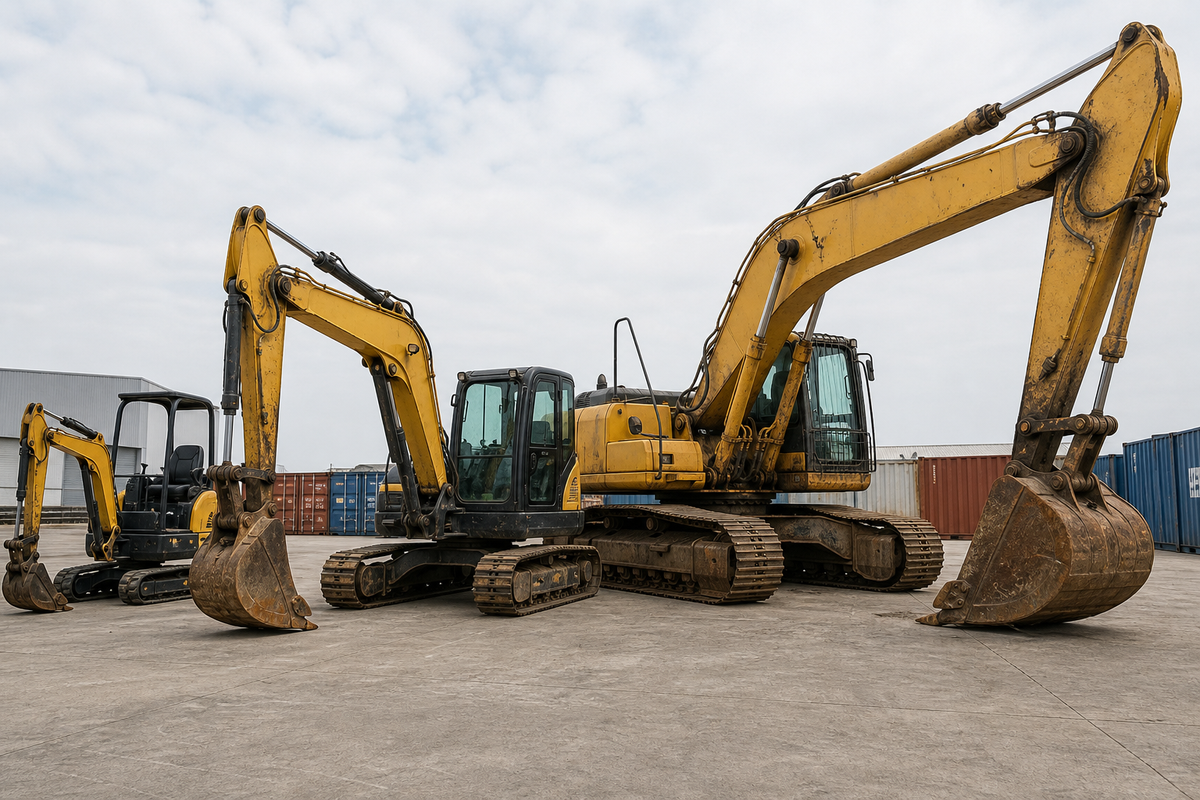
Choose size before brand: job size, transport limits, soil, attachment demand, and resale plans determine whether a mini, medium, or heavy excavator fits. Brand prestige cannot fix a machine that is too large to move.
ISO lists ISO 6165:2022 as “Earth-moving machinery – Basic types – Identification and vocabulary” under earth-moving machinery. In buying decisions, that standard-language context is less important than job fit, but it helps when a tender or broker asks for formal machine classification.
Liehuang groups its inventory into “0-10-ton mini excavators,” “10-30-ton excavators,” and “30-ton-plus heavy excavators.” This grouping helps potential customers shortlist the work class first, then compare machines from Cat, Komatsu, Hitachi, Volvo Construction Equipment, Sany, Hyundai, Doosan, Kubota, or Kobelco.
| Use Case | Typical Class | Proof To Request | Limitations / Not suitable for |
|---|---|---|---|
| Urban utility trenching | 3-8 ton mini | Boom swing, rubber tracks, blade, width | Slow for deep mass excavation |
| Landscaping and farms | 1.5-6 ton mini | Trailer weight, bucket set, thumb option | Limited lift radius and breakout force |
| General construction | 12-22 ton medium | Hydraulic cycles, track life, dig depth | Can be too large for tight urban access |
| Road and drainage work | 15-30 ton medium | Reach, grade control, bucket widths | Transport permits may raise delivered cost |
| Demolition sorting | 20-35 ton medium/heavy | Guarding, auxiliary lines, grapple fit | High abuse history raises crack risk |
| Breaker work | 10-45 ton carrier | Flow, pressure, breaker size, coupler | Undersized carriers overheat or lose output |
| Quarry loading | 30-80+ ton heavy | Rock bucket, frame, boom, engine load | High freight and port handling cost |
| Dealer resale stock | Popular 6-22 ton models | Brand, parts supply, market demand | Unusual specs can sit in inventory |
| Remote site fleet | Common major-brand class | Parts, diagnostics, service-tool access | Orphan electronics can stop work |
Brand, Parts, and Resale: Add a Repair-Ecosystem Gate
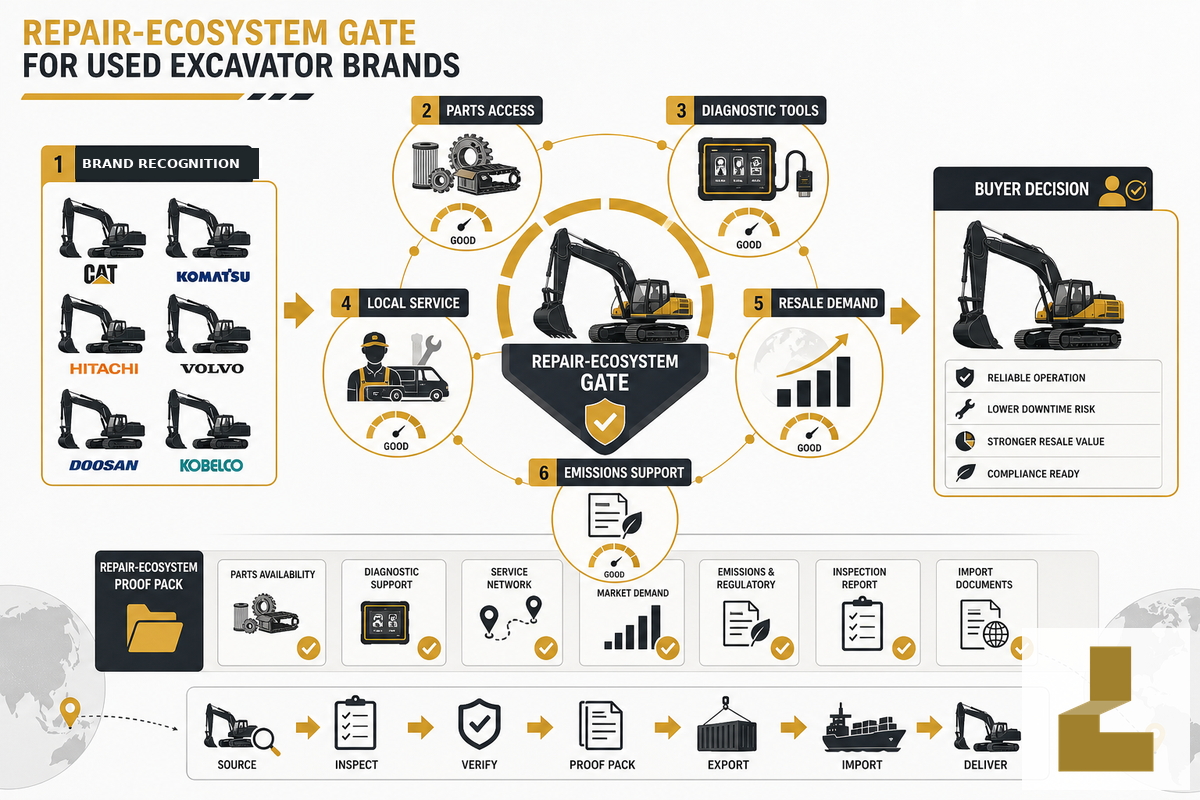
While major manufacturers typically make equipment easier to resell and supply parts, brand name alone does not prove that a machine can be serviced or updated in the buyer’s market. Diagnostic software, dealer service access, tools, emissions components and local support play a larger role.
Brands like Caterpillar, Komatsu, Hitachi, Volvo, Kobelco, Hyundai, Doosan, Kubota and Sany are popular on the used equipment market because many customers recognize the product families and where to source parts. Liehuang has a selection of popular brands across its used excavators for sale. However, a machine popular in one market can still lack diagnostic or repair resources elsewhere.
According to FTC, the inability to get parts, manual or diagnostic tools or update software has increased, leading to “right to repair” concerns. “Instead of asking if it’s Cat or Komatsu, the real question for the used equipment buyer is whether your workshop can get code reading and writing capabilities, get parts, update the software and control modules, and service the emission system,” FTC notes.
Common Mistake: buying a major-brand unit because it has resale appeal, then discovering the local market lacks the model-specific pump, ECU, monitor, hydraulic controller, or diagnostic service needed to fix it.
Inspection Checklist: Engine, Hydraulics, Undercarriage, Pins, and Structure
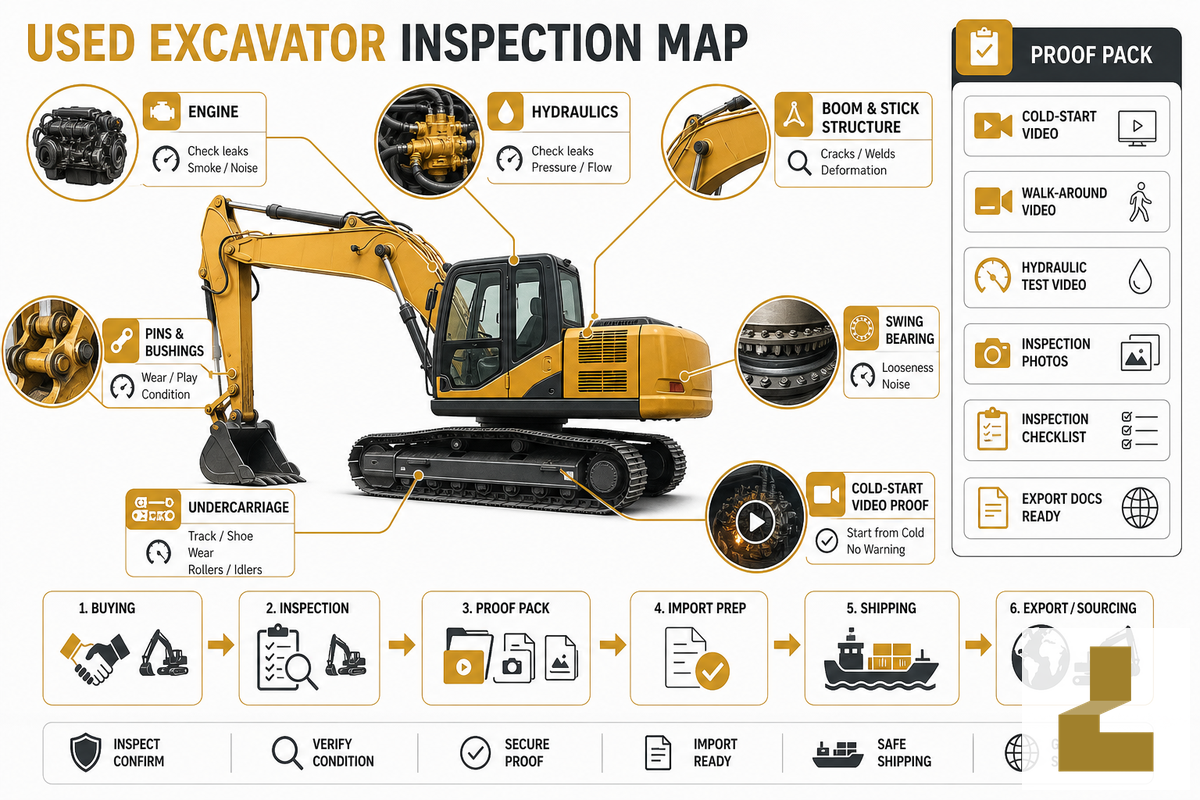
“The inspection should demonstrate how the machine will perform in conditions that would show wear, not just a quick walk-around.” This should include a cold start, hydraulics check, undercarriage condition, boom swing, pin inspections, the frame and comparing the available records to the serial plate.
Equipment World recommends allowing one to two hours for a thorough used excavator inspection, with particular attention to the undercarriage and hydraulics. This is an excellent time frame to have in mind if a buyer has to rely on only a 90-second walkaround video from a seller. Ask for a video showing a cold start, idle, travel, swing, boom raise/lower, arm in/out, bucket curl, track speed, open service doors, oil condition, and close-ups of the undercarriage so you can see rails, rollers, idlers, sprockets, and pads.
Caterpillar’s guidance on excavators addresses wear on track chains, shoes, rollers, idlers, sprockets, etc. It shouldn’t surprise you that undercarriage wear often remains last on the agenda in negotiations. If buying a machine remotely, ask for pictures of the undercarriage wear measured on a ruler, or a third-party inspection report, instead of a percentage scribbled in a chat window.
Engineering Note: For breaker or cutter work, inspection must include auxiliary hydraulic flow and pressure compatibility. Construction Equipment Guide gives examples such as a 150-hp excavator needing at least 55 gpm for a 3,000-lb drum cutter and a 100-hp machine with 75 gpm for a rock saw cutting 25 inches deep.
Scenario: A dealer is seeking a 20-ton class excavator for road drainage work and encounters two seemingly similar options online. The first, lower-priced listing shows only pristine yard photos and a 4,800-hour meter reading. The second machine, more expensive but with a visible serial/PIN plate, includes a cold-start video, undercarriage close-ups, a hydraulic cycle video, and service notes with a higher 6,200-hour reading. This second excavator isn’t necessarily superior, but it’s much easier to price with certainty because the buyer can clearly assess the risks before making a purchase.
Price Is Not Landed Cost: FOB, CIF, Freight, Duty, and Insurance
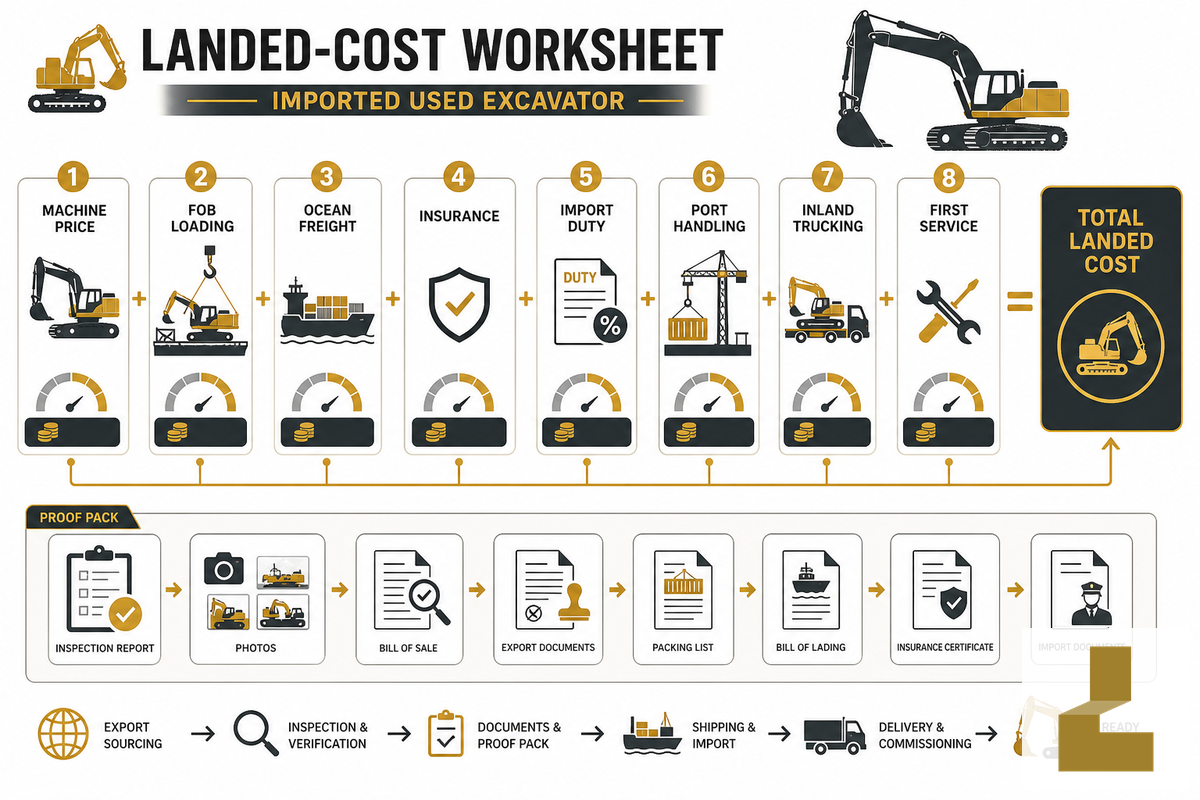
The lure of a bargain excavator price can often evaporate once freight, insurance, duty, port fees, local trucking, inspection costs, and potential repair expenses are factored into the total landed cost. FOB and CIF terms define how quotes are structured, but they don’t represent the actual cost of delivery to your door.
Use FOB when you or your forwarder want more control over freight and insurance. Use CIF when you need the seller to quote ocean freight and insurance to the destination port. Trade.gov explains that Incoterms clarify buyer and seller tasks, costs, and risks; they do not cover all sale conditions or specify customs-clearance documents. Either way, the importer or broker still needs to check classification, declared value, duty rate, destination rules, local taxes, and shipping constraints such as RoRo, flat rack, or 40HQ container suitability. US law places reasonable-care duties on the importer of record for entry information such as classification, value, duty, and other applicable legal requirements.
| Cost Line | Who Usually Quotes It | Proof To Request | Limitations / Not suitable for |
|---|---|---|---|
| Machine price | Seller | Serial/PIN, invoice draft, inspection report | Does not prove condition by itself |
| FOB loading | Seller | Port, loading terms, container/RoRo plan | Buyer arranges main freight |
| CIF ocean freight | Seller/forwarder | Destination port, validity date, included insurance | Port charges and customs still separate |
| Duty/tax | Broker/importer | HS code review, value basis, destination rules | Seller quote is not legal advice |
| Port and handling | Port/broker/trucker | Discharge, storage, inspection, demurrage terms | Varies by port congestion and timing |
| Inland trucking | Buyer/logistics provider | Weight, dimensions, permit needs | Oversize routes can change cost fast |
| Initial service | Buyer/workshop | Filters, fluids, oil sample, wear parts | Do not ignore for high-hour machines |
| Attachment setup | Seller/buyer | Pins, coupler, hoses, flow, tool weight | Wrong match can make the tool unusable |
| Compliance review | Importer/broker | Engine, emissions, safety, conformity route | Destination-specific; confirm before shipment |
Import Documents and Compliance: Engine Tier, HS Code, and Customs Proof
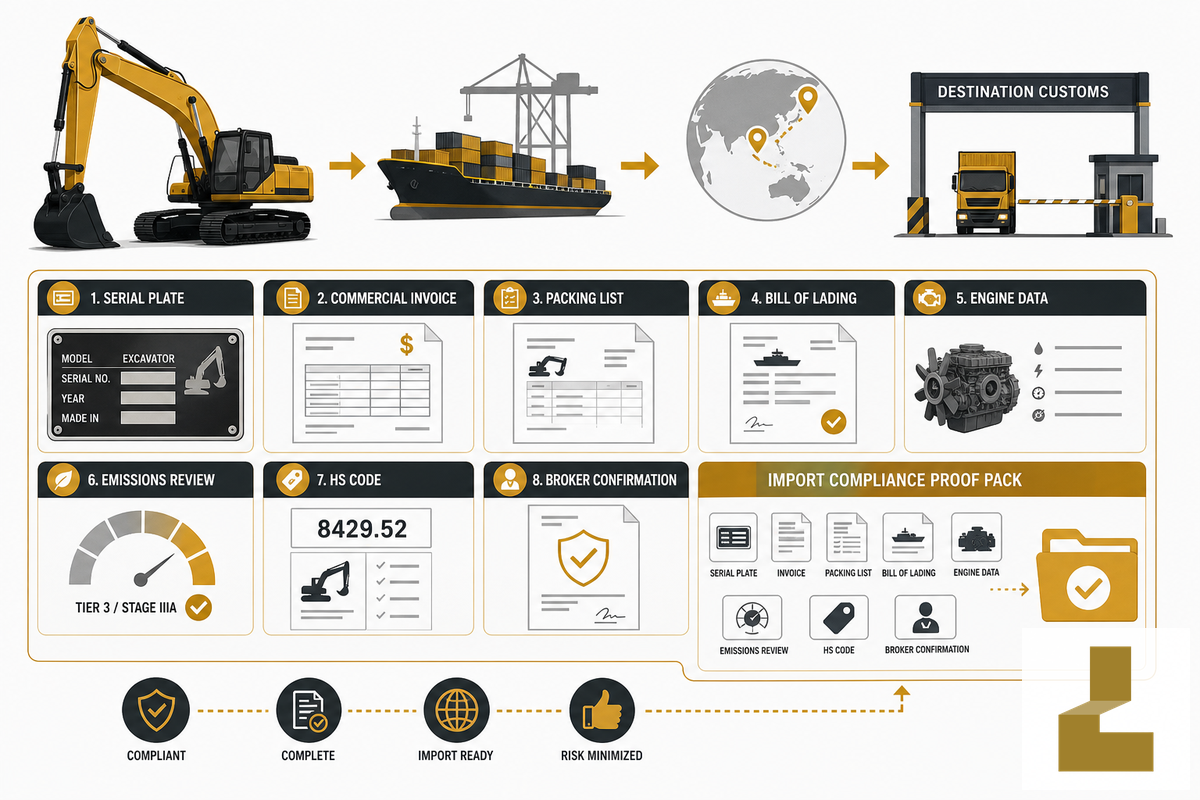
Ensure the used excavator has accompanying paperwork that aligns with the machine, engine, destination regulations, and shipping details. A single missed customs or emissions step can transform an attractive low price into an expensive problem at the port. Treat compliance as specific to your destination rather than a generic checklist.
With US-bound nonroad diesel equipment, the U.S. Environmental Protection Agency explains that nonroad compression-ignition diesel engine rules include excavators and other construction equipment, and EPA Tier 4 standards are part of that system. EPA import resources also reference forms for engines already installed in equipment, including Form 3520-21. That means the buyer should review engine information and admissibility before the machine leaves the port of origin.
For EU planning, Regulation (EU) 2023/1230 sets the machinery framework for products placed on the Union market, including second-hand products imported from a third country, and includes importer obligations from its operative application timeline, with general application from January 14, 2027. Buyers should ask whether CE marking, declaration paperwork, instructions, and transition timing are required for the intended route. In other markets, ask the local broker what is required for used machinery, engine emissions, certificate of origin, inspection, tariff classification, and whether HS code 8429 is the correct starting point for the exact excavator type.
Boundary condition: Liehuang can help prepare machine details, invoice, packing information, origin documents, and shipping support, but the buyer’s importer of record or customs broker must confirm destination-specific legal requirements.
Attachments and Carrier Fit: Bucket, Breaker, Thumb, Coupler, and Flow
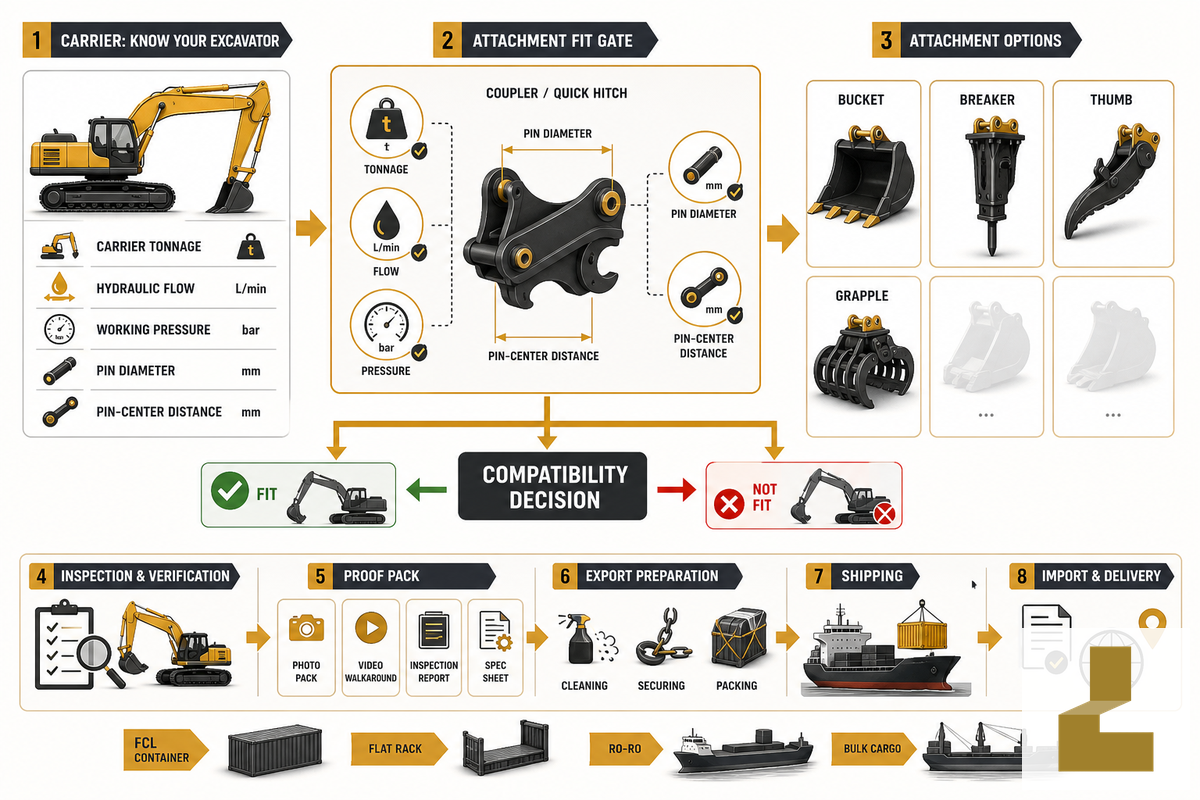
The excavator must match the tool; bucket width, breaker size, hydraulic flow, pin geometry and coupler safety are what determine if the machine can perform its job when it arrives. A good carrier with the wrong attachment setup is still a bad buy.
Liehuang’s excavators and attachments page outlines buckets, hydraulic breakers, grapples, couplers, rippers, augers, quick hitches and other tools covering carriers from 0.8 tons to 50+ tons. If purchasing hydraulic breakers or excavator buckets with your excavator, request pin diameter, center distance, ear width, carrier tonnage and hydraulic flow prior to quoting.
ISO 13031:2016 specifies safety requirements for quick couplers used on earth-moving machinery. Use the current ISO page to confirm standard status and any listed amendments, then treat the standard as a question guide for coupler safety rather than a substitute for checking the exact coupler model and condition.
For any attachment package, request carrier tonnage range, tool weight, pin diameter, pin-center distance, ear width, auxiliary flow, working pressure, condition of hoses/couplers and photos of wear areas on the actual equipment. You need to have proof of compatibility from the specific quoted carrier and tool, not the general category.
Auction, Marketplace, Local Dealer, or Inspected Exporter?
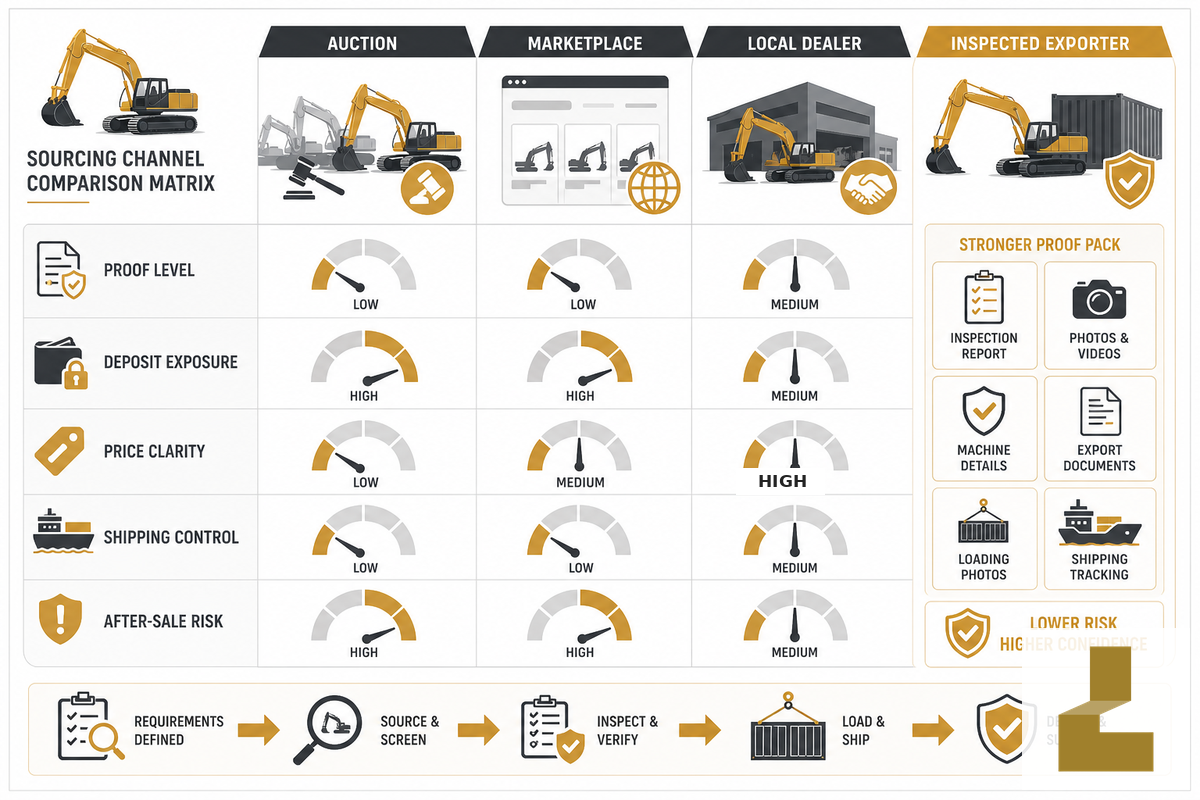
Choose the channel that confirms machine identity, condition, payment exposure, and shipping terms before balance payment. Auctions, marketplaces, local dealers, and inspected exporters all have tradeoffs, so the safest channel is the one that proves the exact unit before money moves.
Buying from a local dealer offers support services and potential warranties but comes with limited inventory and potentially higher costs. Auctions may offer lower prices but require prompt payment and offer less time for inspection. Marketplaces provide a vast selection but necessitate strong vetting. An inspected exporter should demonstrate expertise through specific machine details rather than generic images of a warehouse.
Used excavator buyers may discover cheap prices lead to unexpected expenses. Many Heavy Equipment Forums members cite examples of a low purchase price being followed by electrical problems, dealer service visits, pump failures, and ongoing issues with tracks or other components. Remember that the purchase price is only the beginning.
2026 Buying Outlook: Used Demand Rewards Faster Proof
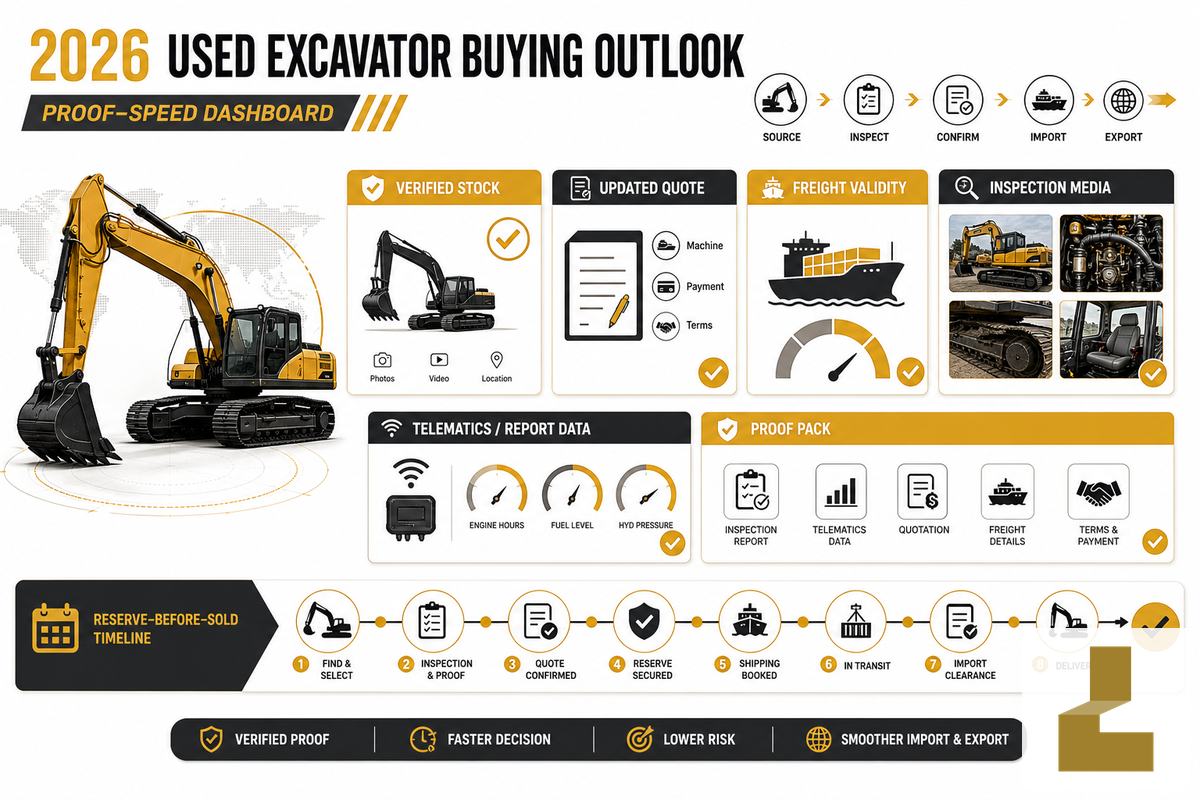
2026 used excavator buyers will want to have a list of the information they’ll request ready to go, because a good used machine can be gone quickly in a market driven by strong demand and low inventory. Market information can serve as a guide to assist you in compiling your “proof pack” of what you need before asking for a quote.
Equipment World/Fusable and Sandhills/MachineryTrader suggest a volatile market for used excavators in 2025, with finance sales, inventory, and asking prices changing differently across classes and months. For someone planning a 2026 purchase, a concrete step is to ask for updated, machine-specific quotes with shipping validity rather than relying on previous asking price trends.
A pragmatic approach for buyers planning a project in 2026 involves skipping the market speculation. Instead, create a preliminary specification now for your desired tonnage range, brand(s), destination port, compliance market, any specific attachment needs, your target engine hours, and what proof documents you’ll require. For importers and distributors, the risk is delay: a promising machine can be reserved or a freight quote can change within 30 days. Liehuang can help reduce that delay by preparing a serial/PIN-bound shortlist, proof media, destination assumptions, and attachment notes before the buyer asks for final approval.
RFQ Checklist: What to Send Liehuang for a Verified Shortlist
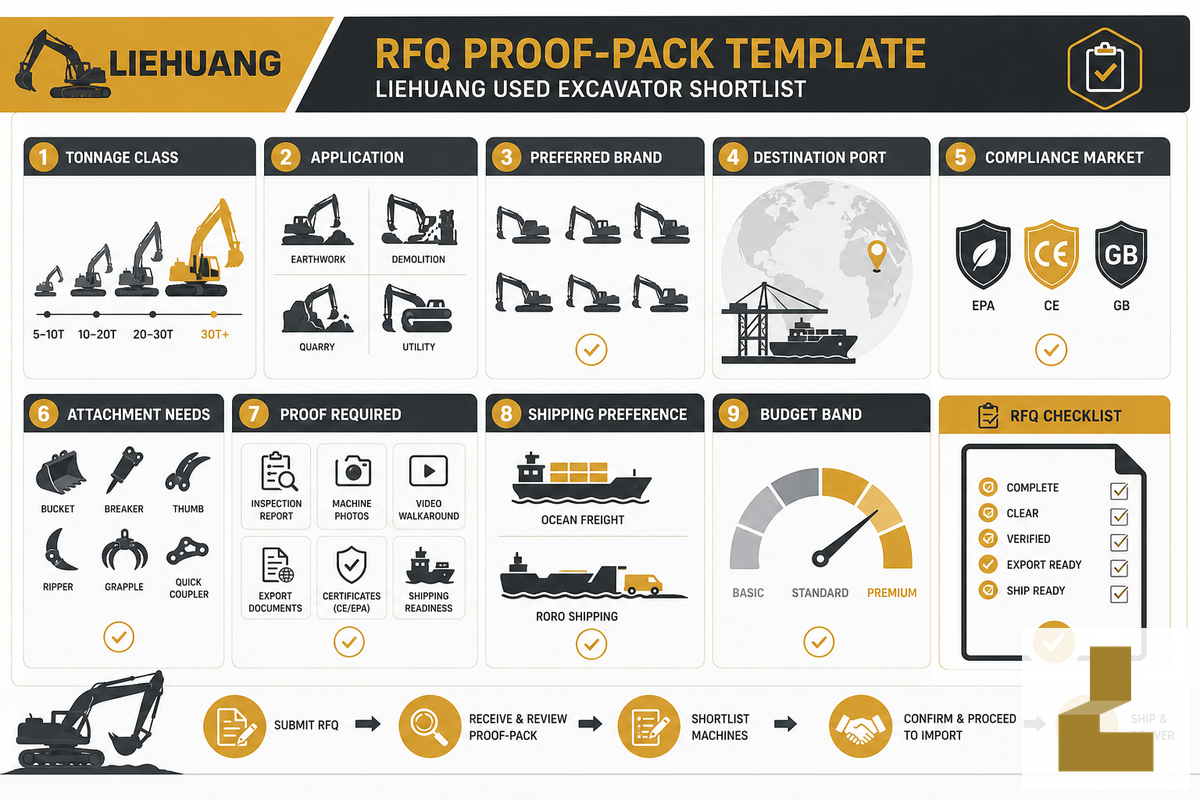
Provide your supplier with enough information for a useful RFQ; sending only “give me your best price for an excavator” will result in non-specific proposals. Instead, include application, tonnage, destination, compliance market, attachment requirements, and necessary documentation all in one message.
For remote machine proof, request the following: a 2-minute cold-start video, 1-minute of engine idle operation, 2-minute of travel and swing, 30-second hydraulic hold test, a full 360 walkaround, and close-ups (using a 10 cm scale reference where wear is hard to discern) to inspect for component wear. Also ask if your quote is valid for 7 days or 30 days, and request a refresh if internal approval takes 14 days, because shipping costs and availability can fluctuate rapidly compared to approval times.
A practical remote media template is: 2 min cold start, 1 min idle, 2 min travel, 30 sec swing-left, 30 sec swing-right, 30 sec boom hold, 30 sec arm hold, 30 sec bucket hold, a 10 cm scale card, a 20 cm frame reference, 7 days quote validity, 14 days approval refresh, 30 days freight refresh, and 24 hours to reconfirm machine availability before deposit.
Copy This RFQ Format
- Machine class: mini 0-10 ton, medium 10-30 ton, or heavy 30+ ton.
- Application: trenching, road work, demolition, quarry, farm, rental fleet, or resale stock.
- Preferred brands and models: for example Cat 320, Komatsu PC200, Hitachi ZX200, Sany SY215, Volvo EC210.
- Destination port and country.
- Compliance concerns: US EPA, EU machinery, local broker requirements, or no known special requirement.
- Attachment needs: bucket size, breaker class, thumb, grapple, quick coupler, hydraulic line requirements.
- Proof required before balance: serial/PIN, inspection report, cold-start video, undercarriage photos, hydraulic test, documents.
- Shipping preference: FOB, CIF, container, flat rack, RoRo, or buyer-arranged forwarder.
- Budget band and acceptable repair allowance.
With this information, Liehuang can quickly locate suitable machines from used excavator inventory, identify matching attachments, and compile machine specifications for your review.
Request a machine-specific proof pack
Provide Liehuang with your tonnage range, brand preferences, destination port, and attachment requirements. Request a machine-specific, serial/PIN-bound inspection report with photos, a cold-start video, and an FOB or CIF price quote before making your final choice.
Request Inspection Report and CIF QuoteFAQ
How many hours are too many on a used excavator?
There is no universal hour cutoff for a used excavator; verified maintenance, hydraulic condition, undercarriage wear, and serial/PIN evidence matter more than the meter alone.
While the hours on a machine are important, a well-maintained, higher-hour machine with documented maintenance and service history is often a safer buy than a lower-hour unit with little to no verifiable history. Undercarriage condition, hydraulic health, documented maintenance, repair logs, and serial/PIN verification hold significant weight in the purchasing decision. Treat the hours as a signal to investigate deeper – examine undercarriage, hydraulics, wear components, and service records – not as the sole decision-making factor.
What is the most important inspection item before buying a used excavator?
The undercarriage and hydraulic system deserve the earliest attention.
The undercarriage and hydraulic system can hide wear that photos do not fully reveal. Ensure your machine-specific proof package for your exact serial/PIN includes evidence for tracks, rollers, idlers, sprockets, hydraulic cylinders, hoses, swing bearing, and center pivot. A walkaround and cold-start video are helpful complements, but they should be integrated into a detailed written inspection report with photos showing measured wear, operational test results, and maintenance records rather than replacing it.
Is importing a used excavator from China worth it?
Importing can be worth it when the supplier proves the exact machine, quotes realistic landed cost, and the buyer confirms destination rules safely before shipment.
Use market value to judge inspected stock, export packing, machine-specific documentation, and FOB/CIF terms against other resale options. Trouble starts when a buyer accepts generic inspection photos, ignores compliance limits, or compares FOB prices without freight, customs, and broker responsibilities. Confirm condition, shipment terms, engine/document requirements, Incoterm limits, and broker responsibilities before paying the balance for a RoRo, flat rack, or container shipment. Destination expectations should be verified before export from China, and the landed cost should be compared with local resale value, parts access, and expected first-service spend.
What documents do I need to import a used excavator?
The baseline document set normally includes invoice, packing list, bill of lading, origin proof, serial/PIN identity, engine details, and destination-specific broker review checks before shipment.
Additional destinations may require engine/emissions documentation, conformity files, inspection certificates or broker statements. US-bound nonroad equipment may require EPA import-form review and engine configuration documentation. EU-bound equipment may activate machinery importers’ obligations under machinery regulations. Confirm with your customs broker before shipment.
Should I buy a used mini, medium, or heavy excavator?
Choose by work and transport first.
Mini machines excel in confined spaces, landscaping, utilities and easier shipment. Medium-sized machinery is ideal for general construction, paving and rental fleets. Large machinery is best for quarrying, demolition, mining and high-production earthmoving but poses greater logistics and repair risks.
Can Liehuang supply attachments with the excavator?
Yes, Liehuang can discuss buckets, hydraulic breakers, grapples, couplers, and other tools, but attachment matching should be checked before the quote is final and the machine ships.
Share the machine model, carrier weight, hydraulic requirements, pin sizes, and intended application before confirming an attachment package. Liehuang can discuss buckets, hydraulic breakers, grapples, couplers, and other tools, but each tool must match the carrier and destination requirements.
Transparent sourcing note: This guide combines public regulatory, standards, trade-press, patent, forum, and first-party Liehuang page evidence. Price and market figures are directional and can change by region, date, condition, and freight market. Final import requirements should be confirmed by the buyer’s customs broker or local authority.
Related Liehuang Resources
- Used excavators for international buyers
- Mini excavators for sale 0-10 ton
- Medium excavators for sale 10-30 ton
- Heavy excavators for mining and large jobs
- Excavator attachments for carrier fit
References & Sources
- OSHA 1926.602 Material Handling Equipment – Occupational Safety and Health Administration
- Regulations for heavy equipment compression-ignition engines – US EPA
- Learn About Importing Vehicles and Engines – US EPA
- EPA publications and forms for importing vehicles and engines – US EPA
- 19 U.S. Code § 1484 Entry of merchandise – Office of the Law Revision Counsel
- Regulation (EU) 2023/1230 on machinery – EUR-Lex
- ISO 53.100 Earth-moving machinery catalogue – International Organization for Standardization
- ISO 13031:2016 Quick couplers – Safety – International Organization for Standardization
- Cat Undercarriage – Caterpillar
- Excavator Buyer’s Guide – Construction Equipment Guide
- Inspection Checkpoint: How to inspect a used excavator – Equipment World
- Excavator sales trends 2025 – Equipment World
- Trends in Used Excavators and 5 Tips – For Construction Pros
- Used construction equipment asking prices – MachineryTrader/Sandhills
- Used excavator buyer thread – Heavy Equipment Forums
- Know Your Incoterms – International Trade Administration
![Excavator Bucket Manufacturers: Buyer Evidence [Guide]](https://lhusedexcavator.com/wp-content/uploads/2026/08/excavator-bucket-manufacturers-r2-featured-768x512.png)