Get in Touch with Liehuang Company

HEAVY
EQUIP
EQUIP
Excavator Attachments
Excavator Attachments for Sale — Buckets, Breakers, Thumbs, Grapples & Couplers
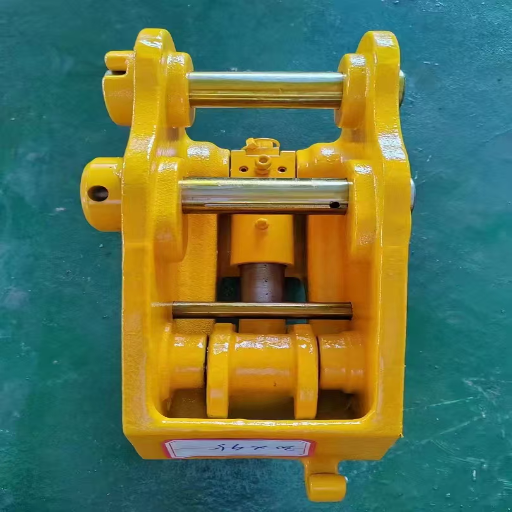
Liehuang stocks excavator attachments — buckets, hydraulic breakers, thumbs, grapples, rippers, augers and quick couplers — for importers and distributors worldwide. Each order can be quoted with specification sheets, carrier-fit details, ISO 13031 coupler requirements where applicable, and inspected new or used units for major carrier brands. We supply direct from China on FOB or CIF terms so buyers can compare landed cost before committing to stock.
Request a Wholesale Quote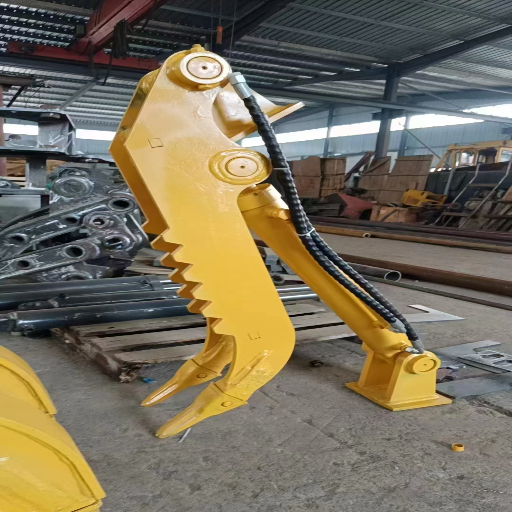
0.8–50+ t
Carrier tonnage range covered
9 types
Buckets · breakers · thumbs · grapples · rippers · couplers · augers · compactors · shears
ISO 13031
Quick-coupler safety standard
9 brands
CAT · Komatsu · Sany · Volvo · Hyundai · Doosan · Kubota · Hitachi · Kobelco
FOB / CIF
Transparent export pricing terms
New + Used
Inspected, documented condition
Sourcing Excavator Attachments for Import & Distribution — The Challenge, and How We Close It
An excavator attachment is an interchangeable working implement — whether a bucket, hydraulic breaker, thumb, grapple, ripper, auger, or coupler — which attaches to the dipper arm of a carrier and determines whether, and how profitably, that carrier can dig, demolish, grade, or handle material on a construction site. Sourcing them for resale, however, remains an obstacle. Web pages ranking for "excavator attachments" fall into two primary camps: manufacturer brochures that show images and model names but no weight, capacity, or price; and e-commerce sites that post a price but stop at your own doorstep. Neither answers the two questions a distributor must address before committing to a container-sized order: is this compatible with my customers' fleet, and what is the ultimate landed price?
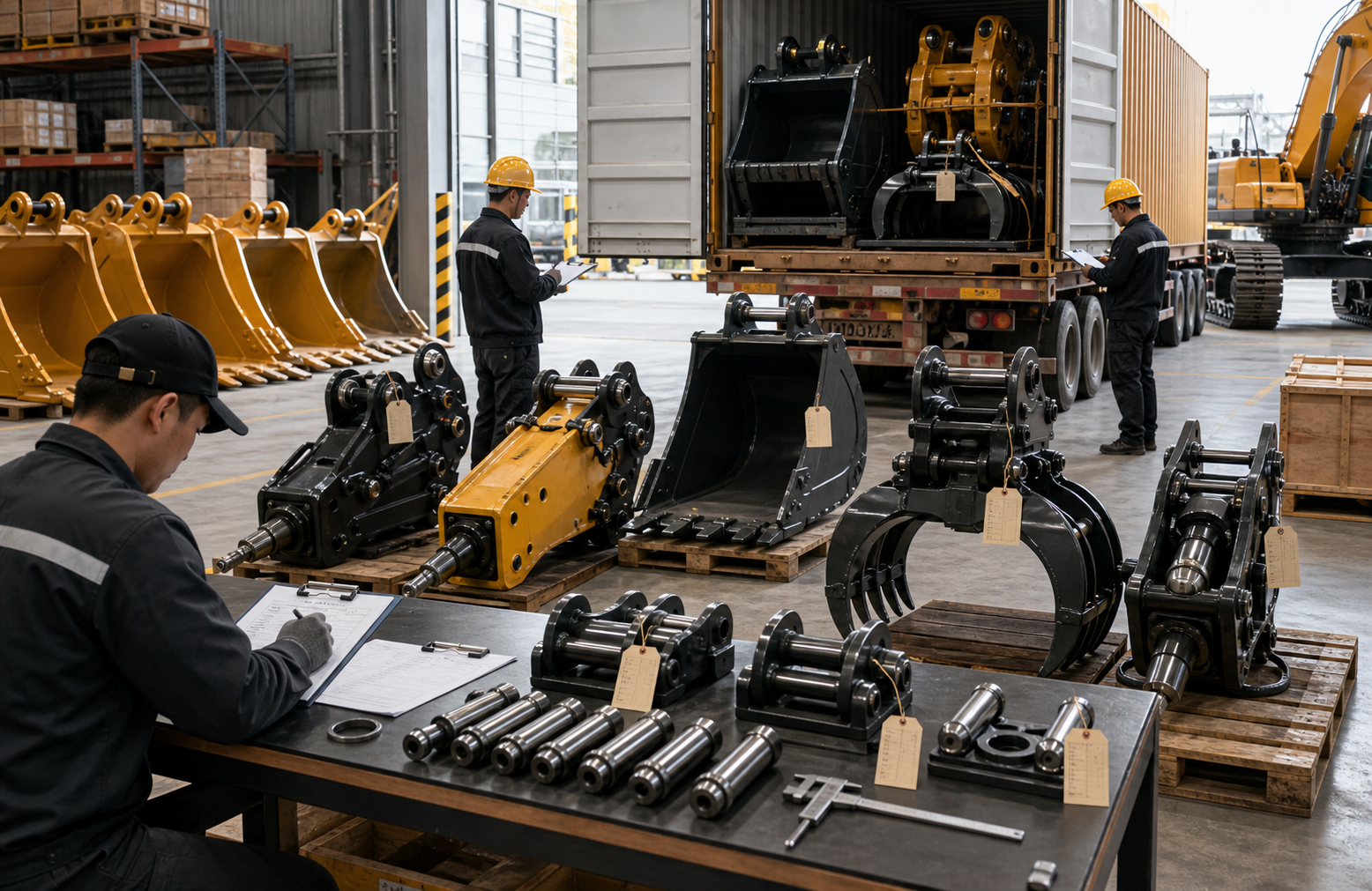
This information gap is our opportunity. This page was built to address both concerns. You will find a complete attachment classification mapped against carrier tonnage; the specific coupler and pin specifications required for proper fit; the safety standards each item is tested against; a clear comparison between new and used options; and purchasing guidance geared toward high-volume procurement — the kind of volume that fills a 40-foot container — rather than a weekend rental. Each specification is cross-referenced to its source or standard, because misrepresentation is the fastest way to lose an importer's trust.
ISO 6165 Classification
Excavator equipment carries an international classification under ISO 6165 (Earth-moving machinery — Basic types — Identification and terms), the vocabulary your customers' OEM manuals use. We hold to it across all documentation, so an engineer in Santiago and a procurement manager in Lagos read the same spec the same way. Ideal for: resellers and fleet operators running mixed-brand machinery who need attachments that arrive ready to mount, documented, and priced to compete.
Unlike the brochure pages that hide specs and the marketplaces that hide landed cost, Liehuang publishes both: across nine carrier brands and the 0.8-to-50-tonne range, every used unit ships with a documented inspection report, and every new unit's specifications are keyed to ISO standards. That is the difference between a catalogue and a sourcing partner.
Excavator Attachment Types — A Full-Range Selector by Application
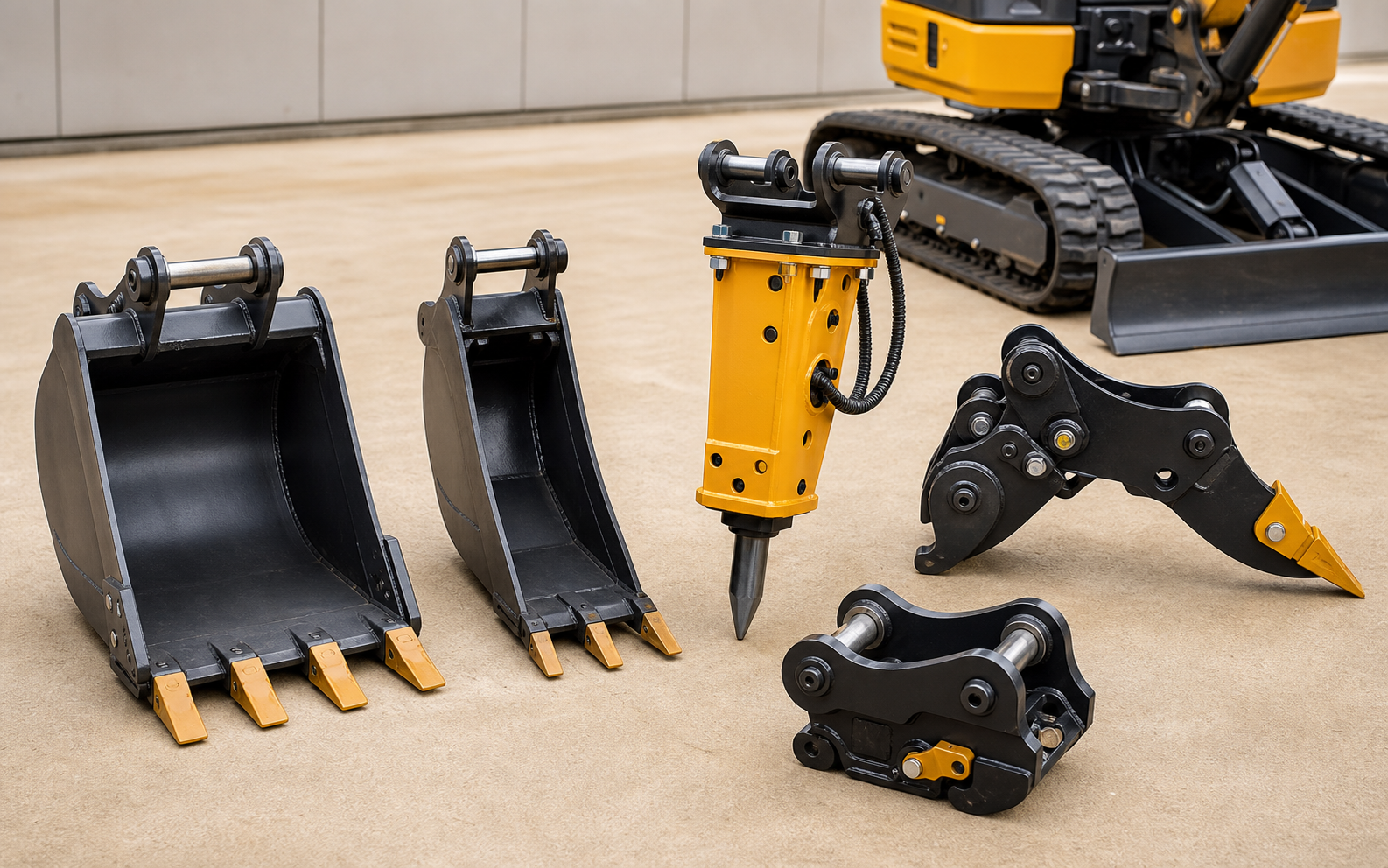
Whether your customers run mini excavator attachments on two-ton carriers or work rock with 50-ton machines, the attachment should match the job first and the carrier second. Oversizing a bucket or breaker can reduce cycle speed, strain hydraulics and shorten carrier life. Use the application, carrier tonnage, hydraulic flow, pin dimensions and coupler type to select the right tool. The selector below summarizes nine stocked attachment families by use case and tonnage range.
Attachment type
Primary application
Typical carrier band
Key spec to verify
Best for
Digging bucket (toothed)
Trenching, bulk excavation
0.8–50 t
Width, tooth count, SAE J296 capacity
General earthmoving contractors
Grading / ditching bucket
Finishing, slope, clean-up
1.5–40 t
Width (wide), smooth edge, tilt option
Roadwork & landscaping crews
Tilt / tiltrotator bucket
Grading at angle, no repositioning
2–33 t
Tilt range, rotation, hydraulic ports
High-precision finishing & utility work
Hydraulic breaker / hammer
Rock, concrete, asphalt demolition
0.8–50 t
Impact energy class vs carrier flow/weight
Demolition & quarry operators
Thumb (hydraulic / mechanical)
Material handling, sorting
1–40 t
Pairing bucket, pin spacing, links
Demolition sorting & land clearing
Attachment type
Primary application
Typical carrier band
Key spec to verify
Best for
Grapple (incl. rotating)
Logs, scrap, demolition debris
1.5–50 t
Jaw opening, rotation, tine count
Scrap, forestry & recycling yards
Ripper
Frozen / hard ground, roots
3–50 t
Single vs multi-shank, tip strength
Hard-ground & cold-climate sites
Auger drive
Post holes, foundations, drilling
0.8–25 t
Torque, drive output, bit diameter
Fencing, solar & foundation crews
Quick coupler
Fast tool changes between the above
0.8–50 t
ISO 13031 lock type, pin dia & spacing
Any fleet running 2+ attachments
Compactor plate / shear / pulverizer / rake / mulcher / brush cutter
Compaction, demolition processing, clearing
1.5–50 t
Operating weight, flow demand
Specialist demolition & site-prep work
View Image
View Image
View Image
TECHNICAL SPECIFICATION // MATCHING
Sizing & Compatibility —
Match Attachments to Your Carrier
The single most expensive mistake in importing attachments is assuming they are universal. They are not. Unlike skid steers, excavators have no universal mounting system; fit is governed by carrier tonnage class, pin diameter, pin spacing (centre-to-centre), and the coupler standard. An attachment that is "the right size" can still be impossible to mount if the pins or coupler do not match. That is why every order we ship is matched to a stated carrier, and why we lead with the matrix below rather than a parts list.
01
Mini (0.8–10 t)
Typical digging bucket width
12–24 in (300–600 mm)
Breaker class
Light / mini class
Common coupler / pin
Pin-grab or dedicated pins, 35–65 mm
Attachments that fit
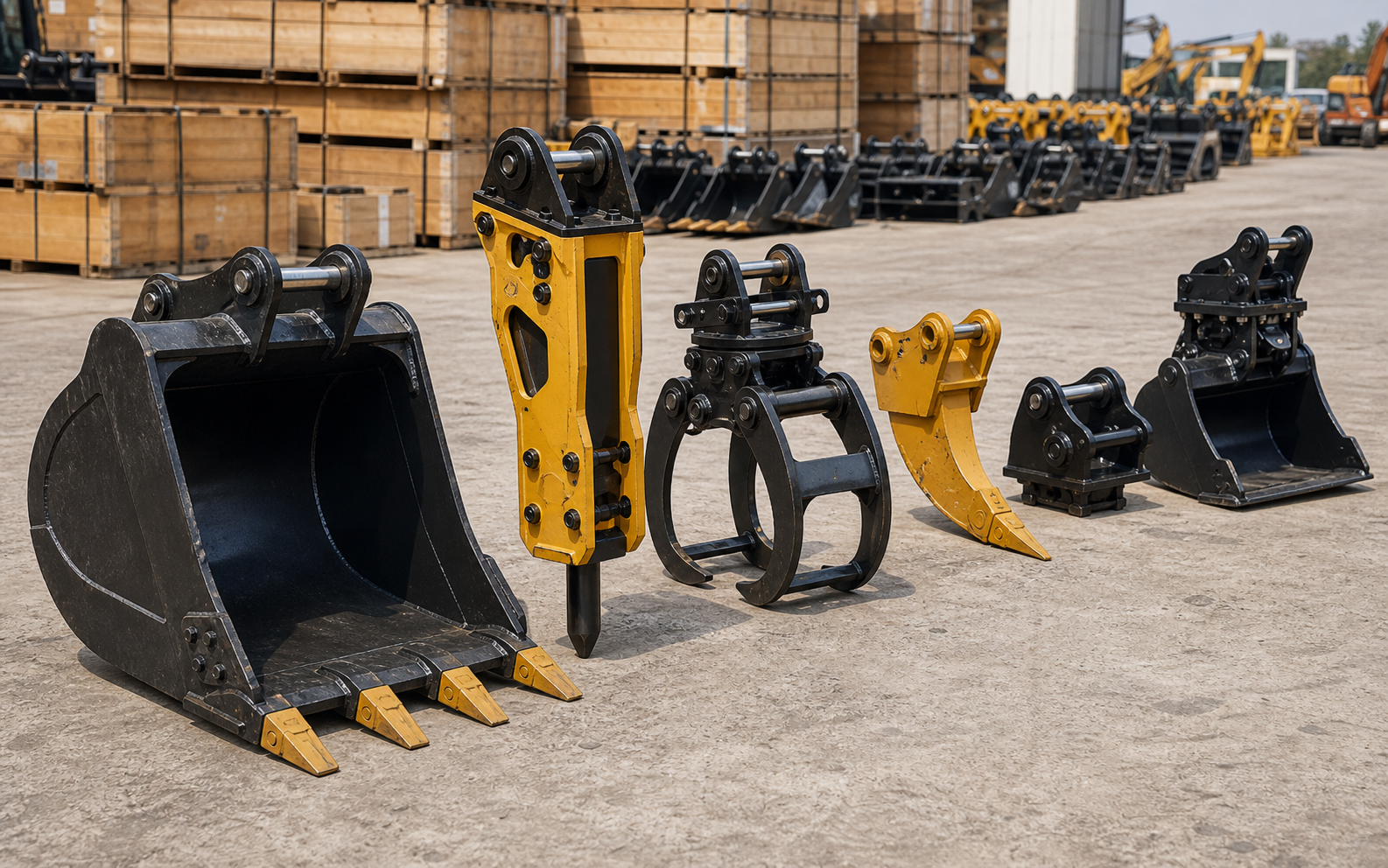
Thumb, auger, compactor, small buckets, mini breaker
02
Midi (10–30 t)
Typical digging bucket width
24–42 in (600–1050 mm)
Breaker class
Medium class
Common coupler / pin
Hydraulic quick coupler, 65–90 mm pins
Attachments that fit
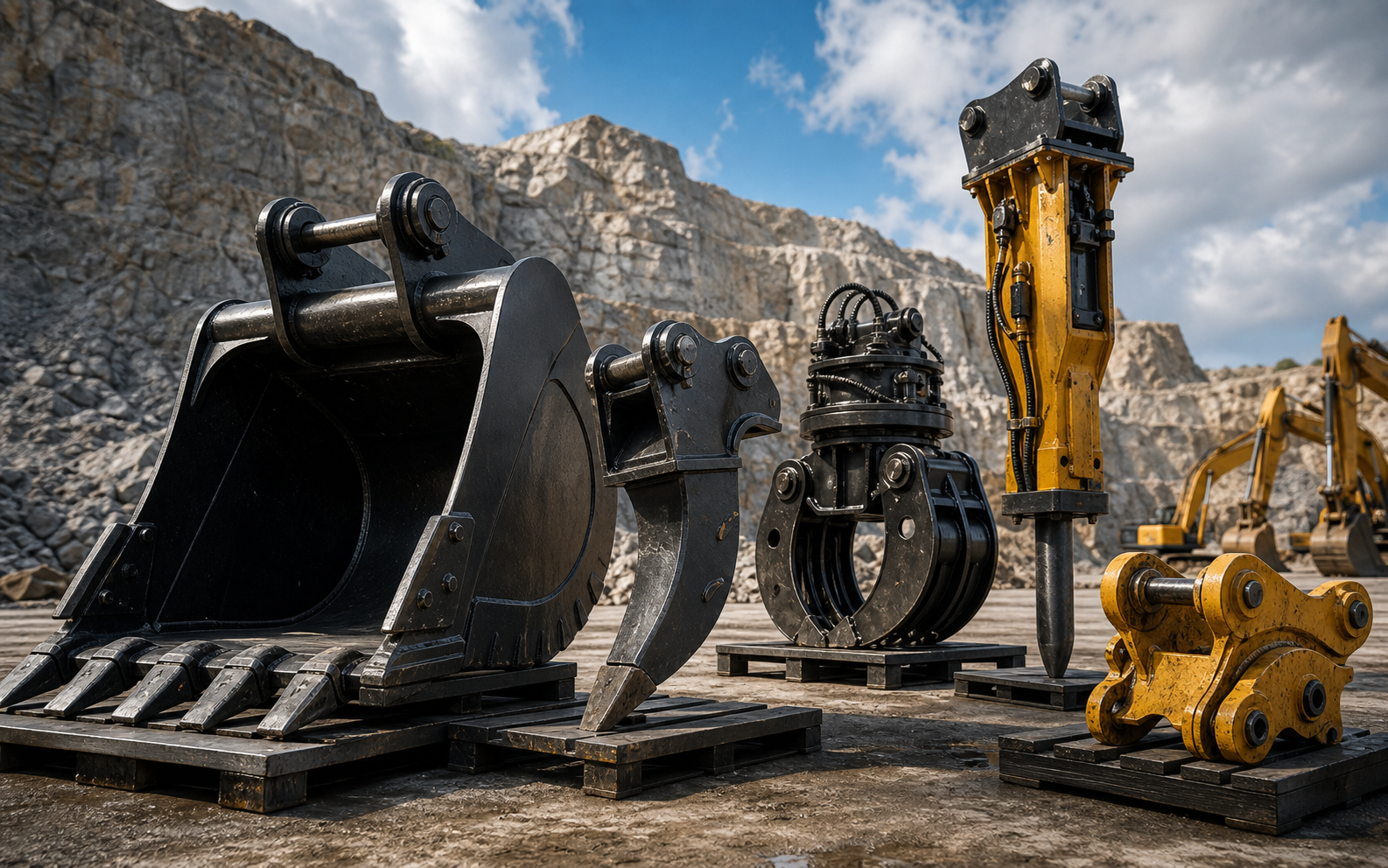
Grapple, ripper, breaker, tilt bucket, shear
03
Heavy (30 t+)
Typical digging bucket width
42–60 in (1050–1500 mm)
Breaker class
Heavy class
Common coupler / pin
Hydraulic QC / wedge, 90 mm+ pins
Attachments that fit
Rock bucket, large breaker, pulverizer, demolition shear
Bands are typical industry references for matching, not absolute limits; confirmed against each carrier's pin geometry before shipment.
New, Used, or Wholesale-Direct? A Transparent Comparison
Landed cost, not list price, is what decides your margin. A rock-bottom FOB price can be wiped out by condition issues, contingency, and port charges; equally, a "safe," branded dealer can bury a markup that makes the same machine uncompetitive in your market. A fair comparison is never simply new-versus-used — it is verifiable condition and total landed cost. The matrix uses concrete attributes, not High/Medium/Low.

| Attribute | Liehuang (wholesale-direct) | Local dealer | Online marketplace | OEM direct |
|---|---|---|---|---|
| Published specs | Struck/heaped capacity, weight, pin data | Often on request only | Varies, frequently incomplete | Full, but premium-priced |
| Price terms | FOB & CIF, itemized | Retail + dealer margin | Listed, +shipping/duty unclear | List, rarely negotiable |
| Compatibility check | Per-carrier, pre-shipment | In person | Buyer's risk | By OEM part number |
| Certification docs | ISO 13031 / EN 474 / CE on request | Sometimes | Rarely | Yes |
| New + used options | Both, condition-documented | Both, local stock | Mixed, unverified | New only |
| Parts / after-sale | Wear parts & hydraulics sourced | Local support | None | OEM network |
| Total-landed-cost clarity | FOB/CIF + container plan | Local, no import math | Hidden fees common | High, predictable |
Verification Checks
At least two verification checks should accompany any meaningful comparison. First, breaker impact classes should be reviewed against measured or supplier-documented data instead of relying only on marketing labels. Second, lowest list price does not always mean lowest landed cost. Condition issues, missing wear parts, port fees and demurrage can change the margin after the shipment arrives. A quote backed by photos, inspection notes, packing details and Incoterm assumptions gives importers a safer basis for resale pricing than a low number without documentation.
Want the import math for your specific order?
Get a free container-load quote (FOB/CIF) →
Quality Assurance — Inspection, Certification & Transparency
The most common objection to sourcing attachments out of China-that the quality assurance is "non-existent"-is also the simplest to solve. Quality control is, admittedly, non-existent at the very bottom of the used equipment market, and yes, this worry may lead you to an expensive middleman. The actual solution: documentation, not slogans. Since hydraulic hoses and seals are the first things to give out on any used attachment and documented through field reports as having a high failure rate, we explicitly test and detail condition reporting on these as well as on structural welds, pin and bushing wear and cylinder seal conditions for every used unit. You receive condition photos and a complete inspection report before you ever ship a container.
As for safety, the attachments that we sell have undergone an impact testing to standards, not a subjective test on our own word. Imported LIEHUANG brand Quick-attach couplerS are all certified against ISO 13031:2016, a dual-lock standard and four times the weight load in a static test designed by the manufacturer, precisely due to the history of "dropped-attachment" accidents documented by U.S. NIOSH machine safety researchers. For all sales into the EU market we provide the appropriate CE Declaration of Conformity and conformity to EN 474-1. Manufacturers' and discount market advertisements don't display these standards because-the entire category largely overlooks this fact-these certification and validation steps are what separates serious vendors from imitators.
"We treat the hydraulics and the coupler as the two things most likely to come back to us, so they get the closest look. On a used unit we pressure-check the cylinders and replace any hose or seal that is even borderline — it is cheaper than a warranty claim shipped across an ocean."Liehuang Inspection & QC Team
ISO 13031:2016
Quick-coupler safety, 4× load test completed
EN 474-1 + CE
EU conformity provided on request
Multi-point report
Testing on welds, pins, cylinders & seals
Condition photos
Fully documented before shipment to ensure transparency
Parts & hydraulics
Premium wear parts reliably sourced for long-term resale
Engineering & Specification Suite
Excavator Attachment Engineering & Planning Tools
01
Excavator Bucket Sizing Guide
Match the bucket to the task first, then size it to the carrier. Bigger is not always better — an oversized bucket exceeds breakout force, slows cycles, and accelerates wear. Capacity follows ISO 7541 / SAE J296 (excavator buckets rated at a 1:1 heap angle).
Run Digital Guide →02
Attachment-Mix Load Optimizer
Enter the attachment mix for your order to gauge how it fills a 20′ or 40′ container. This is a planning heuristic in relative load units — not a freight quote. Mixing small couplers and buckets with one or two large attachments usually maximises utilisation. Send your mix for a real consolidated FOB/CIF load plan.
Run Optimizer →03
Excavator Attachment & Coupler Compatibility Checker
Select your carrier class and brand to see the bucket widths, breaker class, coupler standard, and attachment families that fit. Bands follow ISO 7541 / SAE J296 sizing and ISO 13031 coupler conventions — confirm exact pin geometry before ordering.
Run Checker →Payment protected by staged delivery proof
Pay the balance after machine proof, not on blind trust.
Used excavator buyers need more than a product photo. Liehuang uses a staged payment workflow: deposit to reserve the machine, inspection evidence before balance, and export documents plus shipment tracking before release.
Verified machine videoLoading and customs filesBalance paid after confirmation
Quote & machine selectionChoose the model, hours, attachments and export destination before we reserve stock.
Deposit to lock stockA deposit holds the exact machine while inspection media and documents are prepared.
Inspection proof sentReceive walkaround video, hour-meter photos, serial details and loading plan.
Balance after confirmationPay the remaining balance only after you confirm the machine condition and export evidence.
Shipment & customs trackingWe share loading photos, bill of lading progress and customs support until release.
For high-value used equipment, trust is built by evidence. Ask for the current stock list, payment schedule and export document sample before you decide.Request stock proof