Get in Touch with Liehuang Company

Hydraulic Breakers
Hydraulic Breakers for Excavators, Matched to Your Carrier, Built for Export
One source for impact breakers sized to any excavator, from 1-ton minis to 45-ton heavies, fitted to every major carrier brand and crated for global shipment. We match the breaker to your machine, not the other way around.
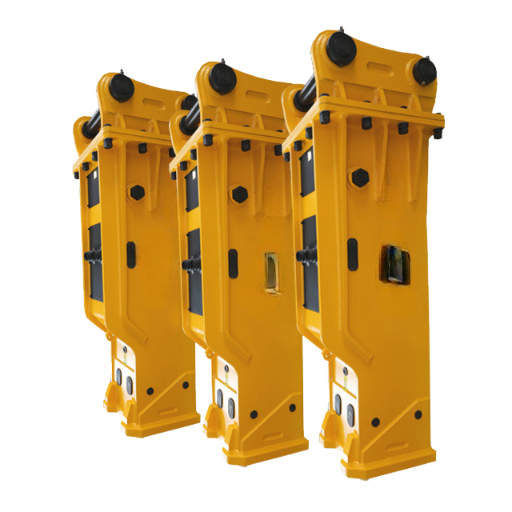
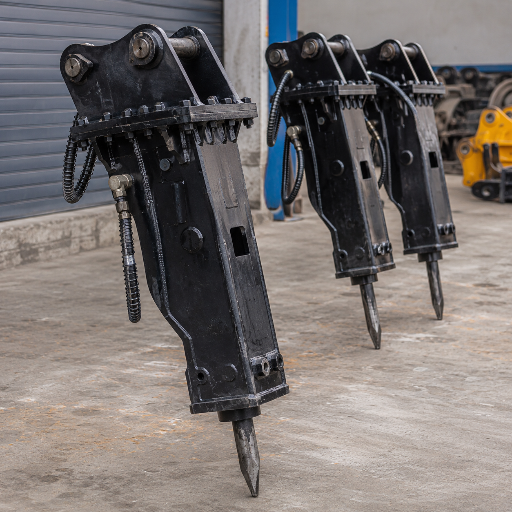
A hydraulic breaker for excavator work is only as good as its match to the carrier underneath it. Pick the right operating-weight class and oil-flow range and the tool breaks rock and reinforced concrete for years; pick wrong and you stall the job or wear out the machine. This page is how YOURBRAND sizes, fits, and ships that match.
- Carrier range
- 1–45+ metric tons (mini to heavy)
- Impact energy
- ~200–16,000+ J by class
- Required oil flow
- 4–77 GPM (15–290 lpm)
- Working pressure
- 140–183 bar (2,030–2,650 psi)
- Carrier brands fitted
- Cat, Komatsu, Sany, Volvo, Hyundai, Doosan, Kubota, Hitachi, Kobelco
- Mount
- built to your pin diameter, pin centers & stick width
- Standard reference
- ISO 16417:2020 commercial specs
- Supply
- new & inspected used, container-ready for export
The Cost of the Wrong Breaker Class, and How Carrier-Matching
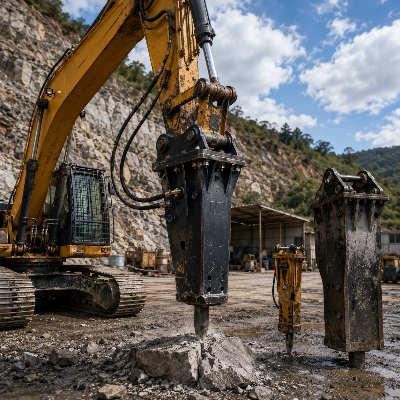
ISO 16417:2020 STANDARD
The most expensive breaker is the one that doesn’t fit your excavator. Operators describe the failure the same way across every forum: the breaker isn’t hitting like it used to, and the real problem is that an under-fed or oversized tool is quietly destroying the machine it hangs on. That damage is rarely about where the breaker was made; it’s about the match, and a mismatch can crack a stick pin or wear a carrier pump within the first 100 hours.
Here is the part most catalogs skip: a bigger hammer is not a better hammer.
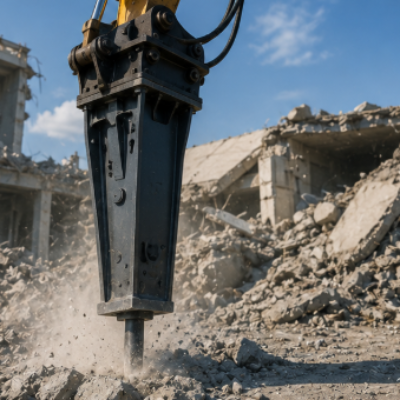
An oversized breaker overloads the arm, pins, and hydraulic circuit of a light carrier, while an undersized one drags the job out and burns operator hours. The root cause is hydraulic, if the carrier cannot deliver enough oil flow, the piston cannot recover between blows and the tool hits soft; if it delivers too much, you blow seals and crack internal parts. A hydraulic breaker, a percussion attachment, also called a hydraulic hammer or an excavator jack hammer, that converts the carrier’s oil pressure into repeated high-energy impacts, only delivers its rated energy inside a defined flow and pressure window. Unlike a handheld jackhammer that runs on its own compressor, an excavator breaker hammer borrows the machine’s pump, so carrier and tool are one system. YOURBRAND sizes that system first and chooses the brand second, confirming the class against your machine’s measured oil flow before any mount is fabricated in-house. The international reference for stating those commercial specifications, operating weight, impact rate, oil flow, carrier class, is ISO 16417:2020, and every quote we send is framed in its terms.
Hydraulic Breaker Classes by Excavator Size: Mini, Medium & Heavy
Match starts with the carrier’s operating weight, then confirms oil flow and pressure. Get it wrong and the symptoms are familiar, a breaker that hits soft, excessive vibration, premature seal wear, and a stalled job that bleeds labor by the hour, because the piston cannot recover between blows outside its design window. This ladder maps the industry-typical relationship of carrier weight to breaker class, built from published manufacturer ranges and framed to ISO 16417:2020, not a single brand’s catalog. YOURBRAND sizes to your machine’s measured oil flow, not the brochure class, and the same chart covers skid steers and backhoes that share these weight bands. One honest caveat the trade rarely prints: an “impact energy class” is a marketing rating and does not equal measured impact energy, so you cannot compare class numbers across brands, you compare carrier weight, oil flow, and working pressure.
| Class band | Excavator weight | Impact energy (J) | Blow rate (BPM) | Required oil flow | Working pressure | Tool dia. |
|---|---|---|---|---|---|---|
| Mini-light | 1–1.8 t | ~200 | 480–1,200 | 4–9 GPM (15–35 lpm) | 140 bar (2,030 psi) | 42 mm |
| Mini | 1.3–3.5 t | 270–475 | 450–1,300 | 4–15 GPM (15–55 lpm) | 170 bar (2,465 psi) | 47–57 mm |
| Compact | 2.7–7.3 t | 680–1,120 | 500–1,200 | 7–26 GPM (25–100 lpm) | 170 bar (2,465 psi) | 66–76 mm |
| Medium-low | 5.5–14 t | 1,760–2,710 | 400–1,000 | 13–40 GPM (50–150 lpm) | 150–180 bar | 86–106 mm |
| Medium | 13–25 t | 3,390–4,070 | 400–900 | 26–53 GPM (100–200 lpm) | 180 bar (2,600 psi) | 116–126 mm |
| Heavy | 25–45 t | 5,425–10,850 | 320–650 | 44–66 GPM (165–250 lpm) | 180 bar (2,600 psi) | 136–156 mm |
| Super-heavy | 45–118+ t | 16,270–27,115 | 210–400 | 58–119 GPM (220–450 lpm) | 172–180 bar | 165–214 mm |
Carrier-to-breaker class selection matrix, excavator weight 1–45 t to impact energy, blow rate, oil flow and tool size.
Buyers on a 3-ton machine almost always ask the same follow-up: side type, top type, or box type? Those are mount and body styles, not power classes, and confusing them is a common mistake. A top-mount (open-frame) breaker is lightest and cheapest and suits demolition where noise is not regulated; a side-plate breaker adds bracket rigidity for prying loads; a silenced box breaker fully encloses the percussion unit to cut noise and vibration for urban and indoor work, where the sound-power directive applies. Carrier class fixes the power; body style fixes the worksite fit. Carriers themselves are defined in ISO 6165 (earth-moving machinery terminology), which is why this matrix speaks in operating weight rather than horsepower.
Beyond power class, a few breaker features decide day-to-day efficiency. Solid-body (SB) designs, one slim casing with few internal parts, stay reliable and durable because there’s less to fail, and its narrow profile reach the tight trenches and narrow spaces a bulkier tool can’t. Blank-fire prevention systems stop the piston from firing into empty ground, the result being far less wear per task. Higher blows per minute suit brittle material; fewer, harder blows suit rock or concrete of high strength. These hydraulic attachments stay versatile across a mini excavator, skid steer loaders, or a 30-ton carrier, as long as the excavator hydraulic circuit matches the class. Premium makers such as Epiroc trace the modern design to the first serial rock breaker, the Krupp HM 400 of 1967; YOURBRAND doesn’t specialize in reinventing that physics, only in matching it efficiently to your fleet.
Decision Matrix — Job vs Carrier Class
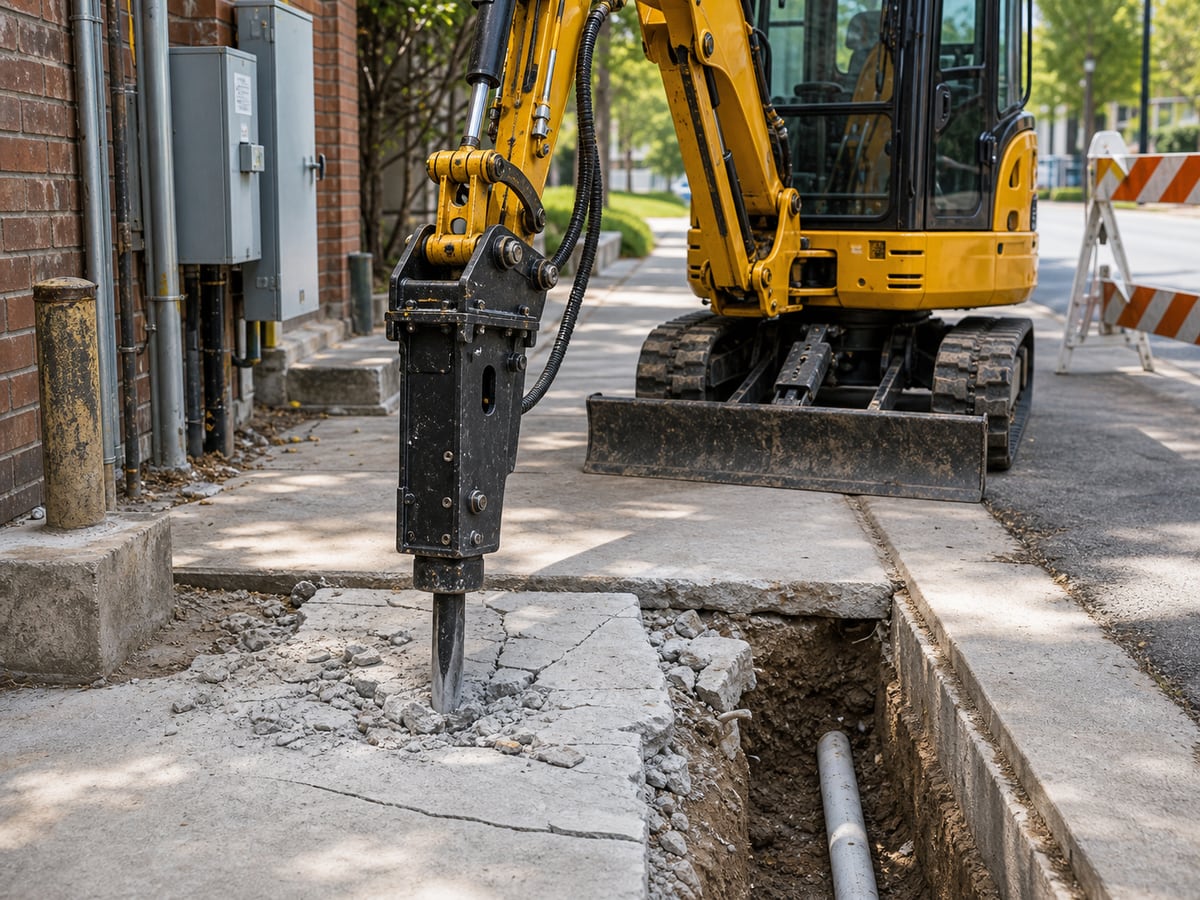
Indoor / utility / sidewalk
- 1–4 t mini Mini, silenced box
- 5–14 t Compact, silenced
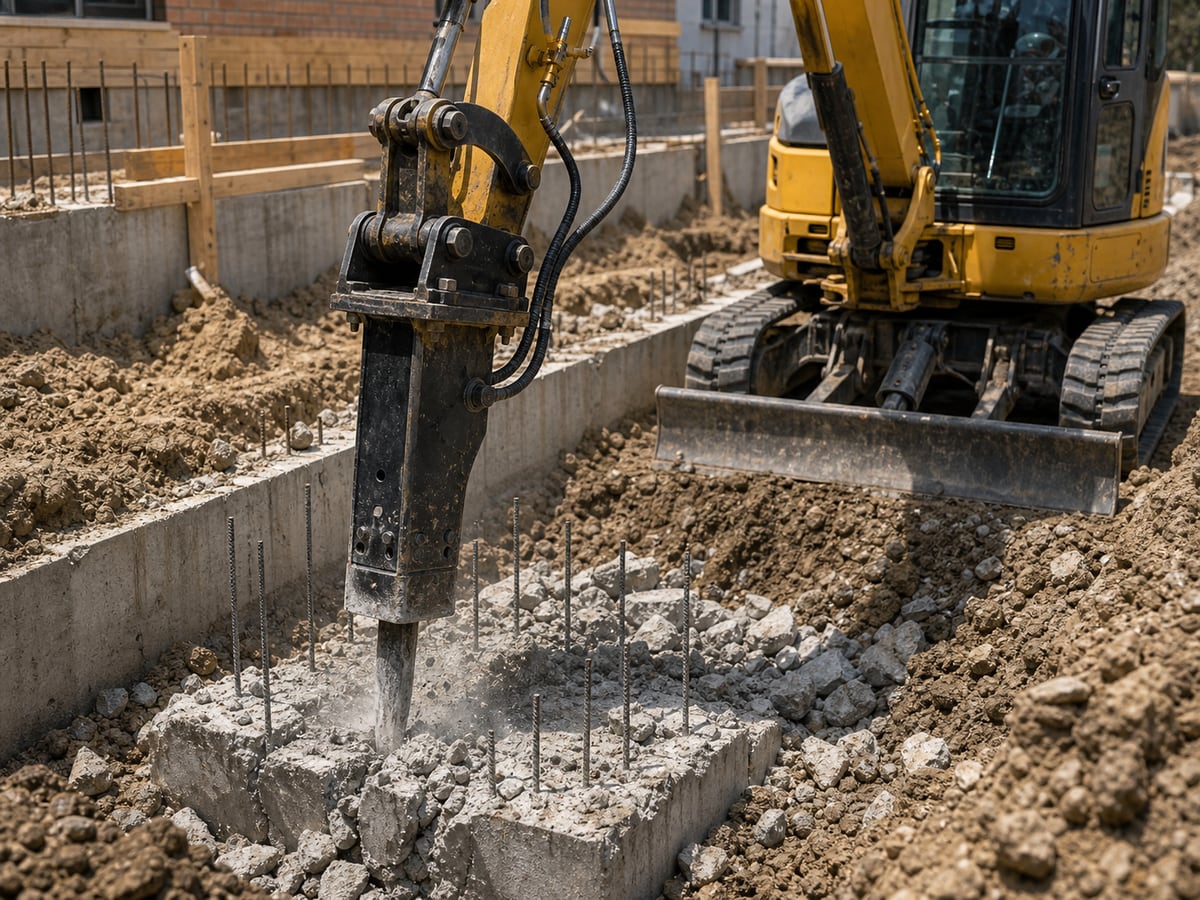
Trenching & foundations
- 1–4 t mini Mini
- 5–14 t Compact–Medium-low
- 15–30 t Medium
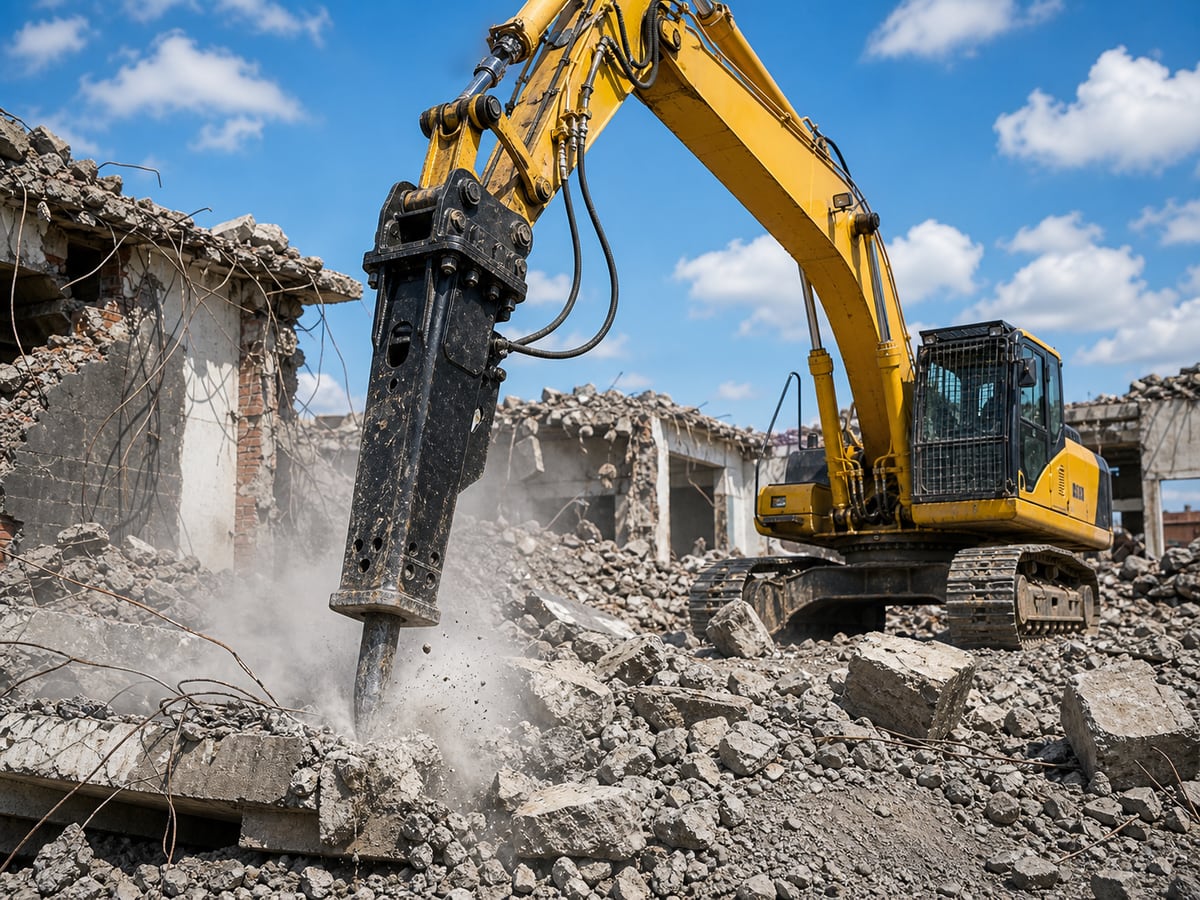
General demolition
- 5–14 t Medium-low
- 15–30 t Medium
- 30 t+ Heavy
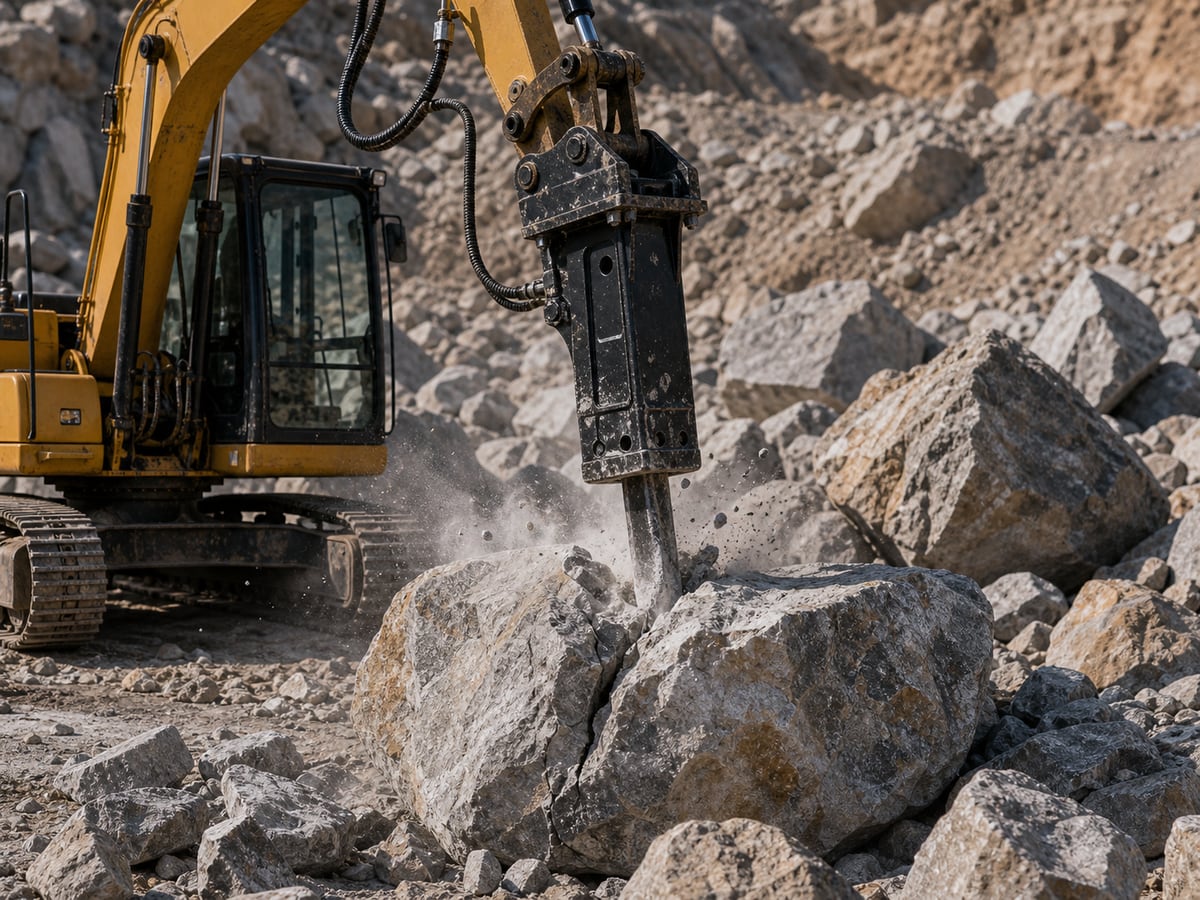
Secondary rock / boulder
- 5–14 t Compact
- 15–30 t Medium
- 30 t+ Heavy
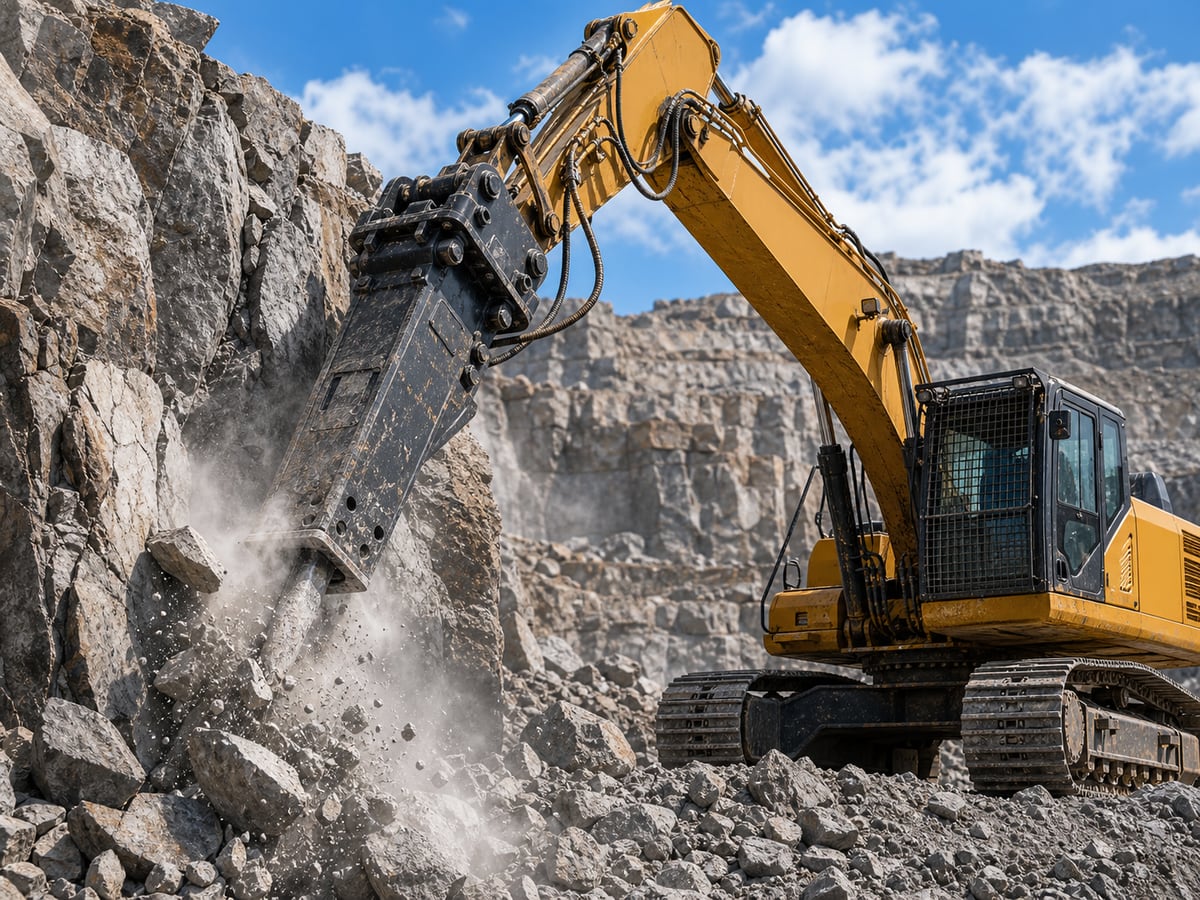
Quarry / primary rock
(150–180 MPa)
(150–180 MPa)
- 15–30 t Medium–Heavy
- 30 t+ Super-heavy
Not sure which row is yours?
Send your excavator model and we confirm class, oil flow, and mount.
Carrier-Brand Fitment: Cat, Komatsu, Sany, Volvo, Hyundai, Doosan, Kubota, Hitachi & Kobelco
Because YOURBRAND supplies the excavators as well as the attachments, we map breakers to specific carrier families every week, and the mistake we see most often is a generic bracket that doesn’t match the machine. Unlike a one-size bracket, every YOURBRAND mount is cut in-house to your pin diameter, pin centers, and stick width, and ships ready for installation with the hoses and the flow window on the paperwork. A hydraulic breaker attachment that’s a class too large strains the arm and pins; too small and it never breaks 150 MPa rock. This chart pairs common OEM excavator classes with the breaker band that fits their weight and standard auxiliary flow. It’s a fitment guide, not a price list; final selection always confirms your machine’s measured auxiliary GPM against the class window above.
Multi-OEM Carrier Fitment Chart
| Excavator class & example models | Operating weight | Matched breaker class | Typical mount / pin |
|---|---|---|---|
| Kubota U / KX, Cat 301–302, Sany SY16–35 | 1.5–3.5 t | Mini | Pin-on, 40–50 mm pin, silenced option |
| Cat 305–308, Komatsu PC30–78, Hyundai R35–80 | 3.5–8 t | Compact | Pin-on or quick-coupler, 50–65 mm pin |
| Cat 312–315, Komatsu PC120–138, Doosan DX140 | 12–16 t | Medium-low | Quick-coupler, 65–80 mm pin |
| Cat 320–323, Komatsu PC200–210, Volvo EC200–220, Hyundai R210, Hitachi ZX200 | 20–24 t | Medium | Quick-coupler, 80–90 mm pin |
| Cat 326–330, Komatsu PC290–360, Volvo EC300–360, Kobelco SK300 | 26–36 t | Heavy | S-type coupler, 90–110 mm pin |
| Cat 336–349, Komatsu PC390–490, Sany SY365–500 | 36–49 t | Heavy / Super-heavy | S-type coupler, 100–120 mm pin |
| Doosan DX55–80, Hitachi ZX55–75, Kobelco SK55–75 | 5–8 t | Compact | Pin-on, 55–65 mm pin |
| Volvo EC140–160, Hyundai R140–160, Hitachi ZX130–160 | 14–17 t | Medium-low / Medium | Quick-coupler, 70–85 mm pin |
| Sany SY215–265, Doosan DX225–260, Backhoe loaders | 21–27 t | Medium | Quick-coupler, 80–95 mm pin |
Multi-OEM carrier fitment, matched breaker class and mount pin by excavator brand.
This is also where the trust question gets answered honestly. The fear that an unfamiliar supplier means an unreliable tool does not survive contact with the field: operators report numerous major repairs on premium-brand hammers too, and the most-praised breakers in those same threads win on a simple, few-moving-parts design rather than a badge. A breaker matched to the right carrier, charged correctly, and greased on schedule outlasts a mismatched premium unit, the difference is the match and the maintenance, not the flag on the box. A backhoe hydraulic breaker follows the same rule. YOURBRAND backs the match with documentation in ISO 16417:2020 commercial-specification terms so you verify class against your carrier before anything ships. See WO2016111495A1 for the percussion-unit principle these classes share.
Hydraulic Breaker vs the Alternatives, and the Ownership Math
Before you commit a breaker to a job, confirm it is the right demolition tool at all, then confirm it is worth owning rather than renting. The comparison below puts the breaker against the attachments it is most often confused with, in the terms that decide the job: what each one is for, the material it suits, and the relative throughput. The failure mode to avoid is the one the data keeps surfacing, most hydraulic hammer damage traces to operator error (wrong size, dry or “blank” firing, poor setup), not to the country stamped on the housing. That is the honest version, and it is why an Atlas Copco hydraulic breaker run on a mismatched carrier still fails. Judged on the rated terms of ISO 16417:2020, a properly matched breaker is the right call for concrete and rock.
Click to Swap
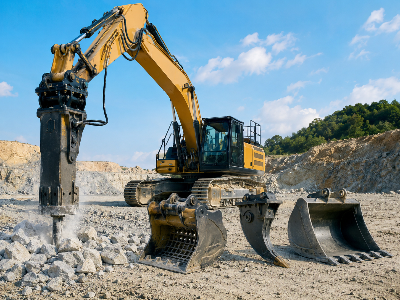
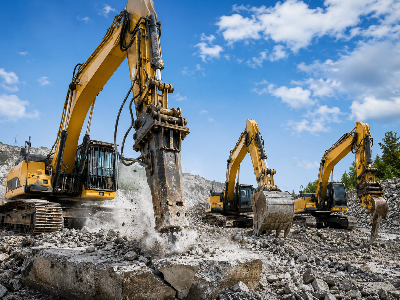
Hydraulic Breaker vs Common Alternatives
| Attachment | Best for | Material | Relative throughput | Where it loses |
|---|---|---|---|---|
| Hydraulic breaker | Demolition, trenching, secondary rock | Concrete, rock, asphalt | High on brittle material | Slow separating ductile steel/rebar |
| Hydraulic shear / pulverizer | Cutting steel, processing concrete + rebar | Rebar concrete, steel | High on mixed demolition | Poor on solid rock |
| Bucket / thumb | Digging, sorting, loading | Soil, loose debris | n/a for breaking | Cannot fracture intact rock |
| Rock saw | Precision trenching in rock | Soft–medium rock | Precise, slow | Cost and wear on hard rock |
| Attachment | Best for | Material | Relative throughput | Where it loses |
|---|---|---|---|---|
| Hydraulic breaker | Demolition, trenching, secondary rock | Concrete, rock, asphalt | High on brittle material | Slow separating ductile steel/rebar |
| Long-term rental hammer | One-off short jobs | Same as breaker | No capital outlay | Cost compounds above breakeven hours |
Applications & Job Matches: Demolition, Trenching, Rock Excavation, Quarrying, Concrete & Road
Breakers earn their keep across the build cycle, but the right class shifts with the material and the phase, and a mismatch here's expensive, because the wrong class either stalls on 150–180 MPa quarry stone or hammers a light carrier to early wear. The bottleneck on most sites isn't raw power; it's matching impact energy and blow rate to what you actually demolish, since reinforced concrete structures, weathered rock, and hard quarry stone reward very different tools. A concrete breaker for excavator work in town is a different animal from a quarry primary breaker, even on carriers of equal weight. The table maps the common jobs to the class that clears them without overloading the machine; YOURBRAND specs the class to the material, not the other way around, so each tool is suitable for the duty it actually sees.
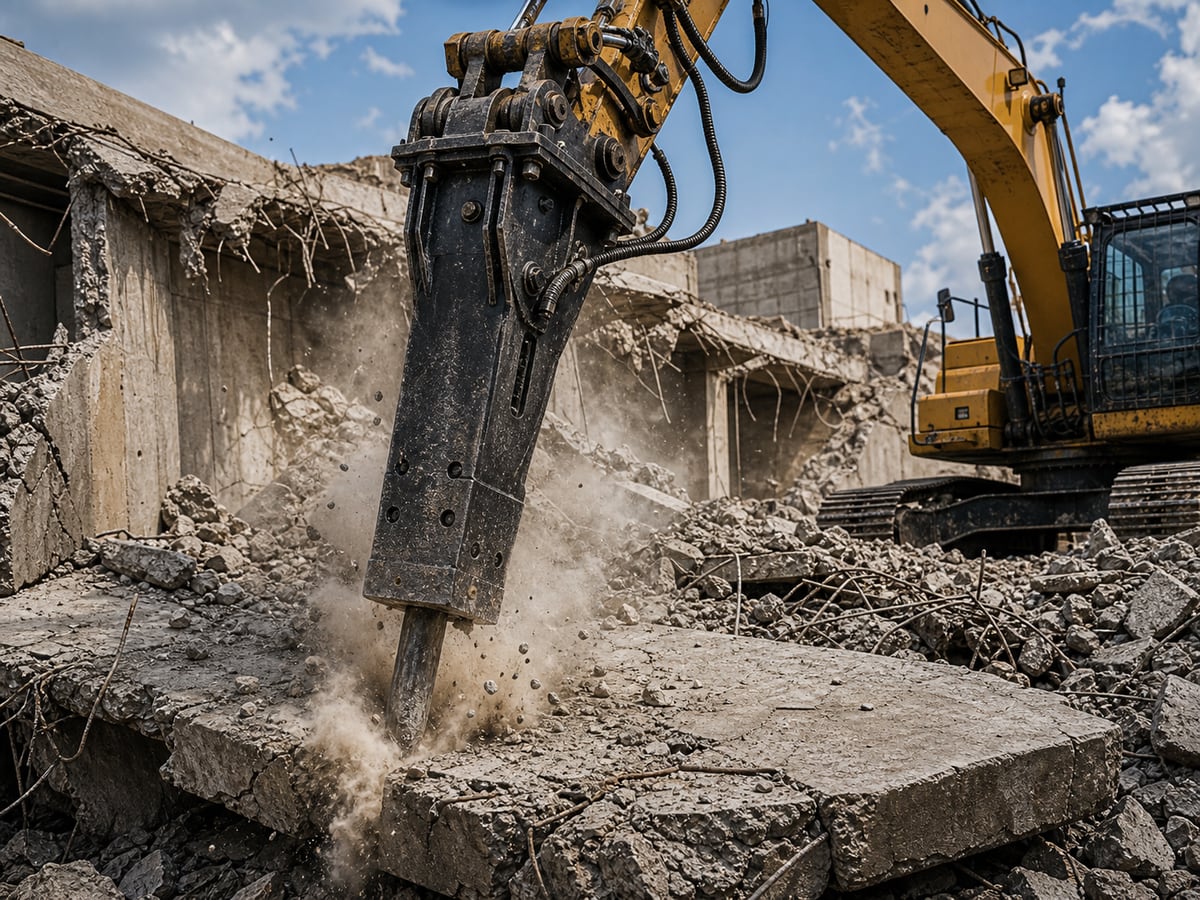
Primary demolition (slabs, walls)
Typical Class
Medium–Heavy
What Governs The Choice
Reinforced concrete thickness; high blow rate clears faster
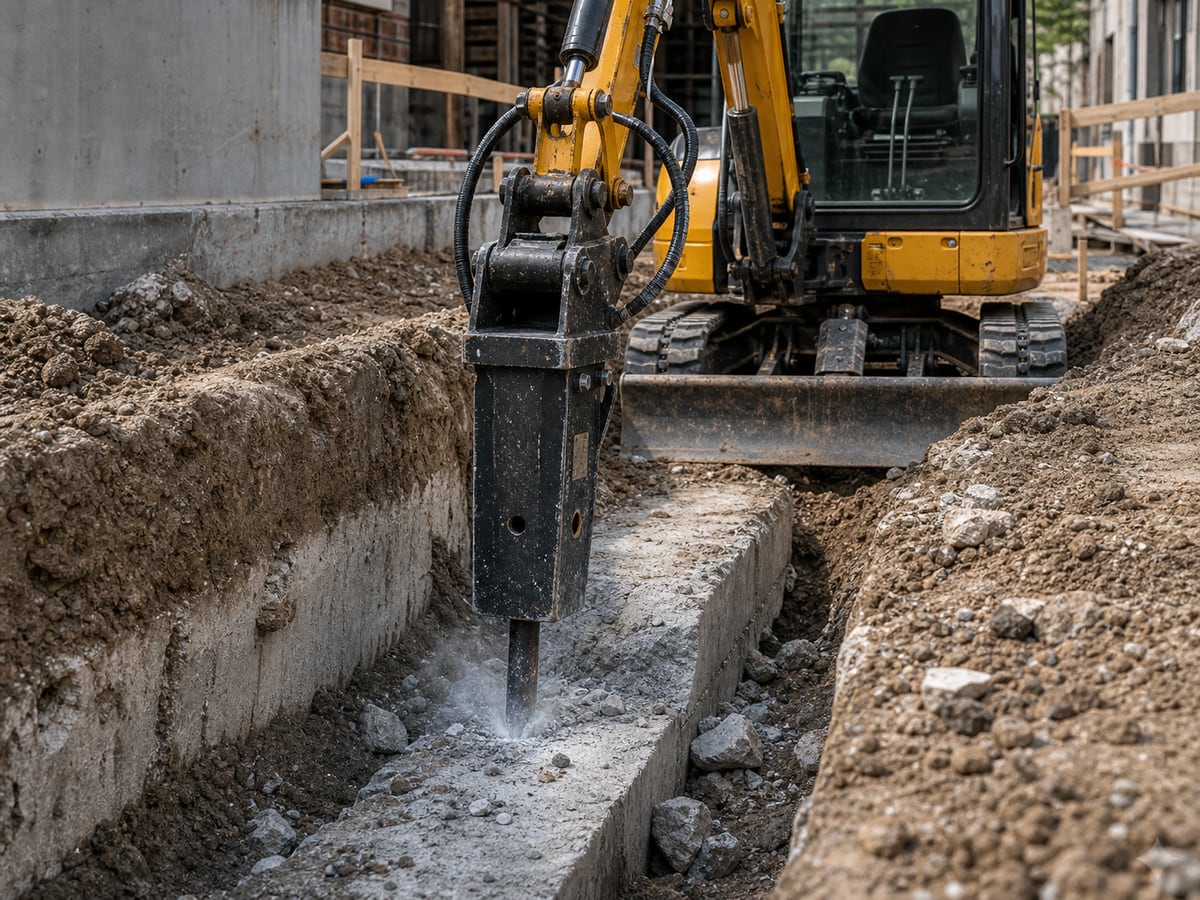
Trenching & foundation removal
Typical Class
Compact–Medium-low
What Governs The Choice
Carrier reach + confined access; favor silenced body in town
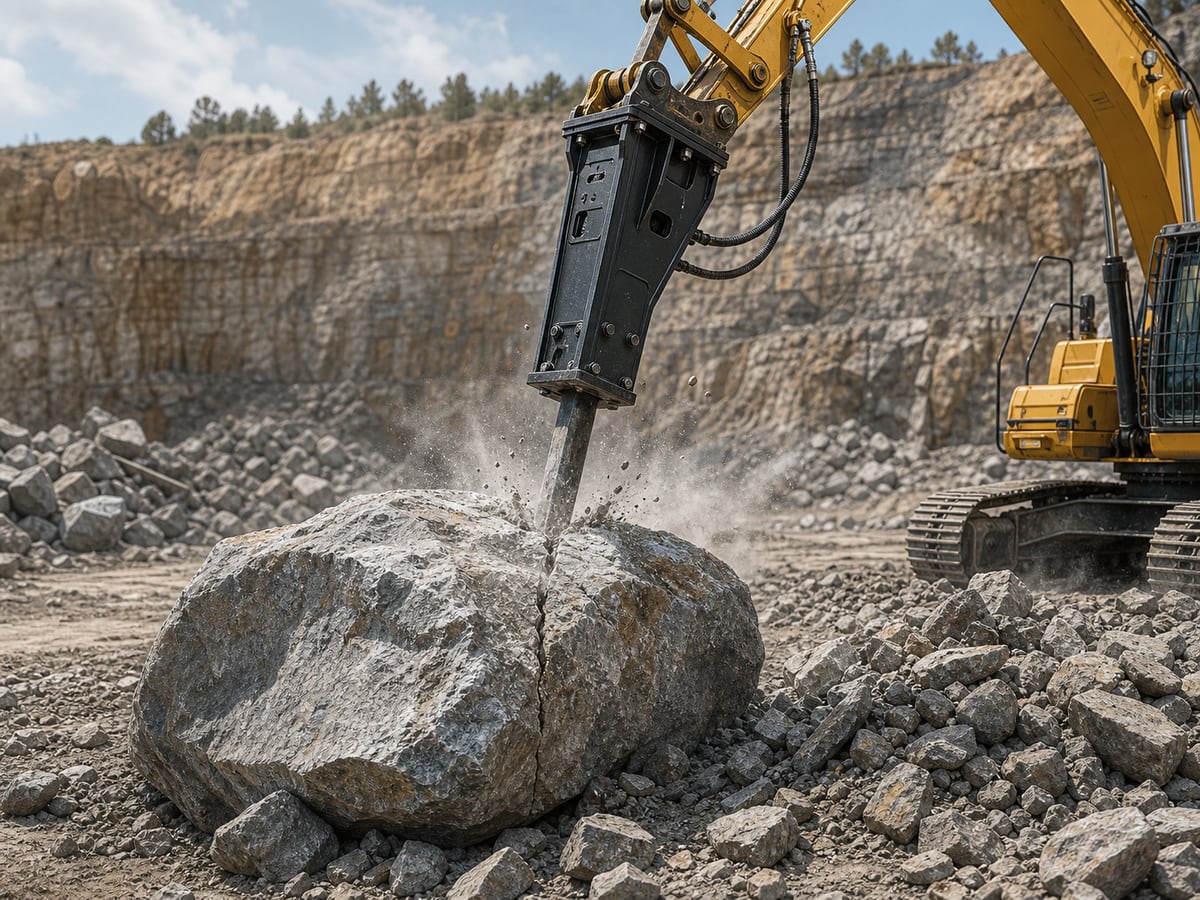
Secondary rock breaking (boulders)
Typical Class
Compact–Medium
What Governs The Choice
Boulder size; high frequency for repeated hits
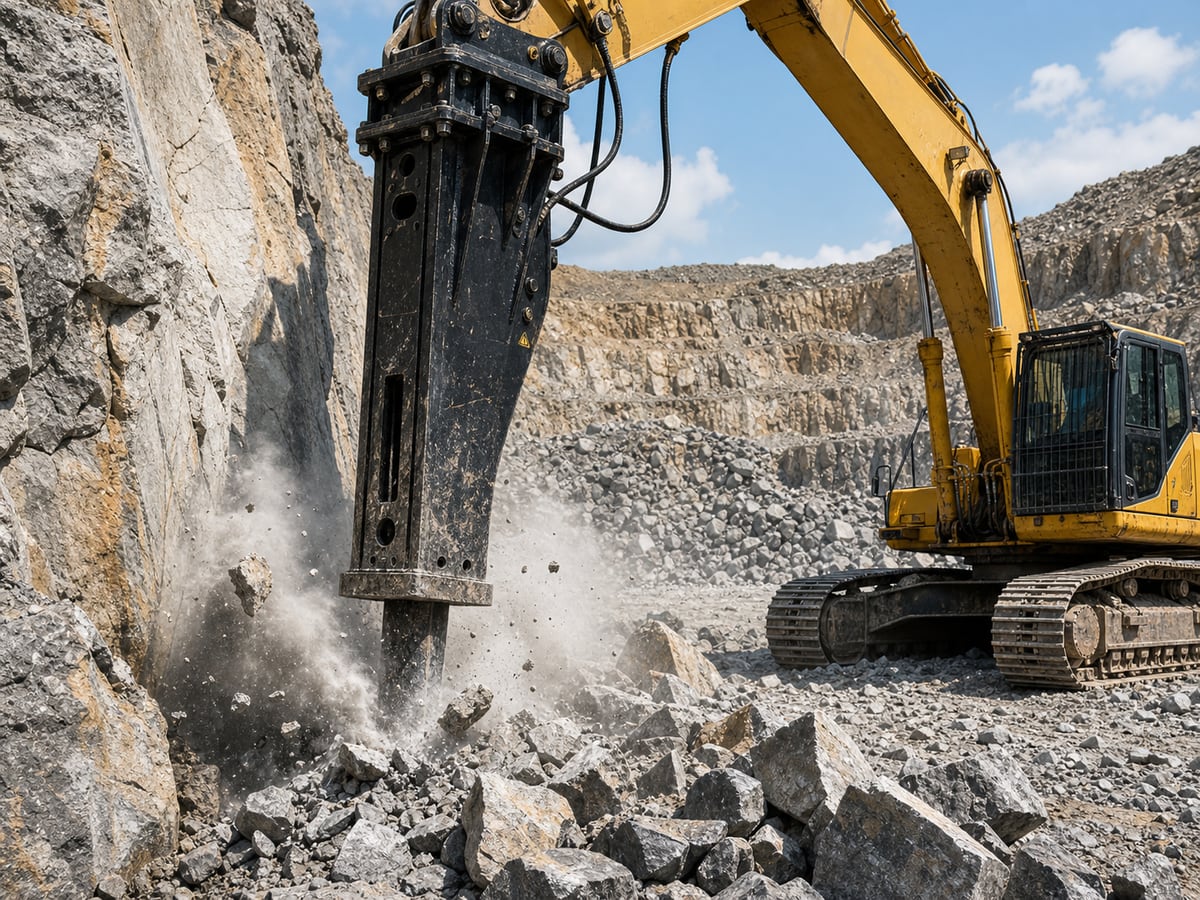
Primary rock / quarry (hard stone)
Typical Class
Heavy–Super-heavy
What Governs The Choice
Rock compressive strength (150–180 MPa); high single-blow energy
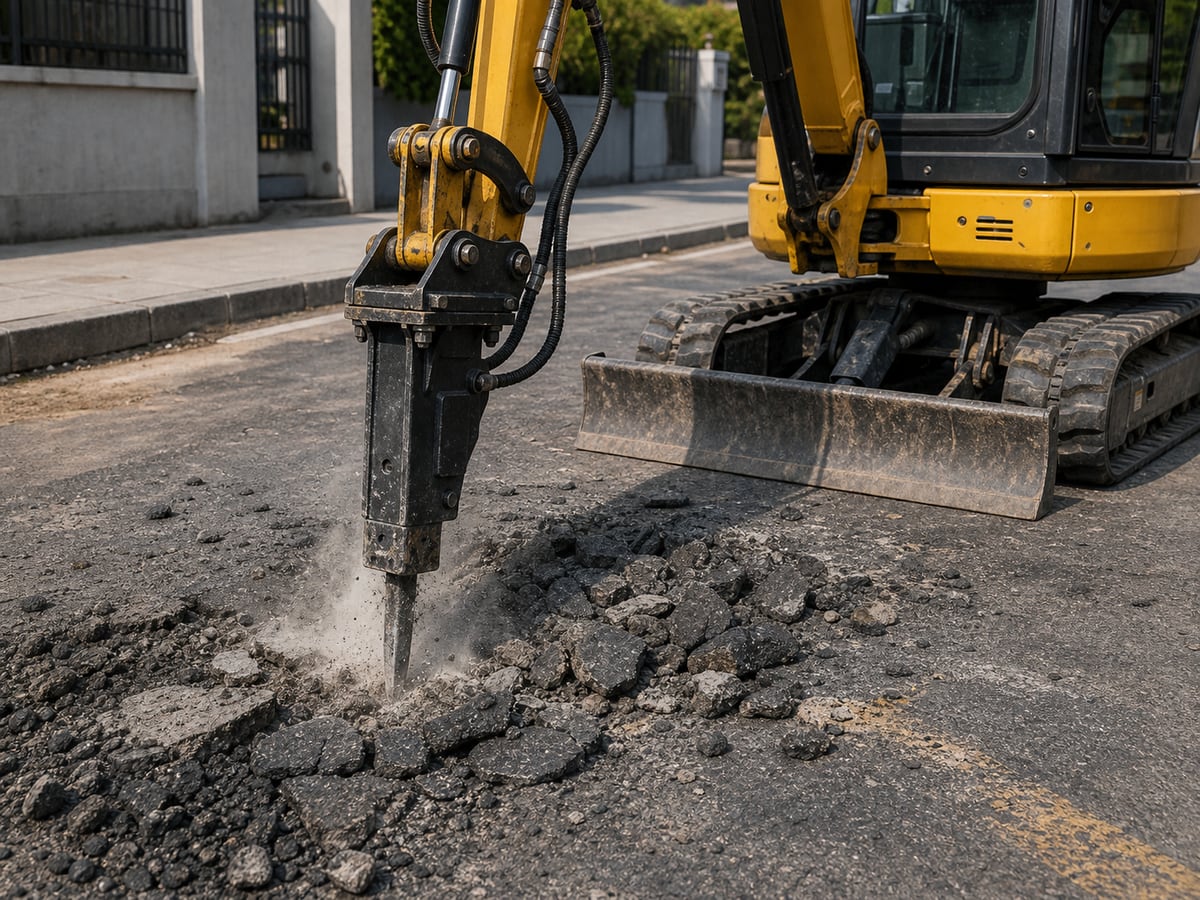
Asphalt & road breaking
Typical Class
Mini–Compact
What Governs The Choice
Layer depth; moil or asphalt-cutter tool
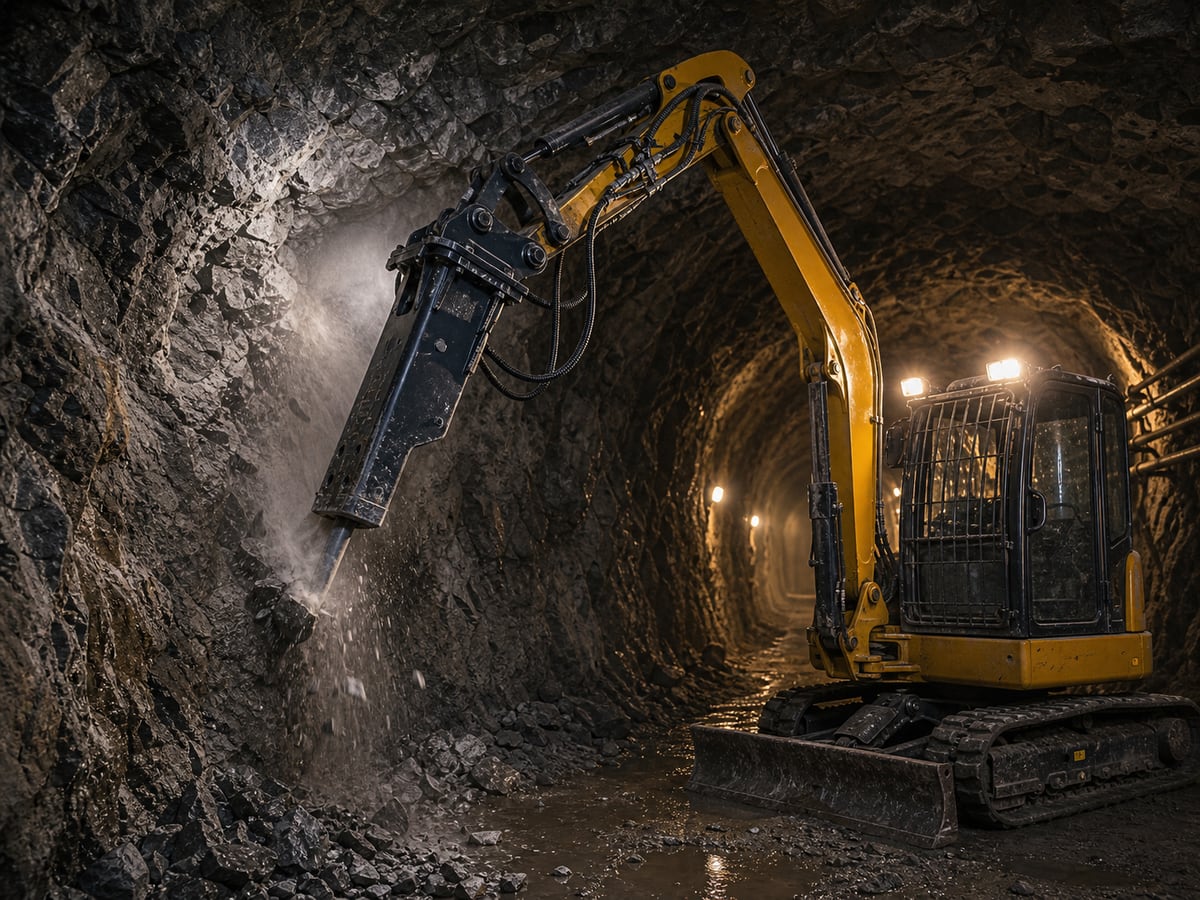
Scaling / underground
Typical Class
Mini–Compact
What Governs The Choice
Reach and weight; chisel tool, controlled blows
Specs, Oil Flow & Compatibility, Getting the Hydraulics Right Engineer
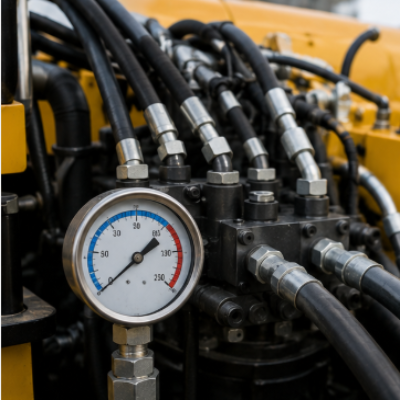
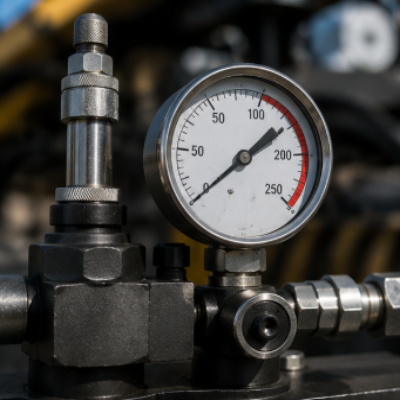
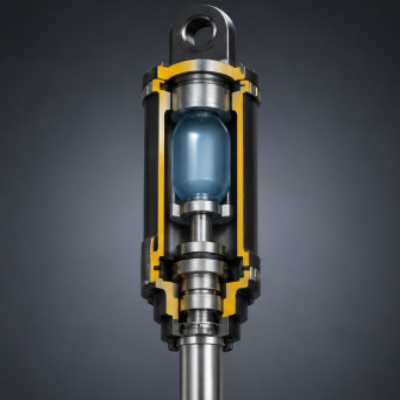
Everything upstream comes down to four numbers your carrier must satisfy: auxiliary oil flow (GPM/lpm), relief pressure (bar/psi), back-pressure tolerance, and the nitrogen charge that pre-loads the piston. Real money rides on this, fall short on flow and the breaker hit soft; overshoot and you blow seals at 180 bar. Get the flow into the class window and the tool deliver rated energy. Before fitting, YOURBRAND has the dealer or your hydraulics tech set the carrier’s auxiliary flow and relief to the breaker’s plate values, the manual’s minimum and maximum flow aren't suggestions. Each unit ships with matched hoses and a maintenance schedule, because performance over a 5,000-hour life is set by what you do every shift, not by the casting.
SYS. ACTIVE // HYDRAULICS
01
Oil flow
Match to class window (4–77 GPM); set carrier aux flow to plate value
02
Pressure
140–183 bar (2,030–2,650 psi) typical; confirm relief setting
03
Nitrogen charge
Back head ~55–60 kg/cm² at 20°C, always per the model manual
04
Noise & vibration
Sound power 110–124 dB(A) by class per Directive; silenced body
05
Tools
Moil point, chisel, blunt, asphalt cutter — matched to material
06
Hoses & maint
Grease the tool bushing on schedule; dry running scores the bore
Hydraulic Breaker Operations Suite
Breaker-to-Carrier Match Calculator
Optimize your heavy equipment operations. Enter your excavator operating weight to instantly determine the precisely matched breaker class, impact energy, oil-flow demand, and tool size.
Access CalculatorOil Flow Compatibility Checker
Operating outside optimal flow parameters degrades performance and risks catastrophic equipment failure. Verify your carrier’s auxiliary flow against precise breaker specifications.
Check CompatibilityOwn-vs-Rent & Landed-Cost Estimator
A data-driven financial framework. Enter your localized costs and utilization rates to dynamically compare hourly ownership expenses against current rental market rates.
Estimate CostsCarrier-Brand Fitment Lookup
Precision engineering for seamless integration. Select your excavator brand and weight class to instantly identify the exact breaker match and typical pin/mount specifications.
Find FitmentPayment protected by staged delivery proof
Pay the balance after machine proof, not on blind trust.
Used excavator buyers need more than a product photo. Liehuang uses a staged payment workflow: deposit to reserve the machine, inspection evidence before balance, and export documents plus shipment tracking before release.
Verified machine videoLoading and customs filesBalance paid after confirmation
Quote & machine selectionChoose the model, hours, attachments and export destination before we reserve stock.
Deposit to lock stockA deposit holds the exact machine while inspection media and documents are prepared.
Inspection proof sentReceive walkaround video, hour-meter photos, serial details and loading plan.
Balance after confirmationPay the remaining balance only after you confirm the machine condition and export evidence.
Shipment & customs trackingWe share loading photos, bill of lading progress and customs support until release.
For high-value used equipment, trust is built by evidence. Ask for the current stock list, payment schedule and export document sample before you decide.Request stock proof