Get in Touch with Liehuang Company
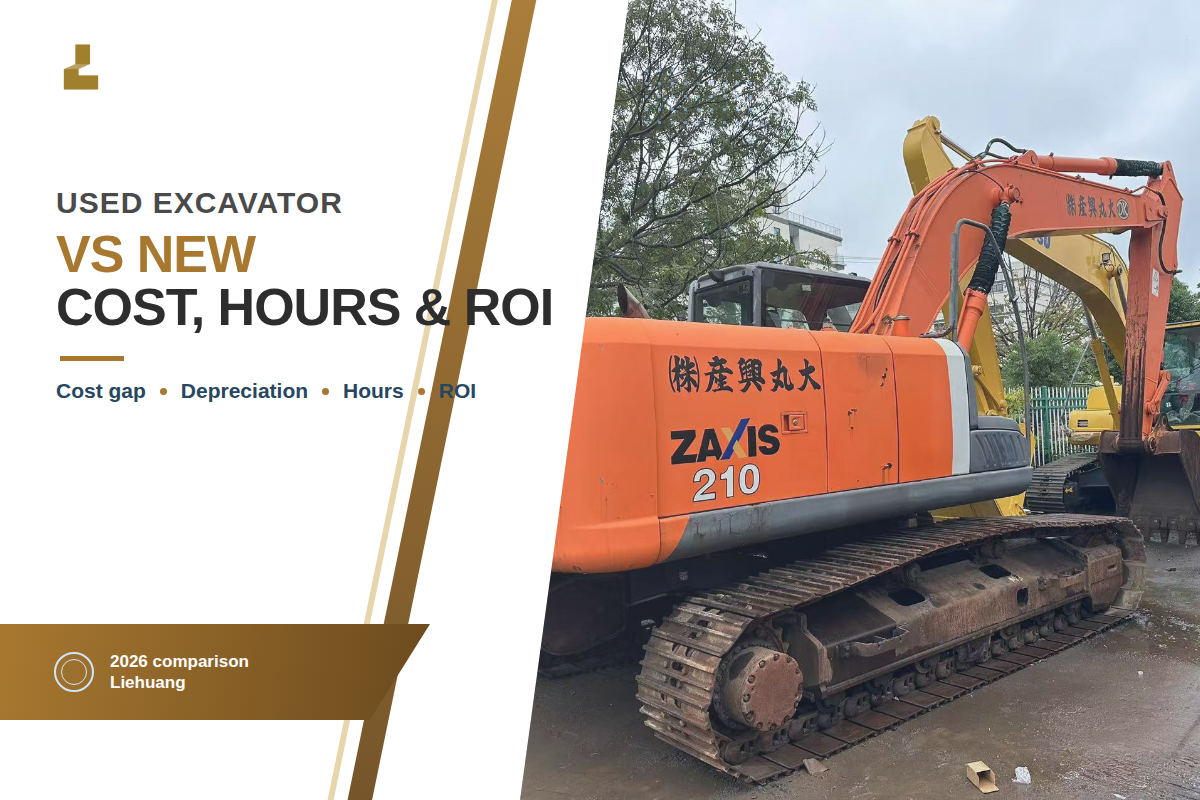

The used excavator vs new decision is one of the largest capital calls a contractor or fleet buyer makes, and the honest answer is that neither option wins every time. Buying a new one brings predictability; buying a used one brings a lower upfront price tag and allows you to bypass the steepest portion of the depreciation curve. This article takes an apples-to-apples look at both sides – considering purchase price, total cost of ownership, safe hour thresholds, emissions technology, warranty, inspection and origin – to give you a framework for making your own choice.
Quick Decision Snapshot
| Lower upfront price | Used — commonly 30–60% below a comparable new machine |
| Predictable cost of ownership | New — warranty + fixed-price servicing |
| Best value sweet spot | 2–4-year-old machine, low hours, full service records |
| Availability | Used — on-site in days; new — weeks of lead time |
| Single biggest risk with used | Undercarriage and major hydraulic component wear |
New vs Used Excavator: At a Glance
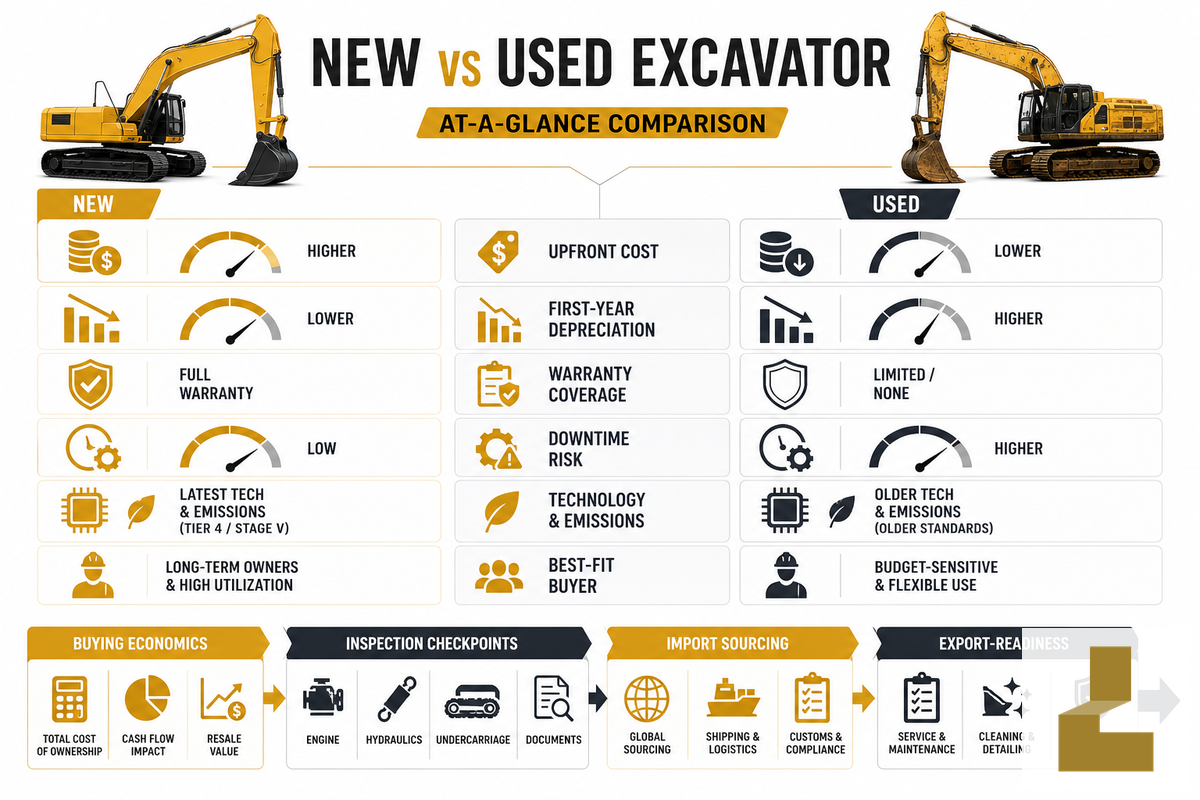
Below is a 30,000-foot view of the used versus new choice. New is a known quantity and comes with an OEM warranty, but used saves money on purchase and is immediately available, bypassing the steep depreciation climb. Which route is right for you hinges on how many hours you work per year, whether you have your own maintenance facility, and how much risk you can afford.
| Factor | New Excavator | Used Excavator |
|---|---|---|
| Upfront price | Full retail (highest) | ~30–60% less, by age and hours |
| Year-1 depreciation | Steepest drop (first owner absorbs it) | Already past the cliff |
| Warranty | Multi-year OEM factory warranty | Usually none, or short dealer/CPO cover |
| Downtime risk | Low and predictable | Higher; depends on maintenance history |
| Technology & emissions | Latest Tier 4 Final / Stage V, telematics, grade control | Older tier; simpler to service |
| Best-fit buyer | High-utilization fleets, tech-driven sites | Budget buyers, occasional use, self-maintainers |
Key Takeaway: New wins on certainty and technology, used wins on price and depreciation. Read on to see how to weigh the two sides of that trade-off for your specific operation.
Upfront Cost: How Big Is the Price Gap Really?
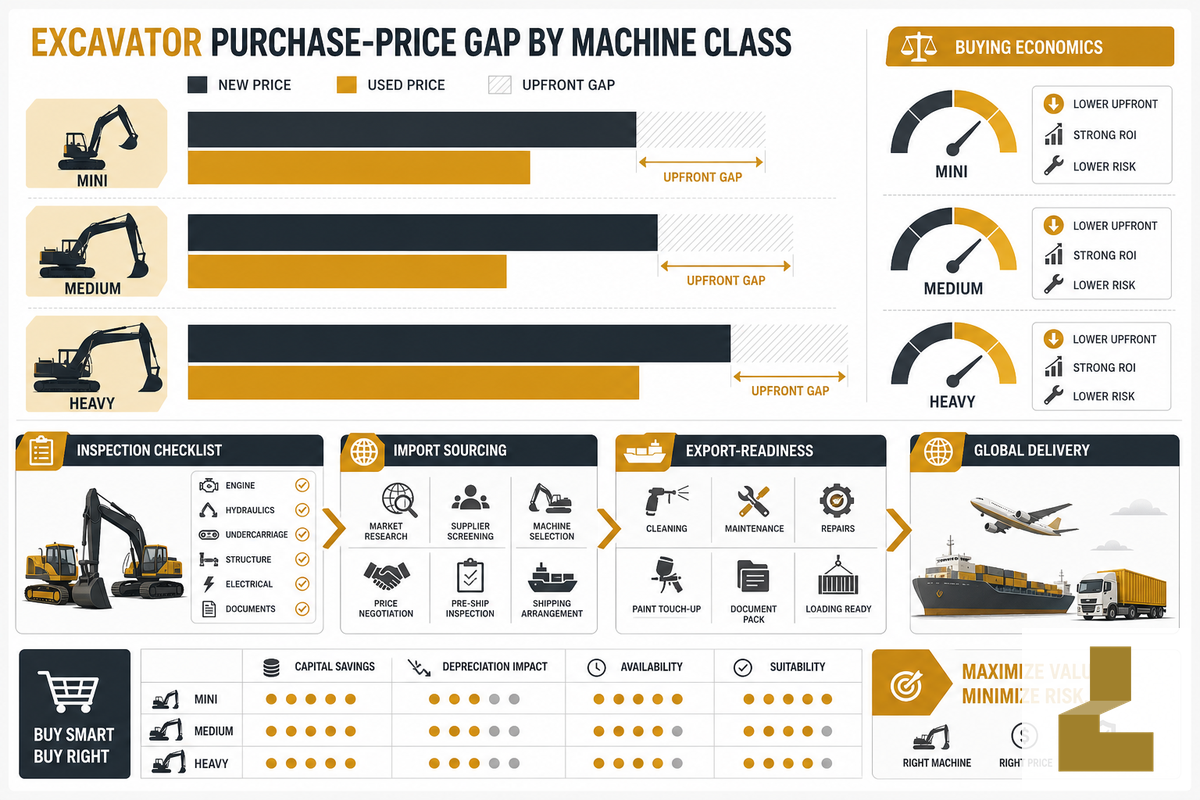
You wouldn’t be reading this article if the upfront price of a new used excavator wasn’t so eye-watering. To illustrate the magnitude of the price difference, compare a low-hour used mini used excavator, priced in the low tens of thousands, against a new, 25-tonne class mid-size unit that can run in the hundreds of thousands, or even into the low millions depending on spec and option packages. The percentage savings decrease sharply with age and hour meter readings, which is why relying solely on the price tag to choose your equipment is not the right approach.
It’s cheaper to own a used excavator, and it’s available now if you have an upcoming job. However, with used comes an unknown history. One major failure-of the final drive, hydraulic pump, slew ring, or engine-can eat up all the savings in the initial purchase price.
✔ Buying Used — Advantages
- Lower entry price frees working capital
- Immediate availability, no build lead time
- Lower insurance premiums on a lower-value asset
- Past the steepest depreciation
⚠ Buying Used — Limitations
- Unknown or incomplete maintenance history
- One major component failure can wipe out savings
- Little or no warranty backing
- Older emissions tier and no built-in telematics
Key Takeaway: Consider the purchase price a deposit on risk. Compare total cost of ownership to determine the true value.
Total Cost of Ownership: Where Used Actually Wins or Loses
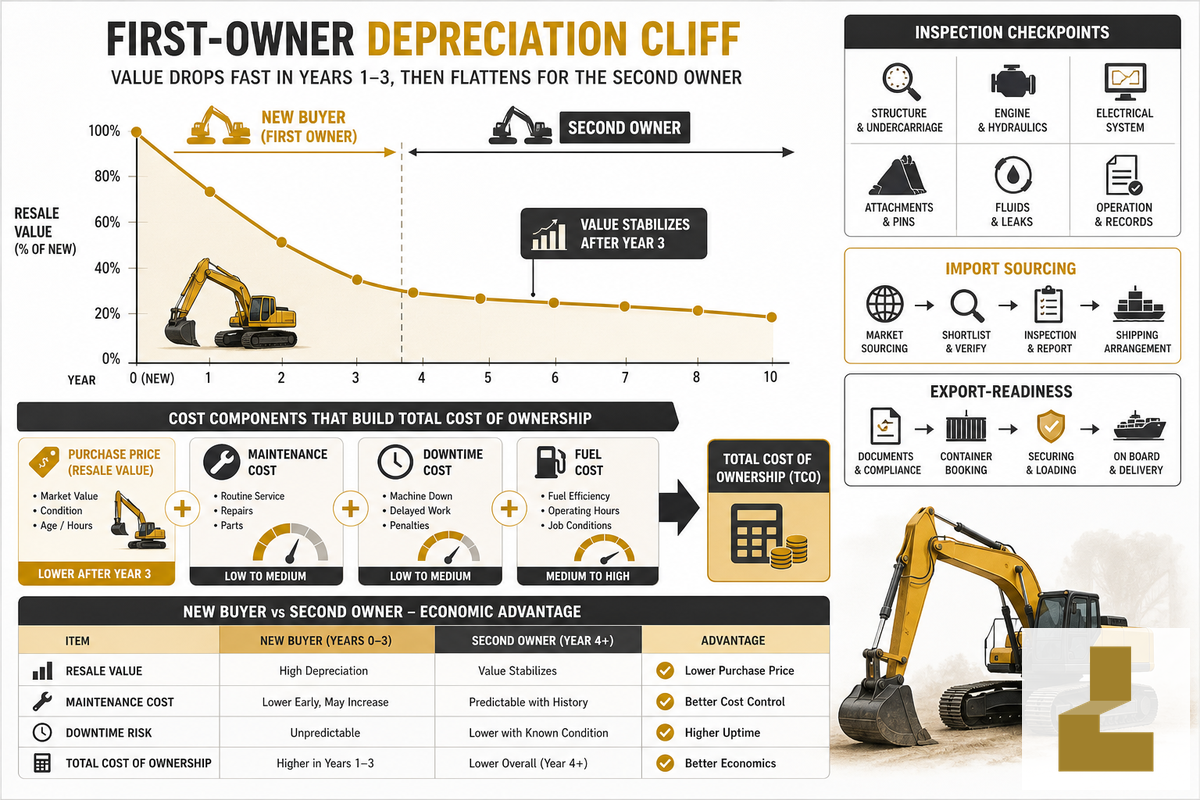
Purchase price is just the tip of the iceberg; Total Cost of Ownership (TCO) is the real metric to consider. TCO includes both ownership costs (depreciation, interest, insurance) and operating costs (fuel, repairs, wear items). Iowa State University’s machinery cost analysis clearly shows that TCO per hour goes down sharply as machine utilization increases, which explains why the low-annual-hour used machine owner and the high-utilization fleet operator may arrive at very different conclusions from the same machine price tag.
Depreciation is the largest line item in ownership cost, and the main benefit of buying used is that you can avoid the heaviest depreciation cliff. A new excavator falls steepest in the first two to three years. By the IRS’s MACRS rules, a five-year asset (what heavy equipment often is for tax purposes) writes off approximately 20% of basis in year one and 32% in year two, about half the initial depreciation in two years. (The IRS calculation isn’t the same as a market resale, but the direction is). The first owner pays that steep upfront depreciation; a second owner, two to four years down the road, largely avoids it, but gets a relatively low-hour unit.
📐 Engineering Note — the TCO formula
Compare total cost of ownership (TCO), or (purchase price minus expected resale value) + (lifetime maintenance cost) + (downtime cost) + (finance cost), and divide by expected working hours to find cost per hour. While a used machine may lead on the first factor by reducing depreciation, a new machine may ultimately win when maintenance and downtime costs are lower. However, run the TCO calculation using your estimated annual hours – not the seller’s estimate – and you might be surprised at how many machines tip over to the used camp between 400-600 hours of annual use.
The First-Owner Depreciation Cliff-the main selling point for used-is that someone else already paid for year one depreciation. Your task is to cash in on that discount without inheriting a junk heap.
Reliability & Hours: How Many Is Too Many?
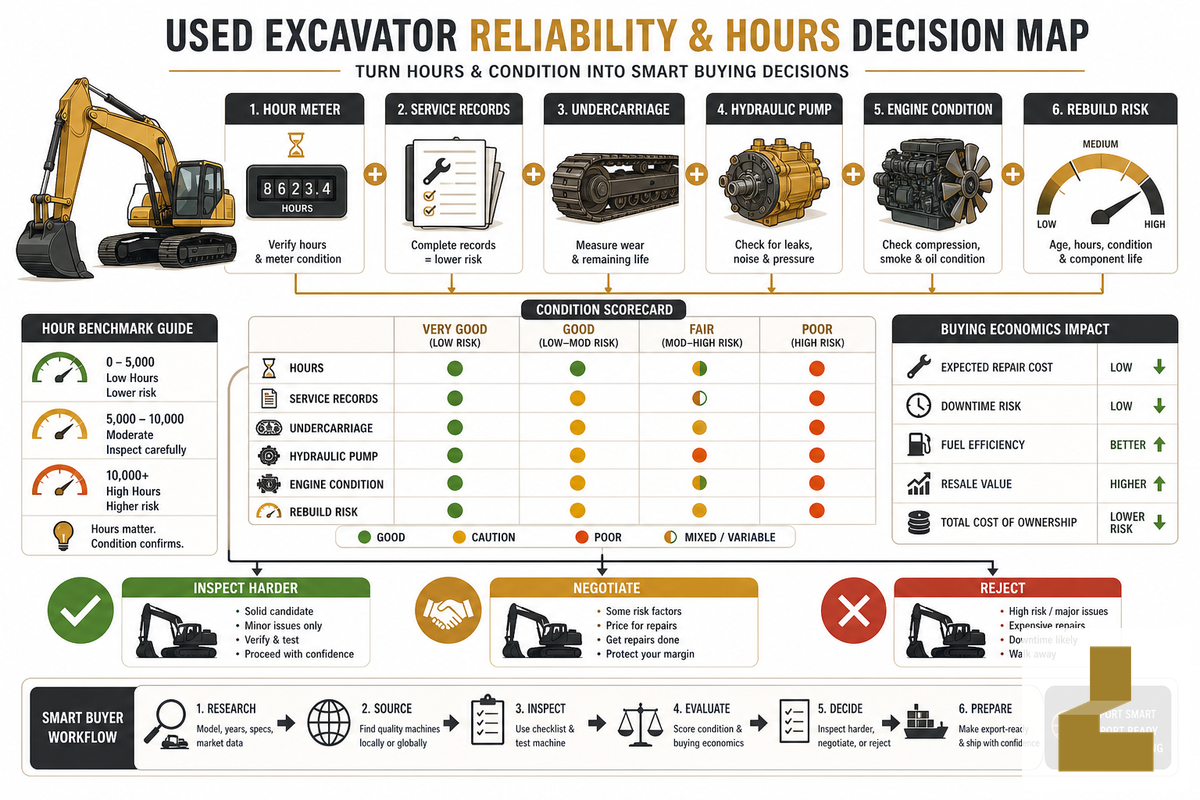
Hours function as the excavator odometer, but that’s only part of the story. What matters most is how those hours were used and if the relevant components have been properly maintained. Two machines with the same hour meter can differ significantly in actual condition.
How many hours is good for a used excavator?
One good rule of thumb: A compact excavator with under about 3,000-4,000 hours, and a larger machine with under about 6,000-8,000 hours, with the requisite maintenance records, is generally in the comfortable sweet spot. Many industry resources suggest the life of a compact excavator is in the ballpark of 10,000 hours, with a major hydraulic overhaul usually around the 10,000-12,000-hour mark, and a lot of equipment requiring some component overhaul in the 7,000-10,000-hour range. Higher hour ranges don’t automatically preclude a purchase; it’s a red flag that it may be time to inspect harder and account for the cost of a rebuild.
What is the lifespan of an excavator?
Properly maintained engines on excavator machinery will frequently top 10,000 hours, and a well-cared-for hydraulic pump should last the life of the engine. Conversely, poor-quality hydraulic fluid will decimate that same pump in short order. Therefore, life span isn’t an immutable factor; it is the product of maintenance. Buyers who have bought a used machine on hour-meter readings alone find out the hard way that low hours can be a trap. The general wisdom among practitioners is that a poorly maintained 1,500-hour mini may already require an undercarriage, whereas a well-maintained 6,000-hour machine can have years of productive service life remaining.
💡 Pro Tip
Demand to see the service history tied to hour usage, not just the hours listed on the meter. A machine with service records showing regularly scheduled oil changes and hydraulic-fluid replacements will command a higher price than a lower-hour machine with no records.
Bottom line: Buy the service history, not the hour reading. Hours determine how intensively you’ll need to inspect, but maintenance records tell you the value of the machine.
Technology, Emissions & Fuel: What You Give Up With Used
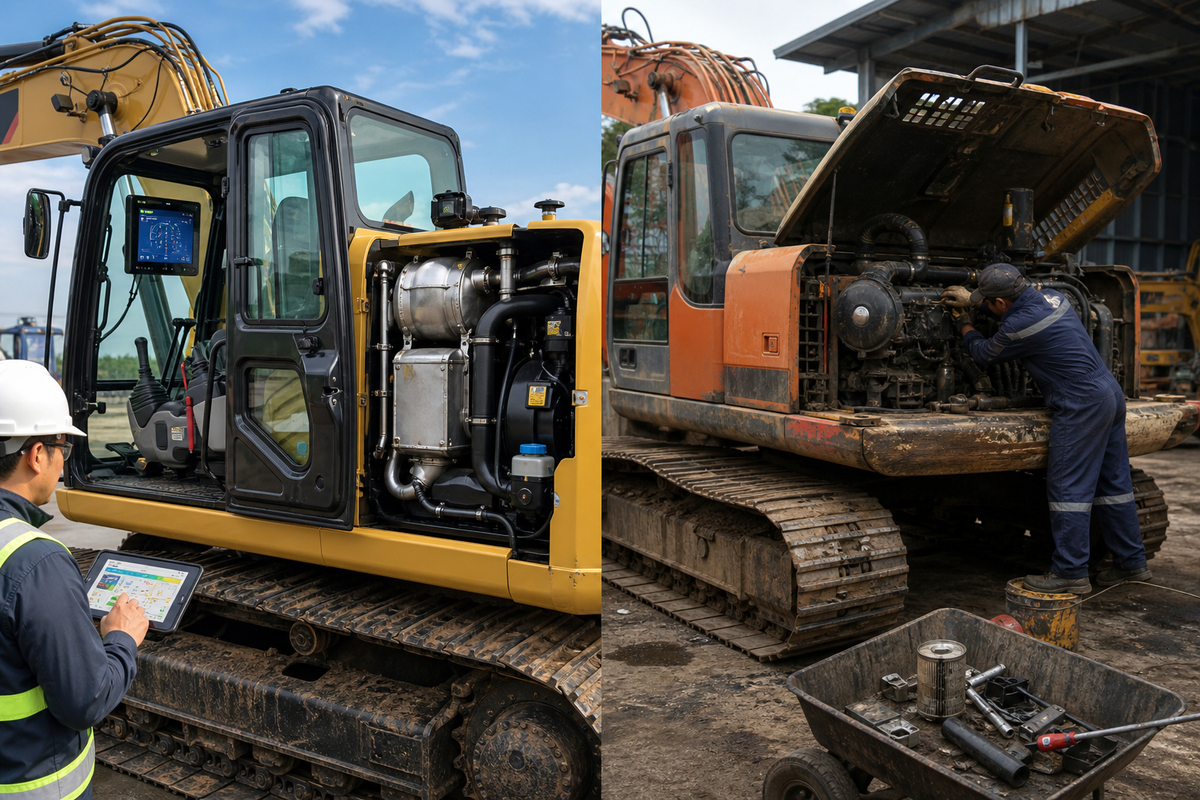
It’s the single greatest argument for new, with one big caveat: the export market. Today’s excavators are loaded with state-of-the-art emission technology and productivity-enhancing tech that the older generation used machines could only dream of. The U.S. EPA nonroad diesel program combines Tier 4 engine standards with ultra-low-sulfur diesel, capped at 15 ppm, or about a 99-plus% reduction in sulfur compared with older diesel fuel. These Tier 4 Final engines and their European equivalent, the Stage V engine, are able to cut particulate matter and NOx emissions by around 90% compared with prior tier standards, DieselNet data indicates.
Newer machines burn less fuel – figures show the latest machines, a Stage V, can achieve fuel savings of around 10% against a Stage IV engine – and the latest have features like grade control, telematics and operator assistance, which can improve the quality of the work to avoid costly reworks, and can assist less-experienced operators to carry out jobs that would otherwise be impossible.
The flip side is that the Tier 4 aftertreatment, including SCR, diesel exhaust fluid and diesel particulate filters, is something of an Achilles’ heel in regions where DEF and/or dependable ultra-low-sulfur diesel fuel aren’t readily available. Those exporting to parts of the world where high-sulfur diesel reigns or service is hard to come by often find that the old tier unit isn’t necessarily the compromised option, but rather the practical one.
Headline: fresh efficiency wins and a good outcome on compliance for domestic high-tech sites; the older simpler machinery still wins when the fuel is iffy or DEF is hard to get.
Warranty, Financing & Parts Support
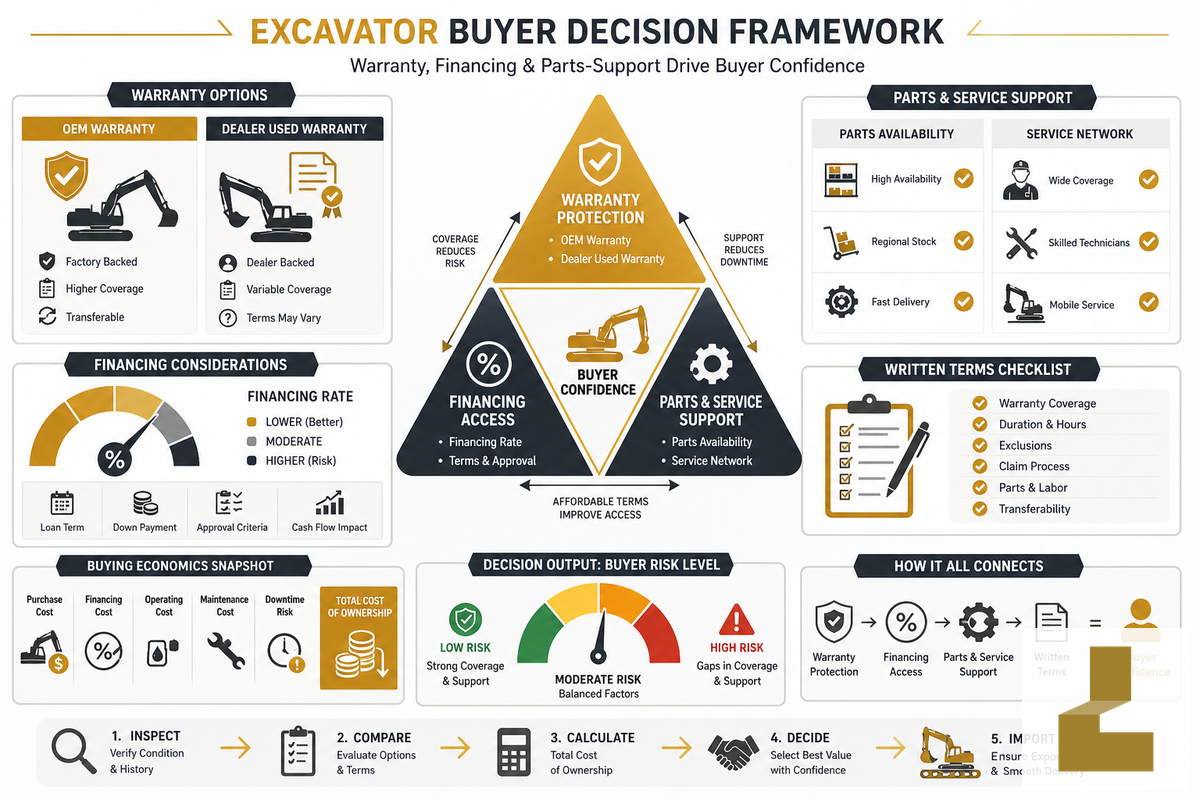
Each machine’s warranty package post-sale often tip the balance for the more risk-averse. A brand new excavator comes with a several-year manufacturer’s warranty and, quite commonly, a scheduled, fixed-cost servicing scheme that includes routine maintenance within a single fixed monthly payment. While the used machine comes with no warranty – save for certain inspected dealer-prepared or certified used machines, always verify exactly what coverage you get and the extent of that coverage.
What financing options are available for both new and used excavators?
Equipment loans, leases and dealer finance plans are available to buy new and Used-machine used excavators. Because the rate of interest for new equipment loans is typically lower than it is for loans on used equipment, and there are more favourable manufacturer-funded programmes and depreciation incentives available in many countries on the newer models, it may still be worth taking the cost-benefit of the financing rates into account when calculating TCO and looking at new machine.
Parts availability and access to attachment is the darkhorse decider. Big players like CAT, Komatsu, Hitachi and Kubota have a long and far reaching global parts supply chain which makes old machines still serviceable for a while after purchase. However, a discontinued, obsolete, rare or specialized machine could leave you high and dry waiting for parts to turn up regardless of cost.
The deal: a new buyer can buy with factory-warranty peace of mind; a used buyer should confirm warranty terms on paper and parts support for the exact model.
How to De-Risk a Used Excavator Purchase
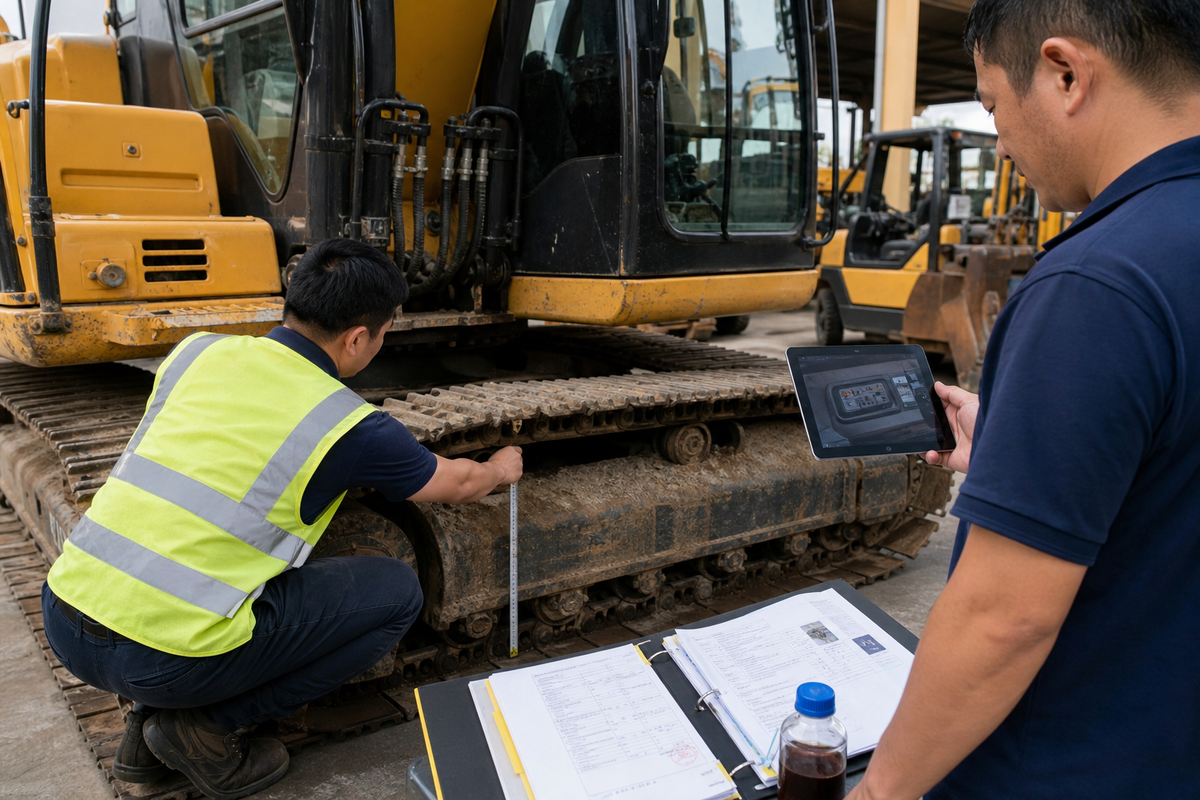
Everything good about buying used is based on a single principle: test it before you buy it. It goes without saying that a pre-purchase inspection on any used equipment is non-negotiable. This test must, above all else, focus on the components that are the most expensive to repair. For instance, the undercarriage of an excavator accounts for a disproportionate share of its total lifespan repair costs, which is why serious inspectors don’t even bother looking at the hour meter until after they’ve checked it over.
- Undercarriage – measure track, roller, idler, and sprocket wear; this is the highest-cost wear item
- Hydraulics – check for cylinder drift, leaks at hoses and fittings, and pump noise under load
- Pins and bushings – excessive slop signals hard use and coming repair
- Service records – dated proof of oil, filter, and hydraulic-fluid changes
- Oil analysis – a lab sample flags internal engine or hydraulic wear the eye cannot see
📐 Engineering Note — undercarriage acceptance
Treat wear to the undercarriage in percentage, not just a quick look/pass fail. Any component worn more than about 80% into its service limit must be priced into a replacement. Don’t expect a machine with worn beyond this range to survive the next big job. You’ll always want to match the hour meter readings to visible wear, service records, and parts replaced – inconsistencies suggest a manipulated hour meter.
Common mistake: trusting a low hour meter. Low hours with no records and heavy undercarriage wear is worse than higher hours with a clean service book.
Brand, Origin & the Grey-Market Question
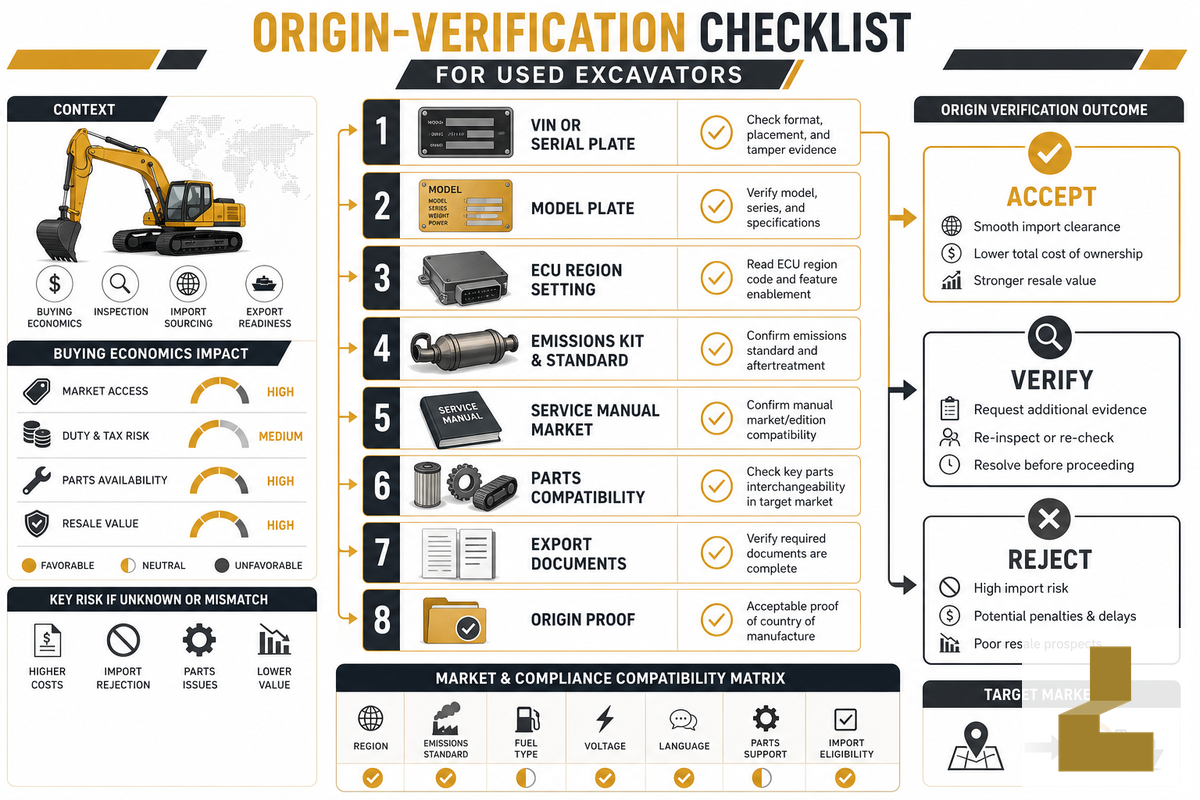
What many buyers’ guides won’t tell you, and where a used machine can catch even experienced operators out, is the machine’s original market specification. Two otherwise identical machines, built by the same maker for the same model, may differ significantly in terms of electronics, emissions components, documentation and available parts.
“The most common surprise for first-time importers is that a machine’s model number does not guarantee its spec market. A domestic-spec unit and a grey-market unit can share a model plate but differ in ECU region settings, emissions hardware, and the service manual they were built to. Verifying origin before purchase is what separates a good deal from an expensive parts hunt.”
Our experience shipping overseas shows this is most relevant for equipment with a high degree of electronics and emission hardware. A machine built for one region (a grey market machine) that’s re-exported into another could have control software specific to that original region, a non-matching emissions kit, or documents formatted for the original market. This isn’t necessarily bad, but you’ll want to verify it and price it accordingly. Here is our checklist to determine origin before making your purchase:
Origin-Verification Checklist
- Match the VIN/model plate against the ECU’s declared region setting
- Confirm the emissions tier of the engine matches your local fuel quality
- Ask which market’s service manual and parts catalogue the machine follows
- Check that documentation and hour-meter history are consistent and complete
- Confirm parts for that spec are available through your regional dealer network
Bottom Line: Reliability earns a place on your shortlist, but origin verification and a proper specification check gets you a machine you can actually run. You can shop inspected used excavators for sale that include provenance reports, instead of taking your chances on an unknown.
Which Should You Buy? A Decision Framework
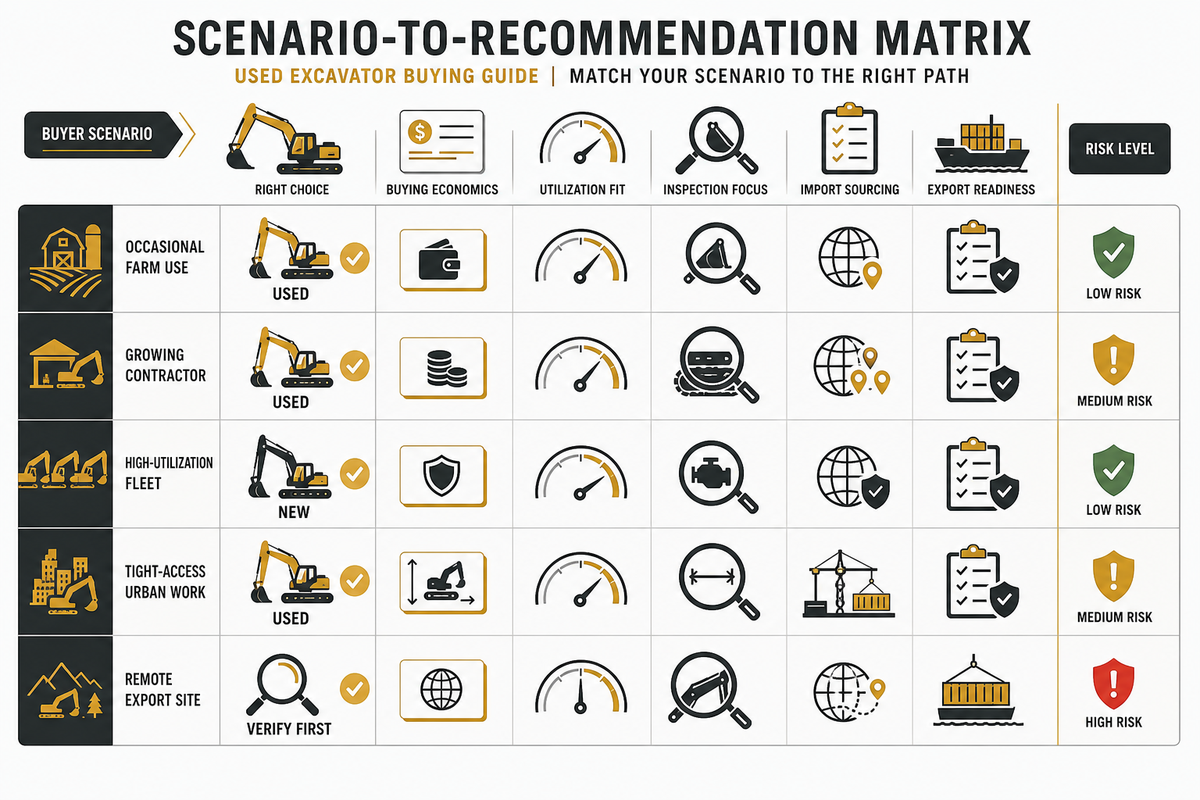
If you asked us if buying used is right, the answer was “it depends.” Here’s an empirical rule that accounts for the realities of how the machines actually are used: Find your annual usage and site condition and read across. The logic also works for any used skid steer or wheel loader purchase.
| Your situation | Recommendation | Why |
|---|---|---|
| Occasional / farm use, under ~400 hrs/year | Used | Low annual hours never justify new-machine depreciation |
| Growing contractor, tight budget | Used (2–4 yr, inspected) | Captures the depreciation discount with life left |
| High-utilization fleet, 1,500+ hrs/year | New | Warranty, uptime, and fuel savings dominate at scale |
| Tender work needing latest emissions/tech | New | Stage V / Tier 4 Final and grade control are contract requirements |
| Export / remote site, limited DEF & service | Used (simpler tier) | Older aftertreatment-free machines are easier to fuel and fix |
Is buying a used mini excavator worth it?
For most small contractors, landscapers, and property owners: Yes. Mini excavators tend to hold up well, mainstream parts availability is high, and the depreciation savings on a 2-to-4-year-old model are still substantial. A properly vetted used mini that has been well maintained and has a verifiable inspection and clean undercarriage represents an excellent value buy.
Bottom Line: Use hours and site conditions to match machines to your needs first; then you can determine whether buying new or used is best.
Industry Outlook: Used Excavator Values in 2026
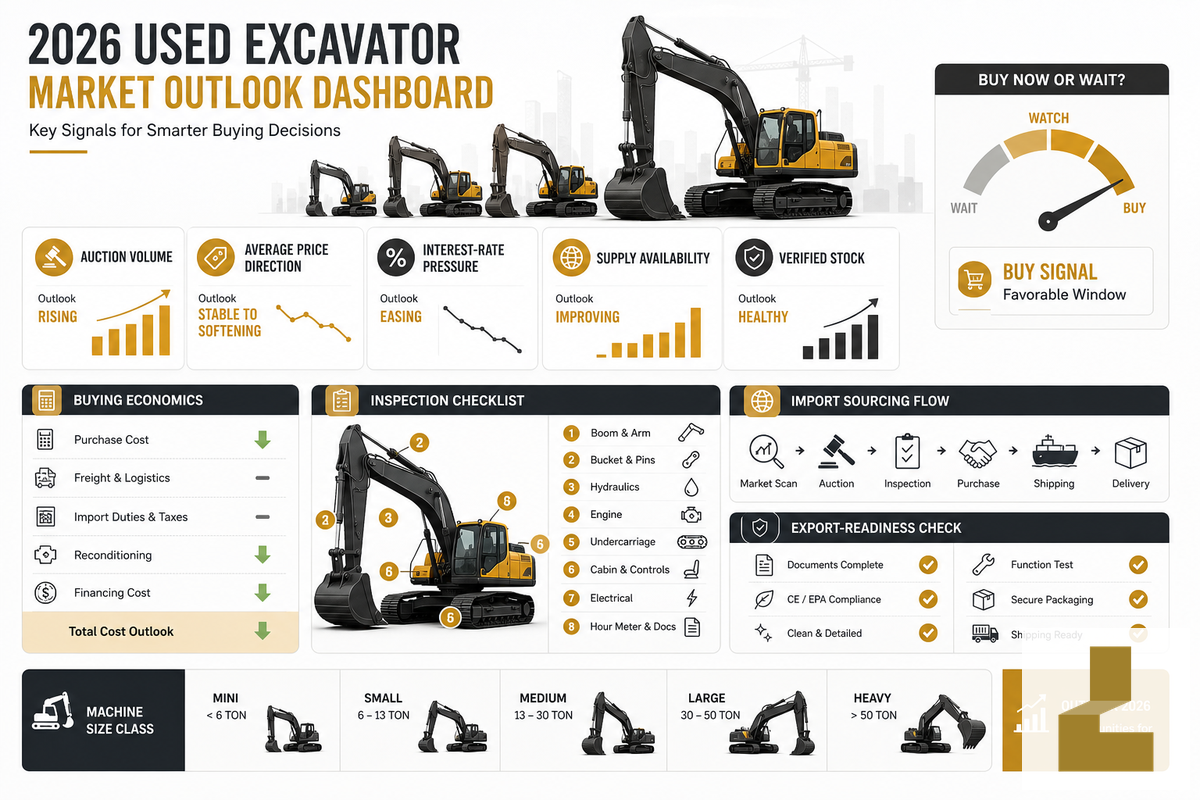
It matters what month of what year you buy. In recent years, the used equipment market has softened with excavators and wheel loaders declining in price, based on auction records such as Ritchie Bros. Through 2025, most of the value erosion has eased with the market levelling off into 2026. Excavators saw increased volumes at auctions in Q1 2026, and their average sales prices held or improved in the U.S. and Canada. This means that much of the expected further downward price movement has not yet materialized in early 2026, and the value has stabilised, even with more transactions occurring.
This data has real-world implications for any potential buyer. As supply begins to align with demand, many of the bargains of the 2025 dips are now off the table. If you were hoping for lower used excavator prices this year, the numbers suggest that expectation may no longer be valid. If you are planning to begin work in 2026, you will likely be better off purchasing the correct, verified machine at today’s market rate than betting on a future drop that isn’t reflected in current sales data.
Bottom Line: 2026 has brought an end to the deep buyer’s market that existed in 2025. Be pragmatic and purchase the machine you need from a reputable source now, rather than waiting for prices to fall.
Frequently Asked Questions
What brand of excavator is most reliable?
View Answer
CAT, Komatsu, Hitachi, Kubota, John Deere, and Volvo: these manufacturers consistently rate highly in terms of equipment reliability, but it is just as important to remember their global reach in terms of parts and service networks. This global network provides value for the used buyer by making a wider range of parts available and helping to extend the service life of an older machine. For imported equipment, parts access, model-region compatibility, ECU support, and local mechanic familiarity often matter more than the badge alone.
How does depreciation affect the choice between new and used?
View Answer
For any owner of a new machine, the depreciation is likely to be your largest ongoing expense. New machines lose the biggest chunk of their value within the first two to three years of operation. Buying a used two-to-four-year-old unit allows you to avoid that steepest depreciation, while still typically finding the low hour count that forms the fundamental rationale behind buying used equipment.
Is it better to buy a used excavator from a dealer or an auction?
View Answer
Generally, a reputable dealer inspects and reconditions machines, providing a condition report that helps protect you from risk, but it often costs more. Auctions are cheaper but transfer all the inspection risk to you. If you can’t inspect a machine yourself, or have it inspected, buying from a dealer is safer for most.
Can a used excavator still be under warranty?
View Answer
Sometimes. A lightly used machine can still have some factory warranty time, and many certified pre-owned and dealer-inspected machines come with a limited warranty. Ensure you understand the exact terms and duration before you make a purchase decision.
What are the pros and cons of a used name-brand versus a new budget machine?
View Answer
A used name-brand machine will give you established engineering and excellent parts availability but comes with wear, and you may need to confirm specifications if it is a grey-market model. New budget machines offer a warranty and no wear, but their resale and parts networks can be less extensive. For buyers who can inspect correctly, used mainstream brands often prove more reliable in the long run.
When is it time to replace rather than repair heavy equipment?
View Answer
Generally speaking, when the cost of a major overhaul (such as engine, hydraulics, or undercarriage) becomes a significant percentage of the machine’s residual value, or when cumulative downtime costs you jobs, replacement is the more economical choice. An increase in repair frequency, not a single catastrophic repair bill, is the most definitive indicator.
Comparing specific used excavators?
Obtain a certified inspection report and verified origin details before deciding to ensure you are purchasing a reliable machine rather than a potential risk.
Request a Machine Inspection Report →Why We Wrote This Comparison
As we export inspected used excavators to importers and distributors globally, our daily work involves assessing the critical new-vs-used trade-offs outlined in this guide, such as hours, undercarriage wear, emissions tiers, and machine origins. Our figures are based on public standards and market data, and our guidance on origin and inspection is derived from the checks we perform on machines before shipping them out.
References & Sources
- Regulations for Emissions from Heavy Equipment (Compression-Ignition) — U.S. Environmental Protection Agency
- U.S. Internal Revenue Service – Publication 946: How to Depreciate Property (2025)
- Estimating Farm Machinery Costs — Iowa State University Extension
- DieselNet – USA: Nonroad Diesel Engine Emission Standards
- Q1 2026 Construction & Transportation Market Trends Report — Ritchie Bros.
![Excavator Bucket Manufacturers: Buyer Evidence [Guide]](https://lhusedexcavator.com/wp-content/uploads/2026/08/excavator-bucket-manufacturers-r2-featured-768x512.png)