Get in Touch with Liehuang Company
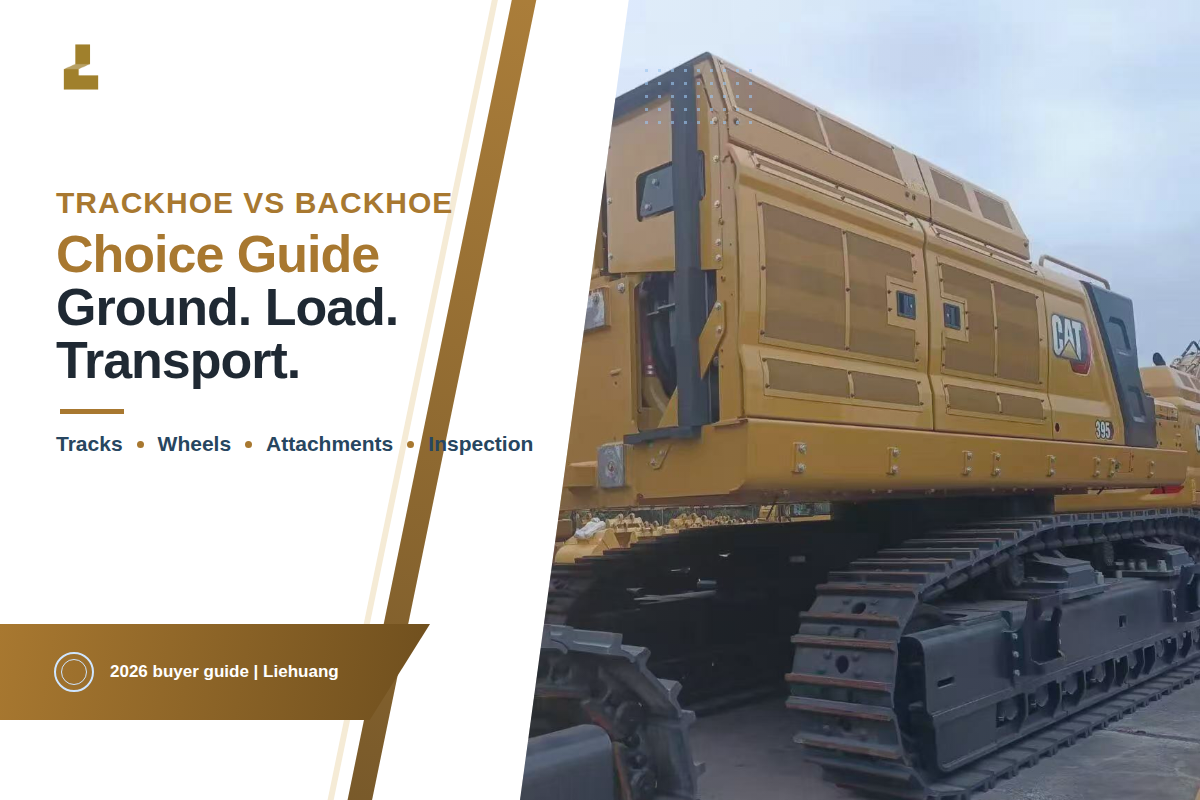

Equipment comparison guide
This is more than a semantics debate. If someone says they want to buy a trackhoe, they usually mean an excavator (tracked), which is good at excavating, lifting, grading, demolition, and various attachment-based work. When they talk about a backhoe, they often mean a backhoe loader – a front loader and backhoe arm on wheels.
Quick Answer
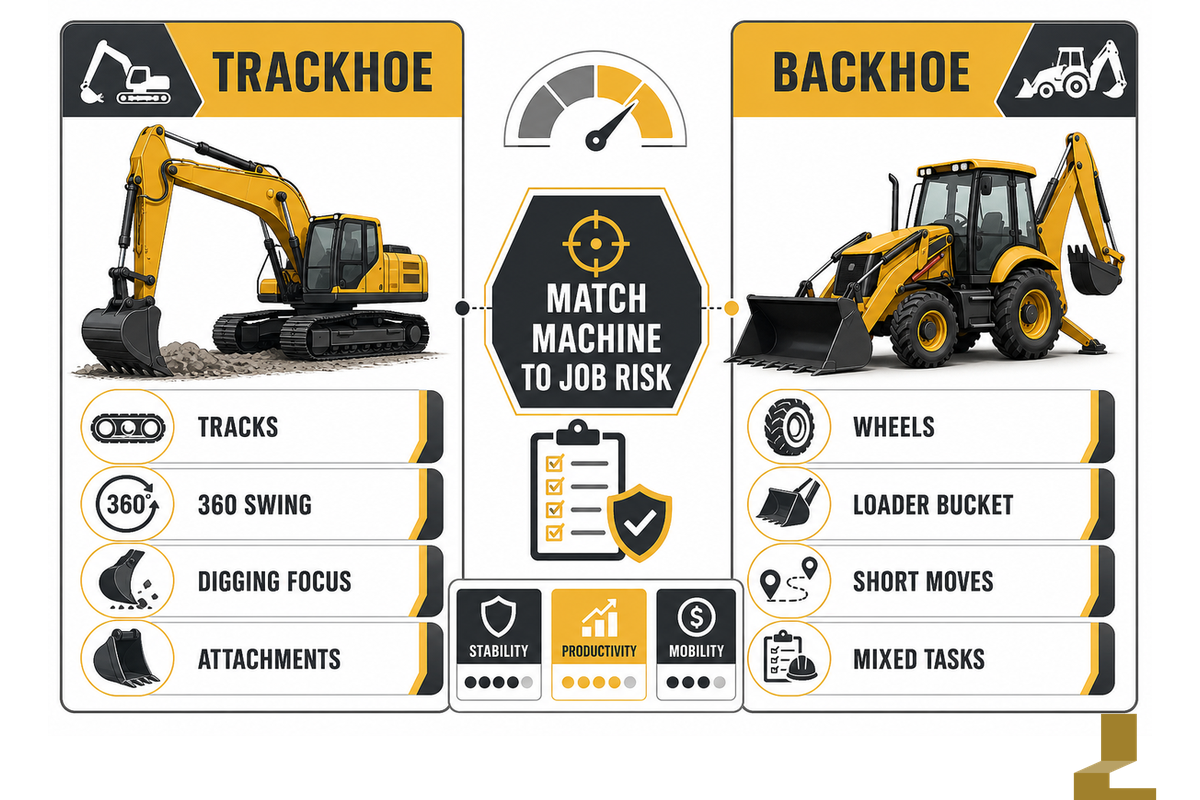
Select a track hoe when the job involves a majority of excavation, the site has a soft or uneven surface, the equipment requires a 360-degree swing capability or the buyer desires a used excavator already equipped with a bucket, breaker, thumb or quick coupler. Go with a back hoe when a single operator must dig, load, backfill and traverse relatively short distances on solid terrain.
Used-equipment buyers should move past “which name is correct?” The better question is: which machine keeps your ground, load, transport, and inspection risk under control?
Trackhoe vs Backhoe at a Glance
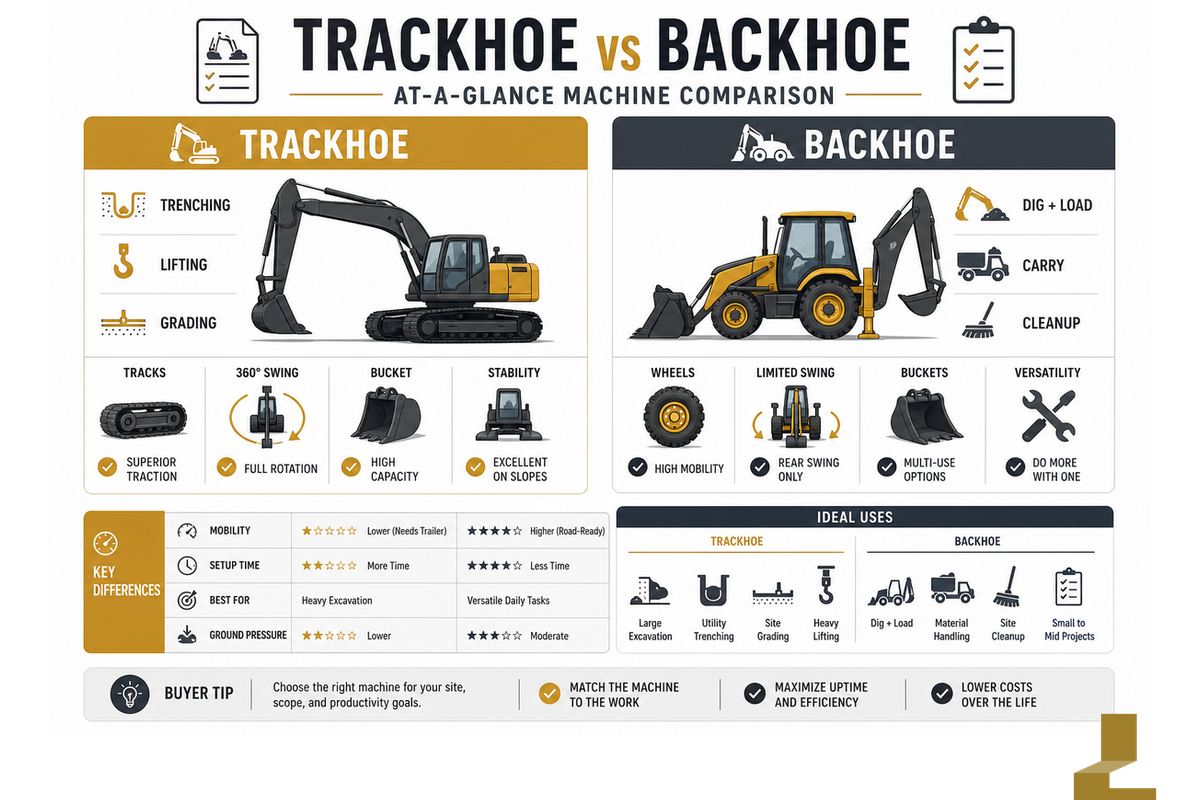
Backhoes can dig. So can trackhoes. That’s where the confusion lies. In a work environment though, they have different functions and responsibilities on the site.
A trackhoe is a digging-focused machine; it has tracks, rotates 360 degrees on its base, and spends most of the day excavating holes and trenches with the boom, stick, and bucket assembly. A backhoe loader, however, is a multi-work machine, capable of excavating at the back end, and carrying/loading material at the front.
| Decision point | Trackhoe | Backhoe |
|---|---|---|
| Common machine type | Tracked excavator | Backhoe loader |
| Main job | Digging, trenching, lifting, demolition, grading | Digging plus loading, carrying, backfill, cleanup |
| Movement | Tracks for traction and ground contact | Wheels for short travel on firm surfaces |
| Upper-body swing | Full 360-degree swing on most excavators | Rear boom swing is limited by machine design |
| Used buyer fit | Best when excavation is the revenue task | Best when one unit must cover many small tasks |
Quick Specs Card: Sample Excavator
A Volvo CE 20-ton crawler excavator brochure lists sample maximum digging depths from 6,680 mm to 6,760 mm. Treat this as one model-family example, not a promise for every used trackhoe.
Quick Specs Card: Sample Backhoe
A John Deere 310 G-Tier brochure lists SAE maximum digging depth from 4.16 m to 5.29 m based on dipperstick setup. That smaller dig number is only one part of the story; the front loader bucket changes the workflow.
What Is a Trackhoe, and Is It Just an Excavator?
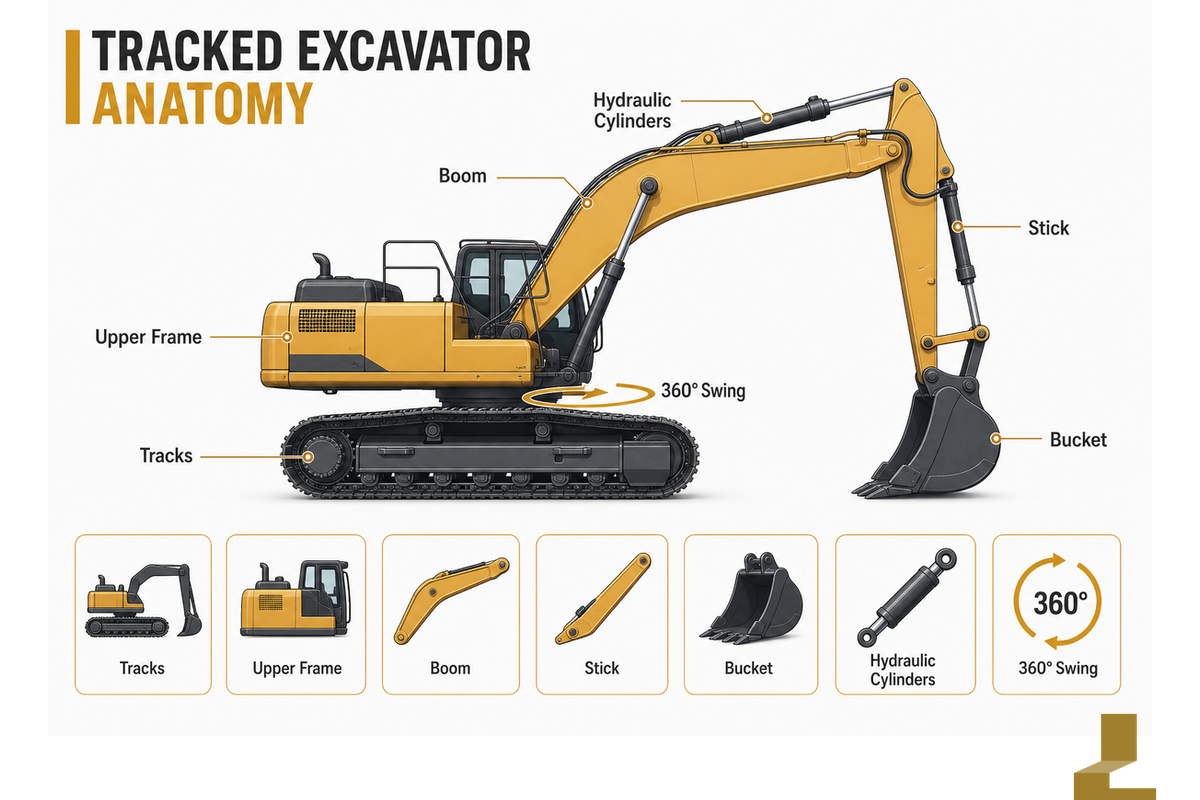
In everyday U.S. equipment talk, “trackhoe” usually means a tracked hydraulic excavator. It isn’t a separate official class in the way that “mini excavator” or “crawler excavator” appears in many product catalogs. Here, the word is buyer language. Sellers may write trackhoe, track hoe, crawler excavator, or excavator in a used listing for the same basic machine family.
Focus on working parts more than the nickname: an undercarriage with tracks, a rotating upper frame, a boom, a stick, hydraulic cylinders, and a bucket or work tool at the end. That layout gives the operator a digging cycle that doesn’t depend on driving the whole machine forward and backward after every scoop.
LH Used Excavator buyers need the naming issue cleared up because search and sourcing catalogs can split the same inventory under different terms. Buyers looking for a 20-ton used trackhoe should also check medium crawler excavator listings, the used trackhoe options, and matching size-class pages.
What is another name for a trackhoe?
Another name for a trackhoe is tracked excavator or crawler excavator. Some crews shorten it to excavator. Wheeled excavators are still excavators, but most buyers using “trackhoe” are asking for the tracked version.
Digging Depth, Reach, and Stability
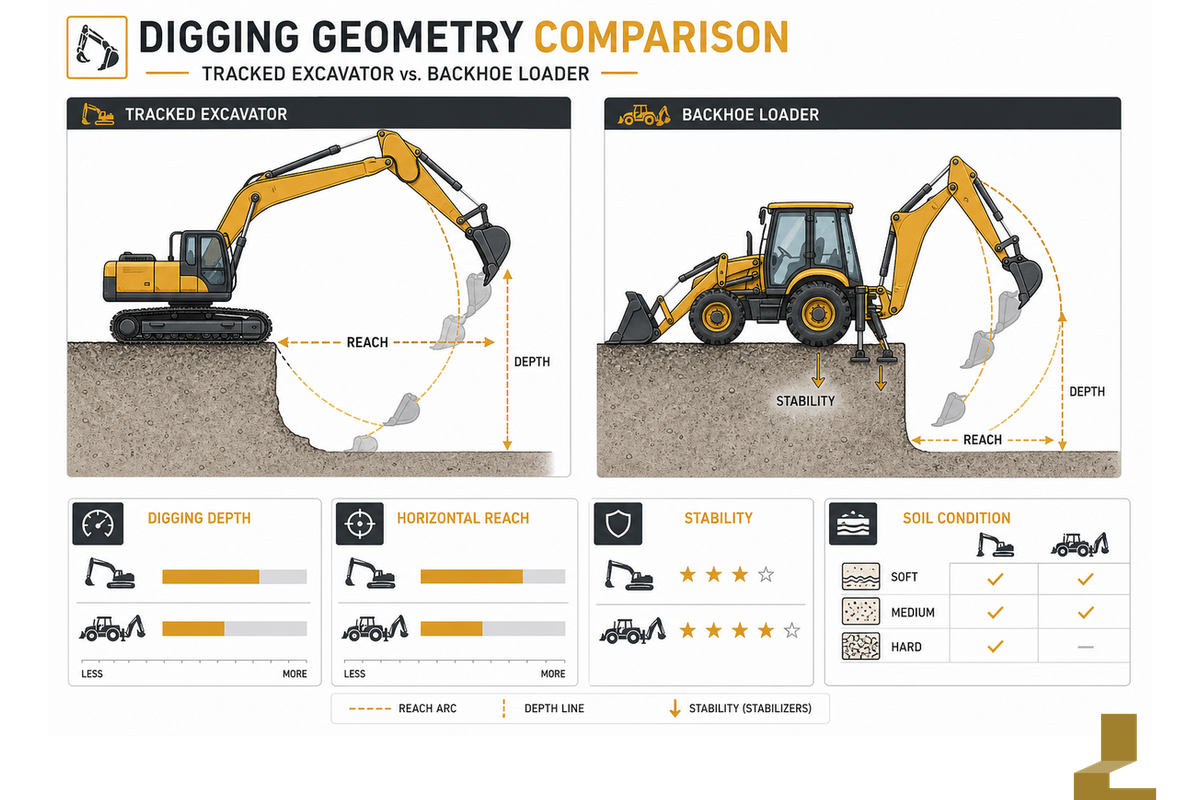
If the job is mostly digging, a trackhoe usually earns its keep faster. Tracks spread machine weight across more ground contact than tires. Its upper body can swing around the undercarriage. Boom and stick design supports repeated trench, foundation, ditch, and loading-to-truck cycles.
That doesn’t mean every trackhoe beats every backhoe on paper. Large backhoes with extendable dippers can reach deeper than compact mini excavators. Poorly kept 20-ton excavators with weak hydraulics may perform worse than well-kept backhoe loaders. Use model, hours, hydraulic condition, undercarriage condition, bucket size, and soil type for the real comparison.
Engineering Note: Do Not Compare Names. Compare Working Geometry.
In one 20-ton crawler excavator brochure, Volvo CE lists sample maximum digging depths from 6,680 mm to 6,760 mm. By comparison, a John Deere 310 G-Tier backhoe loader brochure lists SAE maximum digging depth from 4.16 m to 5.29 m based on dipperstick setup.
Always ask for the original spec sheet and get photos of the boom, stick, bucket linkage, pins, bushings, cylinders and undercarriage prior to looking at a used machine to make your comparison on depth.
Stability also changes the decision. Tracks help on soft, muddy, sloped, or uneven ground. Stabilizers help a backhoe dig, but the machine still has a loader chassis and tires. If the operator must trench on rough ground all day, the tracked excavator has the cleaner work pattern.
7-Line Spec Evidence Table for Used Machine Quotes
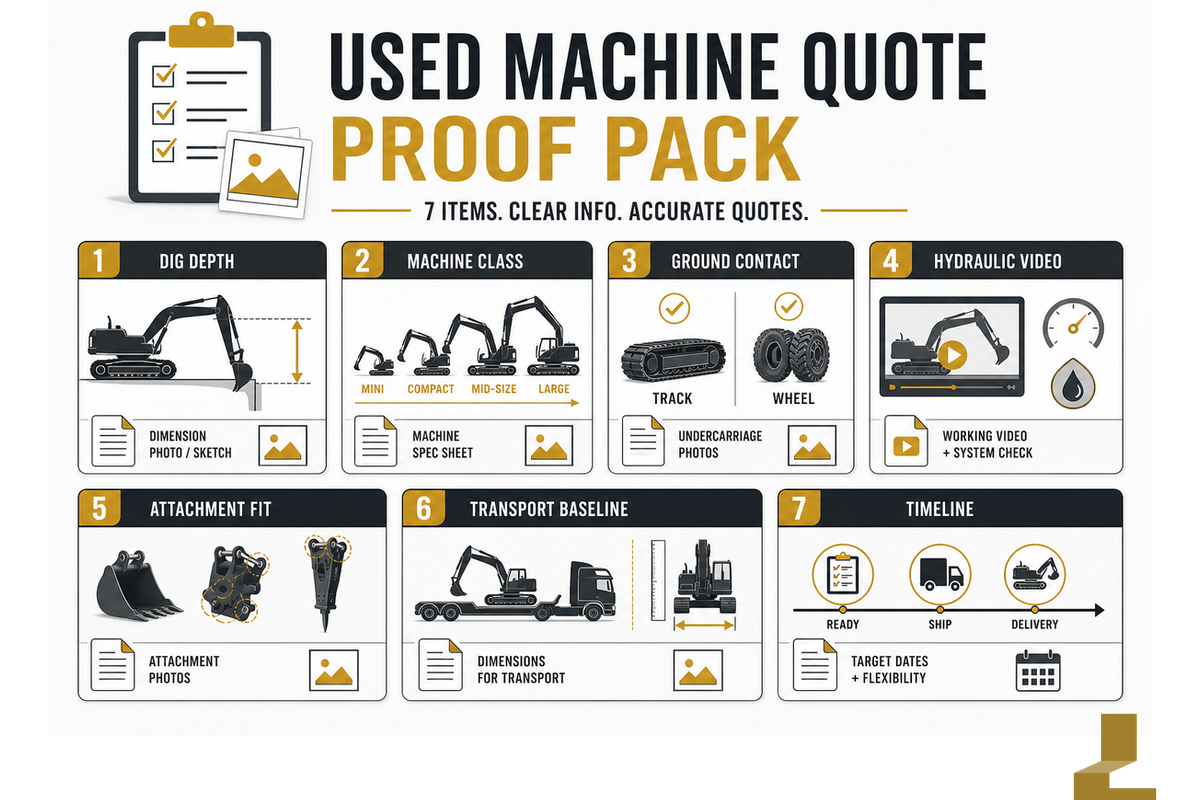
Used listings often start with a model name and a photo set. That isn’t enough. Before a buyer compares trackhoe vs backhoe pricing, the quote should carry a baseline set of model evidence that ties the machine to the project, the customer timeline, and the installation site. This is where many weak purchases start: the buyer compares a 20-ton excavator with a backhoe loader as if the names alone define the outcome.
The table below gives the quote team a practical evidence baseline. It isn’t a price sheet. It’s a way to ask for the same proof across different suppliers, so a 0-10 ton mini excavator, a 10-30 ton medium excavator, a 30+ ton heavy excavator, and a backhoe loader are judged on visible machine facts rather than sales copy.
| Model evidence | Trackhoe quote proof | Backhoe quote proof | Buyer action |
|---|---|---|---|
| Dig depth | Ask for the model chart; one 20-ton Volvo CE brochure shows 6,680-6,760 mm examples. | Ask for the dipperstick option; the John Deere 310 G-Tier shows 4.16-5.29 m examples. | Match depth to trench, ditch, or foundation design before comparing price. |
| Machine class | Confirm 0-10 tons, 10-30 tons, or 30+ tons in the supplier quote. | Confirm backhoe loader weight, rear boom type, loader bucket, and tire size. | Reject vague “medium size” descriptions without a model sheet. |
| Ground pressure proxy | Request track shoe width in mm and undercarriage photos from both sides. | Request tire size, tire condition, stabilizer photos, and axle condition notes. | Choose tracks for weak ground; choose wheels when short hard-surface travel matters. |
| Hydraulic proof | Ask for boom, stick, bucket curl, swing, and travel videos of at least 30 seconds each. | Ask for both loader-end and rear-hoe-end hydraulic videos. | Do not price attachments until hydraulic lines and pin dimensions are shown. |
| Attachment fit | Confirm bucket pin size in mm, coupler type, breaker flow, and thumb mounting. | Confirm front bucket cutting edge, rear bucket width, and stabilizer pad condition. | Build the quote around the work tool, not only the machine name. |
| Transport baseline | Confirm loading width in mm, machine height in m, and local haul plan. | Confirm road travel need, tire condition, and trailer loading clearance. | Ask for loading photos before final payment. |
| Customer timeline | Use the excavator when one digging zone drives the project schedule. | Use the backhoe when 3-5 small work zones share one operator. | Write the deployment plan before signing the order. |
Manufacturer spec snapshot to keep with the quote
One Volvo CE 20-ton crawler excavator brochure gives a useful example of the detail level buyers should expect: 19,800 kg to 20,300 kg operating weight, 123 kW gross power, 9,840 mm to 9,970 mm maximum digging reach, and 6,680 mm to 6,760 mm maximum digging depth. A backhoe quote should carry the same style of proof, including the exact dipperstick option and the 4.16 m to 5.29 m digging-depth range shown in the John Deere 310 G-Tier brochure.
For a remote inspection packet, ask for at least 1 minute of cold start, 1 minute of idle, 1 minute of travel, 1 minute of swing, 1 minute of boom-and-stick movement, and 1 minute of hydraulic hold. That 6 minute video baseline gives the customer, project manager, and mechanic the same evidence before shipment.
Scenario: one quote, two very different machines
Picture a rural drainage project with a 300 m ditch, two culvert repairs, and one customer who wants the installation finished in 2 working days. If the baseline job is one long trench beside weak soil, the trackhoe quote should move first. If the same customer also needs gravel moved, spoil pushed back, and 3 short moves between gates each day, the backhoe quote may be the more honest first comparison. That scenario is why the machine class, attachment fit, and transport plan need to sit in the same table.
Mobility: Tracks vs Wheels on Real Jobsites
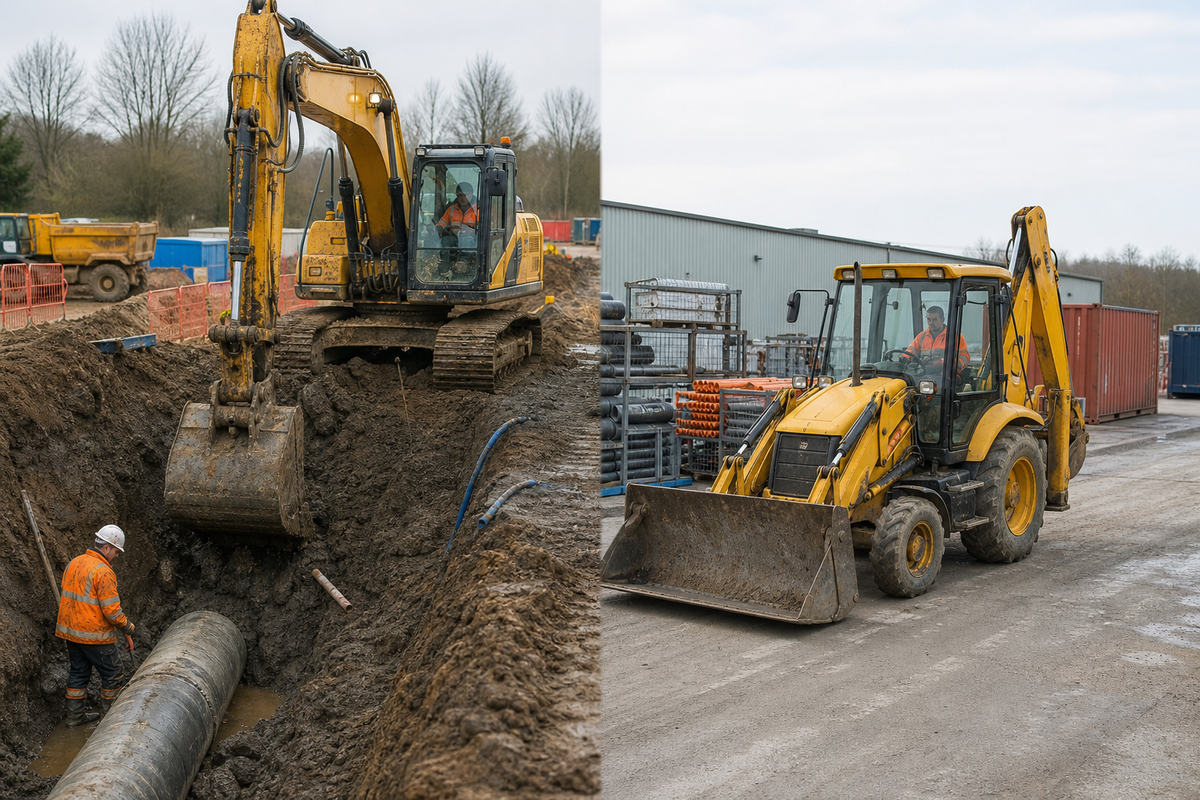
Mobility is where backhoe loaders will remain king. A backhoe loader is likely to work a whole shift without loading onto a trailer every time it makes a short move around the yard, farm, road project, campus, or town. That’s a big deal when the workday includes many small digs, hauls, backfill passes, and grading tasks.
Trackhoes move slowly on their tracks and are usually hauled between distant work areas. That extra transport step is worth it when the machine will spend hours digging in one area. It becomes a burden when the operator has five small tasks spread across hard surfaces.
Trackhoe Advantages
- More confident digging on weak or uneven ground.
- Cleaner trenching cycle with full upper-body swing.
- Better fit for breaker, thumb, grapple, and grading tasks.
- Less need to reposition during repeated excavation cycles.
Backhoe Advantages
- Front loader bucket handles spoil, gravel, pallets, and cleanup.
- Wheeled chassis suits short moves on firm ground.
- A single operator can dig, load, and backfill without hiring in another machine.
- A farm or small contractor may prefer a single machine instead of a pair.
Are backhoes better than excavators?
Backhoes are better when the work is scattered and mixed. Excavators are better when the work is concentrated and digging-heavy. Tie the question to the job plan, not brand preference.
Loader Bucket, 360-Degree Swing, and Attachments
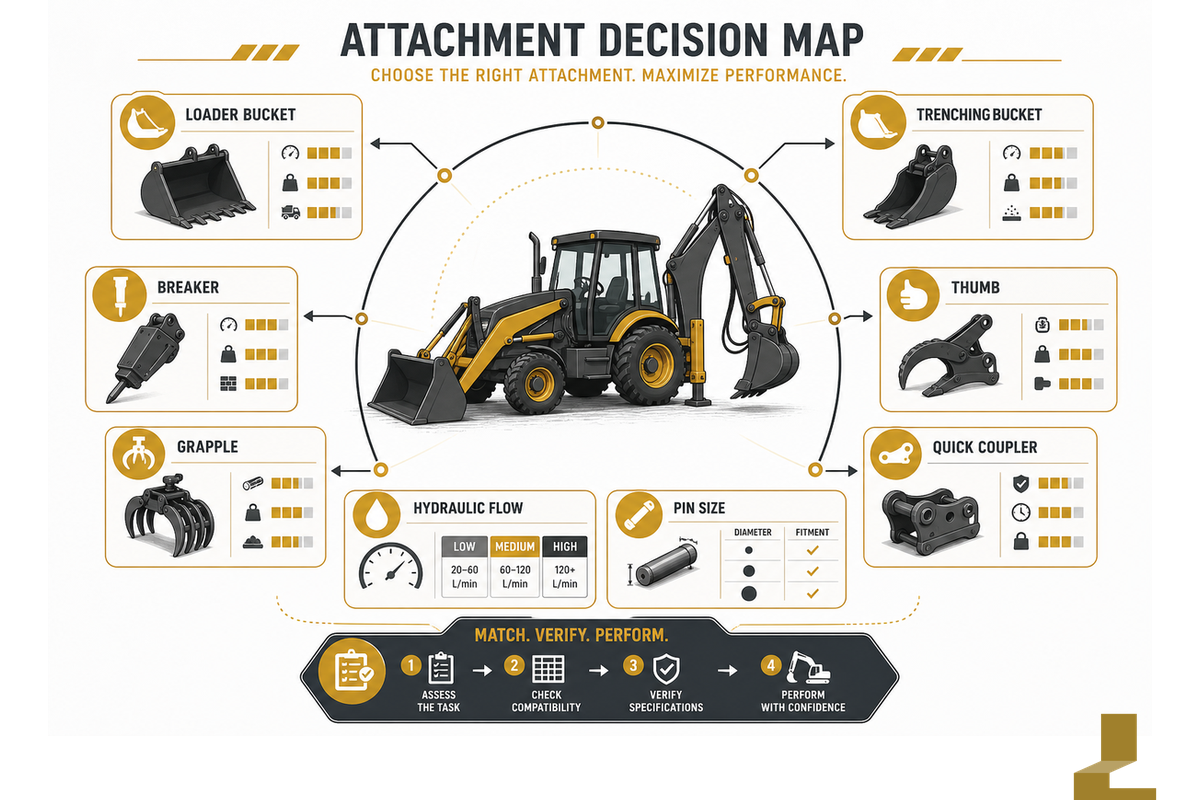
The backhoe loader has one feature a trackhoe doesn’t: a front loader bucket. That bucket can move loose material, rough-grade, backfill, push spoil, and clean up a work area. Repair crews and farms may buy a backhoe for that reason even when an excavator digs faster.
Trackhoes counter with 360-degree swing and a deeper attachment path. Common used excavator work tools include trenching buckets, ditch-cleaning buckets, hydraulic breakers, thumbs, grapples, compactors, and quick couplers. LH Used Excavator can source buckets, breakers, grapples, and other tools with used excavators.
| Work task | Better first choice | Why |
|---|---|---|
| Trenching all day | Trackhoe | Stable digging cycle, reach, and swing. |
| Load, carry, and backfill | Backhoe | Front bucket changes material-handling flow. |
| Breaking concrete | Trackhoe | Breaker match and hydraulic flow can be checked by model. |
| Grabbing brush or pipe | Trackhoe | Thumb or grapple gives better handling from the excavator arm. |
Match the attachment to the machine before money changes hands. Check the excavator bucket options, thumb attachment choices, and quick coupler fit against the machine class, hydraulic lines, pins, and coupler style.
Cost: Renting, Buying, Transport, and Resale
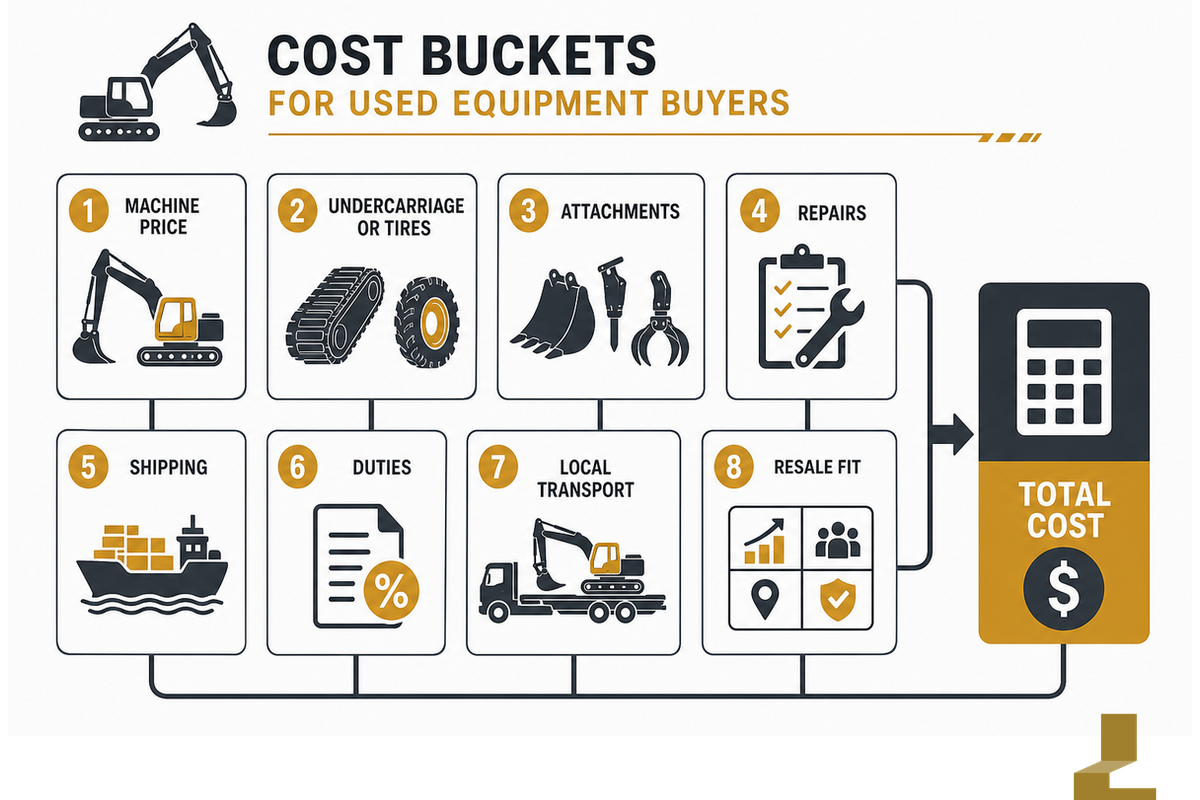
Sticker price is the weak way to compare trackhoe vs backhoe. Freight, attachment mismatch, repairs after arrival, wrong emissions setup, or poor resale fit can erase the price advantage. That’s why used-equipment buyers should build a full cost sheet before choosing.
Trackhoe cost buckets include machine price, undercarriage wear, bucket or work-tool package, spare parts, shipping method, port charges, duties, local transport, and inspection proof. Backhoe cost buckets include tire condition, loader arm wear, stabilizer condition, rear boom pins, front bucket wear, road travel needs, and local service access.
Cost Checklist for International Buyers
- Machine year, hours, serial number, and current photos.
- Engine, hydraulic pump, cylinders, final drives, and swing motor condition.
- Undercarriage wear for tracked units; tire and stabilizer condition for backhoes.
- Included bucket, breaker, thumb, coupler, and spare parts.
- Shipping route, loading method, FOB cost, port fees, duties, and inland freight.
- Destination emissions rules and import forms before purchase.
Buyers who already lean toward a trackhoe can compare trackhoe for sale guidance, estimate shipment through the FOB-to-landed cost estimator, and ask LH Used Excavator for machine photos, inspection notes, and available attachment packages.
Choose With the 4-Question Ground-and-Load Matrix
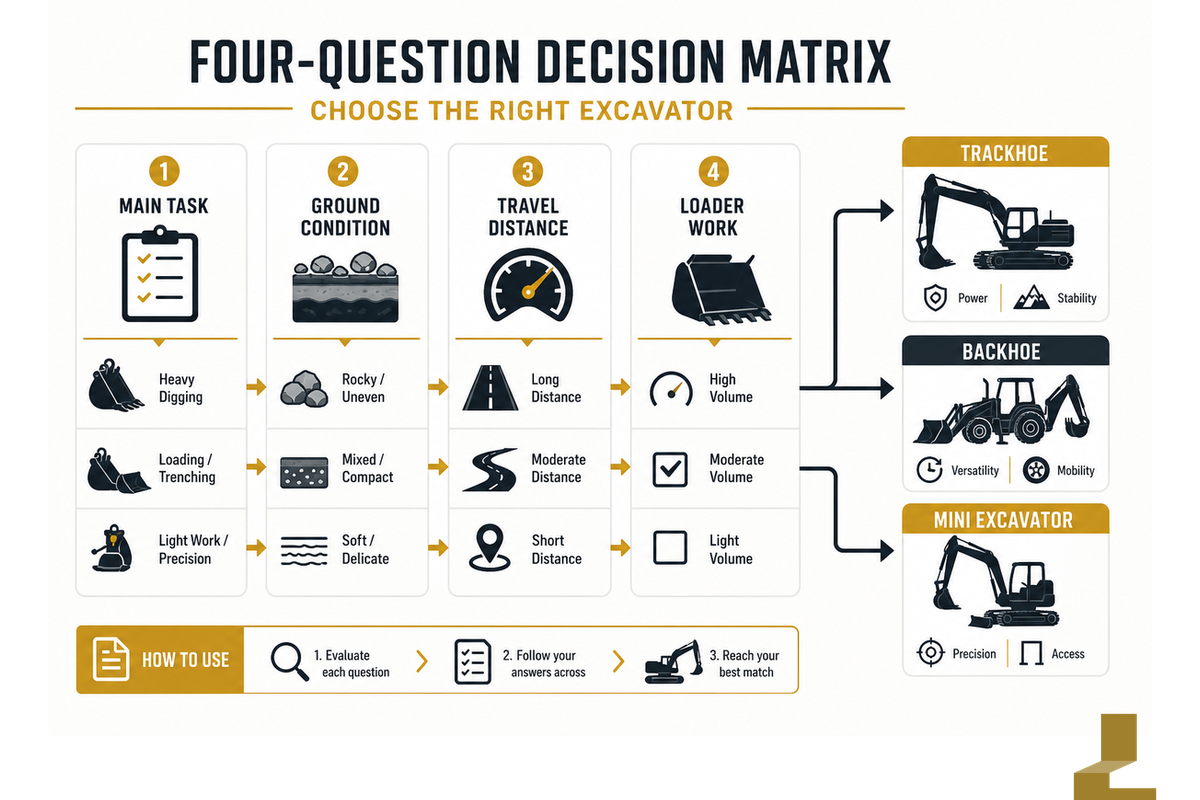
This 4-Question Ground-and-Load Matrix turns the comparison into a jobsite answer. Work through the four questions in order. If two or more answers point to the same machine, that’s the machine to quote first.
| Question | Answer points to trackhoe | Answer points to backhoe |
|---|---|---|
| What is the main task? | Digging, lifting, grading, demolition. | Digging plus loading and cleanup. |
| What is the ground like? | Soft, sloped, muddy, uneven. | Firm, hard, paved, spread out. |
| How far must it move? | Mostly one work zone. | Several short moves in one day. |
| Is loader work covered? | Yes, another loader or skid steer is available. | No, one unit must load and dig. |
Some answers point to a third choice: a mini excavator. If the site is tight, the digging is light, and transport weight matters, review mini excavators in the 0-10 ton class. General construction and infrastructure work often fits medium excavators in the 10-30 ton class. Mining, deep excavation, and heavy civil work usually start with heavy excavators above 30 tons.
Used Machine Inspection Checklist Before You Buy
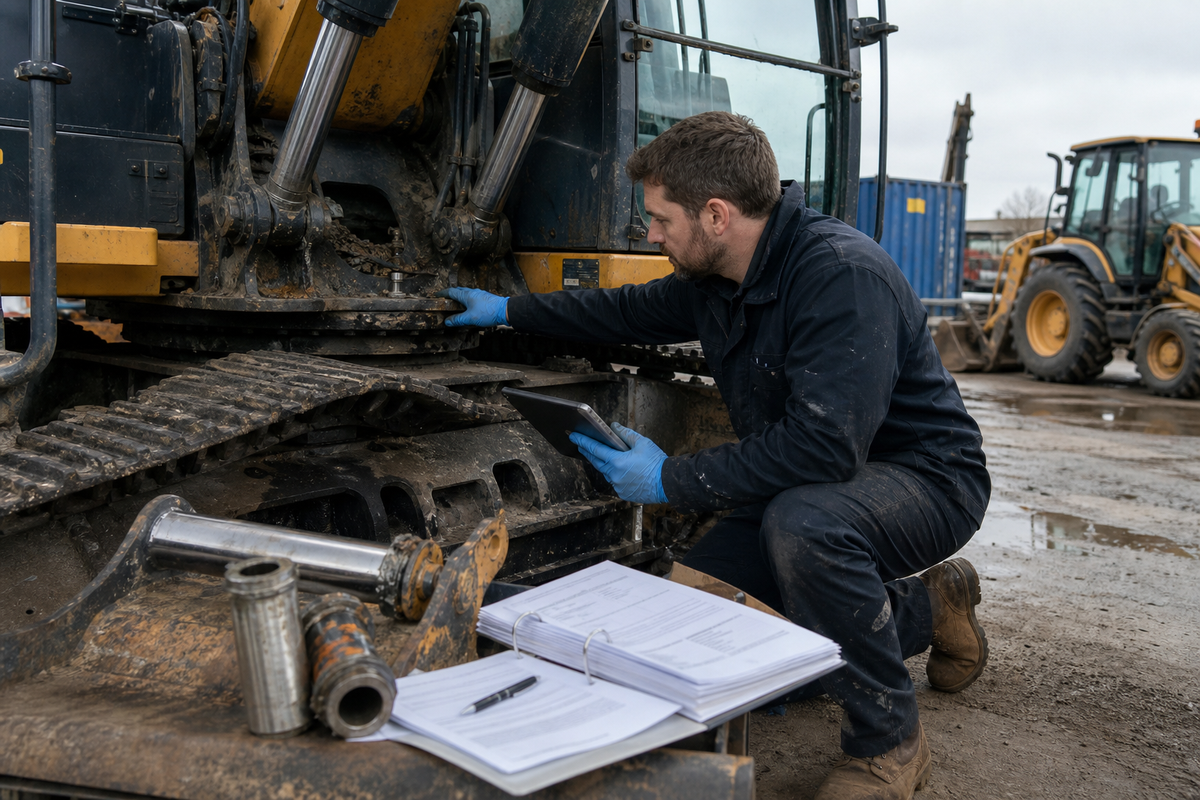
A used trackhoe or backhoe can look clean in listing photos and still carry expensive risk. Before paying a deposit, ask the seller for current photos, videos, serial number confirmation, service records where available, and a clear list of included attachments.
On tracked excavators, the undercarriage can decide the deal. Ask for track shoe, roller, idler, sprocket, and chain photos from both sides. Request a video showing cold start, idle, travel, swing, boom raise, stick in and out, bucket curl, and hydraulic cylinder condition. Backhoe inspections shift toward tires, stabilizers, loader arms, rear boom swing, bucket pins, and brake condition.
Trackhoe inspection asks
- Undercarriage photos from both sides.
- Engine cold-start video and smoke check.
- Hydraulic leak check around pump, lines, cylinders, and valve bank.
- Boom, stick, bucket, pins, bushings, and coupler wear.
- Attachment fit by pin size, oil flow, and machine weight.
Backhoe inspection asks
- Tire wear, cracks, rim damage, and axle noise.
- Loader bucket cutting edge and loader arm play.
- Rear boom, dipper, bucket, swing frame, and stabilizer wear.
- Transmission shift, brakes, steering, and road-speed behavior.
- Hydraulic function at both loader and backhoe ends.
Safety should be part of the inspection, not a separate afterthought. NIOSH reviewed 346 deaths associated with excavators or backhoe loaders during 1992-2000 and identified struck-by incidents and bucket detachment as common causes. That makes coupler condition, bucket lock status, warning labels, operator controls, and training records worth asking about.
In trench work, OSHA says cave-ins are the greatest risk in trenching and excavation, and OSHA guidance treats protective systems as a core trench-safety requirement. Machine choice doesn’t remove the need for soil review, utility location, safe spoil placement, and competent supervision.
Start with the used excavator inspection checklist, then compare the broader used excavator buying guide before you request final quote terms.
Compliance and Transport Checks Before the Deposit
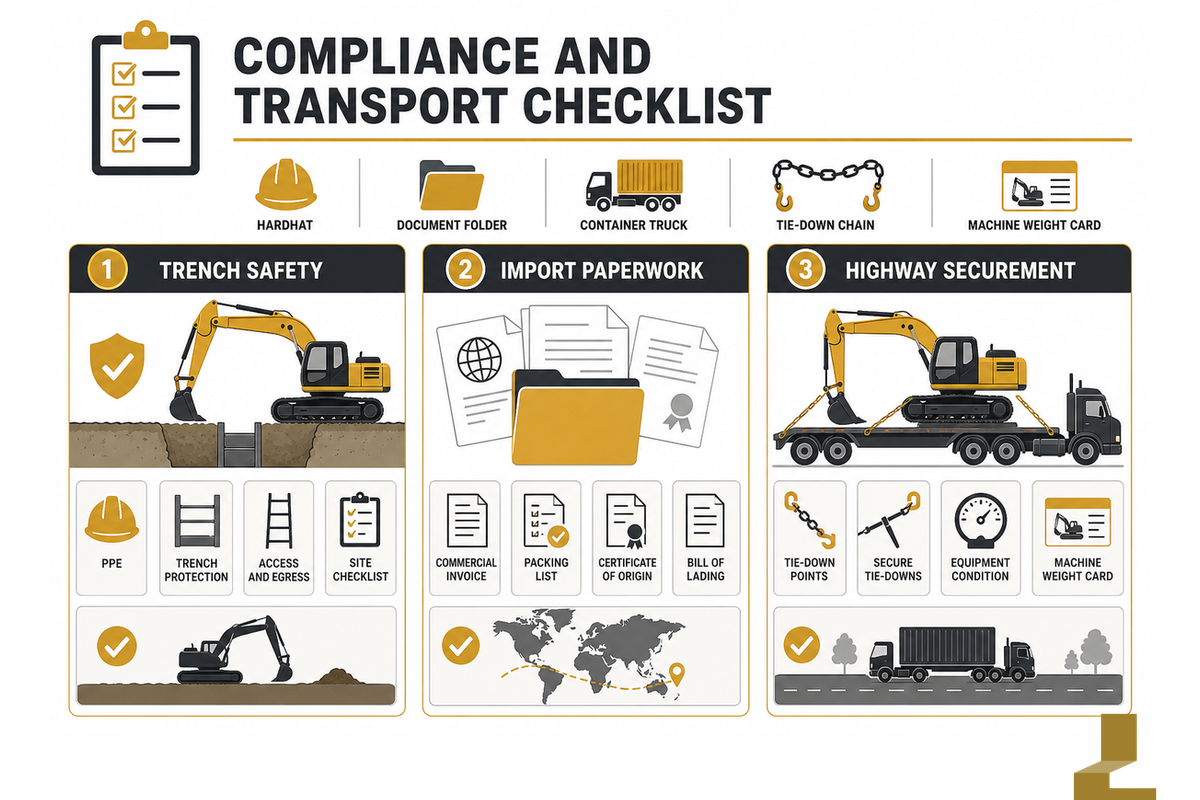
The machine choice is only one part of the purchase. A used trackhoe or backhoe loader still needs a safe jobsite plan, a legal import plan, and a transport plan. The table below keeps those checks close to the buying decision instead of leaving them for the last week before shipment.
| Check area | Code or source to review | Number to keep in the quote file | Why it affects trackhoe vs backhoe |
|---|---|---|---|
| Trench access | OSHA 29 CFR 1926.651 | 4 ft (1.22 m) trench access trigger and 25 ft (7.62 m) lateral travel limit appear in the rule text. | Deep trench work usually points toward a stable excavator setup, not a naming shortcut. |
| Spoil and edge control | OSHA 1926.651(j) | 2 ft (0.61 m) edge distance is a useful safety prompt for spoil and equipment placement. | Loader cleanup can matter, but machine traffic near the excavation edge still needs control. |
| Protective systems | OSHA 29 CFR 1926.652 | 5 ft (1.52 m) is a common protective-system review point unless a valid exception applies. | A deeper digging machine raises planning needs; it does not remove trench protection duties. |
| Struck-by and bucket risk | CDC/NIOSH equipment injury notice | 346 deaths were associated with excavators or backhoe loaders during 1992-2000. | Coupler checks, bucket locks, and 30-second function videos belong in both quote paths. |
| U.S. import review | 40 CFR Part 1068 Subpart D | Record engine family, model year, serial number, and exemption status before payment. | A cheap used machine can become expensive if the import file is wrong. |
| U.S. highway securement | 49 CFR Part 393 Subpart I | Keep machine weight in kg or lb and loading dimensions in m or ft in the haul file. | Trackhoes usually need planned haul equipment; backhoes may still need securement after long moves. |
Scenario: the imported machine that arrives before the job is ready
An overseas customer may approve a used excavator in week 1, arrange loading in week 2, and plan port pickup in week 6. That timeline fails if the project team hasn’t checked 40 CFR Part 1068 paperwork, machine weight in kg, loading width in mm, and local road limits. A backhoe buyer can face the same deployment delay if the loader bucket and rear hoe arrive without matching transport records. Good purchasing work keeps the quote, shipment, and installation scenario tied together from the first email.
What Is Changing in the Trackhoe vs Backhoe Decision?
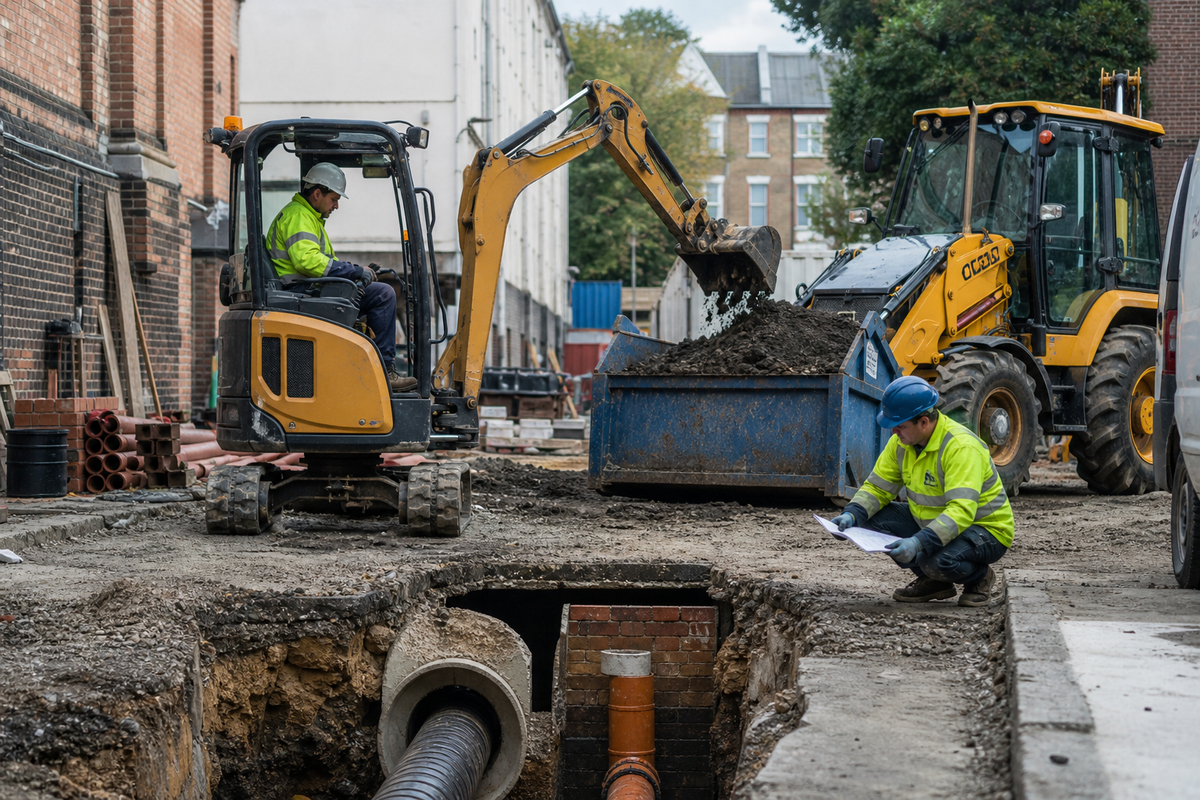
Market signals don’t point in one clean direction. Compact equipment keeps gaining attention because urban, utility, landscaping, and repair sites need smaller machines, easier transport, and better access. Utility Expo reporting says compact machines are playing a larger part in utility construction as urban jobsites tighten and access gets harder.
At the same time, the backhoe loader isn’t gone. Current OEM brochures still cover backhoe loaders as active digging and loading machines, and the John Deere 310 G-Tier example shows why the category remains useful: rear digging reach plus a loader chassis in one unit.
Buyer action is simple: quote the machine class that matches the job, then check inspection proof and compliance before payment. EPA states that the Clean Air Act prohibits import of nonconforming motor vehicles, engines, nonroad engines, and equipment, including used units. eCFR import rules also say engines and equipment subject to EPA standards generally need a certificate of conformity unless a valid exemption or exclusion applies, plus the proper EPA declaration.
If the machine is bound for the United States, review emissions before the deposit. If it’s bound for another country, check the local diesel, customs, and port rules. LH Used Excavator can help buyers compare used machines, attachment packages, and shipping plans, but the importer must confirm destination rules before entry.
For more background on U.S. diesel emissions, read the excavator Tier 4 emissions guide. EPA also maintains a heavy-equipment nonroad emissions page for current rule categories.
Best Choice by Buyer Scenario
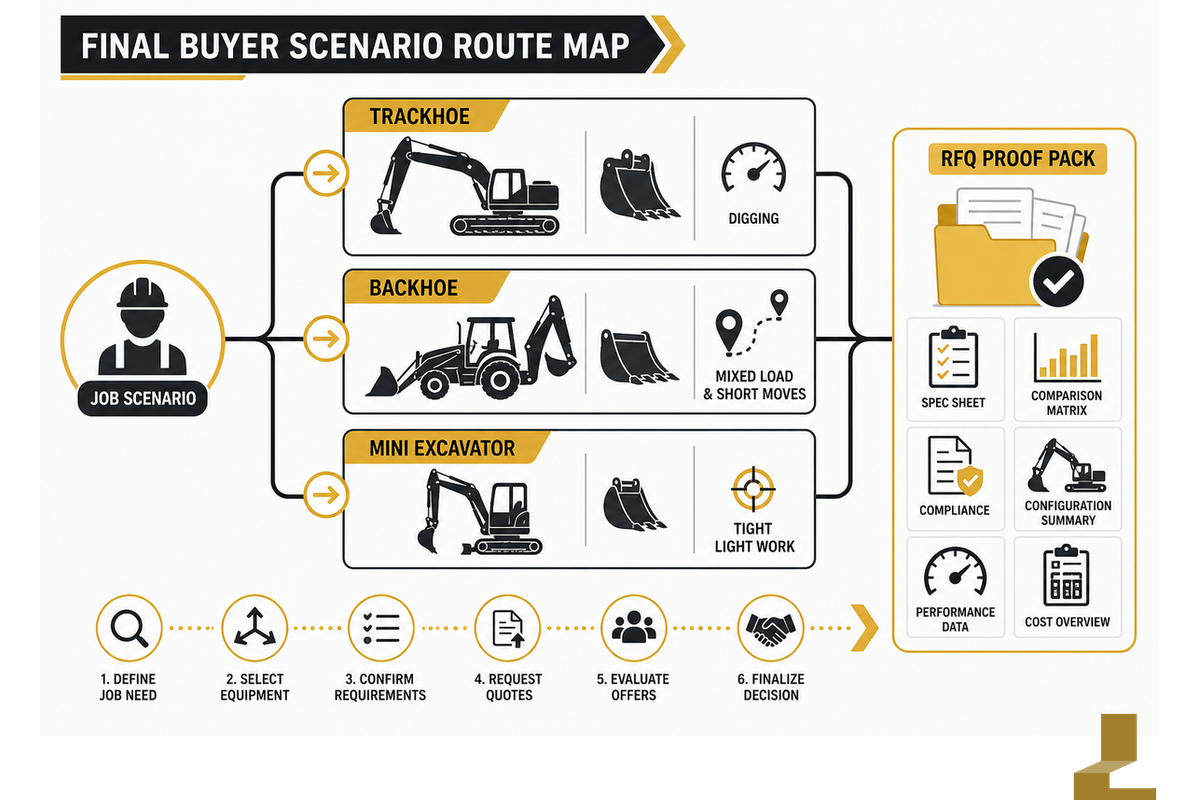
Choose a trackhoe if your job entails trenching, foundation construction, demolition prep work, ditch cleanup, grading slopes, land clearing or long-term excavation projects. Once you’ve selected the class of machine, confirm that your desired accessories – like breakers, bucket kits, thumbs, or couplers – will match the unit hydraulically before adding them to the purchase.
Choose a backhoe if the project mixes shallow trenching, short road moves, front bucket loading, backfill, light cleanup, and one-machine staffing. Farms, campuses, municipalities, and small contractors often care more about covering many tasks than about peak digging output.
When should you buy used excavators instead of backhoes? If space is tight, you need minimal ground disruption, and the excavation is light, go with a mini excavator. If you need more productive digging, bigger buckets, more reach, heavier tools, or longer use times, a medium or heavy excavator will be the better choice.
LH Used Excavator exports mini excavators from 0-10 tons, medium excavators from 10-30 tons, and heavy excavators above 30 tons. This supplier works with used machines from Caterpillar, Komatsu, Sany, Volvo, Hyundai, Doosan, Kubota, Hitachi, Kobelco, and more, with inspection, refurbishment, testing, attachments, and export support.
Use the used excavator size-class selector before asking for a quote. It helps separate a compact trackhoe, medium used excavator, and heavy excavator before the supplier sends photos and model options.
FAQ
Are backhoes better than excavators?
View Answer
Backhoes win for mixed work and short moves. Excavators win for steady digging.
Why are backhoes less popular?
View Answer
Compact excavators, skid steers, and compact track loaders have taken some jobs that backhoes once handled. Rental fleets and contractors can pair a mini excavator with a loader and get faster digging plus better material handling. That said, a backhoe still solves a real problem when one operator must dig, load, drive around the property, and backfill without calling a second unit. Recent trade coverage shows weaker share, but manufacturers still release new models because the one-machine use case hasn’t disappeared.
What is another name for a trackhoe?
View Answer
Use tracked excavator, crawler excavator, track hoe, or excavator.
Is a mini excavator considered a backhoe?
View Answer
No, mini excavators aren’t the same as backhoe loaders.
They’re compact excavators. They may dig with a bucket in a backhoe-like pulling motion, yet they don’t carry the same front-loader plus rear-hoe layout. Buyers compare them because both can handle small sites, shallow trenches, landscaping cuts, and repair work. The better choice comes down to loader need, access width, transport weight, and how often the machine must move.
What is the difference between a backhoe and an excavator?
View Answer
Backhoe loaders feature both a front loader bucket and a rear digging arm.
Excavators are characterized by a rotating upper body, a boom, stick, and bucket or another work tool.
Should I buy a used trackhoe or a used backhoe?
View Answer
Buy a used trackhoe when revenue comes from excavation, demolition prep, grading, lifting, or attachment work. Buy a used backhoe when one machine must handle digging, loading, carrying, road movement, and cleanup. Export buyers should request inspection proof, attachment details, shipping plan, emissions review, loading photos, and serial number confirmation before payment.
References & Sources
- OSHA, Trenching and Excavation Safety
- OSHA, 29 CFR 1926.651 Specific Excavation Requirements
- OSHA, 29 CFR 1926.652 Requirements for Protective Systems
- CDC/NIOSH, Preventing Injuries When Working with Hydraulic Excavators and Backhoe Loaders
- EPA, Learn About Importing Vehicles and Engines
- eCFR, 40 CFR Part 1068 Subpart D – Imports
- eCFR, 49 CFR Part 393 Subpart I – Protection Against Shifting and Falling Cargo
- EPA, Regulations for Emissions from Nonroad Vehicles and Engines
- Volvo CE, 20-ton crawler excavator brochure
- John Deere, 310 G-Tier Backhoe Loader brochure
- The Utility Expo, compact construction equipment trends
![Excavator Bucket Manufacturers: Buyer Evidence [Guide]](https://lhusedexcavator.com/wp-content/uploads/2026/08/excavator-bucket-manufacturers-r2-featured-768x512.png)