Get in Touch with Liehuang Company

Excavator Size Guide for Used Equipment Buyers

Used Excavator Buying Guide
The right size excavator is not the heaviest one you can buy. It is the machine that can get onto the site, reach the work, dig to the required depth, take the right bucket or tool, and still make sense to transport, inspect, and support once it arrives.
Excavator Size Chart: Size Categories by Type of Excavator
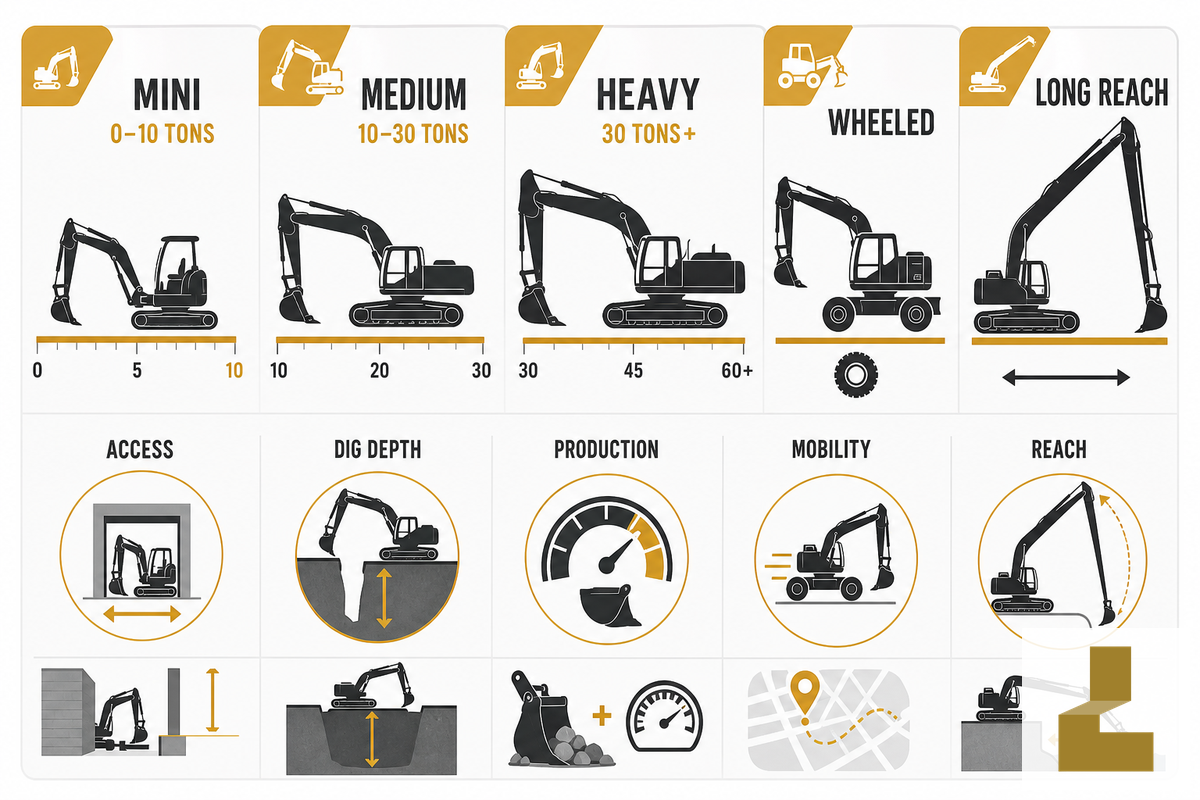
Many buyers default to operating weight as the primary specification, which is helpful but can obscure critical fits like maximum dig depth, ground-level reach, swing radius, ground pressure, bucket capacity, hydraulic flow, loading height, and transport limitations.
At LH Used Excavator, our approach for sourcing used excavators centers on three general groups: mini (0-10 tons), medium (10-30 tons), and heavy (>30 tons).
| Size band | Best-fit work | Main advantage | Common buying risk |
|---|---|---|---|
| 0-10 tons Mini and compact excavators |
Urban utility work, landscaping, small foundations, drainage, tight access, indoor or courtyard jobs. | Easy movement, lower site disturbance, better access in narrow work areas. | Undersizing for reach, lifting, trench box handling, or production speed. |
| 10-30 tons Medium and standard excavators |
General construction, site preparation, roadwork, trenching, loading trucks, mid-size demolition. | Balanced digging force, reach, bucket size, and transport economics. | Choosing by price alone and missing hydraulic condition, undercarriage wear, or attachment fit. |
| 30 tons+ Heavy excavators |
Large earthmoving, quarry support, mining, deep excavation, heavy demolition, long reach applications. | High production, stronger lift, larger buckets, and longer reach options. | Transport cost, site bearing pressure, oversized machine idle time, and slower repositioning. |
These broad bands help importers and dealers narrow their focus before comparing models to find machine matches for their customers.
Mini Excavators (0-10 Tons): When Small Machines Win
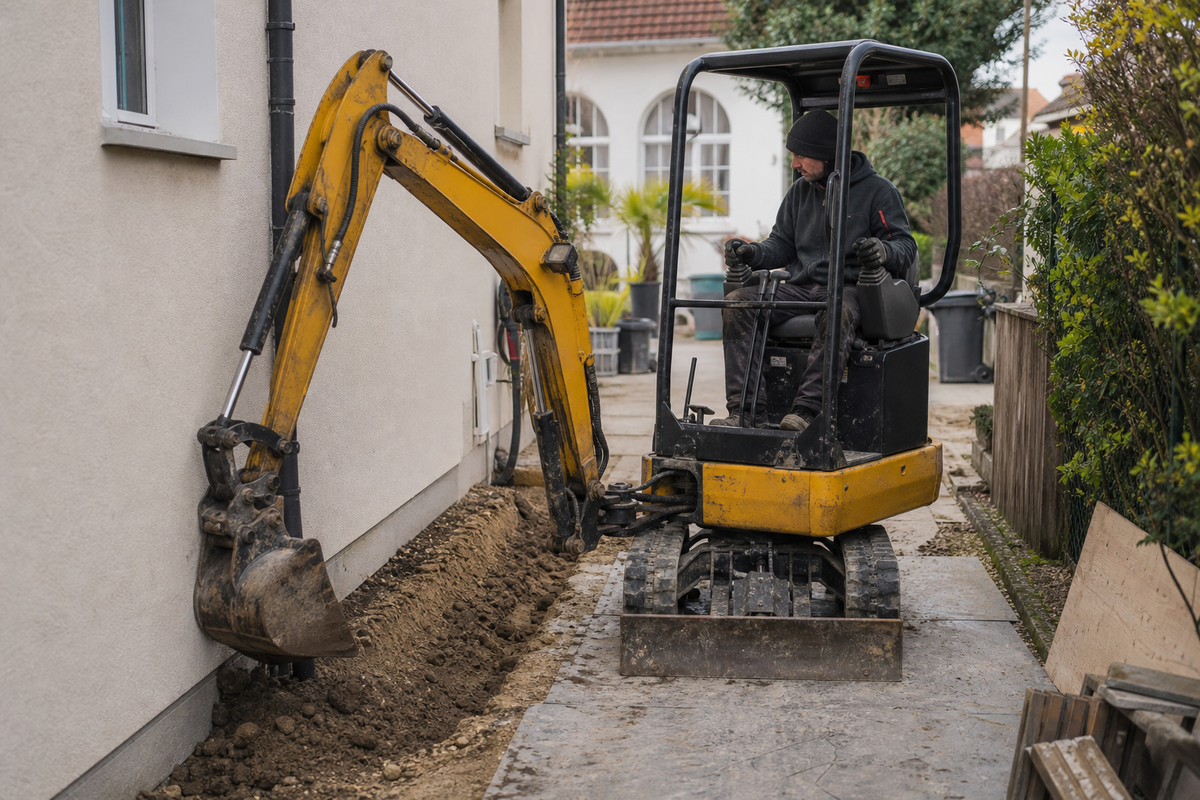
Bobcat’s compact excavator guidance points to size, weight, dig depth, reach, swing radius, dump height, bucket capacity, ground pressure, and transport ability as factors that shape whether a compact excavator fits the job.
Compact machines also win in tight spaces and confined spaces where maneuverability matters more than raw bucket size. If the operator must maneuver between walls, utilities, trees, or finished pavement, a smaller tail swing can protect the site and still finish the work.
Mini excavators are at their best when digging is tight, repetitive, or access is limited, as with many urban utility repairs, residential basement and drainage jobs, landscaping projects, and smaller excavation projects.
Mini excavator fit test
LH Used Excavator maintains a supply of mini excavators within the 0-10 ton range for contractors and importers needing compact units for construction, landscaping, and small jobs. Importers find value here by meeting the needs of rental companies, small contractors, and municipal clients.
Just because a mini excavator fits between buildings does not mean it has enough digging depth, reach, hydraulic power, bucket capacity, or lift capacity for the project. The machine still needs to handle the workload and schedule.
Medium Excavators (10-30 Tons): The General Construction Workhorse
Bobcat offers guidance for 5-6 metric ton machines for small to medium construction and landscaping jobs, while its 7-10 metric ton compact excavators can be applied to more serious excavation, earthmoving, and demolition applications. The gap between a 1-ton unit and an 8-ton unit within the mini category is significant.
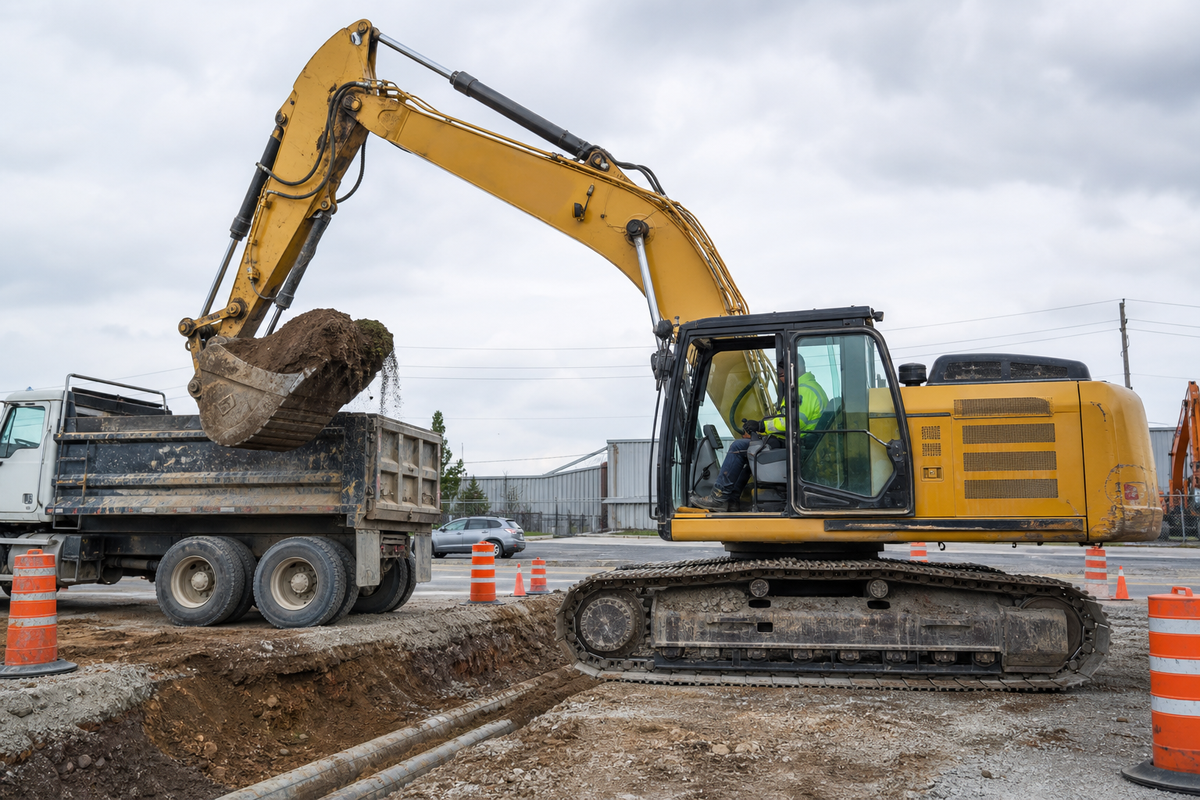
Medium excavators often serve as a do-it-all machine for digging, loading, grading, demolition, and infrastructure tasks. A mid-size excavator can be the safest starting point for commercial construction when one machine must handle common attachments without the transport cost of larger machines. In road or municipal work, some buyers also compare wheel excavators when jobsite travel and hard-surface mobility matter.
At LH Used Excavator, the 10-30 ton group covers many machines used on general construction sites, in industrial settings, and in rental or municipal programs. This is where buyers often compare Cat, Komatsu, Sany, Volvo, Hyundai, Doosan, Hitachi, and Kobelco machines side by side.
Common pitfall: assuming that two 20 ton excavators are equivalent. Between two 20 ton excavators, boom geometry, arm length, stick length, counterweight, hydraulic flow rate, bucket size, lifting chart, track width, undercarriage condition, parts availability, and hydraulic service lines can vary widely. For used machines, these differences mean more than the badge on the door.
- Trenching is most demanding of ground level reach and maximum dig depth.
- Truck loading relies heavily on boom lift to dump height, bucket capacity and cycle times.
- Demolition requires large hydraulic flow, auxiliary service lines, guards and suitable attachments.
- Resale value depends on brand, engine-family commonality, parts support, and repair history.
Heavy Excavators (30 Tons+): When Reach, Lift, and Production Rule
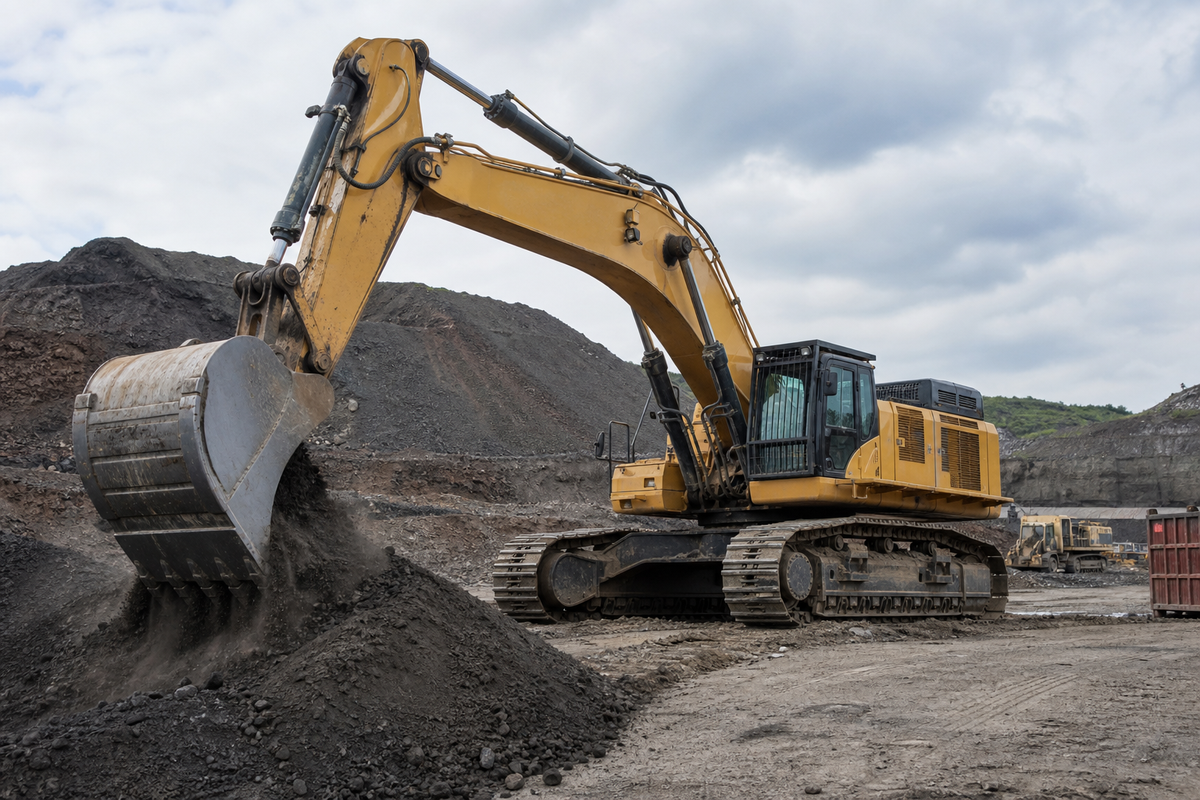
Large excavators earn their keep when the work needs high hourly productivity, significant digging depth, long reach, heavy lifting, larger buckets, or demanding attachment use. They fit large earthworks projects, road construction, mining, major building excavations, quarry support, and heavy-duty demolition.
LH Used Excavator carries 30-ton-plus heavy excavators for large construction sites, mining work, and other high-output applications. Used condition for heavy excavators is extremely important because repair work, undercarriage wear and tear, leaking hydraulics, stressed boom and stick, and shipping costs may offset the initial price quickly.
Heavy-duty excavation is the right target when the site must move heavy materials, hold larger buckets, or work at long reach for many hours. Larger machines can deliver that production, but only when ground conditions, access, and haul routes can support them.
Caterpillar’s excavator category helps illustrate why machine weight and work ability should be checked separately, with filters such as operating weight, maximum dig depth, and net engine power. Even a big excavator with the wrong boom, stick, bucket, or counterweight can still be the wrong machine for the job.
Heavy excavator rule of thumb
Do not make the transition into 30+ ton machinery based solely on price per ton alone. Move up in size when the project requires higher output, lifting, reach or the attachment torque that medium excavators cannot safely deliver at an affordable price.
Choose the Right Excavator Size With the Five-Spec Filter
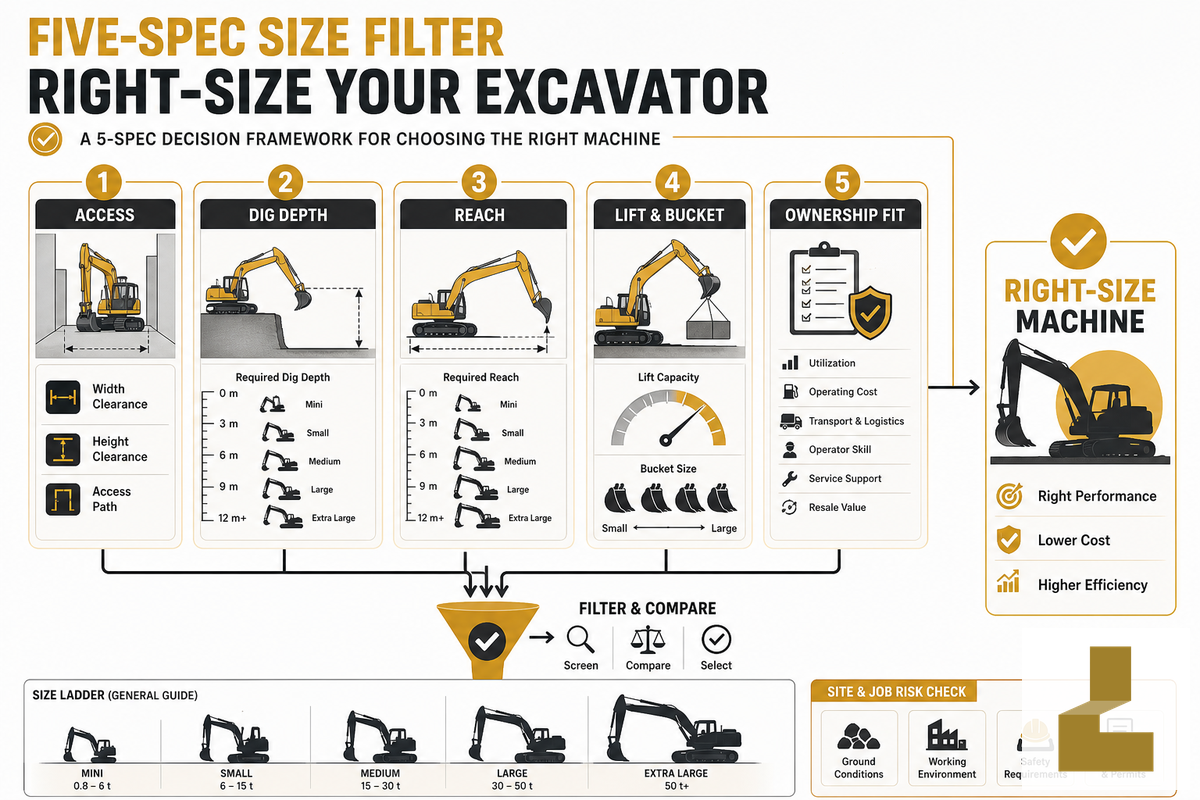
When the purchasing department asks “how big of an excavator do I need?” the answer should follow this sequence. It prevents the common mistake of buying by operating weight before defining the task.
1. Access
Gate width, road limits, ground bearing, working radius, tail swing, and transport route.
Gate width, road limits, ground bearing, working radius, tail swing, and transport route.
2. Dig depth
Required depth plus working margin, trench profile, bedding, and safe access.
Required depth plus working margin, trench profile, bedding, and safe access.
3. Reach
Distance from machine position to trench, pile, truck, bank, slope, or obstacle.
Distance from machine position to trench, pile, truck, bank, slope, or obstacle.
4. Lift and bucket
Pipe, trench box, breaker, grapple, bucket capacity, dump height, and load chart.
Pipe, trench box, breaker, grapple, bucket capacity, dump height, and load chart.
5. Ownership fit
Parts, inspection report, undercarriage life, shipping, resale, operator familiarity.
Parts, inspection report, undercarriage life, shipping, resale, operator familiarity.
DOZR’s excavation guide uses six factors for comparing excavators: operating weight, max dig depth, max dump height, max reach, engine power, and bucket capacity. This mirrors practical use, as weight identifies class, and specs verify suitability.
Do not select a machine just because a brochure lists 24 feet of reach or another attractive single number. Check the load chart, working radius, bucket, soil, slope, and operator position before treating that number as usable reach.
When considering a used excavator, include a seventh filter: condition. Large, worn machines with undercarriage issues, low hydraulic power, loose pin connections or an inadequate maintenance history may prove less effective than a smaller, carefully inspected excavator well-suited to the job.
Excavator Specs: Dig Depth, Reach, Bucket Capacities and Lift
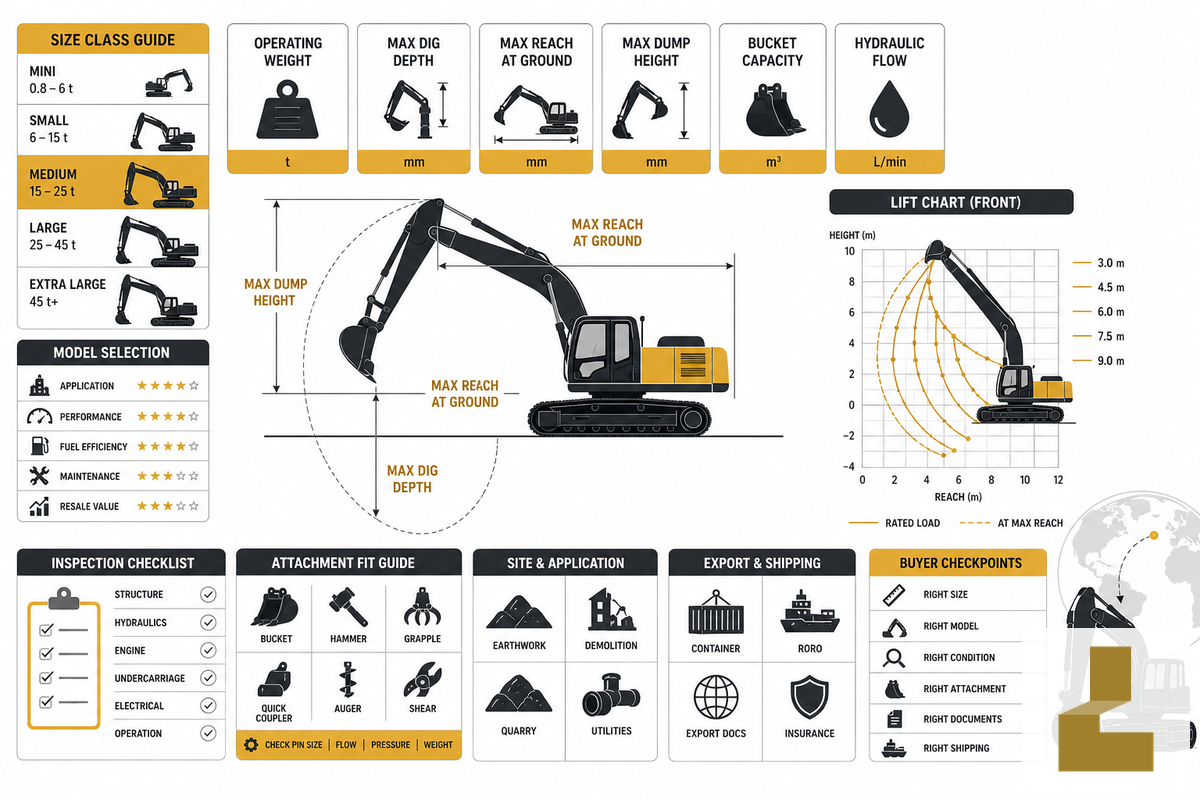
Though a model may be well known, the specifications are the definitive determinant of fit. Rather than accepting general model designations, seek precise configuration details including the year and serial number, as boom, stick, bucket, counterweight, undercarriage, hydraulic systems and attachment configurations vary.
| Spec | Why it matters | Used-buyer question |
|---|---|---|
| Operating weight | Sets the basic class, stability, transport needs, and ground pressure. | Does the listed weight include bucket, counterweight, blade, or added guarding? |
| Maximum dig depth | Determines trench, basement, drainage, and utility depth capability. | Will it reach depth while staying far enough from the edge? |
| Maximum reach | Controls bank work, loading position, slope access, and obstacle clearance. | Is reach adequate with the actual stick installed? |
| Dump height | Affects truck loading, stockpile handling, and material transfer. | Can it clear your truck sideboards with the bucket loaded? |
| Bucket capacity | Affects cycle count, trench width, breakout demand, and truck loading time. | Is the bucket matched to soil, machine class, and coupler? |
| Hydraulic flow and pressure | Controls breakers, grapples, thumbs, mulchers, shears, and other attachments. | Are auxiliary lines installed, tested, and matched to the attachment? |
Bobcat identifies several of these work specifications, including swing radius, dump height, and bucket capacity, and links them to confined-area tasks, dump-truck loading, and material handling; apply these definitions when evaluating used excavators from various manufacturers.
Attachments and Bucket Capacities Can Change the Right Size
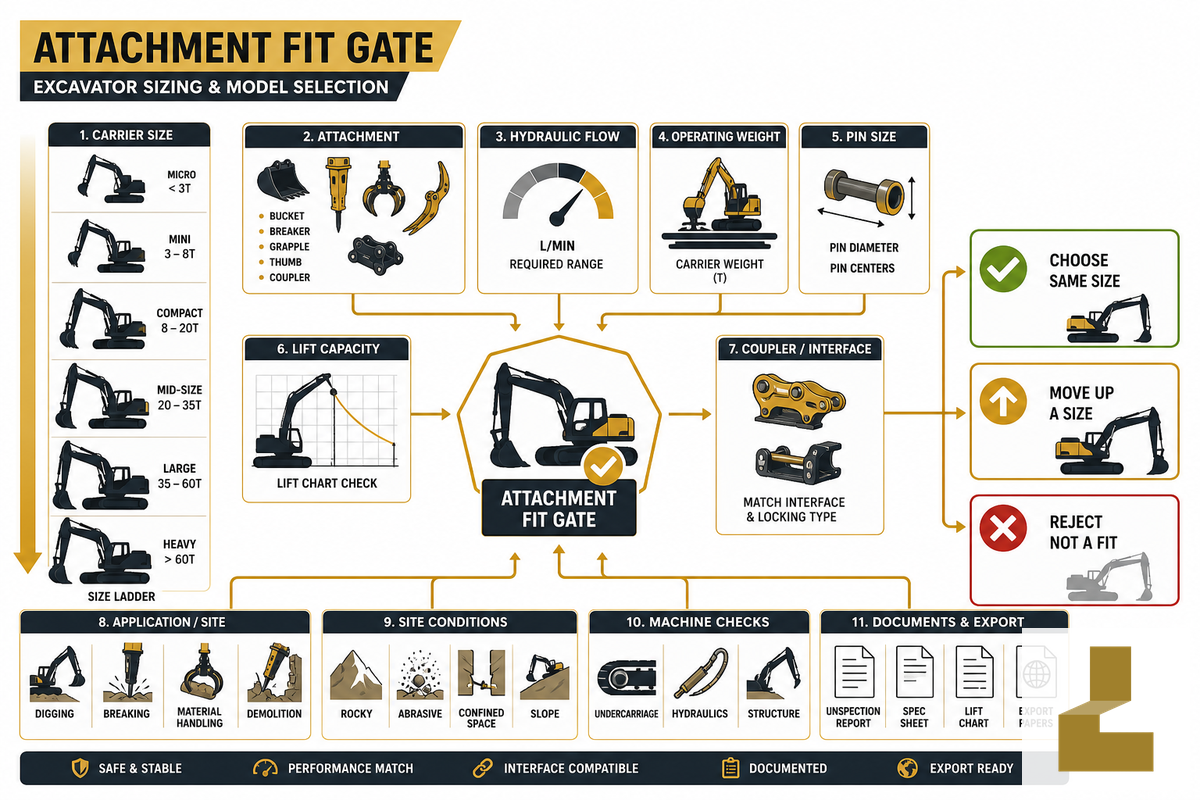
An excavator isn’t just for digging. The attachment plan can drive you up or down one size class. A trenching bucket, rock bucket, hydraulic breaker, grapple, thumb, tilt coupler, auger, compactor, or ripper will affect loading on the boom, hydraulics, pins, bushings, and undercarriage.
LH Used Excavator supplies buckets, hydraulic breakers, grapples and other excavator attachments, allowing buyers to evaluate the machine and attachment as a single package rather than as separate items.
Attachment sizing checks
- Breaker: check oil flow, pressure, carrier weight and mounting bracket.
- Grapple: check lift chart, auxiliary lines, rotate function, and guarding.
- Bucket: check width, capacity, pin size, coupler type, tooth system, and soil type.
- Thumb: confirm linkage, hydraulic circuit, cylinder condition, and clearance.
- Long reach: check counterweight, boom and stick condition, and safe working radius.
With the right bucket, a 12 ton excavator may be a better option than a 20 ton unit with a poorly matched width or height relative to a dump truck.
The inverse can be true as well: a compact excavator may be too light for a breaker or grapple, even though it can physically mount it.
Cat Excavator Sizes, Excavator Models and Brand Fit
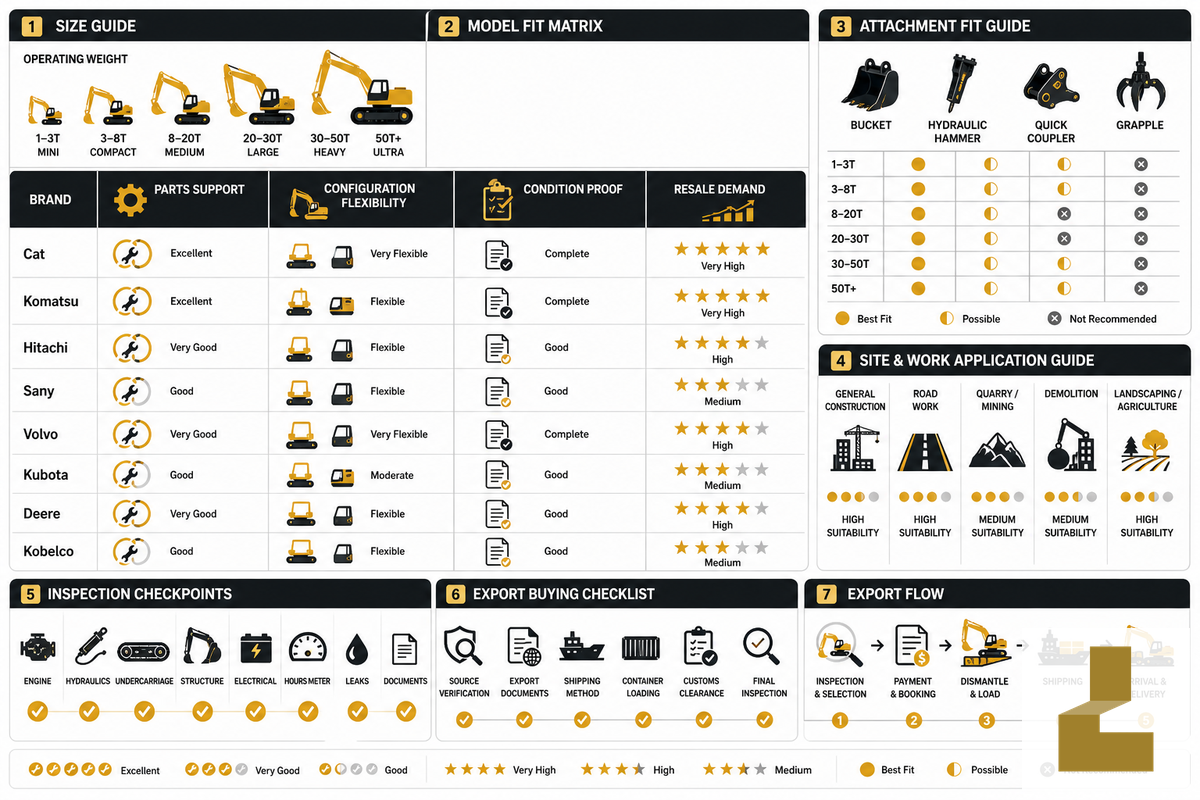
While brand choice can be important, that is usually after a target size class and configuration is established.
Buyers considering Cat excavator size, Komatsu excavator size, Sany excavators, or Kubota mini excavators will typically identify the job envelope: access, dig depth, reach, lift, attachments and parts support in the target market.
LH Used Excavator deals in Caterpillar, Komatsu, Sany, Volvo, Hyundai, Doosan, Kubota, Hitachi, Kobelco and many other brands.
For global buyers and distributors, the primary question is not “which is the best brand,” but “which inspected machine has the correct condition, specification, price, part flow and demand in my market?”
| Buyer priority | What to compare | Why it changes resale |
|---|---|---|
| Dealer and parts support | Engine family, hydraulic pumps, filters, track components, electronic controls. | Local service access reduces buyer hesitation. |
| Configuration | Boom, arm, blade, tracks, coupler, hydraulic lines, cabin, guarding. | Useful configurations sell faster than bare machines. |
| Condition proof | Inspection photos, videos, meter hours, undercarriage, leakage, pins, bushings, test run. | Evidence protects margin when buyers compare offers. |
Equipment Rental, Used Importers and Excavator Rental Size Fit
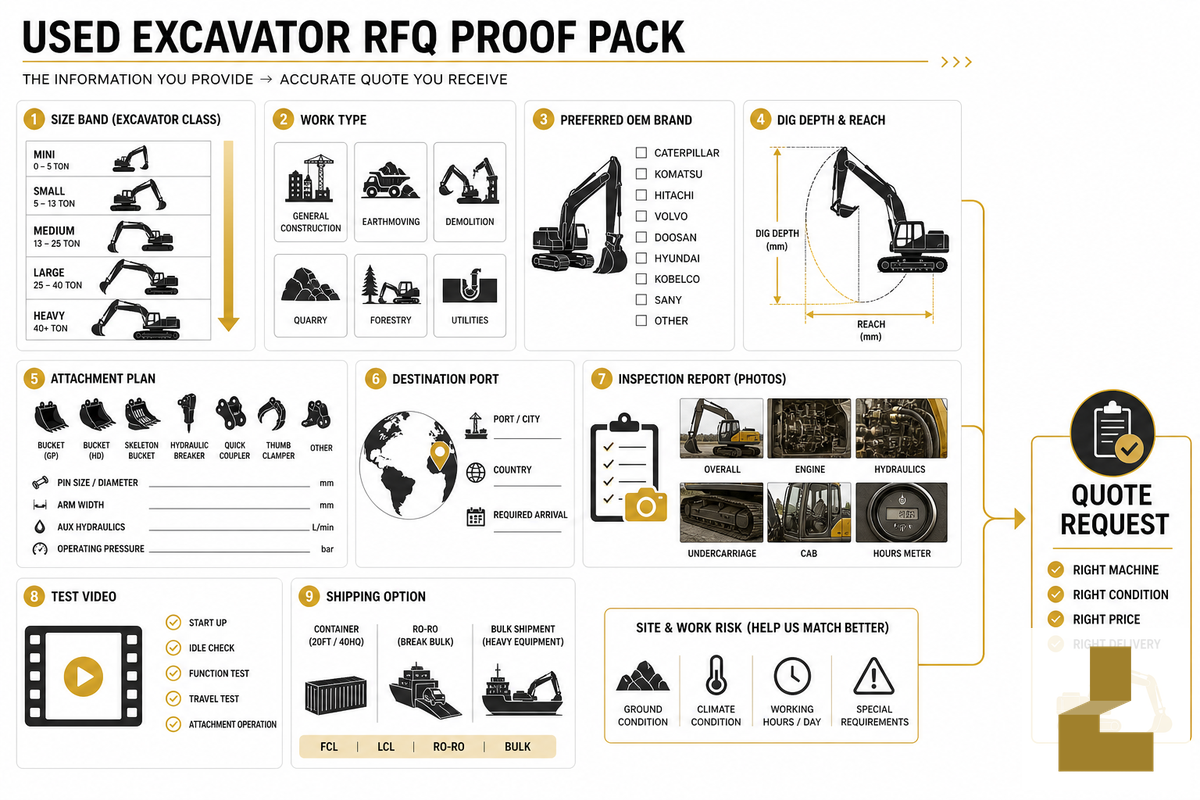
Used excavators are the right commercial choice if they are inspected, correctly described, and matched to the customer base. Risks extend beyond machine wear; a much larger risk is purchasing a size class that local contractors do not want, cannot transport, or cannot support.
Fair market value, forced liquidation value, resale trends, auction data, market volume, and forecasting all affect used equipment valuation. EquipmentWatch tracks these market segments for construction, lift/access, and agriculture equipment; procurement professionals should therefore treat size choice as both a jobsite and resale decision.
LH Used Excavator assists global customers with inspected, refurbished, and tested used excavators, export logistics, attachment supply, and model selection assistance. If you have already decided on the size range, you can begin by browsing available used excavators for sale and requesting photos, videos, inspection reports, and shipping options.
Equipment rental and excavator rental buyers should also think about fleet repeatability. A yard that stocks similar excavator models can simplify buckets, filters, track parts, operator training, and resale conversations.
Used excavator RFQ checklist
- Target Size Band: 0-10 tons, 10-30 tons, or 30+ tons.
- Primary work: trenching, foundation excavation, truck loading, demolition, quarrying, mining, roadwork, landscaping, or utility work.
- Required dig depth, reach, dump height, and bucket width.
- Preferred brands and acceptable alternates.
- Attachment Plan: breaker, grapple, thumb, auger, bucket set, compactor, or long reach.
- Destination port, shipping deadline, and local transport limits.
- Condition Requirements: hours range, undercarriage condition, paint/refurbish preference, test video, inspection report.
Safety and Site Constraints Before You Choose a Size
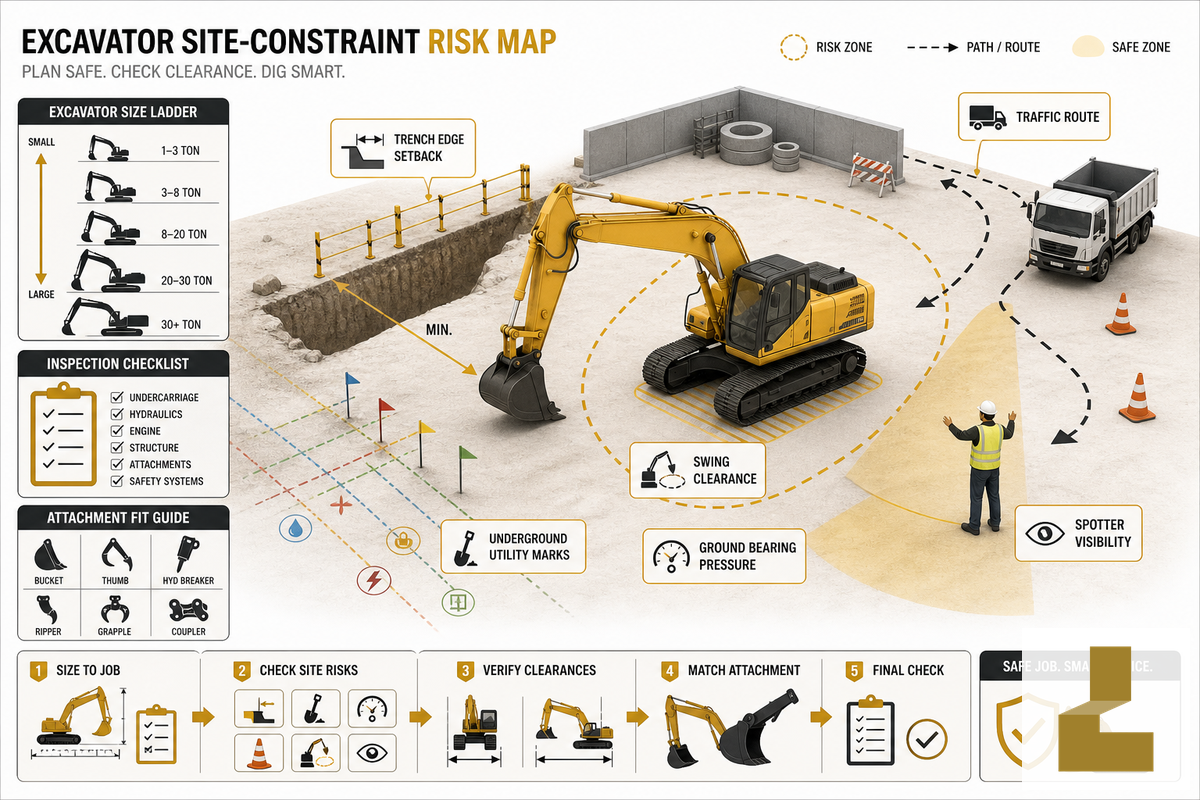
Machine size changes the risk picture. Heavier excavators may require more room around trench edges, stronger access roads, better visibility, a wider work envelope, and more rigorous traffic management. Utility work is also governed by locating requirements and tolerance zones.
OSHA’s trenching and excavation safety information links this type of work to 29 CFR Part 1926, Subpart P, and treats it as hazardous construction work. It specifies that items that might slide or fall into the excavation should be set back 2 feet or anchored, and warns that alert systems may be necessary for mobile equipment operated near the excavation edge.
OSHA 1926.651 also details how to ensure adequate entry/exit in trenches 4 feet or deeper, the risks associated with falling loads, the use of warnings for mobile equipment, atmospheric dangers, and accumulation of water. These are just a few of the reasons a sizing guide shouldn’t consider only reach and digging depth as pure production capabilities.
On underground utility work, AGC/CGA’s best-practice guidance requires excavator operators to identify the location of underground facilities through a one-call center, retain reference details, confirm marks, keep marks visible, and exercise care when working within the tolerance zone. This guide defines the tolerance zone as the facility width plus 18 inches on each side, or as otherwise mandated by local regulations.
Site constraint questions before purchase
- Can the machine maintain the appropriate distance from trench sides while reaching the excavation work?
- Will the machine handle the travel path safely over access routes, pads, bridges or soft ground?
- Will the swing clearance accommodate street width, buildings or the utility corridor?
- Is the excavation edge, the dump truck, the spotter and underground utilities clearly visible?
- Are the local 811, locating, tolerance zone, and trench safety rules integrated into the plan?
2026 Used Excavator Outlook: Size Choice and Availability
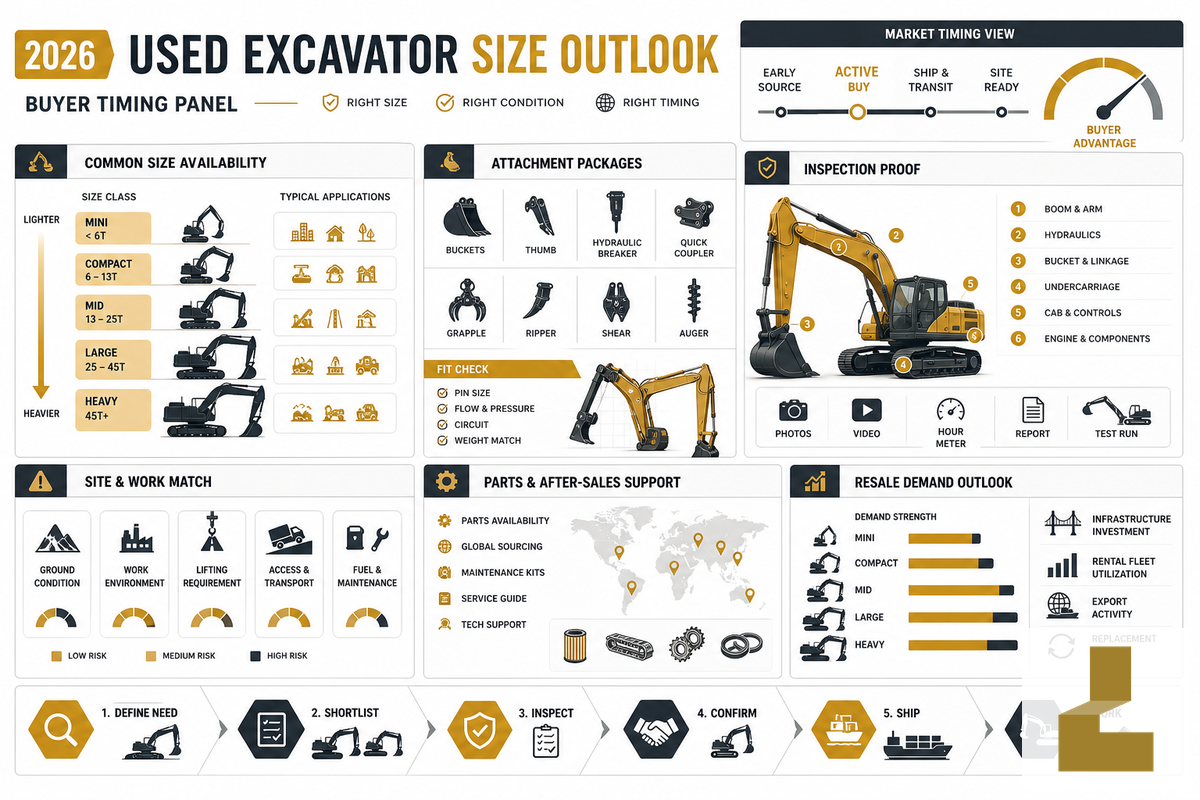
Supply and demand for used excavators is influenced by infrastructure spending, the cycle for replacing rented equipment, the length of time it takes to get new machines, exchange rates, parts availability in the region, and buyer confidence in the inspection records. As such, the ideal machine size can vary depending on the market.
In one country, a distributor might move compact excavators quickly; in another, larger, general construction-class machines (around 20 tons) might be in higher demand.
Mordor Intelligence, a commercial market research firm, projects the used construction equipment market to reach USD 132.67 billion by 2026 and estimates that excavators accounted for 42.68% of the used market share in 2025.
Please use this data for market-trend context only; it is not an official government figure.
The conclusion for potential buyers is straightforward: look for a size category with strong local demand, convenient access to parts, adequate performance for typical projects, and compelling proof of inspection that can support a good resale value.
Used excavators that are properly matched to your needs will be easier to sell, rent, service, and finance compared to heavily discounted machines that are the wrong size.
Recommended Buying Path
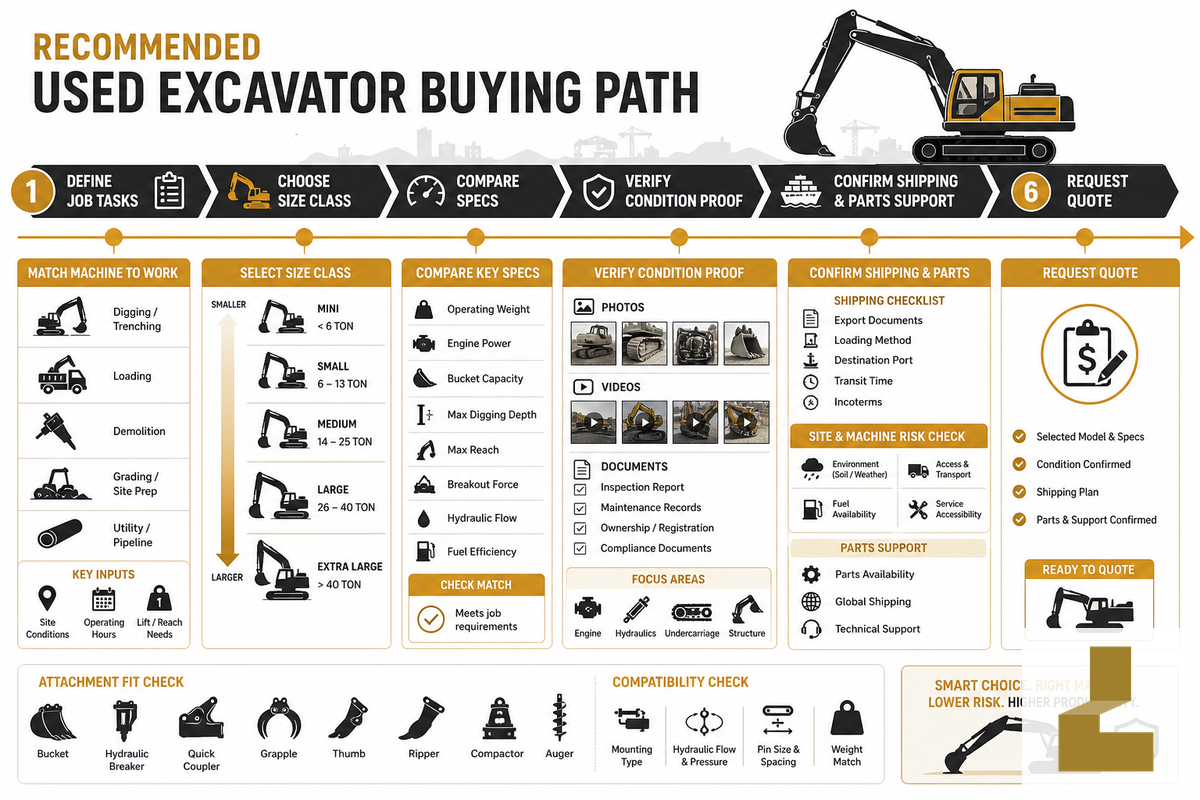
- Write down your project tasks: what is being dug up, how deep will you dig, how far out will you need to reach, how much lift is required, what is the site access like and what attachments do you plan to use?
- Select your size class: 0-10 tons, 10-30 tons or 30 tons+.
- Compare specs, not just model names.
- Gather proof of the machine’s condition: look for documentation of undercarriage condition, hydraulic system, hours, maintenance records, pin and bushing wear and review inspection videos.
- Confirm shipping, destination-market parts support, and resale fit.
If you’re looking for a dealer that can match your specifications for size, make, attachment, inspection quality, and export needs, LH Used Excavator can assist you in narrowing down your choices among mini excavators, medium excavators, and large excavators.
View our used excavators for sale Get advice on machine models
FAQ: Excavator Sizes and Used Buying
What is the most common excavator size?
For many general contractors, the common choice is a mid-size standard excavator. Mini excavators fit landscaping, utility repairs, drainage, and tight access. Confirm depth, reach, and transport before choosing.
Is a mini excavator enough for foundation work?
Sometimes, especially for smaller jobs or those with tight site access, but it will slow production. For large foundation work, a mini excavator will likely have limited reach, bucket capacity, and lift capabilities, not to mention its tendency to crawl across the work surface. Evaluate your required digging profile, where the spoil will be placed, truck loading and traffic plans, and required safe setback distances before you pick the right machine.
Should I buy a larger used excavator if the price is close?
Not necessarily. Larger excavators may require more investment in shipping, towing, fuel, repairs and storage. If your job site doesn’t permit access or the surface isn’t capable of handling the weight, then a lower purchase price for a bigger rig will be of no help. Purchase the bigger unit only if the reach, lift capability, bucket capacity or attachment power is necessary to perform the work.
What should I inspect before buying a used excavator?
Examine undercarriage condition, track condition, signs of hydraulic leaks, excessive engine smoke, oil quality, pump action, swing performance, boom and stick integrity, bucket and coupler wear, condition of pins and bushings, condition of the cabin, presence of electrical faults, the number of hours the unit has on it, available maintenance records and any available test run videos.
Can LH Used Excavator help match attachments to the machine?
Yes. LH Used Excavator is able to source and locate equipment and attachments, including buckets, hydraulic breakers, and grapples, as well as provide assistance to buyers to help them verify machine fit, hydraulic requirements and international shipping information prior to purchase.
References & Sources
- Trenching and Excavation Safety – Occupational Safety and Health Administration
- 29 CFR 1926.651 Specific Excavation Requirements – Occupational Safety and Health Administration
- Underground Utility Excavation Safety and Damage Prevention Program – Associated General Contractors of America / Common Ground Alliance
- Monthly Market Report – EquipmentWatch
- Used Construction Equipment Market – Mordor Intelligence
Why We Write This
About Liehuang
Liehuang is a China-based used excavator supplier focused on verified machines, inspection records, and export-ready documentation. Our blog is written for buyers who need more than a model name and a low price before sending a deposit.
We publish practical guides on used excavator cost, machine hours, inspection points, import paperwork, attachments, and brand selection so contractors and equipment buyers can compare machines with fewer blind spots.
Inspection FirstEngine, hydraulics, undercarriage, serial-number photos, hour-meter photos, and machine video can be prepared before shipment.
9 Brands In StockCaterpillar, Komatsu, Volvo, Sany, Hyundai, Doosan, Kubota, Hitachi, and Kobelco excavators across common tonnage classes.
Export SupportContainer and RoRo shipping support with destination-focused quote details, Incoterm discussion, and paperwork coordination.
SYS.PROFILE
Contact Profile
NameLiehuang Used Excavators Team
CompanyHefei Liehuang Machinery Co., Ltd.
Product FocusUsed Excavators / Attachments / Export Supply
Buyer RequestInspection report, video, price, freight, and delivery timeline
Websitehttps://lhusedexcavator.com/
![Excavator Bucket Manufacturers: Buyer Evidence [Guide]](https://lhusedexcavator.com/wp-content/uploads/2026/08/excavator-bucket-manufacturers-r2-featured-768x512.png)

Payment protected by staged delivery proof
Pay the balance after machine proof, not on blind trust.
Used excavator buyers need more than a product photo. Liehuang uses a staged payment workflow: deposit to reserve the machine, inspection evidence before balance, and export documents plus shipment tracking before release.
Verified machine videoLoading and customs filesBalance paid after confirmation
Quote & machine selectionChoose the model, hours, attachments and export destination before we reserve stock.
Deposit to lock stockA deposit holds the exact machine while inspection media and documents are prepared.
Inspection proof sentReceive walkaround video, hour-meter photos, serial details and loading plan.
Balance after confirmationPay the remaining balance only after you confirm the machine condition and export evidence.
Shipment & customs trackingWe share loading photos, bill of lading progress and customs support until release.
For high-value used equipment, trust is built by evidence. Ask for the current stock list, payment schedule and export document sample before you decide.Request stock proof