Get in Touch with Liehuang Company
![Excavator Bucket Manufacturers: Buyer Evidence [Guide]](https://lhusedexcavator.com/wp-content/uploads/2026/08/excavator-bucket-manufacturers-r2-featured.png)

Buyer brief
Use this guide to turn a broad supplier search into a documented check of bucket scope, carrier interface, coupler condition, working limits, wear evidence, and quote documents.
Excavator bucket manufacturers are businesses presented as building, supplying, or coordinating excavator buckets for sale. Here, the label is a discovery term, not proof of the quoted unit’s factory role, interface fit, or support scope.
Searching for excavator bucket manufacturers often produces a familiar mix of factory pages, dealer catalogues, attachment hubs, and marketplace listings. Those results are useful for discovery, but they don’t settle the purchasing decision. The question that protects the buyer is more specific: what evidence connects this quoted bucket to this carrier, this coupler arrangement, this material, and this job?
This is a buyer-education guide for importers, distributors, fleet teams, and contractors. This buyer guide doesn’t rank suppliers, promise a fit, or replace the carrier manufacturer’s instructions. Instead, it gives you a repeatable evidence screen before you compare price, shipment terms, or an attractive product photo.
For a construction buyer, a heavy-equipment engineer, and a sales team, the same process creates a common record across the construction equipment industry. That record also prevents a backhoe or loader context from being silently transferred into an excavator-bucket request. Where a published standard is relevant, record its stated scope before treating it as an approval for the quoted equipment.
Commercial searches may include “excavator pins and bushings suppliers,” “mini excavator bucket manufacturers,” and “excavator bucket suppliers.” Related phrases such as “excavator bucket manufacturers near me,” “excavator bucket manufacturers in usa,” and “best excavator bucket manufacturers” show commercial intent, not a local-availability or ranking claim. This guide uses them only to frame the evidence questions a buyer should ask.
Why a Manufacturer Label Is Not a Buying Decision
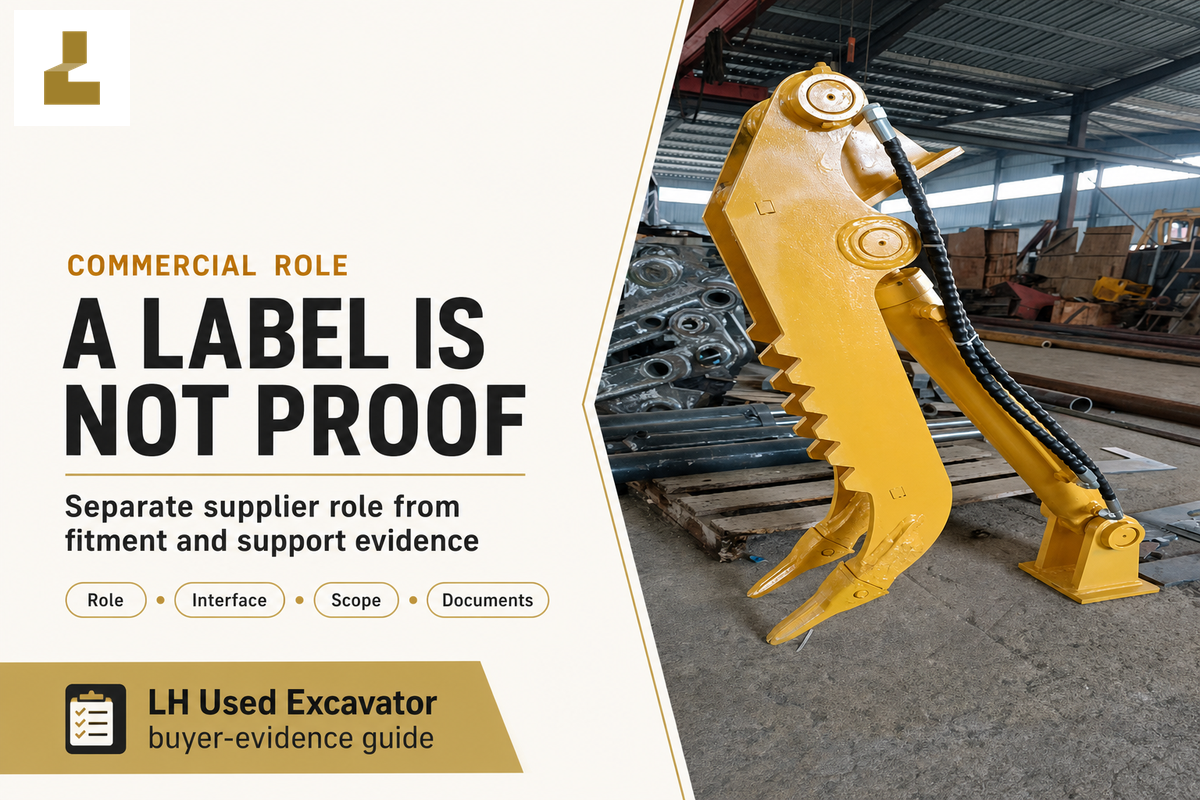
Manufacturer, supplier, exporter, or dealer labels identify commercial roles; they do not prove the exact configuration, connection, inspection condition, or support scope in your quote. Treat the label as the start of a conversation, then ask for evidence that binds the bucket to the intended machine and work.
That distinction matters because attachment safety and suitability are configuration questions. In its 2024 publication, the National Institute for Occupational Safety and Health warns that quick-coupler failure can allow an attachment to fall suddenly, with potentially severe consequences. Its guidance belongs in a safety conversation, not in a marketing claim about any particular seller’s quality. Read the NIOSH quick-coupler safety publication.
Use the commercial label to identify who will quote, coordinate, or supply the attachment. Then separate five things that listings often blend together: who owns the design, who is supplying this unit, what the bucket is intended to do, how it connects to the carrier, and what documentation follows the quoted configuration.
The 7-Field Bucket Evidence Ledger
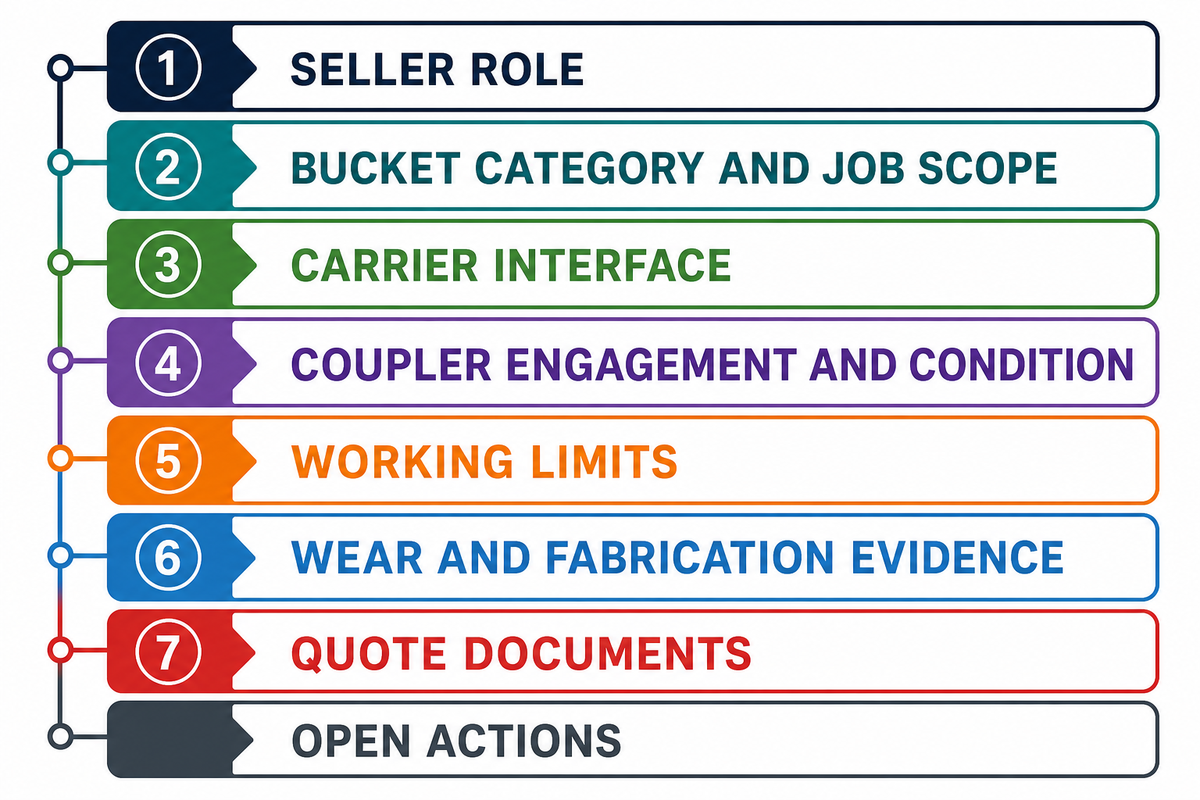
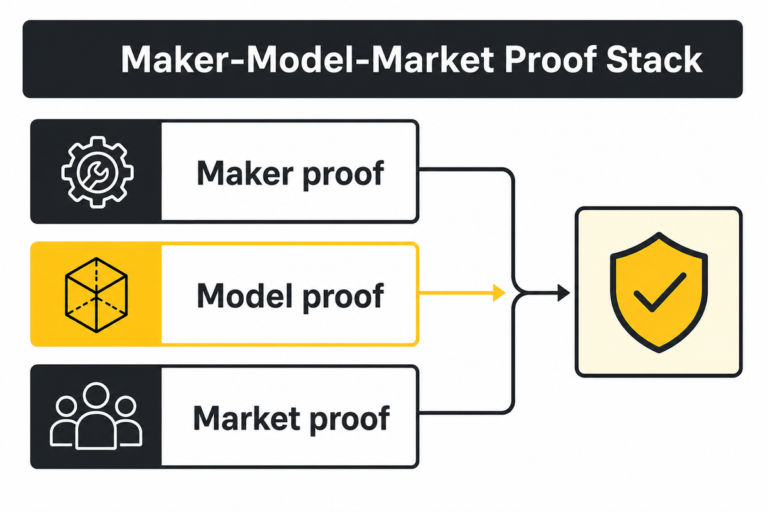
A useful bucket comparison is a 7-field evidence ledger, not a brand list. It records the commercial role, job scope, interface, engagement condition, working-limit confirmation, wear or fabrication evidence, and documents attached to the quotation. Missing fields do not automatically disqualify a supplier, but they prevent a like-for-like comparison.
Start the ledger before you request pricing. It gives sales, operations, and technical reviewers the same frame, and it makes ambiguity visible early rather than after a bucket is packed or mounted.
| Field | Ask for | What it prevents |
|---|---|---|
| 1. Seller role | Who supplies this unit and who answers technical questions? | Assuming a catalogue label proves factory role. |
| 2. Bucket category and job scope | Material, task, bucket family, and expected work pattern. | Comparing unlike buckets as if they were substitutes. |
| 3. Carrier interface | Machine model, linkage or mounting details, pin dimensions, ear gap, and pin centres. | Tonnage-only fitment assumptions. |
| 4. Coupler engagement and condition | Coupler type, compatible attachment confirmation, engagement procedure, and connection-test expectation. | A dimensional match mistaken for safe engagement. |
| 5. Working limits | Machine-specific lift and stability confirmation for the stated setup. | A pin match treated as a load or stability approval. |
| 6. Wear and fabrication evidence | Wear-part scope, inspection record, and the boundaries of any test claim. | A steel or weld phrase treated as a service-life promise. |
| 7. Quote documents | Drawing or dimensional schedule, photos, exclusions, packing, and handoff contacts. | A quote that cannot be checked after shipment. |
| Open actions | Unresolved questions, owner, and required handoff. | Treating an open technical question as an approval. |
The Claim-to-Evidence Normalization Matrix
Search tools and supplier pages often surface attractive phrases that do not carry the same evidentiary weight. Use this matrix to turn each phrase into a buyer action. It deliberately records the words without endorsing them, ranking a company, or claiming that they describe the quoted bucket.
| Claim-language group | Examples a buyer may encounter | Normalize it into this request | Do not infer |
|---|---|---|---|
| Material and fabrication | AR400, using hardened steel, advanced metallurgy, heavy-duty, rugged, durable, precision, weld, plate | Ask for the stated material, heat-treatment scope, specimen or inspection method, wear components and configuration. | Exact durability, service life or performance. |
| Promotional quality | high-quality, premium, reliable, best choice, unmatched durability, toughest jobs, excellence, commitment, reputation | Replace adjectives with photos, dimensions, inspection records, exclusions and acceptance steps. | Superior quality or a top excavator supplier ranking. |
| Engineering and origin | in-house engineering, OEM specifications, proudly made, manufacture, build, advance | Ask who owns the drawing, who built the unit, which revision applies and which records identify the facility. | Factory ownership, country of origin or OEM approval. |
| Commercial support | warranty, customer service, shipping, partner, solution, sales, customer, company, ensure, extensive | Request the written warranty scope, claim route, Incoterm, packing, document list and responsible contact. | Coverage, delivery time or support outcome. |
| Portfolio breadth | full range, wide range, buckets and attachments, attachments for excavators, thumb, mini excavator, loader, backhoe | Name the exact bucket family and quoted configuration rather than accepting catalogue breadth. | Universal compatibility or stock availability. |
| Application language | dig, grading, cutting, loading, mining, environment, efficiency, performance, end-user | Describe the material, task, work cycle, carrier and acceptance condition. | A productivity or efficiency gain. |
| Geography and ranking | USA, UK, near me, top excavator, best choice | Verify destination requirements, logistics scope and the basis of any local claim. | Local presence, legal compliance or a market ranking. |
| Competitor-name queries | Werk-Brau, Werk‑Brau, Strickland Mfg, TAG Manufacturing | Move company-specific research to a separate, sourced comparison task. | Equivalence, inferiority or superiority of any named company. |
The ledger is deliberately evidence-first. It does not ask you to diagnose an attachment from afar. Instead, it prompts the right parties to show which configuration they are quoting and what remains to be checked at installation.
Carrier, Interface, and Coupler Proof
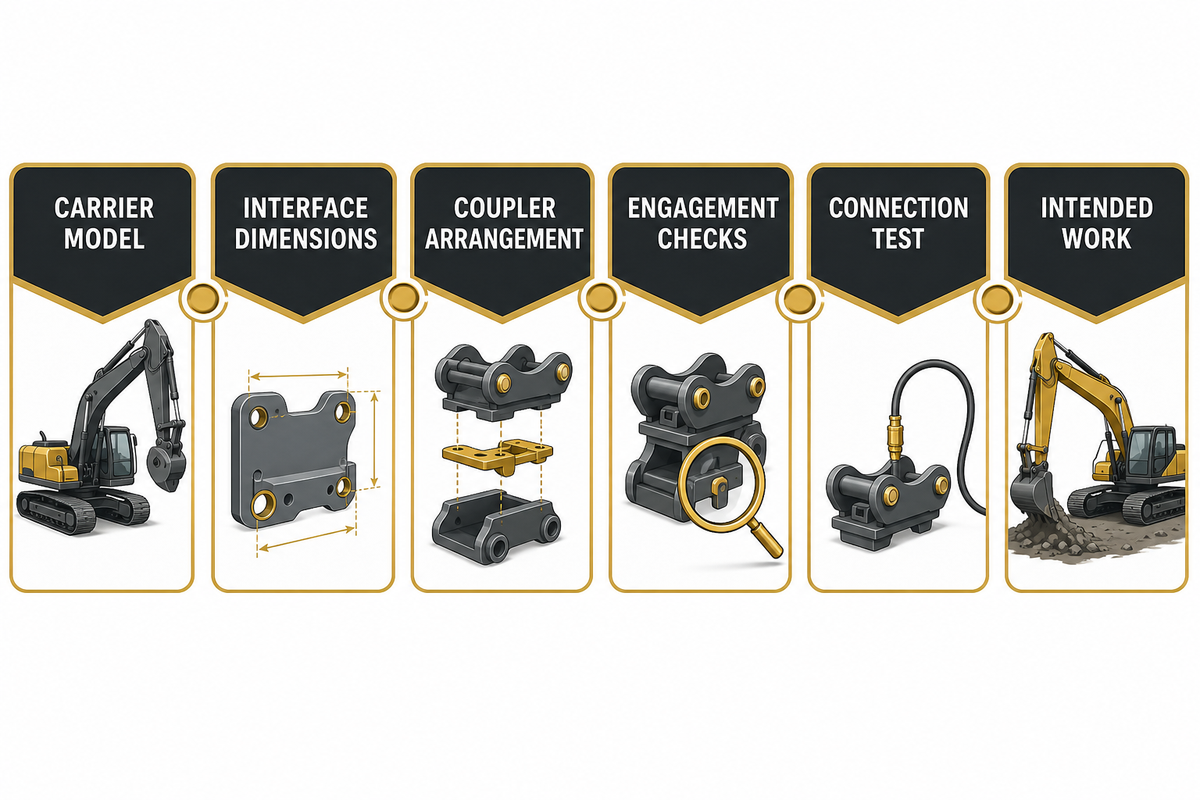
Carrier proof is a documented match among the excavator, the mounting interface, the coupler arrangement, and the intended work. A broad machine class can help you start the search, but it does not replace the dimensions, coupling details, approved-attachment information, engagement checks, and connection test required for the actual setup. The ledger’s interface and engagement fields become useful only when that carrier-specific proof is recorded.
NIOSH’s 2022 safety bulletin recommends manufacturer-approved compatible attachments, engagement checks, a manufacturer-specified connection test, and maintenance. Those recommendations explain why a supplier should not be asked only, “Will this fit a 20-ton excavator?” They do not tell you that a remote seller can approve your individual installation. Review the NIOSH prevention guidance.
Field experience adds a practical procurement lesson. In a dated Heavy Equipment Forums discussion, contributors repeatedly pointed to pin diameter, the gap between ears or plates, pin centres, boss spread, and coupler type. Use that as an attributed prompt for measurement, not as a universal dimensional chart. An older trade article also attributed a 3–6-inch tip-radius change and an approximately 3–5% breakout-force effect to some quick-coupler configurations; it is an illustration of configuration sensitivity, not a universal performance rule. Read the qualified trade context.
“Sort buckets by pin diameter, gap between plates and pin centres; hitch type can change the answer.”
Heavy Equipment Forums contributor, 2009; field experience, not a universal specification.
Do
- Record the carrier model and its actual linkage or coupler arrangement.
- Ask for the quoted bucket’s interface dimensions in one document.
- Keep engagement and connection-test steps with the installation handoff.
Don’t
- Use operating weight as a complete fitment decision.
- Assume a pin match answers every coupler question.
- Let a product photo substitute for a documented interface.
If your team needs a structured next step after collecting those details, use the site’s attachment compatibility checker as a handoff tool. Keep the result tied to the actual carrier and attachment information rather than treating it as a generic category selector.
Bucket Family Scope Before Supplier Comparison
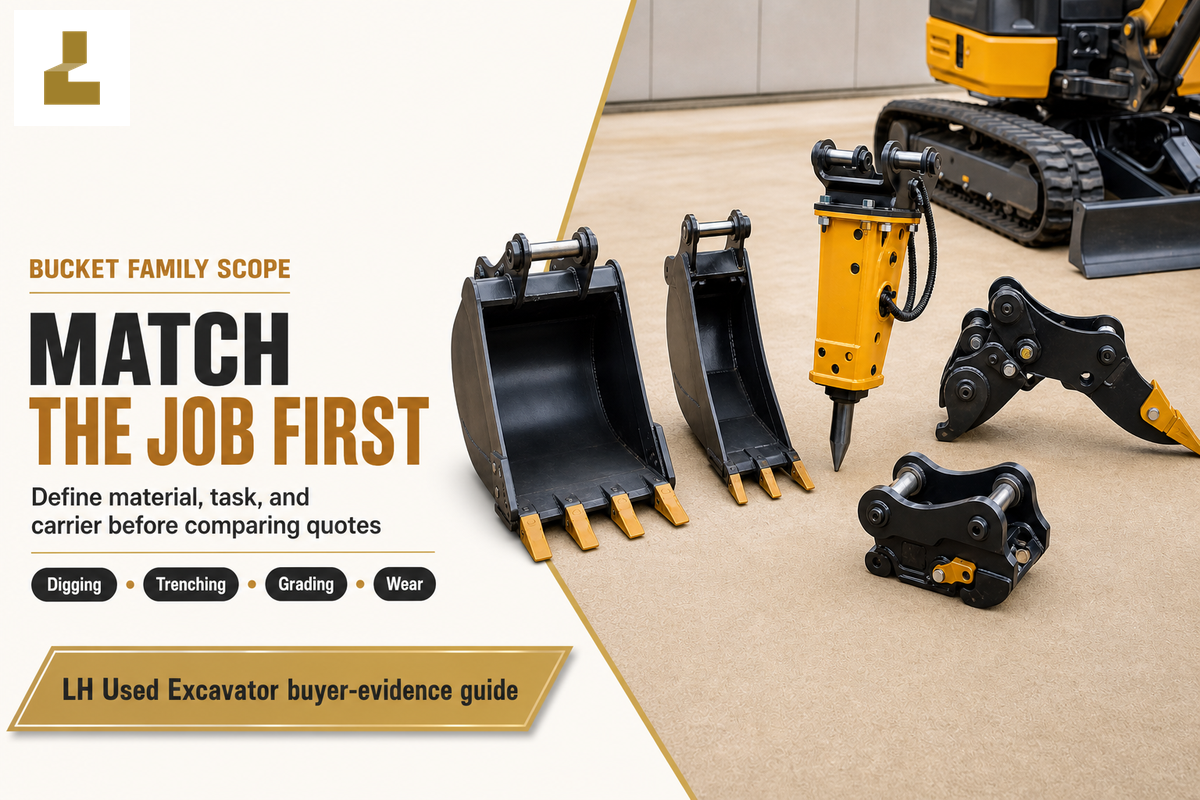
Bucket families answer different job questions, so a quote comparison starts with work scope rather than a generic “bucket” line item. With the carrier and coupler record already established, digging, trenching, grading, rock, skeleton, and tilt configurations can be compared against the intended material flow, profile, reach, or separation need.
Write the material and task in plain language: excavation in ordinary soil, narrow trench work, final grading, rock handling, screening, or a task that calls for a tilt function. Then ask the supplier to state the bucket family they are quoting and the limits of that description. This keeps a sales comparison from collapsing several applications into one vague word.
| Bucket category | Job question | Evidence request |
|---|---|---|
| Digging | What material and cycle is expected? | Quoted family and carrier interface record |
| Trenching | What trench profile is required? | Width and interface documentation |
| Grading | What finish or profile control is required? | Work description and configuration scope |
| Rock | What loading and wear conditions apply? | Wear-part inclusions and test-claim boundary |
| Skeleton | What separation task is intended? | Opening and application description |
| Tilt | Which function and connection are needed? | Coupler, hose, and operating boundary review |
| Used unit | What condition must be disclosed? | Current photos, condition notes, and exclusions |
| Custom enquiry | What must be confirmed before quote release? | Open-items list and technical handoff |
Capacity labels need the same care. ISO 7451:2007 offers a conventional method for comparing hoe-type and grab-type bucket capacities, and its scope explicitly says it is not intended to define true capacity. ISO 7546:1983 covers a different front-loader/front-loading-excavator rating scope. Neither page turns a published volume into a jobsite payload or machine-suitability decision. See ISO 7451’s stated scope and the separate ISO 7546 scope.
For a commercial follow-up after the evidence screen, you can review bucket-family options with the on-site selector. Use it to organise the product conversation, not to overwrite carrier-specific checks.
Wear Parts and Material Evidence
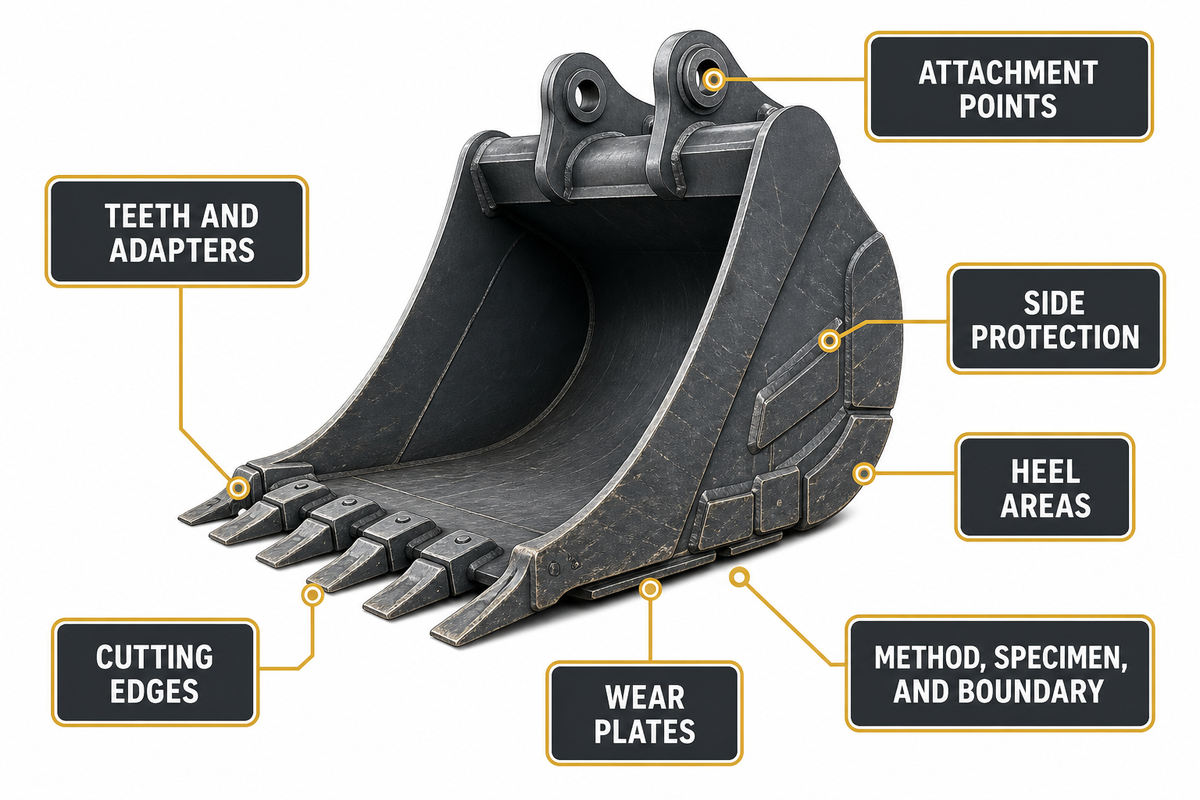
Wear evidence should tell you what is included, what was inspected, and what a quoted test actually means. After the bucket-family screen and carrier evidence are settled, teeth, adapters, cutting edges, side protection, heel areas, wear plates, and attachment points can be assessed against the job, material, maintenance practice, and particular bucket configuration.
Ask suppliers to identify the ground-engaging and wear components included in the quote; note any replacement scope; and distinguish observations from promises. Statements about steel, hardening, plate, or welding are not automatically durability conclusions. Any performance conclusion needs a defined method, specimen, and boundary.
For example, ASTM G65 ranks metallic materials by abrasion volume loss under specified dry-sand/rubber-wheel conditions. That makes it useful for understanding a controlled abrasion comparison, not for predicting exact service resistance in your material and environment. Read the ASTM G65 scope.
Likewise, ISO 9015-1 describes hardness testing on transverse sections of arc-welded joints. Its scope is a test method, not a certificate for an entire bucket or a factory. See ISO 9015-1’s stated scope. For procurement, request the relevant evidence, then state exactly what it does, and does not, support.
Used, OEM, and Aftermarket Scope Boundaries
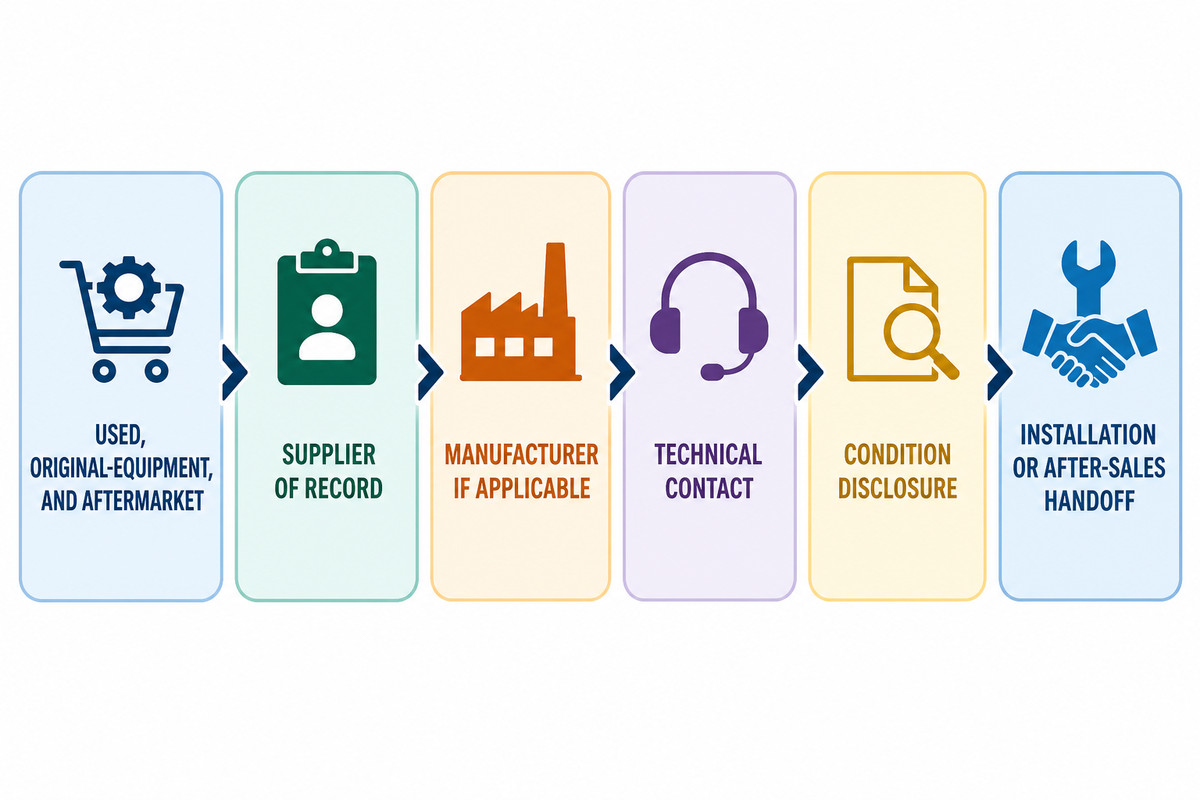
Used, original-equipment, and aftermarket labels describe sourcing context; they should not be used as shortcuts for condition, factory role, compatibility, or support. The buyer’s task is to ask what is being supplied, in what condition, for which carrier arrangement, and who owns the next technical or service decision.
This applies especially when an exporter or used-equipment supplier coordinates attachments. LH Used Excavator’s excavator attachment range describes buckets, hydraulic breakers, grapples, and other attachment categories alongside its used-excavator portfolio. Here, the page is first-party supply context. It is not independent proof that every listed attachment is manufactured by the seller, or that a listing establishes a specific fit, material grade, certification, lead time, or performance outcome.
Write the role directly into the RFQ: “supplier of record,” “manufacturer if applicable,” “technical contact,” “condition disclosure,” and “installation or after-sales handoff.” Clear role boundaries protect both sides because they make the right question reach the right person.
The Carrier-to-Bucket Proof Sequence
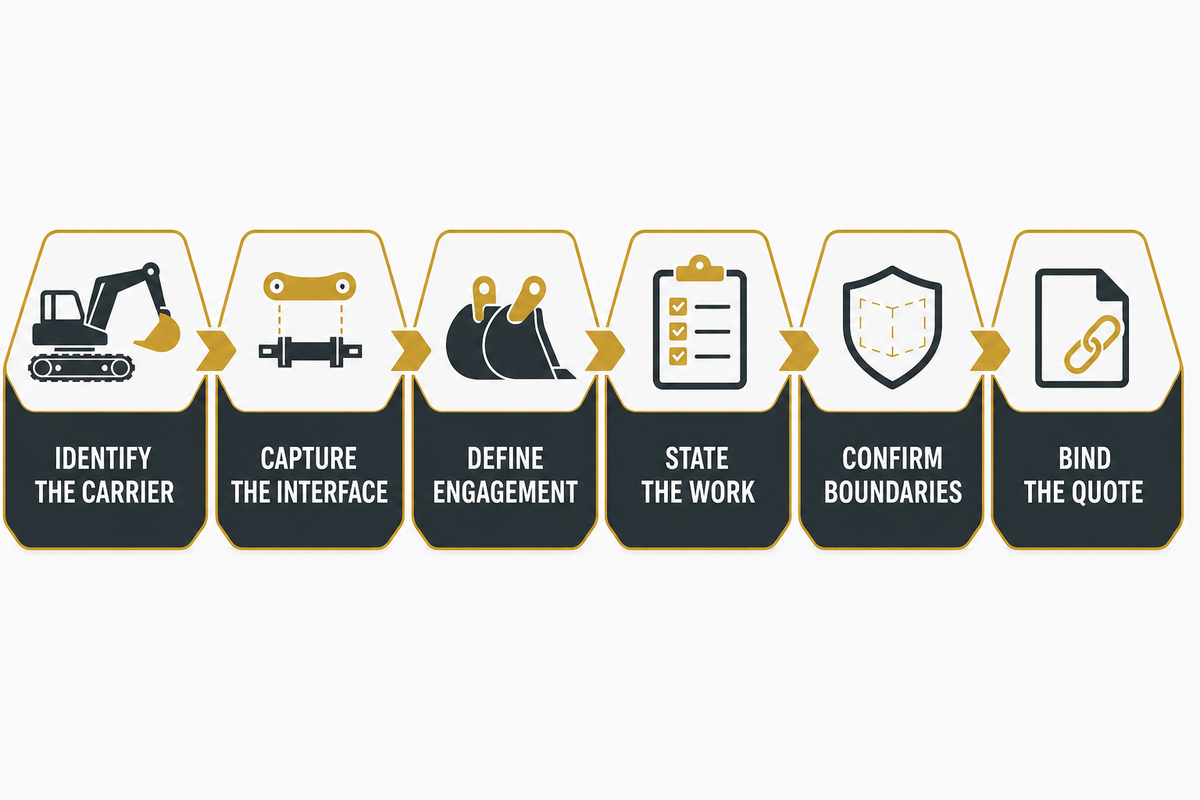
The carrier-to-bucket proof sequence moves from identity to interface, engagement, work scope, limits, and documents. It exposes the hidden bottleneck in a quick purchase: a bucket can look suitable in a listing while one unresolved connection, coupler, condition, or working-limit question remains open.
One more boundary belongs in that sequence. ISO 10567:2007 covers a method for hydraulic excavator lift capacity and applies to both hydraulic lift-capacity and machine-tipping limits. ISO 10567 does not give a buyer a do-it-yourself safety calculation. Its scope signals the need to request machine-specific confirmation for the stated arrangement when lifting or stability is relevant. Read the ISO 10567 scope.
- Identify the carrier — record the exact excavator model, configuration, and installed coupler or linkage information.
- Capture the interface — place pin, ear-gap, centre, and other mounting details in the enquiry record.
- Define engagement — name the coupler arrangement and retain the applicable engagement and connection-test steps.
- State the work — describe material, task, bucket family, and any wear-part expectation.
- Confirm boundaries — escalate machine-specific lift or stability questions to the appropriate manufacturer or qualified technical party.
- Bind the quote — check photos, dimensions, exclusions, documents, packing, and handoff contact before release.
When the carrier information is complete, a dedicated OEM fitment check can help structure the next product conversation. That fitment checker should complement, not replace, the manufacturer’s instructions and the actual connection test.
Build a Comparable RFQ Before You Ask for Price
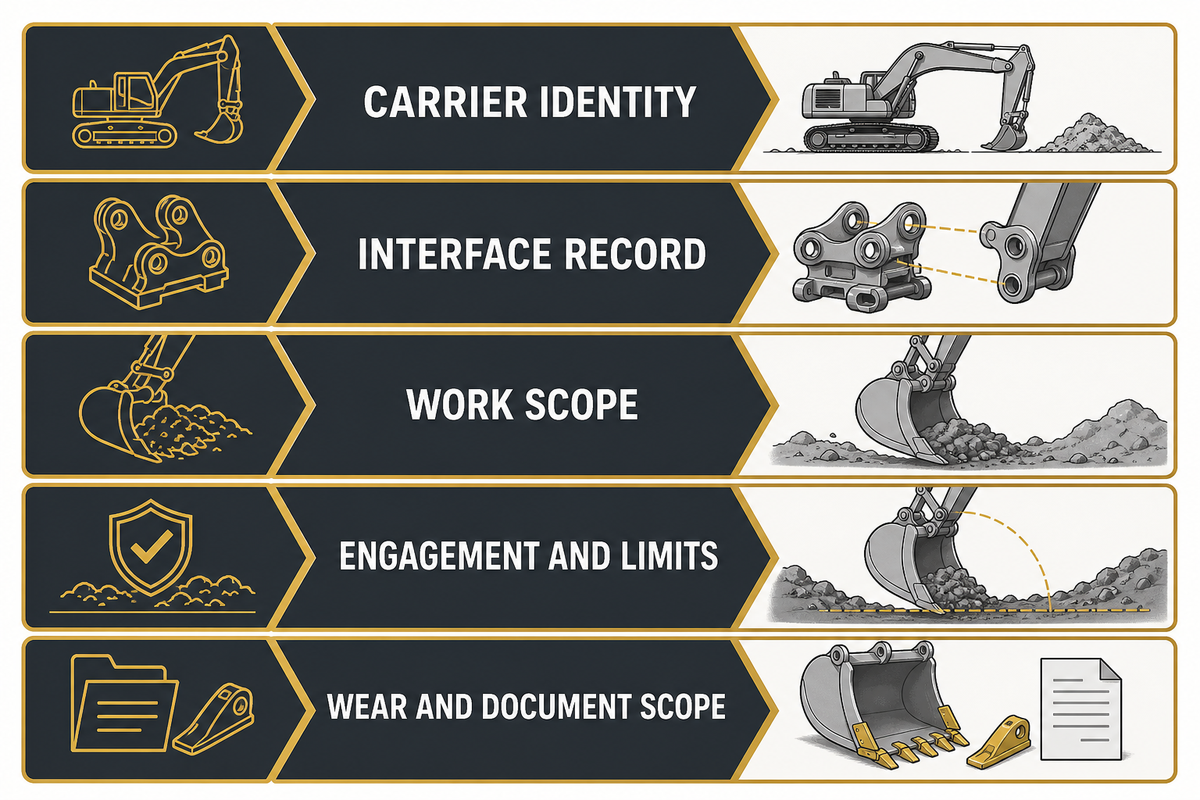
A comparable request for quotation names the carrier and interface, the task and bucket family, the wear-part scope, requested documents, and the responsible contacts. That structure prevents two suppliers from answering different questions under the same product name, then appearing comparable only because both supplied a price.
Use the following checklist as an enquiry template. Leave fields blank if you don’t know them yet, but label them as open items. That’s better than filling an assumption into the request and allowing it to travel through the quote unnoticed.
RFQ checklist — copy these into your quote request:
| Parameter | Requested detail | Why it matters | How to verify |
|---|---|---|---|
| Carrier identity | Model, configuration, linkage or coupler | Sets the fitment context | Carrier records and current photos |
| Interface record | Pin, ear-gap, centre, and coupler details | Avoids category-only assumptions | Dimension schedule and technical confirmation |
| Work scope | Material, task, and bucket family | Makes the quote comparable | Written use description |
| Engagement and limits | Coupler procedure and any lift or stability escalation | Keeps safety questions visible | Applicable instructions and qualified confirmation |
| Wear and document scope | Included wear parts, inspection evidence, exclusions, packing, and contact | Defines what follows the unit | Quote annex, photos, and handoff record |
Price becomes more meaningful after this record exists. You can then compare whether each supplier has answered the same configuration, not merely whether each has named a bucket. For a catalogue-level follow-up, the bucket sizing guide can help your team organise preliminary inputs before it seeks configuration-specific confirmation.
Use the Right On-Site Tool After the Screen
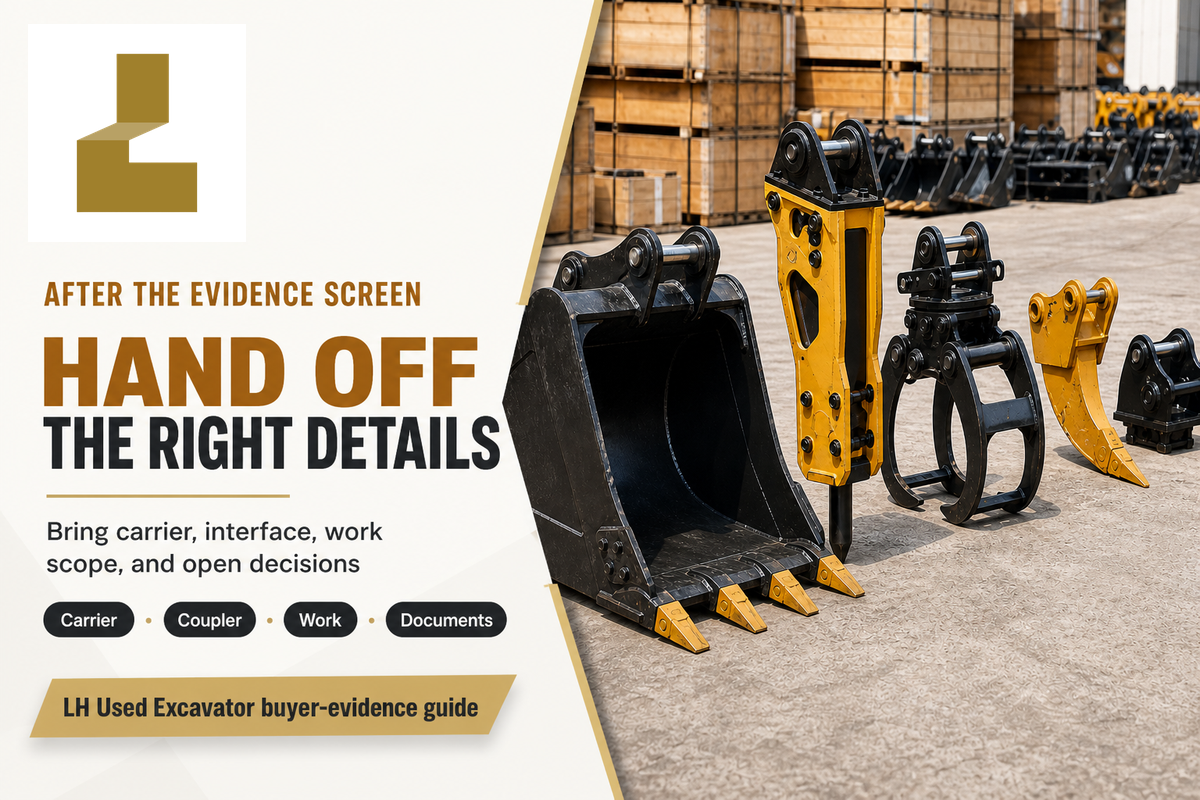
An article should help you ask better questions; it shouldn’t impersonate a sizing calculation, a fitment record, a connection test, or a carrier manufacturer’s instruction. Once your evidence ledger is complete, move to the appropriate site tool or technical contact with the actual details already assembled.
The handoff is more efficient than starting again from a broad category page. Your team already knows the carrier, interface questions, job, bucket family, document requirements, and unresolved decisions. With that record, the team can now use an attachment hub to review options without losing the proof trail that made the shortlist defensible.
Key takeaway
The best excavator bucket manufacturer comparison is not a name list: it is a documented chain from the exact carrier and connection through the work scope, safety boundary, wear evidence, and quote handoff.
If you’re ready to move from the evidence screen to an attachment discussion, explore LH Used Excavator’s attachment range with your completed carrier and work details at hand.
Frequently Asked Questions
Who makes excavator buckets?
Excavator buckets may be supplied through original-equipment channels, attachment specialists, dealers, exporters, and aftermarket manufacturers. Commercial labels do not establish the exact role for a quoted unit, the unit’s condition, or the carrier configuration it fits. Request a role disclosure, a technical contact, an interface record, and documents that identify precisely what the supplier is offering.
Are excavator buckets universal?
No. A bucket search can start with carrier class, but connection details, coupler arrangement, linkage, condition, intended work, and applicable instructions still need confirmation for the actual setup. A similar-looking bucket or a matching operating-weight class does not substitute for a documented interface and engagement review before installation or use.
What should I ask before ordering an excavator bucket?
Ask for carrier identity, mounting or coupler details, interface measurements, intended material and task, bucket-family scope, wear-part inclusions, documents, exclusions, and the technical handoff path for unresolved safety or stability questions. Keep every open item visible in the request for quotation, so a price comparison cannot conceal that suppliers answered different configurations.
Does a capacity rating prove jobsite payload?
No. Capacity ratings can have defined comparison methods and scopes. They do not by themselves establish material density, machine suitability, field payload, breakout force, or the safety of a particular attachment arrangement. Confirm which bucket family the rating covers, what volume convention the supplier used, and whether the quoted carrier, coupler, intended work, and material have been evaluated separately. Where lifting or stability is involved, retain the applicable manufacturer instructions and obtain machine-specific confirmation from the appropriate qualified technical party before installation or use.
Should I ask a supplier for a fixed bucket recommendation from tonnage alone?
No. Provide the model, linkage or coupler details, work scope, and known measurements. Use tonnage only as a discovery filter, then retain applicable manufacturer instructions and connection testing for the actual arrangement.
References & Sources
- NIOSH Publication 2024-102: quick-coupler failure safety information
- NIOSH: preventing struck-by injuries from quick-coupler failures
- ISO 7451:2007 bucket capacity-comparison scope
- ISO 7546:1983 bucket-rating scope
- ASTM G65 abrasion-test scope
- ISO 9015-1 weld-hardness-test scope
- ISO 10567 hydraulic-excavator lift-capacity scope