Get in Touch with Liehuang Company
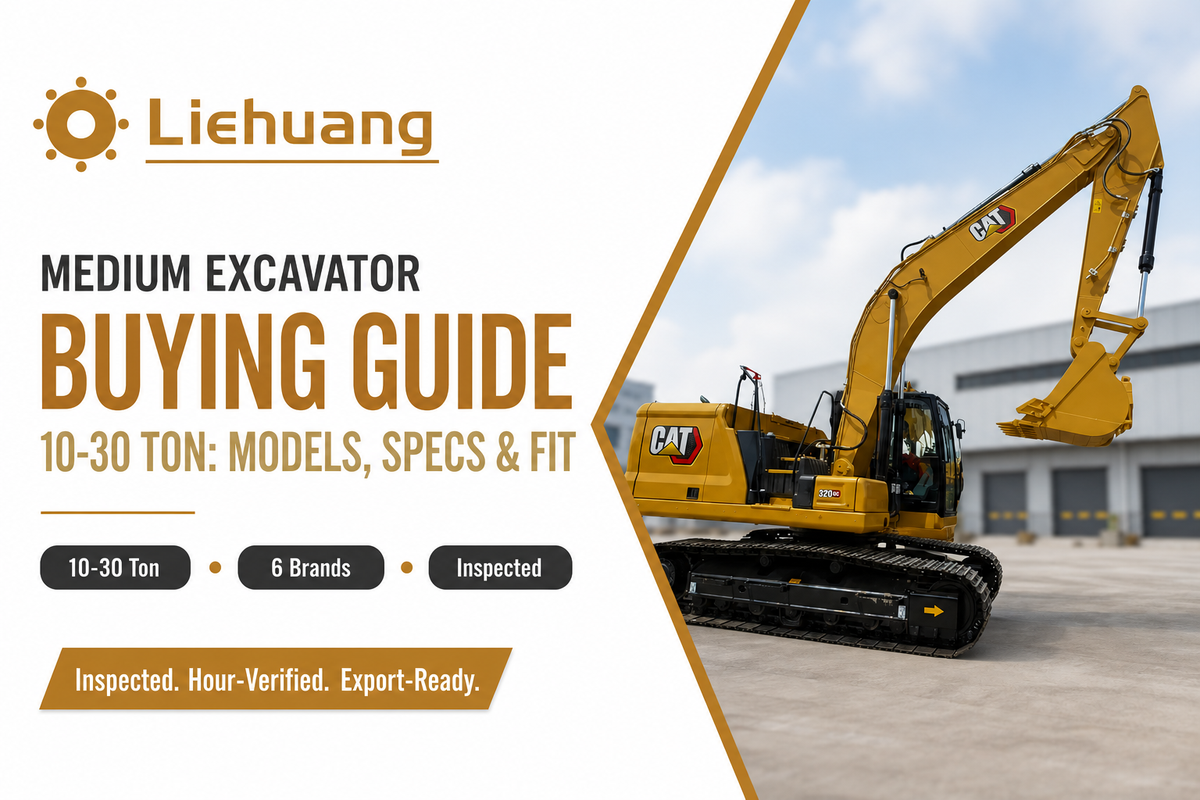

A mid size excavator is a crawler or wheeled excavator in roughly the 10-30 ton operating weight class-the industry’s workhorse machine, and the size most contractors and equipment dealers actually spend their money on. It’s also where the most expensive buying mistakes happen. Before you compare a single listing, it helps to know what “medium” really means across brands, which specific excavator models sit in this range, and which numbers on a manufacturer specification sheet actually predict how the machine will perform on your job.
Quick Specs: Medium Excavator Class
| Operating weight range | ~20,000-66,000 lb (9-30 metric tons), depending on which OEM’s cutoff you use |
| Typical max dig depth | 15-24 ft (4.6-7.3 m) across the class |
| Typical bucket capacity | 0.5-1.5 yd³ (0.4-1.1 m³) |
| New excavators >10t sold in the US | ~16,000 units, July 2024-June 2025 (+2.6% year over year) |
| Transport | Standard trailer up to ~20t; lowboy + possible permit above that |
What Counts as “Medium” (10-30 Ton)? Defining the Middle Tier
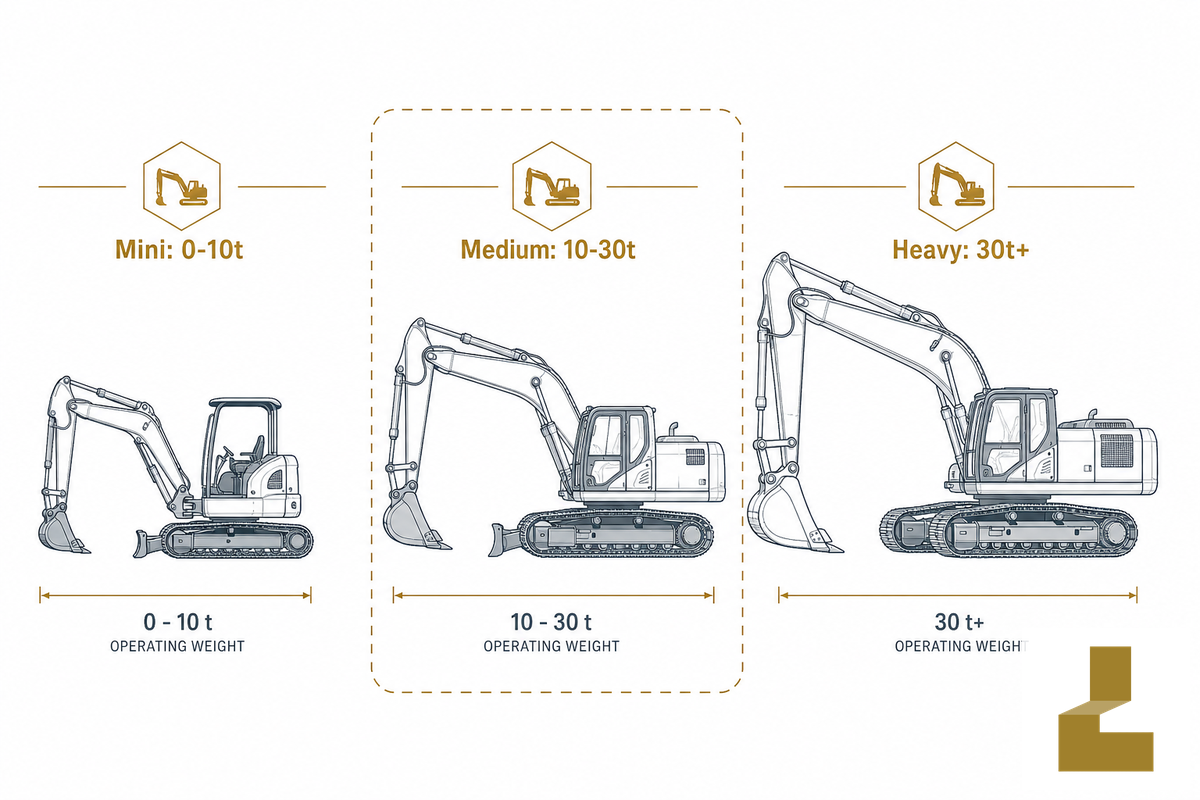
Medium is not a fixed number in the excavator market, and treating it like one is a real procurement trap: it’s roughly a 10-30 ton operating weight range that most dealers use, but because OEMs themselves define the cutoff three different ways depending on the manufacturer, there’s no one single fixed industry standard.
The ISO 6165:2022 earth-moving machinery classification standard gives the industry a shared vocabulary and identification structure for excavator types, but it does not itself hand down a specific “10-30 ton = medium” cutoff – that number comes from individual manufacturers, and they don’t agree. Caterpillar treats mini as under roughly 10 tons and large as over 45 tons, john deere’s own mid-size line spans 7.5-40 tons, and one commercial buyer’s guide places its “mid-size” category at 20,000-50,000 lb (about 9-22.7 metric tons) – a narrower band than the 10-30 ton range most dealers, including used-equipment exporters, use as their working definition.
What the vocabulary in ISO 7135:2009 does settle is the machine type itself: a self-propelled crawler or wheeled hydraulic excavator, distinct from a wheel loader, backhoe, or skid steer. Three “types” questions come up often enough to answer directly: crawler excavators (tracked, the standard for medium-class work), wheeled excavators (road-mobile, less common above 15 tons), and compact/mini excavators (compact models under roughly 10 tons, a separate class not covered here). OEM spec sheets typically list maximum digging depth and reach separately from operating weight – check both, not just the tonnage number.
For a machine you’re actually comparing, stop reading the size label and check the operating weight in pounds or metric tons directly, the same way you’d cross-reference an OEM’s own excavator size chart – that’s the number that determines transport, permits, and job fit, not whether a listing calls it “medium” or “mid-size.” Cat excavator sizes, Komatsu excavator sizes, and every other brand’s excavator sizes and weights are published to a slightly different cutoff, so the chart only tells you the class; the spec sheet tells you the machine.
Matching Tonnage to the Job: A Medium-Tier Fit Framework
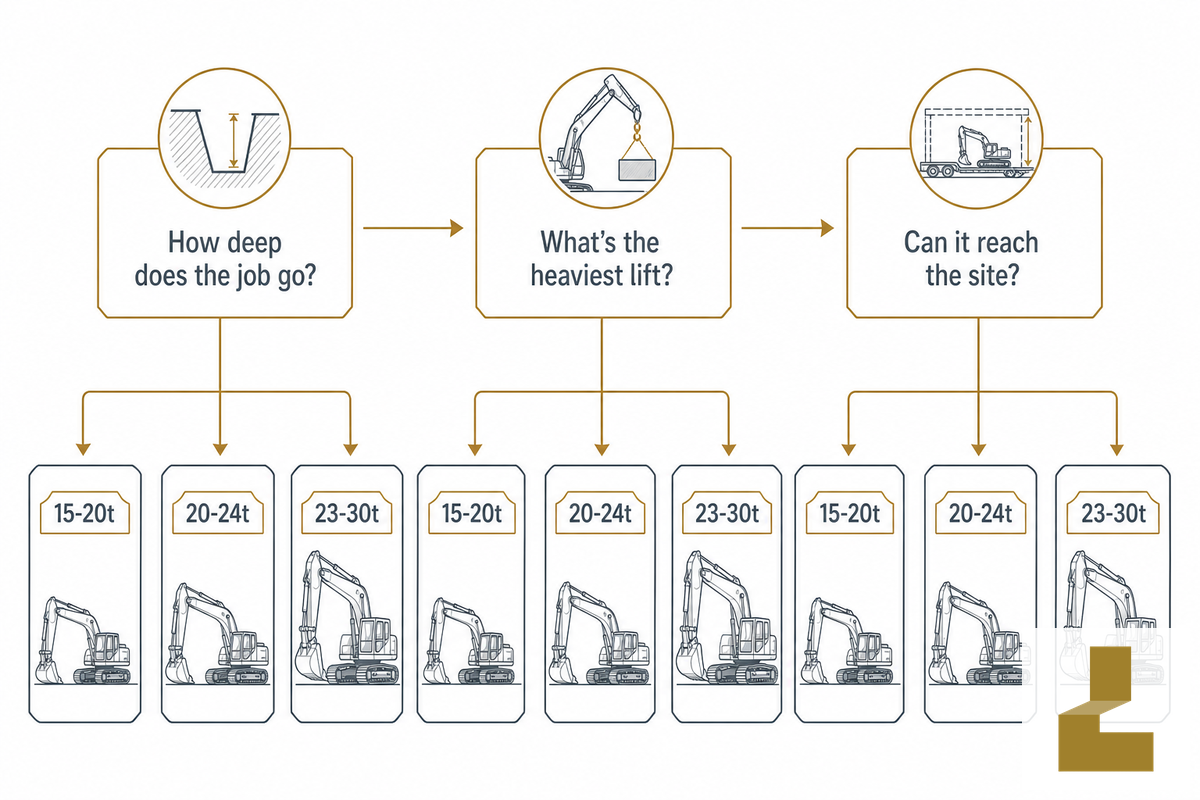
Within the 10-30 ton range, the machine that fits a utility trenching job isn’t the machine that fits a foundation dig or a demolition site – and picking by “roughly this size” rather than the job’s actual requirements is where both over- and under-buying happen. Two datasets confirm the cost runs both ways: underspecified machines lose an estimated 40-55% of productivity on jobs that exceed their capacity, while oversized machines waste an estimated $12,000-$28,000 a year in unnecessary fuel and transport costs on jobs that didn’t need the extra tonnage.
Bigger isn’t automatically better; matched is better, because the 40-55% and $12,000-$28,000 figures above both come from picking tonnage by “roughly this size” instead of by the job’s actual depth, lift, and transport requirements.
Three questions narrow the tonnage band before you look at a single listing:
The 3-Question Medium-Tier Job-Match Framework
- The depth: Utility and residential foundation digging will generally get you no deeper than 15-18 ft; that’s a 15-20 ton machine. For deep foundations, pipelines, site clearing, and quarry support digging, you typically have to go to a depth of 20-24 ft, requiring 23-30 ton equipment.
- The single biggest lift is…how big? Well, the rated capacity increases as tonnage goes up, but excavators aren’t rated for use with a crane out of the box, nor are wheel loaders and backhoes according to OSHA’s crane standard (29 CFR 1926.1400). This is true even if you’ve added a sling or chains to hoist a load suspended from the lift arm. Always verify the OEM’s rated capacity of your machine’s specific setup with your training level before you put that lift in your project plans, not after.
- Can it actually reach the site? Most 10-20-ton machines travel on a regular trailer with no permit needed. Above about 23-25 tons you generally look to the lowboy + permit world; the Federal Highway Administration’s size regulations cap standard National Network width at 102″ width, and most states’ height limit around 13’6″-14′ – anything beyond that height/width needs a permit and route assessment before you ever touch the site, which is a scheduling issue not a productivity issue.
Put it together, a utility contractor doing utility work in a tight urban jobsite, a land clearing operator working open acreage, and a foundation or demolition contractor working 20-24 ft depths with heavier lift and breakout requirements each land in a different band even at similar depths-site conditions shape the call as much as dig depth does. The 15-22 ton band typically covers utility trenching with intermittent pipe-handling lifts; 23-30 tons suits foundation and demolition work with heavier lifting capacity and breakout requirements (acknowledging the transport, permitting, and closer site maneuverability implications that come with larger size). Difficult urban confined conditions can steer this suggestion towards a short-radius model even within a similar tonnage band.
Medium-Class Models by Brand: Cat, Komatsu, Hitachi, Volvo, Doosan & More

Now that you know what weight class your machine fits into, there’s the question of which mid size excavator models actually meet that criteria, and excavator manufacturers’ 2025-2026 lineups made bigger moves than most would imagine. According to Equipment World’s 2025 Excavators Buyer’s Guide-which uses financing data from Fusable/EDA-the No. 1 and No. 2 best-selling new financed excavators over 10 metric tons in the U.S. both wear the Cat brand. They’re the 340 and 336 respectively.
Rounding out the top five, according to this data, are the 320 (4th) and 315 (5th) models. Third on the list is the john deere 210 P-Tier-which at 23.6 metric tons and 159 horsepower is Deere’s highest-volume excavator model over 10 metric tons-with another Cat model, the 320D L, sitting in sixth place.
| Brand / Model | Operating weight | Engine power | Notes |
|---|---|---|---|
| Caterpillar 320 | ~32,000 lb (14.5 t) | 162 hp | EDA sales rank #4 >10t US |
| Caterpillar 340 | ~30t class | — | EDA sales rank #1 >10t US (top seller) |
| Komatsu PC210LC-11 | 23.2-23.4 t | 165 hp | EDA sales rank #9; new PC220LC-12 succeeds this class |
| Hitachi ZX210-class | ~19.9 t | 147 hp | Lineup runs ZX130 (13.7-15.4t) to ZX350C-7H (36.4t) |
| Volvo EC260 / EC300 | 26 t / 30 t | — | All-new 2025 redesign replacing EC250; Volvo cites 15% better fuel efficiency and 10% faster cycle times vs. the prior generation |
| Develon (formerly Doosan) DX225 / DX255 | ~22-25 t class | — | Doosan Infracore’s excavator brand was renamed Develon under HD Hyundai; older used units are still correctly labeled “Doosan” |
| Case CX145D SR | 32,100 lb (14.6 t) | 102 hp | Case’s top-selling model in this range, short-radius tail swing |
| Bobcat E220 / E245 | 23 t / 25 t | 174 hp / 189 hp | Bobcat’s first-ever excavators in this tonnage tier, launched 2025 |
Across these mid-sized excavators, digging force and cycle time for a given tonnage is comparable. On-site performance or versatility has rarely been the true differentiator. It more often has to do with parts availability, dealer network depth and 3-5-year resale demand, which clearly differentiates a wise buy from an intelligent set of excavator specifications published figures. That’s an information query, not marketing; find any dealer, used or new, ask them about actual equipment availability; for a specific model number how many common wear items (undercarriage, hydraulic seals, filters, etc.) are in stock versus special-order in the area and what’s the lead time on the special order.
The machine’s stated production capacity only means so much if the infrastructure to support the unit will keep it operating.
How to Read a Spec Sheet: What Actually Predicts Productivity
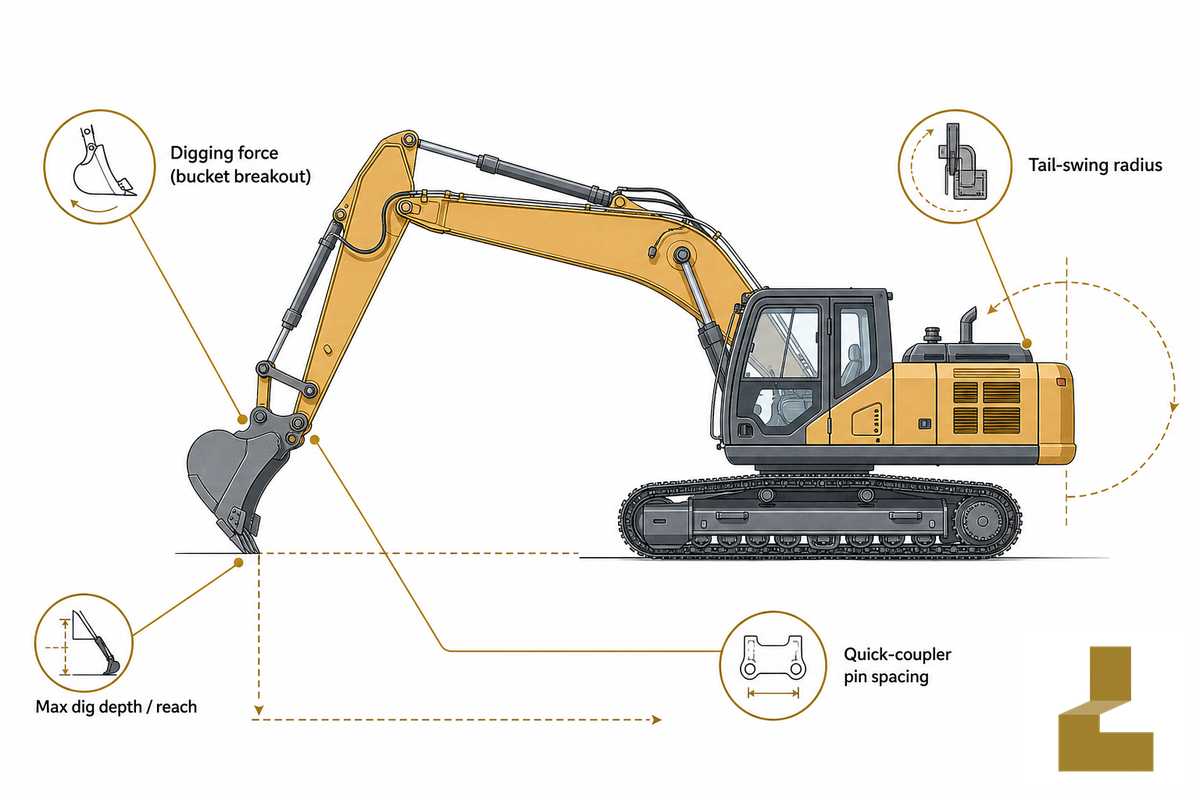
Your ton tonnage specifies a size class, not how a machine will work in reality in your yard. A handful of other spec sheet specs are more important than the majority of buyers actually care about:
📐 Engineering Note
Digging force – bucket breakout force-is key in hard and compacted material-in this class, typically 20,000 to 42,000 lb-ft. a 20-ton with good breakout force can outperform a 25-ton machine with a softer hydraulic system when digging dense soil. As much as reach on tight sites is important, tail-swing radius is the prime factor: a short-radius (SR) and zero-tail-swing design sacrificed some of its counterweight-generated lifting ability for the capacity to work to a property line or against a wall. fuel consumption-six to nine gallons per hour at maximum load and duty cycle for this tonnage-can easily show $5,000 to $10,000 a year differences based on fuel economy alone. A more fuel-efficient model in the same tonnage class pays that difference back through lower fuel spend and less downtime lost to extra stops at the fueling station if not refueled at midday.
Sightlines, control responsiveness and noise suppression in the cab have real dollar value in productivity; as do the durability beneath.
Coupler compatibility must match – do not guess it. Coupler engagement and attachment-release failure is a recognized safety issue in the industry, serious enough that the international standards body has a dedicated quick-coupler safety standard in development (ISO/DIS 13031, still a draft), defining coupler engagement and lock-verification criteria. Double check coupler pin spacings and flow ratings to your bucket, thumbs or hydraulic breakers you already use, before you make a purchasing assumption about “one size fits all.”
✔ Advantages of buying in this tonnage band
- Largest in brand/mode-S selection of any excavator class, above 15 models of 6+ major OEMs more than 10T each
- Deepest resale market-most heavily traded size class in the used-equipment space dealers
- Deals with a larger variety of jobs in the fleet with one machine only
⚠ Limitations to plan around
- For anything above about 23-25 tons it goes to lowboy plus permit vs. regular trailer
- Costs of fuel and undercarriage rise with weight – going bigger than necessary comes at a tangible yearly cost
- Actual lift capacity ranges greatly based on equipment set-up; “tonnage” across manufacturers not comparable
New vs. Used at This Size Class
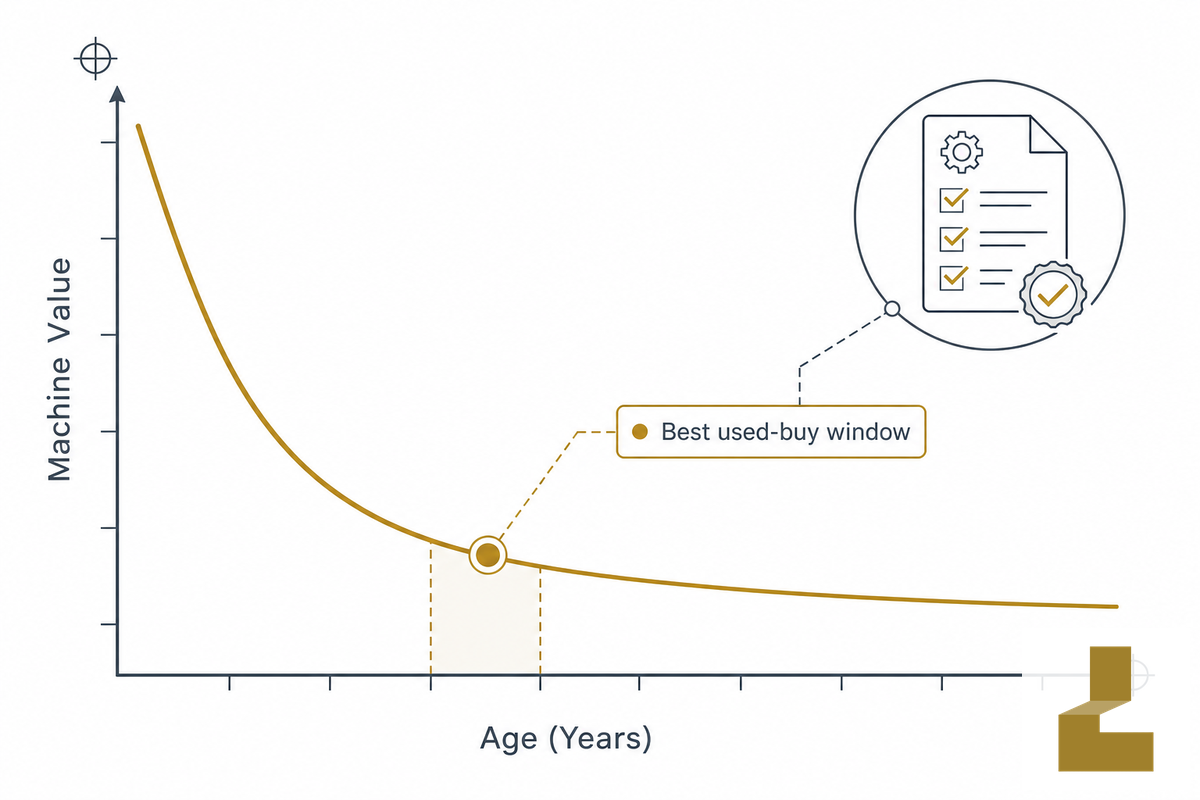
Whether the job ahead is trenching, grading, or demolition, buying used in this class mostly comes down to the depreciation curve: a new excavator depreciates most dramatically in its first one to two years of life and then slows significantly, making three- to five-year-old units still most of their useful lives away, at a fraction of the new price. Take a hypothetical 4-year-old, 20-ton machine with 4,500 verified hours and full service records: it’s already absorbed most of its first-owner depreciation, but still has the bulk of a typical 8,000-10,000-hour undercarriage life ahead of it-a materially better price-per-remaining-hour trade than the same model at 1 year old. That math only holds, of course, if machine condition lives up to the cost promise, since a history-free unit can hide the true costs the depreciation curve was meant to mitigate; an unverified low-hour unit with gaps in its service record is a worse bet than a well-documented higher-hour machine, not a better one. Machine-level condition ratings and full total cost of ownership breakdowns for Liehuang’s own inspected used medium excavators (10-30 ton) are contained on that page, rather than here. One misconception worth correcting up front: an older used excavator isn’t automatically noncompliant just because it’s aged past a newer emissions rule. Under 40 CFR Part 1039, engines that originally met Tier 1, Tier 2, or Tier 3 standards remain subject to those original standards, not whatever tier applies to new machines today-age alone doesn’t retroactively bar a properly maintained older unit.
What to Check Before You Buy at This Scale
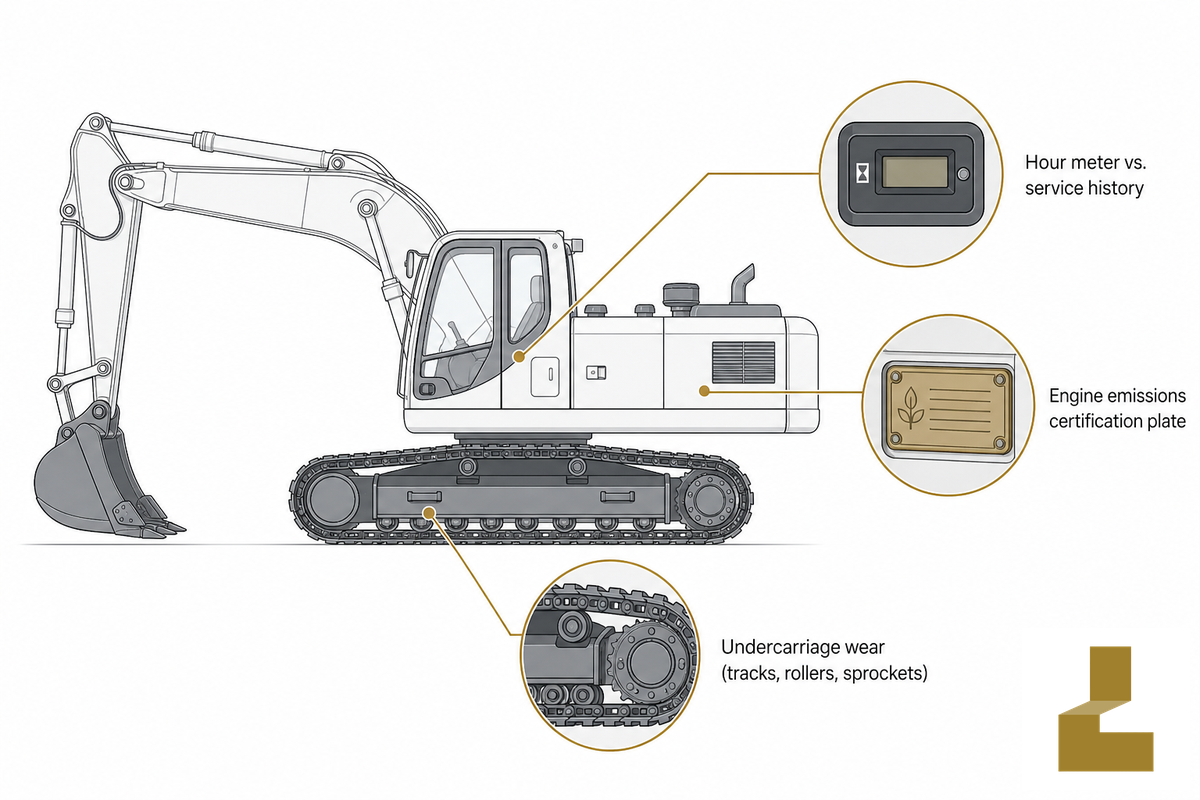
Before placing an offer at this scale, check three things: undercarriage wear, measured rather than estimated; the hours logged on the meter against the machine’s documented service history; and, for imported machines, engine emissions compliance certification. Missing any one of these costs far more on a 20-30 ton machine than on a smaller one.
Missing an unseen problem is proportionately more expensive on 20 to 30-ton machines than on smaller ones-the undercarriage wear on a mini excavator would be an easy fix, whereas here it could necessitate a $15,000-$35,000 undercarriage replacement cycle (undercarriages can range from 25 to 40 percent of machine value depending on age, wear and how value is measured). A mismatch between logged hours and documented history should be treated as an immediate red flag, not a legalistic detail, and EPA nonroad diesel engine rules may restrict importability and usage on a border-crossing purchase. Liehuang’s 12-point inspection scorecard documents all three areas on every unit, cross-referenced against serial number and maintenance records.
Industry Outlook: Is the Medium-Class Used Market Tightening?

Updated July 2026. Two independent sets of data-Manufacturers’ New Orders for Construction Machinery Manufacturing (FRED) increased from $4,099 million in January 2026 to $4,879 million in May 2026, and new excavator machines weighing over 10 tons, according to Fusable/Equipment World data, accounted for 16,000 units in the U.S. between July 2024 and June 2025-corroborate one trend: demand is up.
That growth isn’t an anomaly. Last year alone, 11 manufacturers, including Bobcat and Volvo (which just redesigned their EC260 and EC300 series), launched new machines into the midsize range.
Put together, the result is a more vibrant medium-size construction machinery market than equipment blogs sometimes imply. What this translates to for a buyer is increased choice, rather than diminishing availability, from a market whose primary machines are being expanded, not scaled back, by manufacturers.
“Volvo began the biggest redesign of its midsize and large excavators in more than 20 years in 2024 and continued the rollout into 2025” — Equipment World, Excavators Buyer’s Guide 2025
That’s not an isolated data point. Eleven manufacturers released new models in the medium-to-large range in the same window, including Bobcat’s first-ever entries into the 23-25 ton tier and Volvo’s ground-up EC260/EC300 redesign. This isn’t to say you need to jump in and buy immediately before supply dwindles-the mistake would be assuming the opposite, that a shrinking market means fewer options and higher prices ahead. Rather, because popular models-including the Caterpillar 340, Cat 336 and John Deere 210 P-Tier-tend to carry lead times or higher price tags precisely because demand for them is strong, a buyer with flexibility on brand can often move faster, negotiate harder, and reduce operating costs on a comparably specced machine from a less back-ordered line. If you’re shopping in the next two to three quarters, that means checking Liehuang’s current medium-class inventory against more than just the top sellers-a less in-demand model at a comparable spec can close the deal faster and reduce costs not just today, but throughout the life of the equipment.
Frequently Asked Questions
Q: What is considered a midsize excavator?
View Answer
There’s no industry-wide standard. Most used-equipment outfits-including ours, Liehuang-tend to set the 10- to 30-ton range for medium-size (or “mid-size”-more on that below) machines, but individual OEM catalogs define that boundary a little differently-Caterpillar puts anything under about 10 tons in their “mini” category and anything over 45 tons in “large”; their own mid-size line ranges from 7.5 to 40 tons; at least one common buyer’s guide specifies “medium-sized” from 20,000 to 50,000 pounds (around 9-22.7 metric tons). ISO 6165 gives the industry a shared classification standard and common terminology for excavator types but doesn’t itself specify the tonnage break. For an actual comparison between two specific machines, compare the operating weight in pounds or metric tons instead of the size designation.
Q: What is the best mid-size excavator for my job?
View Answer
There is no one best medium excavator for every job. The right choice depends on your specific dig depth, lift requirements, transport capabilities, and other factors, all of which we walk you through in the Medium-Tier Job-Match Framework above. However, it is worth knowing that the current best-selling medium and heavy excavators (by actual financing volume in the US) among machines over 10 metric tons are the Cat 340 and 336 (in first and second place, respectively) and the Deere 210 P-Tier (in third place overall). Popularity, of course, doesn’t equate to fitness. For example, a 30-ton Cat 340 would be a poor choice for a 15-ton utility trenching job, regardless of its market ranking.
Q: How much does a medium-sized excavator cost?
View Answer
Cost varies greatly by tonnage, brand, hour meter reading, condition, and age. Simply quoting a price range for “medium excavators” would be highly misleading; new machines in this size range are reported to be in the rough price neighborhood of $185,000 to $420,000, while used machines can be significantly less than that. Price is usually driven much more by machine hours, condition of the undercarriage, and verified maintenance records than by brand alone. To get an up-to-date, verified quote on a specific unit in our current inventory of used medium-size excavators, visit our used medium excavators for sale page, where each unit’s specific pricing factors are listed.
Q: What are the different sizes of excavators?
View Answer
Very roughly, here’s a useful way to break down excavators by size (keeping in mind that specific definitions can vary by manufacturer, so a mini excavator size chart from one OEM won’t line up exactly with another’s): mini or compact (under about 10 tons), medium or mid-size (roughly 10 to 30 tons, which this guide focuses on), and heavy or large (30+ tons). If your job is better served by a machine outside the medium size range, please visit our used mini excavators page (0-10 tons) or our used heavy excavators page (30 tons and above).
Q: Should I buy new or used at this size class?
View Answer
In general, used will cost you less over time, provided you carefully verify its condition and maintenance history. A new machine will typically lose the greatest percentage of its value within the first two years of operation. You can find a more detailed explanation of the numbers in the New vs. Used section above, or consult Liehuang’s full TCO breakdown for the specific numbers behind that decision.
Q: What maintenance should I expect on a mid-size excavator?
View Answer
Maintenance follows a relatively set pattern: grease and fluid levels are checked at the 50-hour mark (or daily), a full fluid and filter service typically occurs at 250-500 hour intervals, with a more thorough hydraulic system inspection and detailed component wear check performed closer to the 2,000-2,500 hour mark. By far the largest component for wear cost in terms of expense – track, rollers, sprockets, idlers, pins, and bushings – can run anywhere from a quarter to 40% of a machine’s total value, depending on wear status, and generally requires a full overhaul or rebuild at 3,000-6,000 hours depending on terrain and usage intensity. For those purchasing used, a detailed, complete service record is just as, if not more, important than low operating hours. An older machine with a fully-documented service record is often a better buy than an unknown, low-hour machine that may hide hidden wear or component problems that a quick coat of paint cannot.
References & Sources
- ISO 6165:2022, Earth-moving machinery, Basic types — International Organization for Standardization
- ISO 7135:2009, Earth-moving machinery, Hydraulic excavators — International Organization for Standardization
- ISO/DIS 13031, Earth-moving machinery, Quick couplers (draft standard) — International Organization for Standardization
- 29 CFR 1926.1400, Cranes and Derricks in Construction, Scope — U.S. Occupational Safety and Health Administration
- Compilation of Existing State Truck Size and Weight Limit Laws — Federal Highway Administration
- Regulations for Emissions from Nonroad Vehicles and Engines — U.S. Environmental Protection Agency
- Manufacturers’ New Orders: Construction Machinery Manufacturing — Federal Reserve Economic Data (FRED), Federal Reserve Bank of St. Louis
- Excavators Buyer’s Guide 2025 — Equipment World / Fusable EDA
- 40 CFR Part 1039 — Control of Emissions from New and In-Use Nonroad Compression-Ignition Engines — Electronic Code of Federal Regulations
Why We Write This
The purpose of this guide is that “medium excavator” is too often a marketing phrase, not a technical designation, and as a result, machine purchasers overpay for this ambiguity when the intended use isn’t met, buying more or less machine than the job actually requires.
Market value and equipment data was compiled and validated from Liehuang’s selection of medium-class excavators from the Cat, Komatsu, Hitachi, Volvo and Develon brands within the 10-30-ton weight class, rather than from individual spec sheets alone. July 2026 Update. Verified by the Liehuang Technical team.
Related Articles
- Medium Excavators for Sale (10-30 Ton) — Liehuang’s inspected, in-stock medium-class inventory
- Mini Excavators for Sale (0-10 Ton) — for jobs under the medium-tier range
- Heavy Excavators (30 Ton and Up) — for mass excavation and mining-scale work
- Excavator Buckets: Cost & Wear-Life Guide — sizing and replacing your bucket
- Hydraulic Breakers: Operation, Tools & Maintenance — attachment compatibility for this size class