Get in Touch with Liehuang Company

Updated June 2026. Reviewed by the Liehuang technical team.
Excavator buckets are the steel digging and material-handling attachments that mount on an excavator’s arm, and they’re the one part that decides whether a machine move dirt profitably or just burns fuel scraping it. Most buying guides stop at “which type for which job.” This one start where the money actually leaks: what an excavator bucket really costs to own, how to size it for the lowest cost per yard instead of the biggest number on a spec sheet, and how to read wear so you replace it on evidence rather than on a hunch. If you only need the catalog, every profile, the full sizing ladder, and OEM coupler fitment, that lives on our excavator buckets catalog and fitment page. This guide is the economics behind those choices.
The short answer: A new excavator bucket usually costs roughly $300 (mini) to $8,000+ (heavy-duty), driven by four things — size, steel grade, ground-engaging tools (GET), and coupler type. Size it by cost per yard, not cubic yards: effective payload = material density × fill factor, capped by your machine’s breakout force. Replace it on condition — worn-back cutting edge, perforated side plates, or a cracked floor — not on a fixed schedule.
Quick Specs: Excavator Bucket Economics at a Glance
| New price (mini → standard → heavy-duty) | ~$300 → $2,500 → $8,000+ (varies by build) |
| GET share of lifetime running cost | ~30–50% (teeth, adapters, locks) |
| Tip life by duty class (run-hours) | General >800 h · Heavy 400–800 h · Severe 200–400 h · Extreme ≤200 h |
| Real fill factor (moist loam → dry rock) | >100% → 75–90% |
| Quick-coupler breakout loss vs pin-on | ~5–10% |
Sources: SAE J296 / ISO 7451 capacity ratings; SSAB wear data; GET industry field conventions. Prices are open-market estimates and vary by supplier and spec.
What an Excavator Bucket Actually Costs (and What Drives the Price)

“How much do excavator buckets cost?” has no single answer, because a bucket isn’t one product, it’s a bundle of decisions. A new excavator bucket runs roughly $300 for a small mini-machine profile to $8,000 and up for a severe-duty rock bucket, open-market figures that vary widely by supplier, spec, and region. The spread isn’t arbitrary. Four cost drivers set the number, and knowing them lets you read a quote instead of guessing at it.
| Cost driver | Why it moves the price | Relative impact |
|---|---|---|
| Size (carrier class & width) | More steel, larger structure, heavier ground-engaging hardware | High |
| Steel grade (shell + wear zones) | Quench-and-tempered AR/Hardox plate costs more than mild steel but lasts far longer | High |
| Ground-engaging tools (GET) | Tooth system, adapters, side cutters — and they are the recurring cost, not a one-time one | Medium (recurring) |
| Coupler / mounting | Pin-on is cheapest; brand-specific wedge or hydraulic couplers add cost and lock you to one interface | Medium |
Notice what’s missing from that list: brand badge and country of origin. Buyers who actually evaluate buckets rank those last and rank provable steel grade, a durable and tough build, and provable fitment first, a heavy-duty bucket from a serious manufacturer earns its price on wear life, not its badge. The trap is budgeting the sticker price and forgetting the running cost, GET alone accounts for an estimated 30–50% of a bucket’s lifetime spend. Price the system, not the shell. For the full profile-by-profile catalog and a quote against your exact machine, the excavator bucket catalog spells out grades and fitment line by line; this guide stays on the math.
Match the Bucket to the Job, and Count the Cost of Getting It Wrong
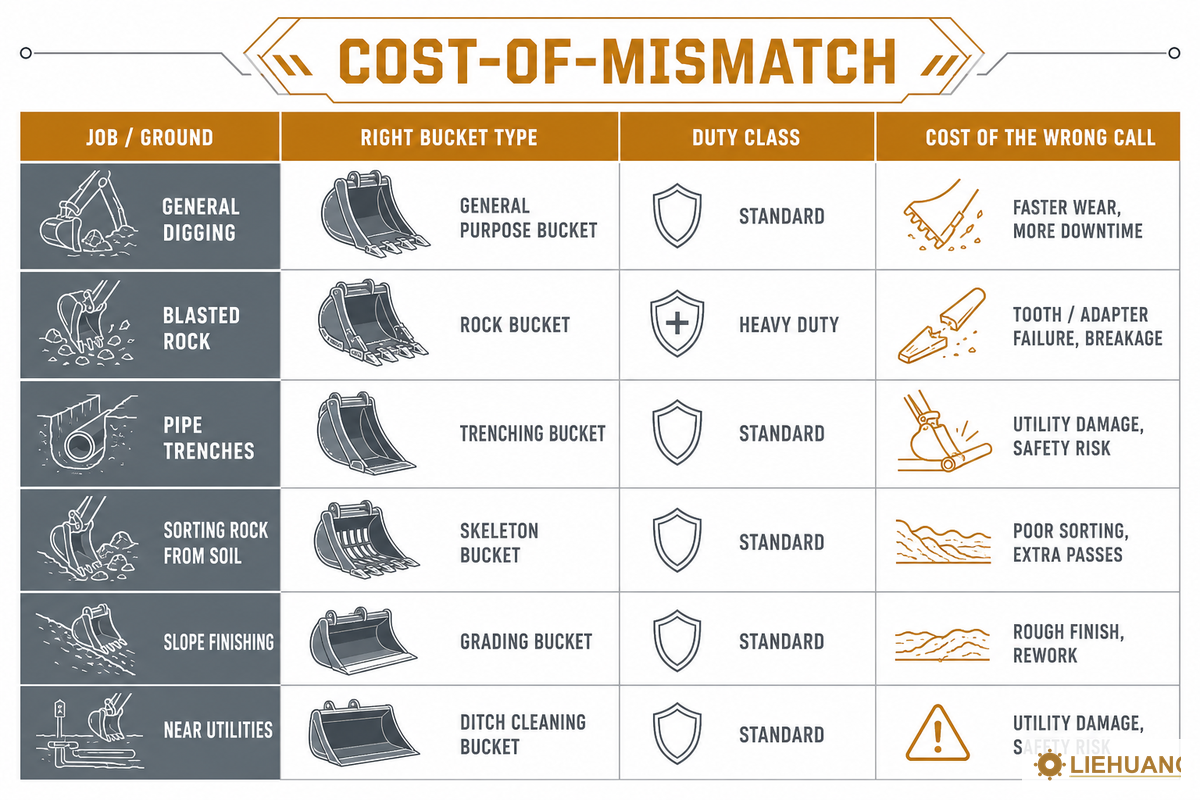
A bucket is a wear part with a job description, and picking the wrong profile cost you twice: once in slow cycles, again in premature wear. The versatility of a general-purpose bucket has limits, and specialty profiles exist for mining and quarry work precisely because extreme-duty ground destroys a general one. The construction equipment trade press is blunt about it, selecting the wrong attachment for the application become a costly mistake, from reduced performance to premature wear of the bucket and the machine, according to For Construction Pros. Below maps the cost of the mismatch across the common excavator bucket types, not just the catalog.
| Job / ground | Right bucket type | Duty class | Cost of the wrong call |
|---|---|---|---|
| Mixed soil, general digging | General-purpose / digging | General | A rock bucket here over-penetrates and wastes break-out force |
| Blasted rock, quarry | Rock / severe-duty (AR450–500) | Severe / Extreme | A general bucket loses its cutting edge in weeks, not seasons |
| Pipe & cable trenches | Trenching (width = pipe + 4–6″) | Heavy | An oversized bucket means backfill and rework on every run |
| Sorting rock from soil | Skeleton / screening | Heavy | A solid bucket forces a second pass to separate material |
| Slope finishing, ditch clean-out | Grading / ditching (no teeth) | General | A toothed bucket gouges the finish you were paid to smooth |
| Digging near utilities | Utility (rounded, no teeth) | General | A toothed bucket risks a cable strike — a safety cost, not just a wear cost |
| Frozen / cemented ground | Frost / ripper | Severe | A standard bucket stalls and burns fuel without breaking the crust |
| Demolition cleanup | Skeleton / grapple-ready | Heavy | A closed bucket can’t separate rebar and debris from reusable fill |
| Loose, light bulk material | Hi-capacity (deep throat) | General | A small heavy bucket leaves payload capacity unused every pass |
The scenario that burns crews most often is the rock mismatch. A contractor fits the widest general-purpose bucket the boom will carry, runs it into shot rock to “save a trip to the yard,” and watches the edge round over and the corners tear inside a few weeks. The replacement edge, the downtime, and the slow cycles in between cost far more than the severe-duty bucket would have. The fix is not a bigger bucket, it is the right geometry, bucket design, and steel for the ground you dig. Earth-moving bucket terminology is standardized in ISO 6165, which is why a “grading bucket” and a “ditch-cleaning bucket” describe the same tool to an engineer even when two sellers name them differently. For the complete profile taxonomy, see the bucket type selector.
Size for Cost-Per-Yard, Not Cubic Yards (The Productivity Math)
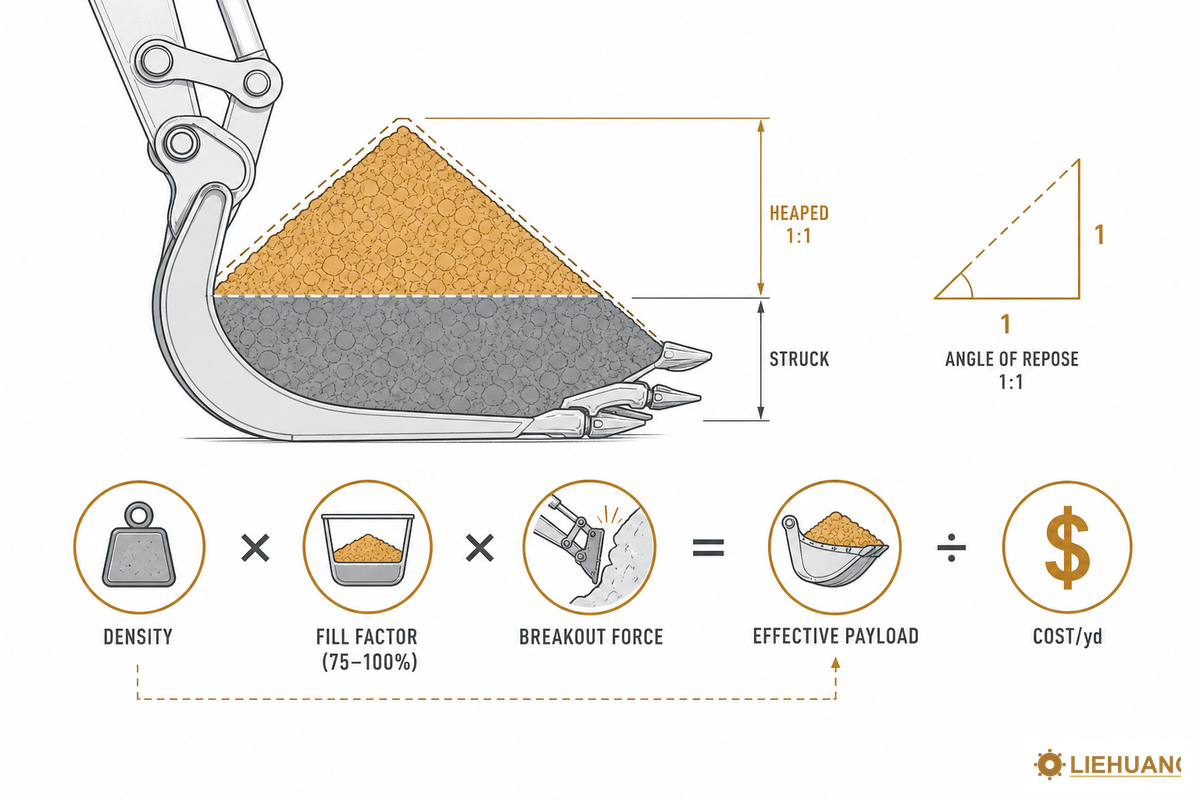
Here’s the most expensive misconception on a jobsite: bigger is more productive. It isn’t always true, and the construction trade press says so plainly, when a bucket is too big for the material density, it has a major effect on performance. A wider bucket lowers breakout force, drops the fill factor below 100%, and slows cycle times until the machine move less material per hour at higher fuel burn and faster edge wear. The right call is the largest bucket your machine can still fill and curl in one clean pass. On a 48-inch grading profile, that efficiency depends on the taper of the side plates and a heel that let the bucket pry roots loose with precision rather than brute force.
Capacity is not a number a seller invents. Excavator buckets are rated to defined methodsSAE J296 and ISO 7451. Struck capacity is the volume to the strike plane; heaped capacity adds material at a 1:1 angle of repose for excavator buckets (loaders use 1:2, per SSAB). So the honest sizing question is not “how many cubic yards” but “how many cubic yards of your material, at your breakout force, per pass.”
📐 The Cost-Per-Yard Bucket Equation — a worked example
Take a 20-ton excavator with a 36-inch bucket rated at ~1.2 yd³ heaped (SAE). You’re digging bank clay at roughly 3,400 lb/yd³, which packs at a fill factor near 0.85. Effective payload per pass = 1.2 × 0.85 = ~1.0 yd³. If your cycle time is 20 seconds, that’s 180 cycles/hour, or ~180 yd³/hour, before any breakout-force limit. Now mount the same bucket on a quick coupler: you lose an industry-typical 5–10% of breakout force (the exact figure varies by coupler and machine), so in hard clay you may only fill to 0.78, dropping effective payload to ~0.94 yd³ and ~169 yd³/hour. The cost-per-yard is your hourly machine + fuel + GET cost divided by that real number, not the nominal 1.2. Run your own machine’s breakout rating and material density through the same three steps before you upsize.
📐 Engineering Note: tip radius and the breakout trade-off
A short tip radius raises breakout force and penetration but lowers capacity; a long tip radius does the reverse. So, unlike the catalog assumption, a “bigger” long-radius bucket can lose to a smaller short-radius one in hard digging. Material density compounds it: bank clay runs ~3,400 lb/yd³, dry sand ~2,700, crushed stone ~4,500, the same bucket is a different machine in each. Confirm the chosen width against your carrier’s rated breakout force before you buy, not after. The full machine-class ladder is on the Carrier-Class sizing ladder.
Bucket Teeth and GET: the Cost Line You Actually Control
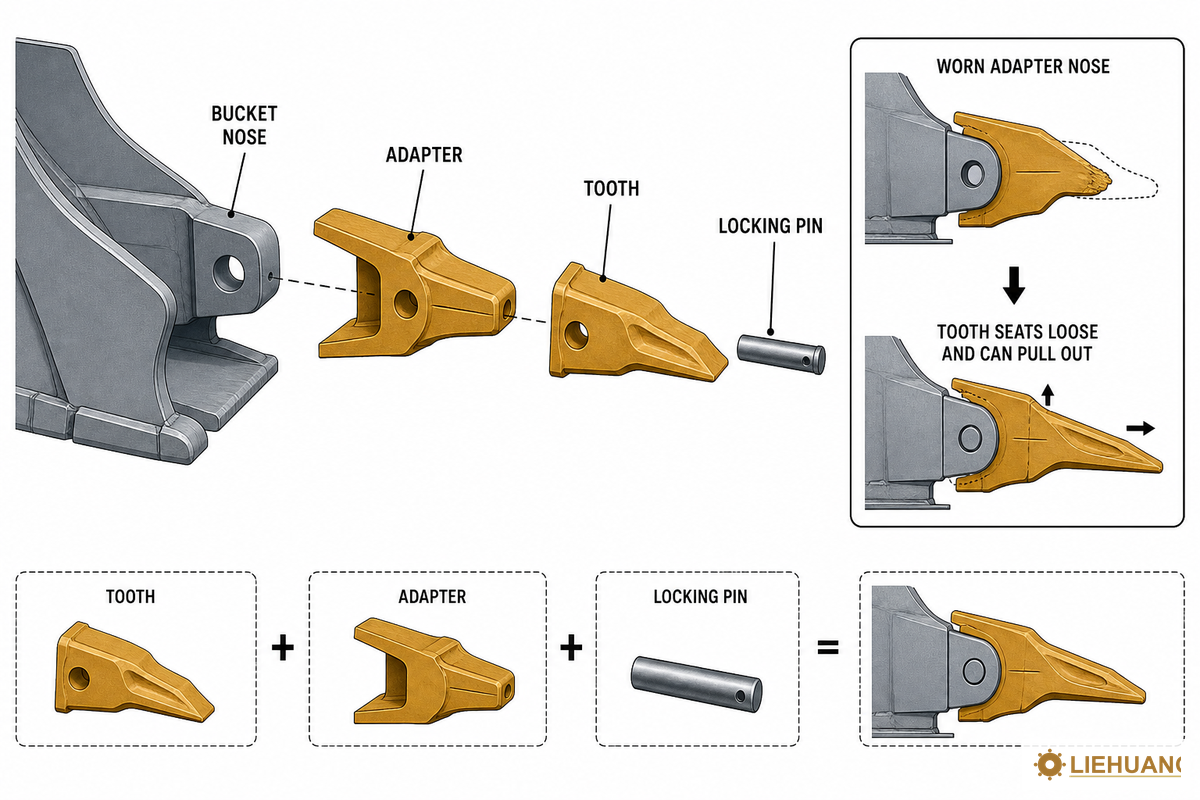
The teeth are where a bucket earns or loses money every shift. Ground-engaging tools, teeth, adapters, side cutters, locks, are widely estimated to account for 30–50% of a bucket’s lifetime running cost (the exact share varies with ground and duty), and unlike the steel shell, it’s a cost you steer day to day. Industry buyer guides report that the right combination of tooth profile, material, and fitment can extend GET life by 30–50%, directly reducing your cost per ton. Put a number on it: a lost tooth is an hour of downtime plus a $40–$120 replacement, and an operator who keeps pressing new teeth onto a worn adapter loses a tooth a week because the nose no longer grips, the adapter, not the tooth, is bleeding the budget.
“The nub that the teeth go on has been worn down so much that fitting a tooth on does not last very long, too much time wasted maintaining instead of digging.”
That failure is almost never the tooth or the brand, it’s a worn adapter and locking pin that no longer hold the tooth, so a new tooth seats loose and works free. The real spec to control is the GET system, not the loose tooth. Replace tooth, adapter, and lock as a matched set, with the lock spec called out, match the make and model for compatibility, since the manufacturer stamps the wear components and tooth series on the part, and you buy durability you can plan around. The industry is engineering this exact failure out: patents such as US 12,203,245 B2 (a position-biased locking pin for ground-engaging wear members) exist precisely because the lock, not the tooth, is the weak link. One field check tell you which it’s: a correctly pinned tooth has slight up-and-down play but no side-to-side movement; if it rattles sideways, the adapter is shot, replace the adapter, not just the tooth.
One distinction worth keeping straight: GET lock retention (the tooth-to-adapter interface above) is not the same as coupler retention, which lives at the machine-to-bucket interface. A dropped tooth is a productivity problem; a worn quick-coupler that drops a bucket is a different, machine-level safety problem, match those four coupler dimensions on the OEM fitment checker. A self-sharpening or carbide-armored tip can roughly double tip life in abrasion versus a plain cast tip, and that multiplier, not the per-tooth price, is what sets your true cost per ton. One honesty note on the wear-zone steel that backs those teeth: the published wear-life multipliers (a harder grade lasting “80–100% longer,” for example) are relative rankings from standardized lab abrasion tests such as ASTM G65, not field guarantees, they rank materials under controlled dry-sand abrasion but do not predict exact life across impact, moisture, and mixed ground. Match grade to your ground on the Ground-to-Grade steel selector and read the multipliers as direction, not promise.
How Long Should a Bucket Last, and When to Replace It
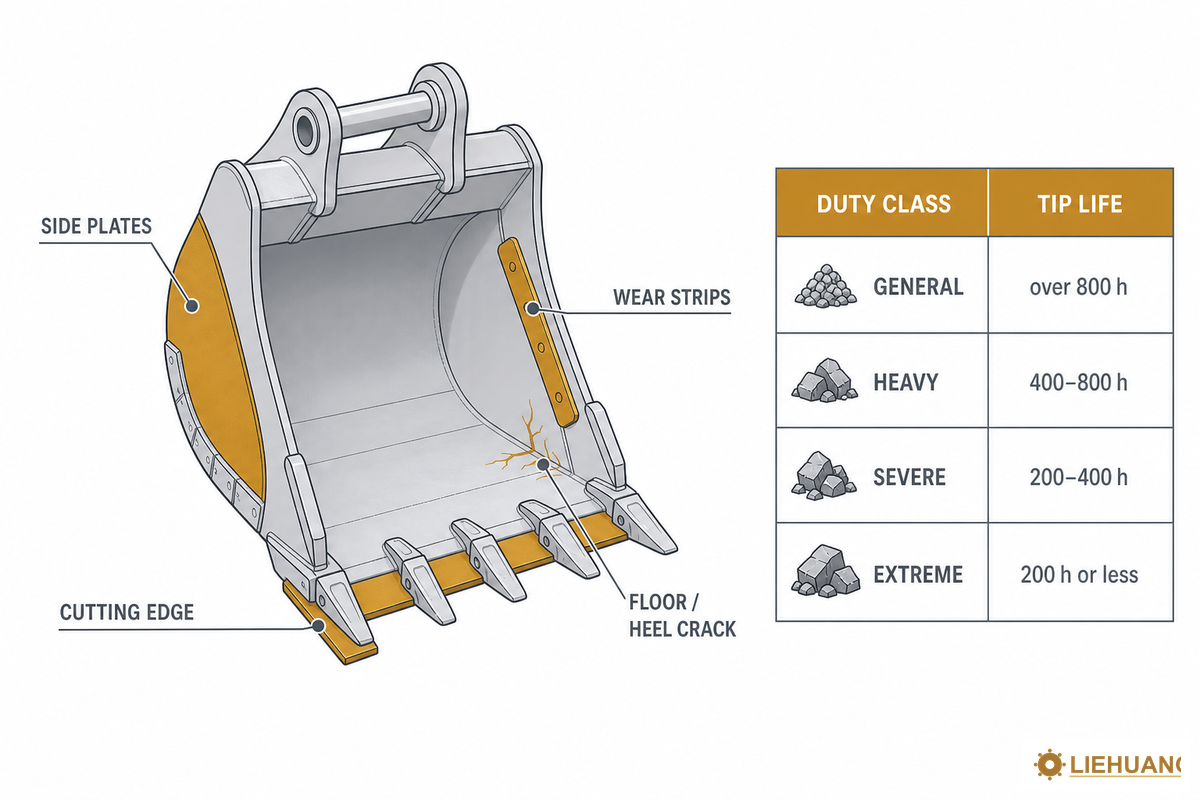
Replace an excavator bucket by condition, not by calendar, there’s no fixed schedule. The body usually outlives several sets of teeth, so you replace the bucket itself when the cutting edge wear back past the wear strip, the side plates perforate, or the floor cracks at the welds. Teeth wear on a faster, separate clock.
That question get answered wrong most often because people want a calendar. What you can anchor to is tip life by duty class, a widely used field convention from major GET makers rates run-hours as General over 800 h, Heavy 400–800 h, Severe 200–400 h, and Extreme 200 h or less. Those are tip-wear numbers, not bucket-body numbers; even a rugged shell usually outlives several sets of teeth. A crew that runs a bucket 300 hours into shot rock and ignores a perforated side plate spills 5–10% of every load, because the corners no longer hold material, the edge rebuild they deferred now costs several times the side-cutter they skipped.
- ✔Cutting edge worn back past the wear strip, penetration and fill both fall.
- ✔Side plates perforated or side cutters gone, material spills and the corners tear.
- ✔Floor or heel cracking at weld points, a structural flag, not a wear flag.
- ✔Adapters worn so teeth keep pulling out, the GET system, covered above, has reached end of life.
There’s a safety dimension here that the spec sheet hides. A worn bucket isn’t just a slow bucket, incorrect pin selection and worn interfaces cause premature wear and even failure, and U.S. work rules treat the interface as a hazard. OSHA 1926.602 applies safety requirements and limitations to machine and attachment usage, and OSHA 1926.651(e) prohibits workers from standing under loads handled by digging equipment. Replacing a cracked or over-rotating bucket is a compliance decision as much as a cost one. Inspect at every GET change; the bucket is telling you when it’s done.
Repair, Rebuild, or Replace? A Decision Framework
Once a bucket is worn, the money question is whether to fix it or buy new. Field data backs the case for disciplined repair: one fleet that tightened its maintenance and inspection practices reduced total excavator maintenance costs by 45% and extended average operational life by 18% — proof that the rebuild-or-replace call is worth making deliberately rather than by reflex.
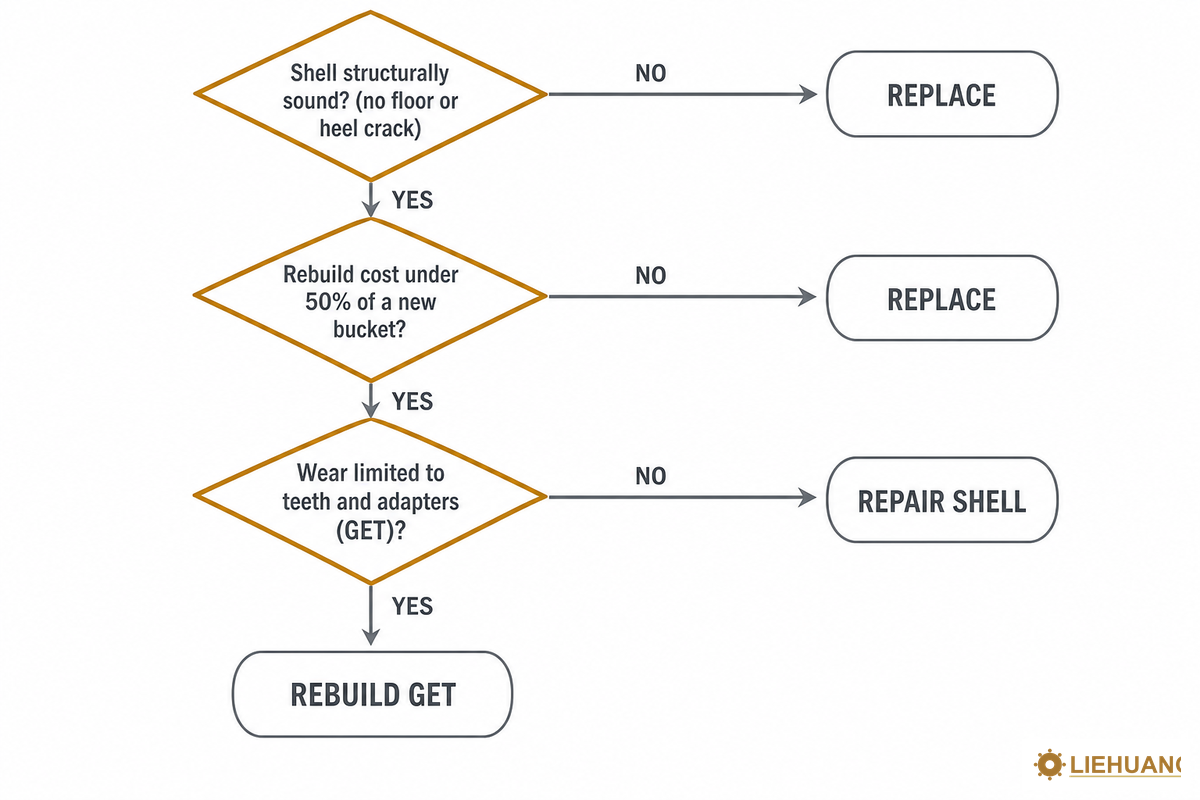
The Repair-or-Replace Decision Gate
- Is the shell structurally sound? If the floor or heel is cracked, or the back has worn through → replace. Structure doesn’t repair economically.
- Is rebuild cost under ~50% of a new bucket? If yes, and the structure is sound → repair: new cutting edge, side cutters, wear strips, and a fresh GET set.
- Are you replacing teeth onto a worn adapter again? If teeth keep pulling out → rebuild the GET system (adapters + locks), not just the teeth.
- Has the bucket already been rebuilt once and is wearing out fast? The steel is fatigued → replace, and consider a harder wear-zone grade for the next ground.
Consider a fleet owner with a 25-ton machine whose bucket has a hairline crack at the heel but otherwise good steel. The instinct is to weld it and move on. Run the gate: a cracked heel is a structural flag, so even though the wear plates have life left, this one is a replace, a re-cracked heel mid-shift is a downtime and safety event under OSHA 1926.602, not a savings. The discipline is in not letting a cheap weld defer an expensive failure.
Used vs New Excavator Buckets: the Value Math
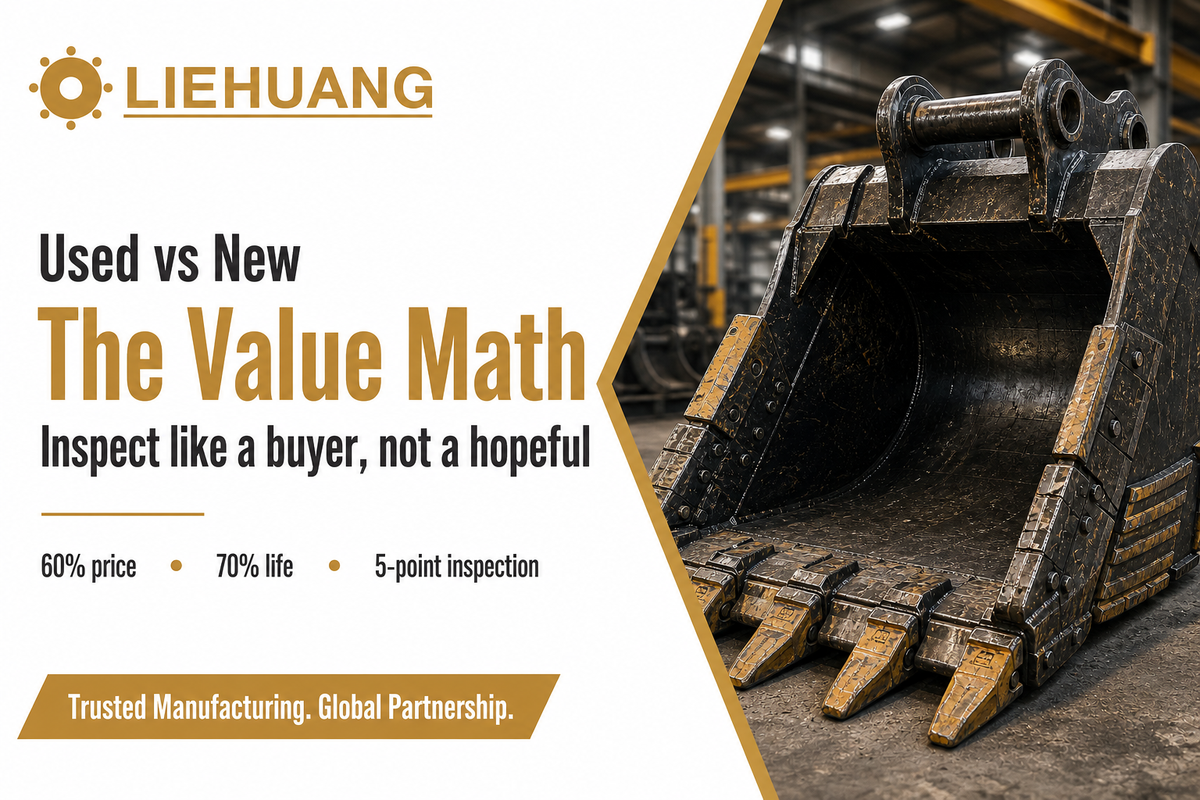
Buying used can be the right economic call, if you inspect like a buyer, not a hopeful. As an exporter that inspect and refurbishes used excavators and attachments before they ship, our team weighs the same things a careful buyer should: condition against price, with the condition stated up front. A used bucket at 60% of new price with 70% of its life left is a good deal; the same bucket with a worn adapter set and a tired edge isn’t.
💡 Used-bucket inspection checklist
- Cutting edge: measure remaining material against the wear strip, a worn-back edge is a hidden re-edging cost.
- Welds and heel: look for cracks with a rust fringe; a fissure is a structural reject.
- Teeth and adapters: scalloped teeth still work; worn adapter noses don’t hold new teeth.
- Ears and pin bores: side-to-side slop means worn interfaces and over-rotation risk.
- Coupler match: confirm the four fitment dimensions before money changes hands.
Search demand for used excavator buckets has been climbing, and that isn’t a coincidence, thinner margins push buyers toward proven value. The trade-off is always condition versus price, and an honest seller will put the grade, the cert, and the fitment in writing. We supply both new buckets we manufacture to spec and used excavator buckets for sale, a Kubota mini profile or a 30-ton unit, and we state the condition and loading capability so there are no surprises at the port. The reliability of a used unit comes down to the same check, matched to your make and model. For current new-versus-used inventory, the excavator buckets page lists both.
Total Cost of Ownership: the Cost-Per-Yard Model
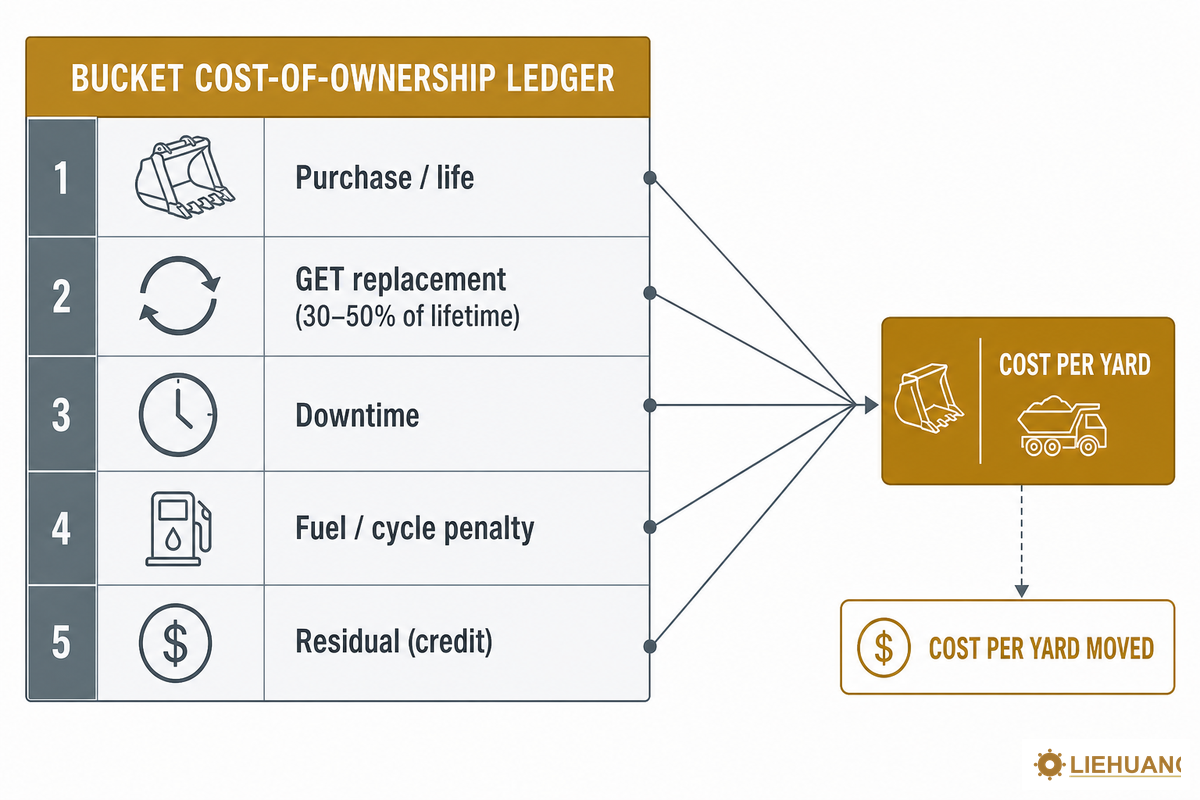
Every section above is a line in one ledger. The cheapest bucket to buy is rarely the cheapest to own, because purchase price is usually the smallest number in the stack. Here’s the model, the 5-Line Bucket Cost-of-Ownership Ledger, that turns “which bucket is cheaper” into “which bucket moves a yard of my material for less.”
The 5-Line Bucket Cost-of-Ownership Ledger
| Ledger line | What goes in it | How it hits cost-per-yard |
|---|---|---|
| 1. Purchase ÷ life | Bucket price spread over expected service hours | Small; a harder grade costs more but the line shrinks as life grows |
| 2. GET replacement | Teeth, adapters, locks over the bucket’s life | Large — 30–50% of lifetime cost; the line you control most |
| 3. Downtime | Hours lost to GET swaps, edge repair, mis-fit | Hidden and large; the wrong bucket multiplies it |
| 4. Fuel / cycle penalty | Extra burn from over sizing, low fill factor, coupler loss | Per-pass; compounds over every hour |
| 5. Residual | Resale or refurbishment value at end of use | A credit; well-kept buckets and matched GET hold value |
Add lines 1–4, subtract line 5, divide by the yards that bucket will move over its life, and you have a number, anchored to the SAE J296 / ISO 7451 rated capacityyou can compare across options. Run it once and the “expensive” severe-duty bucket in abrasive ground often wins, because lines 2 and 3, GET and downtime, dwarf the purchase gap. Fleets that measure true cost per yard, tracking cycle time and fuel rather than sticker price, consistently sharpen their bids. The ledger is the point of the whole guide: a bucket is a cost-per-yard machine, and the spec sheet only shows you line 1.
What’s Changing in 2026: Compact Machines and the Used-Value Shift
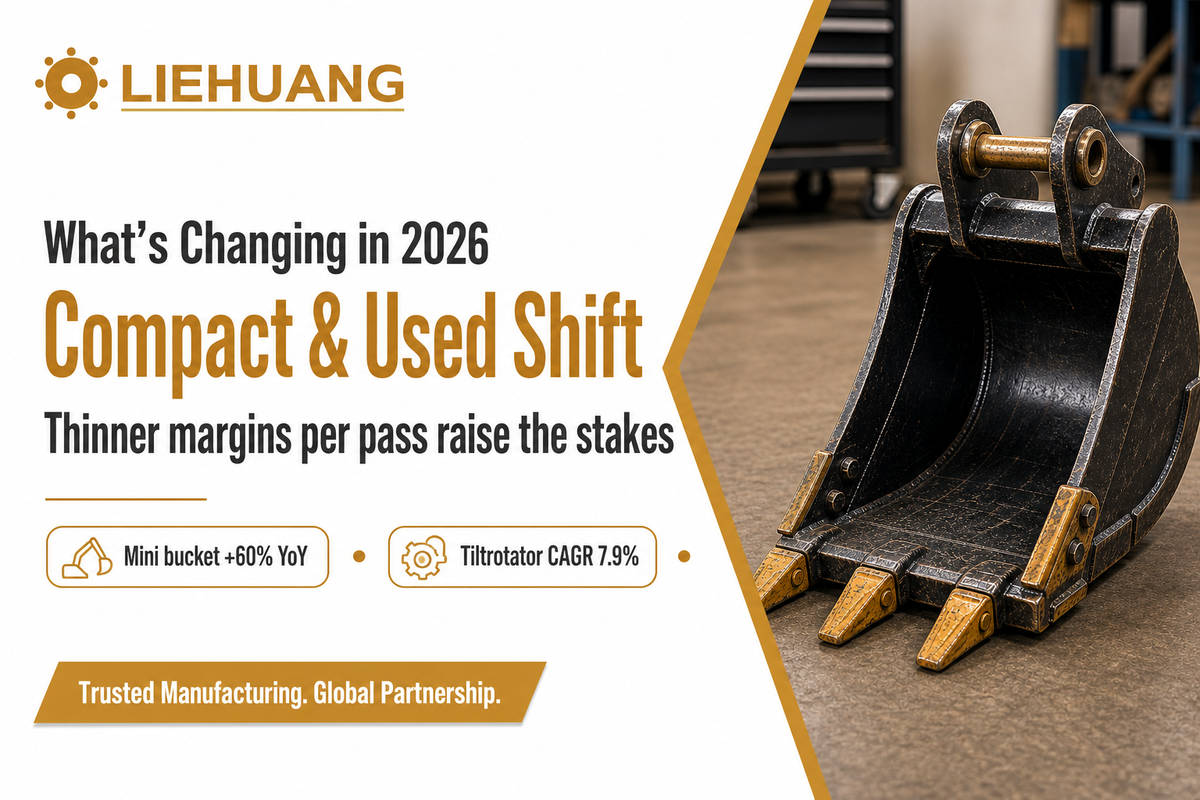
Two shifts are changing excavator-bucket buying in 2026: demand is tilting hard toward compact and mini machines, and budget pressure is pushing buyers toward used and refurbished value. Both raise the stakes on getting the economics right, because thinner per-pass margins punish a sizing or GET mistake harder.
Compact and mini machines are a distinct basic type under ISO 6165, and search interest in mini excavator buckets is up sharply year over year. For a compact-machine owner moving 80–120 yd³ a day, a half-yard sizing error is 10–15% of daily output, a margin a large fleet absorbs and a small one cannot. The used-value shift, in turn, raises the premium on inspection rigor over brand badges.
On the technology side, tiltrotators are the fastest-growing class of bucket attachments, pushing more jobs, grading, trenching, even land clearing, toward one bucket that finishes at an angle without repositioning the machine, which only deepens the cost-per-yard logic, since a tiltrotator bucket has to earn back a higher purchase line through fewer machine moves. As back ground, market trackers put the broader excavator-attachments market in the high-single-digit CAGR range through the early 2030s; treat those figures as directional context, not a buying reason. The buying reason is the margin math: as machines get smaller and money gets tighter, the operators who win in 2026 are the ones sizing to cost-per-yard and treating GET as the controllable daily cost. If you’re planning a 2026 fleet refresh, run the ledger before you run the catalog.
Frequently Asked Questions
How much do excavator buckets cost?
View Answer
A new excavator bucket generally runs from about $300 for a small mini-excavator profile to $8,000 or more for a severe-duty rock bucket. The price is set by four drivers: size and carrier class, steel grade in the shell and wear zones, the ground-engaging tools (teeth, adapters, side cutters), and the coupler type. Used buckets cost less but must be priced against remaining life. Treat the sticker as one line in a larger ledger — GET and downtime usually cost more over the bucket’s life than the purchase itself.
How often should excavator buckets be replaced?
View Answer
Replace by condition, not by calendar. The bucket body usually outlives several sets of teeth. Replace it when the cutting edge is worn back past the wear strip, the side plates are perforated, or — most important — the floor or heel cracks at the welds, which is a structural flag. Teeth follow a separate, faster clock: a field convention from GET makers rates tip life by duty as General over 800 hours, Heavy 400–800, Severe 200–400, and Extreme 200 or fewer. Inspect at every tooth change.
What kind of bucket do I need for an excavator?
View Answer
Start with the ground and the job, not the machine. A general-purpose (digging) bucket is the safe default for mixed soil and the most versatile choice. Move to a rock or severe-duty bucket for blasted rock and quarry work, a trenching bucket for pipe and cable runs, a grading or ditching bucket (no teeth) for slope finishing, and a skeleton bucket to sort rock from soil. When the ground is unknown, a heavy-duty digging bucket is the safe default. The profile decides productivity; the steel grade decides how long it lasts.
What are standard excavator bucket sizes?
View Answer
Bucket width is measured by inside width and scales with carrier weight — roughly 6–24 inches for sub-1-ton minis up to 18–60 inches (and 84-inch grading buckets) for 20–25-ton machines. There is no universal size; match width and capacity to your machine and material.
Are used excavator buckets worth buying?
View Answer
Often yes, if you inspect properly. Check the cutting edge for remaining material, the welds and heel for cracks, the adapters for wear (worn noses won’t hold new teeth), the ears and pin bores for side-to-side slop, and confirm the coupler fitment. A used bucket at a fair fraction of new price with most of its life and a sound structure is good value; one with a tired GET system and a cracked heel is not, at any price.
How do I know if a bucket will fit my machine?
View Answer
There is no universal excavator-bucket standard, so “fits your excavator” is not an answer — fitment is decided by four measurements: pin diameter, ear (boss) spread, pin-center distance, and coupler family. A pin-grabber coupler only needs the ear spread matched, while a wedge or dedicated coupler is brand-locked to one make, and even within a model line two variants may not be interchangeable. Get any one wrong and the bucket either won’t hang or over-rotates into the arm — a safety problem, not just a fit problem. Send your machine’s make, model, and serial, or the four measurements, and confirm against a drawing before anything is cut. The OEM fitment checker walks through all four.
Why We Wrote This
We export new and inspected used excavator buckets and attachments to importers and dealers worldwide, and the questions we field most aren’t “which type” — they’re “what will this actually cost me to run.” This guide reflects what we see in that trade: the cost-per-yard math, the GET running cost, and the wear signals that decide repair-versus-replace. Reviewed by the Liehuang technical team.
Need a bucket sized and priced against your exact machine and ground?
Request a Bucket Quote →References & Sources
- ISO 6165, Earth-Moving Machinery, Basic Types & TerminologyInternational Organization for Standardization
- EN ISO 6165:2022, Identification and TerminologyCEN / ISO
- How to Calculate Bucket Capacity (SAE J296 / ISO 7451, fill factor)SSAB
- OSHA 1926.602, Material Handling EquipmentU.S. Department of Labor
- OSHA 1926.651, Specific Excavation RequirementsU.S. Department of Labor
- ASTM G65, Standard Test Method for Measuring Abrasion (dry sand/rubber wheel)ASTM International
- US 12,203,245 B2, Position-Biased Locking Pin Assembly for a Ground-Engaging Wear MemberUSPTO
- Scratch Below the Surface with Excavator Bucket SelectionFor Construction Pros
Related Articles
- Excavator Buckets, OEM-Fit Types, Sizes & GET Catalogthe full profile taxonomy, sizing ladder, and fitment matrix
- Excavator Attachments, Buckets, Breakers & Grapplesthe full attachment range by machine class
- Ground-to-Grade Steel Selectormatch wear-zone steel grade to your ground
![Excavator Bucket Manufacturers: Buyer Evidence [Guide]](https://lhusedexcavator.com/wp-content/uploads/2026/08/excavator-bucket-manufacturers-r2-featured-768x512.png)