Get in Touch with Liehuang Company

Updated July 2026. Reviewed by the Liehuang Used Excavators technical team.
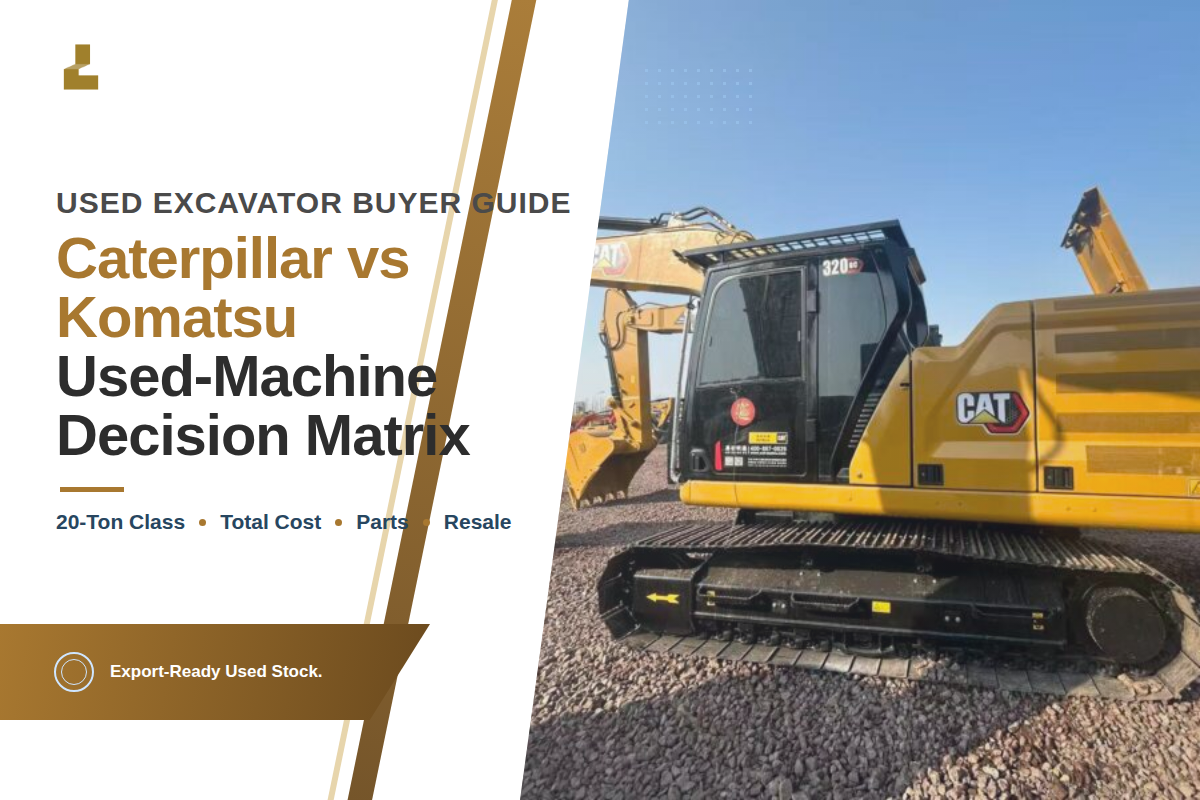
A Caterpillar vs Komatsu excavator is rarely a simple pick: it comes down to two questions, which brand costs less to buy, and which costs less to own. The comparison rarely has a one-word answer, and for used-machine buyers it splits into those two very different trade-offs. Caterpillar and Komatsu are the two most-financed excavator brands in the United States, so both are safe bets, the real work is matching the right badge to your budget, your job, and the market you operate in.
This guide compares them the way an importer actually shops: real 20-ton specs from machines we stock, verified market and auction data, fuel, performance and resale math, parts reality, and the emission-tier rules that decide whether an older unit can even clear customs. We sell both brands, so where one wins we say so plainly.
Quick Specs: Cat 320 vs Komatsu PC200 (20-Ton Class)
| Operating weight | Cat 320: 21,900 kg | PC200: 20,010 kg |
| Engine power | Cat 320: 121 kW (162 hp) | PC200: 110 kW |
| Max dig depth | Cat 320: 6.72 m | PC200: 6.10 m |
| Bucket capacity | Cat 320: 0.80-1.20 m³ | PC200: 0.8-1.0 m³ |
| Used FOB reference | Both: US$25,000-58,000 (China main port) |
Reference values from our own 20-ton listings. Confirm year, hours and condition against the actual available unit before quoting.
Caterpillar vs Komatsu Excavators at a Glance
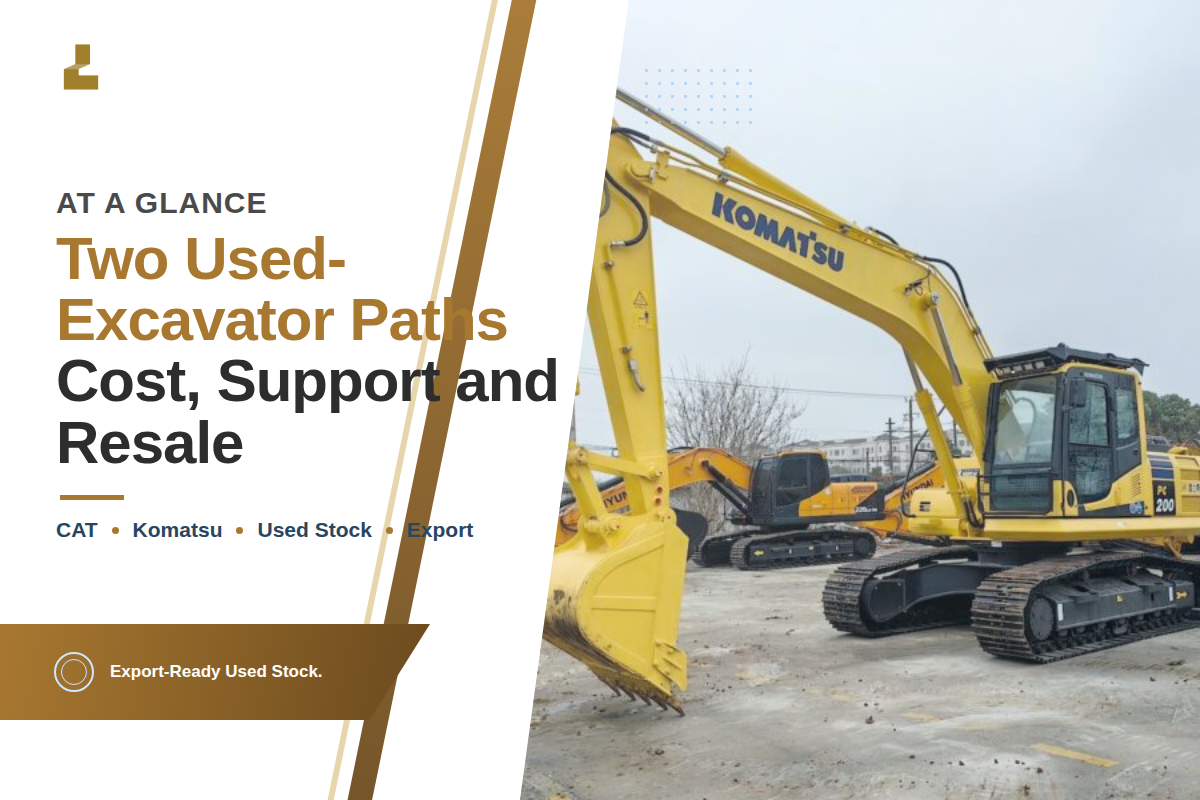
Caterpillar wins on resale value, repair ease, and dealer reach; Komatsu wins on upfront price, fuel efficiency, and hydraulic smoothness. That single sentence covers roughly 80% of the cat vs komatsu decision, the rest comes down to where you operate and whether you plan to resell. Neither brand is “worse”; each is built for a different kind of owner.
| Buying criterion | Caterpillar edge | Komatsu edge |
|---|---|---|
| Upfront price (used) | — | ~5-10% lower for comparable machines |
| Fuel efficiency | — | ~10-15% lower burn on 20-ton class (reported) |
| Resale / residual value | Cat took 13 of top-20 auction price spots | — |
| Repair ease & parts reach | Easier to fix, widest global dealer net | — |
| Breakdown frequency (uptime) | — | Reported to spend less time in the shop |
| Dig depth (20-ton) | 6.72 m (Cat 320) | 6.10 m (PC200) |
| Best-fit buyer | Resale-minded fleets, dealer-served regions | Budget buyers, long-shift operators |
Auction share from Equipment World / Fusable EquipmentWatch, 12 months to Feb 2026. Fuel and price figures reported by used-equipment sources; see sections below.
Browse the full inventory in our used Caterpillar excavators and used Komatsu excavators categories as you read.
The Companies Behind the Machines, Who’s Bigger?
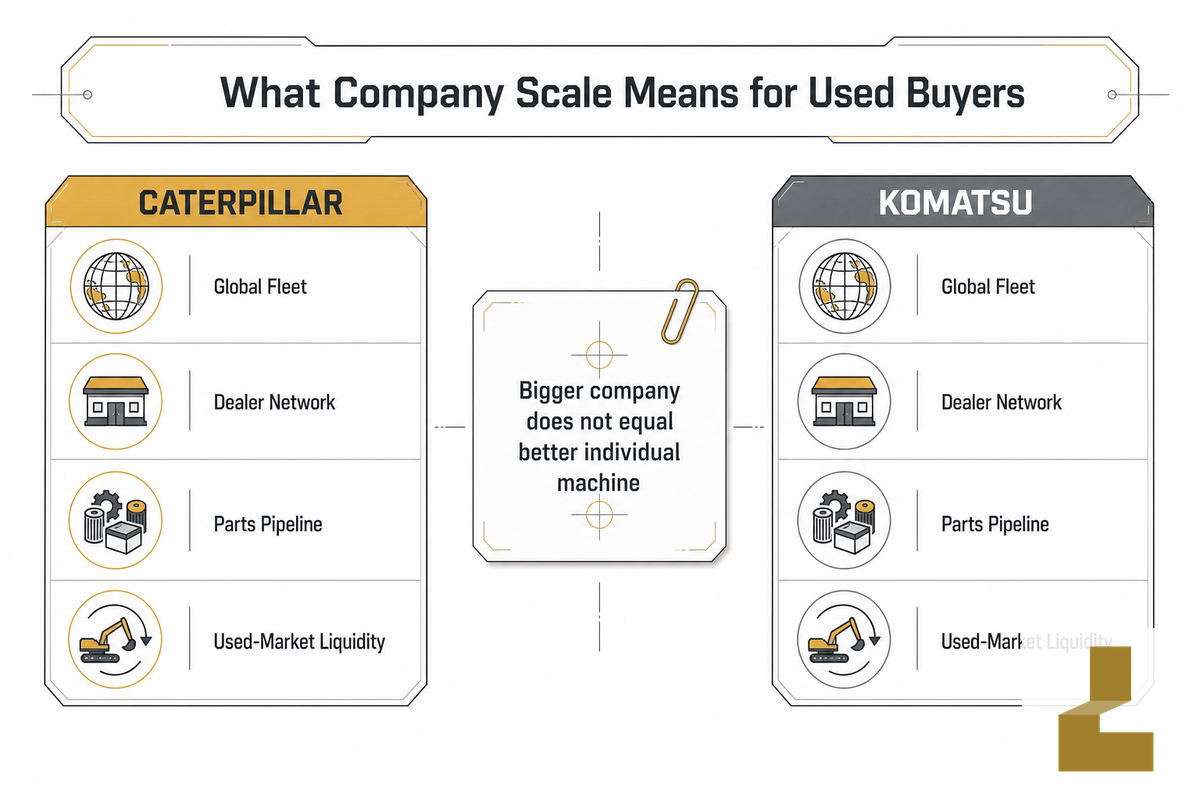
By revenue, Caterpillar is the world’s largest construction-equipment maker, and Komatsu of Japan is its long-standing number two. That scale gap isn’t trivia, it drives how easily you find parts, dealers, and trained technicians once your machine is a decade old and sitting on a jobsite far from a major city.
Headquartered in Peoria, Illinois, Caterpillar reports construction-equipment revenue near US$59 billion and consistently ranks first in global OEM sales tables, according to Construction Briefing’s top-10 ranking. Komatsu holds second globally. In the U.S. financed-excavator market specifically, Caterpillar led with 27.4% of new units in 2025, with Komatsu among the top three brands.
Who is Caterpillar’s biggest competitor?
Globally, Komatsu is Caterpillar’s closest rival across the full equipment range. In the U.S. excavator segment, John Deere also runs neck-and-neck with Komatsu for the number-two spot on units financed. For a used importer, the practical takeaway is simple: both Cat and Komatsu have enough installed base worldwide that parts and service are rarely a dead end, a comfort you don’t get with smaller brands.
20-Ton Spec Showdown (Cat 320 vs PC200)
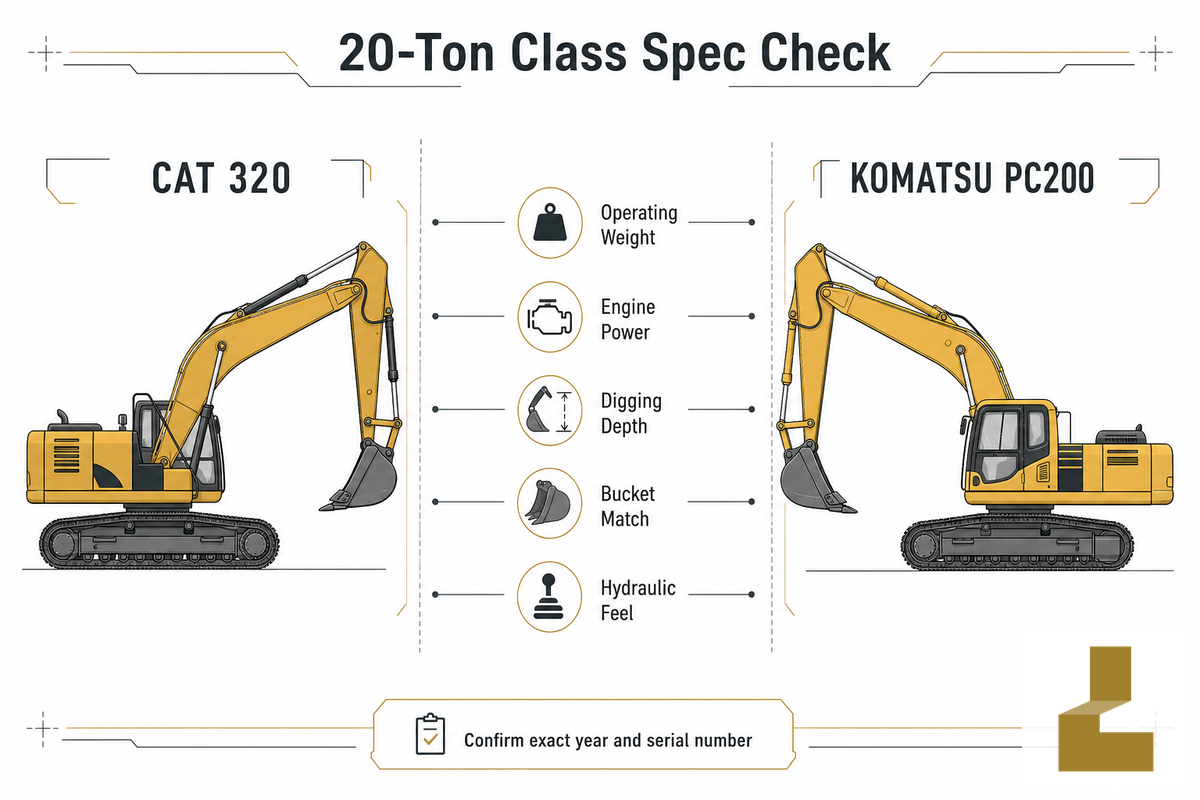
Model to model, the Cat 320 is the heavier, slightly more powerful machine, while the Komatsu PC200 is lighter and leans on fuel economy. At the same 20-ton working class, our own listings put the Cat 320 at 21,900 kg and 121 kW against the PC200 at 20,010 kg and 110 kW, a real difference you feel in reach and lift, not just on paper. That extra horsepower shows up as digging performance in heavy work, while the lighter Komatsu trades some of it for economy.
| Spec | Caterpillar 320 | Komatsu PC200 |
|---|---|---|
| Operating weight | 21,900 kg | 20,010 kg |
| Engine power | 121 kW (162 hp) | 110 kW |
| Max dig depth | 6.72 m | 6.10 m |
| Bucket capacity | 0.80-1.20 m³ | 0.8-1.0 m³ |
| Used FOB reference | US$25,000-58,000 | US$25,000-58,000 |
| Not suitable for | Tightest urban sites where every extra tonne limits float transport | Deepest single-pass trenching where the extra 0.6 m matters |
Specs from our current 20-ton listings. Generation matters: a 320D, 320E, 320F and Next-Gen 320 differ in cab and electronics.
Beyond the headline pairing, it helps to see how the two lineups line up class by class, so you can shortlist the right equivalent before comparing price.
| Weight class | Caterpillar model | Komatsu equivalent | Typical use |
|---|---|---|---|
| ~3.5 t mini | Cat 303.5 | Komatsu PC35 | Landscaping, tight sites |
| ~5.5 t mini | Cat 305.5 | Komatsu PC55 | Utilities, residential |
| ~8 t compact | Cat 308 | Komatsu PC78 | Urban construction |
| ~12 t | Cat 310/315 | Komatsu PC120 | General contracting |
| ~13-15 t | Cat 315 | Komatsu PC130/PC138 | Trenching, roadwork |
| ~20 t (mainstream) | Cat 320 | Komatsu PC200 | Bulk earthmoving |
| ~25 t | Cat 325 | Komatsu PC210 | Heavy production |
| ~30 t | Cat 330 | Komatsu PC300 | Quarry, large sites |
| ~36 t | Cat 336 | Komatsu PC360 | Mining support, mass excavation |
Equivalents are approximate weight-class matches from our Cat and Komatsu lineups; confirm exact operating weight per unit.
One caution that spec sheets hide: the “320” badge spans several generations. A used Cat 320 could be a 320D from the early 2010s or a Next-Gen unit with grade control and a very different cab. The same applies to the Komatsu PC200 across its dash numbers. Always match generation before you compare price, and read the meter with a skeptical eye, our guide to excavator hours covers what a believable reading looks like.
📐 Engineering Note
Match hydraulic generation, not just tonnage. A PC200-8’s main hydraulic pump runs around 37.3 MPa; pairing a high-flow breaker or thumb to an older, lower-pressure circuit starves the tool and overheats the pump. A tired pump or swing motor shows up as slow cycle time and weak breakout force, so confirm relief-valve pressure, swing-motor response, and auxiliary flow (L/min) against the attachment spec before you buy, for both brands, generational hydraulic differences matter more than the badge.
Need help placing a machine in the right size band? Both the tonnage picker in our medium excavators (10-30 ton) category and the Cat class-model selector narrow it down fast.
Price and Total Cost of Ownership, Is Komatsu Cheaper?
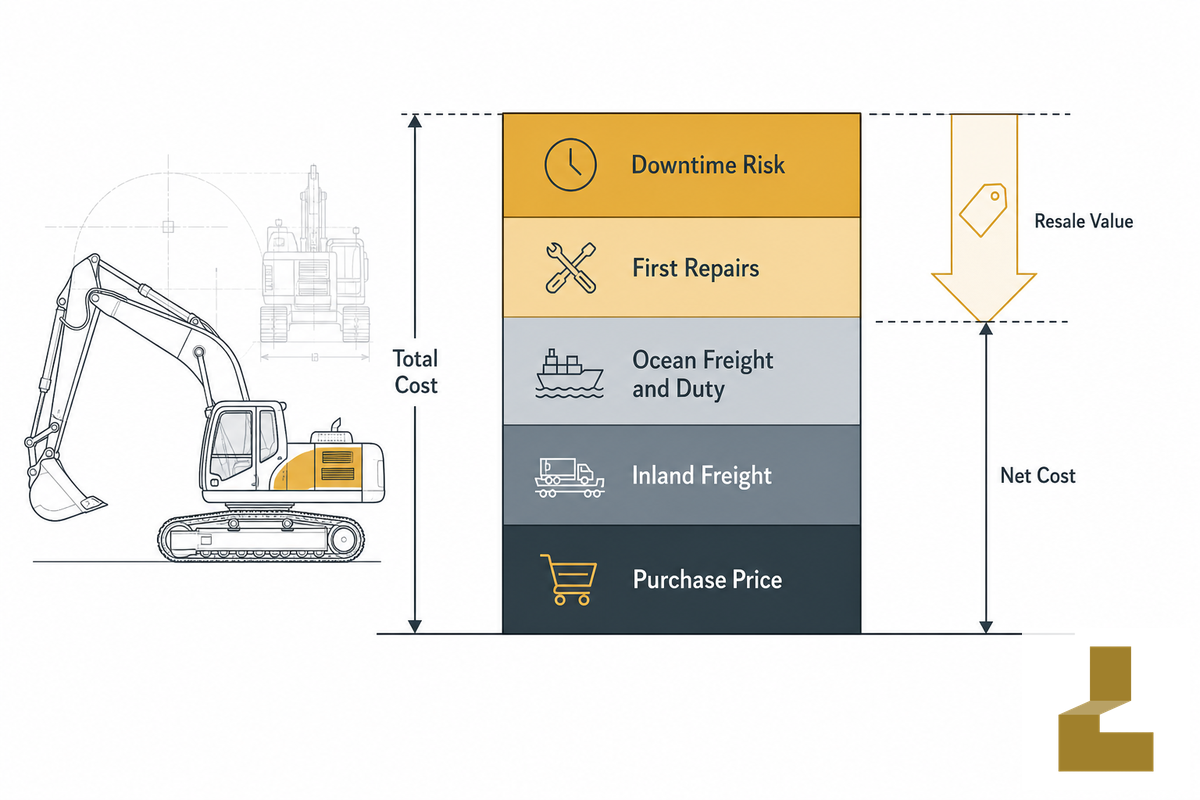
On caterpillar vs komatsu price, Komatsu is usually cheaper to buy, but not always cheaper to own. Used Komatsu units run roughly 5-10% below a comparable Caterpillar, yet Cat’s stronger resale and lower repair cost can close, or reverse, that gap over a five-year hold. What matters isn’t “which is cheaper today,” it’s “which is cheaper across the whole ownership cycle.”
Illustrative 5-year total cost of ownership, one used 20-ton machine:
| Cost item (5-yr) | Caterpillar 320 | Komatsu PC200 |
|---|---|---|
| Purchase (used, FOB) | US$42,000 | US$38,000 |
| Fuel (2,000 hr/yr @ ~US$1.20/L) | ~US$216,000 | ~US$187,000 |
| Maintenance & spares | Lower per-repair, wide parts | Fewer repairs, regional parts |
| Downtime risk | Faster parts = shorter stops | Fewer stops overall |
| Resale recovery (yr 5) | Stronger (auction-proven) | Solid but lower |
Payback example: the Komatsu starts US$4,000 cheaper and, at a reported ~12% fuel saving on 2,000 hr/yr, trims roughly US$29,000 of diesel over five years — a real lead. But if the Cat resells for US$8,000-12,000 more at year five (consistent with its auction dominance), much of Komatsu’s running-cost win is handed back at disposal. Net winner depends on how long you keep it and whether you resell.
Fuel and price percentages are reported ranges from used-equipment sources, not fixed quotes; diesel price and duty cycle vary by market. Treat the table as a framework to drop your own numbers into.
To model the delivered number for your port, run the figures through our used excavator landed-cost estimator before you commit, and see our used vs new comparison for the bigger buy decision.
Reliability and Build Quality: The Repair-vs-Resale Split
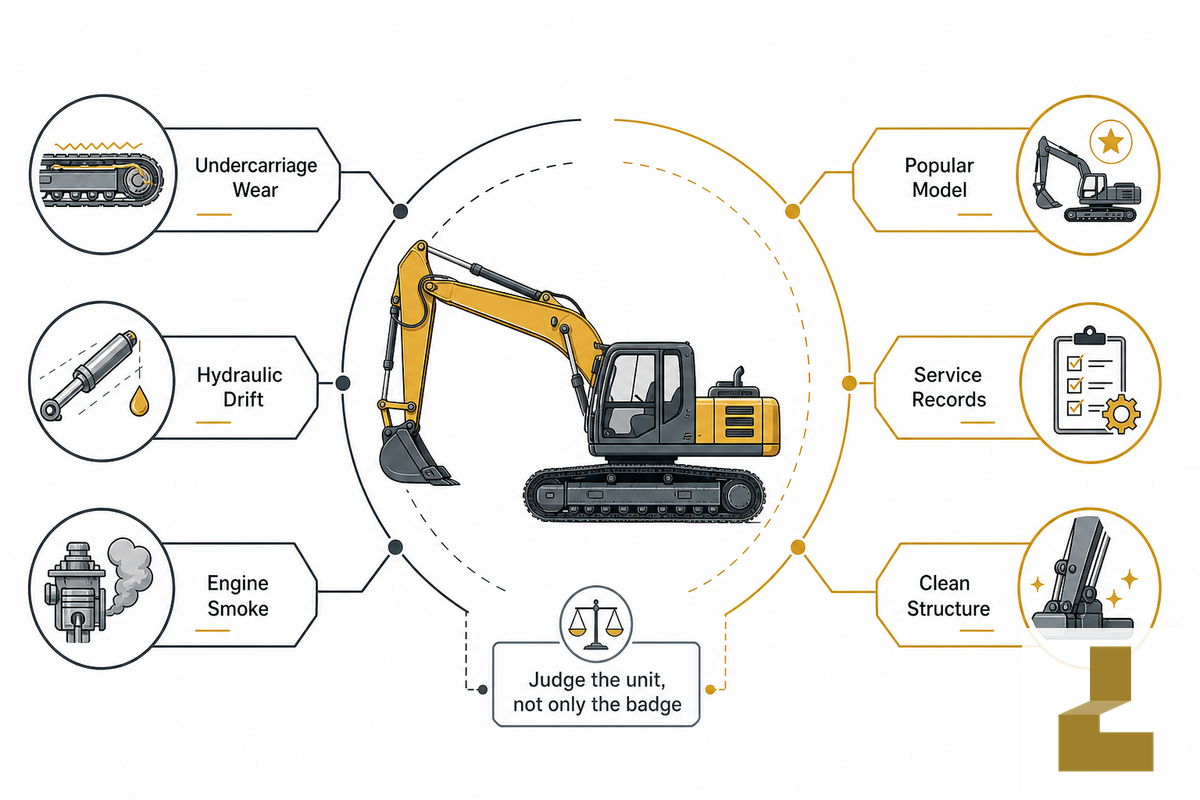
The caterpillar vs komatsu reliability debate usually stalls right here, because reliability isn’t one number, it’s two, and the brands split them. Field reports consistently say Komatsu machines spend less time broken down, while Caterpillar machines are easier and cheaper to fix when something does go wrong. We call this The Repair-vs-Resale Split, and it explains why two honest owners can swear by different brands.
On the Komatsu side, dealers and used-equipment specialists report the machines simply sit in the shop less often. On the Caterpillar side, operators on forums like r/heavyequipment put it bluntly: the Cat is easier to repair and feels better built, and routine maintenance and undercarriage parts are simple to source. Both can be true. Komatsu’s edge is uptime; Caterpillar’s edge is that its enormous parts-and-dealer network turns a breakdown into a short stop instead of a long one.
✔ Caterpillar Advantages
- Easier, cheaper repairs; widest global parts network
- Strongest resale and auction demand
- Deeper dig and higher lift in the 20-ton class
- Well-supported grade control on Next-Gen units
⚠ Caterpillar Limitations
- Higher upfront price for a comparable used machine
- Generally thirstier than the Komatsu equivalent
- Premium badge can mean paying for brand, not condition
- Generation spread (320D to Next-Gen) complicates like-for-like pricing
“On a used machine, the badge is the tiebreaker, not the decision. We’ve shipped a well-kept PC200 that outlasted a neglected 320, and seen it go the other way just as often. Buy the inspection report, not the brand.”
Liehuang Used Excavators technical team
Here’s how that plays out. A road contractor in Kenya weighing komatsu vs caterpillar for a 20-ton buy chose a PC200 at about US$34,000 to save on both purchase and fuel across a 2,000-hour season. A firm one town over went with a Cat 320 at roughly US$41,000, betting on resale, and two years later recovered close to US$9,000 more at auction than the depreciated Komatsu would have returned. Same weight class, opposite strategies, and each was right for its own math.
One buying lesson stands out: don’t read “reliable” as a single score. If your jobsite is far from a dealer, Cat’s repair-ease can matter more than Komatsu’s lower breakdown rate, and vice versa near a Komatsu service center. Whichever badge you pick, condition beats brand: work through our used excavator inspection checklist and insist on cold-start, hydraulic-cycle, track-chain and undercarriage video, plus a clear hour-meter photo, before any deposit.
Fuel Efficiency and Daily Operating Cost
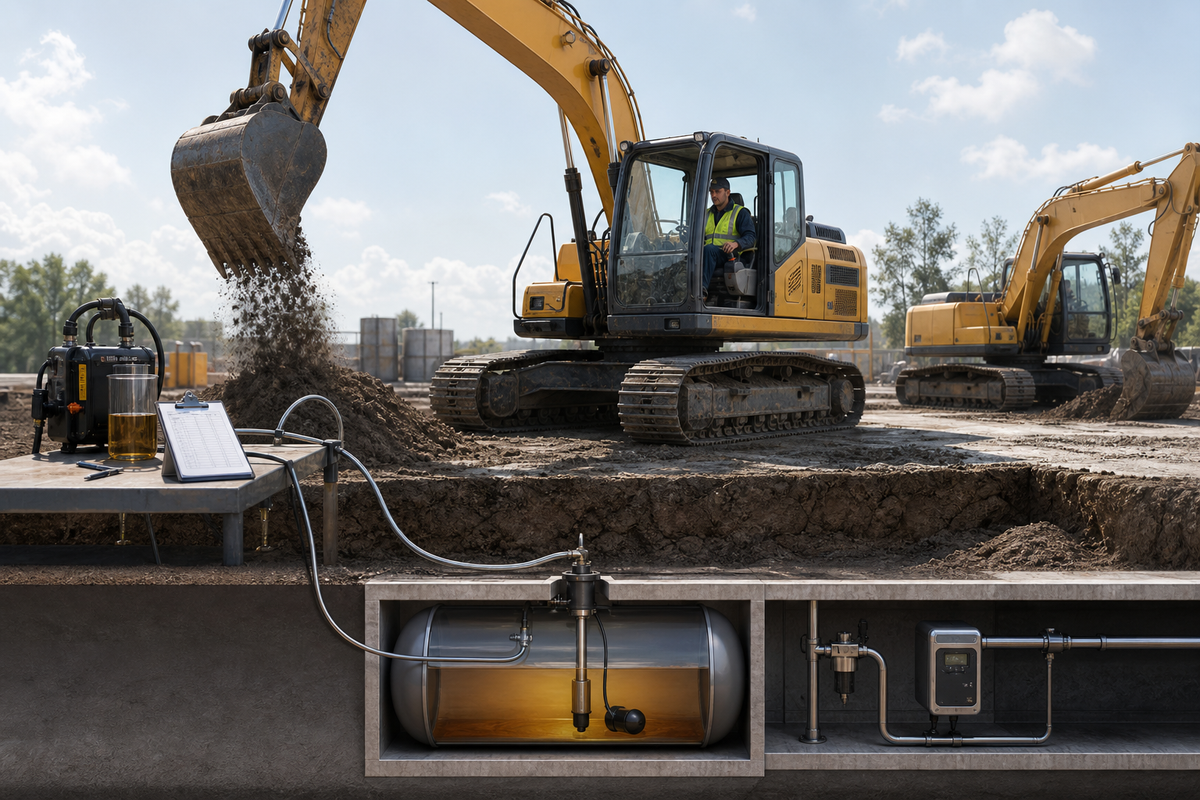
Komatsu generally shows lower fuel consumption in the 20-ton class, and over a full year that adds up. The gap partly reflects engine tuning rather than raw kilowatt output, the Komatsu makes do with slightly less power for the same work. Used-equipment sources report a Komatsu PC200 using roughly 12-15 litres per hour and saving on the order of 10-15% versus a comparable Cat 320D over a long project. A minority of Cat-favoring sources claim the opposite, so treat the edge as real but modest, not decisive.
Both makers patent load-sensing and swing-energy-recovery hydraulics to trim fuel burn, see, for example, the hydraulic swing-motor control circuit patent (US4586332A). Put numbers on it. At 2,000 hours a year and US$1.20 per litre, a 13.5 L/hr machine burns about US$32,400 of diesel annually. A 12% saving is roughly US$3,900 a year, or close to US$19,500 over five years, meaningful, but, as the ownership table showed, capable of being handed back at resale if you choose the cheaper-to-run machine and it depreciates faster. Run your own hours and local diesel price through the same formula before you let fuel decide the brand.
Parts, Service, and Dealer Support for Export Buyers
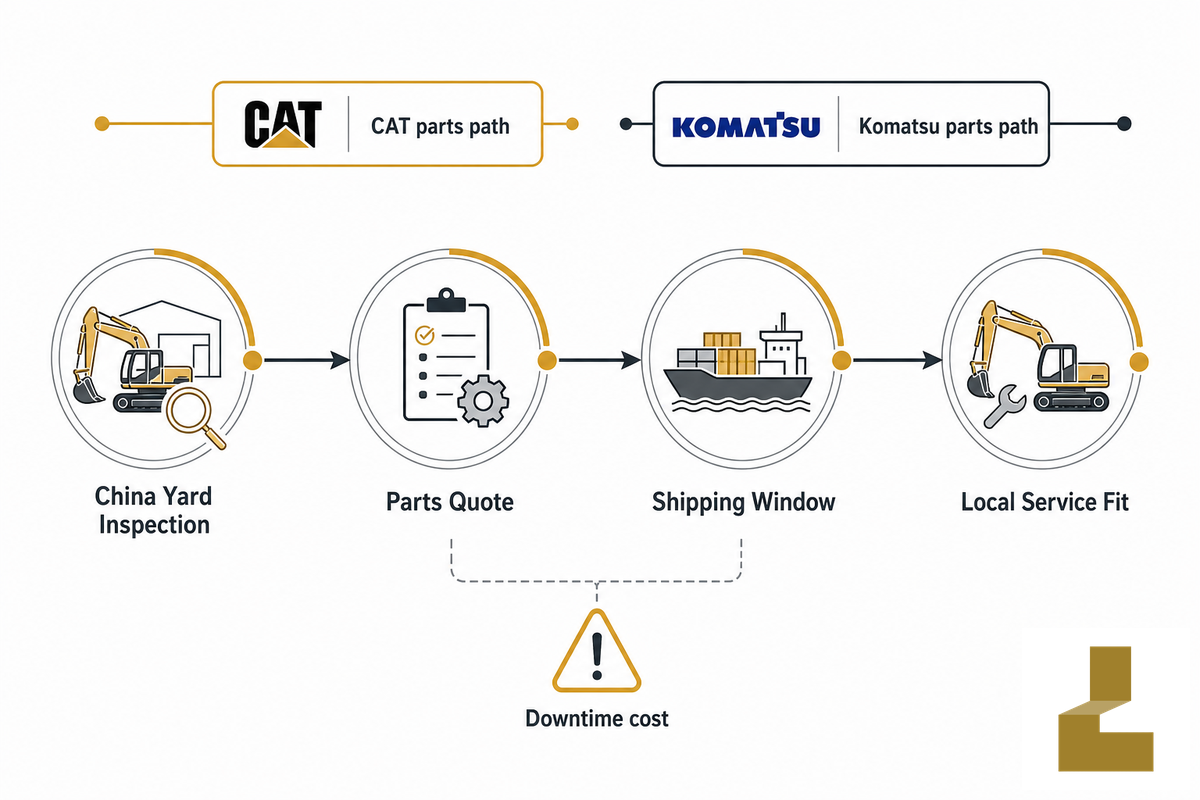
Picture the worst case: a buyer imports a bargain Komatsu into a market with no local Komatsu dealer, a final drive fails at 800 hours, and the nearest stocked replacement sits three countries and two weeks away, idle-machine costs that erase the whole upfront saving. That single risk is why, for a buyer importing to a region without a factory dealer, parts reach can outweigh every spec. Here Caterpillar’s dealer and parts network is the widest in the industry, which is exactly why its machines are easier to keep running far from home; Komatsu’s coverage is strong but more regional. If your country has a well-established dealer for one brand and not the other, that alone can settle the decision.
Telematics also differ. Caterpillar ships Product Link and Cat Grade on newer units; Komatsu counters with KOMTRAX for remote monitoring and its Smart Construction suite. One extra wrinkle for older machines: emission-system parts for lower-tier engines can be harder to source as standards tighten under the EPA’s nonroad diesel rules. On aftermarket parts the two are close to a tie, plenty of quality used, rebuilt and new-aftermarket parts exist for both, usually well below OEM pricing, though any factory warranty is long gone on a used machine. In practice the filter is local: check which brand your nearest service shop actually stocks and knows before you weigh anything else.
💡 Pro Tip
Before you choose a brand, phone two local repair shops and ask which excavator brand they carry filters, final drives and hydraulic seals for. The badge with same-week parts availability in your region is usually the cheaper machine to own, whatever the spec sheet says.
Resale Value and Depreciation
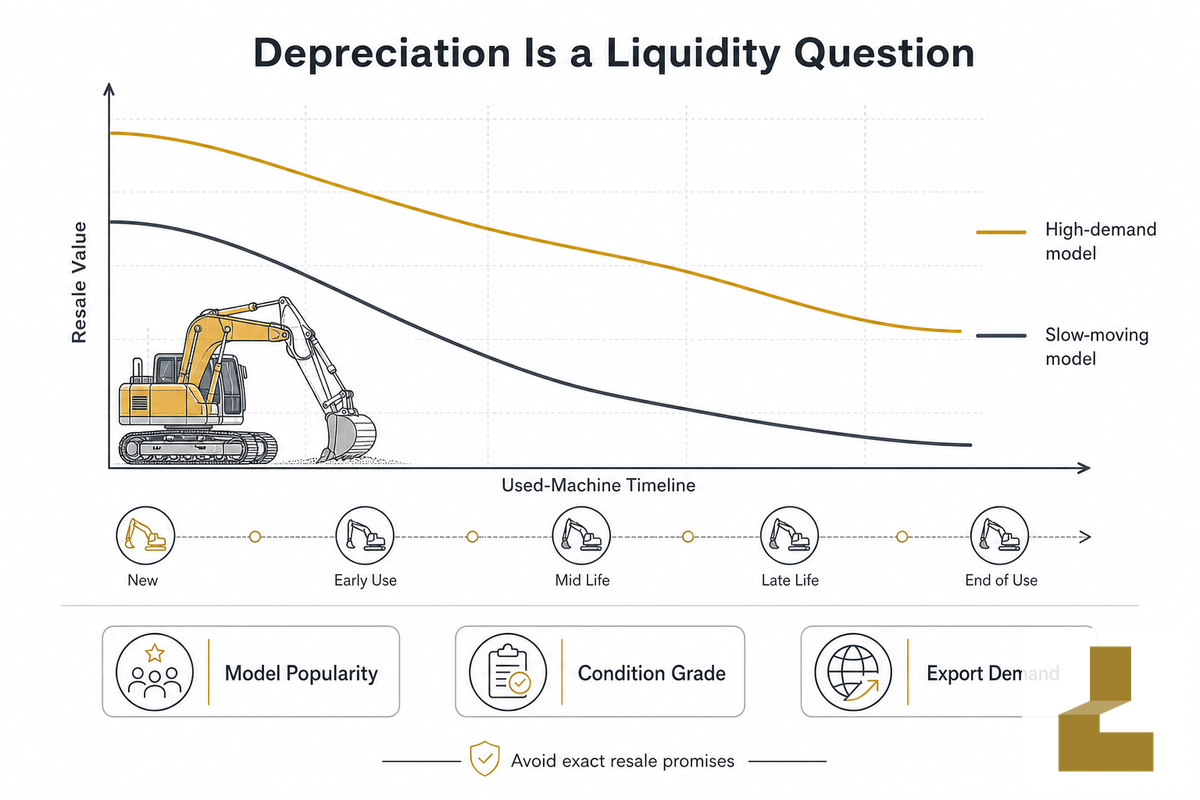
On resale, Caterpillar holds its value better, and the auction record proves it. Over the 12 months to February 2026, Caterpillar took 13 of the top-20 crawler-excavator auction price spots, with Komatsu claiming the rest, the top sale being US$740,000 for a 2023 Cat 395 with 1,912 hours, according to Equipment World’s Fusable EquipmentWatch data.
Two market facts frame any resale plan. First, the average used excavator sold for around US$155,000-159,000 over that period, and the average machine’s age drifted up from 7.1 to 7.7 years, buyers are keeping units longer. Second, that same data shows Caterpillar’s residual strength is structural, not a fluke of one sale. If you expect to resell within five years, Cat’s premium is partly a deposit you get back; if you’ll run the machine into the ground, Komatsu’s lower entry price is money kept today.
Which Should You Buy Used? The 3-Question Cat-or-Komatsu Used Selector
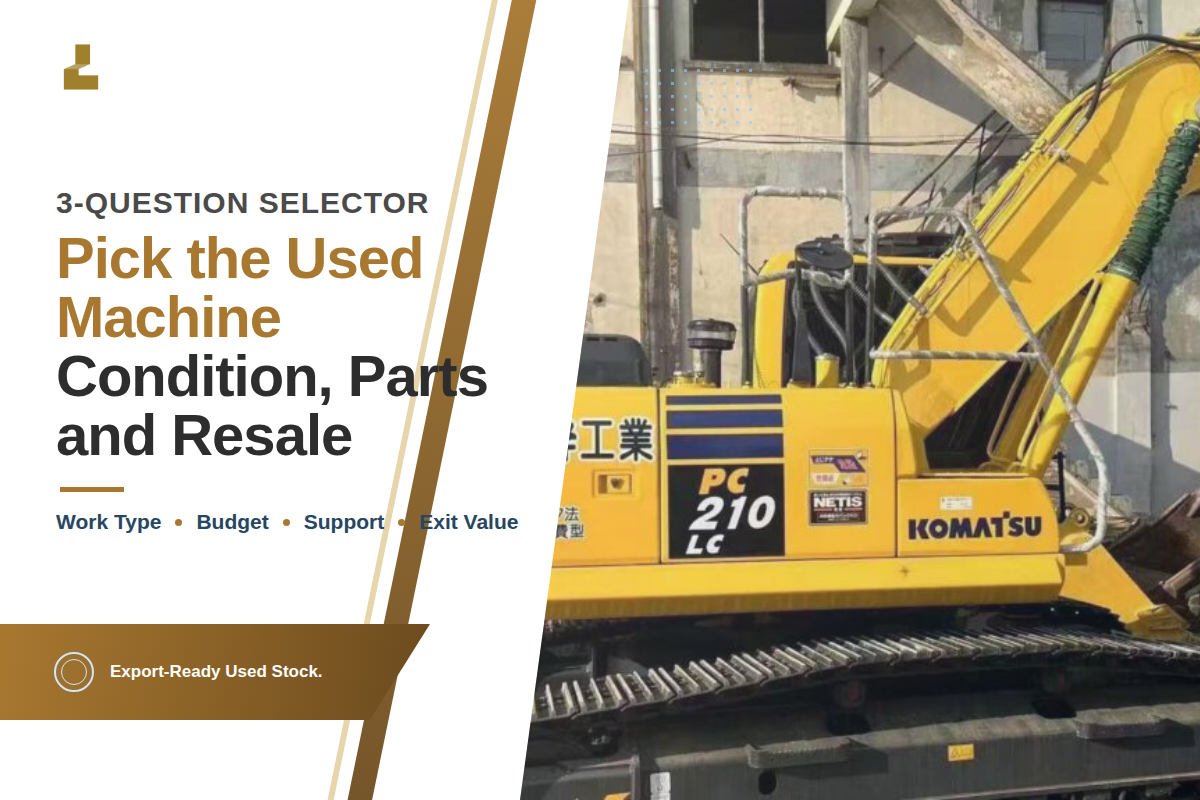
Pick the brand with three questions, not a coin toss. Answer budget, job type, and operating region honestly and the choice usually makes itself. The framework below is the same one we walk import buyers through before we quote a machine.
| If your priority is… | Lean toward | Why |
|---|---|---|
| Lowest cash out today | Komatsu | ~5-10% lower used price + lower fuel burn |
| Reselling within ~5 years | Caterpillar | Strongest residual + auction demand |
| Remote site, few dealers | Caterpillar | Widest parts net + easiest repairs |
| Long shifts, fuel-heavy work | Komatsu | Better fuel economy + strong uptime |
| Deep single-pass digging | Caterpillar (320) | 6.72 m vs 6.10 m dig depth |
When NOT to buy each: skip Caterpillar if your budget is tight, you’ll keep the machine for its whole life, and there’s a strong Komatsu dealer next door, you’d be paying a resale premium you never collect. Skip Komatsu if you resell often, operate far from a Komatsu service center, or need the deepest reach in the class. And skip either brand if the inspection video is missing: a clean paint job never proved a pump.
Bottom line: Buy Komatsu for the lowest cost to get working and to run; buy Caterpillar for the lowest cost to own if you resell or operate far from support. In the 20-ton class that’s Cat 320 for reach and resale, Komatsu PC200 for price and fuel — and for either, condition and documentation matter more than the badge.
Not sure which size class fits at all? Start with our used excavator buying guide or run the Komatsu PC model matcher.
Emission Tiers and Used-Import Eligibility: What’s Changing
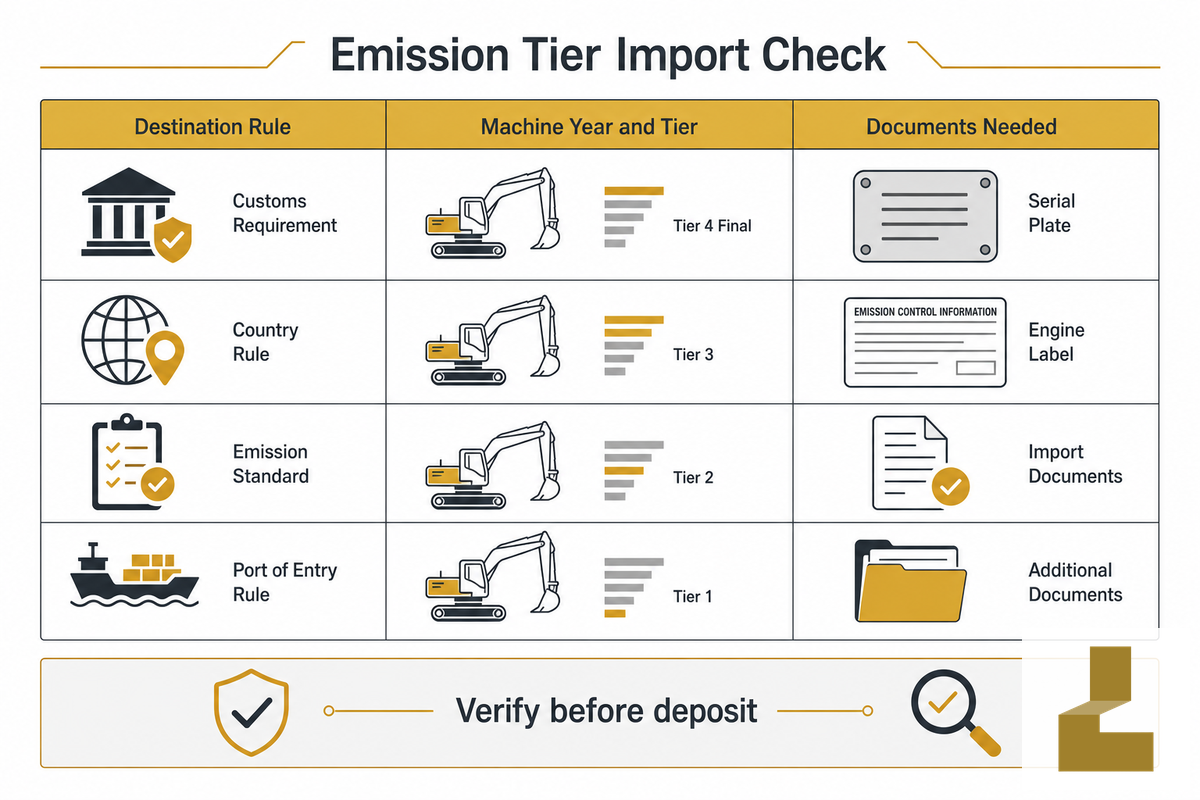
Before price or brand, check whether the machine can legally enter your market at all, because emission rules now gate used imports. An excavator’s engine tier, not its badge, decides eligibility, and the thresholds are tightening. This is the single check that can turn a great deal into a machine stuck at customs.
In the United States, the EPA’s nonroad compression-ignition standards set progressively stricter Tier 1 through Tier 4 Final limits on NOx and particulates. In Europe, EU Stage V is the toughest non-road standard in the world, and the European Commission is due to report on its review by 31 December 2025. So an older, lower-tier Cat or Komatsu that’s a bargain in one country may be un-importable in another.
This trend runs alongside a real demand shift. In 2025, U.S. new excavator sales fell 4.1% while used sales rose 5.3% year over year, buyers are leaning into the used market exactly as emission rules make engine documentation more important. Verify the engine’s tier and build year on the nameplate before you buy, and check destination-port requirements early; our team can confirm eligibility for your market as part of a quote.
Our Perspective
We stock and export both Caterpillar and Komatsu excavators from China, so we’ve no reason to push one badge over the other. The spec figures here come from our own 20-ton listings, and the resale and sales data from Equipment World’s Fusable market reports. Our honest read: Komatsu wins the day you buy, Caterpillar often wins the day you sell, and a documented inspection beats both.
Want a specific Cat or Komatsu machine priced to your port, with inspection video and specs?
Or try the Cat model selector, estimate your landed cost, or send a spec question on WhatsApp.
Frequently Asked Questions
Q: What is the most reliable excavator brand?
Caterpillar and Komatsu are both top-tier, but they lead on different measures: Komatsu tends to break down less often, while Caterpillar is easier and cheaper to repair thanks to its parts network.
Neither is universally the “best excavator brand” for reliability. Field and dealer reports give Komatsu the edge on uptime (fewer shop visits), while Caterpillar’s advantage is that its enormous global dealer and parts network turns a breakdown into a short stop. For a used buyer far from a dealer, repair ease can matter more than raw breakdown frequency.
Q: Who is bigger, Caterpillar or Komatsu?
Caterpillar is the bigger company — it’s the world’s largest construction-equipment maker by revenue, at roughly US$59 billion, with Komatsu of Japan ranked a solid second globally and John Deere close behind.
Caterpillar reports construction-equipment revenue near US$59 billion and ranks first in global OEM sales tables year after year, while Komatsu of Japan is the long-standing number two. In the U.S. financed-excavator market, Caterpillar again led on new units in 2025 with about 27% share, with Komatsu among the top three brands. For a used buyer, that scale gap matters in a practical way: Cat parts, dealers and trained technicians are easier to find in far-flung markets, which shortens downtime when a machine needs work.
Q: Are Komatsu excavators any good?
Yes — Komatsu excavators are among the most respected machines in the world, known for strong fuel efficiency, smooth hydraulics, and reliable uptime that keeps them working longer between shop visits.
Komatsu is Caterpillar’s closest global rival for good reason. Owners consistently praise the fuel economy and smooth hydraulics, and independent repair records suggest the machines spend less time in the shop than several competitors. The main trade-offs versus Caterpillar are a slightly lower resale value and more regional rather than fully global dealer coverage. That coverage gap matters most if you import to a market without a nearby Komatsu service center, where parts can take longer to arrive.
Q: Is Komatsu cheaper than Caterpillar?
Usually cheaper to buy, but not always cheaper to own — Komatsu runs about 5-10% below a comparable used Cat, yet Caterpillar’s stronger resale can close the gap.
A comparable used Komatsu typically costs 5-10% less than the Cat equivalent, and it burns less fuel. But Caterpillar resells for more — Cat took 13 of the top-20 crawler auction price spots in the year to February 2026 — so if you sell within five years, much of Komatsu’s upfront saving is handed back at disposal. Over a full-life hold with no resale, Komatsu stays cheaper.
Q: Which holds resale value better, Cat or Komatsu?
Caterpillar holds resale value better than Komatsu, and hard auction data backs it up: Cat took 13 of the top-20 crawler-excavator price spots in the year to February 2026, with Komatsu claiming the rest.
Cat’s residual strength is structural, not a one-off.
Q: Cat 320 vs Komatsu PC200, which should I buy used?
Choose the Cat 320 if you want more reach, lift, and resale value; choose the Komatsu PC200 if a lower upfront price and better fuel economy lead your priorities for the buy.
In our 20-ton listings the Cat 320 is heavier and stronger (21,900 kg, 121 kW, 6.72 m dig depth) than the PC200 (20,010 kg, 110 kW, 6.10 m), and both quote FOB US$25,000-58,000 used. Buy the 320 if you value deep digging and resale; buy the PC200 if upfront cost and fuel burn lead your list. Then let condition and the inspection video make the final call — match the generation, read the meter carefully, and confirm the emission tier for your import market.
Related Articles
- Used Excavator Buying Guide — inspection, hours, price and import proof in one place.
- How to Inspect a Used Excavator — the 12-point field checklist to run before any deposit.
- How Many Hours Is Too Many for an Excavator? — reading the meter without getting fooled.
- Used Excavator vs New — cost, hours and ROI compared.
References & Sources
- Regulations for Emissions from Heavy Equipment with Compression-Ignition EnginesU.S. Environmental Protection Agency.
- EPA Emission Standards for Nonroad Engines and VehiclesU.S. Environmental Protection Agency.
- European Stage V Non-Road Emission StandardsInternational Council on Clean Transportation.
- Excavator Sales Trends 2025: New and Used ModelsEquipment World / Fusable EDA & EquipmentWatch.
- US3922855A, Hydraulic circuitry for an excavatorGoogle Patents.
![Excavator Bucket Manufacturers: Buyer Evidence [Guide]](https://lhusedexcavator.com/wp-content/uploads/2026/08/excavator-bucket-manufacturers-r2-featured-768x512.png)