Get in Touch with Liehuang Company

Quick Specs
| Weight range covered | 0–10 metric tons (micro to small compact class). |
| Governing standard | ISO 6165:2022 (Edition 7, earth-moving machinery basic types). |
| Typical used price band | $9,000–$85,000 depending on tonnage, hours, and brand. |
| Top used-market brands (financed sales share) | Caterpillar 24.3%, Bobcat 20%, Kubota 16.2%. |
| This guide’s focus | Buyer-side evaluation — works for any seller, not just one vendor. |
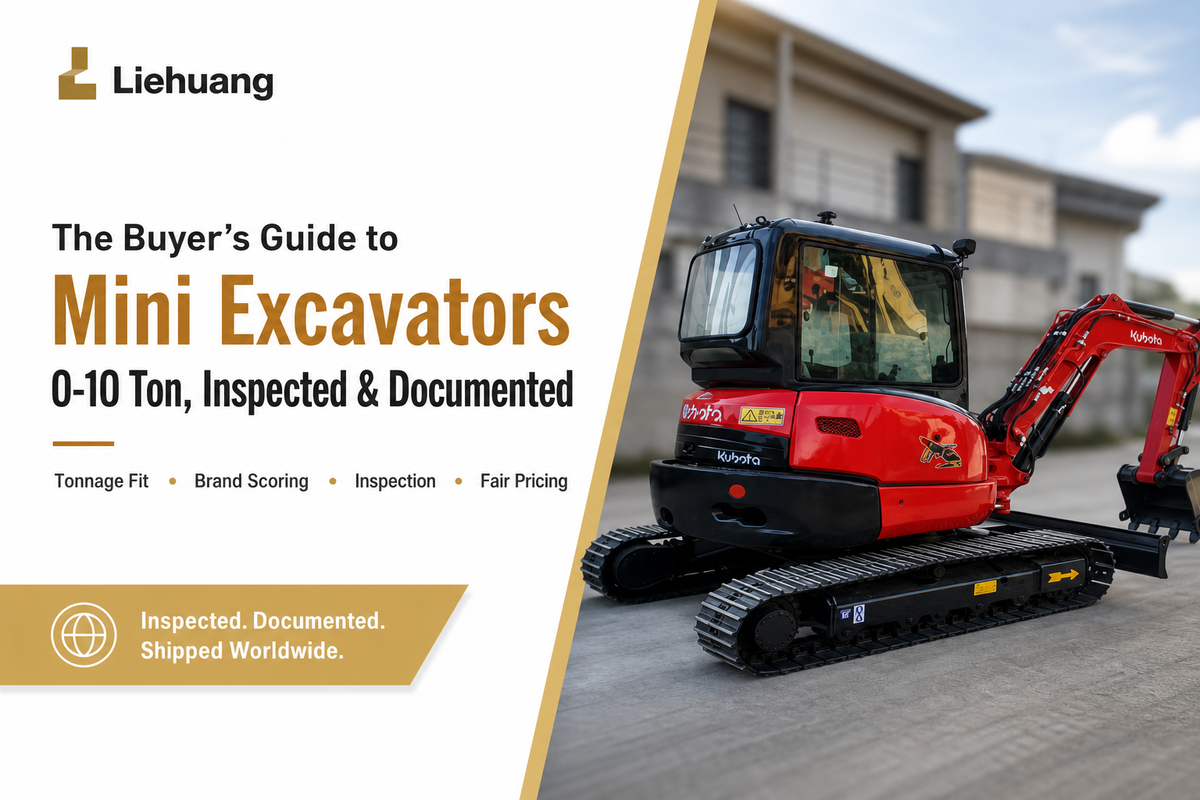
Mini excavators for sale (0-10 ton) are among the most frequently resold construction machines on the market. That high turnover is exactly why the used-listing inventory is so uneven – and in this case, downright dishonest: two photos can make a tidy, low-hour Kubota indistinguishable from a repainted, mile-marker-reset piece of absolute junk. This guide, however, is for the buyer – whether you’re comparing used mini excavators for sale from a small-scale local dealer or a national marketplace listing.
It will walk you through selecting the appropriate tonnage, fairly assessing the quality of a particular brand, making the right rent-vs-buy decision, analyzing the pricing, and physically checking any machine that’s changing hands – no matter the country of purchase, dealership, or seller.
ISO 6165 has a mini excavator (0-10t) classified under “tracked digging machine” as a subcategory within the broad earth moving base types-not a 0t limit-as the “mini” classification itself is an arbitrary market segmentation term and not defined. Used equipment of this type generally falls into $9,000 – $85,000, contingent on hour meters and make; the three top-selling used brands, Cat, Bobcat and Kubota, make up the vast majority (approx. 60% of the total) of financed used transactions.
What “Mini Excavator (0-10 Ton)” Actually Covers
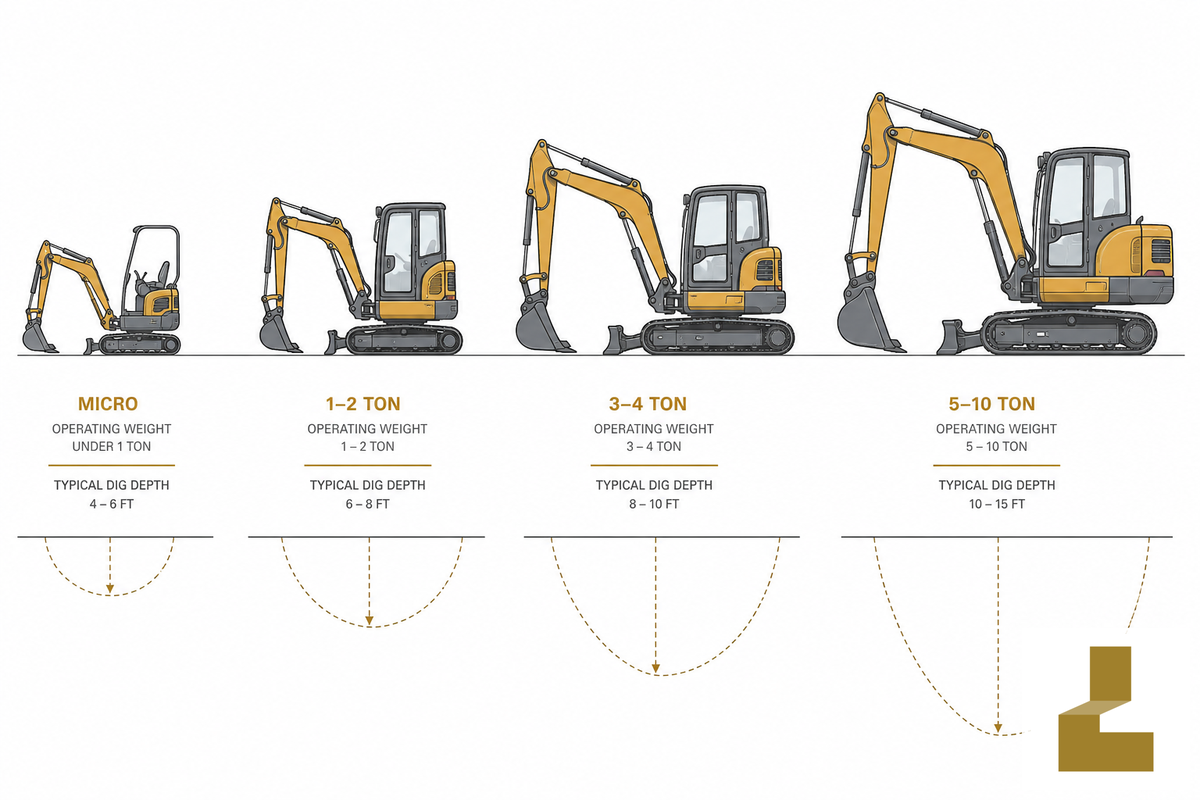
Here’s a fact that surprises most first-time buyers: there is no single international standard that defines “mini excavator” by weight. ISO 6165:2022 – the current 7th edition of the earth-moving machinery classification standard, replacing the withdrawn 2012 edition – identifies excavators by function and design configuration, not by a tonnage threshold.
That 0–10 ton “mini” or “compact” bracket you see across dealer sites and marketplaces is industry convention, built up informally over decades of catalog marketing, not a regulatory line drawn by the standard itself. That matters practically: a “1-ton micro” and an “8-ton compact” both get called mini excavators, yet they can differ in operating weight by a factor of eight.
Within that 0-10 ton window, sub-bands show up consistently across manufacturer spec sheets even without a codified standard behind them. This table is a classification reference, not a shopping list, built at 1-ton resolution so you can place any specific machine precisely instead of guessing which “class” a dealer’s marketing copy means:
| Sub-Class | Operating Weight | Approx. Dig Depth | Market Label |
|---|---|---|---|
| Micro | Under 2,200 lb (<1 t) | 4–5 ft | “Micro” / “sub-compact” |
| 1–2 ton | 2,200–4,400 lb | 5–6 ft | “Mini” |
| 2–3 ton | 4,400–6,600 lb | 6–8 ft | “Mini” |
| 3–4 ton | 6,600–8,800 lb | 8–10 ft | “Compact” (rental fleet “sweet spot”) |
| 4–5 ton | 8,800–11,000 lb | 9–11 ft | “Compact” |
| 5–6 ton | 11,000–13,200 lb | 11–13 ft | “Compact / small” |
| 6–7 ton | 13,200–15,400 lb | 12–14 ft | “Small” |
| 7–8 ton | 15,400–17,600 lb | 13–14 ft | “Small” |
| 8–10 ton | 17,600–22,000 lb | 14–15 ft | “Small” (upper mini/compact boundary) |
The groupings tend to break out into four general categories within this range, based on both dealer catalog listings and the machines usually found on a rental fleet: micro-units (the smallest micro excavators on the market), designed for demolition and post-demolition cleanup work in narrow gates; 1-to-2 ton units designed to tackle utility trenching, digging foundations, and backfill; the popular 3-to-4 ton “sweet spot” class machines commonly seen on rental jobsite fleets and for general contractor applications; and the 5-to-10 ton machines used on commercial sites and for main utility work. No such grouping is formal, but rather they jump out when comparing a few manufacturers’ specs – precisely the reason why the next section organizes machine choices around a job-first, not equipment-first, method.
💡 Pro Tip
The spec-sheet lines most buyers skip and later regret: cab type (open station, canopy, or a fully enclosed all-weather cab – ROPS/FOPS-certified on cab models, an important safety spec on its own); a 2-speed travel motor (faster road/site transport speed, standard on most machines above 3 tons); the diesel engine size; maximum digging height alongside dig depth (matters for loading over a truck bed, not just trenching); and tail-swing configuration (standard versus zero tail swing). A zero-tail-swing machine costs a bit more but might be your only choice if you have to operate within a fenced urban lot.
What Is a Mini Excavator?
At approximately 10 metric tons operating weight and below, a mini excavator – sometimes called a compact excavator, small excavator, or simply a mini digger – is a tracked, hydraulically powered digging machine that differs from full-sized excavators by virtue of its minimal swing radius, compact size, and maneuverability in tight residential and urban environments.
Some models add a swing boom (also called an offset boom), letting the boom pivot independently of the tracks to dig alongside a wall or foundation without repositioning the whole machine – a compact design detail that matters more than tonnage on tight urban lots. Powered by an engine (diesel, but occasionally gas on sub-ton sized machines), the unit’s hydraulic system features a boom-arm-bucket setup along with auxiliary hydraulics (extra hydraulic circuits) to power accessories such as breakers, augers and thumbs. The main strength of the machine compared to say a skid steer or backhoe lies in precise digging and trenching versus loading and moving material (as is detailed later in this guide).
Matching Tonnage to the Job
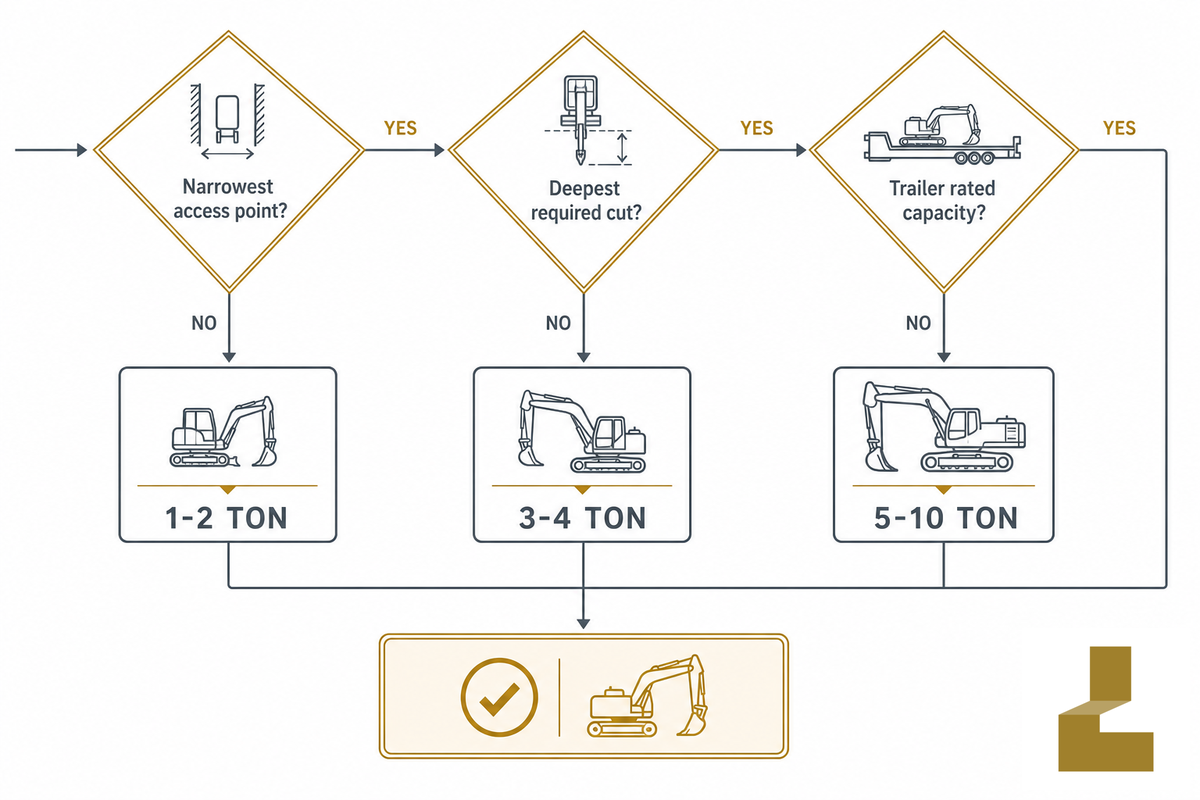
So ISO 6165 won’t make this decision for you, employ a job-first approach and ditch static weighted checklists. If you’ve been searching “2 ton mini excavator for sale,” “3 ton mini excavator for sale,” “4 ton mini excavator for sale,” or “5 ton mini excavator for sale” without landing on a clear answer, that’s a symptom of shopping by number before shopping by job – the tonnage you actually need almost always falls out of the three questions below, not the other way around. The decision to move from one tonnage class to another comes before the first listing thanks to three key questions:
The 3-Question Tonnage Filter
- Narrowest Access – Do you’ve side-yard gate that’s less than 36 inches wide?Then you’re pretty much confined to a 1-2 ton capacity machine. In fact, most residential side-yard gates will limit you to a machine 3-4 feet wide.
- What’s your deepest required cut?A 3-4 ton class rig typically cuts down to 8-10 ft – if you’re in a utility trench that needs more than 12ft of depth, you’re into the 5-10 ton bracket no matter your access restrictions.
- What’s your trailer rated for?Any single-axle trailer under 7,000lb isn’t legally/safely going to move anything but the lightest 4-toners when you use attachments. It instantly prevents upsizing for most small outfits.
Example: a landscaper doing residential drainage work behind a 34-inch side gate, digging to 6 ft, towing with a 6,000 lb-rated trailer, is answered by all three questions before price ever enters the picture – the gate width alone caps them at the 1-2 ton class, and the trailer rating confirms it. By contrast, a commercial contractor digging 11 ft utility trenches with a dedicated tandem-axle trailer skips straight to the 5-10 ton band – and a contractor whose required depth exceeds roughly 15 ft has outgrown this guide’s scope entirely and should be shopping the 10-30 ton medium excavator class instead.
⚠️ Important
A commonly held but incorrect assumption amongst first-time owners of new machinery is that a larger unit is inherently the more capable and productive machine. The reverse is actually the case when considering the attachment sizing failure modes discussed by Equipment engineers working on attachment sizes, where over-specifying a bucket or a attachment in comparison to the carriers’ hydraulic capabilities simply results in system strain and a reduced cycle-time rather than increased output – a similar analogy could be drawn with oversizing the entire machine. In reality, a rightly specified 2-ton machine working at 34 inches will achieve more throughput than an oversised 4-ton unit that cannot even reach the job.
Which Brand Actually Fits You
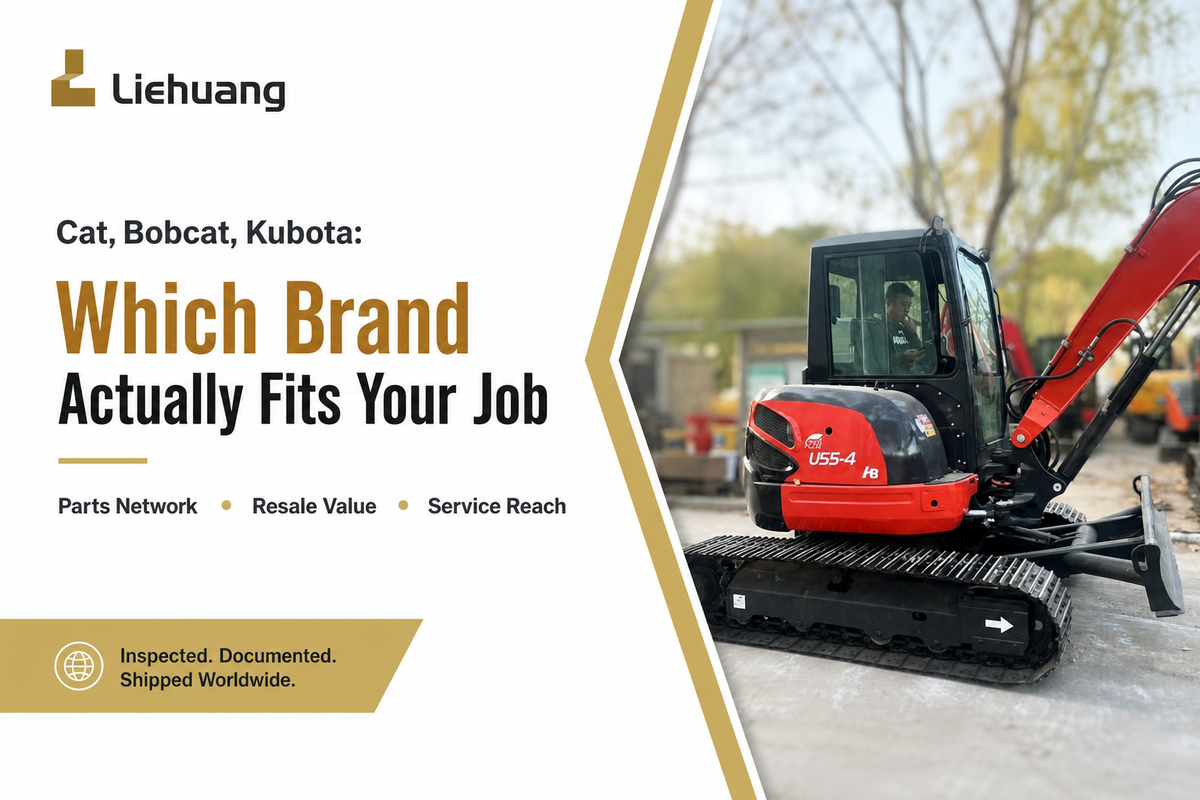
Brand preference in this group of equipment is much more the reality of a working resale and parts network than some tribal identification. According to the latest published used-equipment financing breakout of equipment, the financing volume by machine brand for 2024-2025 sales in the analyzed data shows CAT accounting for 24.3% of used-financed mini excavator sales, Bobcat with 20.0%, and Kubota with 16.2%.
Together these three represent roughly three-fifths of financed used equipment in the analyzed set. One brand worth knowing even though it doesn’t top the financing-share chart: Takeuchi, which built the world’s first compact excavator in 1971 per the company’s own account, and whose machines are frequently reported by owners to hold resale value well – its demand is real, just concentrated more regionally than Cat/Bobcat/Kubota’s nationwide financing share.
This grouping of machines isn’t by accident in marketing; it represents network effects; more units of a particular brand working in a market leads to more service shops carrying its filters and seals, which keeps the price strong on the used equipment a few years down the road.
“Get in the machine and practice, you learn more about how a piece of equipment actually behaves in twenty minutes of hands-on operation than from any spec sheet.”
instead of a brand’s reputation ranking: score any contender on these three measurable axes before you can be enticed:
| Axis | 1 point (weak) | 3 points (strong) |
|---|---|---|
| Parts-network depth | One regional dealer, special-order parts | Multiple independent shops carry filters/seals locally |
| Resale demand | Under 5% of local used-financed sales | Top-3 financed-sales share (Cat/Bobcat/Kubota nationally) |
| Service-network reach | No certified technician within 100 miles | Factory-authorized service within your region |
7-9 total score will likely make a safe long-term purchase regardless of brand, and 3-4 is a good buy as a project tool as long as you consider the parts lag time and value depreciation.
Buy vs. Rent: The Break-Even Math
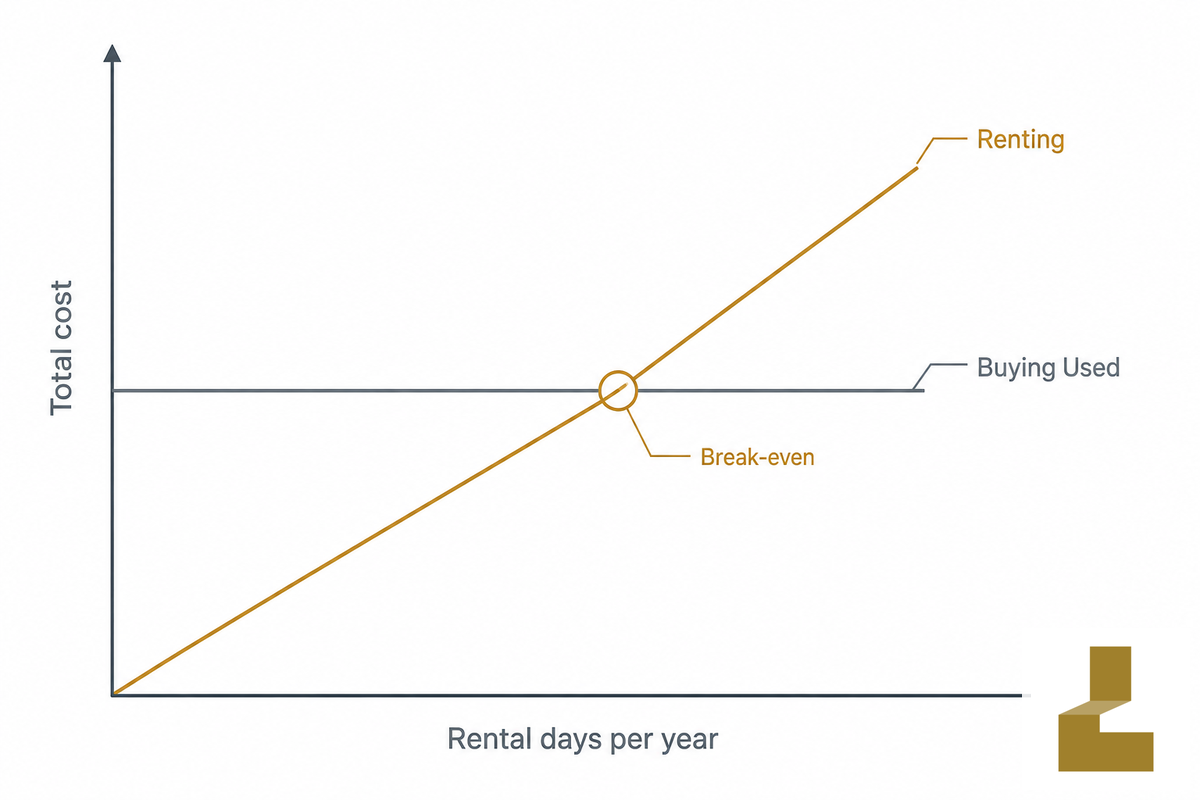
Eventually, most buyers have asked, “Should I’ve just rented?” Searching “mini excavator for rent” instead of a purchase listing is a completely reasonable first move if your project is a one-off – the mistake is staying in rental mode once your annual usage crosses the break-even point below. Our Buy-vs-Rent Break-Even Framework answers the question with your numbers, not a rule of thumb:
Buy-vs-Rent Break-Even Framework
Break-even hours = Purchase price/(rental daily rate times day-per-hour-of-use factor)
More directly: Buy it for [your machine’s purchase price] / [(cost of renting similar use day – your assumed cost to own year on day use)]. If that break even day is before how much you plan on actually using your machine each year, buy it.
Let’s look at the math: a regional rental rate for a 3-4 ton mini excavator is going to be somewhere in the $200-$500 per day range; let’s use $350/day as a midpoint planning number or roughly $1,500/week. A good condition, used 3.5-ton machine might cost about $32,000-$42,000. With 20 rental days per year at $350/day, you’re already at $7,000; 60 rental days/year (which is only about 12 weeks of intermittent work) will cost $21,000/year-that’s more than half the price of buying the used machine in one year! Work that into your own project schedule: if you anticipate renting more than approximately 25-30 days/year, a used purchase generally will have paid for itself within 12-18 months, even including depreciation, storage, and maintenance costs.
💡 Pro Tip
In some markets, such as the U.S. (under tax code Section 179), you can deduct accelerated depreciation for purchased equipment that you typically cannot for leased or rented equipment-this further strengthens the case for buying in certain situations. Tax rules vary by country and by business entity, so consult your local tax professional before using this to guide your purchase decision.
Is It Better to Buy or Rent a Mini Excavator?
For one-off jobs requiring roughly 10-15 rental days a year, renting is the smarter option once you factor in maintenance, storage, insurance, and the depreciation risk of buying. Dealers, fleet operators, or contractors using the machine regularly-well beyond that 20-30 day-a-year mark-usually save money owning a well-inspected used unit instead.
Reading a Used-Machine Price Like a Buyer, Not a Shopper

The most expensive mistake in this price range isn’t overpaying by a few thousand dollars – it’s misreading why a listing is priced the way it is and buying a mechanical problem instead of a bargain. Prices for used mini excavators between 0-10 tons fall within a very broad spectrum-from about $9,000 for a well-worn 1-ton machine to upwards of $85,000+ for a low-hour, fully-equipped 5-8 ton unit with an enclosed cab. That wide range is driven by four key factors in descending order of importance: hour count, brand/parts-network tier, overall condition (as verified through inspection, discussed in the next section), and location. A listed price that’s disproportionately low relative to hours and brand is usually the most reliable initial red flag (it doesn’t guarantee fraud, but you should proceed cautiously and plan for a thorough inspection).
The sticker price also isn’t the whole picture of what the machine actually costs you. In the U.S., IRS Publication 946 governs how purchased business equipment can be depreciated, and Section 179 treatment can let a qualifying buyer deduct a large share of the purchase price in the same tax year rather than spreading it over several – a real dollar difference that a pure listing-price comparison misses entirely. Rules vary by country and business structure, so this is a reason to ask your tax advisor before you buy, not a reason to skip the inspection questions above.
How Much Does a 10-Ton Excavator Cost?
Higher-end used excavators in the 8-10 ton range with moderate hours will often command $55,000 to $85,000 and above, depending on the brand, specific configuration (e.g., hydraulic attachments), and cab amenities-new machines in this size range often exceed $95,000. Used units on the lower end of that range tend to be higher hour, lower-brand-tier value propositions, and it’s important to understand which element is primarily responsible for the price discount.
Three Price Red Flags Worth Slowing Down For
- Listing price is 20%+ below comparable units of the same brand, tonnage, and hour range with no specific reason given for the discount (such as an accident history, a non-running machine, or missing attachments).
- Listing includes perfectly rounded hour numbers (e.g., exactly 2,000 / 3,000 / 5,000 hours) with no supporting maintenance records.
- The seller refuses to permit a pre-purchase inspection of the equipment by an independent third party selected by the buyer.
The Inspection Checklist No Listing Photo Can Show You
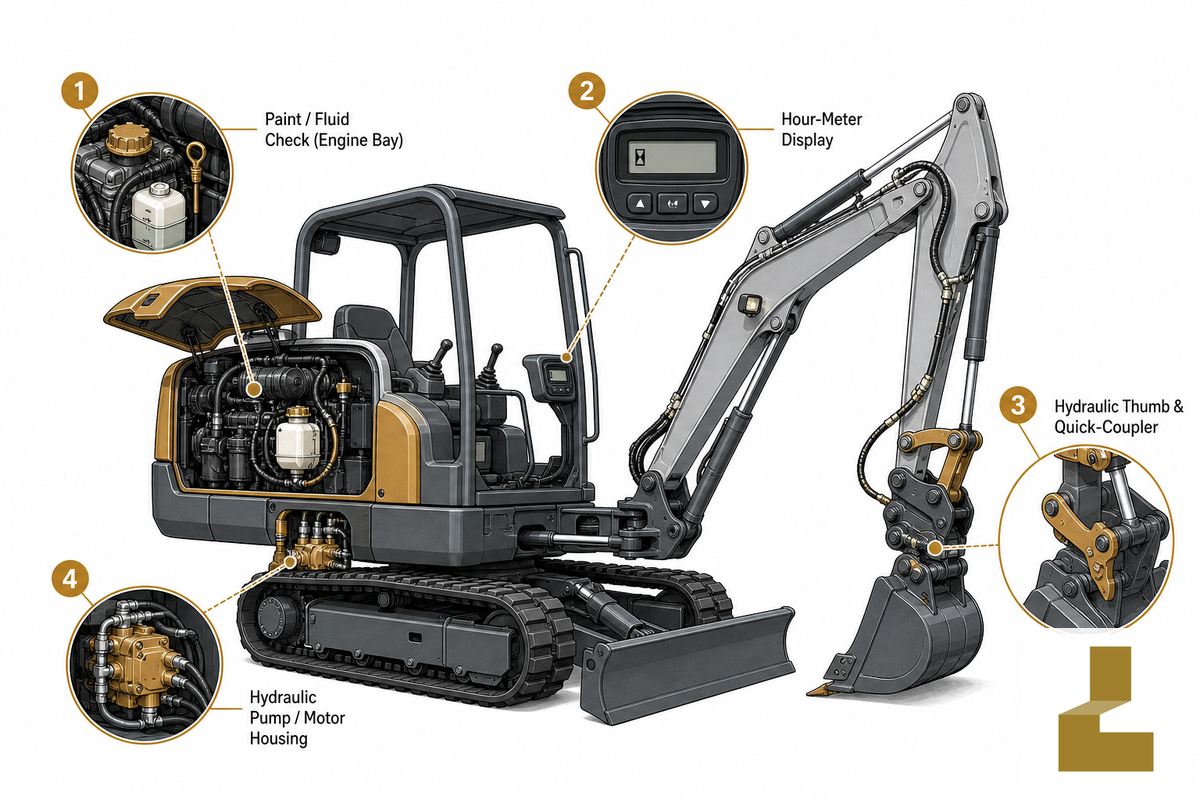
Photos three and the description of a listing aren’t an inspection report. Genuine heavy-equipment forum buyers have repeatedly flagged a specific set of the same indicators that signal an honestly presented machine from one tarted up for sale. The 4-Point Tamper-Check Framework is what boils those commonly expressed warnings into a repeatable protocol you can execute on any machine from any seller in less than a quarter-hour.
The 4-Point Tamper-Check Framework
- Paint and fluid levels. As one of used-equipment.com’s forum posts so accurately put it, “A new paint job on a used machine is about the easiest way there is to cover uprust, filler, or a failed weld,” while a machine with “a drawer of well-kept records… will indicate to a savvy buyer that you’re about the best machine there’s to own. Look at the condition of your engine oil, the condition of your coolant and air filter” – while oil can get dark no matter how well you keep it, a recent filter and good coolant tell you more about how well the machine has been kept up.
- Hour-meter plausibility. Compare hour-meter reading against signs of wear on surfaces most often touched – pedal rubber, grip of lever and the seat cover. If an hour meter reads less than 2,000 on a machine with a saggy seat and thoroughly rounded off pedals, it’s not something to negotiate but to avoid entirely.
- hydraulic thumb and coupler operation One of the patented ratio-control thumb designs, U.S. Patent US6385870B1, retains the thumb cylinder in a somewhat low and steady clamping pressure while it’s disengaged; properly working ones clamp and hold the bucket against moving open, and one that drifts open is always worth noticing while walking a machine regardless of how it’s constructed internally. Regarding the quick coupler, ensure the secondary safety-retention pin or lock is properly installed and engaged according to whatever mechanism is being used (such as the one described in US8347974B2); that’s absolutely critical as evidenced by a 2005 OSHA safety bulletin citing 15 instances of unprovoked excavator bucket release from quick couplers occurring between 1998 and that time and resulted in 8 fatalities, most of which were a result of the secondary retention device missing or being deliberately disabled – that hazard hasn’t decreased.
- Motor & hydraulic pump on cold start. There’s an old saying in forums among used-machine buyers that all wear items can be cheaply replaced with parts that the manufacturer is willing to share, except the motor and the hydraulic pump which really cost money to fix if there’s a problem. Fire a machine on a cold start (not after the seller has already warmed it up), see if you get an awful lot of white or blue smoke after the initial warm-up seconds, and check for any knock when the hydraulic is put under a slight load.
Ever wonder what those 0-10 ton mini excavator you can buy look like before you ever even have them on inventory?
At Liehuang we take and attach a serial-matched condition report, hour-meter photo, and cold start video on all of our inspected units before they’re shipped to you.
Why Parts Availability Is the Real Price Tag
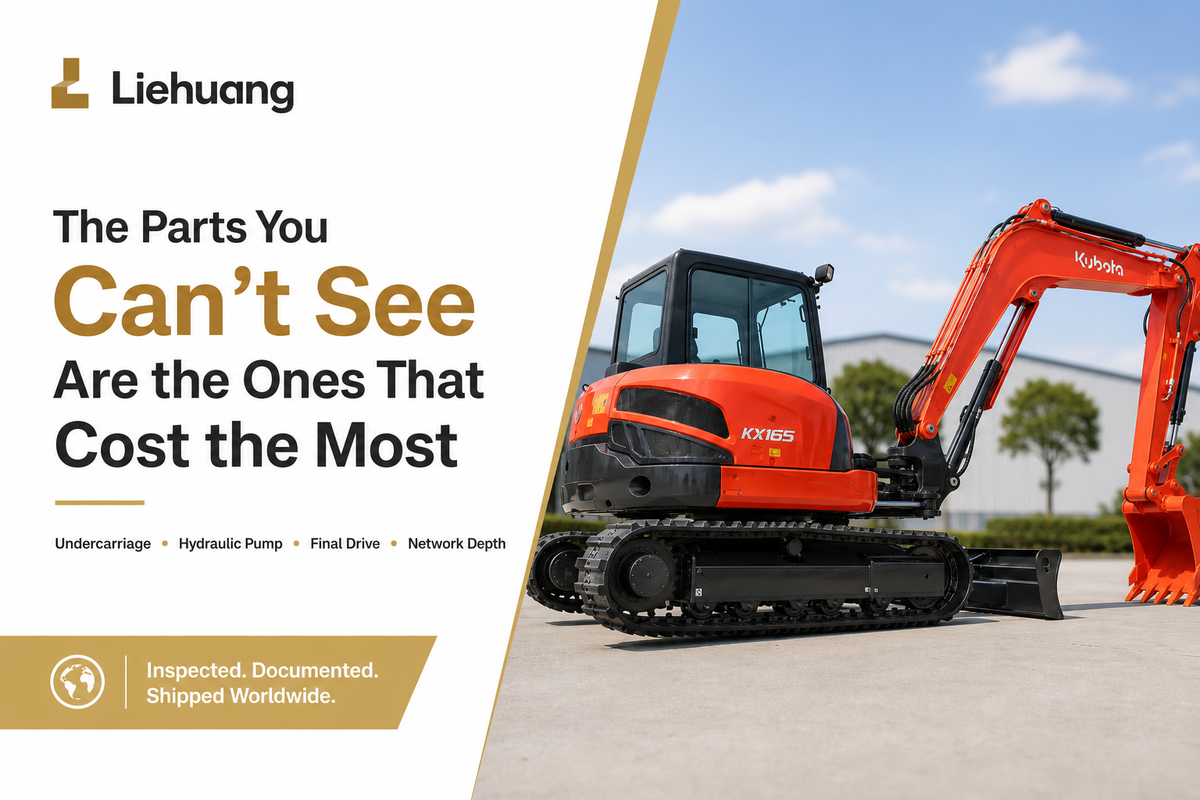
Sticker price of a used machine is only the low end of TCO. Truthfully, a wise used buy is the one that can be brought back to working condition with a minimum amount of effort and cost when — not if — something gives out. That’s the mechanical explanation of why the forum guys are right: wear items tend to be cheap, but motor and hydraulic pump breakdowns are pricey.
How pricey varies wildly with the presence of stock local parts. For high-tier brand (see brand scoring in diagram above) machines, an independent shop can call the dealership by OEM number and get a new final drive, seal kit or travel motor within a few days. For a machine of a brand that’s had a regional network stretched thin, that same repair could be a multi-week repair, with the parts supplied from the OEM on the shelf – and any fabricated hydraulic seal is bound to fail eventually. The attachments only magnify this problem, with their hydraulic thumbs, quick couplers, angle blades, and heavy-duty breakers (refer to hydraulic breaker maintenance guide for specific wear points on breakers and the bucket sizing and wear life guide for tooth and bucket edge life cycles) all in some fashion or other leaning on the same issue.
📐 Engineering Note
When considering a listing’s attachment package, confirm the pin spread of the quick-coupler, as well as the hydraulic flow rate of the coupler to be the same as that which the carrier’s factory aux-hydraulic specification. Usually, a used coupler sourced from another class of machine and sold for this purpose will underperform and may leak because a quick visual check wouldn’t identify any mismatches between the coupling hardware and the machine it’s installed on.
Mini Excavator vs. Skid Steer vs. Backhoe: When Each Wins
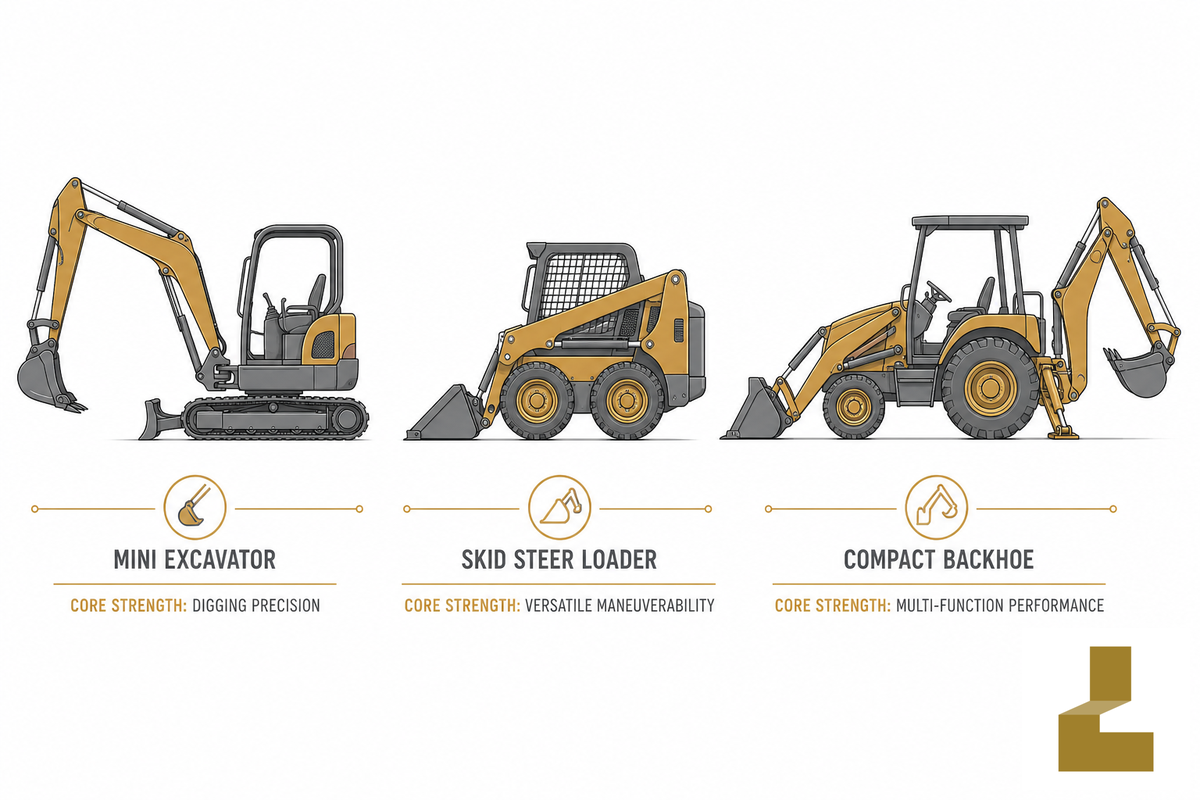
Shop By tonnage: make sure that a mini excavator is what your company actually needs Before purchasing your mini excavator by tonnage, verify whether this is the right kind of machinery. After all, the U.S. Bureau of Labor Statistics designated these types as different categories of construction equipment operation for the very real fact that these machines are constructed around unique primary functions.
| Machine type | Core strength | Typical dig depth / limit |
|---|---|---|
| Mini excavator (0-10 ton) | Precision digging and trenching in confined spaces | Up to ~15 ft in the 6-10 ton band |
| Skid steer loader | Tight-space agility, material loading/carrying, widest attachment breadth | Limited native digging; backhoe attachment can reach 3-ton-excavator depth |
| Compact backhoe/loader | Dual-function loading (front) and digging (rear) on one chassis | 6-11 ft; operating weight roughly 2,700-8,500 lb |
That said, trade coverage of the compact-equipment market sees real overlap: a skid steer with a backhoe attachment can achieve dig depths similar to a 3-ton mini excavator, so these two categories aren’t as distinct in practical terms as the table above suggest – treat it as an initial choice, not a fixed one. If your project is primarily digging and trenching in a limited footprint, the mini excavator prevails. If you need to load, carry, and switch a dozen different attachments across an irregular work site, a skid steer’s versatility often surpasses an excavator dig-depth advantage. And if you need true dual-function load-and-dig without owning two machines, a compact backhoe balances the books – at the expense of not doing either task as well as dedicated equipment. If your work generally exceeds the 10-ton mini-excavator ceiling – mining prep, large demolition, or heavy-civil project work – the appropriate comparison is wholly different: 30-80 ton heavy excavators, not the machines described in the table above; scrolling through a full used excavator inventory across all tonnage levels is a quicker way to identify where your project falls. One more variable merits inclusion in this decision: NIOSH’s occupational-danger review of skid-steer loaders reveals a rollover and struck-by risk profile distinct from tracked excavators, adding to operational considerations, not just digging ones.
Buying From Overseas: A Universal Due-Diligence Checklist
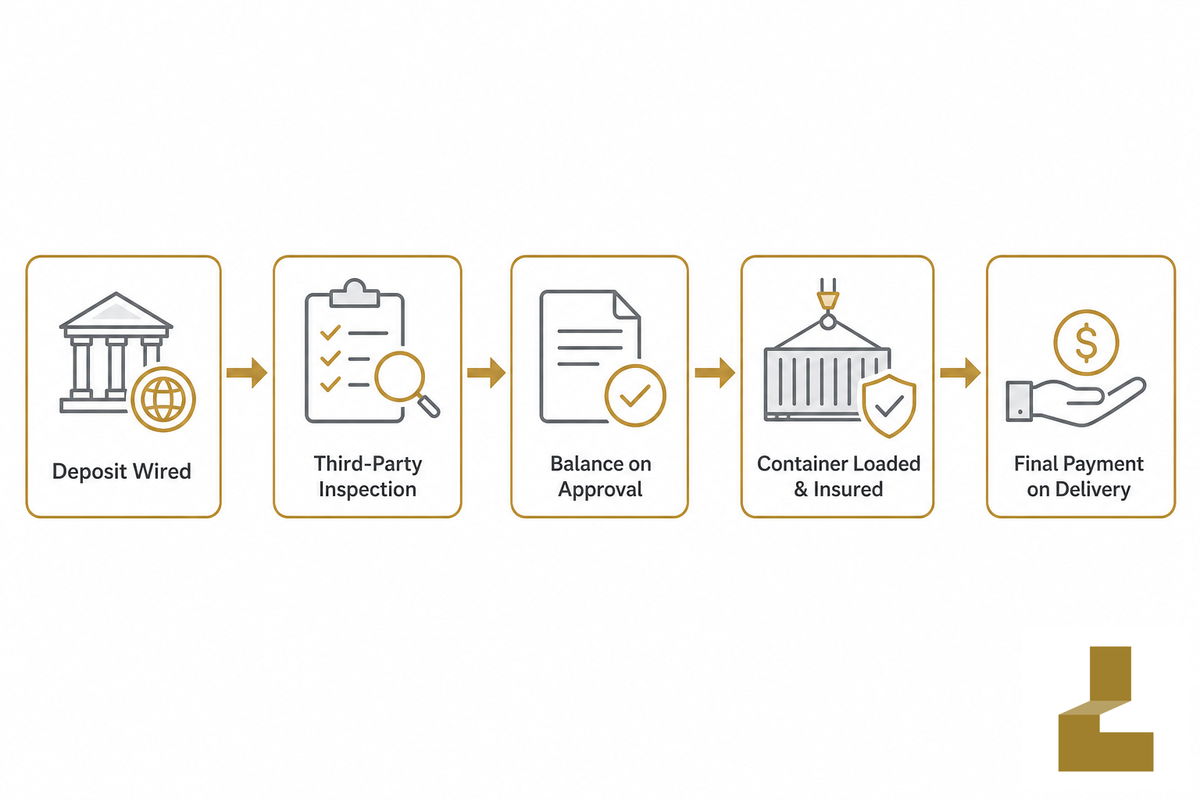
Purchasing a pre-owned machine shipped by container from abroad introduces a transaction-security nuance absent from a local sale – you can’t walk the property before providing payment. This part isn’t about paperwork the seller should supply (compliance documentation is the other’s responsibility); it’s about what you, the prospective purchaser, should confirm before committing funds, regardless of the country or vendor.
This risk shows up in the field, not on paper. A buyer who wires full payment upfront for a container of used equipment and skips independent inspection has no recourse if the hydraulic pump on a 3-ton unit turns out seized on arrival, or if the machine that lands is a different serial number than the one photographed – because once the container has cleared customs, there’s no realistic path to a refund. That’s the structural reason a staged payment schedule and third-party inspection matter more here than on any local purchase: Liehuang’s own CIF shipping process exists precisely to remove that blind spot before the deposit is wired, not after.
Buyer Due-Diligence Checklist for Overseas Purchases
- Demand a staged payment setup (deposit → balance upon inspection → final payment on delivery approval) rather than full-up front payment
- Insist on a third-party inspection option (SGS, Bureau Veritas, TÜV, or Intertek) rather than simply accepting the seller’s own report
- Ensure emissions compliance documentation for your destination is confirmed prior to shipping, not afterward – the U.S. EPA is unequivocal that the Clean Air Act forbids importing nonconforming nonroad engines and machinery, and that Customs and Border Protection can legally confiscate noncompliant shipments and impose penalties on the importer, not just the seller
- Receive serial-number-matched records (photographs, condition report, video) tied to the unit in question, not a generic listing
- Ascertain coverage on the freight itself – insuring approximately 130-150% of total landed cost is a practice common among seasoned importers, covering both the unit’s worth and secondary costs if an insurance claim is filed
And that diligence is nothing new – it’s just the same discipline that every due diligence buyer uses when importing from China, Japan, or any machine’s country of origin for resale into North America. Sellers who’ve long built a similar transparency into their process-as is evident in Liehuang’s publicized workflow for both inspections and CIF shipping-will make using the below checklist effortless, before you ever need to close. But the checklist itself hold regardless.
Industry Outlook: What’s Changing in the Used Mini-Excavator Market

Search trends provide an even more granular window than many of the market overviews would indicate. Tracking search-volume trends through Q2 2026, the March-May 2026 window shows an impressive 2.36x increase for searches involving “Caterpillar mini excavator,” compared against a June-August 2025 baseline, while “Kubota mini excavator” search interest was flat to declining over the same comparison. Changes like this one typically foreshadow a one-to-two quarter shift in used equipment resale values. This suggests that buyers targeting a Cat-badged unit this spring are stepping into a market poised to appreciate-a significantly more meaningful signal than the industry’s constant “the market is growing.”
Beyond brand and demand trends, two more quantifiable market dynamics merit consideration when evaluating your purchase timeline. Firstly, seasonal economics: Our analysis indicates Q1 2026 – the typical production ramp-up window following the Chinese New Year – may offer a price flexibility of approximately 10-15% over similar units compared to other periods of the year. This is a precise timing advantage, not simply an assertion of potential price drops. Secondly, regulatory factors: In California, for example, the 2022 Air Resources Board regulations are steadily removing Tier 0, 1, and 2 diesel engines from service; if you’re buying a used low-emission-tier unit specifically for operation in that state, confirm it isn’t already on the phase-out timeline.
(Note on market size: global mini excavator market estimates for 2026 are highly variable, with various research firms pegging the low end at $11B and the high end at $54B; reported CAGRs of 4.7% to 7% extend through the early 2030s. This context alone isn’t a purchase decision factor.)
Frequently Asked Questions
Q: What is the best mini excavator for the money?
View Answer
“Best for the money” in this category means selecting the unit that performs well across the brand-self-scoring rubric detailed earlier (parts network, resale value, service accessibility) for the amount you are spending-it’s not about finding the machine with the lowest initial price. When comparing well-maintained, mid-range-priced units from brands such as Cat, Bobcat, or Kubota to lower-cost alternatives, it is almost always the case that the premium branded machine will have a significantly lower overall cost per hour over its reliable lifespan, factoring in the parts-network total cost of ownership gap. That gap is exactly why the brand-scoring framework above weighs parts-network strength as heavily as it does purchase price.
Q: How much does a 10-ton excavator cost?
See Answer
For the 0-10-ton segment of the used market, expect to pay at the higher end – roughly $55,000 to $85,000 and beyond, depending on hours, brand and cab specification. In contrast, comparable new units are often priced considerably higher, in excess of $95,000. Refer to the Pricing section above for a breakdown of the four factors – hours, brand tier, condition and region – that most closely determine a machine’s position within this pricing range.
Q: Is the cheapest mini excavator actually a good deal?
Read Answer
Rarely, once you factor in total cost. Cheaper machines from a thin-parts-network brand run fine for the first 1,000 hours, then the math breaks the moment a hydraulic pump or final drive needs a special-ordered, custom-machined part. Whatever savings you made up front can vanish on a single repair – check our parts availability notes above before letting price decide for you.
Q: What can a 1-ton mini excavator actually do?
View Answer
Use these 1-ton sized excavators for light-to-moderate demolition, tight gate access landscaping jobs, small utility repairs and backyard grading tasks where working width is more of a priority than digging depth or lifting capacity. Don’t plan on using them for major utility main line excavation or full-blown commercial site development. Review the 3-Question Tonnage filter at the top to see if this class is a good fit for your intended application before you invest in one.
Q: Is it better to buy or rent a mini excavator?
See Answer
Rent one if your planned annual usage is somewhere around 10 to 15 days a year. If your yearly needs are in excess of 20 to 30 rental days, then buying used becomes the more economically prudent option. You can play around with the Buy-vs-Rent Break-Even Calculator at the top to estimate the crossover point based on your own specific calendar and local rental rates rather than adhering to an arbitrary rule – because the calculation depends heavily on both factors.
Q: How do I know if a used mini excavator’s hour meter is accurate?
Read Answer
Cross-reference the actual hours listed on the equipment’s display with the physical wear found on the seat cushions, pedal grips, and the joysticks themselves. These surfaces are much harder to fake than digital displays and wear at a rate that is proportional to actual operating hours. High hour readings on these surfaces, particularly when paired with a suspiciously low operating hour reading, are usually an indication to walk away from the deal. Review our 4-Point Tamper-Check Procedure to ensure you don’t buy a dud.
Q: What is a mini excavator?
View Answer
mini excavators are track-type hydraulically-powered excavation machines roughly weighing less than 10 metric tons, designed for precision trenching and excavation in compact or otherwise inaccessible work environments where a standard sized excavator simply wouldn’t fit.
View Inspected Mini Excavators (0-10 Ton) →
Why We Write This
We put together this buyer’s guide to address the 3 most commonly flubbed buyer-side questions in the mini excavator market: Tonnage Sizing, Brand Selection, and Inspection using an evidence-based approach, rather than regurgitating standard dealer price lists. All pricing and rental-rate data presented here reflects market conditions in the first and second quarter of 2026, so be sure to check current pricing for your region. Reviewed by the Liehuang technical team.
References & Sources
- ISO 6165:2022, Earth-moving machinery, Basic types – International Organization for Standardization
- Quick Data: Top-Selling Mini Excavators in 2024-2025 – Total Landscape Care
- Mini Excavator Rental Cost (2026 Price Guide) – Beehive Rental and Sales
- US6385870B1, Control System for an Excavator Thumb – USPTO / Google Patents
- US8347974B2, Safety Locking Device – USPTO / Google Patents
- Safety Hazard Information Bulletin: Excavator Quick Couplers – U.S. Occupational Safety and Health Administration
- Construction Equipment Operators Occupational Outlook – U.S. Bureau of Labor Statistics
- Preventing Injuries and Deaths from Skid-Steer Loaders – NIOSH, U.S. CDC
- Learn About Importing Vehicles and Engines – U.S. Environmental Protection Agency
- In-Use Off-Road Diesel-Fueled Fleets Regulation – California Air Resources Board
- Skid Steers Settle in as the Go-To Machine in Compact Equipment – Equipment World
Related Articles
- Mini Excavators for Sale (0-10 Ton) – browse Liehuang’s current inspected inventory
- Medium Excavators for Sale (10-30 Ton) – for jobs that outgrow the mini class
- Heavy Excavators (30-80 Ton) – mining, demolition, and large-scale construction