Get in Touch with Liehuang Company
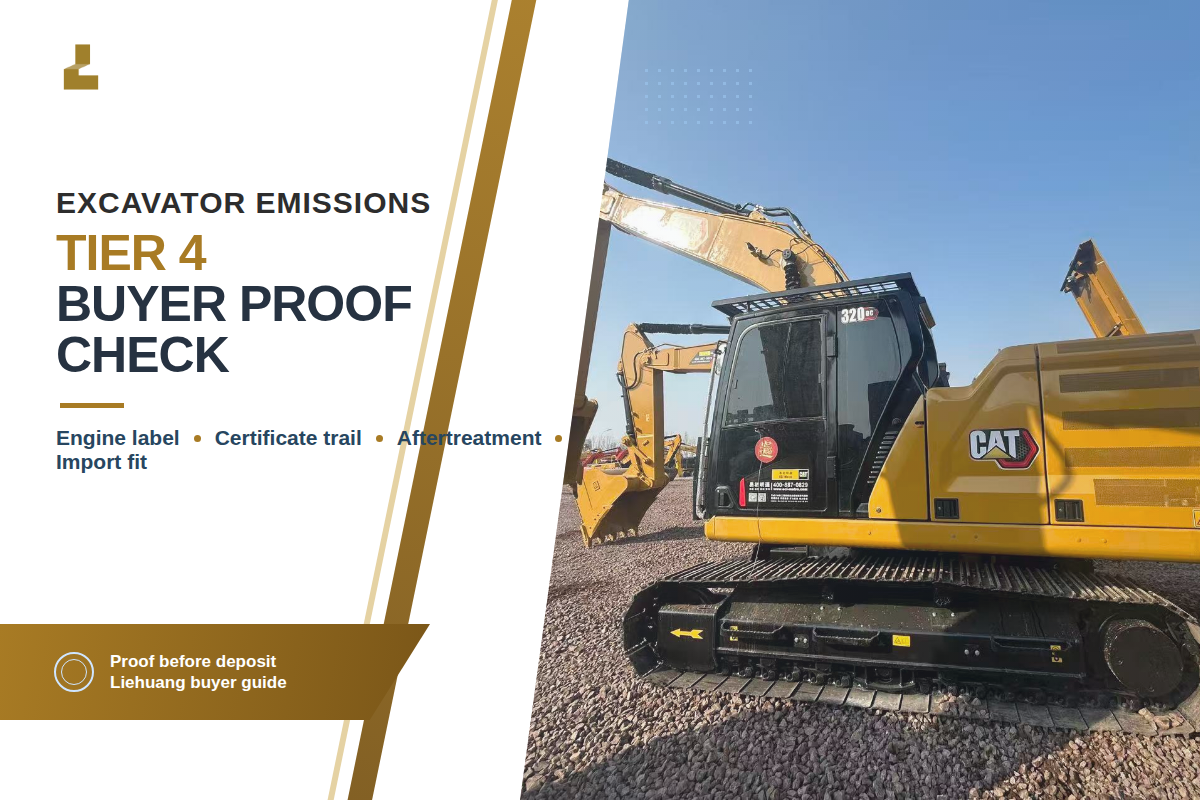

For a used-equipment buyer, excavator emissions Tier 4 is more than a phrase on a sales listing. It’s a paperwork trail, a check of an engine label, an aftertreatment inspection and a destination-market calculation. Sellers might call it “EPA compliant,” but serious buyers require more concrete proof before issuing a deposit or planning import paperwork.
Quick Specs
| Core rule family | United States EPA nonroad compression-ignition diesel engine standards |
| Main buyer proof | Emission label, engine family, certificate trail, aftertreatment evidence, destination paperwork |
| EPA fuel context | Ultra-low sulfur diesel has a maximum sulfur concentration of 15 ppm |
| U.S. import form to check | EPA Form 3520-21 for heavy-duty highway and nonroad engines, including engines already installed in equipment |
| Use of this guide | Procurement screening. It is not legal advice; confirm destination rules before purchase. |
EPA guidance lists excavators as one of several examples of machines using nonroad compression-ignition diesel engines. That positions many excavators into the same regulatory family that you’ve come to know in discussions about Tier 4. Practical point: you’re buying an engine with Tier 4 emission standards, not an excavator with that nameplate.
Advantages
- Solid Tier 4 evidence will often make your arguments more compelling when selling in a U.S.-focused channel.
- Having clear evidence of the engine family and its compliance certificate will speed up your internal review process.
- Cleaner proof can prevent finance and procurement teams from making purchasing errors.
Limits
- Simply seeing “Tier 4” mentioned in a sales advertisement does not constitute proof.
- Your engine manufacturer, model, power rating, and the specifics of its design will determine the aftertreatment setup.
- Different requirements may apply to machines going into California, the EU, and non-U.S. markets.
What Tier 4 Means for Excavators
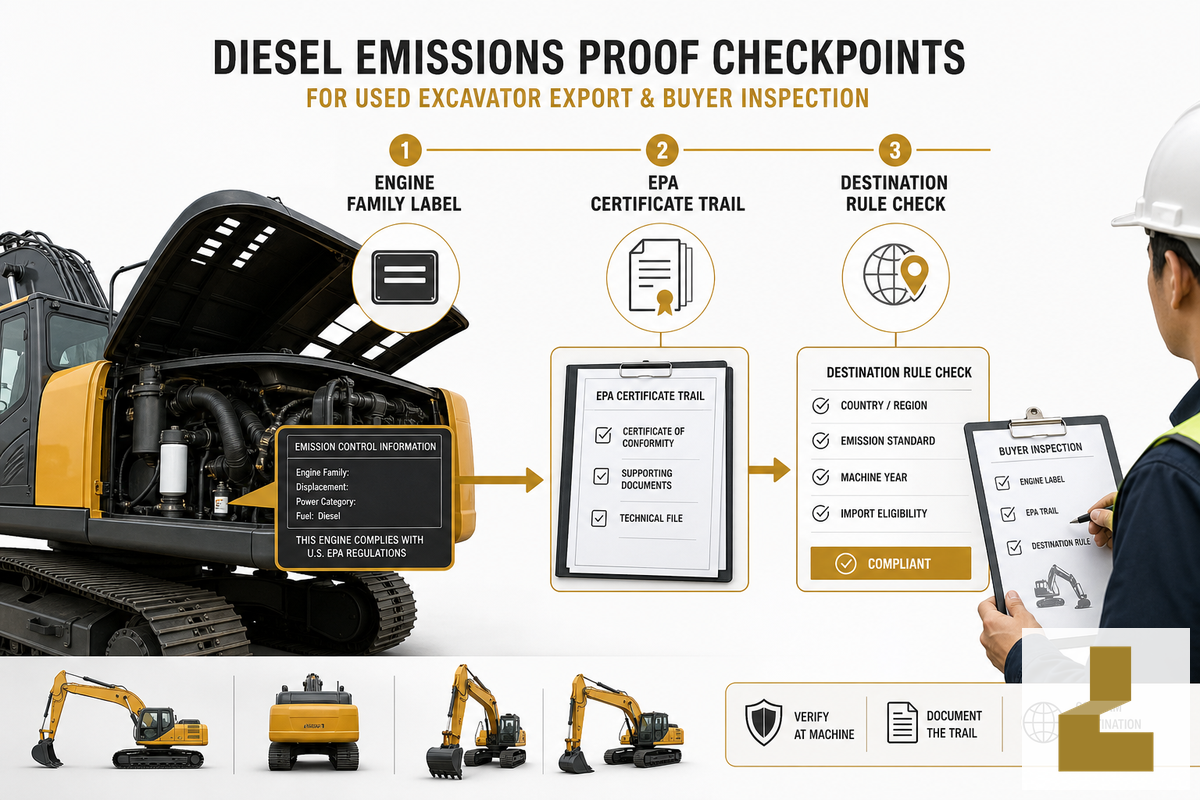
Tier 4 is the latest EPA tier family applicable to many nonroad diesel engines. EPA’s nonroad diesel program does not distinguish by equipment type; it includes heavy equipment like excavators, farm machinery, forklifts, pumps, compressors, and generators.
For procurement teams, EPA Tier 4 is easier to review when you separate regulation language from hardware language. Tier 4 technology may include emission control technologies such as a diesel oxidation catalyst, diesel exhaust fluid system, or particulate filter. Those parts help manage diesel emissions and NOx emissions, but they do not by themselves prove that a used machine is Tier 4 compliant, exempt from Tier 4, or accepted under California Air Resources Board rules or EU Stage V standards.
In 2004, EPA tied stricter Tier 4 nonroad diesel engine standards to lower-sulfur nonroad diesel fuel. For buyers, that makes the engine’s emission control, required fuel, and label part of the same verification task.
Buyers often hear only two pollutant names related to Tier 4-NOx and PM. But in the world of buying used excavators, the much more critical question is whether the seller has proof that the engine family and emission status are aligned with the physical machine.
Tier 4 Interim vs Tier 4 Final vs Tier 3
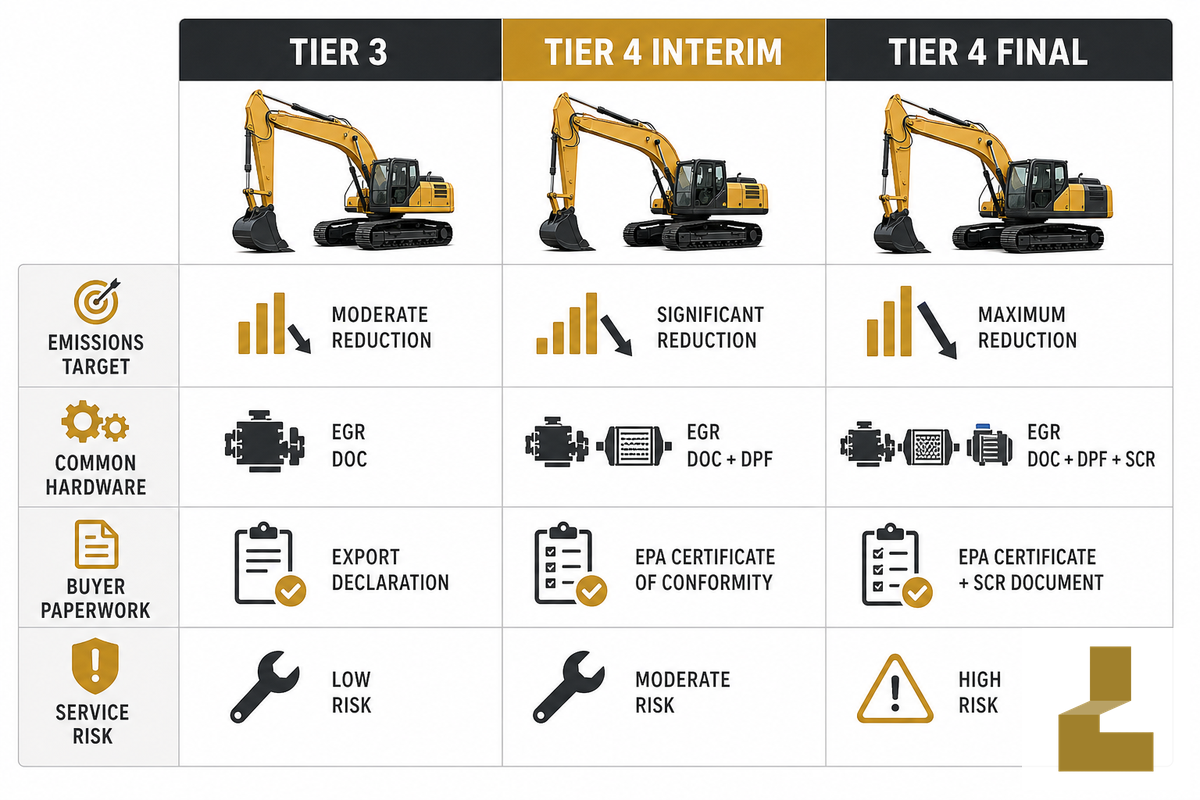
Tier 3, Tier 4 Interim, and Tier 4 Final reflect successive, tightening emission standards. While the machine’s model year might be a starting point, it is insufficient evidence because an engine replacement, rebuild, destination-market modification, or specific import version may change the real compliance status.
For older construction equipment, do not assume a Tier 2 or Tier 3 machine can meet Tier 4 requirements after a simple paperwork review. Tier 3 standards and Tier 4 regulation are separate checkpoints, and emission regulations usually follow the certified engine family rather than the excavator paint and serial badge.
| Buyer question | Weak proof | Stronger proof |
|---|---|---|
| Is it Tier 4 Final or only Tier 4 Interim? | Seller says “Tier 4” | Emission label plus engine family and model year |
| Can it fit a U.S.-oriented resale plan? | Invoice says “EPA compliant” | Certificate trail and import-document review |
| Will aftertreatment create downtime risk? | Exterior photos only | DPF/DOC/SCR/DEF photos when equipped, fault-code screen, service history |
Mistakenly using the excavator model name as a stand-in for compliance can lead to problems. Buyers shopping for a used Komatsu, Caterpillar, Hitachi, Volvo, Sany, Doosan, Hyundai, Kobelco, or Kubota excavator should look beyond the machine’s badges and ask for proof related to the engine itself.
5-Document Tier 4 Proof Stack for Used Excavator Buyers
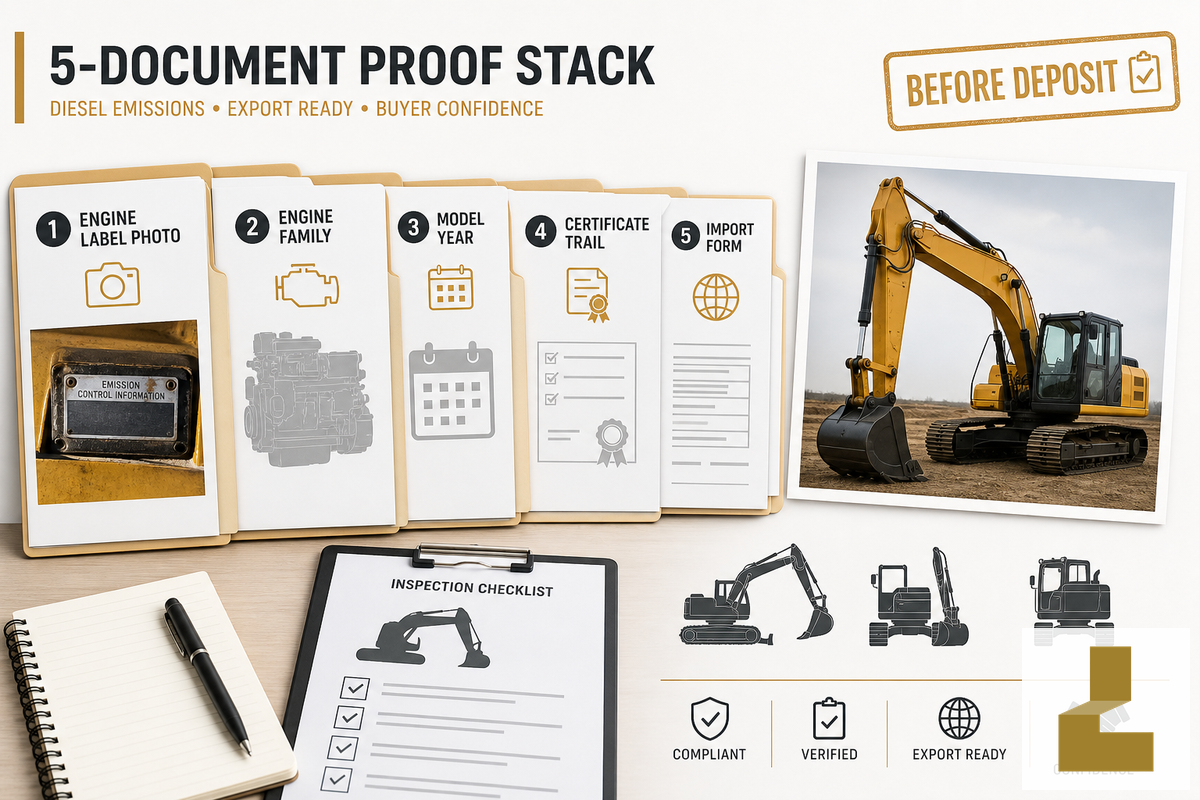
Building a “proof stack” of supporting documents prior to pricing is the best approach to evaluating a used Tier 4 excavator. It transforms a fuzzy emission claim into an objective component of your procurement file.
| Proof item | What to request | Why it changes the buying decision |
|---|---|---|
| 1. Emission label photo | Close-up photo showing the label heading, engine family, manufacturer, power category, fuel statement, and compliance language. | It ties the claim to the actual engine on the machine. |
| 2. Engine family number | The exact 11-character engine family from the label, plus engine model year and manufacturer. | You need the engine family number to obtain EPA certification information. |
| 3. Certificate trail | Certificate of Conformity copy or certification data that matches the engine family. | EPA certification data helps identify products certified for introduction into United States commerce. |
| 4. Aftertreatment evidence | Photos or video of DPF, DOC, SCR, DEF tank, sensors, warning lights, and service screen when the engine uses those parts. | It exposes missing hardware, bypass risk, and likely maintenance cost before the machine ships. |
| 5. Destination paperwork | For U.S. import, review EPA Form 3520-21 path and records before purchase. | 19 CFR 12.74 ties nonroad-engine import release to required EPA paperwork and five-year record retention. |
Engineering Note
According to 40 CFR 1039.135, the emission label must list the engine family and emissions-control technology; for diesel-powered engines, it will often say “ULTRA LOW SULFUR FUEL ONLY.” Even if the label was relocated during installation, duplicate labeling procedures are outlined. To verify, request a photograph that captures the complete label, including its placement on the engine.
Aftertreatment Parts Buyers Should Inspect Before Wiring a Deposit
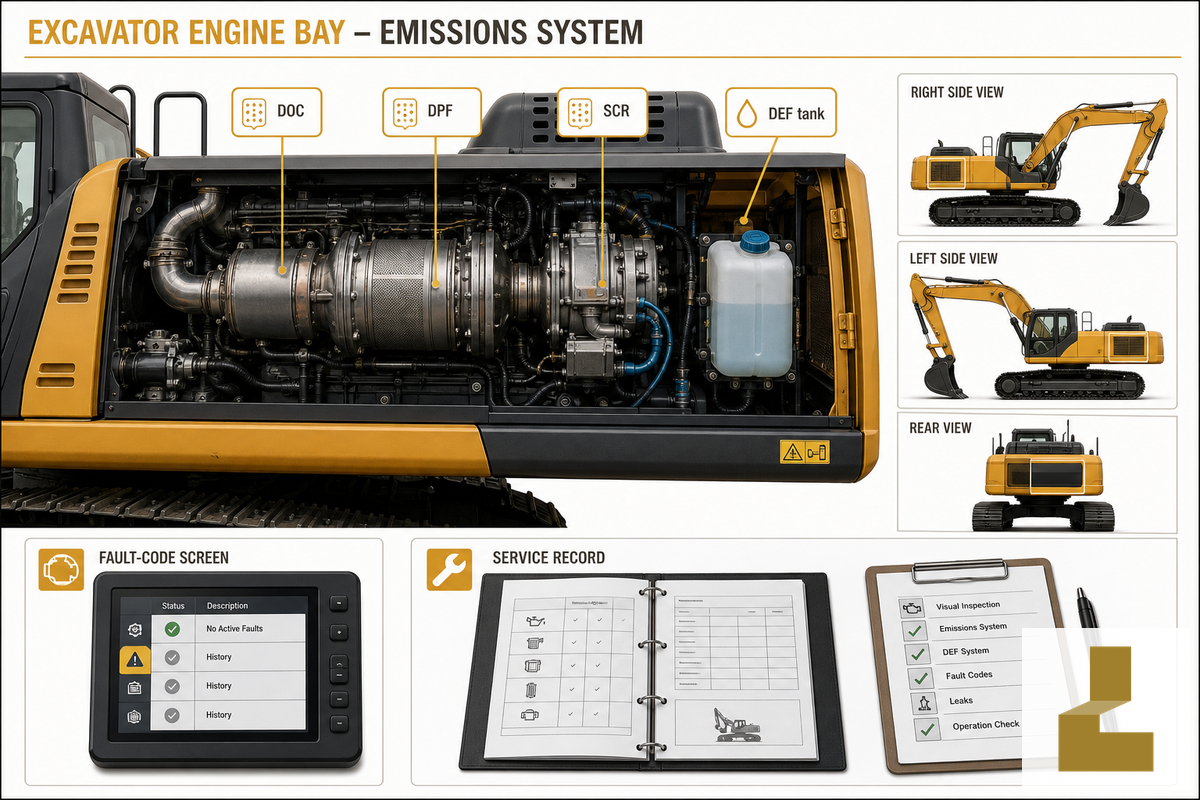
Aftertreatment is the point where a clean listing can go bad and become a repair issue. Tier 4 engines use diesel particulate filters, diesel oxidation catalysts, SCR systems, exhaust gas recirculation, DEF tanks, sensors, and software-driven regeneration. It depends on the specific engine and power class, so write your questions with that in mind.
Hidden bottleneck: local repair readiness
- Can your local technician read the engine’s fault codes and regeneration history?
- Are DPF, SCR, DEF, sensors, and dosing parts available for that exact engine family?
- Does the seller provide dashboard video of the engine running at operating temperature?
- Does the service record indicate filter cleaning, DEF system repair, or warning light events?
- If the destination market does not require Tier 4, is the resale benefit worth the maintenance burden?
“Tier 4 Final engine service requires specialized diagnostic tools and software.”
Jake Gaylord, technical training manager, quoted by ForConstructionPros
This statement rings true for the field, where risk is not merely that an excavator has an emissions system. Real risk begins when you cannot diagnose, repair, or document that system in your own market.
Tier 4 vs Tier 3: How Used Excavator Buyers Should Decide
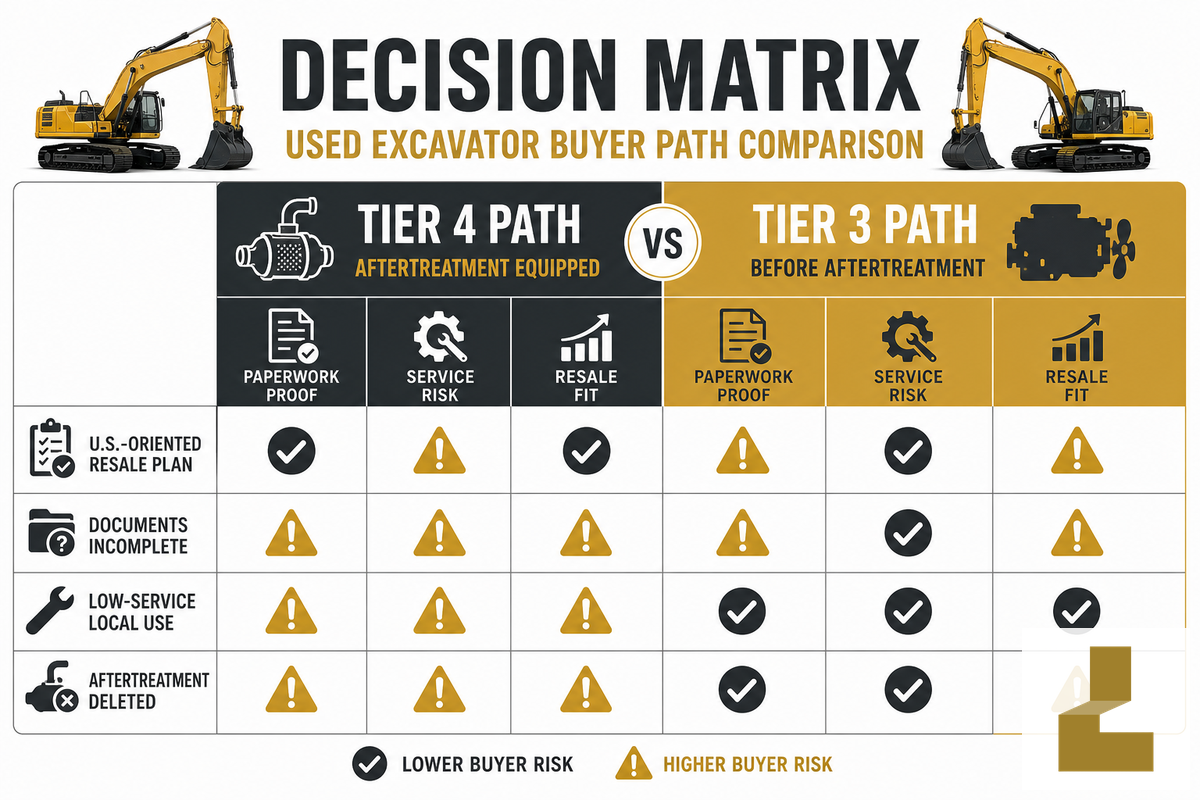
Your best decision depends on destination, resale path, maintenance capacity, and record quality. In some cases, poor records make a used Tier 4 Final excavator a less attractive buy than a Tier 3 unit that realistically fits the buyer’s market. In stricter markets, the lower-tier machine can be the one that causes problems.
Destination market risk matrix. Use the table below to separate import-paperwork risk from maintenance and resale risk before comparing Tier 3 and Tier 4 excavators.
| Destination or buyer case | Minimum decision input | Action before deposit |
|---|---|---|
| U.S. importer | EPA certificate trail, emission label, and Form 3520-21 path | Confirm conformity or valid exemption/exclusion basis with your broker before shipment. |
| California fleet buyer | CARB off-road fleet rule status and engine tier | Check CARB’s in-use off-road diesel fleet requirements before adding equipment. |
| EU-oriented buyer | EU NRMM type-approval path and power-range category | Do not treat U.S. Tier 4 Final as automatic EU Stage V approval. |
| Distributor reselling to mixed markets | Proof stack plus country-by-country acceptance notes | Sort inventory into document-ready, condition-led, and local-use groups. |
| Lower-regulation market with strong repair access | Machine condition, price, parts access, aftertreatment condition | Treat Tier 4 as a resale and paper-trail benefit, not the only buying reason. |
For 2026 purchases, it’s less about a sudden new Tier 5 mandate and more about increased buyer scrutiny. Importers and distributors increasingly want to see records, label photos, and specific configuration details early in the sales process. Any one missing document could derail a deal or shrink your resale market.
Common Mistakes When Evaluating Tier 4 Used Excavators
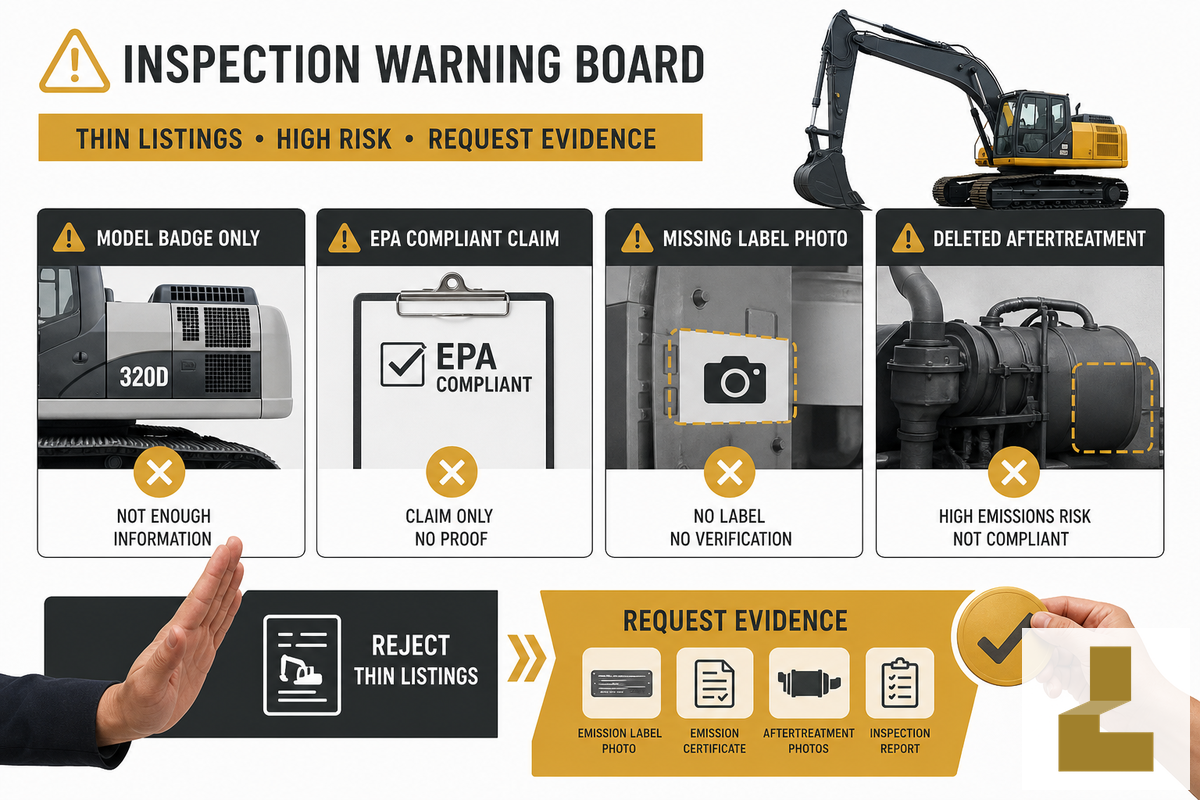
- 1. Relying on model names. A sticker on a counterweight is not proof of engine family.
- 2. Forgetting the label photo. You want a legible, full-frame image, not a grainy picture of a plate.
- 3. Conflating Tier 4 Interim with Tier 4 Final. Type the specific emission claim into your RFQ.
- 4. Thinking all Tier 4 engines are identical. DPF, SCR and DEF setups vary widely. Always confirm the engine family and physical parts.
- 5. Disregarding local support. A clean Tier 4 system still requires qualified technicians, software, sensors, and parts.
- 6. Not considering destination markets first. A U.S. EPA Final machine may not meet California, EU, or other emissions standards.
If the supplier cannot provide the proof stack, the answer is not always “walk away.” Sometimes the right action is to move the machine into a different buying category: condition-led purchase, local-use purchase, parts donor, or non-U.S. resale. Paying a Tier 4 premium without Tier 4 evidence is the real mistake.
How LH Used Excavator Can Help Buyers Ask Better Questions
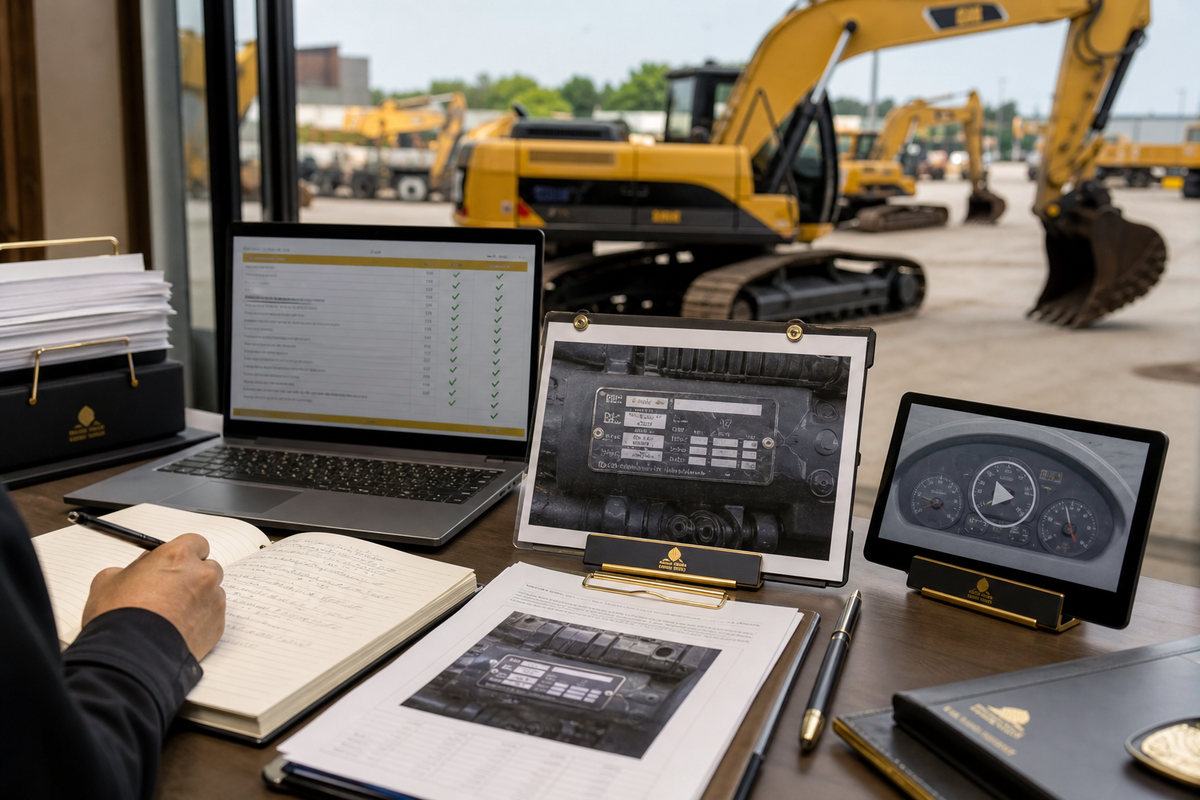
LH Used Excavator supplies inspected used excavators across mini, medium, and heavy classes, with machines from brands such as Caterpillar, Komatsu, Sany, Volvo, Hyundai, Doosan, Kubota, Hitachi, and Kobelco. Its team also supports attachments and export logistics for international buyers.
Make the request specific: ask for the engine label, machine serial information, inspection photos, aftertreatment photos when equipped, and destination-market notes before you choose the unit. LH Used Excavator can help buyers organize machine details for review, but final legal import or fleet-compliance decisions should stay with the buyer’s broker, compliance adviser, or local authority.
Start with the current used excavators for sale list, then request the proof stack for any Tier 4 machine you shortlist.
Buyer request template
Send this short note before paying a deposit:
Please send the engine emission label photo, engine family number, model year, aftertreatment photos, dashboard video, service notes, and any certificate or EPA import-document support available for this excavator. I need these before confirming destination-market fit.
FAQ
What are Tier 4 emissions on equipment?
View Answer
Tier 4 refers to U.S. EPA standards for many nonroad diesel engines. On excavators, buyers should verify the engine family, not only the machine model.
What are Tier 4 requirements?
View Answer
Requirements vary by engine type, power category, model year, and certification path. Before treating a listing as compliant, buyers should match the emission label to the engine family, ask for certificate or import-document support, and check the destination country’s rules for used nonroad equipment.
What is the difference between a Tier 3 and Tier 4 excavator?
View Answer
Tier 4 excavators generally have newer emissions-certified engines and may include more emission-control hardware than Tier 3 machines. For used buyers, the larger difference is paperwork, aftertreatment service risk, and destination-market acceptance.
Does a Tier 4 excavator require DEF?
View Answer
Many Tier 4 Final engines use SCR systems that require diesel exhaust fluid, but not every engine uses the same setup. Check the DEF tank, fill cap, aftertreatment layout, dashboard warnings, service manual, and engine-family documentation. If the machine has been deleted or modified, treat it as a major compliance and downtime risk.
Can I import a used Tier 4 excavator into the United States?
View Answer
Possibly, but confirm the conformity or exemption path before purchase. EPA import paperwork, including Form 3520-21 when relevant, should be reviewed before shipment.
Is Tier 4 the same as EU Stage V?
View Answer
No. U.S. Tier 4 and EU Stage V are separate systems, so buyers still need a destination-market check.
Related Buyer Tools
References & Sources
- United States EPA Regulations for Emissions from Heavy Equipment with Compression-Ignition Engines
- United States EPA Final Rule for Control of Emissions of Air Pollution From Nonroad Diesel Engines and Fuel
- United States EPA How to Obtain a Copy of a Certificate of Conformity
- United States EPA Annual Certification Data for Vehicles, Engines, and Equipment
- United States EPA Publications and Forms for Importing Vehicles and Engines
- Cornell LII CFR mirror 40 CFR 1039.135: Labeling and engine identification
- Cornell LII CFR mirror 19 CFR 12.74: Importation of nonroad and stationary engines
- California Air Resources Board In-Use Off-Road Diesel-Fueled Fleets Regulation
- European Commission Non-road mobile machinery
- Construction Business Owner Understanding Tier 4 Standards: Myths vs. Facts
- Evaluate Tier 4 Final Diesel Engine Maintenance Alternatives – ForConstructionPros
About This Buyer Guide
This guide was prepared for international used-excavator buyers comparing EPA Tier 4 records, aftertreatment risk, and destination-market fit. Brand-specific claims are limited to the information supplied for LH Used Excavator and its public used-excavator page. Regulatory claims are sourced to EPA, CFR, CARB, and EU materials listed above.

![Excavator Bucket Manufacturers: Buyer Evidence [Guide]](https://lhusedexcavator.com/wp-content/uploads/2026/08/excavator-bucket-manufacturers-r2-featured-768x512.png)