Get in Touch with Liehuang Company

Quick Specs
| Also called | Tracked excavator, crawler excavator |
| Size range | Under 1 ton (micro) to 80+ ton (mining-class) |
| Rotation | 360 degrees, independent of undercarriage direction |
| Not the same as | A backhoe (wheeled tractor with a front loader and rear digging arm) |
| Common brands | Caterpillar, Komatsu, Volvo, Hyundai, Doosan, Kubota, Hitachi, Kobelco, Sany |
When you go online to search for a trackhoe for sale, you end up diving into two different worlds: either you land on rental-yard listing pages advertising used excavators for sale by tonnage and location, or you run into buyers who still don’t know exactly what a trackhoe is and whether it differs from an excavator or a backhoe. What’s a trackhoe? It’s an excavator (a specific type of heavy machinery with a rotating body) with a tracked undercarriage (crawler) – full stop. No third type of machine hides behind the term “trackhoe”. This guide is specifically designed for the latter: for you – buyers, estimators, or even those looking for first-time imports who want to get the lay of the land before comparing listings, tonnage, size categories, or even brand specific model names.
A trackhoe is the North American vernacular name for a hydraulic excavator (a kind of wheeled or tracked excavation machine with a rotating platform for operator’s cabin and engine) which comes with a continuous steel or rubber tracked chassis (crawler) and a boom-stick-bucket assembly that can be slewed through a full 360 degrees. A trackhoe isn’t a separate machine from an excavator; it’s also not a backhoe.
Key Takeaways
- “Trackhoe” isn’t a product category. “excavator” is the proper technical term. “Trackhoe” is the slang term used in the United States and Canada on construction jobsites for what manufacturers and international operators call an excavator.
- Dealer classifications, from “mini” to “heavy,” can be somewhat fluid and depend heavily on brand and even the specific dealer selling the equipment. Most buying guides don’t explicitly state this important point.
- It’s about more than just size. Specialized models like long-reach and high-reach demolitions, as well as spider trackhoes (with a unique undercarriage for stability on uneven terrain), have very specific working applications beyond just being a bigger or smaller standard excavator.
- If your search for a trackhoe for sale was a bit more specific – like “John Deere trackhoe” or “Cat 330 trackhoe” – you were referring to a specific manufacturer’s product line. This guide help clarify those brand names when translating them into what dealers use.
- Amidst an overall weakening of demand for new equipment, used-excavator sales in the U.S. increased by 5.3% year over year in 2025, while new-machine sales declined by 4.1%, per Equipment World’s reporting on Fusable equipment-financing data.
Is a Trackhoe the Same as an Excavator? The Straight Answer
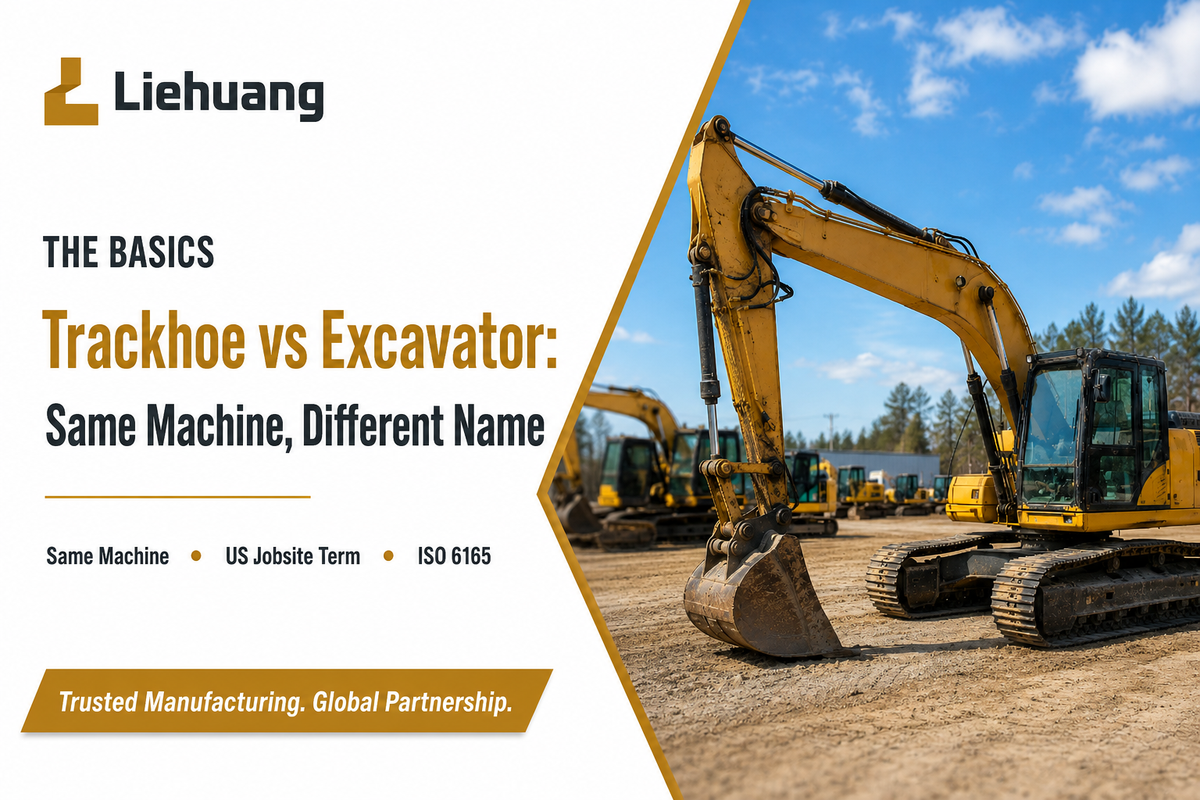
In short, yes – a trackhoe is a hydraulic excavator with a tracked undercarriage, and the two terms are interchangeable. “Trackhoe” is common U.S. and Canadian jobsite slang, while “excavator” is the term equipment manufacturers and international professionals use. Every trackhoe has three main parts: a tracked undercarriage, a house holding the cab and hydraulics, and a digging arm made of a boom, a stick, and a bucket — the stick is also called the dipper on older documentation.
That house swings a full 360 degrees, driven by hydraulic pumps running up to roughly 5,000 psi — the defining feature that separates a trackhoe from a backhoe, which cannot rotate independently of its wheeled chassis. That single distinction is why “used excavators and trackhoes” is really one search, not two: whichever word a listing uses, this is the type of excavator you’re evaluating.
Why Is It Called a “Trackhoe”?
The name is a simple portmanteau: “track,” for the steel or rubber undercarriage the machine travels on, and “hoe,” a term adapted from backhoe construction describing the digging motion of the boom and bucket. Operators coined the nickname to tell a tracked excavator apart from wheeled excavators and wheeled backhoes, and it stuck as jobsite shorthand even though manufacturers still use the formal designation excavator.
As one user on the r/Heavy_Equipment forum put it plainly, “a trackhoe is just a slang term for a tracked excavator,” derived from its two defining features — tracks, and the hoe-style boom and bucket.
Those who try to sort out trackhoe vs excavator vs backhoe, or those performing the more niche search query “what is a trackhoe vs excavator,” are looking to answer two interconnected questions: slang versus machine classification. Classification doesn’t move in sync with informal language. That international vocabulary standard, ISO 6165:2022 (now in its seventh edition, supplanting the 2012 sixth), lays out the taxonomy used by manufacturers and equipment standard bodies to define types of excavation equipment, but it doesn’t acknowledge or contain the term “trackhoe”-it is an operator designation, not a standards document, so this explanation and that information are kept distinctly referenced so as not to imply it has any formal, recognized standards pedigree it does not.
Also worth dispelling, as it can be as confounding as the trackhoe vs excavator debate, is the idea that a trackhoe is a backhoe. Backhoes are equipped with a wheeled tractor base that carries both a front loader bucket and a smaller rear digging boom whose movement is restricted to a 180 to 200-degree arc; to complete a full rotation a backhoe needs to relocate its entire machine. In the U.S., because OSHA covers tracked power excavators under the same “power-operated equipment” and earthmoving equipment standards applicable to crawler tractors, loaders and scrapers at a job site, anyone contemplating purchasing a used track hoe for use in this country will be dealing with a heavy equipment unit. If you’re buying used, that OSHA context is one more reason a well maintained machine with service records beats an unverified listing on price alone.
Trackhoe vs. Backhoe vs. Excavator: The Difference That Actually Matters
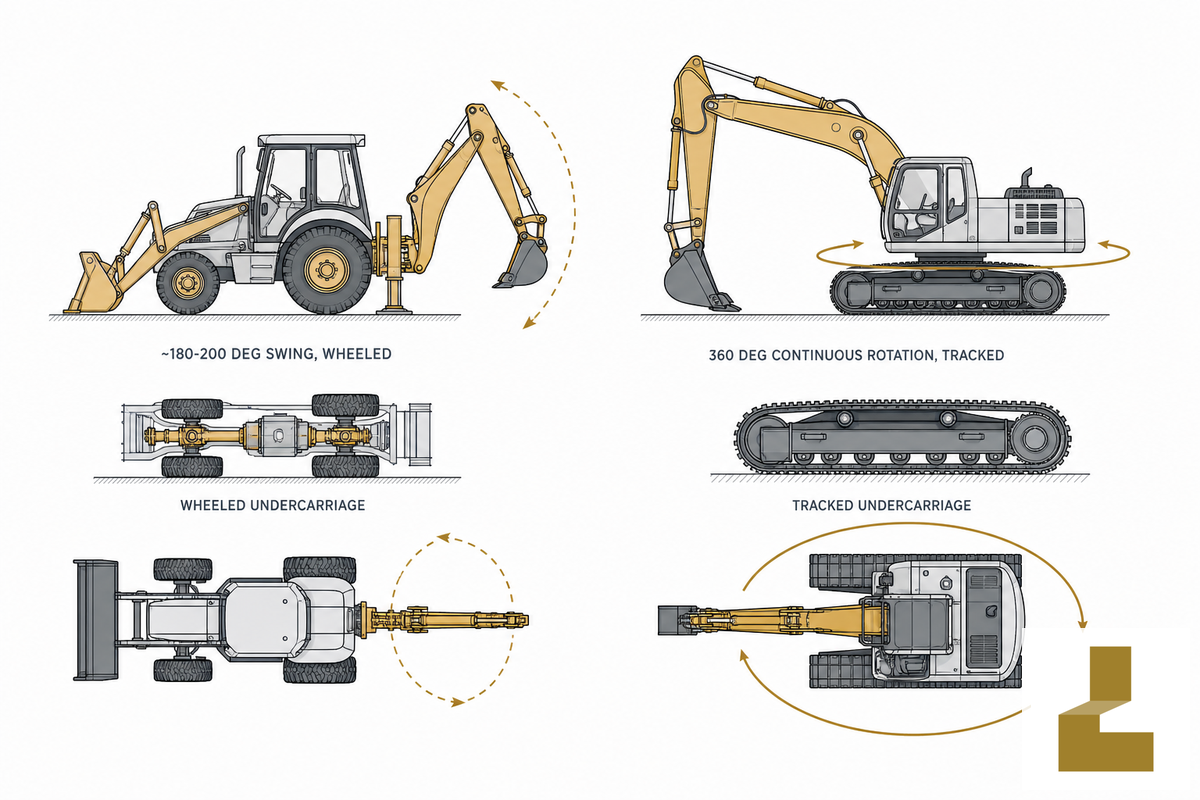
Those three terms, along with the similarly confusing “backhoe vs trackhoe,” do share some real overlap that goes beyond casual language: all of them excavate; all have a bucket at the end of a boom; and all three have come to have a “hoe” informally associated with them in one form or another. When deciding which to buy, the deciding factors between these two machines should be the configuration of the undercarriage and rotation, rather than simply size-related excavator vs trackhoe comparisons; all other factors flow from those two variables. Buying a used excavator without settling this distinction first is how a first-time buyer ends up comparing excavators used for entirely different jobs. The undercarriage-and-rotation split is also how ISO 6165’s formal earth-moving machinery vocabulary separates these categories at the type level, well below any specific brand or size class.
| Feature | Trackhoe (Crawler Excavator) | Backhoe |
|---|---|---|
| Undercarriage | Steel or rubber tracks | Wheels (road-legal, up to ~20 mph) |
| House rotation | 360 degrees, independent of undercarriage | ~180-200 degrees, arm-only |
| Digging depth (mini/compact class) | 8-14 ft | Up to ~14 ft (standard, before Extendastick) |
| Front-end loading | Not built in (attachment-dependent) | Built in (front loader bucket) |
| Site-to-site travel | Requires a trailer | Self-drives between sites |
It’s such a common mix-up it even turns up frequently in operator discussions and equipment forums, where the most common form of the error is simply referring to any digging machine with a swinging cab as a “backhoe” by habit, even when it completely lacks the two essential backhoe characteristics: a front-mounted loader bucket combined with a limited-swing rear arm on a wheeled undercarriage. If the machine you’re looking at has no front loader bucket and swings in a full circle, it’s a trackhoe, plain and simple-don’t let a dealer’s listing title mislead you. And throwing bulldozers into a backhoe vs. excavator vs. bulldozer comparison adds a fourth type of machine to rule out quickly: a bulldozer doesn’t have a digging arm at all-it’s a tracked machine that uses a blade to push earth for grading and clearing, not for excavation. A bulldozer never belongs in a trackhoe-vs-backhoe discussion.
Every Trackhoe Type and Configuration, From Mini to Long-Reach
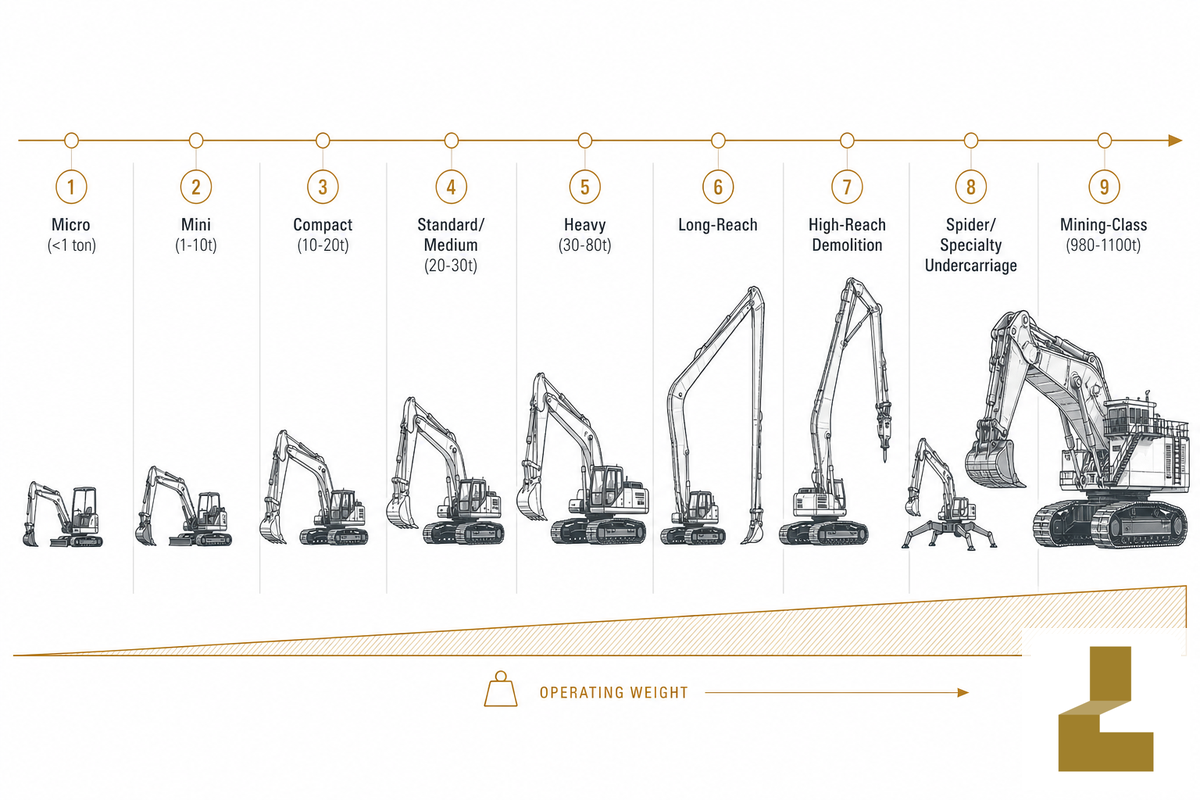
Tonnage is the first filter that most buyers will run any machine through, and it’s a reasonable starting point for sorting excavator types-but be aware that there is no single, universally mandated standard of tonnage to delineate between “mini,” “standard” or “heavy” classes. ISO 6165:2022 sets vocabulary and naming convention, but doesn’t specify what tonnages correspond to those classes; the below thresholds represent general usage by many dealers and manufacturers, but expect some variation by region and brand. The same nine classes apply whether you’re comparing compact excavators for a residential job or large excavators bound for a quarry.
The 9-Class Trackhoe Configuration Spectrum
| Class | Typical Weight | Primary Role |
|---|---|---|
| Micro | Under 1 ton (as light as 2,061 lbs / 13 hp) | Indoor demolition, garden-gate-width access, patio work |
| Mini / compact | 1-10 tons (up to 22,451 lbs at the top of class); digs 8-14 ft deep | Urban utility work, landscaping, zero tail-swing jobs |
| Small / standard | 10-25 tons; digs 17-21 ft deep | General construction, road work, utility trenching |
| Medium | 25-50 tons | Large commercial and infrastructure projects |
| Heavy | 50-80 tons; digs 30+ ft deep | Mining, quarrying, bulk earthworks, heavy demolition |
| Long-reach | Standard-class chassis, extended boom/stick | Dredging, canal work, deep excavation without repositioning |
| High-reach demolition | Standard-to-heavy chassis, tall articulated boom | Multi-story building demolition |
| Spider / specialty undercarriage | Mini-to-compact, widened or extendable tracks | Slopes, wetlands, and unstable ground standard tracks cannot hold |
| Mining-class | 80+ tons (Cat 6090 FS: 980-1,100 tons depending on configuration, 4,500 hp) | Overburden removal, mining-scale earthmoving only |
When choosing your first machine, match the class to your intended work. For urban utility trenching, indoor demolition, or landscaping projects on tightly-packed sites, focus on mini excavators, where the common zero-swing models can swing their houses with ease around buildings without risk of collateral damage. General construction, road work and the majority of utility work are the domain of the medium class, the point at which most contractors find the sweet spot for digging depth vs. job site access. Quarry loading, bulk earthmoving and other heavy demolition work are the tasks for which heavy excavators justify their increased transport and fuel costs. Special applications like long-reach, high-reach demolition and spider-undercarriage configurations are specialty items, and most dealers keep a smaller inventory of them than of standard classes. You should specify stick length or track modification in addition to tonnage when sourcing such a machine.
Just as with tonnage, attachment compatibility is class-specific. You won’t be able to properly run a 20-ton-class hydraulic breaker or grapple on a 5-ton mini, no matter how well it attaches via a hydraulic quick coupler. Before hooking up any attachment to a used machine, check the carrier’s auxiliary hydraulic plumbing for flow and pressure-don’t assume it’s correct. This matters just as much on smaller projects as it does on a major construction project: an undersized coupler circuit on a mini running a dig bucket rated for a bigger carrier wears out faster and digs slower, not just on excavators for smaller projects where owners often mismatch attachments to save money.
📐 Engineering Note
Undercarriage design isn’t static; there’s still patent activity occurring in that area, as evidence from a 2022 U.S. patent application (US 2022/0306219 A1) shows a track roller using an inverted seal design on its axial end to maintain exclusion of contaminants to the roller bearing for the lifetime of the equipment. A key take-away for a used-trackhoe buyer is simply that undercarriage design does vary between machine generations, and walk-around checks of idlers, rollers and guides can save a buyer tens of thousands in replacement parts down the road-a topic detailed in our used equipment field inspection checklist. Two cab-and-undercarriage details worth checking on a used listing rarely get a mention in generic guides: triple grouser track shoes (extra ribs cast into the pad for added grip on loose or sloped ground, standard on many medium and heavy-duty machines shipped in LC, or long-crawler, configuration) and, in the cab, a straight travel pedal and a control pattern changer that lets the operator switch between ISO and SAE joystick layouts-both signs of a machine built with real jobsite versatility in mind, not a stripped-down export special. A working rear view camera is a smaller but equally practical thing to test on a walk-around, since it’s a common early failure point on used units.
While a buyer looking for something under 1,000 tons won’t likely shop that mining class, it provides a useful benchmark that shows just how far-flung the “trackhoe” label truly is-from a 13-horse micro unit that would fit through your back gate to massive, 1,000-ton-plus class machines dedicated to mining overburdens. It’s worth noting that the “trackhoe” name specifically excludes wheeled, rubber-tire mobile excavators built for road travel between sites-those stay in the separate excavator family covered under general classification, not this crawler-specific one.
What Different Brands Call Their Trackhoes (Cat, John Deere, Komatsu & More)
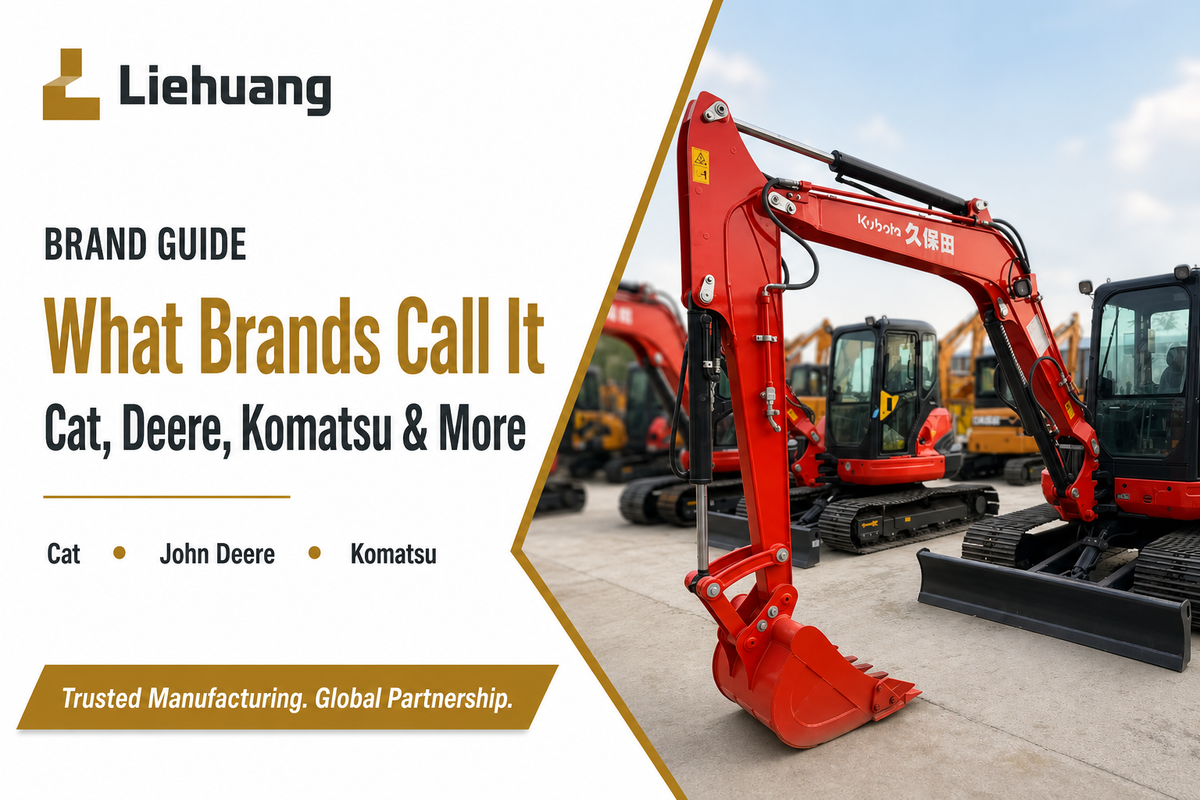
You probably weren’t looking for a nonexistent product line if you typed “john deere trackhoe” or “Cat 330 trackhoe” into the search box; you were simply using a shorthand in the operator lexicon to locate specific crawler excavator lineups from major brands. This search behavior isn’t insignificant, it indicates a real and large pattern of buyer interest that major used-equipment buying guides don’t currently address.
The Trackhoe Naming Cross-Reference
In January 2025, the FTC and the Illinois and Minnesota Attorneys General sued Deere & Company over equipment repair restrictions, alleging Deere makes its fully functional repair and diagnostic software available only to its own dealer network — the exact parts-and-diagnostics access gap that makes brand name alone a poor predictor of how easy a used machine will be to service.
— Federal Trade Commission enforcement action, as reported by Axinn LLP; see also the FTC’s Nixing the Fix report to Congress
| Search Term | Monthly U.S. Searches | What Buyers Are Actually Looking For |
|---|---|---|
| “John Deere trackhoe” | 6,600 | Deere’s crawler excavator lineup generally |
| “Cat 330 trackhoe” | 1,000 | Caterpillar’s 330 crawler excavator model |
| “John Deere 210 trackhoe” | 1,000 | Deere’s 210 crawler excavator model |
| “Cat 325 trackhoe” | 880 | Caterpillar’s 325 crawler excavator model |
| “John Deere 160 trackhoe” | 720 | Deere’s 160 crawler excavator model |
| “Cat 312 trackhoe” | 590 | Caterpillar’s 312 crawler excavator model |
Ultimately, none of these changes what’s important to a used-equipment buyer: market presence, not brand prestige, will determine if your workshop can get parts, diagnostics, and software support for your model. Komatsu or John Deere badge on the equipment doesn’t guarantee protection unless your workshop can obtain diagnostics and updates for the specific model-if not, that badge may not be doing the buyer any good at all. Guessing wrong on brand support is an expensive mistake: a missing OEM part can add 48 hours of unplanned downtime while a shop without local dealer access tracks one down. That gap exists because dealer networks are regional, not global, which is why Liehuang’s in-house refurbishment program is certified to ISO 9001 and stocks nine brands rather than betting on any single name having universal support. At least nine brands consistently appear in both export and domestic crawler excavator listings on the used market: Caterpillar, Komatsu, Volvo, Hyundai, Doosan, Kubota, Hitachi, Kobelco, and Sany. Check each of these against your local parts and service landscape before you buy used excavators bearing any of these badges, and don’t assume a used excavator’s parts availability matches what a new-machine buyer would get from the same manufacturer.
The last element rarely searched for but one you can count on every listing should feature: almost every trackhoe from 13-hp units up to 2021 and 2022 machines use diesel as opposed to gasoline for fuel, and the machine’s emission tier will affect resale as much as the brand. Couplers are also as important as engine; just because a coupler is rated for one carrier’s hydraulic flow doesn’t mean it’s compatible with another-so, like with the hour meter, don’t take claims of a “universal coupler” for a used listing at face value.
The Trackhoe Market in 2026: What’s Changing

US construction spending for May 2026 was down 1.5% vs May 2025, while year-to-date spending through the first five months of 2026 was down 2.7% vs same period in 2025-a real, Census-measured demand slowdown, not a headline exaggeration. New residential construction pulled back even harder: private-sector housing starts in May 2026 was at 1,177,000 seasonally adjusted annual units, off 8.7% vs May 2025’s 1,289,000 unit run rate. Set against this backdrop, US used excavator sales jumped 5.3% y-o-y in 2025, while new-machine sales were off 4.1% on the year, according to Equipment World reporting on Fusable’s equipment financing data. Read together, the two set of numbers tell an entirely logical story: when overall demand for construction slows, buyers don’t simply stop buying machines, they simply trade down to used equipment to save on upfront costs, resulting in an increase in the population of trackhoes changing hands, even as the overall market softens. That shift has been building since at least 2023, and it means the price points separating new and used excavators are doing more of the purchasing decision’s heavy lifting than they were even a couple of years ago.
This shift is mirrored in how people search for this equipment; searching for “trackhoe for sale craigslist” or “trackhoe for sale by owner” now appears more frequently than searches containing dealer-centric terminology like “listing,” and even broad searches for used excavators for sale near a buyer’s own region appear to favor informal marketplace language over formal “excavator” nomenclature. That pattern signals user-language and real-world buyer behavior, rather than OEM nomenclature, is becoming a primary indicator of actual demand in the used equipment space.
That growing gap between manufacturer vocabulary and how users speak is the very problem this guide aims to solve. When you can’t differentiate between a trackhoe and a backhoe, or when the definition of “mini,” “standard,” and “heavy” sizes can vary between dealerships, your purchasing process in a used-heavy market become far more complex than when you were buying new equipment, where a simple OEM specification sheet could answer all of your questions automatically. To ensure you make the right purchase in 2026, you should finalize your tonnage class, configuration, and preferred brand list prior to comparison shopping, not after you’ve become infatuated with a particular machine that appeared ideal in a photograph.
Innovation is continuing in all segments of the industry, including undercarriage engineering. For example, the 2022 track-roller sealing patent discussed previously demonstrates ongoing manufacturer efforts to improve components that are most prone to failure on a used machine. That pattern underscores the significance of model-year and generation in addition to brand when comparing two similar listings.
None of that implies you should postpone your purchase. Rather, it suggests approaching your search with more precise questions: Which tonnage class and configuration is most suitable for your job? Which of the nine major brands has the best parts support in your region? And does the seller’s inspection report thoroughly document the undercarriage and hydraulics in a manner that justifies the asking price? Addressing these three questions beforehand will let you move through a competitive and softening market more effectively than dwelling on whether “trackhoe” and “excavator” are interchangeable.
Whichever channel you use to compare the best new and used excavators for your budget — an auction house like Ritchie Bros., a general marketplace, or a compliant, inspected export supplier — the same three questions apply. Which channel you use changes who verifies the answers; it doesn’t change which questions matter.
FAQ: Trackhoe Terminology, Types, and Brands
Q: Is a trackhoe the same as an excavator?
View Answer
Yes, a trackhoe is a tracked (crawler) hydraulic excavator, and the two words describe the same machine. “Trackhoe” is mainly North American jobsite usage, while “excavator” is the term manufacturers and international standards use. It is different from a backhoe, which is a wheeled tractor with a front loader and a smaller, limited-swing rear digging arm, so comparing a trackhoe to an excavator is really comparing two names for one machine, not two different machines.
Q: Is a trackhoe the same as a backhoe?
View Answer
No. Backhoes run on a wheeled tractor chassis with a front loader bucket and a rear digging arm limited to roughly a 180-to-200-degree swing, built primarily for utility repairs and small trenching jobs. A trackhoe runs on continuous tracks instead of wheels and its house rotates a full 360 degrees, which is what makes it the better choice for sustained heavy digging, demolition, and work on soft or uneven ground where a wheeled machine would struggle for traction.
Q: Why is it called a “trackhoe”?
View Answer
The name blends “track,” describing the continuous steel or rubber tracks that move the machine, with “hoe,” a term borrowed from backhoe equipment for the digging, pulling motion of the boom and bucket. Operators coined it to distinguish tracked excavators from wheeled backhoes, and the nickname stuck as standard jobsite slang across the industry.
Q: What are the main types of trackhoes?
View Answer
Trackhoes fall into six basic configuration classes: mini or compact (under 10 tons), standard or medium (10-30 tons), heavy (30-80-plus tons), long-reach (extended boom for depth or over-water work), high-reach demolition (tall articulated boom), and spider or specialty-undercarriage units for steep slopes and soft terrain.
Q: What’s the largest trackhoe ever built?
View Answer
Mining-class machines like the Caterpillar 6090 FS top out the “trackhoe” category, with an operating weight of roughly 980 to 1,100 tons depending on configuration and twin engines rated around 4,500 horsepower (3,360 kW) combined, per Caterpillar’s own Specalog documentation rather than a marketplace listing estimate. That’s built exclusively for mining-scale overburden removal — nowhere close to what a construction buyer would ever shop for, but a useful reference point for how wide the size range really spans.
Q: Does [Brand] make a “trackhoe,” or is that just a nickname?
View Answer
It’s a nickname, not a separate product category — every major manufacturer sells the underlying machine as a crawler excavator. Search “Cat 330 trackhoe” and you’ll find the same listing as a Cat 330 excavator, just described with the jobsite nickname instead.
Q: Where can I find inspected, verified trackhoes for sale?
View Answer
Once you have a specific brand and class in mind, the next step is verified, inspected inventory instead of vague listings. At Liehuang, we specialize in pre-inspected excavator inventory across mini, medium, and heavy classes, each documented through our ISO 9001 in-house inspection process.
See Our Inspected Trackhoe Inventory →
Why We Write This
“Trackhoe,” “excavator,” and “backhoe” get mixed up constantly in listings and forums, and that confusion has a real cost for a first-time buyer. We inspect and sell trackhoes across nine brands and three size classes, so getting the terminology right helps ensure you’re comparing the equipment you actually need. Classification and search-volume data here come from independent standards bodies and search trends, not our own sales figures.
References & Sources
- ISO 6165:2022, Earth-moving machinery, Basic types — International Organization for Standardization
- 29 CFR 1926.602, Material handling equipment (earthmoving equipment) — U.S. Occupational Safety and Health Administration
- US 2022/0306219 A1, Track roller for undercarriage system having inverted seal — USPTO / Google Patents
- Excavator Sales Trends 2025: New and Used Models — Equipment World / Fusable
- Monthly Construction Spending, May 2026 (CB26-112) — U.S. Census Bureau
- New Residential Construction, May 2026 (CB26-102) — U.S. Census Bureau
- Excavator Undercarriage Maintenance — For Construction Pros
- 6090 FS Hydraulic Shovel Specalog (AEHQ7094) — Caterpillar Inc. official specification sheet
Related Articles
- Used Excavator Buying Guide: Inspection, Hours, Price, and Import Proof — the full buying-process walkthrough once you know what you’re shopping for
- How to Inspect a Used Excavator Before You Buy: A Field Checklist — undercarriage and hydraulic inspection, step by step
- How Many Hours Is Too Many for an Excavator? — reading the hour meter without getting misled by it
- Used Excavator vs New: The Practical Buyer’s Comparison — cost, hours, and ROI compared
- Excavator Attachments: Buckets, Breakers, Grapples & Couplers — matching tools to your carrier tonnage
![Excavator Bucket Manufacturers: Buyer Evidence [Guide]](https://lhusedexcavator.com/wp-content/uploads/2026/08/excavator-bucket-manufacturers-r2-featured-768x512.png)