Get in Touch with Liehuang Company
![Hydraulic Breakers: How They Work, Run & Last [2026]](https://lhusedexcavator.com/wp-content/uploads/2026/06/hydraulic-breakers-guide-featured.png)

A field guide to how hydraulic breakers work, how to run one without wrecking it, and how to keep it hitting hard for years. (Updated June 2026).
Hydraulic breakers are excavator-mounted percussion attachments that break rock, reinforced concrete, and asphalt, fitted to carriers from 1 to 45 tons and running 140–183 bar of working pressure. The same tool quietly destroys carriers when it’s run wrong. Most “weak breaker” complaints are never about the badge on the housing; they trace to oil flow, nitrogen charge, lubrication, and operator technique. This guide covers the parts the spec sheet skips: how the hammer actually work, which tool to fit, and the maintenance that decides whether it lasts two years or ten.
In short: Hydraulic breakers are carrier-powered percussion attachments that convert an excavator’s oil flow and pressure into repeated high-energy impacts, roughly 200 to 16,000+ joules (about 150 to 12,000+ ft-lb) across mini to super-heavy classes. It only delivers its rated energy inside a defined oil-flow and pressure window, so matching, charging, and greasing matter more than brand.
💡 Key takeaways
- Dry (blank) firing, running the hammer when the tool isn’t pressed against material, is the single fastest way to wreck any breaker.
- A bigger hammer isn’t a better hammer; efficiency comes from matching impact energy and blow rate to the material, not from mass.
- A breaker that “stopped hitting” has usually lost nitrogen charge or blown an accumulator diaphragm, both serviceable, neither means “buy new.”
- With correct matching and maintenance, a hydraulic breaker commonly lasts 8–10 years; the tool steel, seals, and diaphragm are the consumables.
Quick Specs: Hydraulic Breakers at a Glance
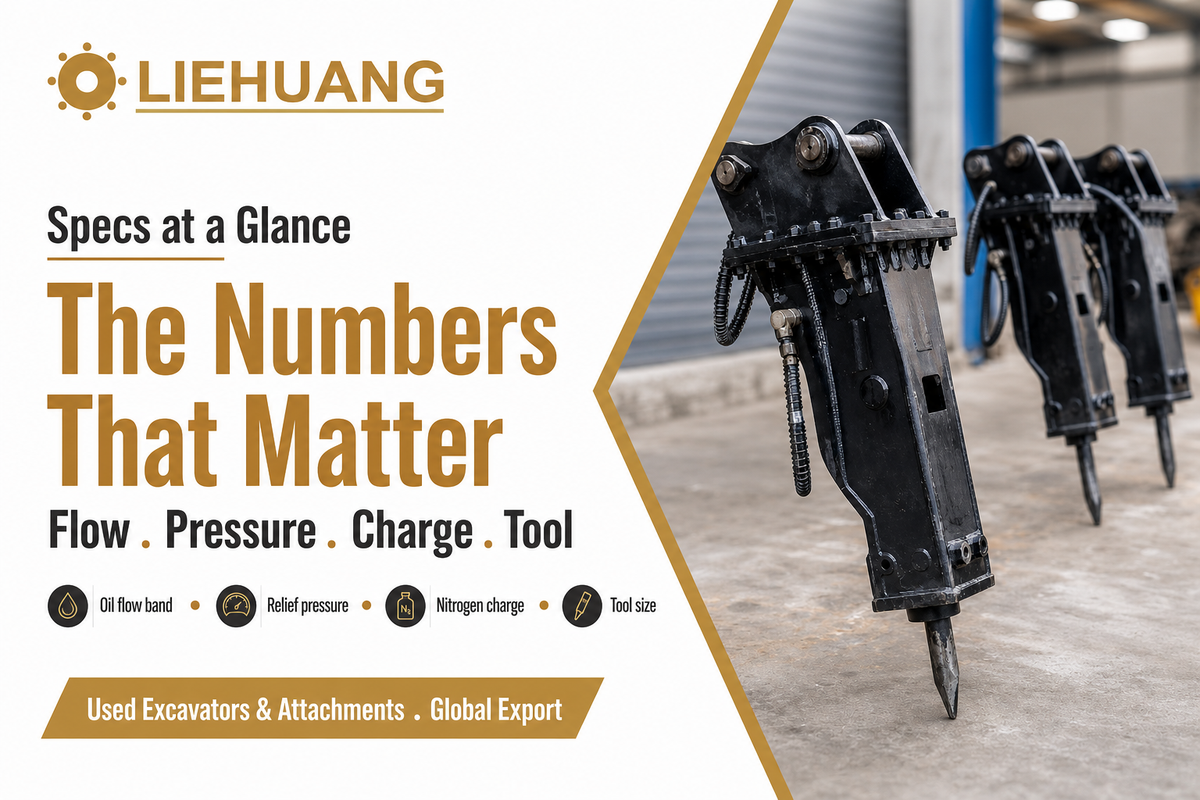
Get any of these four numbers wrong, flow, pressure, charge, or tool, and the breaker fails fast: a starved tool hits soft and cracks, an over-fed one blows seals at 180 bar, and the carrier wear early. This envelope below is where these tools are designed to work.
| Impact energy | ~200 – 16,000+ J (≈150 – 12,000+ ft-lb) |
| Required oil flow | 4 – 77 GPM (15 – 290 lpm) |
| Working pressure | 140 – 183 bar (2,030 – 2,650 psi) |
| Nitrogen charge (back head) | ~55 – 60 kg/cm² at 20°C (per the model manual) |
| Blow rate | 210 – 1,300 BPM by class |
| Working-tool diameter | 42 – 214 mm |
| Noise (silenced vs open) | ~110 – 124 dB(A); a silenced box cuts ≈10–15 dB(A) |
| Service life | ~8 – 10 years with correct matching + maintenance |
How a Hydraulic Breaker Works
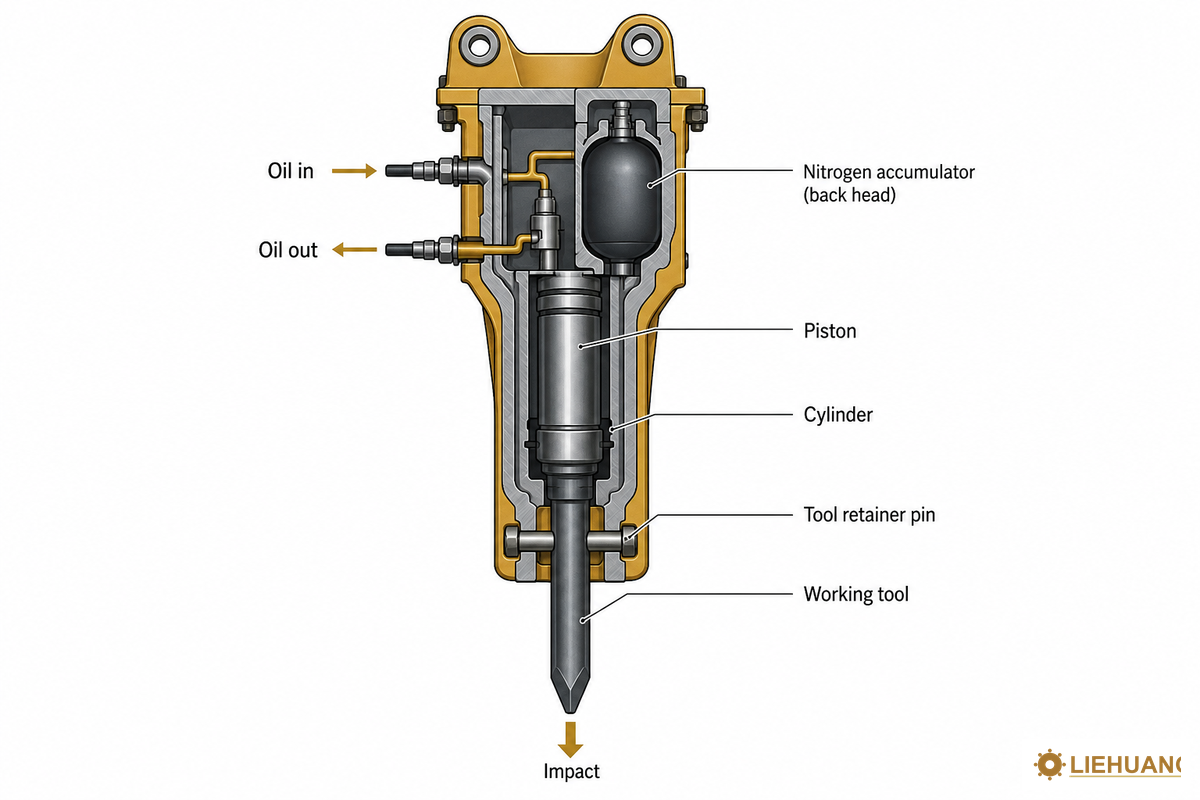
A hydraulic breaker, also called a hydraulic hammer, works by turning the carrier’s oil pressure — its hydraulic power — into a rapid mechanical strike. Oil drives a piston down onto the working tool; on the return stroke a sealed nitrogen accumulator in the back head compresses, then releases that stored energy to slam the piston down again.
Nitrogen doesn’t power the blow on its own; it recovers the piston between strokes and adds downforce so the next strike lands at full energy. That’s why a breaker is rated in impact energy (joules) and blow rate (blows per minute), and why both depend on the carrier feeding the right oil flow. Whether you call it a hydraulic breaker hammer or a rock breaker, the same physics drive hydraulic breakers for concrete, asphalt, and stone.
Carrier and tool work as one hydraulic system, which is the single most useful thing to understand about these attachments. Pistons recover between blows only when the excavator delivers enough flow; starve it and the hammer “hits soft,” flood it past the relief setting and you risk cracked seals and an expensive failure, typical working pressure sits at 140–183 bar (2,030–2,650 psi). The commercial way to state all of this, operating weight, impact rate, oil flow, carrier class, is standardized in ISO 16417:2020, the earth-moving standard for hydraulic breaker terminology and specifications.
Hydraulic breaker vs jackhammer: what’s the difference?
A jackhammer is a handheld tool that runs on its own air compressor or electric motor; a hydraulic breaker is an excavator attachment that borrows the carrier’s hydraulic pump. Because it draws on a 1–45+ ton machine’s hydraulics rather than a person’s arms, an excavator breaker delivers far more impact energy and is built for production demolition, not spot chipping.
That percussion principle traces back to the Krupp HM 400, the first serial rock breaker, in 1967; modern units refine that same physics.
Types of Hydraulic Breakers: Body Styles & Carriers
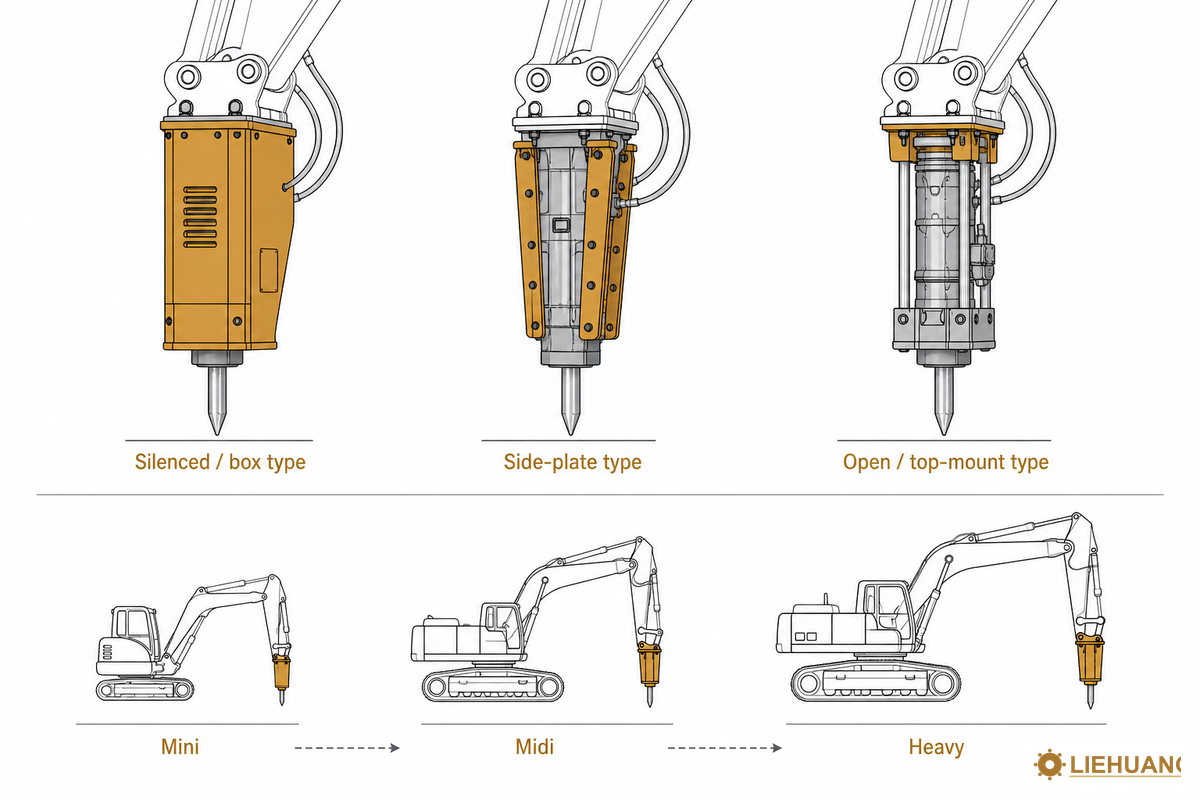
There are two questions hiding inside “what type of hydraulic breaker do I need?” — the body style (which fixes the worksite fit) and the carrier class (which fixes the power). Body style is the choice most buyers get wrong, because a top-mount and a silenced box can sit in the same energy class yet suit completely different jobs.
| Carrier / body type | Best for | Class note |
|---|---|---|
| Top-mount (open frame) | General demolition where noise isn’t regulated | Lightest, lowest cost |
| Side-plate | Prying loads, secondary rock | Added bracket rigidity |
| Silenced (box) type | Urban, indoor, noise-controlled sites | Fully encloses the percussion unit; cuts ≈10–15 dB(A) |
| Solid-body (SB) | Trenches, tight access | Few internal parts; slim, durable |
| Mini excavator (1–4 t) | Sidewalks, utilities, indoor breaking | Mini / silenced class |
| Skid steer / skid loader | Driveways, 4–6 in concrete slabs, light trenching | Compact class; confirm auxiliary flow |
| Standard excavator (12–30 t) | Foundations, primary demolition, secondary rock | Medium-low to medium class |
| Heavy excavator (30 t+) | Quarry / primary rock, heavy demolition | Heavy / super-heavy class |
| Backhoe loader | Mixed utility and trenching | Compact class; same matching rules apply |
Across all of them the application set is the same, demolition, trenching, secondary rock breaking, quarry and primary rock excavation, concrete and asphalt, and the carrier itself is defined in ISO 6165 (earth-moving machinery terminology), which is why the trade talks in operating weight rather than horsepower. Whether it’s a concrete breaker chewing through pavement, a rock breaker scaling hard materials underground, or skid steer loaders on light slabs, the same rules apply. As a rough ladder, a 1.5–3.5 t mini takes a 40–50 mm tool, a 12–16 t excavator a 65–80 mm tool, and a 30 t+ machine a 100 mm+ tool on an S-type coupler. Heavy-duty hydraulic breakers take the quarry and primary-rock work; a mini excavator breaker or a backhoe hydraulic breaker handles utility trenching, and a hydraulic rock breaker suits hard stone. Pick the body style for the worksite; pick the class for the carrier.
Sizing Basics: The Four Numbers That Govern the Match
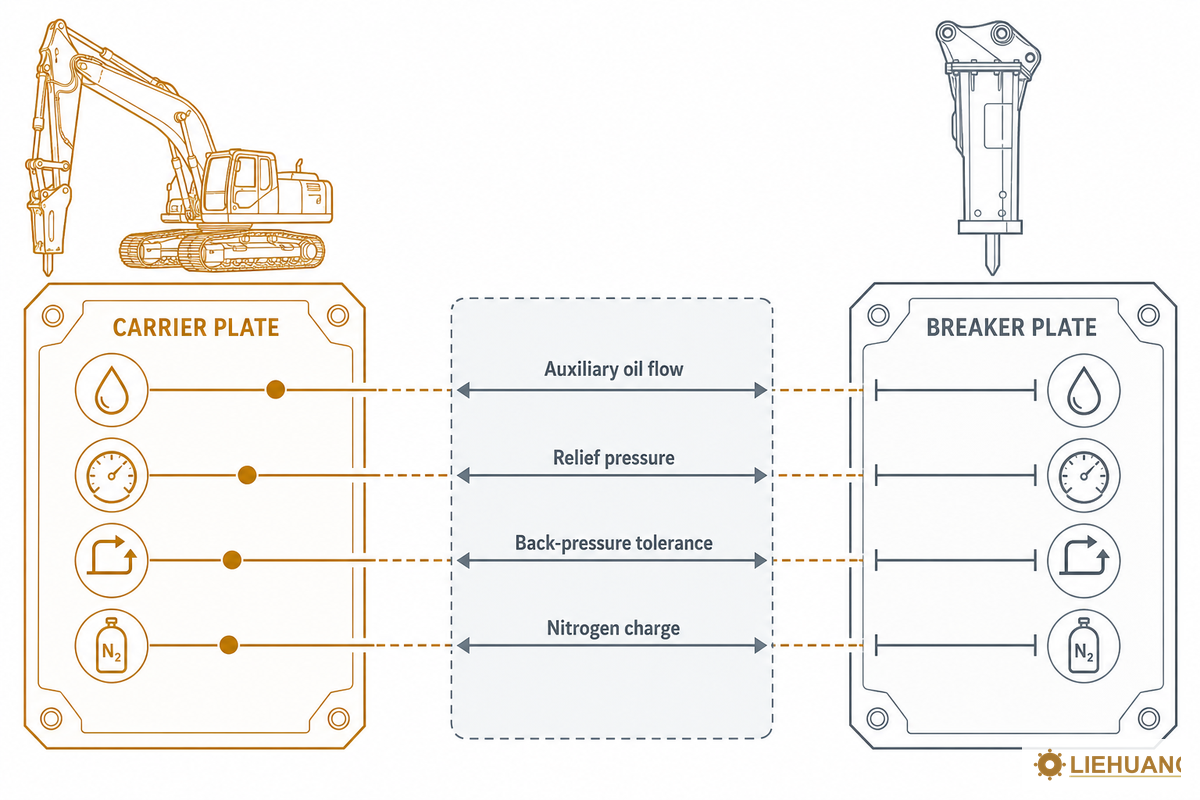
You can skip the catalog guesswork and read the match straight off two plates. Before any breaker is fitted, four hydraulic numbers on the carrier and the breaker have to agree.
The 4-Number Spec-Plate Rule
Check all four against both plates:
- Auxiliary oil flow (GPM / lpm) — has to land inside the breaker’s plate window.
- Relief pressure (bar / psi) — set to the breaker’s plate value, not the carrier default.
- Back-pressure tolerance, long or undersized return lines starve the tool.
- Nitrogen charge, pre-loads the piston; checked against the model manual.
📐 Engineering Note — worked example
Say your carrier’s auxiliary circuit delivers 14 GPM. Match a class whose plate window includes 14 GPM, a compact breaker rated for 7–26 GPM puts 14 squarely mid-window, which is what you want. Fall below the window and the piston can’t recover between blows (it hits soft); push above it and you risk blowing seals at 180 bar, an expensive mistake, and the wrong class also wears the carrier pump. Weight gets you close; measured flow makes it exact. Each unit should ship with matched hydraulic hoses and the mounting cut to your pin spec, with the hydraulic fluid circuit set to the plate values.
This guide deliberately stops at the principle, the full carrier-class selection matrix and a free machine-by-machine match live on the hydraulic breakers for excavators page, where every class band is tied to operating weight, oil flow, and working pressure under ISO 16417:2020, because a breaker only delivers its rated energy inside that flow window.
Working Tools & Lubrication: Moil, Chisel & Blunt
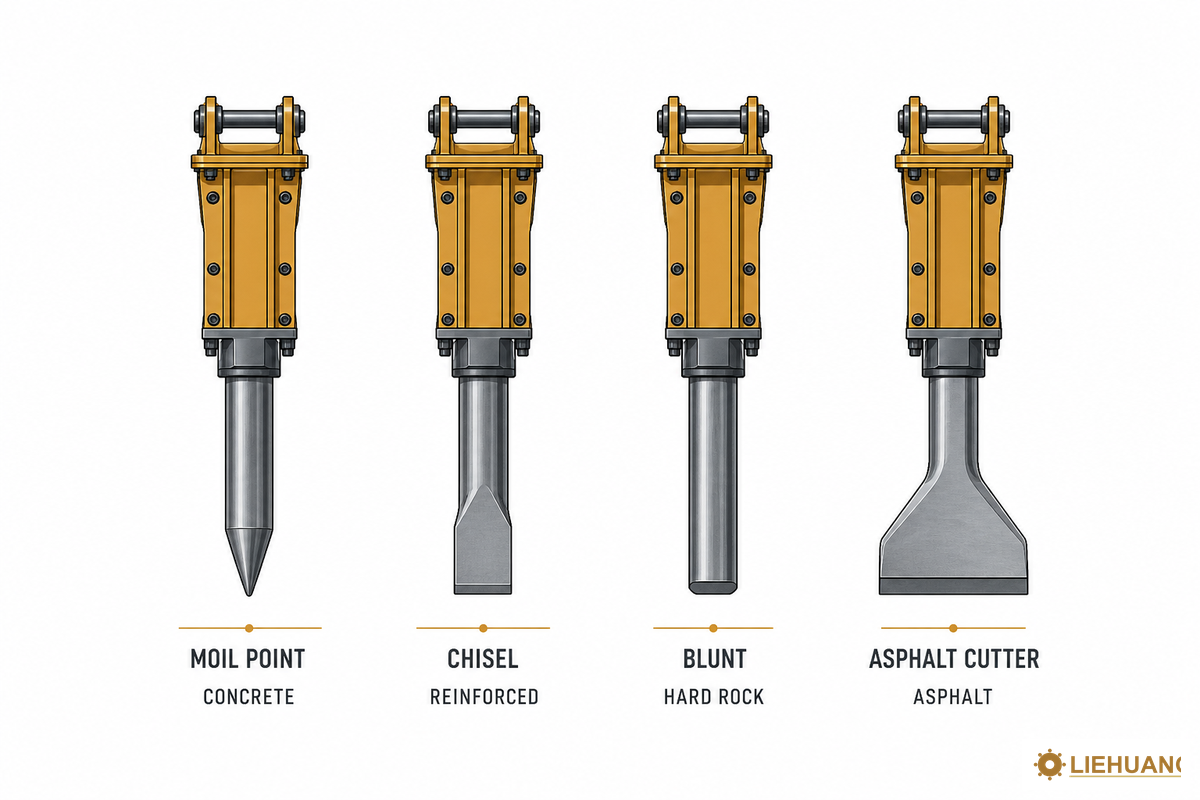
The right working tool is chosen by the material, not by habit. Three shapes cover most jobs, and the construction trade press is blunt about misusing them: as For Construction Pros notes, blunt, moil, and chisel tools each have a job, and forcing the wrong one shortens tool life fast.
| Tool | Best material | Action |
|---|---|---|
| Moil point | General concrete, mixed material | Scores and splits — the all-rounder |
| Chisel | Asphalt, reinforced concrete | Cuts along a line; good for slabs |
| Blunt | Hard rock, boulders | Concentrates energy in one high-energy blow |
| Asphalt cutter | Road layers | Wide blade for clean trench edges |
Tool steel itself is a wear part, quality breaker tools are forged from alloy steels such as Hardox-grade material and will gradually mushroom and shorten. Lubrication is where most tools die early: use a dedicated chisel paste for hydraulic breakers (a high-temperature moly compound), never ordinary grease, and apply it on the working-tool bushing, running dry scores the bore in hours. The stakes are real money: a replacement working tool runs roughly $400 on a backhoe-loader to $5,000+ on a large excavator. Crews routinely turn that $400 swap into a far costlier bushing repair by keeping a worn moil or hydraulic breaker chisel through a full week of asphalt: the mushroomed tool wobbles, scores the bore, and drags the bushing down with it. Concrete, rock, or asphalt, the tool change, the lubrication discipline doesn’t.
How to Operate a Hydraulic Breaker (Without Wrecking It)
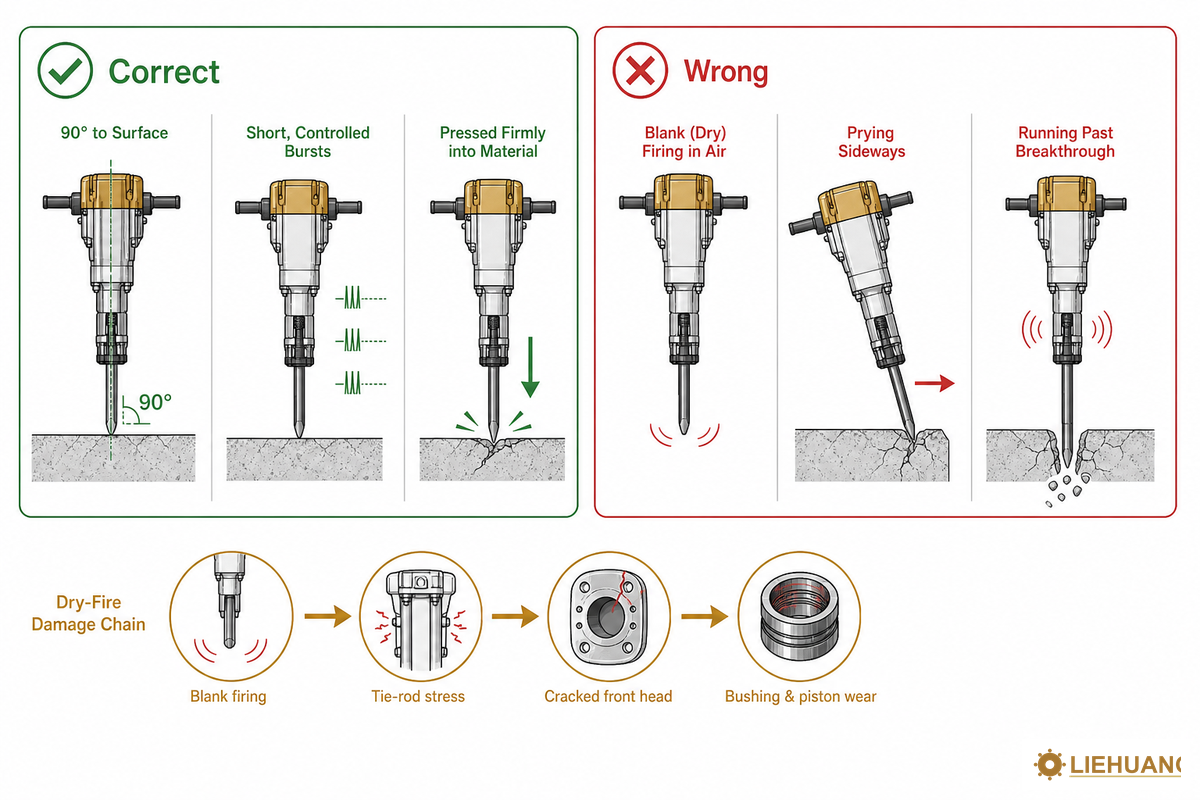
How long should you run a hydraulic breaker on one spot? Only in short, controlled bursts, and you stop the instant the material breaks; to avoid damage to the power cell, never run it dry. One operator habit cost more than all the rest, and it’s worth naming: the Dry-Fire Damage Chain.
⚠️ The Dry-Fire Damage Chain
Blank (dry) firing happens when the hammer run with the tool not pressed firmly against material, in the air, or after the rock has already broken. The piston then fires its full blow into the tool retainer and housing instead of into work. From there the damage cascades: stressed tie rods / through-bolts → cracked front-head assembly → accelerated bushing and piston wear. It’s, by the trade’s own account, the single fastest way to wreck any breaker, premium or budget.
Three field rules keep the tool alive. Work at 90° to the surface with light forward pressure from the arm, so the full blow go into the material. Never pry with the chisel, prying snaps tools and bends rods. And reposition often rather than chasing one spot; if the material hasn’t broken in 15–30 seconds, move the tool. This is also where the biggest myth dies: a bigger, heavier tool is not always the better tool. As one expert breaker guide puts it, real demolition efficiency comes from matching impact energy and blow rate to the material, not from mass. An oversized hammer overloads a light carrier’s arm, pins, and circuit while an undersized one just burns hours. Vibration is the other hidden cost: sustained breaking is a recognized hand-arm vibration exposure for operators, per NIOSH, and the recoil travels up the boom too, which is why vibration-dampened mounts protect both the crew and the carrier.
⚠️ Safety & compliance (not optional)
Breaking concrete, stone, or masonry releases respirable crystalline silica, so U.S. work falls under OSHA 29 CFR 1926.1153 — control the dust with water at the tool or vacuum collection. Sustained breaking is also a regulated noise exposure: OSHA 1910.95 triggers a hearing-conservation program at an 8-hour average of 85 dB(A), and a silenced box that cuts 10–15 dB(A) helps but doesn’t by itself prove compliance, measure the operator’s actual exposure. Picking a silenced, vibration-dampened unit is a first-order safety control, not just a maintenance preference.
Maintenance & Service Life
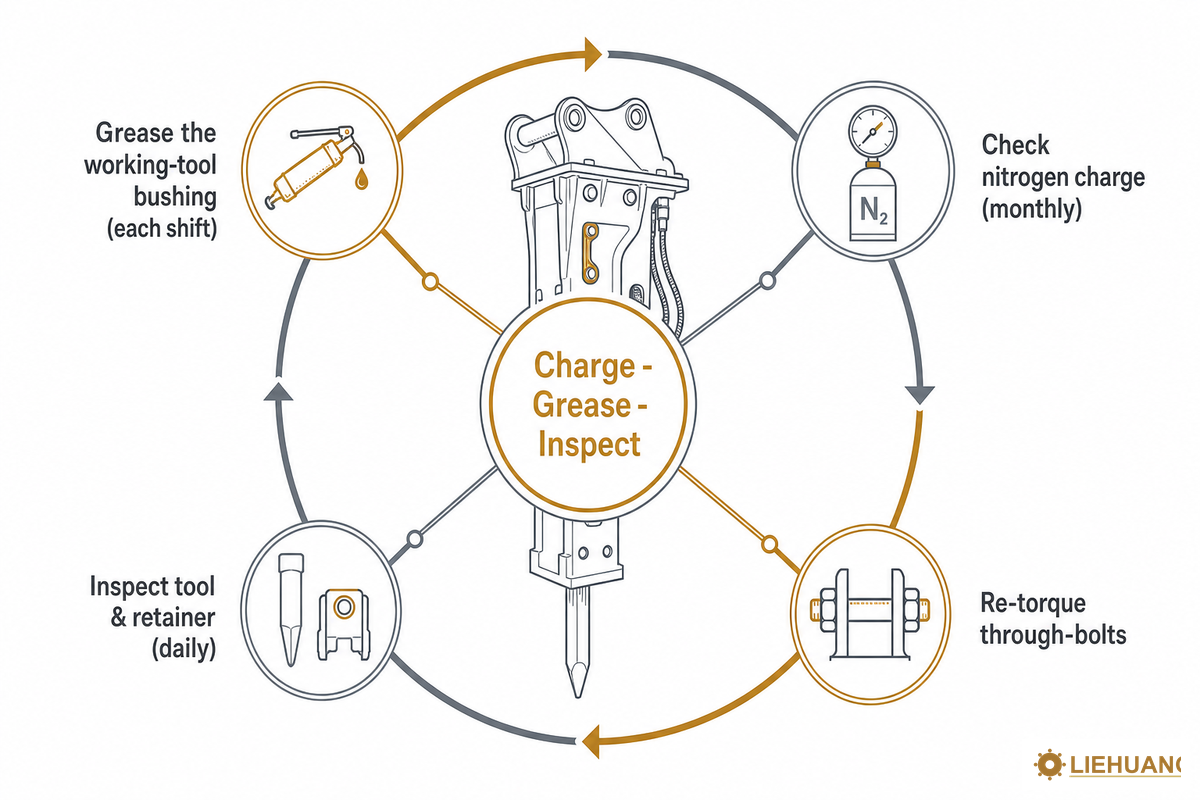
How long do hydraulic breakers last? With correct matching and disciplined maintenance, industry suppliers commonly cite 8–10 years of working life but service life is gated by consumables (tool steel, seals, the accumulator diaphragm), not by the casting, so the real number tracks how the breaker is run against the plate values that ISO 16417:2020 standardizes. That routine is the difference between those two outcomes; we call it the Charge-Grease-Inspect Cadence. Watch for any oil leak at the seals, keep the lubrication system primed, and the breaker’s durability will maximize uptime across a full season.
| Interval | Task | Why |
|---|---|---|
| Every ~2–3 h (per manual) | Grease the tool bushing — ~10–20 pumps, hammer held vertical; adjust to tool wear | Dry running scores the bore |
| Daily / start of shift | Check tool retainer & pins for wear; look for oil weep | Catches a loose tool before it cracks the front head |
| Weekly | Verify auxiliary flow / relief pressure to plate values | Cab gauges drift; settings move |
| Monthly (~200 h) | Check nitrogen charge against the manual; re-torque through-bolts | Lost charge is the #1 cause of weak hits |
| Quarterly (~500 h) | Inspect bushing wear; gauge tool diameter | A worn bushing lets the tool wobble and crack |
| Annually (~1,000 h) | Seal kit / diaphragm service; full teardown inspection | Seals and the diaphragm are scheduled consumables |
| Between jobs | Store the breaker upright | Keeps seals unloaded and the charge held |
“Nine out of ten ‘weak breaker’ problems we troubleshoot come down to flow, charge, or grease, not a broken hammer. We put the flow window on the paperwork and the grease interval on the operator, because that is what decides whether a breaker lasts two years or ten.”
Troubleshooting: When a Breaker Stops Hitting
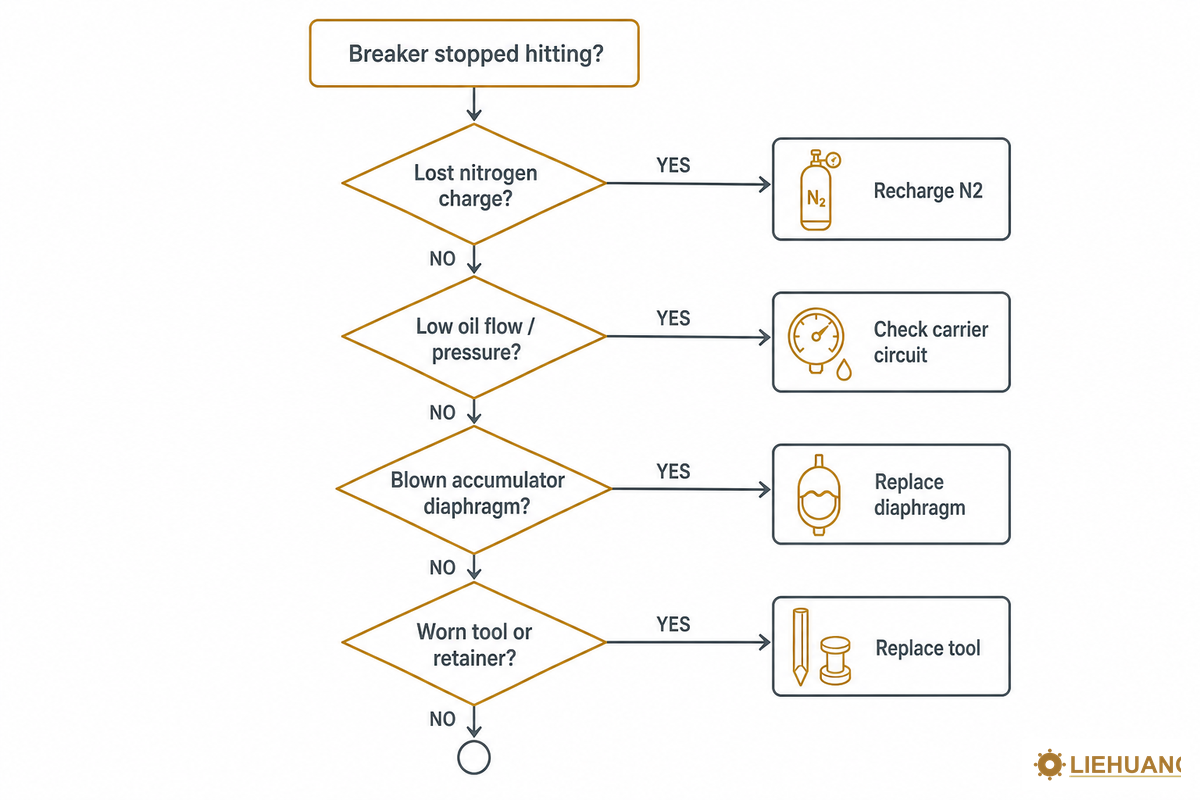
A breaker that “stopped hitting hard” is almost never scrap. Picture a 22-ton excavator on a quarry floor whose hydraulic breaker goes weak right after lunch: a hidden fault that looks expensive but rarely is, nine times out of ten that’s a $90 nitrogen recharge or a worn diaphragm, not the $6,000 rebuild the rental desk fears. Field technicians start with the cheap, common causes before touching internals, work the Stopped-Hitting Triage in order:
Stopped-Hitting Triage
- Low nitrogen charge? Classic tell from the field: it “hits very fast and very light.” Recharge to the manual figure first, it’s the most common cause and the cheapest fix.
- Lost oil flow? A worn carrier pump or a relief set too low starves the piston. Confirm flow with a gauge, not the cab monitor.
- Blown accumulator diaphragm? If a hose jumps and the charge won’t hold, the high-side diaphragm has likely failed, a serviceable part.
- Dry grease / scored bore? No paste, a dragging tool, re-grease and inspect the bushing.
- Worn tool / bushing or internal seals? Last, and only after the above, measure and replace.
Run that order and most “dead” breakers are back hitting hard for the price of nitrogen or a diaphragm. Here’s the lesson the trade keep relearning: diagnose the flow-and-charge system — the same values ISO 16417:2020 standardizes — before you blame the casting.
Buying & Inspecting a Hydraulic Breaker (Including Used)

Are cheaper or used breakers reliable? Reliability tracks matching, charging, and greasing far more than the flag on the housing, field reports show premium brands need major repairs too when they’re run mismatched or dry-fired. A correctly sized, well-maintained breaker outlasts a neglected expensive one. So inspect the unit, not the badge.
- ✔ Charge holds overnight, pressure-test the back head before you commit.
- ✔ No oil weep at seals; bore not visibly scored.
- ✔ Tool retainer and through-bolts intact, not cracked or peened.
- ✔ Parts are actually available for the model, price the seal kit and diaphragm first.
- ✔ The class matches your carrier’s measured oil flow, in writing.
Auction units carry real risk, an unknown hammer on a 20-ton machine is a gamble, not a bargain, and buying the wrong class is an expensive mistake until you’ve priced the major replacement parts. More than one importer has won a “bargain” at the block only to find the seal kit and diaphragm cost more than a graded used unit would have; heavy duty hydraulic breakers hide their wear deep inside the power cell, where a quick yard walk-around never reaches. If you’re sourcing rather than gambling, a supplier that inspect, grades, and documents the carrier-fit class removes most of that risk; see how that works for inspected hydraulic breakers built to your carrier, mini to heavy.
Industry Outlook: Where Hydraulic Breakers Are Heading

Through 2026, the clearest shift is regulatory, not mechanical: tightening urban and indoor noise limits — measured under EN ISO 11200 methods and enforced by limits such as OSHA 1910.95 — are pushing demand toward silenced (box) breakers that cut roughly 10–15 dB(A). If you are buying for jobs near occupied buildings, the body style is now a compliance decision, not a comfort one.
Two more changes matter for buyers. First, Anti-Blank-Firing (ABF) and automatic lubrication are moving from premium options toward standard equipment, both attack the expensive field failures (dry firing, dry bushings) — the mistakes that this guide keeps coming back to, so spec them where you can. Second, demand is tilting toward the compact end: searches for mini-excavator breakers have grown roughly a quarter year over year while broad “hydraulic breaker” interest softened, mirroring the rise of 1–10 ton machines on urban and utility sites. For context only, the broader breaker-attachment market is tracking mid-to-high single-digit annual growth, directional, not a reason to buy. What should drive the purchase is the work in front of you, and the body style and features that fit it.
Frequently Asked Questions
What is a hydraulic breaker, and how does it work?
View Answer
A hydraulic breaker is a percussion attachment for an excavator, skid steer, or backhoe. It uses the carrier’s oil pressure to drive a piston, while a nitrogen accumulator recovers that piston between strokes, producing repeated high-energy impacts that break rock, reinforced concrete, and asphalt. Picture the carrier and the breaker as one hydraulic system: the tool only delivers its rated impact energy when the excavator supplies oil flow and pressure inside the breaker’s design window. Starve that flow and it hits soft; overshoot it and you risk blowing the seals.
How long do hydraulic breakers last?
Show Answer
With correct carrier matching and a disciplined grease, charge, and inspection routine, a hydraulic breaker commonly lasts about 8–10 years. Lifespan is set by consumables — the tool steel, seals, and accumulator diaphragm — far more than by the body casting. Dry firing and skipped greasing are what cut that life short.
Hydraulic breaker vs jackhammer, what’s the difference?
View Answer
A jackhammer is a handheld tool powered by its own compressor or motor, delivering tens to a few hundred joules per blow. A hydraulic breaker is a machine attachment powered by the carrier’s hydraulic system, so it produces far higher impact energy — often several thousand joules — for production breaking. It is the same percussion idea at a very different scale: one chips, the other demolishes.
How often should the nitrogen charge be checked?
View Answer
Check it roughly monthly, or whenever the breaker starts hitting fast and light, and always to the figure in your model’s manual — typically around 55–60 kg/cm² in the back head. Low charge is the most common cause of a breaker that “stops hitting hard.”
What gas goes in a hydraulic breaker?
Show Answer
Dry nitrogen — never compressed air or oxygen. The back head and accumulator are charged with nitrogen because it is inert and stable under repeated compression.
Can you use a hydraulic breaker underwater?
View Answer
Only with a unit set up for it — submerged work needs an air-supply (port-air) kit to keep water out of the percussion chamber. A standard breaker run underwater will flood and fail, so confirm the model is rated for it first.
Are cheaper or used hydraulic breakers reliable?
Read Answer
They can be. Reliability tracks correct matching, nitrogen charging, and greasing more than brand or origin — premium breakers also fail when mismatched or dry-fired. A graded, inspected used unit with documented carrier-fit and available parts is a sound buy; an unknown auction hammer is the real risk.
Does a bigger breaker break faster?
View Answer
Not necessarily. Output is impact energy multiplied by blow rate, matched to the material — an oversized hammer overloads a light carrier and slows the job, while the right class breaks faster and lasts longer.
Need a breaker matched to your excavator?
Send your machine model and we confirm the class, oil flow, and mount, new or inspected used, crated for export.
Get a free breaker-to-carrier match →About This Guide
Liehuang supplies used excavators and attachments, including hydraulic breakers across the mini-to-heavy range, to importers worldwide, so we fit breakers to specific carrier families every week. This guide reflects the operating and maintenance issues we see most often in the field, framed to ISO 16417:2020 terms. Reviewed by the Liehuang technical team.
References & Sources
- ISO 16417:2020, Earth-moving machinery: Hydraulic breakers, terminology and commercial specificationsInternational Organization for Standardization
- ISO 6165:2022, Earth-moving machinery: Basic types, identification, terms and definitionsInternational Organization for Standardization
- NIOSH, Hand-Arm Vibration & construction equipment safetyU.S. National Institute for Occupational Safety and Health (CDC)
- OSHA 29 CFR 1926.1153, Respirable Crystalline Silica (Construction)U.S. Occupational Safety and Health Administration
- OSHA 29 CFR 1910.95, Occupational Noise ExposureU.S. Occupational Safety and Health Administration
- Don’t Hammer Tools to DeathFor Construction Pros
- Maintenance Tips Extend Hydraulic Breaker Attachment LifeFor Construction Pros
- Attachment Roundup: Equipment Attachments You Can’t ForgetEquipment World

![Excavator Bucket Manufacturers: Buyer Evidence [Guide]](https://lhusedexcavator.com/wp-content/uploads/2026/08/excavator-bucket-manufacturers-r2-featured-768x512.png)