Get in Touch with Liehuang Company

Used Caterpillar Excavators: A Buyer’s Guide to Models, Verification, and Import Decisions

Used Caterpillar excavators are pre-owned Cat machines that buyers must evaluate by job fit, machine identity, measured condition, installed configuration, and landed cost. Two machines only become comparable when those five items line up. Model badges and attractive prices are starting points, not a purchase decision.
This guide will help importers, contractors and equipment distributors develop a consistent method for evaluating each machine individually. When you’re ready to begin examining available units, you may view current used Caterpillar excavators. List availability and quote request placement will happen on the category pages.
However, the guide below will address verification.
Direct answer: First define the work and transport route. Then reconcile the product identification number, engine/emissions identity, configuration, records, and documents. Inspect measured wear and hot performance. Finally, compare evidence-adjusted landed cost—not the listing price.
Separate search language from machine evidence
An excavator for sale may be a mini, crawler, or wheel machine, but those broad labels do not establish application fit. Search pages use phrases such as “used excavators for sale,” “used Cat excavators,” “Cat used excavators,” “used excavators from Cat,” “secondhand,” and “pre-owned machines” to organize a large variety of construction equipment. Searching for a Cat excavator price or a Cat mini excavator can open the research; neither query verifies one machine. Treat that language as a way to discover an option, not as proof that one listing is reliable.
Model-year filters such as 2018, 2019, 2020, 2021, 2022, or 2023 do not replace a service timeline. Nor does a brand comparison with Komatsu or another manufacturer resolve the condition of the Caterpillar in front of you. Its diesel engine, cab, forestry guard, digging-trenches setup, or other industrial application package must be verified on the machine.
Commercial labels need the same caution. Cat Certified Used is a named program and should not be confused with an independent supplier’s refurbishment or a dealer warranty. Displaying a Cat® badge does not make “quality,” “professional,” “trusted partner,” “versatility,” or “low hours” measurable claims. Trust comes from the evidence pack, contract, and inspection. Before accepting a deal, update the quote with the exact configuration, maintenance scope, and shipping responsibilities. Buyers can shop or browse an inventory of used machines to discover candidates; the decision still belongs near the serial number and test results.
Choose the Caterpillar Model Family by Job and Transport Constraint
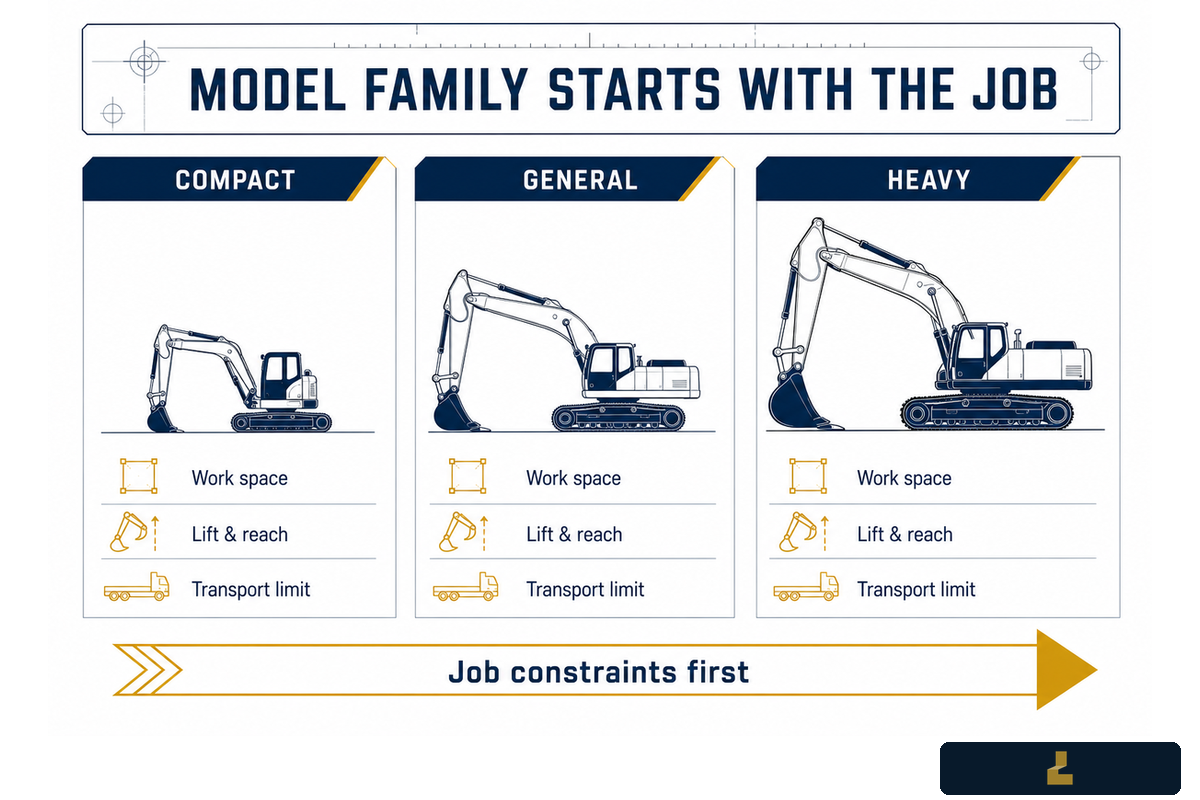
It’s essential to develop a list of useful machines by considering the work the machine must perform, and not by simply selecting the Cat excavator that appears first in the listing.
Other factors that influence performance are dig depth, working radius, lift geometry, daily output, ground pressure, tail swing clearance, attachment weight, and ancillary hydraulics. Although a smaller machine may be easier to relocate, it can become the costly option if it isn’t powerful enough to lift the necessary weight or to meet job productivity requirements.
Caterpillar’s sizing guidance connects operating weight and dimensions with transport, reach, lift, loading, and attachment requirements. In Heavy Equipment Guide, a multi-manufacturer expert discussion adds trench geometry, over-side lift, coupler and bucket weight, boom/stick choice, and jobsite access. Taken together, those factors make a model name a family label rather than a complete specification.
The Cat Model-to-Mission Matrix
| Model family to research | Current category / generation boundary | Likely mission | Constraint to define | Configuration question | Decision owner |
|---|---|---|---|---|---|
| 303.5 / 305.5 | Generation- and market-dependent mini labels; treat 305.5 as a legacy designation until verified | Compact urban work, landscaping, utilities | Gate, alley, slab and tail-swing clearance | Which exact generation, coupler and auxiliary circuit are installed? | Site manager and procurement |
| 308 / 310 | Current mini-excavator class | Utility, road and mixed compact work | Transport and ground-pressure limits | Blade, boom, track and attachment setup? | Site manager and logistics |
| 313 | Current small-excavator class | Small construction and utility work | Lift radius, site access and carrier plan | Which front, blade and hydraulic options are fitted? | Site manager and technical reviewer |
| 315 | Current small-excavator class; do not merge with 320 by model-number proximity | Construction, utility and constrained infrastructure work | Reach, lift radius, access and daily output | Boom/stick, blade, counterweight and hydraulics? | Operations and procurement |
| 320 | Current medium-excavator class | General construction and infrastructure | Reach, lift radius, production and carrier plan | Boom/stick, counterweight, hydraulics and work tools? | Operations, procurement and logistics |
| 325 / 330 | Current medium-excavator class | Heavier earthmoving and production | Carrier, route and site bearing capacity | Undercarriage, guarding and work-tool demand? | Operations and logistics |
| 336 | Current large-excavator class | Heavy excavation, quarry or large civil work | Production, fuel, lift and route permit | Mass-excavation or general-purpose setup? | Operations, finance and logistics |
| 349 | Legacy or market-dependent designation in this comparison; verify generation and local product history | Large civil, quarry and demanding production | Route, assembly, support and site capacity | Front geometry and application package? | Operations and technical reviewer |
| 352 | Current large-excavator class | Large civil, quarry and demanding production | Route, assembly, support and site capacity | Front geometry, counterweight and application package? | Operations, finance and logistics |
| 374 / 395 | Current large-excavator class; mining suitability is configuration- and support-dependent | Very large, high-production earthmoving | Disassembly, route, assembly and support plan | Front, counterweight and site-service arrangement? | Owner, operations, finance and logistics |
Caterpillar can categorize used equipment, but the current U.S. model designation doesn’t cover used inventory from previous generations and markets. However, the following table doesn’t identify 305.5 and 349 as current-category machines and doesn’t transform “mining” to a model category. Ensure equipment includes the full model designation, product identification number, engine/emissions identity, configuration installed, support for destination country, and machine specifications prior to approval.
Transport is route-specific as well as machine-specific. In the United States, federal Interstate weight and bridge-formula rules coexist with state-issued oversize and overweight permits. Other countries and ports have their own limits. Give the carrier the actual shipping dimensions, weight, removable components, loading method, origin, destination, and route, not a generic model brochure.
Best practice: determine a machine-class-only selection, only when both jobsite and route have been described. Then identify the exact machine corresponding to the selected class.
Decode the Model, Year, Product Identification Number, and Configuration
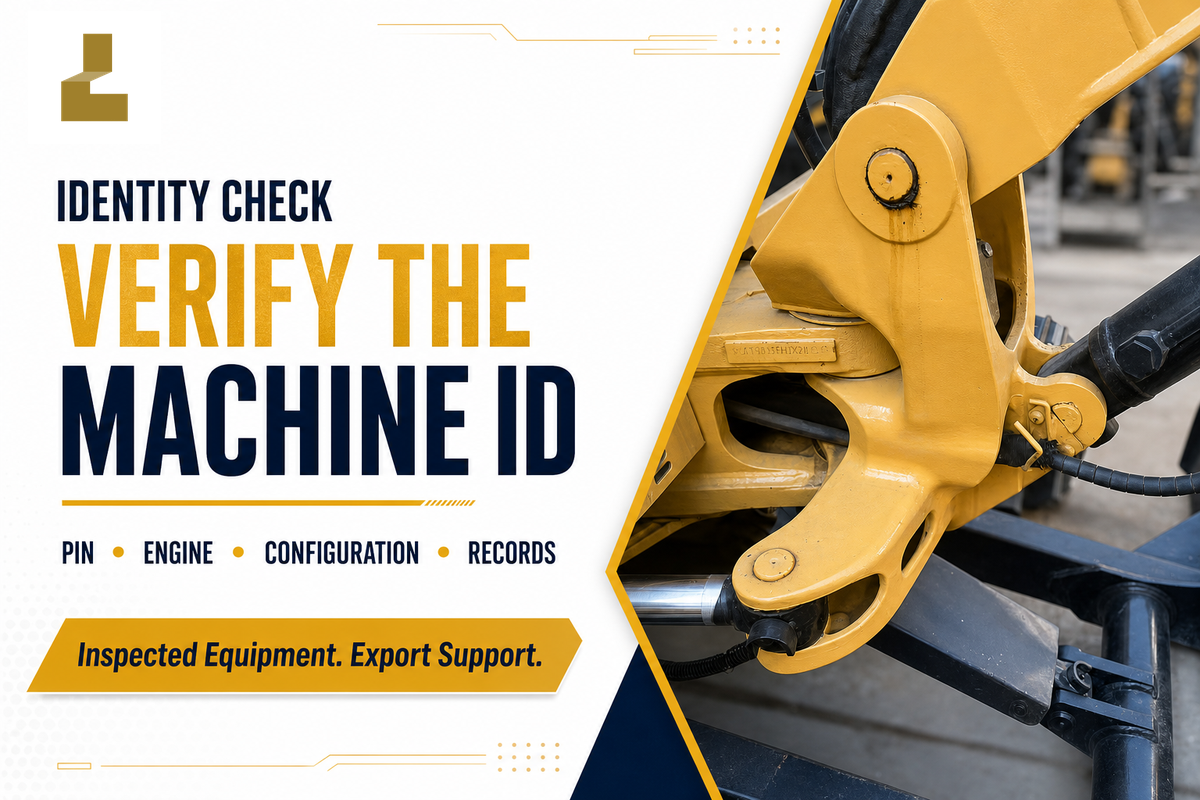
Build the product story from bottom up. A secure identity is built as a chain of linked data points, all referring to the same excavator. Discrepant information may be a reporting error to solve, or it may be a cause for caution. Those aren’t the same condition.
The 6-Link Cat Identity Chain
This is an editorial buyer-control framework, not a Caterpillar-issued six-step procedure. It converts machine-specific evidence into a repeatable procurement check.
- Photograph the product identification plate: request an unedited, close, readable image plus a wider photo showing its position on the machine.
- Reconcile model and serial range: match the plate, seller description, invoice draft, records, and inspection report.
- Establish build information and original market: don’t infer the year from paint, decals, or one typed field.
- Match engine and emissions identity: photograph the engine serial and emissions labels and confirm destination relevance.
- Record the installed configuration: boom, stick, track frame, shoes, hydraulics, coupler, bucket, counterweight, cab and guarding belong in the identity pack.
- Trace service, ownership and shipping continuity: explain who owned, repaired, refurbished and exports the machine, with documents tied back to the same identity.
Caterpillar makes an explicit distinction between the product identifier and engine serial number. Because of that, merely attaching an image of the machine nameplate to a communication or sending its serial number in an email or message are weak pieces of information in themselves. Rather, request a combined set of photos, with date stamps on all the individual files. Request this package: equipment nameplate, engine/emissions label, hour meter, and full machine photo.
Distinguish confidence in identity from confidence in the condition of the machine. A cohesive identity narrative for a piece of equipment doesn’t mean it has no problems with hydraulic pumps, final drives, or track assembly. Likewise, even a machine that runs well may have an outstanding identity verification issue.
When there’s a relevant jurisdiction that provides public records for liens or security interests, inquire how ownership and any such interests were verified in that record. The equipment’s product identification number, invoice, or bill of sale alone don’t guarantee clear title in every jurisdiction. Use a capable local attorney to address property-specific clearance issues.
Best practice: avoid negotiation based on equipment listing identity. Negotiate the deal on the equipment-specific identity profile.
Inspect Condition and Corroborate Reported Hours
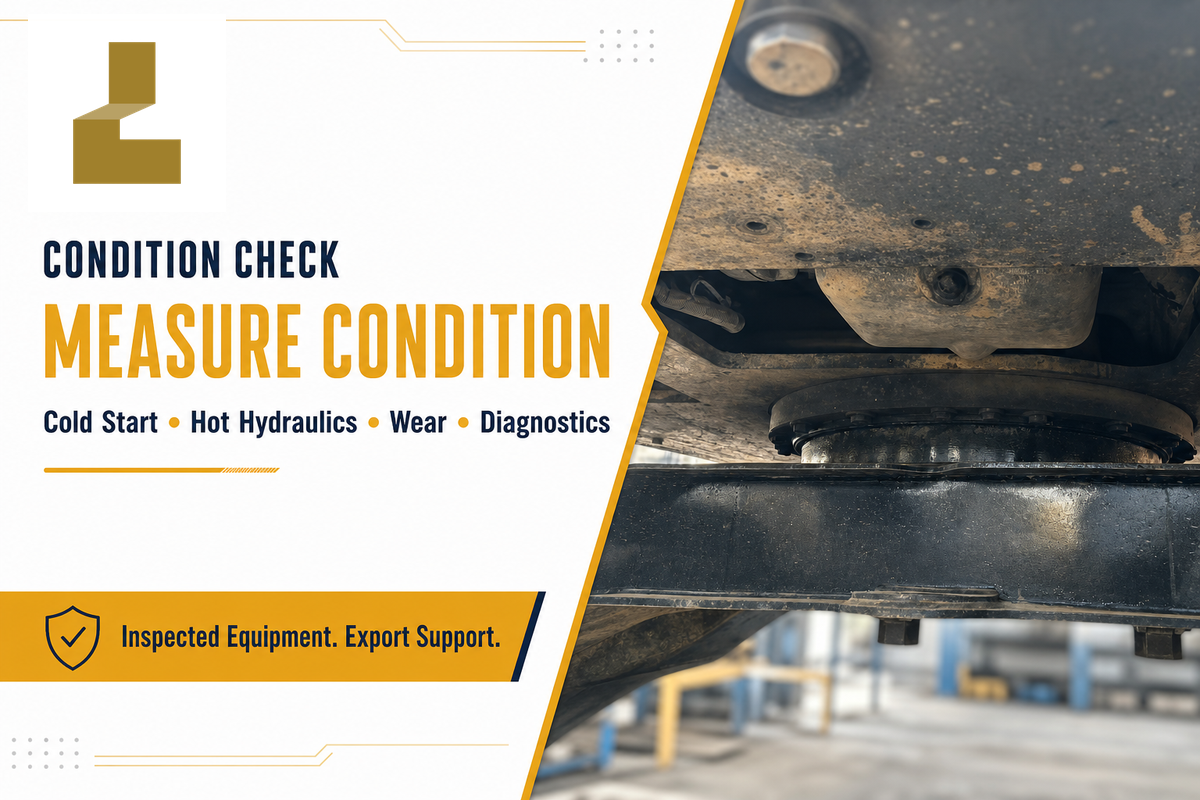
Reported hours are one data point concerning equipment usage, not necessarily an indicator of the machine’s condition. Machines with low hours can experience excessive wear due to hard use, extended idling, lack of maintenance, replaced parts, meter malfunction, or work outside known boundaries. Conversely, high hours don’t preclude good maintenance practices or significant component upgrades. Better question: does the evidence for this equipment coherently lead to a single conclusion?
Do
- Call them reported hours until corroborated
- Match records, component dates and seller timeline
- Compare cab, control, pin and undercarriage wear
- Investigate a mismatch before assigning value
Don’t
- Treat a low number as a condition certificate
- Use one universal “too many hours” cutoff
- Accept a replaced meter without a documented transition
- Let fresh paint answer a history question
For a deeper treatment of hour thresholds, use the excavator hours guide or the true-hours sanity checker. Here, the practical rule is narrower: no single hours figure should outrank physical measurements and dated records.
Request a continuous cold-to-hot evidence sequence
Ask the seller to start recording before the key is turned. The sequence should show the cold engine, exhaust behavior, dashboard and meter, active warnings, engine bay, hydraulic functions, travel in both directions, slew, boom/stick/bucket cycles, the auxiliary circuit where fitted, and a second leak and performance check after the system is warm. A series of short edited clips is easier to stage and harder to audit.
A site inspection should record the serial and hours, check boom and stick play, verify slew-bearing condition, measure the undercarriage, test the hydraulics, and retest after the machine is hot. Use the proper Caterpillar wear chart or service document for the component. “70% undercarriage remaining” is only an estimate until it is tied to measurements and the applicable chart.
- Engine: cold start, blow-by indicators, fluids condition, leaks, warning history, noise indications, service record.
- Hydraulics: cycle behavior, drift, post-hot operation, hose/cylinder condition, leaks, tool operation.
- Structure: boom, stick, frame, weld integrity, cracks/repairs, pin/bushing play, slew speed.
- Undercarriage: link/pin/bushing, roller/idler/sprocket, shoe measurements (not description) and tensions.
- Driveline and controls: travel behavior, final drive behavior, swing, brakes (if applicable), cab controls, cameras, alarms.
- Diagnostics: active report, fault codes (stored and active), service/access constraints, unresolved emissions-related derate or shutdown codes.
Online and remote intelligence is best used to narrow risk; it isn’t a substitute for skilled hands-on inspection when the purchase price is significant. Let the excavator inspection checklist guide your independent inspector.
Configuration Can Change the Value of the Same Model
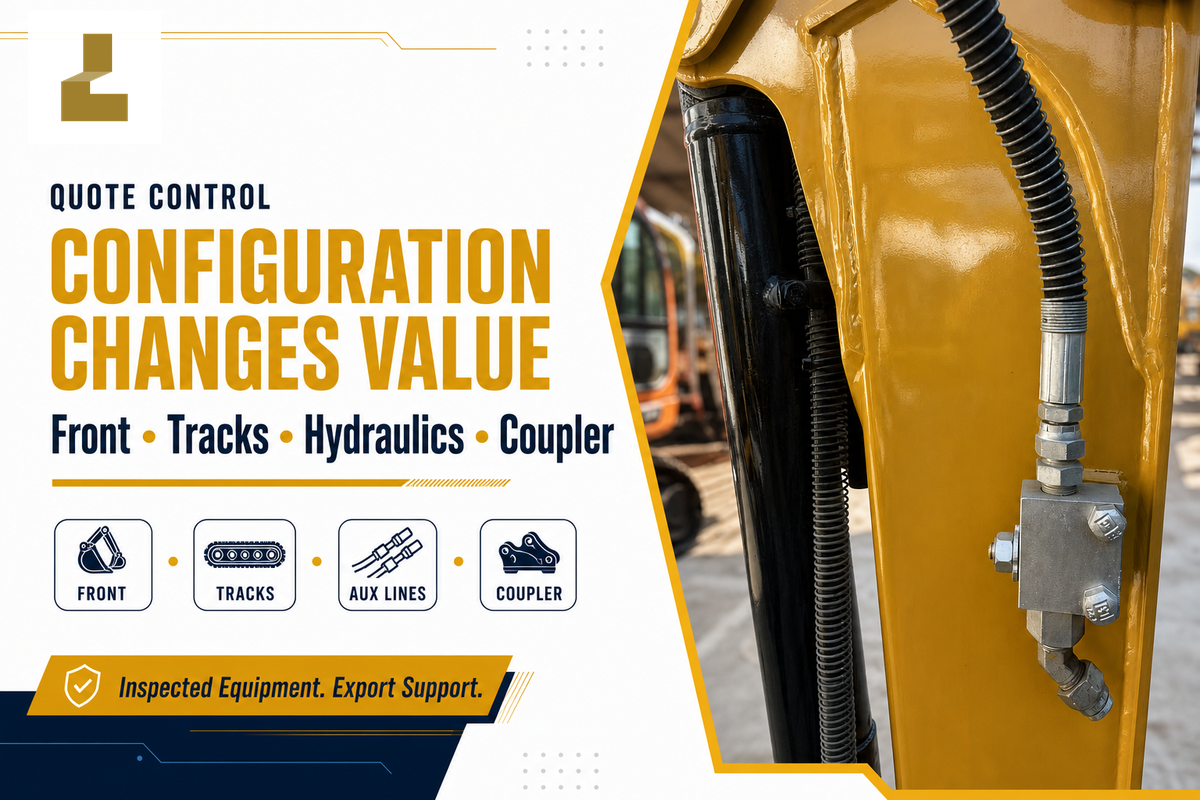
Identical model designations on two machines may not be interchangeable. Working range depends on boom length, stick length, and pin set. Ease of movement, stability, and digging effectiveness depend on the track frame and shoe width. Ability to use an auxiliary attachment hinges on pressure and flow through the system, and the associated controls. Auxiliary work tools add mass, but quick couplers also add mass. Counterweights, guard structures, and front guards impact lift capacity, undercarriage forces, clearance (especially with attachments), and suitability for specific applications.
Build a configuration register beside the identity pack:
- boom, stick and front linkage;
- track frame, shoe width and undercarriage type;
- Auxiliary hydraulics (one-way or two-way), flow and pressure test, and all corresponding controls and indicators.
- coupler type and included bucket or other attachments;
- cab, guarding, cameras, lighting and climate equipment;
- counterweight and any application package;
- engine and emissions configuration for the intended destination;
- shipping configuration, removed parts and reassembly responsibility.
A video might show a particular bucket or attachment mounted on the machine; assume that attachment isn’t included with the purchase unless specifically noted in the order and on the attached parts addendum or pro forma invoice. The order document or parts schedule must clearly list every piece of loose equipment – such as pins, brackets, extra hydraulic hose, hydraulic fittings, oil, and manuals – to ensure its inclusion in the deal. For details, see the excavator attachments guide, bucket guide, hydraulic breaker guide, and Tier 4 emissions guide.
Summary: the configuration is included with the quote. If it’s missing, the value proposition is undefined.
What 2025 Demand Signals Mean for a Used Cat Buyer
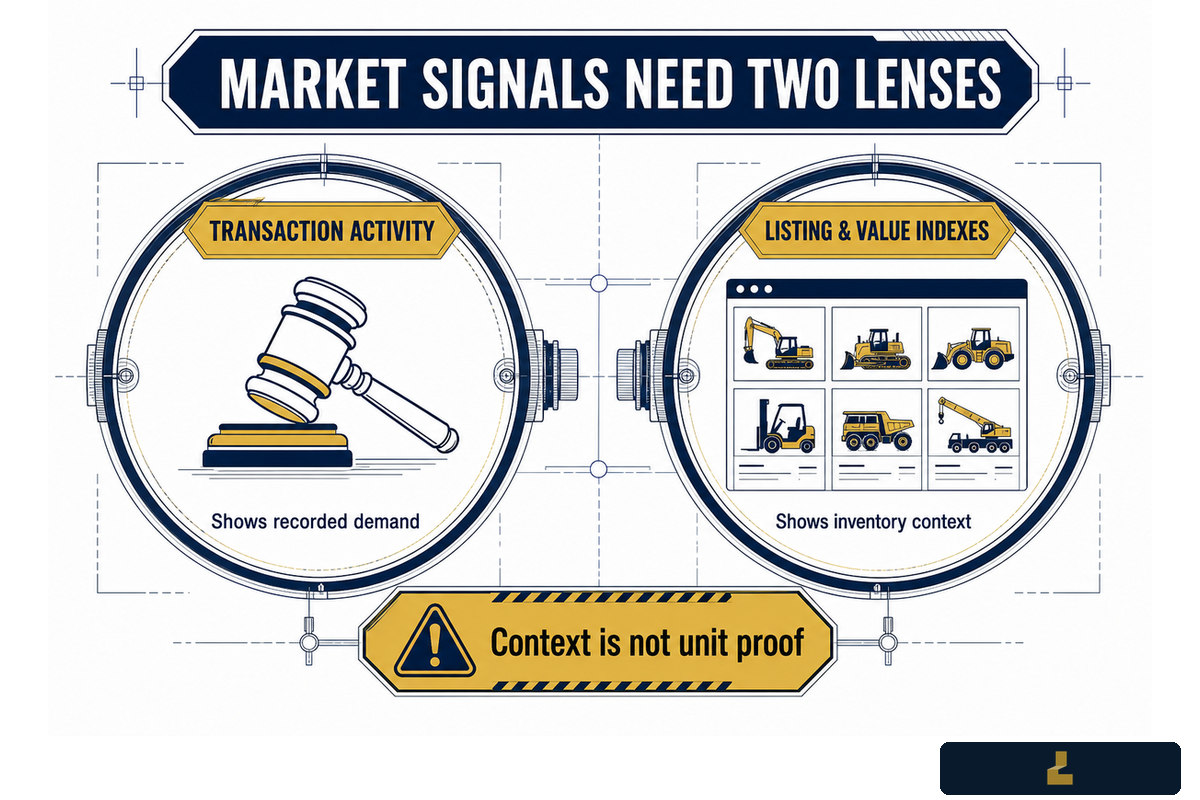
In a busy market, broad demand doesn’t show whether a specific unit is a good deal, but it’s a reason to invest in model-specific research. Buyers browse by a high-level term or model number, while selection depends on supply, transport cost, physical condition, and the often-overlooked configuration, including auxiliary features matched to the jobsite.
In a live United States search sample captured on 2026-07-23, all five returned organic results were inventory, dealer, or marketplace pages, so guide pages represented 0% of that sample. “Used Caterpillar Excavators” and “used CAT excavator” each returned 260 monthly searches at a $2.03 cost per click. Only the first keyword had a saved monthly series, so this analysis does not claim that the second followed the same pattern. Model-first queries for Cat 305, 308, 315, 320, 336, 374, and 395 ranged from 720 to 3,600 monthly searches. Two “for sale” variants each returned 480. The saved series for “used Caterpillar excavator for sale” was 1,000/390/720/390/260/880; the second variant had no independently stored monthly series. Cat 395 recorded the strongest short-window rise among the queried models from July through December 2025. These are directional search-platform signals, not equipment sales, market share, or a forecast.
12,548financed U.S. used full-size transactions in 2025
5.3%increase from 11,918 in 2024
27.9%Caterpillar share within that dataset
Equipment World reported 12,548 financed U.S. used-excavator transactions in 2025, up 5.3% from 11,918 in 2024, for full-size machines of at least eight metric tons. Caterpillar represented 3,504 transactions, or 27.9%, within that dataset. These are financed transaction counts, not global unit sales, cash purchases, or a forecast.
A different lens points in a different direction. Sandhills reported its May 2026 U.S. marketplace indexes with used heavy-duty construction equipment inventory down 11.55% year over year, asking values down 3.02%, auction values down 1.87%, and crawler-excavator auction values down 3.44%. That is platform marketplace-index evidence, not a Caterpillar-only census or a record of every private or off-platform transaction. Viewed within their separate populations, the two datasets aren’t contradictory.
For buyers, the implication is modest: research the exact model and configuration early, compare evidence consistently, and don’t allow a market headline to justify a weak machine. Market data can provide background. It can’t confirm the condition or correct value of one excavator.
Compare Evidence-Adjusted Landed Cost, Not Sticker Price
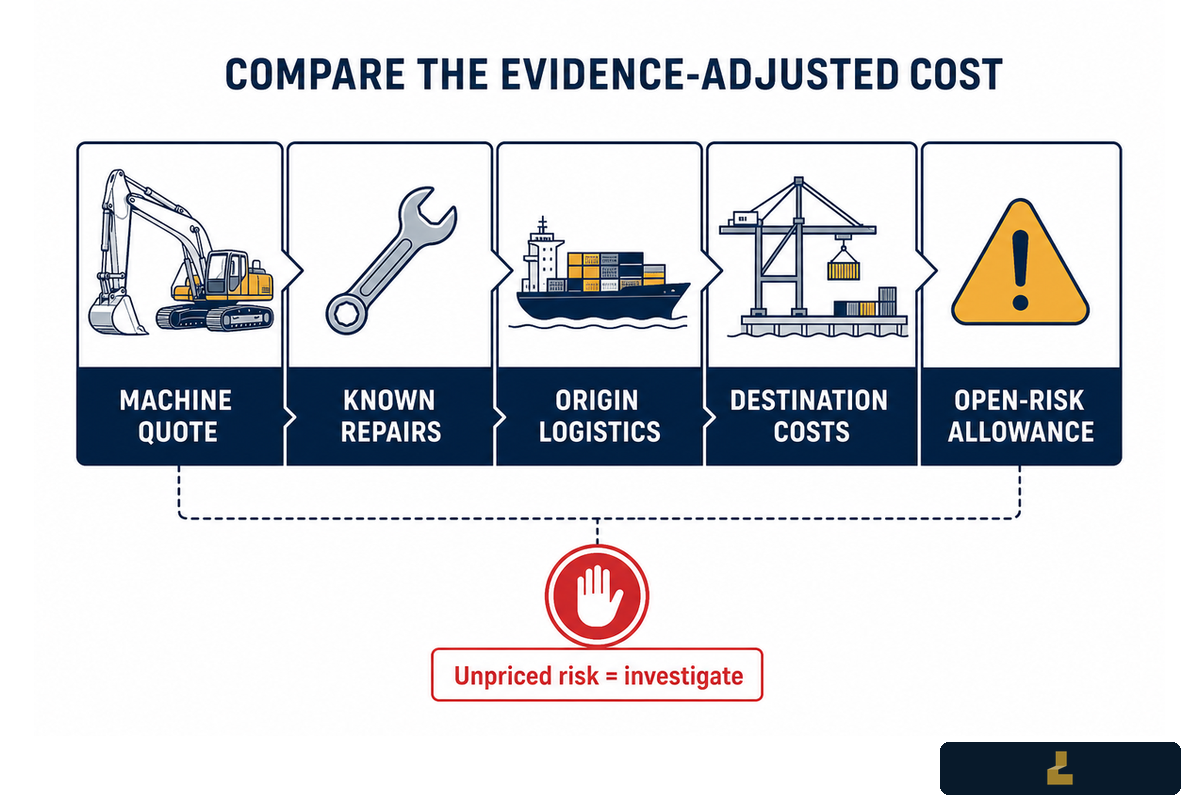
A low listing price may or may not become the lowest landed cost. Final cost depends on what the offer includes, what repairs are already visible, which evidence is absent, the shipping basis and destination rules, and what is required to put the machine into service.
The Evidence-Adjusted Quote Grid
| Field | Record | Evidence | Cost treatment | Owner / evidence provider / approval deadline |
|---|---|---|---|---|
| Identity | Model, year, PIN, engine/emissions | Matched photos and documents | Unresolved conflict is a payment stop, not a small allowance | Procurement owns; seller and inspector provide; owner or finance approves before deposit |
| Condition | Reported hours, wear, leaks, hot performance | Records, measurements, test and inspection | Add priced immediate work; flag unknowns separately | Quality lead owns; independent inspector provides; close before final price approval |
| Configuration | Front, tracks, hydraulics, coupler, tools | Configuration register and function test | Add missing or incompatible items | Site manager owns; seller and inspector provide; approve before contract and carrier booking |
| Logistics | Inland, loading, ocean, port/terminal, delivery | Written Incoterm and route quotes | Use route-specific quotations | Logistics owns; carrier and forwarder provide; close before shipment authorization |
| Destination | Duty/tax, emissions, marking, cleaning, permits | Broker and authority confirmation | Apply only destination-specific amounts | Importer owns; broker or relevant authority provides; close before loading or nonrecoverable payment |
| Evidence risk | Open material questions | Named verification action and deadline | Do not hide unknowns inside a guessed percentage | Deal owner assigns each gap; independent reviewer supplies closure evidence; finance enforces the deadline |
Consider two hypothetical quotes using cost-index units rather than market prices. Machine A begins at 100 units, needs 3 for immediate work, 10 for logistics, and 5 for destination costs: adjusted total 118. Machine B begins at 92, but needs 12 for work, 12 for logistics, and 7 for destination costs: adjusted total 123. After known differences are normalized, the lower sticker figure loses. If Machine B also has an unresolved identity conflict, it shouldn’t receive a guessed “risk allowance”; it should remain outside the payable shortlist.
The Customs duty component doesn’t necessarily consist of a larger sum at every destination. The determined figure depends on the classification, country of origin, destination, and applicable treatment. Investigate duty requirements thoroughly, especially the tariff code, valuation basis, origin rules, taxes, and relevant partner-agency requirements with the consignee or customs broker. For cost categories, consult the used excavator cost guide; the CIF landed-cost estimator helps organize route-specific inputs.
Check Documents and Destination Fit Before Shipment
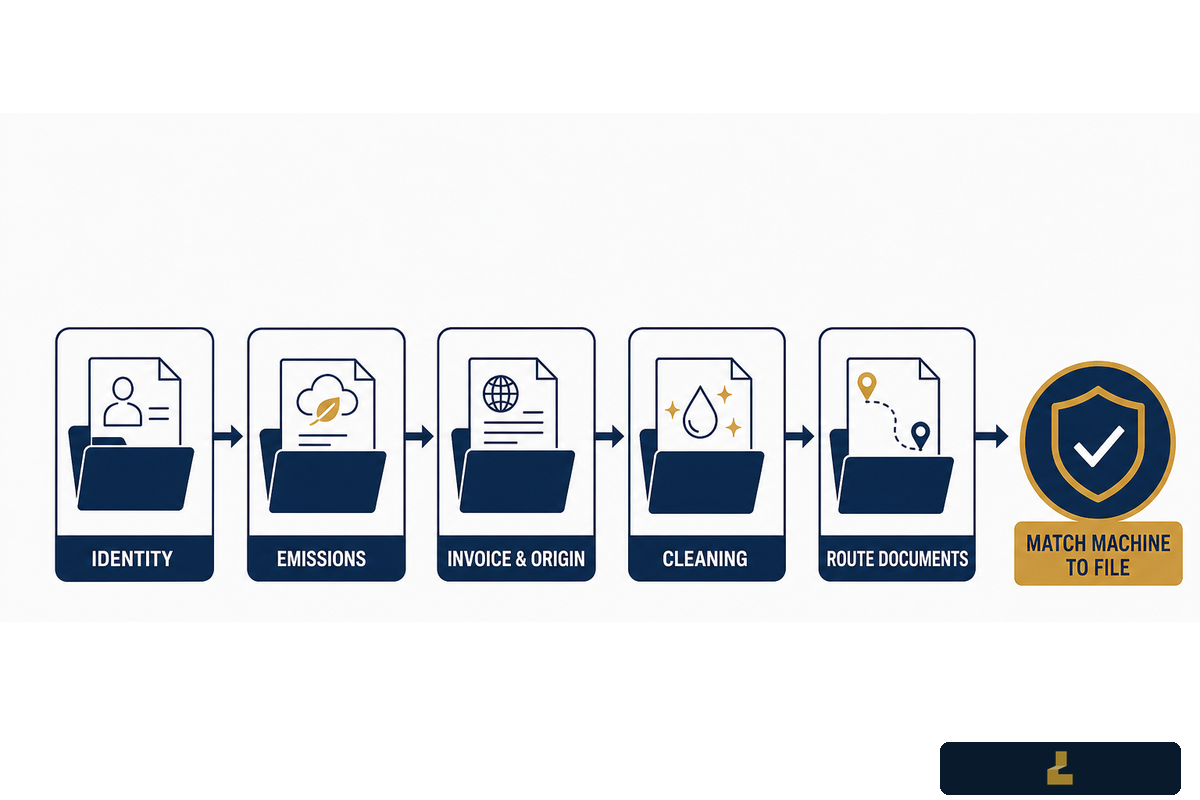
A technically sound crawler excavator can still be delayed or rejected if the document chain, emissions status, origin marking, cleanliness, or route permits do not fit the destination. Make this check before the deposit becomes difficult to recover and before the machine is loaded.
For the United States, EPA says nonroad engines and equipment that do not conform to applicable emission requirements may not be imported unless a specific EPA-authorized pathway applies. Confirm the machine and engine labels, eligibility path, and required approvals with EPA and the importer before shipment. EPA also warns that noncompliant imports can face seizure, export, or penalties. Rules written for highway engines should not be assumed to govern nonroad excavators.
CBP places responsibility on the importer to exercise reasonable care and coordinate relevant partner-agency requirements. Commercial invoice, packing list, bill of lading, identity continuity, declared origin, value, classification, and any required marking or permits should agree. General guidance can’t decide a complex shipment; confirm the facts with the broker and relevant authority.
Australia adds a vivid example of destination risk: used machinery must be free of soil, seeds, plant, and animal material. Government guidance identifies tracks, crevices, pivot areas, and oil-retaining dirt as inspection points. Serious contamination can stop the shipment. Heavily contaminated machinery may be directed for export from Australia at the owner’s or importer’s expense. “Washed” is therefore not enough; ask for dated cleaning evidence and close views of the areas that trap material.
Build a shipment workflow with the China excavator import guide, then have the consignee and broker confirm current destination requirements.
Use the Evidence-Adjusted Quote Grid to Shortlist, Investigate, or Reject
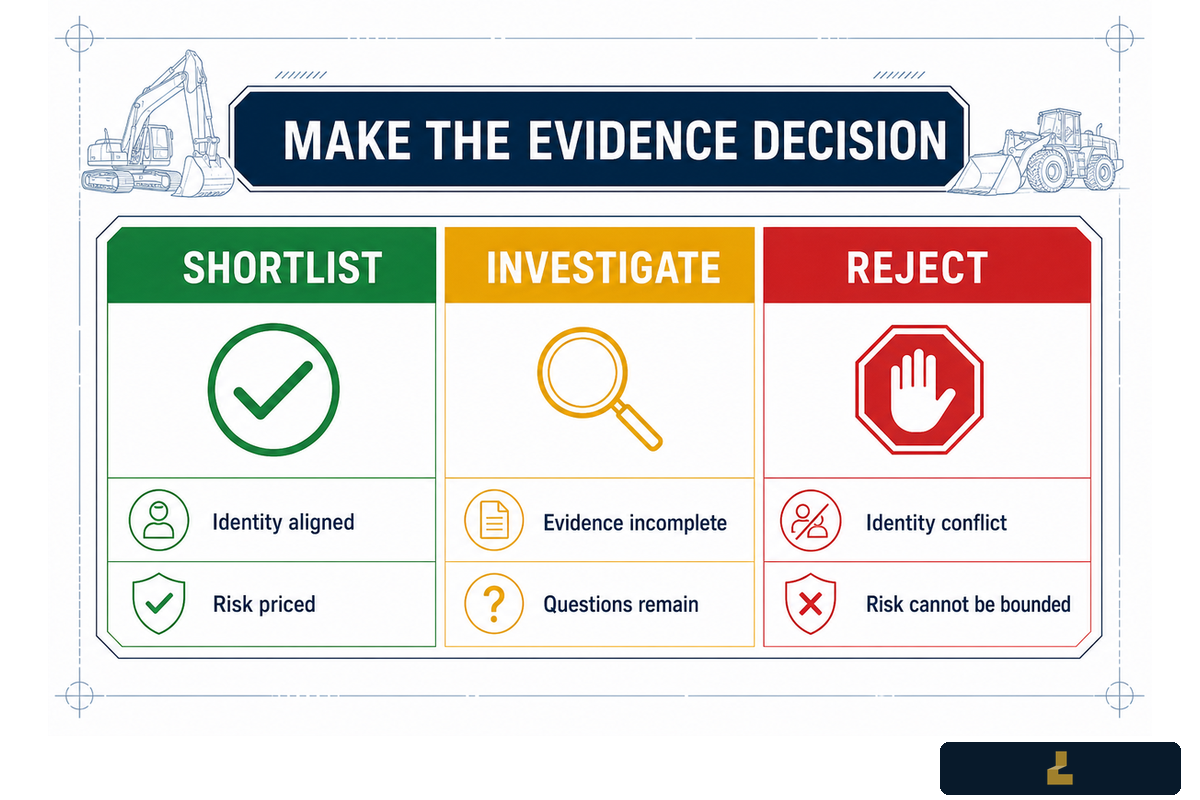
A remote buyer needs more than a checklist. Each finding needs a status, an evidence owner, a closure deadline, and a payment consequence. One or more missing records can remain manageable only when every material gap has a defined independent verification path. Any gap that can’t be closed, or evidence that conflicts across sources, belongs in Reject.
| Status | Typical finding | Evidence owner | Next action | Approval / payment gate |
|---|---|---|---|---|
| Shortlist | Identity is consistent; job and destination fit; measured evidence is coherent; open work is costed | Procurement compiles; quality lead verifies | Confirm final inclusions, inspection condition and shipping basis | Owner or finance approves only under agreed contract and payment controls |
| Investigate | One or more material gaps, each with a defined independent verification path | A named procurement or quality owner assigns the independent verifier and deadline | Obtain every missing label, measurement, diagnostic report, registry check or independent inspection; move to Reject if any material gap cannot be closed or creates a contradiction | No nonrecoverable payment until the approver accepts all closure evidence |
| Reject | Unresolved identity conflict, edited or withheld core evidence, unexplained hours conflict, undisclosed structural repair, destination incompatibility, or an unclosable material gap | Procurement records the evidence and stop reason | Stop work on the quote and preserve the decision record | Owner or finance confirms no payment to “solve it later” |
Before a deposit, request one machine-specific pack: timestamped walkaround and cold-start video; PIN, engine/emissions label, and meter photos in one set; undercarriage measurements; hydraulic and attachment tests; service records or a written absence statement; diagnostic information where available; ownership and lien clearance where relevant; written refurbishment scope; exact inclusions; Incoterm; loading plan; and destination.
Make the remote evidence pack auditable
An auditable pack needs sequence and labels. Ask the seller or inspector to begin with a card showing the machine identity, date, location, and buyer reference, then move through the plate, meter, engine, cab, undercarriage, attachments, and tests in a stated order. A continuous route does not make manipulation impossible, but it makes obvious substitutions and missing steps easier to detect.
File names should identify the machine and test rather than arrive as a sequence of anonymous clips. An inspection summary should point to the relevant photo, measurement, or video time, not merely say “checked.” If one area cannot be accessed, record the limitation. An explicit absence is more useful than a blank field because the buyer can decide whether another test, a price holdback, or rejection is appropriate.
Measurements also need context. Record the instrument or gauge, the measurement location, the component, and the comparison reference. Keep the original image or video, not only a screenshot with a percentage typed over it. When a repair is reported, request the before condition, work description, replaced-part identity where available, completion date, and after evidence. This creates a trail that the purchasing team, inspector, workshop, and seller can discuss without relying on memory.
Convert supplier statements into transaction controls
“Inspected,” “refurbished,” and “tested” become useful only when the contract defines their scope. An inspection might mean a visual walkaround or a measured cold-to-hot test; refurbishment might mean paint and cleaning or documented mechanical work. Ask which interpretation applies to the quoted excavator. List unresolved defects, agreed repairs, acceptance evidence, and responsibility if a promised function fails before loading.
Payment terms should follow evidence milestones. A buyer might reserve a machine after identity review, release the next stage after independent inspection and repair confirmation, and retain the final stage until loading documents and agreed evidence are complete. Exact structure depends on the transaction and legal advice. A material unanswered question should not become harder to resolve because payment has moved faster than verification.
A useful supplier answer is not “good condition.” It is a dated piece of evidence tied to one identified machine.
LH Used Excavator states that it inspects, refurbishes, and tests machines and supports international shipping, selection, and attachments. Treat those as supplier-stated capabilities until the exact excavator’s evidence pack shows what was inspected, what was repaired, who performed the work, which attachments are included, and which shipping responsibilities are in the quote.
Key takeaway: a missing document may be repairable; an identity conflict is different. Give each gap a named verification action, owner, deadline, and payment consequence.
Frequently Asked Questions
What should I check before buying a used Caterpillar excavator?
Start with the job and exact configuration. Verify the product identification number, engine/emissions identity, build information, reported hours, service records, undercarriage, hydraulics, structural condition, attachments, and destination compliance. Compare quotes only after repairs, logistics, duties/taxes, inspection, and destination charges use the same basis. When the exposure is material, remote evidence should lead to, not replace, a competent physical inspection.
How do I choose between Cat 305, 308, 315, 320, and 336 excavators?
Choose by digging and lifting work, access, ground conditions, production target, transport route, and attachment demand rather than model popularity. Smaller families can suit constrained sites; 315- and 320-class choices span broader construction work; 336-class machines address heavier production. Exact capacity, width, weight, reach, lift, hydraulics, and emissions details vary by generation and configuration, so verify the specific serial and installed arrangement.
How can I verify the hours on a used Cat excavator?
Treat the meter reading as reported hours. Compare it with the machine identity, electronic service information where available, dated maintenance records, workshop history, component replacement dates, seller timeline, and physical wear. If the cab, controls, pins, undercarriage, or service story conflicts with the meter, investigate before valuing the machine. The goal is a coherent history, not a universal “good hours” number.
Are used CAT excavators from China worth considering?
They can be, but country of sale doesn’t replace machine-level evidence. Judge the exact model, identity, condition, configuration, supplier documentation, destination fit, and landed cost. Use an independent inspection when the commercial risk justifies it.
How can I check prices or request a quote?
Use the used Caterpillar excavator inventory to identify a relevant model family. Send the job, destination port, attachment needs, transport constraints, and evidence standard. Ask whether refurbishment, tools, inland handling, loading, freight, inspection, duty/tax, and destination charges are included. Until those definitions match, two prices aren’t comparable.
What if the exact used excavator I need is not listed?
Send the model family, operating constraints, required attachments, destination, and evidence standard. Ask whether sourcing is possible, but don’t treat an unverified substitute as equivalent.
Move From Research to a Verified Machine

A disciplined purchase sequence is simple to state: define the mission and route, establish the machine’s identity, measure condition, record configuration, and normalize landed cost. The work is in preserving that sequence when a low price or a polished video creates urgency.
Key takeaway
Buy the evidence-backed configuration that fits the job and destination, not the cheapest model label.
When you’re ready, browse our used CAT excavators, then request the equipment serial number, engine/emissions label, configuration file, cold-to-hot video, dimensions, inspection photos, quote basis, and shipping destination for the precise equipment you want.
References & Sources
- Caterpillar Help Center: equipment and engine serial numbers
- Caterpillar Rentals: choosing the right excavator size
- Heavy Equipment Guide: choosing an excavator by job and configuration
- Federal Highway Administration: oversize and overweight permitting
- Equipment World: used excavator inspection checkpoints
- Equipment World: 2025 new and used excavator transaction trends
- Sandhills Global: May 2026 used-equipment marketplace trends
- U.S. EPA: importing vehicles, engines, and nonroad equipment
- U.S. EPA: heavy-equipment compression-ignition regulations
- U.S. Customs and Border Protection: basic importing and exporting
- U.S. Customs and Border Protection: country-of-origin marking
- Australian Department of Agriculture: used machinery cleanliness requirements
Why We Write This
About Liehuang
Liehuang is a China-based used excavator supplier focused on verified machines, inspection records, and export-ready documentation. Our blog is written for buyers who need more than a model name and a low price before sending a deposit.
We publish practical guides on used excavator cost, machine hours, inspection points, import paperwork, attachments, and brand selection so contractors and equipment buyers can compare machines with fewer blind spots.
Inspection FirstEngine, hydraulics, undercarriage, serial-number photos, hour-meter photos, and machine video can be prepared before shipment.
9 Brands In StockCaterpillar, Komatsu, Volvo, Sany, Hyundai, Doosan, Kubota, Hitachi, and Kobelco excavators across common tonnage classes.
Export SupportContainer and RoRo shipping support with destination-focused quote details, Incoterm discussion, and paperwork coordination.
SYS.PROFILE
Contact Profile
NameLiehuang Used Excavators Team
CompanyHefei Liehuang Machinery Co., Ltd.
Product FocusUsed Excavators / Attachments / Export Supply
Buyer RequestInspection report, video, price, freight, and delivery timeline
Websitehttps://lhusedexcavator.com/
Payment protected by staged delivery proof
Pay the balance after machine proof, not on blind trust.
Used excavator buyers need more than a product photo. Liehuang uses a staged payment workflow: deposit to reserve the machine, inspection evidence before balance, and export documents plus shipment tracking before release.
Verified machine videoLoading and customs filesBalance paid after confirmation
Quote & machine selectionChoose the model, hours, attachments and export destination before we reserve stock.
Deposit to lock stockA deposit holds the exact machine while inspection media and documents are prepared.
Inspection proof sentReceive walkaround video, hour-meter photos, serial details and loading plan.
Balance after confirmationPay the remaining balance only after you confirm the machine condition and export evidence.
Shipment & customs trackingWe share loading photos, bill of lading progress and customs support until release.
For high-value used equipment, trust is built by evidence. Ask for the current stock list, payment schedule and export document sample before you decide.Request stock proof