Get in Touch with Liehuang Company
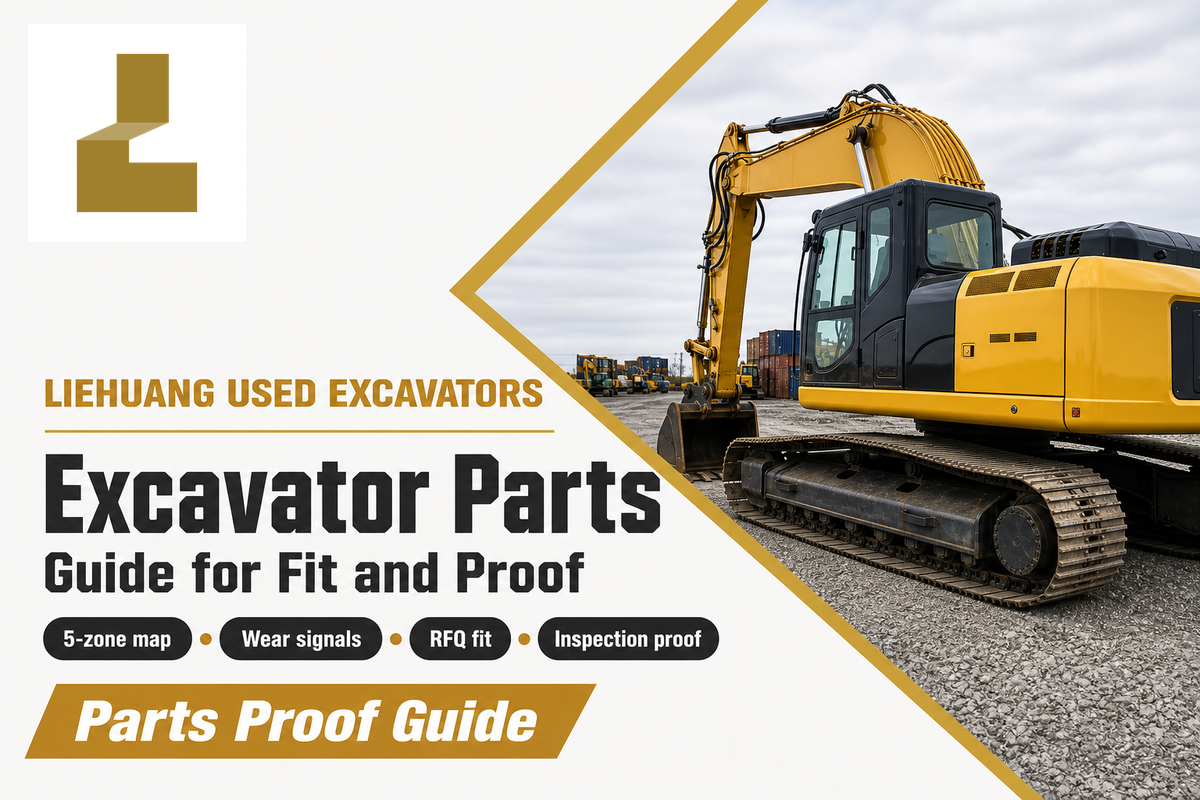

This Excavator Parts Guide explains the parts of an excavator by function, not just by diagram. An Excavator Parts Guide is a buyer’s map for connecting part names to inspection proof, fit data, and purchase risk. If you’re comparing a used machine, ordering spare attachments, or sending a parts RFQ, the real question is simple: which excavator parts change the buying risk, and what proof should you request before balance payment?
For Liehuang Used Excavators, that proof-led view matters because a used excavator is a working system. A track roller, hydraulic pump, final drive, quick coupler, bucket tooth, serial plate, or inspection report isn’t just a name on a list. It’s evidence that the machine, attachment, and shipment can match the buyer’s job and destination.
Brand scope note: Liehuang Used Excavators is the export-facing brand of Hefei Liehuang Machinery Co., Ltd. This article uses ISO 6165 and ISO earth-moving machinery references only for terminology context. It is not an OSHA compliance manual or a replacement for the machine maker’s service instructions.
Quick Answer
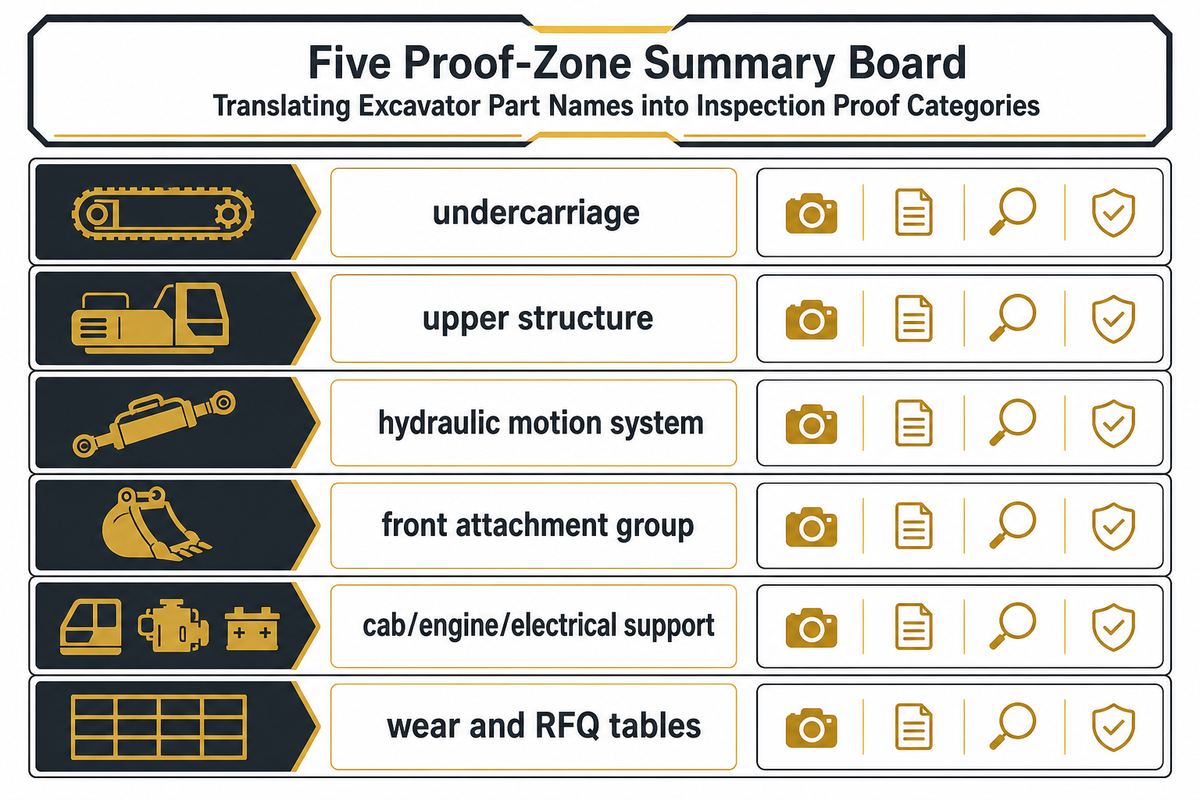
The main excavator parts are grouped into five zones: undercarriage, upper structure, hydraulic motion system, front attachment group, and cab/engine/electrical support. The highest-risk used excavator parts are usually undercarriage wear items, final drives, hydraulic components, swing components, structural boom or arm damage, and quick-coupler or attachment-fit errors.
Use the names below to identify the machine, then use the wear and RFQ tables to decide what photos, videos, measurements, maintenance records, and export documents to request.
When a buyer searches for an excavator parts name pdf, excavator bucket parts name, excavator arm names, or hydraulic excavator parts name, treat those phrases as labels to translate into the proof terms below. Search labels such as end part of an excavator called, excavator attachments called, and spinning part of an excavator called usually map to bucket teeth or bucket edge, work tools, and the swing group.
Excavator Parts at a Glance: The 5-Zone Map
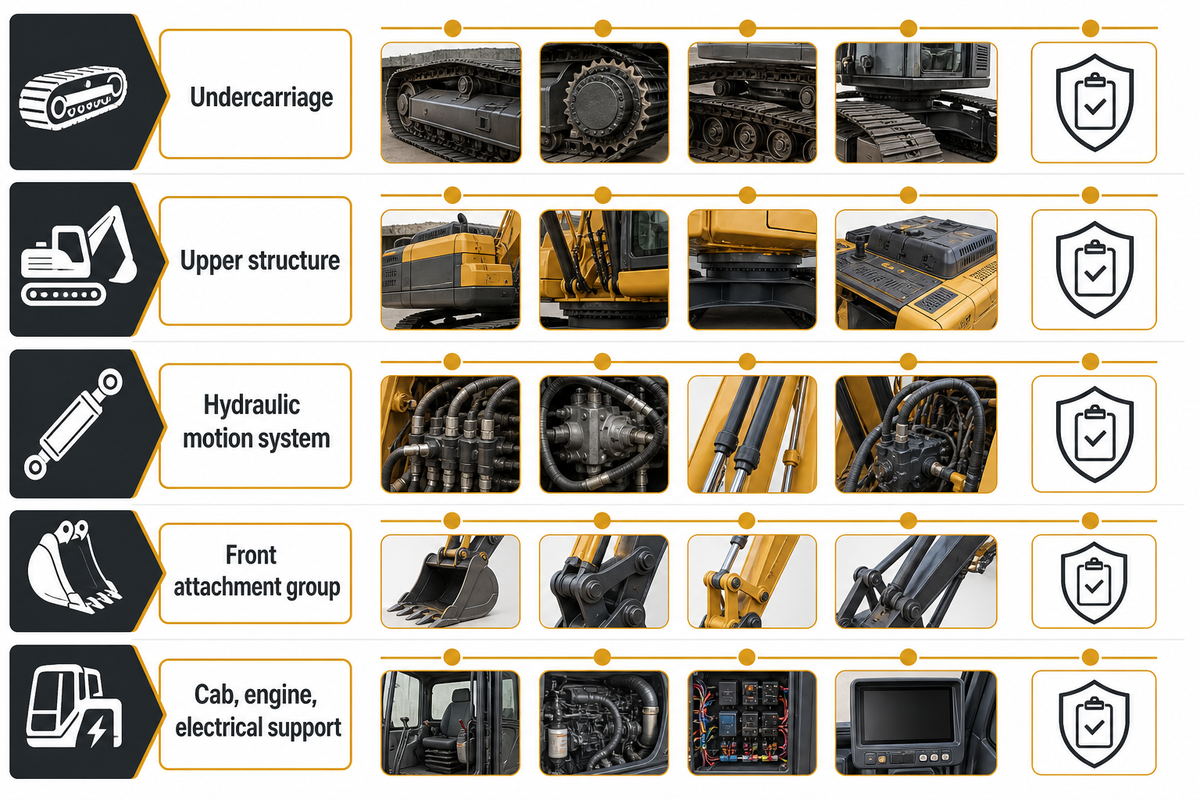
Most excavator parts names make more sense when they’re grouped by job. A generic parts diagram might show the boom, arm, cab, tracks, bucket, counterweight, engine, and final drive, but a buyer needs one more layer: which zone affects movement, digging force, stability, operator control, attachment fit, or repair exposure?
A practical parts of an excavator map starts with these five zones. Use it as the 5-Zone Parts Priority Map for deciding where proof should be strongest. The International Organization for Standardization keeps excavators within earth-moving machinery standards context, so this article uses that standards language as a terminology boundary, while the buying guidance comes from machine inspection evidence, supplier troubleshooting sources, NIOSH safety guidance, and Liehuang first-party inspection fields.
| Zone | Common excavator components | Buyer risk question |
|---|---|---|
| Undercarriage | Track chain, track shoes, rubber tracks, track rollers, carrier rollers, idlers, sprockets, recoil spring, final drive, travel motor. | Can the machine travel straight without expensive wear or hidden drive damage? |
| Upper structure | House, counterweight, swing bearing, swing motor, engine cover, pump bay, cooling package. | Is there play, cracking, leakage, overheating, or swing noise? |
| Hydraulic motion system | Hydraulic pump, main control valve, boom cylinder, arm cylinder, bucket cylinder, hoses, seals, swivel joint. | Does the machine cycle smoothly with clean oil and no leak evidence? |
| Front attachment group | Boom, arm or stick, bucket, bucket teeth, pins, bushings, quick coupler, thumb, hydraulic breaker lines. | Will the attachment fit the carrier tonnage, pin specifications, coupler type, and hydraulic lines? |
| Cab, engine, electrical support | Cab, monitor, joystick controls, wiring, engine, radiator, filters, batteries, lights, camera. | Can the operator verify hours, alarms, cooling, starting, and safe control function? |
Excavator Part Diagram Glossary for RFQ Buyers
An excavator part diagram is useful only when it turns the anatomy of the machine into RFQ proof. Many diagrams label the parts of an excavator correctly, but they do not tell a buyer which replacement parts need serial confirmation, which aftermarket excavator parts are cost-effective, or which photos prove that an assembly is still usable. Use the glossary below as a practical bridge between a diagram, a parts list, a supplier conversation, and earth-moving machinery terminology.
This is also where machine-class confusion should be removed. Excavators come with various attachments for excavation, grading support, trenching, demolition preparation, material handling, and loading support, but a crawler excavator is not the same machine class as a loader, skid steer, bulldozer, truck, or crane. Those are all heavy machinery or construction equipment terms in the world of construction, but ordering the wrong excavator part because a catalog says “fits heavy equipment” can create fit risk for the contractor on the job site.
| Diagram or RFQ term | What it usually means | Proof to request before ordering |
|---|---|---|
| Undercarriage assembly | Track frame, track pads, chain, rollers, idlers, sprockets, final drive, travel motor, rock guards, and each pad that keeps the excavator in contact with the ground. | Side-view travel video, straight-line movement of the excavator, sprocket tooth close-ups, idler leakage photos, track-frame photos, and wear and tear around bolts and guards. |
| Hydraulic cylinders and valve group | Boom cylinder, arm cylinder, bucket cylinder, main control valve, hoses, seals, and hydraulic fluid passages that create the excavator’s functionality. | Full-cycle hydraulic system video, chrome-rod close-ups, leakage points, oil clarity, pump bay photos, and a check that the valve response is smooth. |
| Boom and arm, or boom and dipper | The boom lifts; the arm, stick, or dipper connects the boom to the bucket and gives reach at the end of the arm. | Weld photos, alignment checks, pin bore condition, boom and arm movement video, and close-ups around stress points before shipment. |
| Bucket is the primary digging tool | The bucket is the primary tool for digging, loading, scraping, and many excavation tasks; its linkage, side cutters, teeth, pin, and bushing condition affect precision and productivity. | Bucket width, capacity, pin diameter, stick width, pins and bushings photos, bolt condition, tooth profile, and linkage movement. |
| Control center of the excavator | The cab is the control center of the excavator, with the operator seat, monitor, joysticks, pedals, cameras, alarms, and essential controls and safety features. | Meter panel, warning lights, cold start, throttle response, joystick response, camera display, seat condition, and serial or PIN plate. |
| Attachment package | Quick coupler, grapple, auger, thumb, hydraulic breaker, ripper, trenching bucket, and other key components used in construction projects beyond basic digging. | Carrier tonnage, hydraulic pressure class, line routing, coupler type, locking proof, attachment weight, pin data, and fit confirmation. |
| Aftermarket excavator parts | Non-original replacement parts that may be practical for visible wear items, guards, filters, some bucket parts, or support pieces, but risky for hidden hydraulic or drive parts. | Part number, compatible model list, measured dimensions, warranty terms, supplier after-sales process, and proof that the part does not reduce optimal performance. |
| Mobility and rotation parts | Travel motors, final drives, sprockets, swing bearing, swing motor, and center swivel help propel, steer, and rotate the excavator under load. | Travel-speed comparison, steering test, swing video, noise check, leak inspection, debris around covers, and service-history notes. |
| Parts you need for uptime | The parts you need first are not always the cheapest items; prioritize high-performance operation, minimize downtime risk, and separate cosmetic panels from critical motion parts. | A short RFQ fit card, model photos, serial data, application, equipment rental or owner-use schedule, delivery deadline, and inspection proof. |
A simple rule helps keep the diagram useful: name the excavator part, connect it to its primary function, then ask for one photo, one measurement, and one motion or condition proof. That process keeps the buyer from accepting a catalog label as evidence, and it helps Liehuang’s team match the machine, attachment, or part to the buyer’s actual application.
Undercarriage Parts: Tracks, Rollers, Idlers, Sprockets, and Final Drives
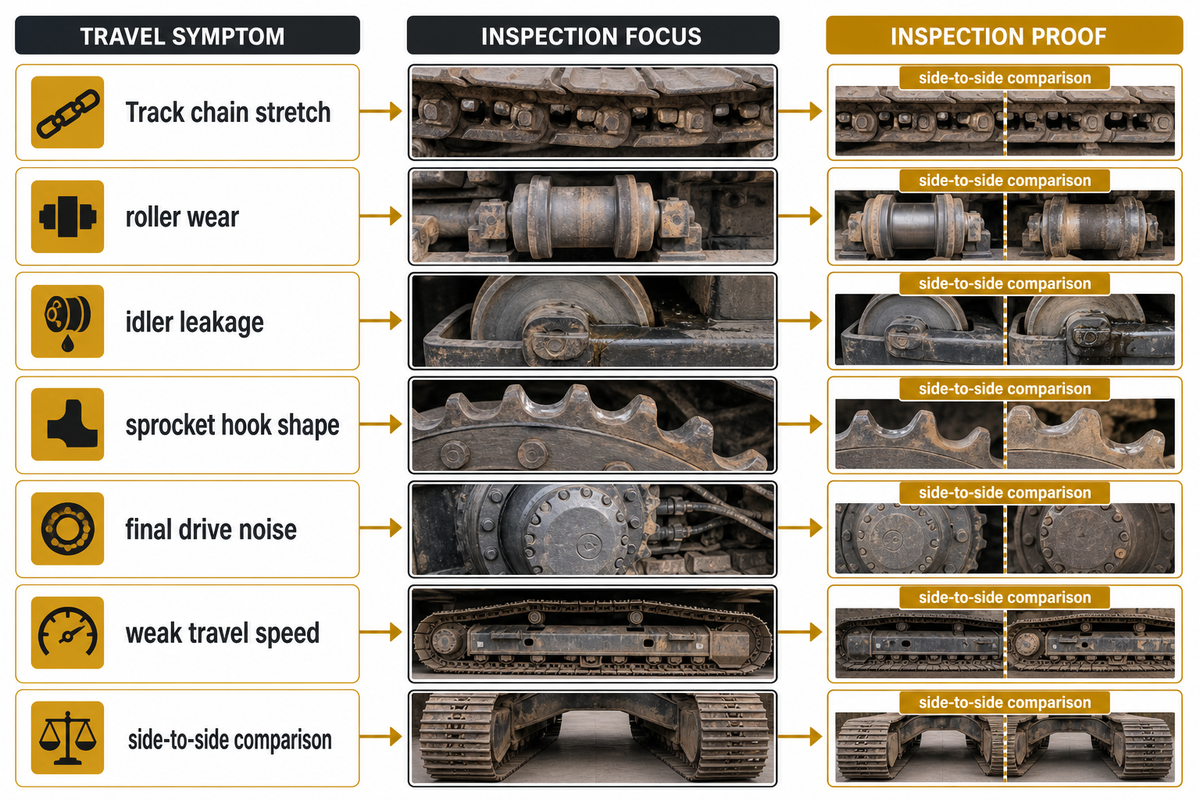
The undercarriage is where many used-machine negotiations become concrete. Track chain stretch, roller wear, idler leakage, sprocket hook shape, rubber tracks, loose track shoes, and final drive noise are visible or testable. They also affect whether a used excavator can travel straight, turn under load, and work without immediate downtime.
Supplier guidance from final-drive specialists gives useful symptom language: weak travel speed, grinding, clicking, whining, hydraulic-fluid leaks, overheating, and jerky movement are all warning signs worth documenting. Forum experience adds a caution: a travel problem isn’t always the final drive itself. Pressure checks, side-to-side comparison, valves, drive motors, and the center swivel can also be part of the diagnosis. Treat forum material as field language, not as authority.
Liehuang’s first-party CAT 336 evidence lists inspection risk fields that fit this logic: final drive noises, track chain stretch, roller wear, swing bearing play, cooling package condition, and hydraulic oil clarity. That’s more useful to a buyer than a bare list of excavator parts names.
Hydraulic Parts: Pumps, Cylinders, Hoses, Swing Motors, and Swivel Joints
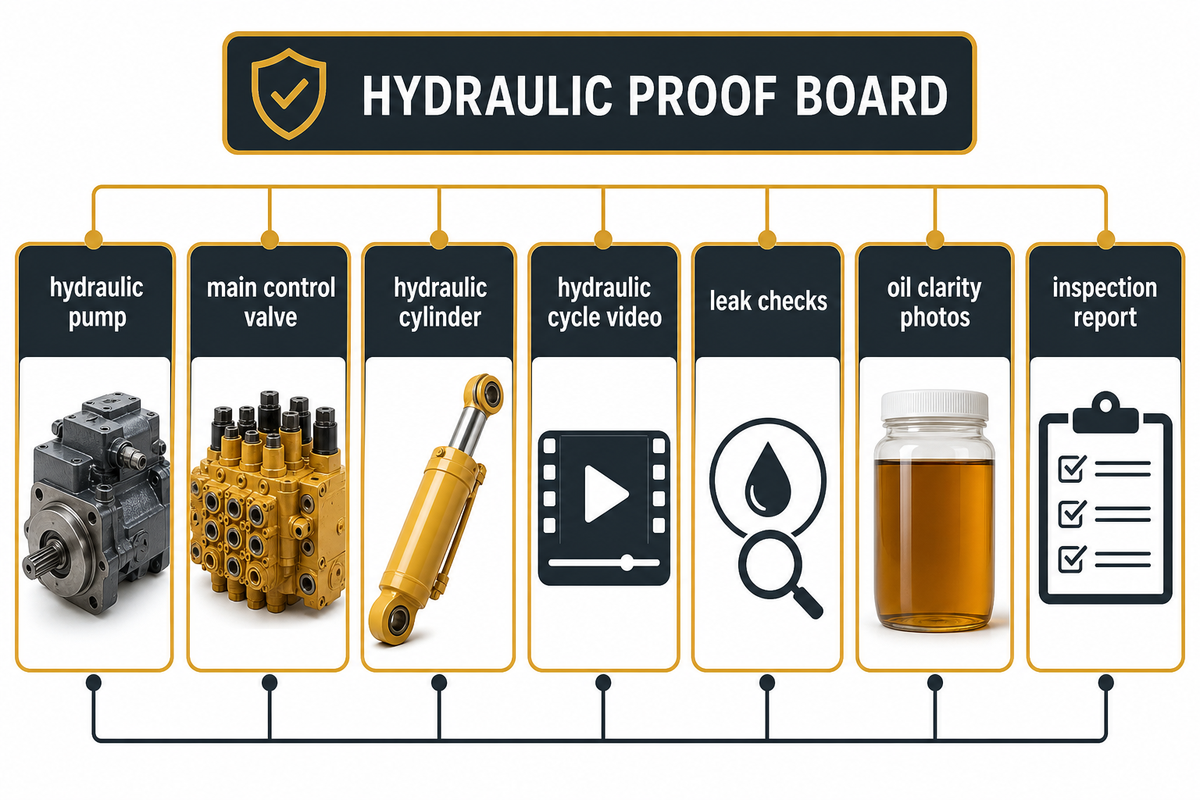
Hydraulic parts control motion. The hydraulic pump sends flow, the main control valve directs it, the hydraulic cylinder turns pressure into movement, and hoses, seals, swing motors, travel motors, and the swivel joint keep that movement connected while the upper structure rotates. A weak hydraulic system can make a clean-looking excavator expensive.
NIOSH hazardous-energy guidance is relevant because hydraulic pressure is a stored-energy source. That doesn’t turn this guide into a service manual, but it does shape the buyer proof: request a hydraulic cycle video, leak checks around the pump bay and cylinders, oil clarity photos, maintenance records, and a safety-aware inspection report. The goal isn’t to guess age. The goal is to see motion, leakage, fluid condition, and control response.
Liehuang inspection rule of thumb: do not approve a hydraulic or travel-side concern from a still photo only. Ask for a cold start, full-cycle movement video, close-up leakage photos, and the inspection report before balance payment.
Front Attachment Group: Boom, Arm, Bucket, Teeth, Coupler, and Breaker Lines
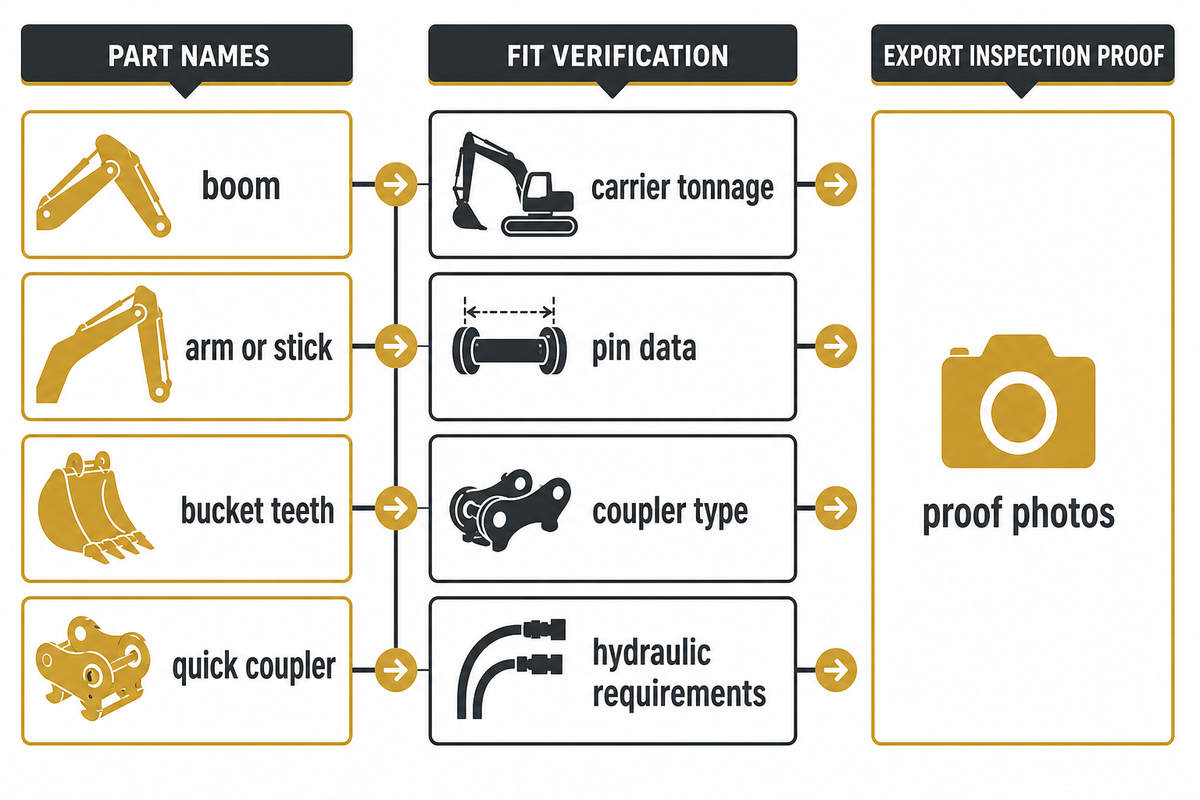
The front group includes the boom, arm or stick, bucket, bucket teeth, pins, bushings, quick coupler, thumb, grapple, ripper, auger, hydraulic breaker, and breaker lines. This is where a buyer often moves from naming parts to matching work tools.
Quick-coupler and attachment fit deserve special caution. NIOSH Publication 2024-102 warns that excavator quick-coupler failures can lead to severe struck-by injury or death. CASE lists quick couplers for 1 to 85 ton excavators and references ISO 13031, EN 474-1, AS4772, and the Machinery Directive 2006/42/EC. That combination supports a practical RFQ rule: never accept “fits your excavator” without carrier tonnage, pin data, coupler type, locking status, hydraulic requirements, and proof photos.
Liehuang’s excavator attachments page follows the same buyer logic. Buckets, hydraulic breakers, thumbs, grapples, rippers, augers, and quick couplers need carrier tonnage, pin specifications, coupler fit, bucket capacity, and bucket weight. If you need help checking that package, use the parts and attachment fit check.
Model Proof Snapshot
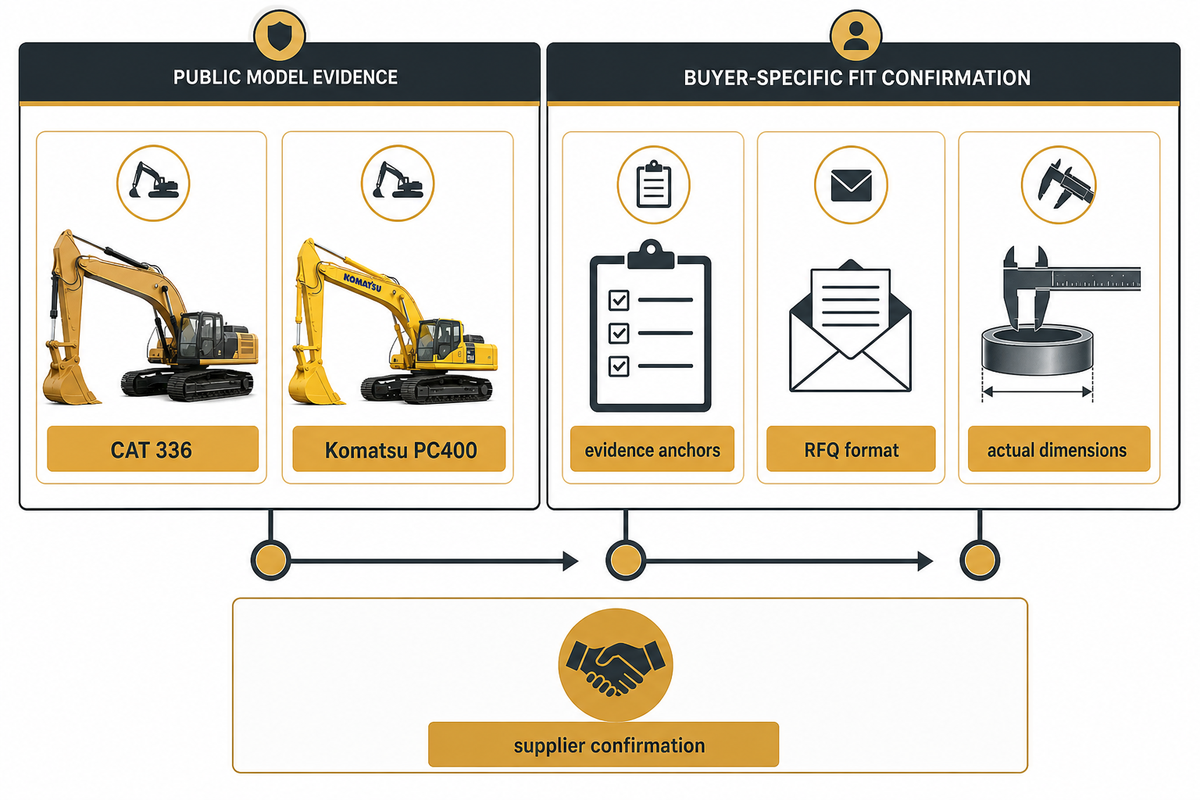
Use numbers as evidence anchors, not as universal fit rules. Liehuang’s public heavy-model evidence includes CAT 336 references around 36,200 kg to 37,200 kg operating weight, 225 kW engine power, and FOB examples from $48,000 to $85,000. Komatsu PC400 evidence includes 41,200 kg operating weight, 214.02 kW engine power, 9.26 m digging depth, and FOB examples from $48,000 to $84,000.
For an attachment RFQ, measurement examples might include an 80 mm or 90 mm pin diameter, 450 mm or 500 mm pin center distance, 310 mm stick width, 20 MPa hydraulic pressure class, or 1 ton to 85 tons quick-coupler carrier range. These numbers are placeholders for the RFQ format. The actual dimensions must come from the buyer’s machine and supplier confirmation.
If a supplier source mentions 50% undercarriage maintenance exposure, 500 hours, or 1,000 hours, treat it as context unless the machine maker’s manual and maintenance records confirm the interval for that exact model.
Cab, Engine, Cooling, and Electrical Parts Buyers Should Not Ignore
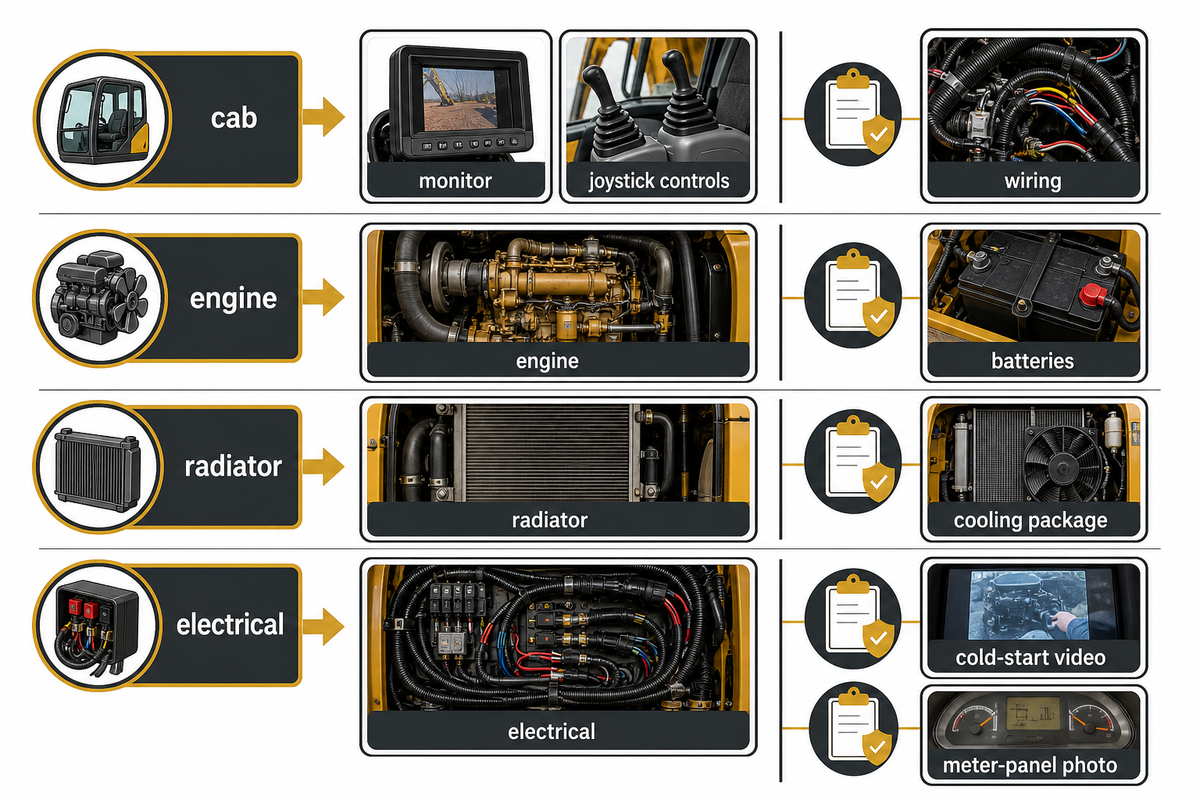
Some excavator components are less dramatic than a final drive or hydraulic pump, but still decide whether the machine is practical. The cab, monitor, joystick controls, wiring, batteries, lights, camera, engine, filters, radiator, and cooling package should be checked together. A cheap monitor fault, damaged wiring bundle, weak battery, or blocked cooling package can hide downtime that’s hard to see in a parts diagram.
For a used Caterpillar, Komatsu, Hitachi, Volvo, Kubota, or Sany excavator, ask for the serial plate or PIN plate, meter-panel photo, cold-start video, idle and throttle behavior, warning lights, and cooling package close-ups. For heavy models such as a used CAT 336 excavator or Komatsu PC400, this evidence can matter as much as the visible bucket.
Used Excavator Parts: When Salvage Makes Sense and When It Adds Risk
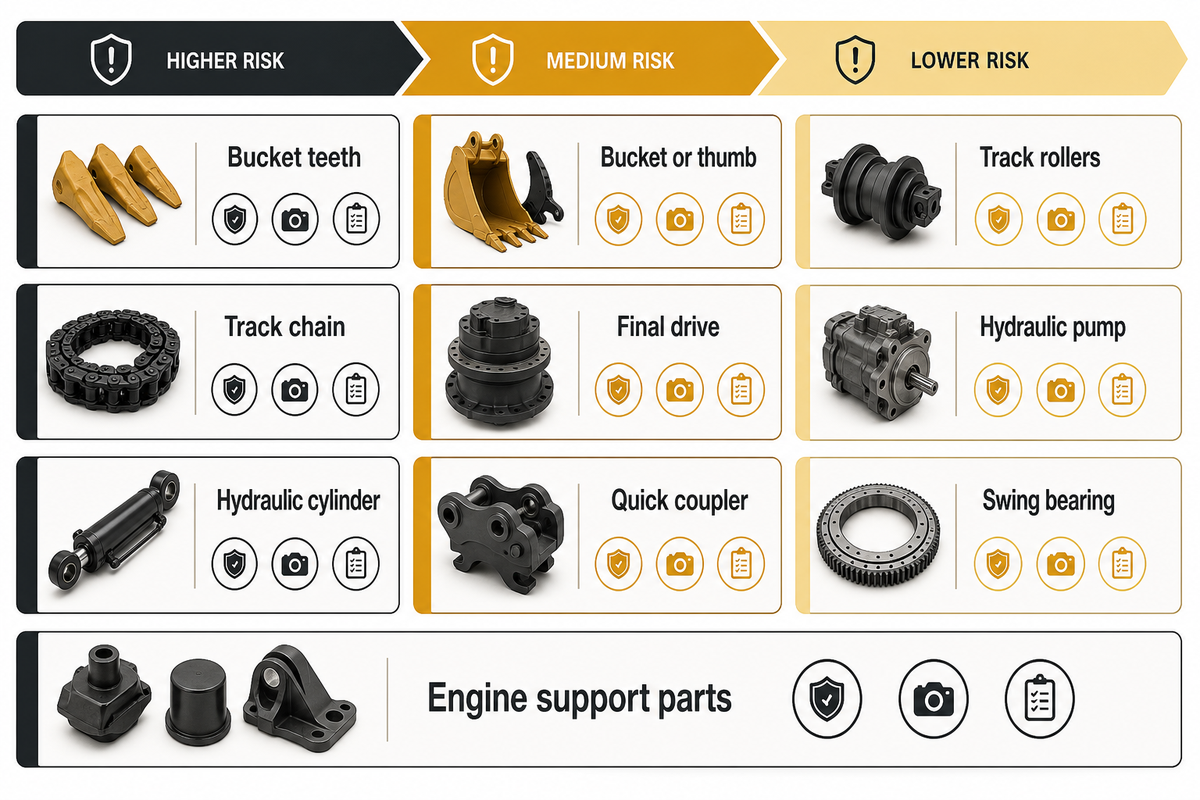
Used excavator parts aren’t one risk category. A used panel, counterweight part, bucket, thumb, or visible wear item may be practical when the fit and condition are clear. A used final drive, hydraulic pump, swing bearing, control valve, cylinder, travel motor, or safety-related quick coupler needs stronger proof because hidden internal condition can erase the price saving.
A counterintuitive supplier source argues against used final drives because of hidden internal condition, unknown stress history, short warranty, downtime cost, compatibility risk, and early failure. That isn’t proof that used parts are always bad. It’s a useful warning to segment risk before buying.
| Part category | Used-part logic | Proof to request | Red flag | Limitations |
|---|---|---|---|---|
| Bucket teeth | Often practical as wear parts if tooth system matches. | Tooth type, adapter photo, bucket width, wear photo. | Mixed tooth systems. | Does not prove bucket structure. |
| Bucket or thumb | Good used option if pins and structure are clear. | Pin diameter, pin center distance, stick width, weld photos. | Cracks around ears. | Hydraulic thumb also needs line fit. |
| Track rollers | Visible wear item; condition can be compared. | Close-ups, leak signs, flange wear, machine model. | Oil leakage or seized roller. | One roller does not solve full undercarriage wear. |
| Track chain | Needs measurement and matching pitch. | Chain stretch evidence, shoe width, link count, photos. | Uneven wear or missing shoes. | May need sprocket/idler package. |
| Final drive | High-risk used part unless tested and warranted. | Travel video, noise check, oil condition, model number. | Whining, weak travel, overheating. | Internal condition remains hard to prove from photos. |
| Hydraulic pump | High-risk unless flow, pressure, and history are known. | Cycle video, leak photos, oil clarity, maintenance records. | Weak response or metal-contaminated oil. | Bench-test data may be needed. |
| Hydraulic cylinder | Can be practical if rod and seals are clear. | Rod surface, seal area, drift test, cylinder part number. | Scored rod or oil streaks. | Seal kits differ by version. |
| Quick coupler | Fit and safety proof matter more than price. | Locking photos, pin data, carrier tonnage, coupler type. | No clear locking proof. | Must follow manufacturer and site safety requirements. |
| Swing bearing | High labor exposure; verify before buying. | Swing play video, noise, grease condition, model fit. | Excessive play. | Repair cost includes labor and downtime. |
| Engine support parts | Some parts are simple; major engine faults are not. | Cold-start video, smoke, leaks, cooling package photos. | Hard start or overheating. | A part quote cannot replace engine inspection. |
The Wear-to-Decision Matrix for Used Excavator Buyers
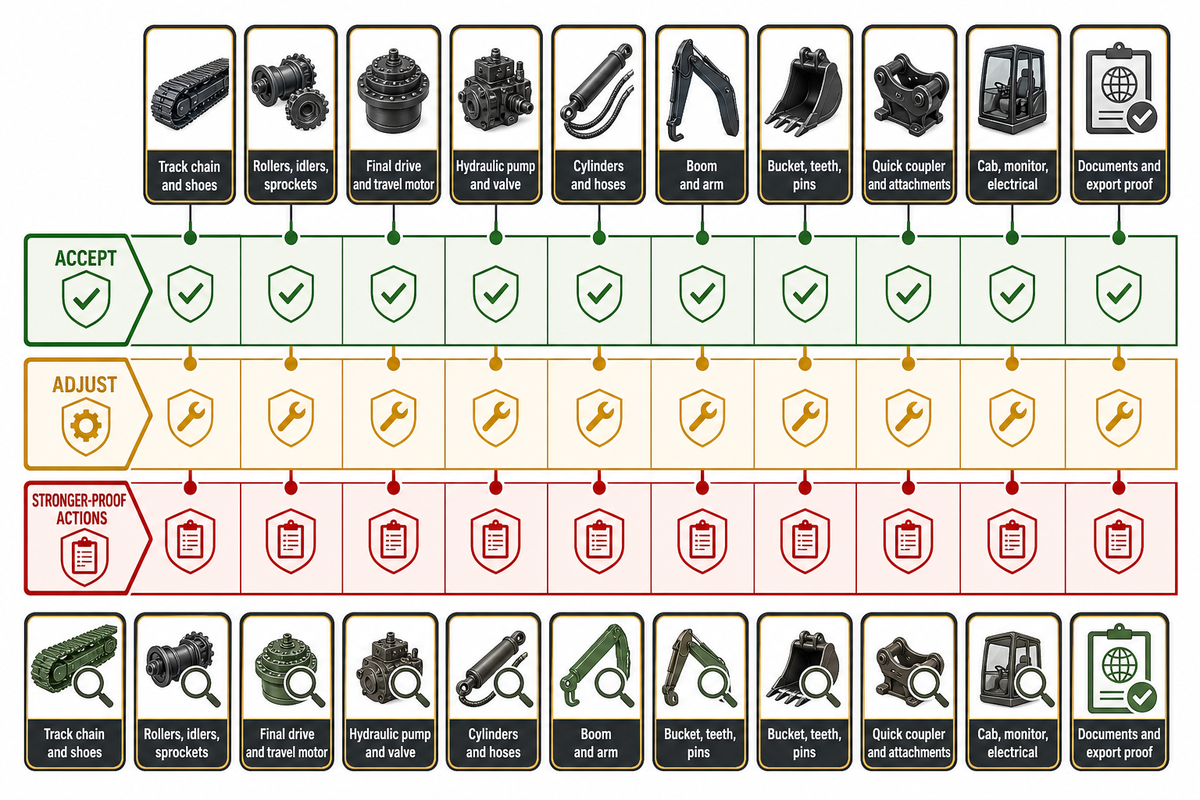
A buyer shouldn’t treat every worn part the same. Some wear is normal and negotiable. Some wear changes the machine price. Some wear should stop the deal until there’s more proof. Use this matrix when reviewing inspection photos, video, and FOB quote details.
| Decision zone | Acceptable proof | Decision impact |
|---|---|---|
| Track chain and shoes | Close-up photos, link count, shoe width, side wear, tension evidence. | Price adjustment or undercarriage package review. |
| Rollers, idlers, sprockets | Leak photos, flange wear, sprocket tooth shape, idler condition. | Reject if leaks and heavy wear cluster together. |
| Final drive and travel motor | Travel video, turn test, noise check, oil condition, both-side comparison. | High priority; request stronger proof before deposit or balance. |
| Hydraulic pump and valve | Full-cycle video, pump bay photos, oil clarity, maintenance records. | High priority; do not price by hours alone. |
| Cylinders and hoses | Rod surface, seal area, hose routing, leakage after movement. | Repairable, but include parts and labor exposure. |
| Boom and arm | Weld seams, crack-prone areas, pin boss condition, bushing play. | Structural cracks can stop the deal. |
| Bucket, teeth, pins | Bucket width, tooth system, pin diameter, pin center, stick width. | Usually manageable if dimensions are proven. |
| Quick coupler and attachments | Locking proof, model fit, hydraulic line needs, carrier tonnage. | Safety and fit risk; verify before shipping. |
| Cab, monitor, electrical | Meter-panel photo, alarm screen, joystick response, wiring photos. | Can hide downtime; ask for operating video. |
| Documents and export proof | Inspection report, loading photos, export documents, shipment tracking. | Tie balance payment to verified proof. |
RFQ Fit Card: What to Ask Before Buying Parts or an Attachment
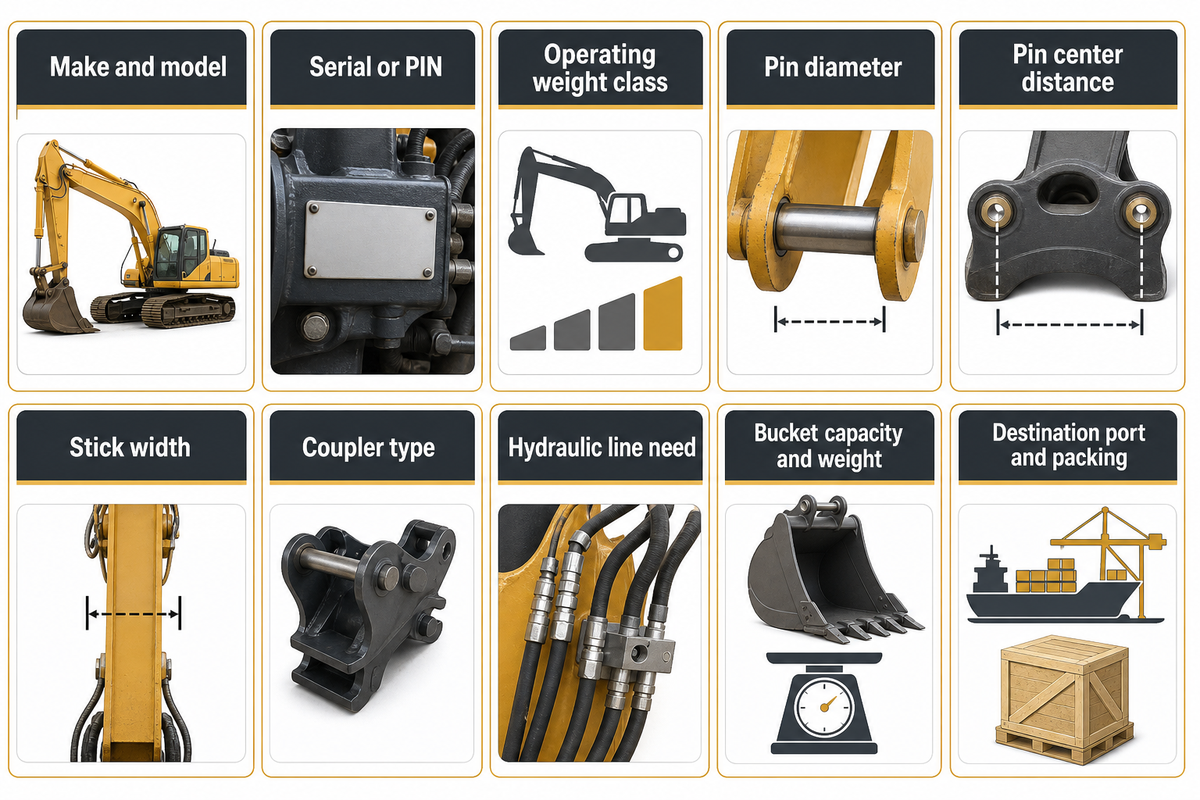
An RFQ for excavator parts should prevent rework. A price-only message creates risk because mini excavator parts, used CAT excavator parts, used Komatsu parts, bucket teeth, hydraulic breaker lines, and quick couplers depend on exact model fit. Send the data below before asking for the final quote.
| RFQ field | Why it matters | Best evidence | Limitations |
|---|---|---|---|
| Make and model | Basic fit filter for Caterpillar, Komatsu, Hitachi, Volvo, Kubota, Sany, and other brands. | Model plate photo. | Same model can have version changes. |
| Serial or PIN | Confirms version and avoids look-alike parts. | Serial plate or PIN plate photo. | Damaged plates need extra photos. |
| Operating weight class | Carrier tonnage limits attachment size and coupler class. | Spec sheet or machine page. | Counterweight or long-reach packages change balance. |
| Pin diameter | Controls bucket, thumb, coupler, and attachment fit. | Caliper measurement photo. | Worn pins can mislead measurement. |
| Pin center distance | Prevents wrong linkage geometry. | Measurement between pin centers. | Measure on the correct attachment ear pair. |
| Stick width | Prevents side clearance problems. | Inside ear and stick-width photos. | Bushings may be worn. |
| Coupler type | Quick coupler systems vary by lock and geometry. | Coupler plate and lock photos. | Follow manufacturer safety instructions. |
| Hydraulic line need | Hydraulic breaker, thumb, grapple, and auger packages need flow compatibility. | Auxiliary line photos and flow requirement. | Flow and pressure must match the tool. |
| Bucket capacity and weight | Oversized bucket can slow cycles and stress the machine. | Capacity target and work material. | Material density changes payload. |
| Destination port and packing | Affects quote, packing, export documents, and shipment tracking. | Port, country, packing request, spare parts list. | Local import rules remain buyer responsibility. |
Inspection Proof Before Balance Payment: What Liehuang Checks
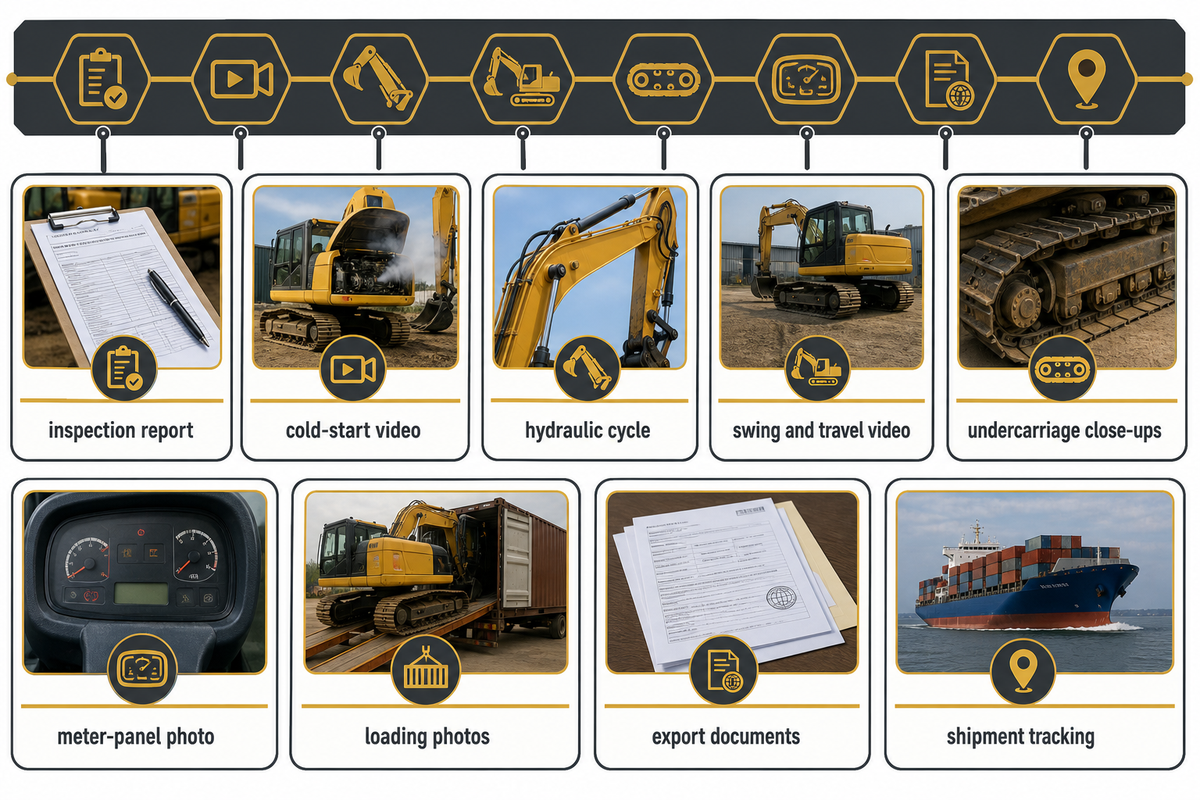
A used excavator or attachment order shouldn’t rely on trust language alone. Liehuang’s public brand information emphasizes inspection, refurbishment, testing, export documentation, global logistics, and shipment tracking. For buyers, the practical takeaway is to tie balance payment to proof: inspection report, photos, cold-start video, hydraulic cycle, swing and travel video, undercarriage close-ups, meter-panel photo, loading photos, export documents, and shipment tracking.
For a machine sourcing path, review inspected used excavator solutions. For broader buyer context, compare the used excavator buying guide and the used excavator inspection checklist. For attachment-specific decisions, use the excavator attachments guide.
Need a Parts or Attachment Fit Check?
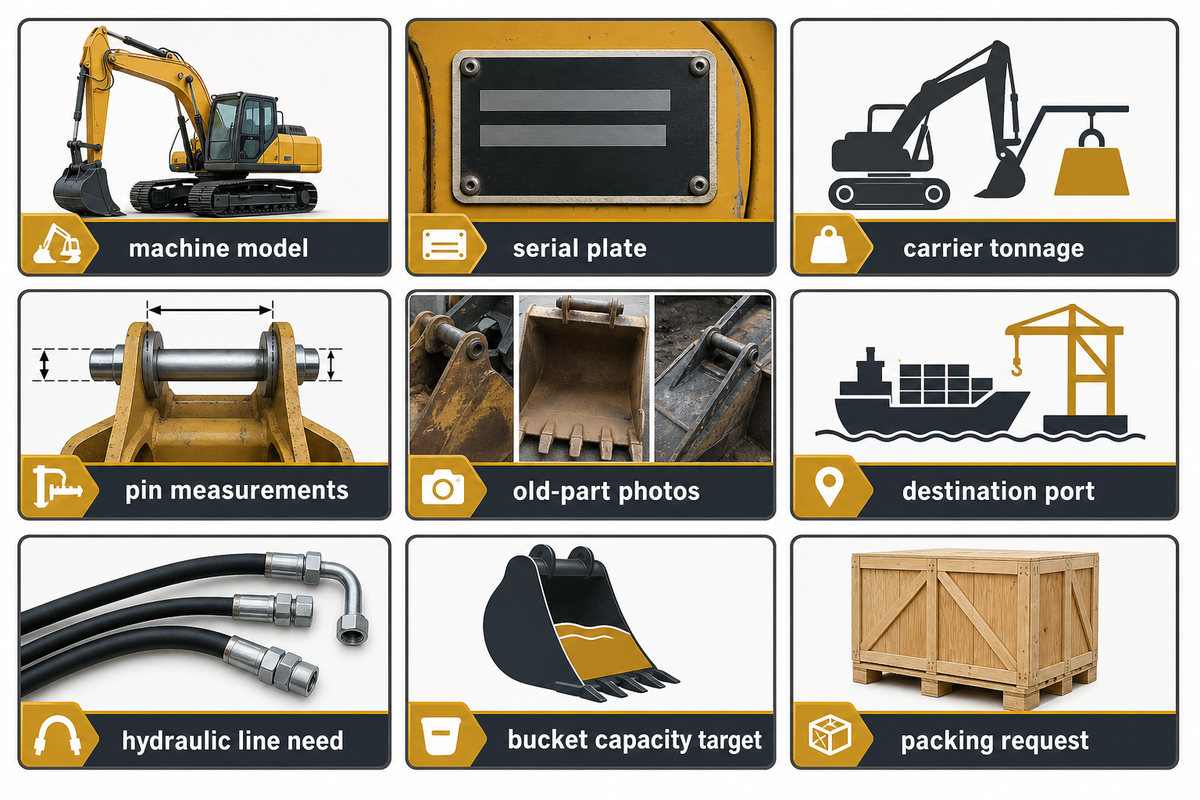
Send the machine model, serial plate, carrier tonnage, pin measurements, old-part photos, destination port, and the part or attachment you need. Add work condition, hydraulic line need, bucket capacity target, and packing request if available. Liehuang can review fit evidence before quoting.
Parts Trends in 2026: Attachments, Mini Machines, and Aftermarket Risk
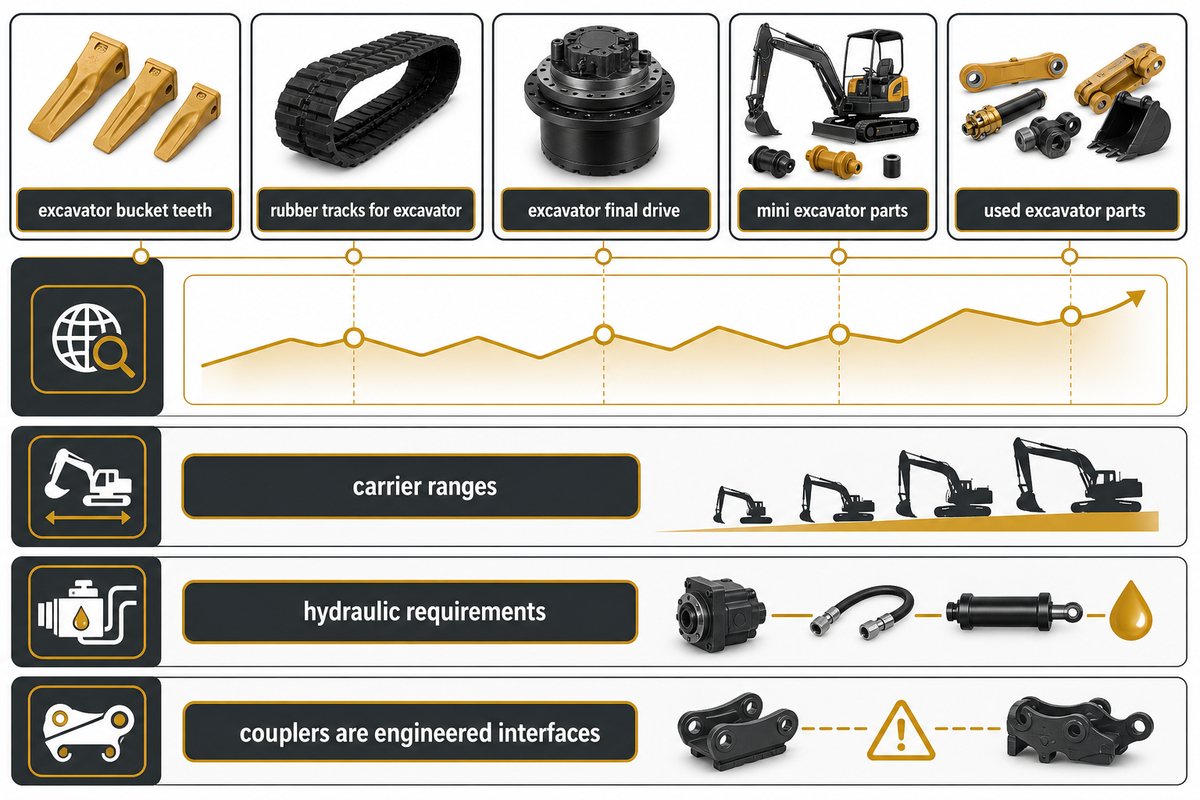
The 2026 parts picture isn’t just about one replacement part. DataForSEO keyword data collected for this article showed measurable demand around excavator bucket teeth, rubber tracks for excavator, parts of an excavator, excavator final drive, mini excavator parts, used excavator parts, excavator undercarriage parts, excavator hydraulic pump, and excavator salvage yard. Treat that as search-demand evidence, not as proof of total market size.
For market context, one commercial report projects excavator attachment growth from USD 10.06 billion in 2024 to USD 20.07 billion by 2035 with a reported 6.48 percent CAGR estimate. Because that’s a market-report source, it should be phrased as directional context. Equipment World’s attachment coverage is more useful for day-to-day RFQ behavior because it shows how many attachments have carrier ranges, hydraulic requirements, and job-specific use cases. Patents around quick couplers and coupler alarms also reinforce a simple point: couplers are engineered interfaces, not simple hooks.
FAQ
What are the main parts of an excavator?
The main excavator parts are the undercarriage, upper structure, hydraulic motion system, front attachment group, and cab with engine support. For buying, treat those groups as proof zones rather than simple diagram labels. Check travel wear below the machine, swing and pump evidence in the upper structure, hydraulic motion under load, attachment fit at the front, and cab or engine signals before agreeing to balance payment.
Which excavator parts wear out fastest?
The fastest-wearing parts depend on soil, rock, demolition debris, travel distance, track tension, operator habits, and the attachment being used. Start with bucket teeth, pins, bushings, hoses, seals, track chain, track shoes, track rollers, idlers, sprockets, and rubber tracks. Then look for clusters. One worn roller may be manageable; worn rollers, hooked sprockets, stretched track chain, and weak travel together point to a larger undercarriage decision. That pattern should change the buyer’s price discussion or trigger a stronger inspection request.
What is the most expensive part of an excavator to replace?
There is no single answer for every model. A hydraulic pump, final drive, swing bearing, engine, travel motor, control valve, or worn undercarriage can all become major cost drivers. The expensive part is usually the one that combines high part cost, hidden internal condition, labor time, downtime, and uncertain fit. That is why inspection video, oil condition, travel testing, and maintenance records matter more than a parts-name list.
Can I buy used excavator parts safely?
Used excavator parts can be reasonable when the risk is visible and the fit is proven. Buckets, panels, counterweight parts, some attachments, and ordinary wear items are easier to judge from photos, measurements, and inspection notes. Be stricter with final drives, hydraulic pumps, swing bearings, control valves, cylinders, travel motors, and quick couplers because their condition can be partly hidden. For those parts, ask for model and serial fit, close-up photos, motion video, oil or leakage evidence, warranty or return terms, and a written inspection agreement. For attachment or coupler purchases, add 80 mm or 90 mm pin diameter, 450 mm or 500 mm pin center distance, 310 mm stick width, 20 MPa hydraulic class, 1 ton to 85 tons carrier range, bucket capacity, and old-part photos when those fields apply.
What should I ask before ordering excavator parts or attachments?
A strong RFQ should include machine make, model, serial or PIN plate, operating weight class, attachment type, pin diameter, pin center distance, stick width, coupler type, hydraulic line requirement, bucket capacity target, old-part photos, destination port, packing request, inspection proof, and export document requirements. If the order involves a bucket, thumb, quick coupler, breaker, grapple, ripper, or auger, add 80 mm or 90 mm pin diameter, 450 mm pin center distance, 310 mm stick width, 20 MPa pressure class, and 1 ton to 85 tons carrier range where relevant.
References and Sources
- ISO 53.100 earth-moving machinery standards category
- NIOSH hazardous-energy control resource guide
- NIOSH Publication 2024-102 on excavator quick couplers
- CASE quick coupler for excavators
- Equipment World attachment examples
- Texas Final Drive final-drive warning signs
- Final Drive Parts undercarriage maintenance guidance
- Heavy Equipment Forums final-drive diagnostic thread
- Track Motor used final-drive risk article
- Market Research Future excavator attachments market report
- US8869437B2 quick coupler patent
- WO2012085500A9 coupler alarm patent
- Liehuang Used Excavators about page
- Liehuang excavator attachments page
- Liehuang CAT 336 product evidence

![Excavator Bucket Manufacturers: Buyer Evidence [Guide]](https://lhusedexcavator.com/wp-content/uploads/2026/08/excavator-bucket-manufacturers-r2-featured-768x512.png)