Get in Touch with Liehuang Company

Excavator for Construction refers to choosing a hydraulic earthmoving machine around real jobsite tasks, access limits, trench depth, ground condition, attachment demand, transport rules, inspection proof, and export quote readiness. Buyers are not only choosing a machine size; they are choosing a production tool that must fit before the purchase makes sense.
BLUF: pick the job fit first, then inspect the used machine.
Used excavators can be strong construction assets when the job class, size band, hydraulic setup, attachment package, and condition proof are aligned.
If any one of those inputs is missing, a cheaper quote can become a slow, unsafe, or hard-to-export machine.
Quick Specs and Source Boundaries
| Decision Point | Use This Evidence Carefully | Buyer Action |
|---|---|---|
| Market timing | Equipment World reported 2025 financed full-size excavator data: new units down 4.1%, used units up 5.3%. | Treat used supply as active, not automatically cheap. |
| Safety context | OSHA 29 CFR 1926.602 covers earthmoving equipment use, not a universal used-machine buying checklist. | Ask whether the machine can be operated safely on the jobsite. |
| Attachment risk | NIOSH Publication 2024-102 warns that quick-coupler failure can let an attachment fall suddenly. | Verify coupler, pins, locking, and hydraulic fit before buying attachments. |
Table of Contents
- What Is an Excavator Used for in Construction?
- Match the Excavator Type to the Construction Job
- Choose Size and Tonnage by Access, Dig Depth, and Output
- When a Used Excavator Makes Sense for Construction Work
- Inspection Proof for Construction Duty
- Attachments and Hydraulics Change the Machine More Than Buyers Expect
- Quote Readiness for Imported Used Excavators
- Brand Shortlist: Fit Comes Before Logo
- Construction Excavator Selection Checklist
What Is an Excavator Used for in Construction?
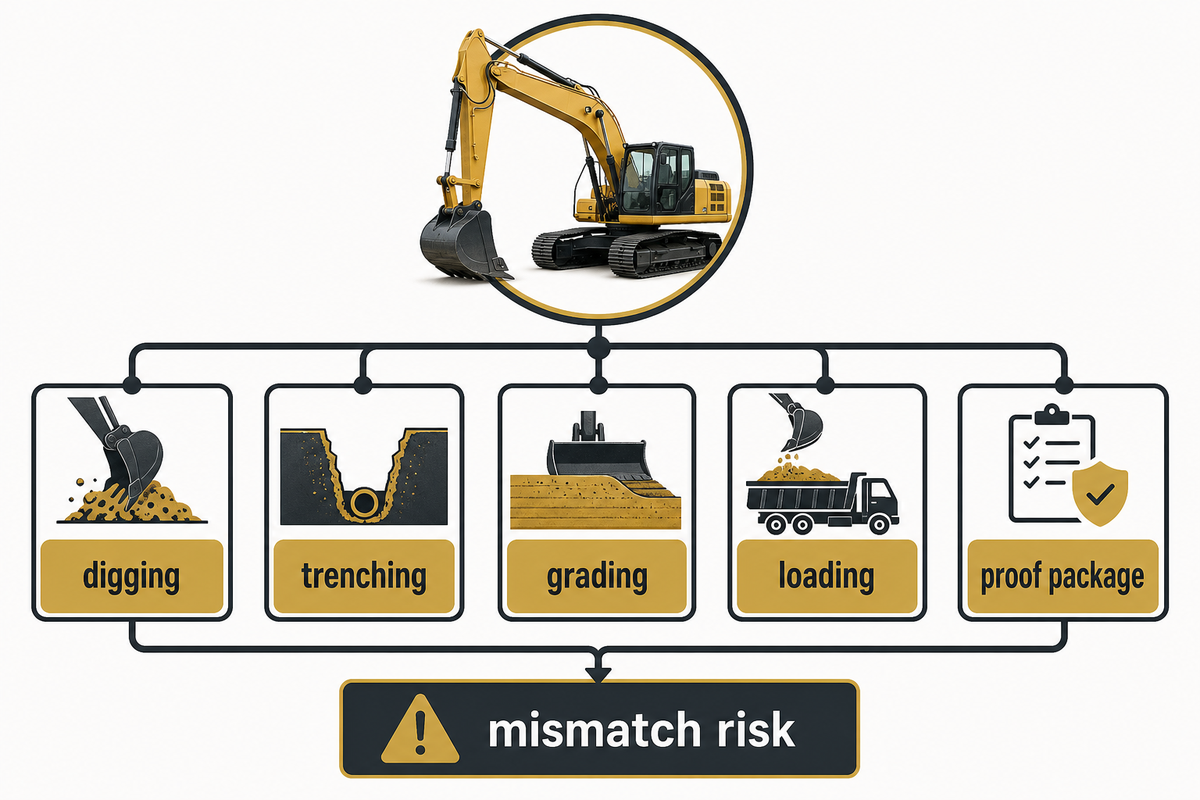
From the fit-first summary above, an excavator is a hydraulic earthmoving machine used for digging, trenching, grading, loading, demolition support, foundation work, utility work, road work, and site preparation. In construction buying, the important point is not the dictionary definition. It is whether the machine can do the intended work at the site speed, access width, reach, depth, and safety profile the project requires.
Major manufacturers organize excavators by size class, operating weight, power, digging depth, and application. These are practical types of excavators, not brand recommendations. That tells buyers something practical: a construction excavator is a system of constraints, not just a bucket on tracks. OEM pages from Caterpillar and Volvo show how the market sorts machines into compact, wheeled, medium, large, demolition, long-reach, and other classes.
For used equipment, add another layer. The machine must also prove that its undercarriage, boom, stick, bucket linkage, hydraulic system, swing bearing, cab controls, and service history are still fit for construction duty. That is why a buyer should separate the question into two parts: first, does this excavator type fit the job; second, does this used unit have enough proof to work.
For a buyer, the risk is mismatch: a machine that can dig on paper may still be too wide for access, too slow for daily output, or unverifiable after repaint. This is why Liehuang Used Excavators treats the definition as a fit-and-proof question. For full-size market context, the Equipment World/Fusable data cited below starts at 8 metric tons, while small-site buying may require a compact class instead.
Match the Excavator Type to the Construction Job
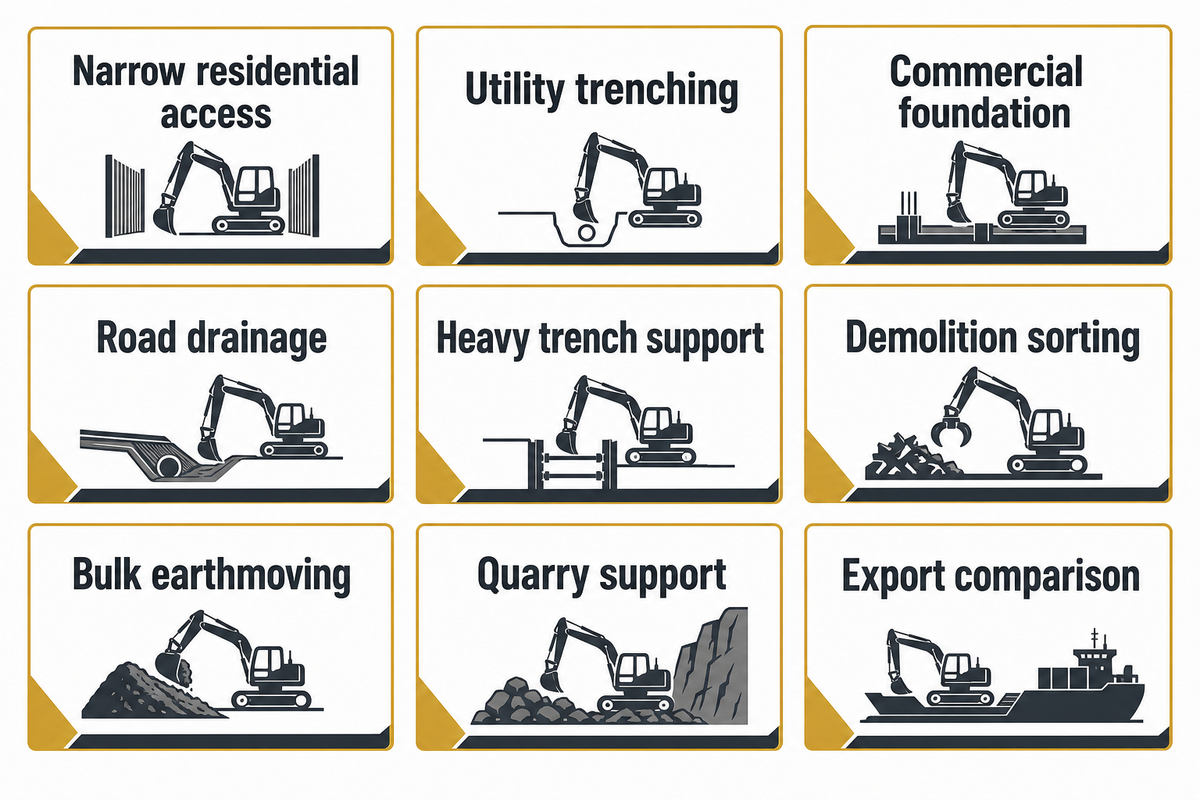
Start with the top jobs, not the brand. Compact excavators may be right for landscaping, utilities, and confined residential work. Medium crawlers may be right for foundations, commercial sites, drainage, and road support.
Larger crawlers may be right for heavy trenching, demolition, quarry support, and bulk earthmoving. Wheeled excavators can make sense where road travel and urban mobility matter.
Selection guidance from For Construction Pros supports the same practical sequence: define the most common jobs, daily production target, available space, attachment needs, hydraulic flow, and transport logistics before choosing the machine.
Common Excavator Types for Construction Projects
For most construction projects, choosing the right excavator starts by matching common types of excavators to jobsite constraints. A standard excavator or hydraulic excavator can dig trenches, load trucks, grade, lift with approved rigging, and support road construction, but only when the model, operator, safety protocols, and attachment plan match the work.
| Type of Excavator | Where Excavators Are Commonly Used | Used-Buyer Check |
|---|---|---|
| Mini excavator, compact class, and small excavators | Using a mini excavator can fit a landscaping project, landscape maintenance, utility repair, tight residential access, light grading, and limited snow removal when the attachment and ground condition allow it. | Check width, blade, rubber tracks, bucket sizes, and whether the excavator comes with usable auxiliary lines. |
| Crawler excavators, tracked excavators, and medium crawler excavators | Excavators are often used in foundation work, trenching, drainage, road construction, and uneven terrain where the undercarriage with tracks or wheels determines ground pressure and travel limits. | Measure track wear, rollers, sprockets, hydraulic cylinders, boom, stick, and the types of buckets supplied. |
| Large excavators and long-reach excavators | Large excavators are typically used for major construction, deep excavation, heavy demolition support, high-volume loading, and reach-limited bank or slope work. | The largest excavator in a catalog is not automatically the right equipment; confirm transport width, counterweight, stick length, and site bearing. |
| Wheeled excavators and excavators with road-mobility duties | Excavators and wheeled excavators can suit urban utility work when wheels instead of tracks reduce road-surface damage and repositioning time between work faces. | Volvo excavators and other manufacturer pages show how excavator models differ; inspect steering, tires, brakes, outriggers, hydraulics, and local road rules. |
| Dragline excavator, suction excavator, and backhoe comparison | A dragline excavator or dragline uses a hoist rope for specialized lifting and digging patterns; a suction excavator and a backhoe are related heavy equipment or construction equipment choices, but not a direct substitute for every crawler job. | Do not buy an excavator just because a different type can perform tasks in theory; compare soil types, reach, cycle time, operator availability, and attachment support. |
Most excavators feature a rotating platform and can rotate a full 360 degrees. Excavators use hydraulic cylinders to control the boom and bucket, while the bucket, breaker, auger, grapple, or other excavator attachments at the end of the boom change efficiency and productivity. Different manufacturers build excavator models across many size bands for various soil types and different jobs, so selecting the right machine is really selecting the right equipment package. Guides about different types of excavators and excavators and their uses help with category screening, but operating an excavator in the construction industry still depends on trained operators, site controls, and proof that excavators offer enough versatility for the work.
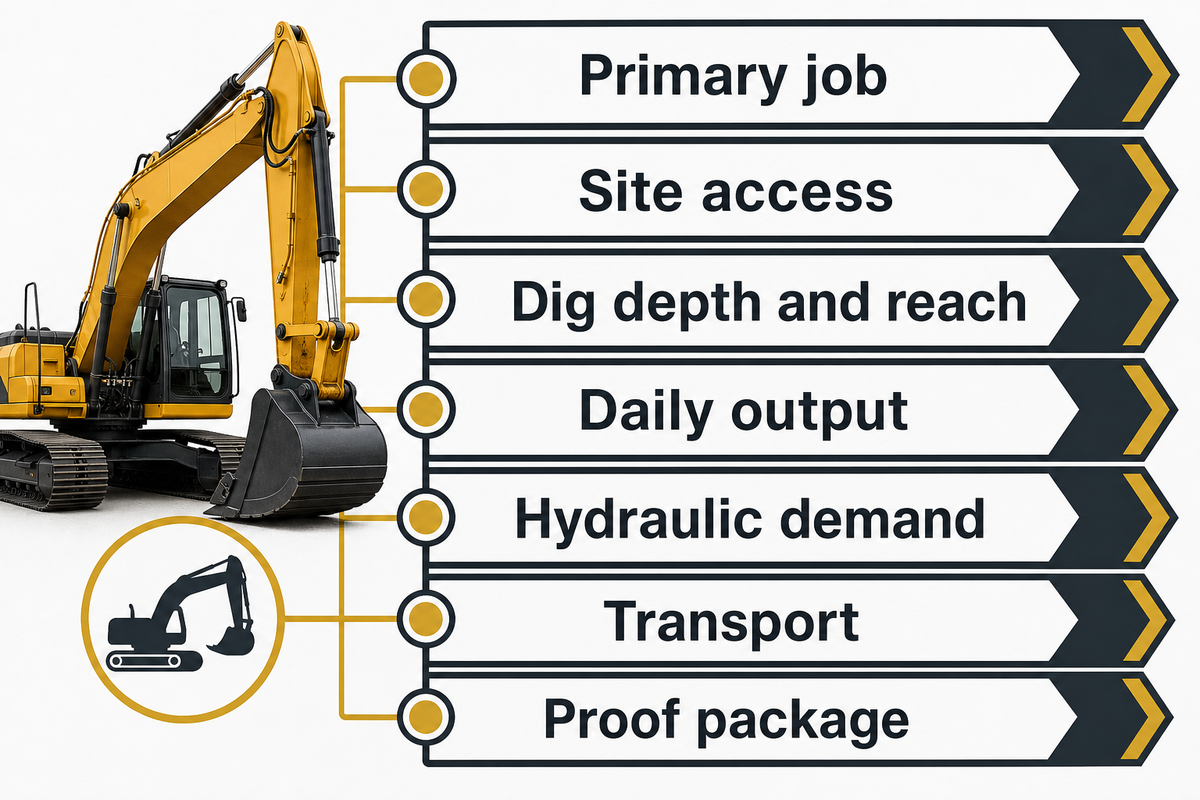
7-Point Construction Excavator Fit Framework
Construction Excavator Fit Score
Score each line from 1 to 5 before asking for a quotation. Low scores do not always kill the machine, but it tells you what proof or adjustment is needed.
| Fit Factor | Ask Before Quote | Low-Score Warning |
|---|---|---|
| Primary job | Trenching, grading, demolition, loading, utility, road, or civil work? | Machine is being chosen from habit, not task. |
| Site access | Gate width, turning radius, overhead restriction, slope, and ground bearing? | Large machines may idle outside the work zone. |
| Dig depth and reach | Maximum trench depth, loading height, and reach over obstacles? | Operator compensates with unsafe positioning. |
| Daily output | How many meters, trucks, trenches, or foundations per shift? | Small machine wins purchase price and loses schedule. |
| Hydraulic demand | Breaker, grapple, thumb, auger, tilt bucket, or coupler? | Attachment is owned but not usable. |
| Transport | Trailer, route, permit, port loading, and unloading plan? | Landed cost changes after payment. |
| Proof package | Inspection photos, video test, diagnostics, service evidence, and serial details? | Cheap quotes are replacing evidence. |
Choose Size and Tonnage by Access, Dig Depth, and Output
After the fit score, size is where buyers tend to oversimplify early. Smaller excavators can reduce transport and site access headaches, but can take a bath if cycle time is too slow. Larger excavators can move more material, but can cause permit, ground-pressure, fuel, and site-access headaches. The right band is the one that can be proved by dimensions, weight, boom/stick reach, bucket size, and attachment set-up; even a 20,000 lb threshold can change trailer, access, and permit assumptions.
This table is a planning tool, not a general guarantee. It converts public jobsite, contractor-category, and manufacturer-category signals into a quote-preparation map. The approved prime stock selection still requires the actual model sheet, inspection evidence, and destination plan.
Use manufacturer ranges only to understand class size. Caterpillar category filters break excavators between: below 20,000 lb, 20,000-70,000 lb, above 70,000 lb. and filter out: below 10 ft dig depth, 10-20 ft and above 20 ft. Volvo example models show how wide the class spread can be: ECR18E with 3,748 lb, 16.1 hp, and 0.02-0.07 yd3 bucket capacity; ECR90 with 19,340-23,170 lb, 73 hp, and 0.1-0.4 yd3; EC220E with 45,350-55,360 lb, 173 hp, and 0.63-1.88 yd3; and EC750E with 162,040-166,008 lb, 516 hp, and 4.3-6.7 yd3.
| Site or Job Pattern | Likely Machine Class | Hidden Bottleneck | Proof to Request |
|---|---|---|---|
| Garden, landscaping, narrow residential access | Mini or compact | Gate width and surface damage | Overall width, track condition, blade, bucket set |
| Utility trenching in tight streets | Compact or reduced-tail-swing crawler | Tail swing and traffic control | Tail radius, digging depth, coupler status |
| Commercial foundation excavation | Medium crawler | Depth and truck loading height | Boom/stick dimensions, bucket capacity, hydraulic cycle video |
| Road shoulder and drainage work | Wheeled or medium crawler | Travel between work faces | Tire/track proof, steering/travel test, transport width |
| Bridge, culvert, and heavy trench support | Medium to heavy crawler | Reach plus stability | Counterweight, undercarriage measurement, pin/bushing check |
| Demolition sorting and breaking | Medium/heavy with attachment circuit | Auxiliary flow and protection | Breaker circuit, guard condition, boom/stick crack inspection |
| Bulk earthmoving on open site | Medium to large crawler | Cycle time and truck match | Bucket size, engine/hydraulic video, load-cycle demonstration |
| Quarry or mining support | Heavy crawler | Undercarriage and structural fatigue | Track measurement, frame inspection, maintenance record |
| Export buyer comparing multiple sites | Shortlist by job class first | Quote inputs are not comparable | Destination, attachments, loading plan, inspection proof |
When a Used Excavator Makes Sense for Construction Work
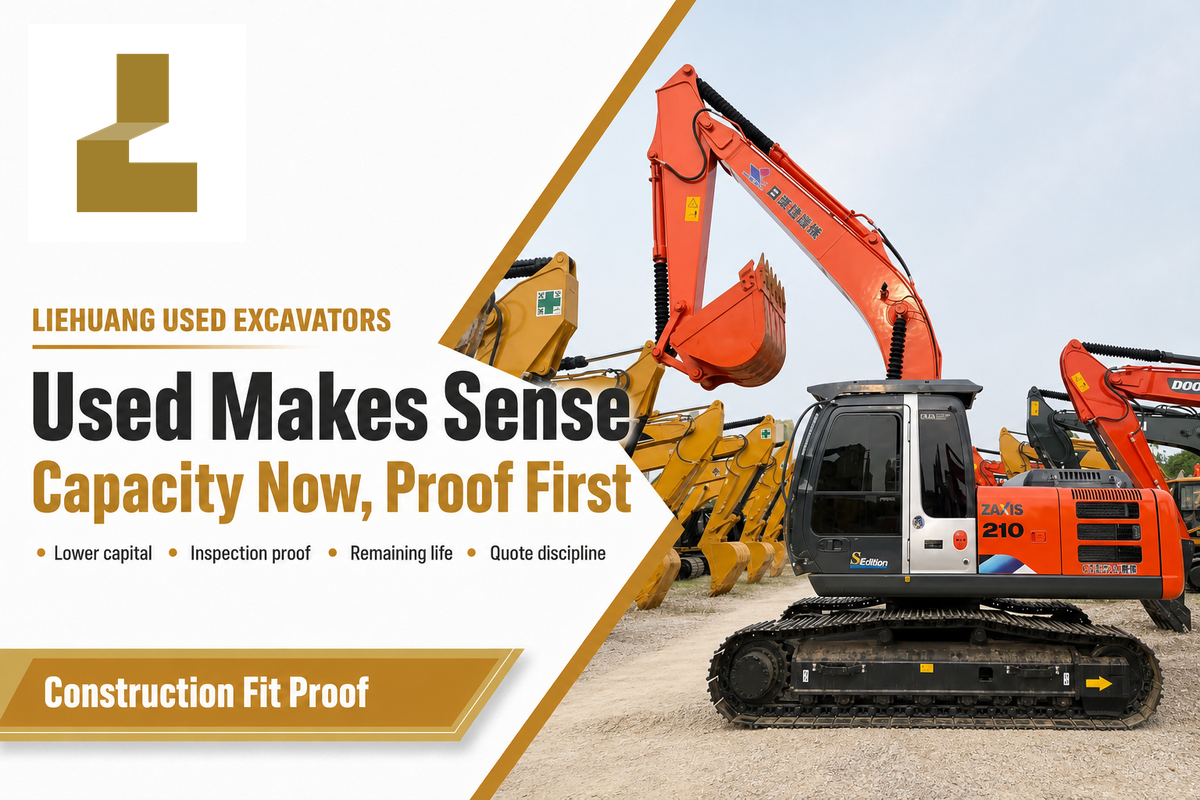
A used excavator makes sense when the contractor needs capacity now, can verify condition before payment, and can accept the remaining-life risk in exchange for a lower capital outlay than a new machine. It works best when the discount is supported by inspection proof, not only by a low quoted price.
The used-market signal is real: Equipment World, using Fusable EDA financing data, reported that 2025 new full-size financed excavator sales fell 4.1% while used financed excavator sales rose 5.3%. The same article reports 15,672 new financed units, 12,548 used financed units, average used price context near $159,000 in July 2025 and about $155,000 in the slower winter season, plus average used-unit age moving from 7.1 years to 7.7 years. The data covers full-size units of 8 metric tons or above, not every mini excavator or every cash sale. For a buyer comparing full-size excavator cost, use those figures as market context, not as a quote promise.
That does not mean every used excavator is a good buy. It means that buyers are actively demonstrating the use of a used channel, and that a value test needs to be more disciplined. Low purchase prices are only useful if the machine can do the site work, pass an inspection, and arrive with the desired documentation, machine, and attachment kit.
Used-machine decision rule
Buy used when proof reduces the risk faster than the price differential increases it. If the discount depends on incomprehensible hydraulic set-up, missing inspection, missing service history, unclear export terms, keep evaluating.
Inspection Proof for Construction Duty
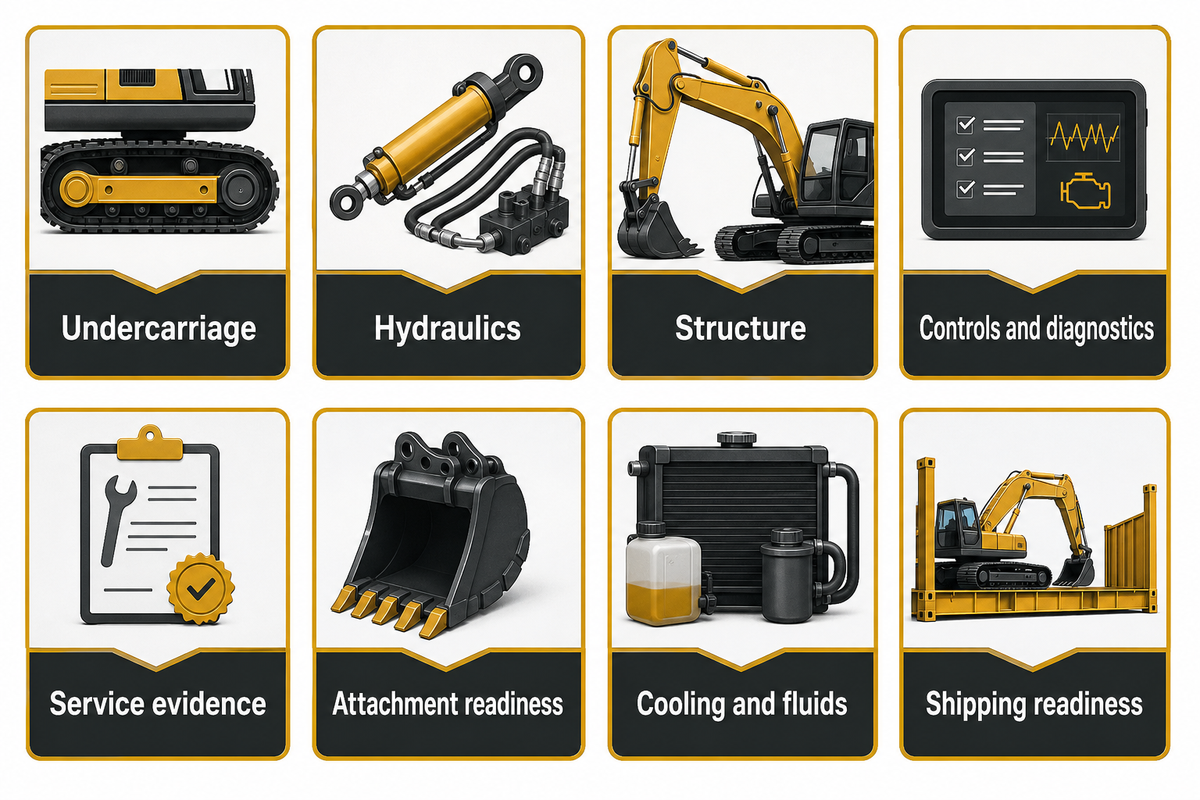
Construction duty is harder than yard movement. Used excavator inspection should start with wear points that affect work: undercarriage, hydraulic power, cylinder condition, boom/stick cracking, bucket linkage, swing bearing, controls, diagnostics, leaks, and movement under load. Equipment World’s used-excavator inspection guide says an inspection takes roughly 1 hour to 2 hours, should pay particular attention to undercarriages and hydraulics, and gives repair examples such as hydraulic pump replacement in the $12,000 to $15,000 range and undercarriage replacement around $12,000 on a 20-metric-ton inspected example.
“Steel doesn’t have much mercy.”
Howard Abell, cited by Equipment World in used-excavator inspection guidance
That short warning is useful because it keeps the inspection practical. Paint, cleanup, and a clean cab do not repair structural fatigue. Ask for close photos and video of the boom foot, stick, bucket linkage, cylinders, sprockets, idlers, rollers, track chain, leaks, and display panel. If the seller can run a demonstration, ask for warm-start, travel, swing, boom, arm, bucket, and drift checks.
| Construction Duty Readiness Score | Score 1-5 | Evidence Needed |
|---|---|---|
| Undercarriage | Track chain, pads, rollers, idlers, sprockets | Measurement photos and travel video |
| Hydraulics | Pump response, leaks, cylinders, hoses | Warm operation video and leak closeups |
| Structure | Boom, stick, frame, repairs, plating | Clean close photos, weld and crack inspection |
| Controls and diagnostics | Display, modes, warnings, error codes | Panel photos and running video |
| Service evidence | Oil, filters, major repairs, ownership trail | Records when available; otherwise condition proof |
| Attachment readiness | Coupler, pins, bucket, auxiliary lines | Compatibility photos and safety checks |
| Cooling and fluids | Radiator, oil, filters, visible leaks | Warm-operation video and service evidence |
| Shipping readiness | Dimensions, loose parts, loading points | Loading photos and destination unloading plan |
For a fuller pre-payment proof process, read Liehuang’s used excavator buying guide. This article focuses on construction job fit; that guide goes deeper into inspection and payment-proof logic.
Attachments and Hydraulics Change the Machine More Than Buyers Expect
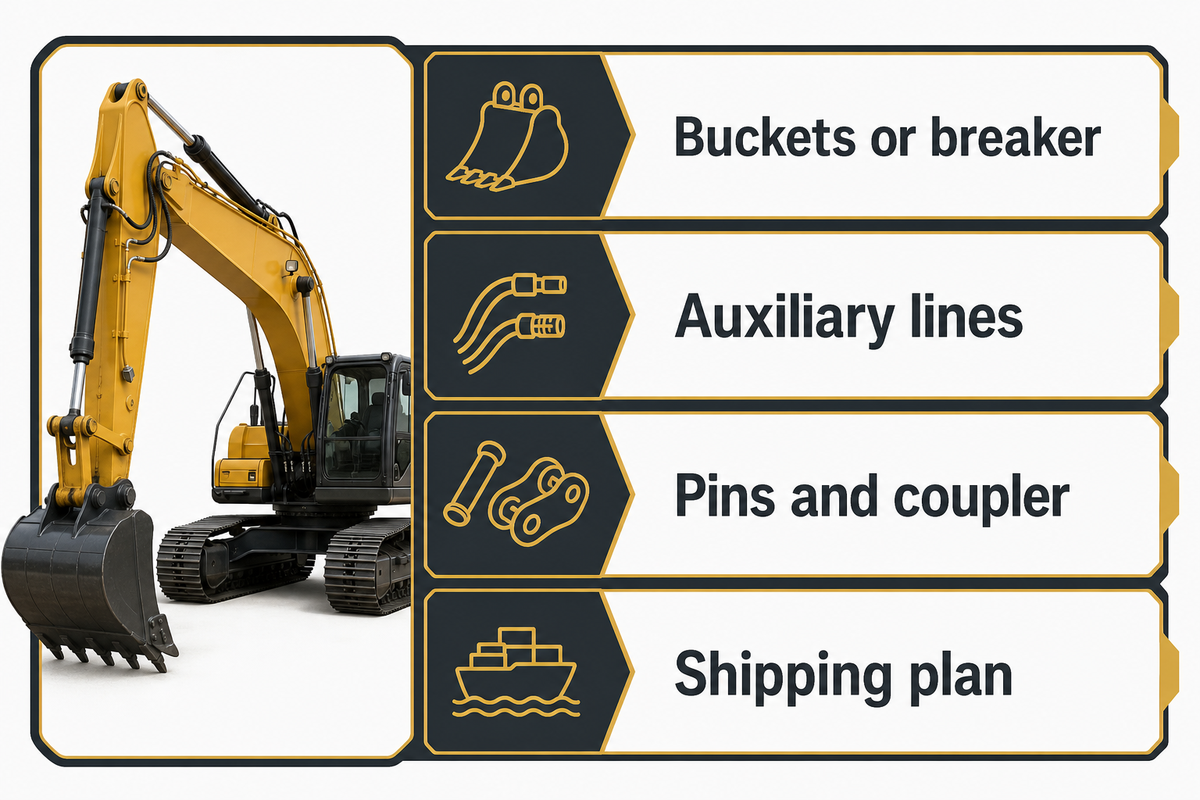
The same excavator can behave like a different machine when the attachment changes. General digging buckets, trenching bucket, breaker, grapple, thumb, auger, tilt bucket, or quick coupler can change hydraulic demand, weight balance, production rate, and jobsite safety. NIOSH warns that excavator quick coupling devices are widely used on construction sites and that a quick-coupler failure can cause the attachment to fall suddenly, causing severe injury or death.
This is why attachment fit belongs before the final quote, not after arrival. Ask for the pin size, bucket width, coupler type, auxiliary line presence, breaker circuit details, hydraulic flow expectation, and photos of the attachment points. Patent records for bucket excavator quick couplers are useful only as technical background: couplers use specific latching and locking concepts. It should not be treated as a claim about any individual machine in stock.
Attachment fit questions
- Will the excavator run only buckets, or also breaker, grapple, thumb, auger, or tilt work?
- Does the machine have the auxiliary lines and control setup the attachment needs?
- Can the supplier show pins, coupler, bucket ears, hoses, and a working demonstration?
- Will the attachment package fit the shipping and unloading plan?
Quote Readiness for Imported Used Excavators
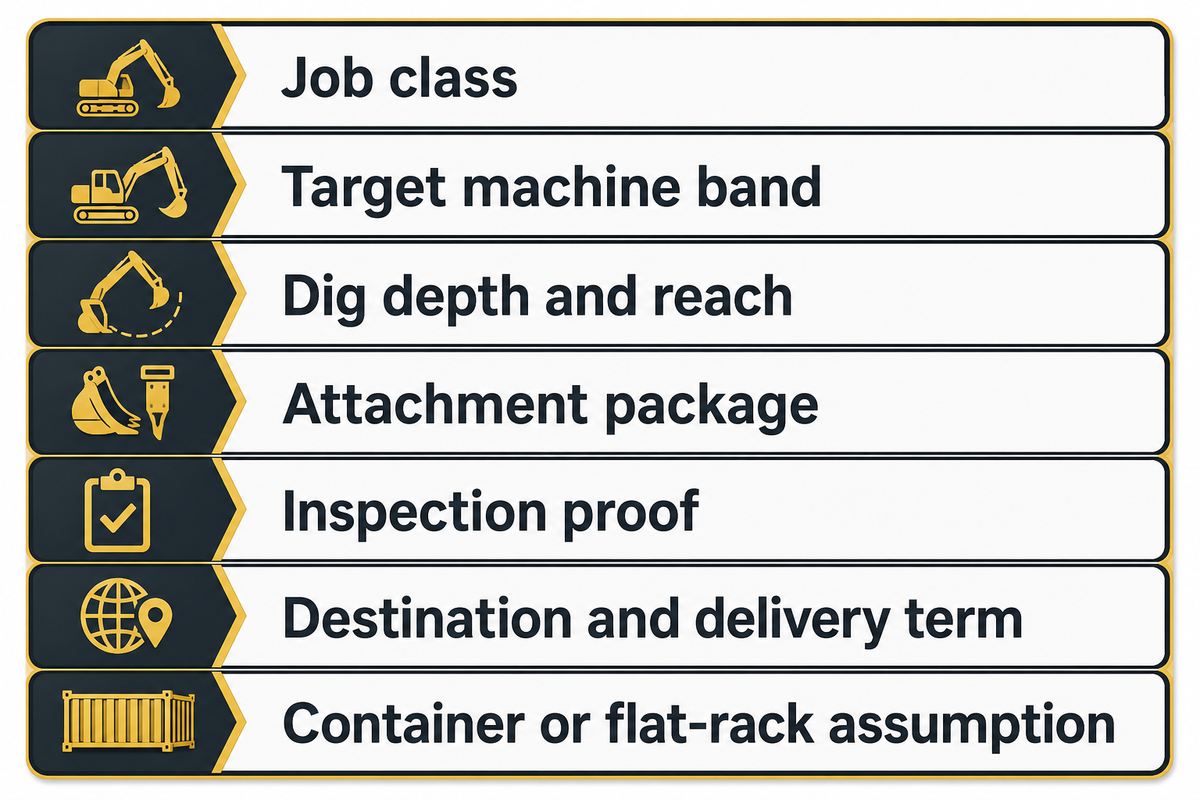
International buyers often compare used excavator quotes too early. Price without site class, target tonnage, attachment needs, inspection standard, delivery term, loading plan, and destination assumptions is not comparable. Liehuang’s public solutions page lists buyer tools such as a Container-Fill & Landed-Cost Planner, Used vs. New Savings Estimator, and Excavator Tonnage Selector. Those tools support a practical RFQ sequence, but destination-specific import paperwork still needs local verification.
| Quote-Ready Fit Sheet Field | Why It Matters | Example Input |
|---|---|---|
| Job class | Prevents brand-first mismatch | Utility trenching and road drainage |
| Target machine band | Narrows stock and transport plan | Medium crawler, around project-suitable tonnage |
| Dig depth and reach | Prevents undersized work envelope | Trench depth plus loading height |
| Attachment package | Changes hydraulic and shipping requirements | Bucket plus breaker circuit |
| Inspection proof | Keeps condition separate from sales photos | Undercarriage, hydraulics, diagnostics video |
| Destination and delivery term | Affects freight, port, unloading, and local checks | Destination port, requested Incoterms, consignee details |
| Container or flat-rack assumption | Affects loading plan and landed-cost discussion | Dimensions, weight, attachment packing request |
When you have those inputs ready, use Liehuang’s landed-cost estimate path or open the quote popup below.
Need a construction-ready used excavator quote?
Send job class, target tonnage, destination, attachment needs, and inspection-proof requirements. Liehuang Used Excavators can return matching stock options and an export quote path.
Brand Shortlist: Fit Comes Before Logo
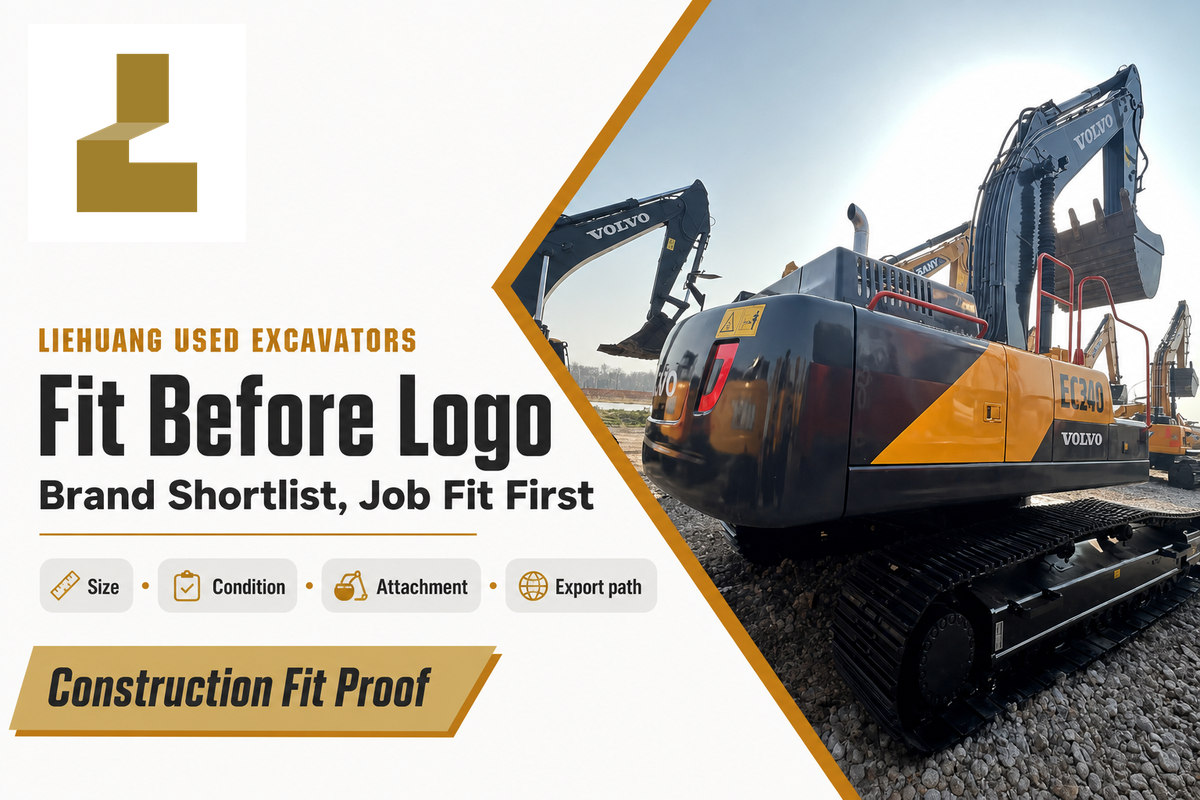
Brand matters, but it should not be the first filter. Equipment World’s market article reports Caterpillar, Deere, and Komatsu as the top financed brands in the 2025 full-size excavator data set, with Volvo CE also in the used-brand list. That is useful market context, not a guarantee that any one brand fits every construction site.
Liehuang Used Excavators lists multiple major brands, including Caterpillar, Komatsu, Sany, Volvo, Hyundai, Doosan, Kubota, Hitachi, and Kobelco. The buyer’s shortlist should start with machine fit, then condition, then parts/service confidence, then price. Familiar logos can’t fix a machine that’s too large for access, too small for output, missing the hydraulic setup, or weak on inspection proof.
| Shortlist Layer | Keep | Reject or Rework |
|---|---|---|
| Job fit | Right size, reach, access, transport, output | Brand-first quote with vague job match |
| Condition proof | Visible undercarriage, hydraulics, structure, diagnostics | Only beauty photos or repaint claims |
| Attachment fit | Coupler, pins, hoses, auxiliary lines verified | Attachment plan handled after purchase |
| Export path | Destination, loading, delivery term, inspection package aligned | Price compared without logistics basis |
Construction Excavator Selection Checklist
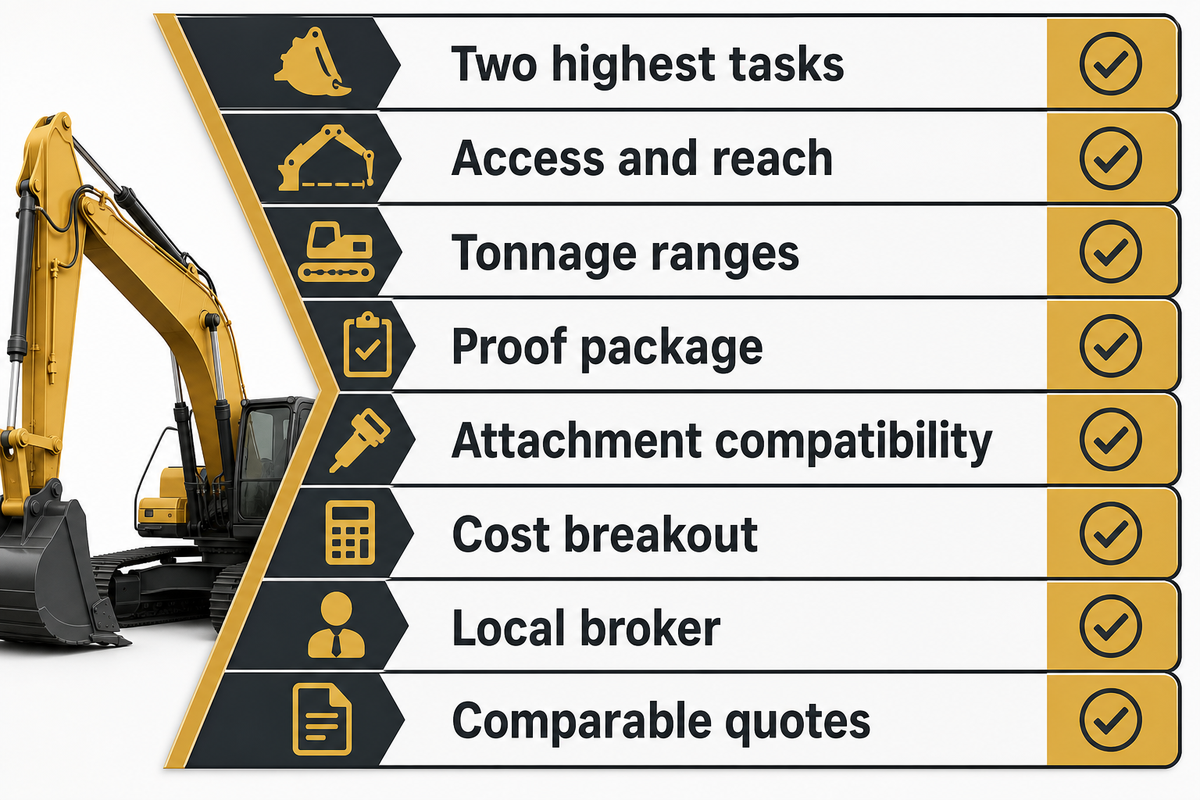
Use this final checklist before requesting a quote. It overlays job class, used-machine inspection, safety context, attachment readiness, and export-readiness. OSHA and NIOSH are not purchase checklists, but they are useful reminders that the excavator will be a working construction-site machine when it arrives.
- 1. Identify the two highest-construction tasks the machine must accomplish in the next 12 months.
- 2. Note limits of access, dig depths, reach, truck loading height, and ground conditions.
- 3. Select the top two tonnage ranges before choosing the specific model.
- 4. Solicit proof of the undercarriage, hydraulics, structure, diagnostics, and movement.
- 5. Confirm attachment, quick-coupler, pin, bucket, breaker, and auxiliary-hydraulics compatibility.
- 6. Look for separate machine price, freight, loading, port, duty/tax exposure, and deposit-for-start-up.
- 7. Ask for destination-specific document guidance from a local broker or qualified import adviser.
- 8. Compare quotes only after each quote has been answered the same fit sheet.
About This Construction Excavator Guide
Liehuang Used Excavators exports inspected used machines and attachments for buyers who need practical construction capacity, not generic category copy. This construction excavator buyer guide turns public market data, construction safety context, and Liehuang’s quote-readiness tools into a field checklist for used excavator selection.
FAQ
Use these answers as a quick wrap-up to the construction excavator checklist before comparing suppliers.
What size excavator is best for construction?
View Answer
Choosing the right size depends on the job. Landscaping, utility work, foundations, road work, demolition, and heavy trenching require different reach, depth, transport, ground pressure, attachment setup, and daily production. Start with job tasks and site access, then pick a tonnage band and ask for model-specific proof: width, operating weight, dig depth, reach, bucket size, and hydraulic arrangement.
Is a used excavator reliable enough for construction work?
View Answer
Yes, if condition proof is sufficient to get the work done. Ask for undercarriage, hydraulic, structural, diagnostic, maintenance, and service proof before sending the deposit. Don’t trust hours, good appearance, or a short video to make the decision. Higher-hour machines with better condition proof can be safer on construction duty than low-hour machines with marginal proof, opaque history, or extreme structural wear indicators.
What should I inspect before buying a used construction excavator?
View Answer
Inspect the undercarriage, hydraulic system, cylinders, hoses, boom, stick, bucket linkage, swing bearing, engine, cab controls, display warnings, service records, and attachment points. For remote buying, request clear photos, warm-operation video, travel, swing, boom, arm, bucket movement, drift checks, and closeups of wear areas so the sales quote is tied to visible proof.
Why do attachments matter when choosing an excavator?
View Answer
Attachments modify the hydraulic requirement, balance, productivity, and safety. Validate your attachment collection before the quote is finalized.
What information should I send for an export quote?
View Answer
Send the job type, target tonnage, dig depth, reach, attachment package, destination port, delivery term preference, inspection-proof requirements, and unloading plan. Include site access limits, expected daily output, local broker requirements, and whether the machine must ship with buckets, breaker lines, or a quick coupler. That makes stock matching, loading assumptions, and landed-cost discussion more accurate before you compare offers.
References & Sources
- 29 CFR 1926.602: Material Handling Equipment – Occupational Safety and Health Administration
- Preventing Excavator Quick Coupler Attachment Struck-by Fatalities and Injuries – NIOSH Publication 2024-102
- Excavator Sales Trends 2025: New and Used Models – Equipment World / Fusable data
- Inspection Checkpoint: How to Inspect a Used Excavator – Equipment World
- 5 Steps to Select Right Excavator for Construction Applications – For Construction Pros
- Quick Coupler for Bucket Excavators – Google Patents
![Excavator Bucket Manufacturers: Buyer Evidence [Guide]](https://lhusedexcavator.com/wp-content/uploads/2026/08/excavator-bucket-manufacturers-r2-featured-768x512.png)