Get in Touch with Liehuang Company
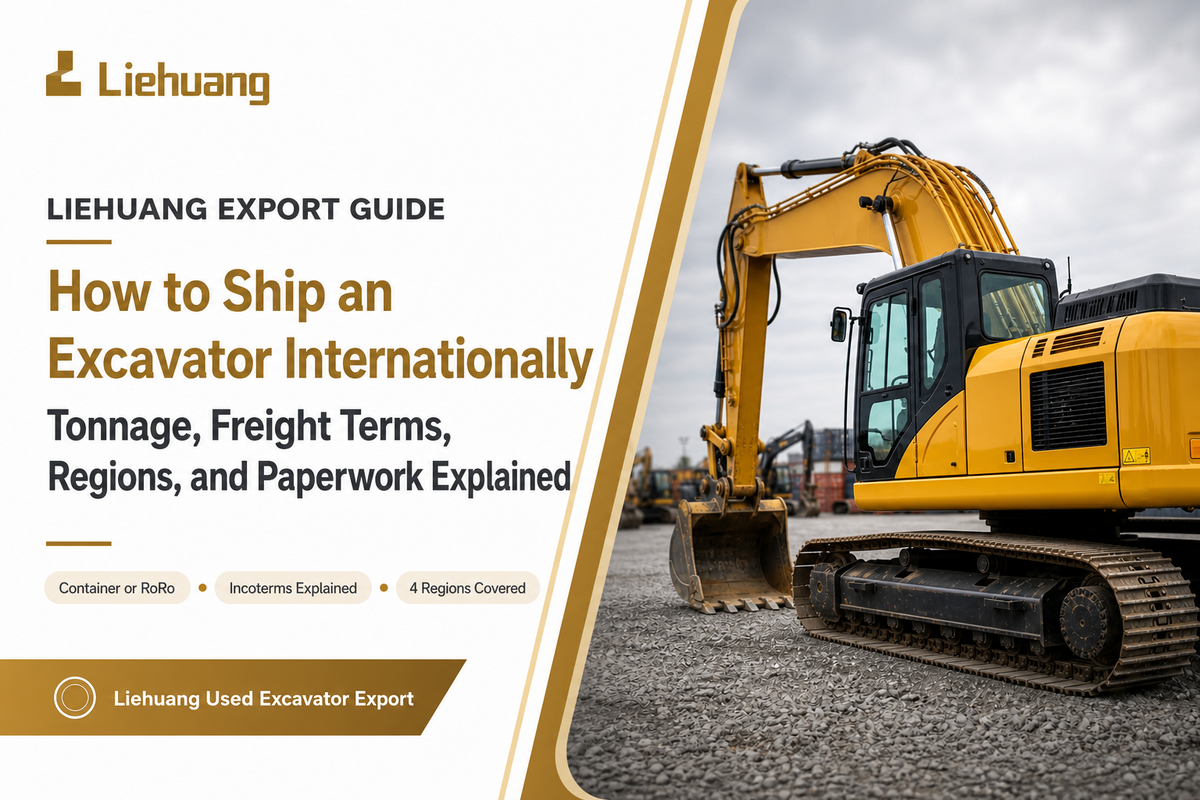

How to ship an excavator internationally means answering four questions: what’s your tonnage, what does the freight quote actually include, how does your shipping region change things, and what paperwork leaves China with the machine. Get any of those wrong and a “cheap” quote turns into a stranded container with a costly inland-haulage bill waiting at the other end. International shipping of heavy equipment rewards buyers who confirm the full route before they commit to a booking, rather than choosing based on the lowest freight price alone.
When you ship an excavator internationally, the machine’s tonnage dictates whether it ships as part of a container, flat rack, roro, or breakbulk service.
Once the mode is determined, you must cover the difference between the FOB price of the machine and the landed cost, which is determined by Incoterms. A 3-ton mini excavator can be fitted into a 40-ft box; anything more than 30 tons is almost always handled as breakbulk or oversized cargo instead of standard container shipping.
Quick Specs: Shipping Modes at a Glance
| Mini (0-4t) | Standard 20ft/40ft container |
| Mini/Compact (4-8t) | Container or flat rack, depending on boom height |
| Medium (10-20t) | Flat rack or RoRo |
| Medium (20-30t) | Flat rack, RoRo, or breakbulk |
| Heavy (30t+) | Breakbulk / project cargo |
Choosing a Shipping Mode by Tonnage Class
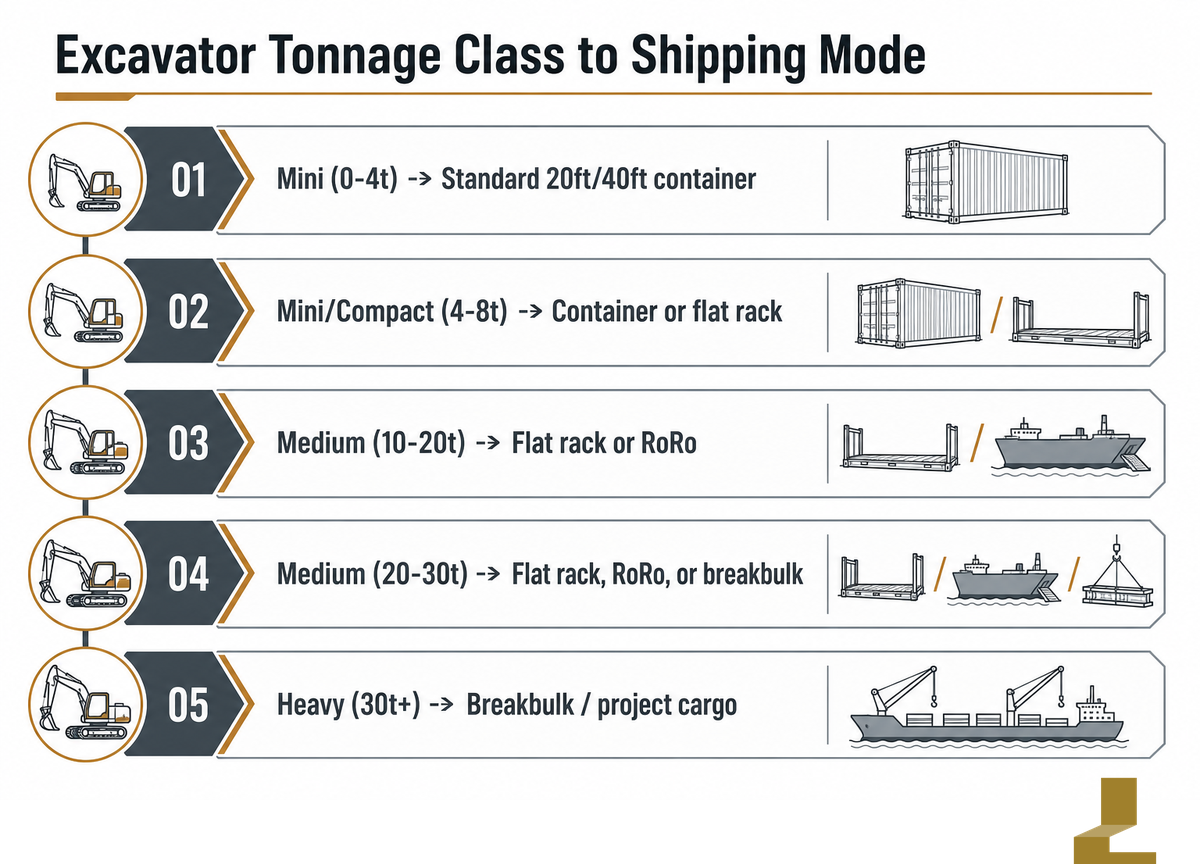
The excavator’s tonnage class determines the available shipping modes-a factor that should be confirmed prior to obtaining any freight quotes.
A 3-ton mini excavator can go in a standard 20-ft container; anything in excess of 35 tons can’t physically be put in one, regardless of the rate.
Mini excavators up to roughly 4 tons are loaded into standard 20-ft and 40-ft containers with plenty of room left over. As a result, the cheapest and most reliable method of transporting these machines is in a standard container.
For machines above 4 tons to around 8 tons, the height of the boom and cab make it necessary to use a flat rack, an open-sided container with collapsible walls. For mid-range excavators (10-30 tons), container service isn’t an option; these machines are shipped on flat rack or RoRo vessels, where they’re driven or winched onto the deck. Heavy excavators over about 30 tons are typically transported as breakbulk cargo, meaning each machine is lifted individually with heavy dockside cranes and secured with reinforced lashing.
Freight forwarders who ship excavators and other heavy construction equipment for a living will already know this tonnage-to-mode logic; buyers arranging their first shipment benefit from asking the forwarder to walk through the same reasoning before accepting a quote. Companies that ship heavy equipment overseas every week treat this as routine equipment transport planning, not a special case, which is exactly why it pays to ask them the same questions they ask themselves.
| Tonnage Class | Example Models | Recommended Mode | Why | Limitations / Not suitable for |
|---|---|---|---|---|
| 0-2t (micro) | Kubota U17, Kubota U25 | Standard 20ft container | Well under 2.3m door height fully assembled | Not suitable for anything wider than the door clearance with attachments on |
| 2-4t (mini) | Kubota U35, Komatsu PC35 | Standard container (20ft/40ft) | Fits ~2.35m door height and ~2.35m width fully assembled | Not suitable if attachments push height over door clearance |
| 4-8t (compact) | Komatsu PC55, Komatsu PC60 | Container or flat rack | Boom/cab height around 2.5-2.7m is the deciding factor, not weight | Not suitable if height exceeds container door without partial disassembly |
| 8-14t (small-medium) | Komatsu PC130, Doosan DX140 | Flat rack | Width around 2.5-2.8m exceeds standard container but fits flat rack decking | Not suitable for tight budgets — flat rack costs more than container |
| 14-20t (medium) | Komatsu PC200, CAT 320 | Flat rack or RoRo | Too wide/tall (~2.8-3.0m) for standard containers; RoRo if self-propelled and route available | RoRo not suitable if machine is non-operational |
| 20-26t (medium-heavy) | Hitachi ZX210, Volvo EC210 | Flat rack, RoRo, or breakbulk | Weight around 21-24 tons and width ~2.9-3.1m narrow the container option out entirely | Flat rack not suitable once dimensions exceed port crane out-of-gauge limits |
| 26-33t (heavy) | Komatsu PC300, Doosan DX300 | Breakbulk or project cargo | Weight above ~28 tons routinely exceeds flat rack payload ratings on many trade lanes | Not suitable for budget-limited shipments — breakbulk handling adds cost |
| 33-42t (large heavy) | Komatsu PC360, Hitachi ZX350 | Breakbulk / project cargo | Requires dockside crane lift and multi-point lashing at this weight class | Not suitable for ports without heavy-lift crane capacity |
| 42t+ (mining/heavy) | Volvo EC480, Volvo EC750 | Breakbulk / project cargo, permitted route | No container or RoRo deck realistically handles this weight/size combination | Not suitable for tight budgets or fast timelines — this is the most expensive, longest-lead-time class |
Other tracked equipment, such as track loaders, bulldozers, and excavators, is shipped by the same tonnage logic. The machine’s dimensions and operating capabilities, rather than its specific equipment type, are the real determining factor.
Treat the table above as a planning guide, not a substitute for the ISO 668 container dimension standard your forwarder will check against your machine’s actual boom-up height and width before confirming a booking. Whether you’re transporting heavy machinery overseas for a single job or shipping an excavator overseas as part of a fleet order, the same equipment size logic applies: get the tonnage-to-mode match right first, and flat rack container shipping, RoRo, or breakbulk booking questions answer themselves. There is no single “best shipping” method for every construction equipment shipping job, there’s only the method that matches the machine you actually have, sitting on the actual route you’re shipping it on.
⚠️ Common Mistake
Booking a flat rack when a machine is actually eligible for RoRo — or the other way around — will lead to a mandatory re-booking by the freight forwarder once they review the excavator’s measurements. That delay alone can push a booked shipment back to the next available ship, setting the loading back by one to two weeks.
Ocean Freight Mechanics and Trade Terms: What Actually Drives the Quote
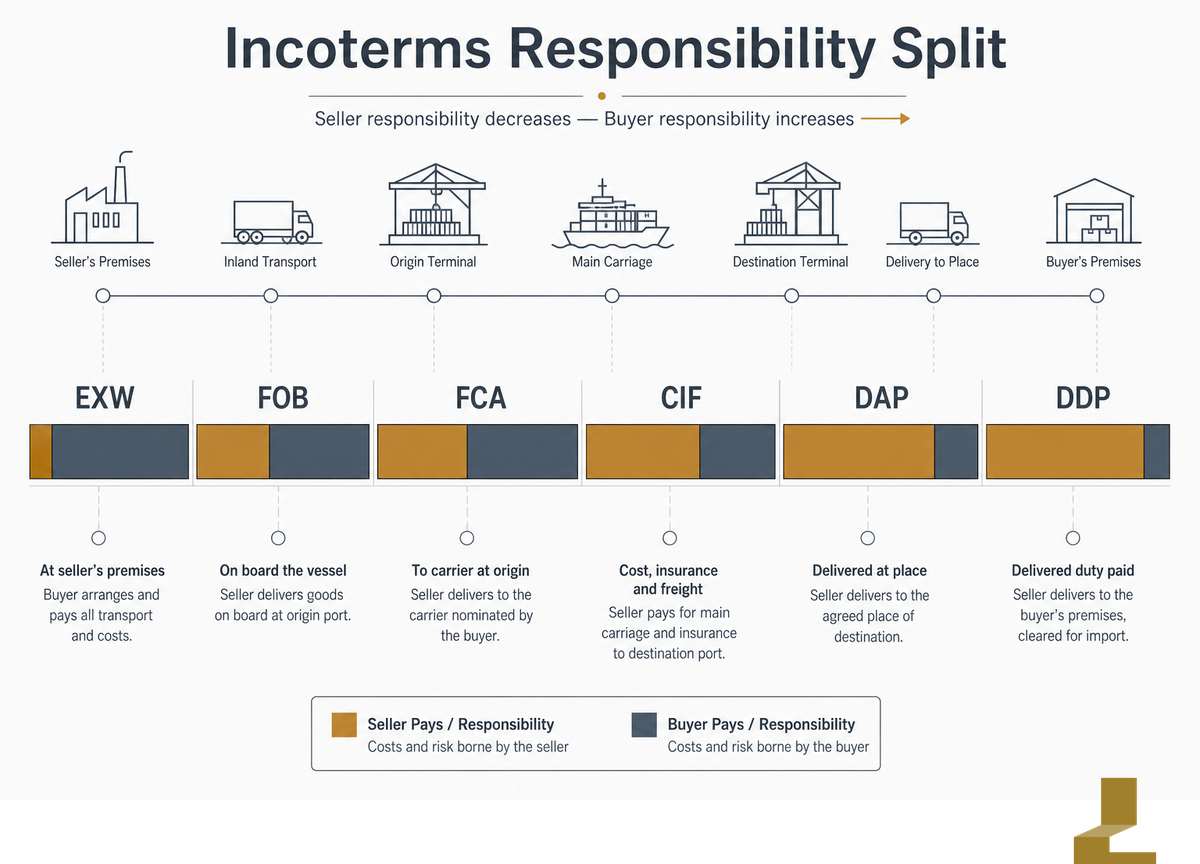
The freight rate quoted by an excavator never truly means “the shipping cost”; instead it’s a series of line items that change hands according to the Incoterm set forth in the sales agreement rather than the rate’s headline price.
The base ocean freight rate covers shipping only. On top of it sit surcharges for bunker fuel, which fluctuate with oil prices; marine cargo insurance; port handling and port fees at each end; and, most critically, whatever costs the Incoterm assigns to the buyer rather than the seller at the destination end. Ocean freight forwarders quote these ocean freight rates differently depending on the carrier relationships they hold and how much of their business runs through ocean shipping versus air or inland modes, which is exactly why two machines with identical base rates can land at very different total costs once FOB versus DDP terms are applied.
| Incoterm | Seller Pays For | Buyer Pays For |
|---|---|---|
| EXW (Ex Works) | Machine ready at the factory/yard gate, nothing more | Export clearance, all freight, all destination charges |
| FOB (Free on Board) | Machine to the origin port, loaded on vessel | Ocean freight, insurance, destination charges |
| FCA (Free Carrier) | Machine to a named carrier/terminal | Everything from that handoff point onward |
| CIF (Cost, Insurance, Freight) | Ocean freight + minimum insurance to destination port | Destination port fees, customs, inland haul |
| DAP (Delivered at Place) | Everything to the named destination (not unloaded) | Import duties, unloading |
| DDP (Delivered Duty Paid) | Everything including import duties | Unloading only |
For the customs-side detail of those terms–HS code classification, EPA/CBP type documentation for admissibility, and a full FOB-to-landed-cost worksheet–consult our excavator import guide, which covers the US compliance side in depth. This guide will cover shipping and logistics aspects common to all destination countries.
RoRo shipping isn’t necessarily cheaper for wheeled or tracked machinery, as it’s often presumed. Freight forwarders on Middle East trade lanes report that RoRo pricing varies with vessel schedule and route competition, so the cost for containerized or flat rack transport can end up comparable or even lower once port fees are included. It’s worth comparing all the modes your tonnage class qualifies for, and asking forwarders for quotes across each one. Heavy machinery buyers who request those comparisons usually land the more cost-effective price. Partnering with an experienced freight forwarder who manages the shipping process from start to finish, not just the ocean leg, is what actually helps you save money and gives you a realistic sense of the total cost of shipping an excavator, rather than a headline number that ignores port fees, inland haulage, and the paperwork that keeps equipment from sitting idle at the dock. Ask any reliable shipping partner how they coordinate inland transport once the vessel clears, and how they keep you informed while your equipment is loaded, in transit, and unloaded at destination — that answer tells you more about the total cost of shipping construction equipment than the base freight quote ever will.
“One common misconception is that RoRo shipping is always the least expensive option for wheeled cargo; that’s simply not true.”
Shipping to Asia, Africa, Latin America, and the Middle East: What Actually Differs by Region
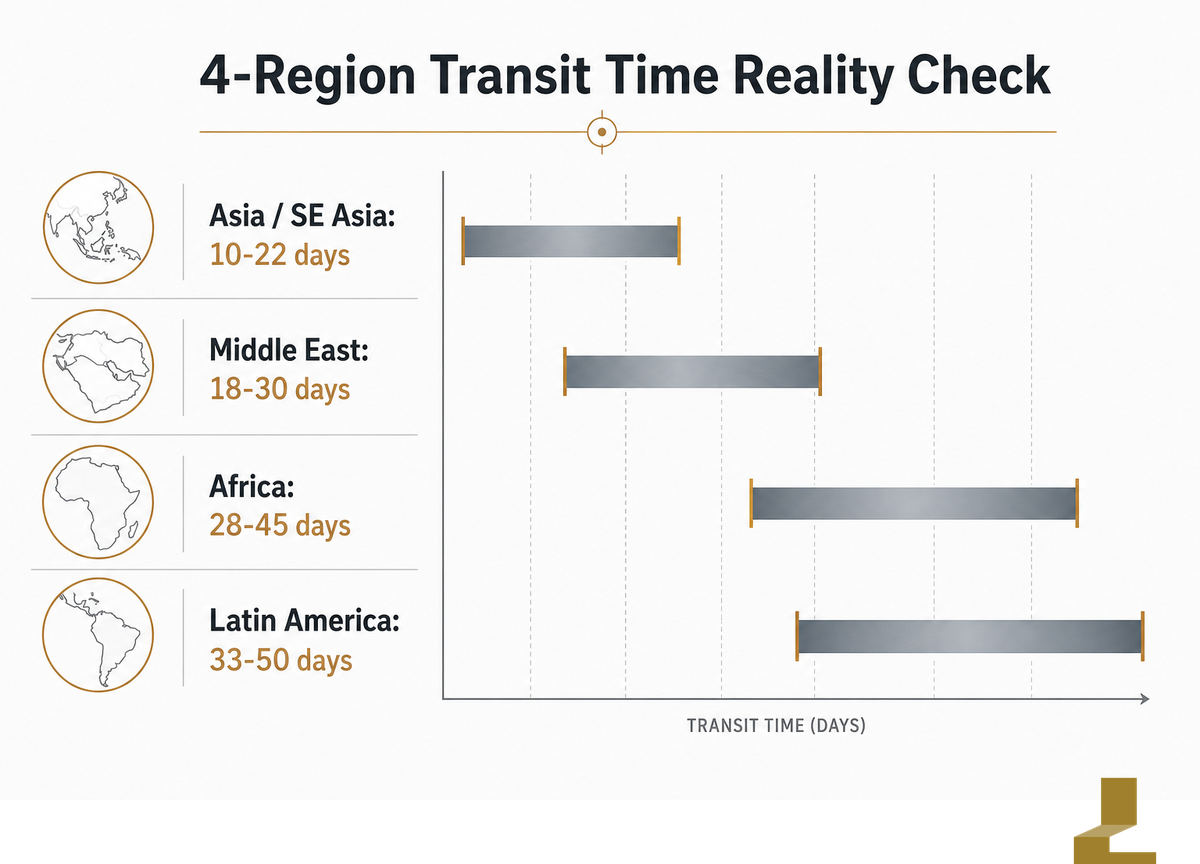
Two factors associated with changes in destination country are rarely included in pre-planning: actual at-sea time and project slack prior to confirmation of the excavator being onsite and operational.
| Region | Typical Transit Time | Common Ports | What Differs |
|---|---|---|---|
| Asia / SE Asia | 10-22 days | Manila, Ho Chi Minh City, Jakarta | Shortest routes, most direct container sailings |
| Middle East | 18-30 days | Jebel Ali (UAE), Dammam (Saudi Arabia), Sohar (Oman) | Regular RoRo and container schedules; construction-driven demand keeps capacity active |
| Africa | 28-45 days | Mombasa (Kenya), Lagos (Nigeria), Durban (South Africa) | More transshipment legs, longer breakbulk handling windows |
| Latin America | 33-50 days | Callao (Peru), Santos (Brazil), Buenos Aires (Argentina) | Longest routes, fewer direct sailings from Chinese ports |
The range figures are taken from a single, industry-recognized source and differ depending on carrier schedules, time of year, and the level of port congestion; they’re merely planning benchmarks, not precise schedules. What stays consistent across all four regions is this: a well-inspected, lower-hour machine sitting in a longer transit window is still the better buy than a rushed shipment with no documented history, because transit time has no bearing on mechanical risk — inspection does.
One region-specific detail is consistently overlooked by competitor shipping guides: used earthmoving machinery, like any cargo, is a recognized vector for biosecurity contamination. The International Plant Protection Convention’s ISPM 41 standard outlines pest risk classification for used vehicles, equipment, and machinery that transit international borders, and Australia’s Department of Agriculture, Fisheries and Forestry openly states that mining, earthmoving, and construction machinery “must be imported clean and free from biosecurity risks,” and that used machinery will be subjected to “compulsory inspection on arrival.” Destination country rules vary, but the practice is universal wherever it’s implemented: a container sitting in a customs over soil, mud or plants clinging to the undercarriage is a documentation error, not bad luck. The same pre-shipment inspection that checks the hours on the engine and the pressure in the hydraulics will also result in the clean, photographed machine that bypasses this obstacle. Emission and import-admissibility regulations are a different set of destination-country gates to contend with (refer to our import guide to understand the US EPA/CBP system and consult your destination customs broker for other regulations), but they’re independent of the excavator’s paperwork.
Export Documentation: What Leaves China With the Machine
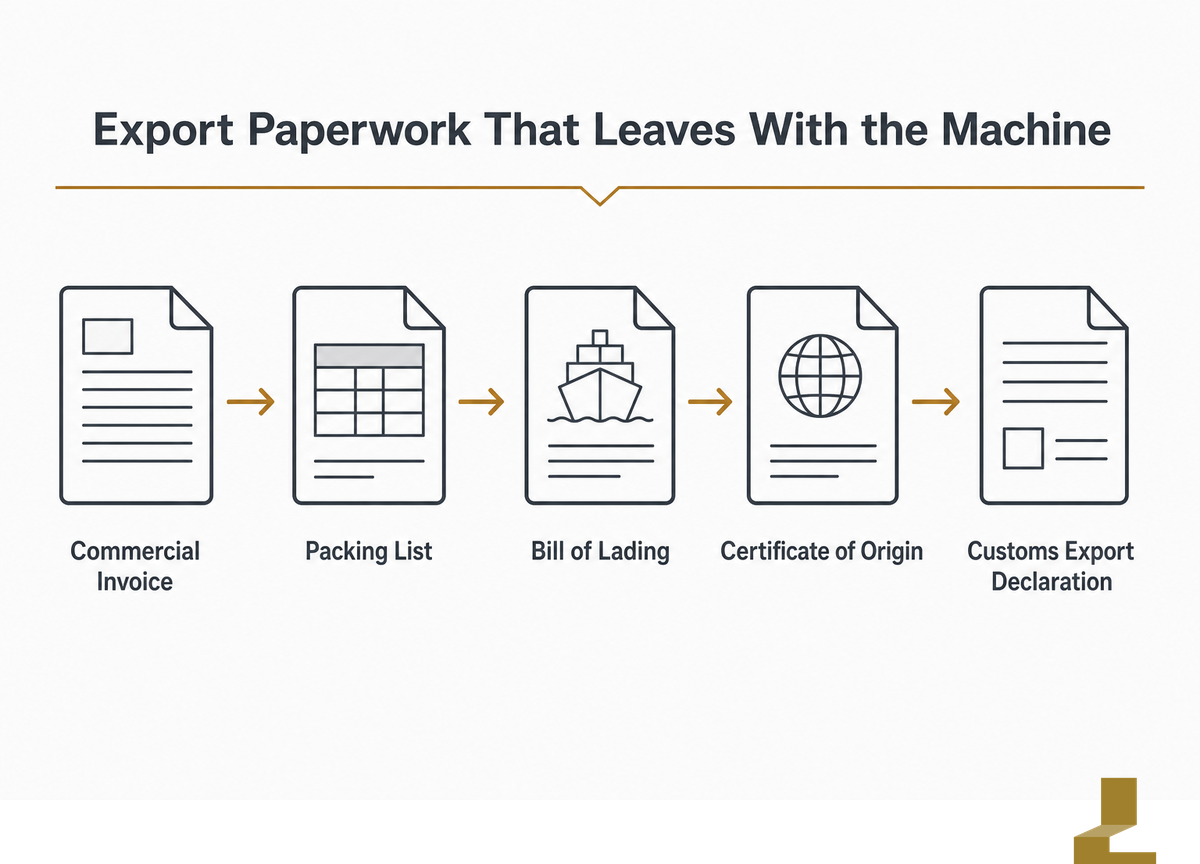
The exporter supplies five key documents that travel with the excavator. The omission of any single item is the single greatest cause for a shipment being stuck in a foreign port, instead of clearing on time.
- Commercial invoice – This must clearly list the buyer, seller, a description of the machine, the HS code for the machine (excavators fit under HS 8429.52), and the value it’s being declared at.
- Packing list – Details of how the machine is packed, its dimensions, weight and whether any accessories are being shipped separately.
- Bill of lading – This document is issued by the carrier or forwarder as a receipt for the cargo and as evidence of the contract for shipping.
- Certificate of origin – Many destination customs authorities will require this document to properly apply tariffs and duties.
- Export customs declaration – The declaration the exporter files with their Chinese customs authorities under the correct HS code.
There’s one other document requirement that has absolutely nothing to do with the exporter’s side and everything to do with the shipping container: as per the International Maritime Organization’s SOLAS framework, all loaded containers must be accompanied by a Verified Gross Mass (VGM) declaration. The container won’t be loaded onto the vessel without this – it’s a pre-shipment check that occurs on the loading docks, before the ship even leave China, and is never mentioned in any of the excavator-shipping guides we found.
📐 Engineering Note
The VGM refers to the total weight of the container once it’s fully packed (excavator weight + packaging and lashing materials + the tare weight of the container itself, roughly 3,800 kg for a standard 40ft box), not just the excavator’s operating weight; a 20-ton excavator with solid blocking and lashing materials will add hundreds of kilograms to the overall container weight, which is why a machine rated at 20,000 kg can easily declare closer to 24,000 kg once packaging is included.
Two more compliance gates lie outside the core document set and are typically missed due to being machine-external. First, if the excavator ships with raw-wood blocking, bracing, or a wooden crate around any attachments, that packaging itself is regulated by the IPPC’s ISPM 15 wood-packaging standard-ask your forwarder if the wood was heat-treated and stamped. Untreated dunnage can result in a compliant machine being detained at a port for reasons unrelated to the excavator itself. Second, if any fuel, hydraulic oil, or batteries are traveling with the machine as shipped goods (not fully drained), this is regulated under the IMO’s mandatory IMDG (International Maritime Dangerous Goods) Code for stowage and segregation. Direct confirmation with your forwarder, not an assumption that “the tank was drained,” is the best way to avoid surprise charges and delays.
None of this is unique to shipping an excavator from China specifically — the same questions apply to any construction equipment from China, or heavy machinery shipping from any origin country. Working with an experienced freight forwarder means you don’t have to become an expert in every rule yourself; it means asking the right questions and getting straight answers about special equipment needs, who’s arranging freight forwarders and port formalities on each end, and what happens between the day your equipment to load leaves the yard and the day your equipment arrives. Depending on the shipping method and destination, the exact document list will shift slightly, but the discipline that helps ensure your equipment arrives on schedule — confirming everything before you ship overseas, not after — stays the same whether you ship your equipment once or every quarter.
What Happens After the Machine Leaves: Liehuang’s 6-Step Export Playbook
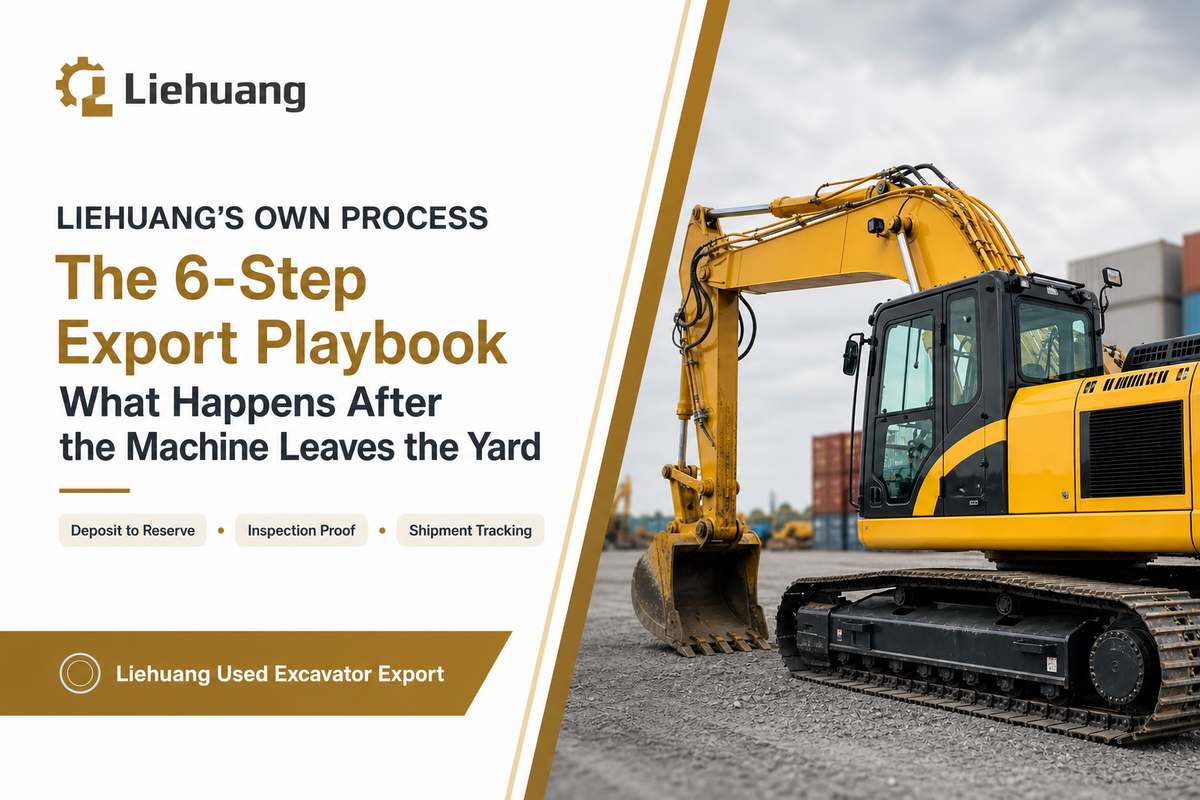
When you purchase from an exporter that handles both inspection and shipping in-house, you follow a straightforward six-step process — knowing the order of these steps is what turns the abstract idea of “my machine is somewhere on a boat” into a process that’s actively manageable.
Buyers shopping for equipment shipping from China quickly discover that companies ship excavators very differently depending on whether they’re a pure freight broker or an exporter who also inspects what they’re selling. Done well, international heavy equipment shipping means you always know where your machine from China stands in the sequence, not just that it “shipped.”
- Inquiry & machine selection — buyer specifies tonnage class, brand, and application; supplier proposes matching units from current inventory.
- Deposit payment — a deposit reserves the specific serial-numbered machine rather than a generic listing.
- Inspection evidence delivered — engine, hydraulics, and undercarriage condition documented with serial-number photos, hour-meter photos, and a walkaround video, sent before any balance is due.
- Balance payment — released only after the buyer confirms the inspection evidence and export documents.
- Customs declaration & shipment — export paperwork filed, VGM declared, container or RoRo booking confirmed, loading photos shared.
- Delivery & customs clearance — bill of lading progress tracked through transit, customs support provided at the destination end.
The order of these steps matters much more than the specifics of any given step: the machine is inspected and evidence of this inspection is delivered before your final payment is due, not after the machine has already departed. That order makes a purchase process an evidence-backed transaction rather than an act of faith based on a photograph. We detail what evidence you should be looking for in our used excavator inspection checklist.
Outlook: Tariff Volatility Is Reshaping 2026 Shipping Decisions
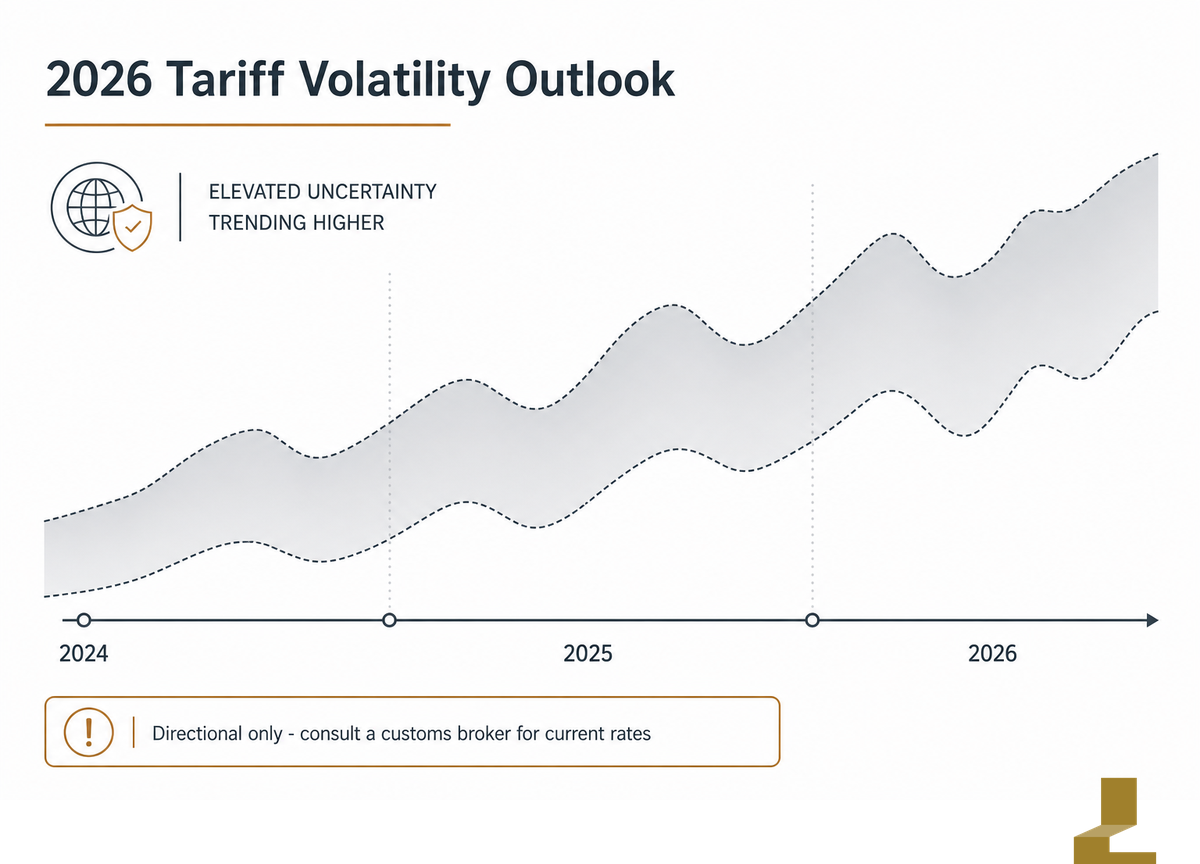
Those buyers who secure a freight quote today, but plan to initiate the purchase project three months later, are increasingly facing unexpected realities-2025’s choppy shipping schedules were directly caused by trade-tariff volatility and that volatility continues into the 2026 purchasing season instead of abating.
According to industry shipping analysis for 2026, this volatility is a direct consequence of shippers pulling forward their vessel space and inventory plans due to tariff uncertainty, rather than reflecting underlying shifts in demand — a pattern visible in the U.S. Bureau of Transportation Statistics’ freight indicators, which track exactly this kind of spot-rate swing on major trade lanes. What that means for an excavator buyer, in practical terms, is less about the specific tariff rate itself (that’s your particular import market); it’s that vessel availability and container shipping rates are more erratic now than they were even a couple of years ago. It’s no longer overly cautious but entirely sensible to build a buffer for shipping costs into your budget and to secure your freight quotes well in advance of your purchase deposit deadline.
Port-to-Jobsite: The Inland Leg Buyers Forget
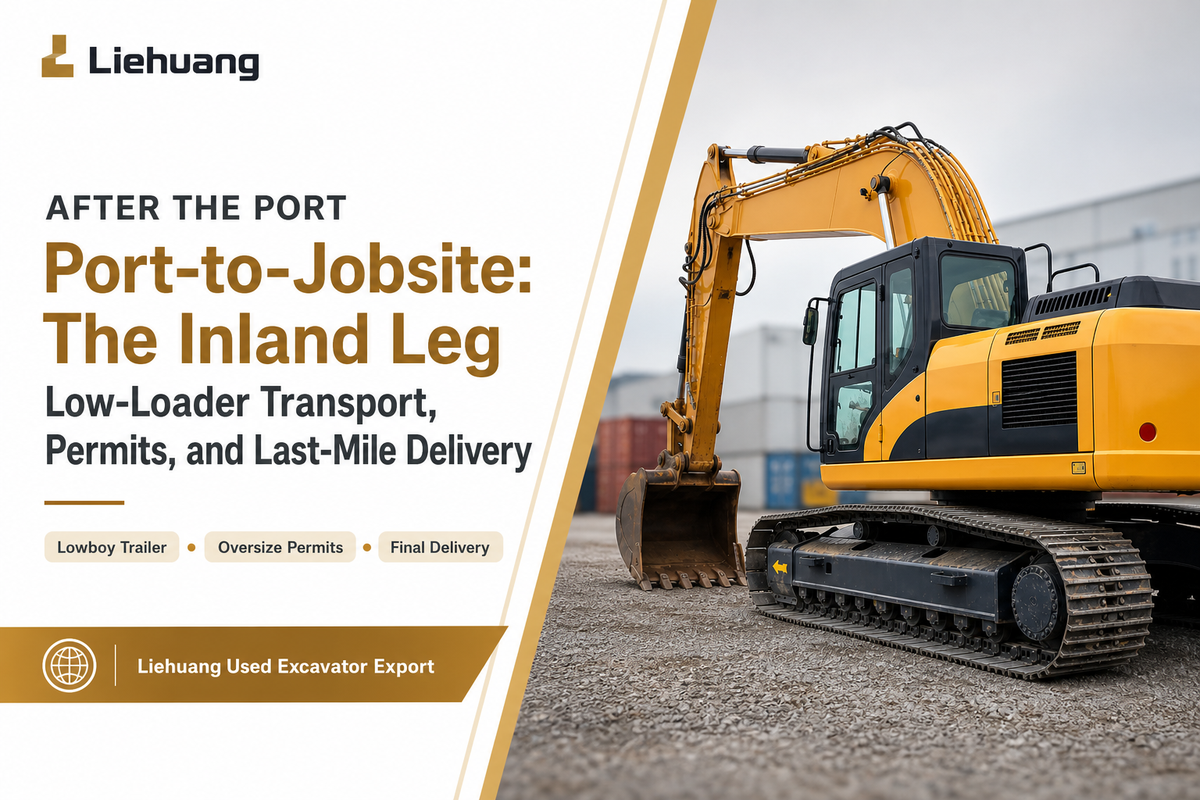
Customs clearance is only half the job; the machine still needs to be physically unloaded and moved off the port, and those final steps involve additional access requirements not accounted for in ocean freight quotes. This is where heavy equipment transport shifts from a shipping-line problem to a trucking-and-permits problem, and the type of equipment you’re moving changes what that inland leg actually requires. A large construction machine that needed a low-bed or roll-off truck for the ocean leg will usually need the same kind of specialized equipment for the road leg, and oversize or overweight loads can trigger their own state-by-state FHWA permit requirements regardless of how far the machine already traveled by sea.
Here’s a real example of why that’s the case: one buyer sourcing equipment through an online marketplace found that picking the machine up from the port required someone holding a TWIC card (a US port-worker security credential) and Port Authority security clearance – neither of which had been arranged in advance. That added an unplanned $1,700 to the total cost. The lesson applies far beyond that one port: make sure you know who’s picking up the machine, what credentials or access passes they’ll need at your destination port, and who’s arranging the low-bed or roll-off truck for the inland haul – before you book your container, not after it has already cleared customs.
Key Factors to Consider Before Booking
- Who’s authorized for pickup at your destination port?
- Who’s responsible for booking the low-bed or roll-off transport?
- Is the exporter’s Incoterm quote “port-to-port only” or “door-to-door delivery”?
None of this changes much whether you’re shipping heavy equipment overseas for the first time or you’re a fleet buyer who has shipped excavators from China before: the type of equipment, the destination, and the Incoterm still drive every number on the quote. Shipping solutions for excavators that look identical on paper — same tonnage, same route, same “all-in” price — can hide very different levels of documentation, inspection, and inland-transport planning behind them. Reliable shipping partners walk you through construction equipment overseas logistics in plain terms instead of a vague “we handle everything” promise, and will explain loading and unloading procedures, what gets the machinery from the ship to your yard, and why one exporter’s heavy machinery exports process looks nothing like another’s once you ask for specifics. When two quotes for shipping construction equipment differ by thousands of dollars, that paperwork and planning gap is usually why.
Key takeaway
Tonnage class decides your ocean-freight mode, the Incoterm decides who pays for what, and destination region decides both transit time and biosecurity risk — get those three right before requesting a quote, not after.
Frequently Asked Questions
Q: How much does it cost to ship an excavator overseas?
International excavator shipping typically runs from roughly $1,800 for a self-propelled RoRo shipment on a short regional route up to $15,000 or more for a heavy machine on a long breakbulk route.
The range is a function of tonnage, mode, and distance, not any “average.” A mini excavator moving to a close Middle Eastern port will be at the bottom end; a 30-plus-ton heavy excavator shipping breakbulk to Latin America, once all port handling, insurance, and inland delivery are included, will be at the top end. Request your freight quotes to break out these costs as separate line items rather than a bundled number so you know where your money is going.
Q: Is a mini excavator considered heavy machinery for shipping purposes?
Yes, even a sub-4-ton mini excavator is classified and shipped as heavy machinery, though it qualifies for the simplest and cheapest mode: a standard container.
The heavy machinery classification impacts what HS code and customs category your shipment falls into-an excavator always lands in HS 8429.52, regardless of size-but it doesn’t impact what shipping mode you can use. Where size does come into play is in the mode itself: a mini excavator’s compact dimensions let it use the least-expensive standard-container route, an option medium or heavy excavators physically cannot access.
Q: Can an excavator fit inside a standard shipping container?
Mini excavators under roughly 4 tons generally fit a standard 20ft or 40ft container fully assembled; larger machines usually need a flat rack or partial disassembly.
The container door height and width are the limitations, not the weight itself. The compact nature of a mini excavator with its boom lowered and cab still intact generally fits standard container dimensions. When the boom height or width extends beyond that, the practical alternatives include an open-top or flat rack container (which have open tops and/or side-loading capabilities for oversize dimensions) or partial boom disassembly for breakbulk handling.
Q: Do excavators need to be cleaned before overseas shipping?
Yes, removing soil, mud, and plant debris from the undercarriage before shipping is standard practice and, in several destination markets, a biosecurity requirement that customs actively checks.
Undercarriage tracks and rollers often collect soil, debris, and organic matter that certain countries classify as pest or contamination risks upon entry. Shipping a dirty machine means it could be held at the destination port for cleaning or inspection at your expense, at the port’s schedule. A properly documented pre-shipment clean with dated photos avoids these headaches altogether.
Q: What documents are required for customs clearance?
A commercial invoice, packing list, bill of lading, and certificate of origin form the core set most destination customs authorities require, alongside the correct HS code declaration.
Specific requirements vary by country; check the required list with a licensed customs broker at your destination. For instance, some markets require additional import permits or specific inspections on used construction equipment. Ensure all exporter paperwork (invoice, packing list, export declaration, certificate of origin) is finalized before the machine loads-not requested after the fact.
Q: How long does excavator shipping take?
Ocean transit alone runs 10-22 days to Southeast Asia and up to 33-50 days to Latin America, so plan your project timeline around the longer end for African and Latin American routes.
These figures are for ocean transit only. Allow an extra 1-3 weeks for pre-shipment checks, paperwork, customs, and inland haulage to site before treating any date as fixed.
Why We Write This
Liehuang exports used mini, medium, and heavy excavators to importers and dealers across Asia, Africa, Latin America, and the Middle East, and the questions in this guide — which shipping mode, what transit time, what paperwork — are the same ones our own buyers ask before every container books. This guide reflects the export process we run ourselves, cross-checked against IMO shipping regulations and industry freight data rather than presenting only our own view.
References & Sources
- Verification of the Gross Mass of a Packed Container — International Maritime Organization
- ISPM 41: International Movement of Used Vehicles, Machinery and Equipment — International Plant Protection Convention (FAO)
- Importing Motor Vehicles, Motorcycles, Tyres and Machinery — Australian Department of Agriculture, Fisheries and Forestry
- HTS Search 8429.52 — U.S. International Trade Commission
Related Articles
- How to Import Excavator from China: 2026 Checklist — the US EPA/CBP customs deep-dive companion to this guide
- How to Inspect a Used Excavator Before You Buy — the inspection evidence referenced in Liehuang’s export playbook
- Used Excavators for Sale — mini, medium, and heavy machines
- Mini Excavators for Sale (0-10 Ton)
- Medium Excavators for Sale (10-30 Ton)
- Excavator Attachments — buckets, breakers, and shipping considerations
![Excavator Bucket Manufacturers: Buyer Evidence [Guide]](https://lhusedexcavator.com/wp-content/uploads/2026/08/excavator-bucket-manufacturers-r2-featured-768x512.png)