Get in Touch with Liehuang Company
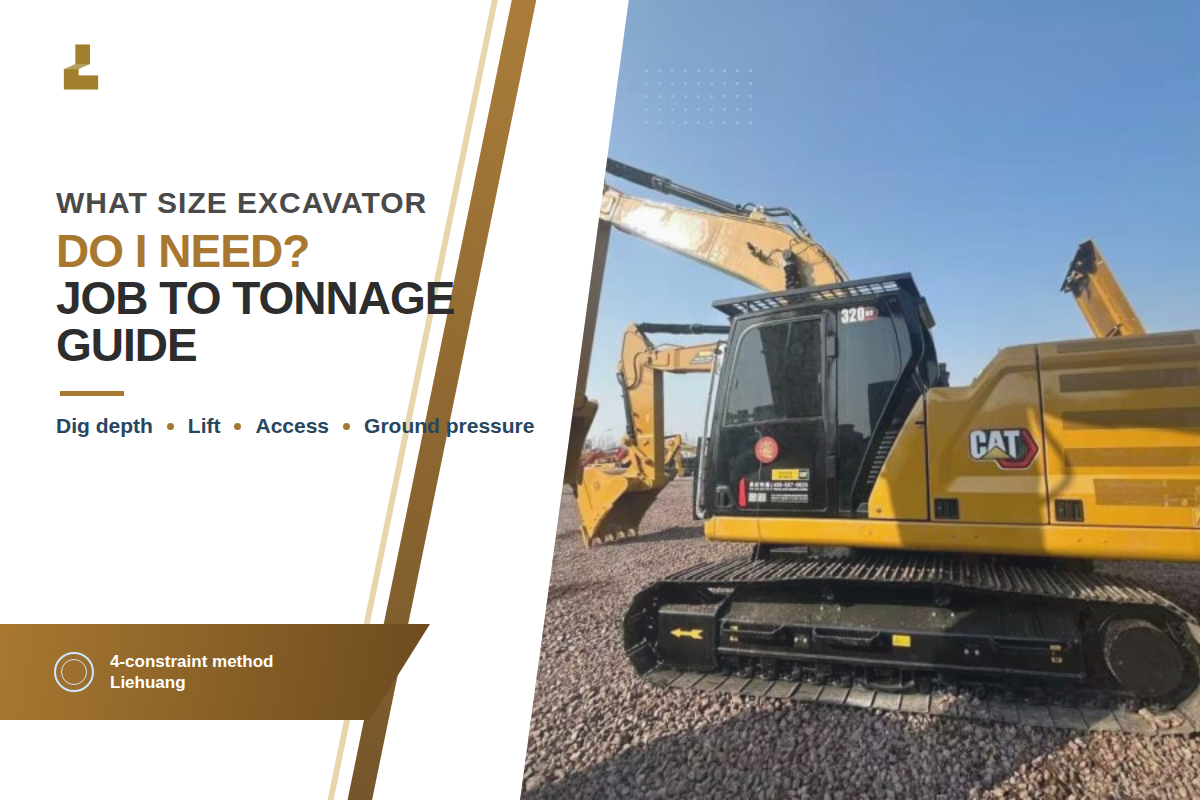

What size excavator do I need is a question that really breaks into four: dig depth and reach, lifting capacity, site access, and ground bearing pressure. You have to dig to a certain depth and reach, lift a specific weight, physically get it and your trailer onto your site, and, lastly, make sure your ground will support its weight. Always opt for the smallest class that answers all four of your requirements to maximize your efficiency and minimize unnecessary costs. Everything below, including the class-by-job chart and cost-saving tips drawn from industry specs, a relevant OSHA trenching regulation, and our own shipping data, will guide you through this selection process.
Quick Answer
- Most typical residential or landscaping jobs: 1-4-ton mini (approximate 6-10-ft dig depth, can be towed behind a 3/4-ton pickup).
- House foundations, deeper utilities: 5–10 ton (digs ~10–15 ft).
- Commercial site work: 15–30 ton standard (digs ~19–24 ft).
- Mining, demolition, mass earthmoving: 30 ton and up.
How to Figure Out What Size Excavator You Need: The 4-Constraint Sizing Method
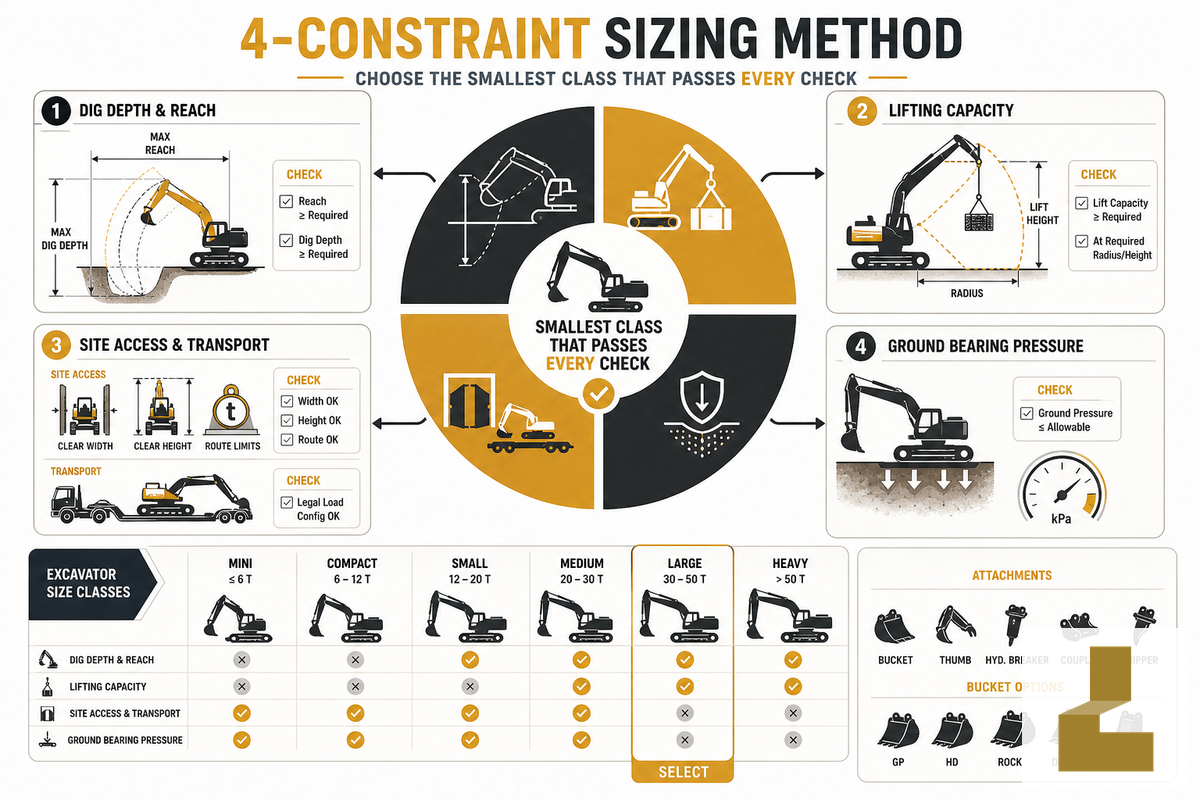
To figure out what size excavator to get, work through four constraints, in order, until you find the smallest size that meets all of your requirements: dig depth and reach, lifting capacity at the radius where you’ll be lifting an object, site access and transportability, and allowable ground bearing pressure — and dig depth in particular is capped by OSHA’s trenching rules, not preference. Those first three tell you how small you can go; the last will force you to widen the load or get more machine. We call this the 4-Constraint Sizing Method. This method exists because there’s no “too big”; size is about fitting within constraints.
Many buyers, especially those in residential settings or working for landscapers, do the reverse: They identify an excavator size they saw on a previous job or from a dealer’s website and then hope the other dimensions fit. The problem? They could wind up with a machine too small to excavate down to a footing or a 20-ton excavator that simply won’t legally fit on a trailer into a backyard. Instead, run these four dimensions:
The 4-Constraint Sizing Method
- Dig depth & reach – This defines the farthest point and greatest depth you must be able to access. This factor is a primary filter for size selection, ruling out certain classes immediately.
- Lifting capacity – This is the maximum weight you’ll lift and the distance from the machine’s center (the radius) where that lift will occur.
- Access & transport – This relates to site gates, tail swing radius, and your legal trailer capacity.
- Ground bearing pressure – This concerns your ability to place the excavator’s footprint on soft or sensitive ground without causing damage or sinkage.
This chart converts those four criteria into specific numbers you can apply to your job requirements.
Excavator Size Classes Explained (Mini to Large)
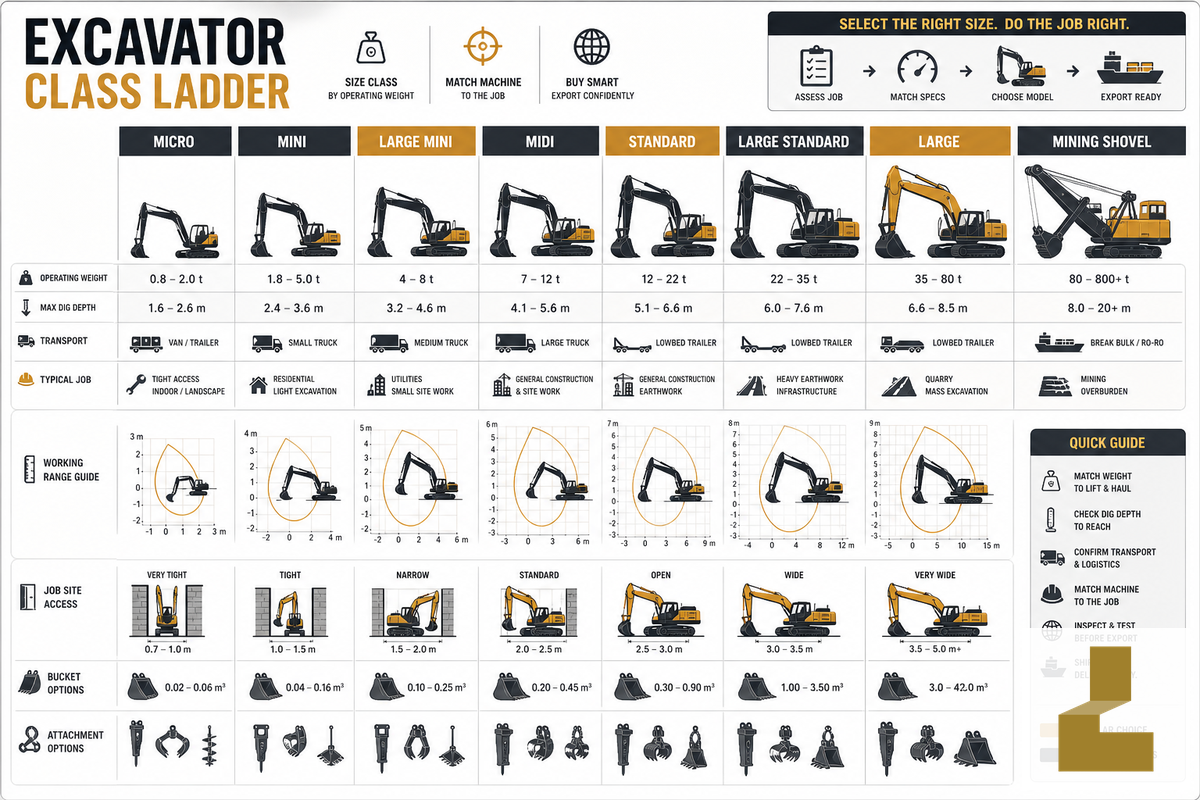
Excavator weights are grouped into classes (mini/compact, midi, standard, and large). Here’s a bit of information that many don’t know: there’s no officially designated weight for any of these classifications. ISO 6165, the standard defining excavators, classifies machinery by function and design (e.g., an “excavator” is defined by how it operates) and not by weight categories. Weight boundaries between these classes are merely convention, so you will find that these classifications can vary between manufacturers, rental companies, and sales agents. Knowing the different sizes of excavators — from the smallest excavator that fits through a 3 ft doorway up to a 90 ton mining shovel — is where sizing starts, but this list is only a reference: always check the specific specs of the machines you’re considering. Buyers often ask what are the different sizes of excavators, what is the smallest excavator, and what is the width of a mini excavator — fair questions, but the class label matters far less than the actual dig-depth, lift, and width numbers on the spec sheet.
Below, the 9-Row Excavator Class Sizing Matrix reconciles these industry conventions with the most relevant technical data needed for a purchase decision.
| Class | Operating weight | Typical max dig depth | Transport note | Typical jobs |
|---|---|---|---|---|
| Micro | < 1 ton | ~4–6 ft | Fits doorways (~2 ft 5 in wide) | Indoor demo, tight backyards |
| Mini (compact) | 1–6 tons | ~6–10 ft | Class 1/2 truck, often no CDL | Landscaping, sewer/water lines |
| Large mini | 6–10 tons | ~10–14 ft | Skid or tag trailer | Footings, residential foundations |
| Midi | 10–20 tons | ~15–20 ft | Deck-over / lowboy | Utilities, road work, small commercial |
| Standard | 20–30 tons | ~19–24 ft | Lowboy; watch 8 ft 6 in width | General commercial construction |
| Large standard | 30–45 tons | ~24–28 ft | Oversize permit likely | Infrastructure, deep excavation |
| Large | 45–90 tons | 28 ft+ | Multi-trailer moves | Quarry, mining, mass earthmoving |
| Mining shovel | 90 tons+ | Site-specific | Assembled on site | Large-scale mining |
The dig depths are generalized to indicate ranges typical for these machines, but the exact digging depth will vary by manufacturer. All ranges are based on industry convention rather than a standardized measurement.
Need the full spec chart with bucket capacities side by side?
See our excavator size chart, or jump straight to mini excavators (0-10 ton), medium excavators (10-30 ton), or heavy excavators (30+ ton).
Match the Size to Your Job: The Job-to-Tonnage Selector
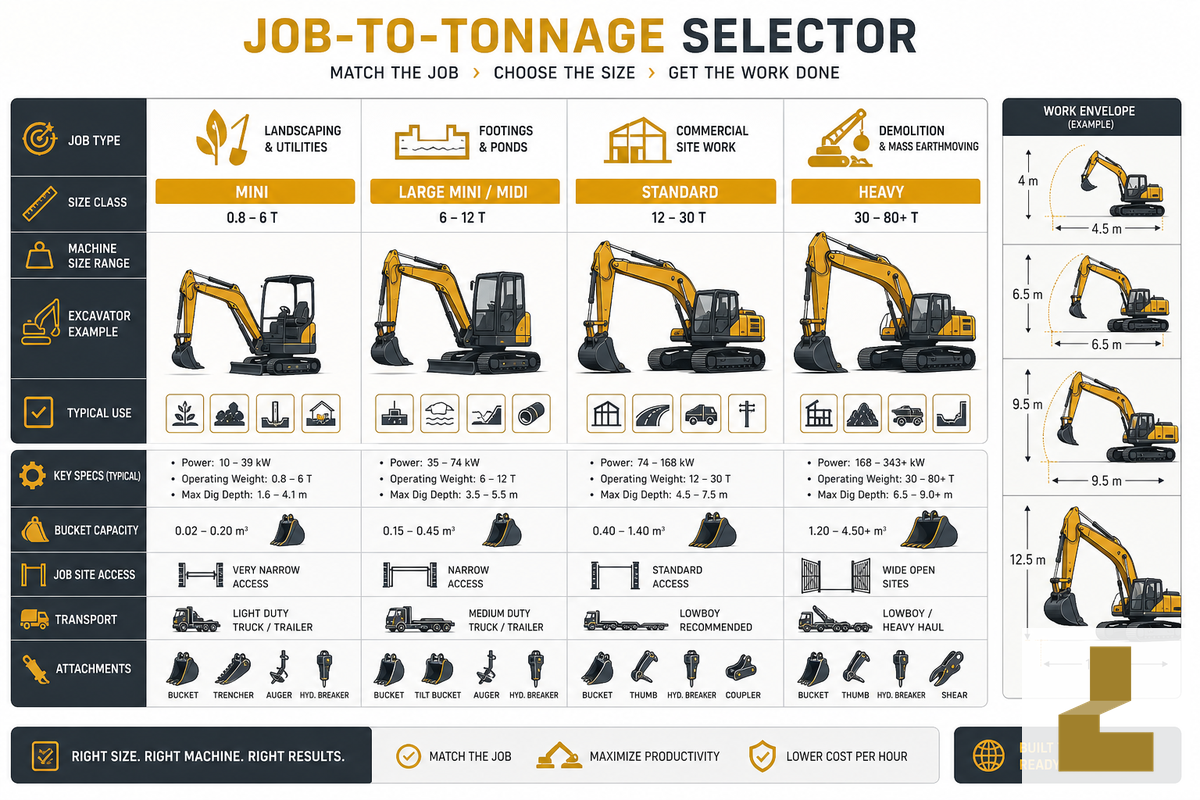
By far the fastest route to a shortlist is to start from the job, not the machine.
The Job-to-Tonnage Selector here maps common projects to the class that usually clears all four constraints. Use it as a starting point, then confirm depth and lift against the specific model.
| Job | Recommended class | Why |
|---|---|---|
| Landscaping, small residential digging | 1–3 ton mini | Fits gates, low ground damage, tows easily |
| Trenching utilities (water, electric) | 3–6 ton | Reaches ~8–12 ft, still site-friendly |
| Footings & residential foundations | 5–8 ton | 10–15 ft depth covers frost + footing |
| Ponds & light land clearing | 6–13 ton | Reach and cycle time for volume |
| General commercial site work | 20–30 ton standard | Depth, lift, and attachment power |
| House / structure demolition | 20–35 ton | Reach + breaker/shear hydraulics |
| Mining, quarry, mass earthmoving | 30 ton and up | Bucket volume and duty cycle |
What size excavator do I need for a foundation?
For most residential foundations, a 5-8 ton excavator is the right size – it digs roughly 10-15 ft, which covers the footing depth plus frost line in most regions — and keeps you planning around OSHA’s 5 ft protective-system threshold — and still fits a standard tag trailer.
Step up to a 10-13 ton midi only if you’re cutting a full basement, working in heavy clay, or need extra reach to spoil away from the hole. Below about 3 tons, you’ll likely run short on depth: one contractor ran a 1-ton machine on footings all day and concluded he needed 1.5-2 tons minimum — a full day lost to an undersized pick. When buying for footing work, picture the deepest hole on the job, not the average, or you repeat that costly mistake.
Dig Depth and Reach: The Constraint That Rules a Class Out
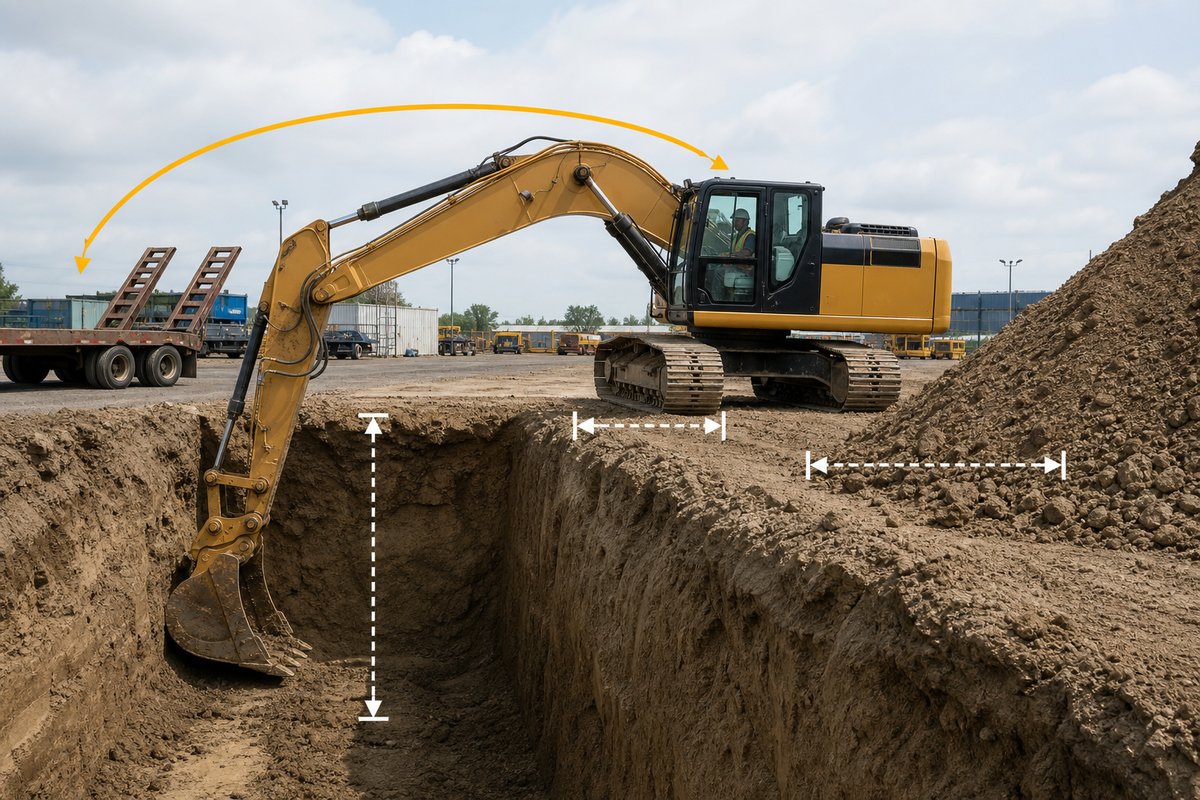
Dig depth is the first constraint to check because it eliminates classes outright – no amount of operator skill makes a machine reach deeper than its spec. Maximum dig depth scales with size: even a compact 3,000-lb unit tops out near 6 ft, a 3-ton mini reaches about 8.5-9.5 ft, a 10,000-lb (~4.5 ton) machine gets to 12-14 ft, and a 15-32 ton standard machine digs 19-24 ft.
Reach (how far out you can dig) follows a similar curve, and matters when you must stand back from a wall or trench edge.
Depth isn’t only a productivity number – it’s tied to safety law.
Under OSHA 29 CFR 1926 Subpart P, any trench 5 ft or deeper generally needs a protective system (sloping, shoring, or a trench box), and any trench 4 ft or deeper needs a safe means of egress. That changes your sizing math: if the box and benching widen the excavation, you may need more reach than the raw depth suggests.
📐 Worked example
Say your frost line is 36 in and you need another 18.5 in for a beam and joists – that means you must reach at least 54.5 in (about 4.5 ft) of clean depth – and that’s before you allow room to work the bucket at the bottom. Any 1-2 ton micro that maxes near 6 ft leaves almost no margin, so a 3-5 ton mini digging 8-10 ft is the safe pick. This is exactly where undersizing bites: a homeowner who assumed a small machine would “get close enough” found it stopped short at 54.5 in.
How deep can a 3-ton mini excavator dig?
A 3-ton mini excavator digs about 8.5 to 9.5 feet (2.5-2.8 m) at maximum depth, depending on boom and stick configuration. That’s enough for shallow footings, utility trenches, and most drainage work, but short for a full basement or deep storm drain – those push you into the 10-20 ton midi range.
Lifting Capacity: Will It Pick Up What You Need?
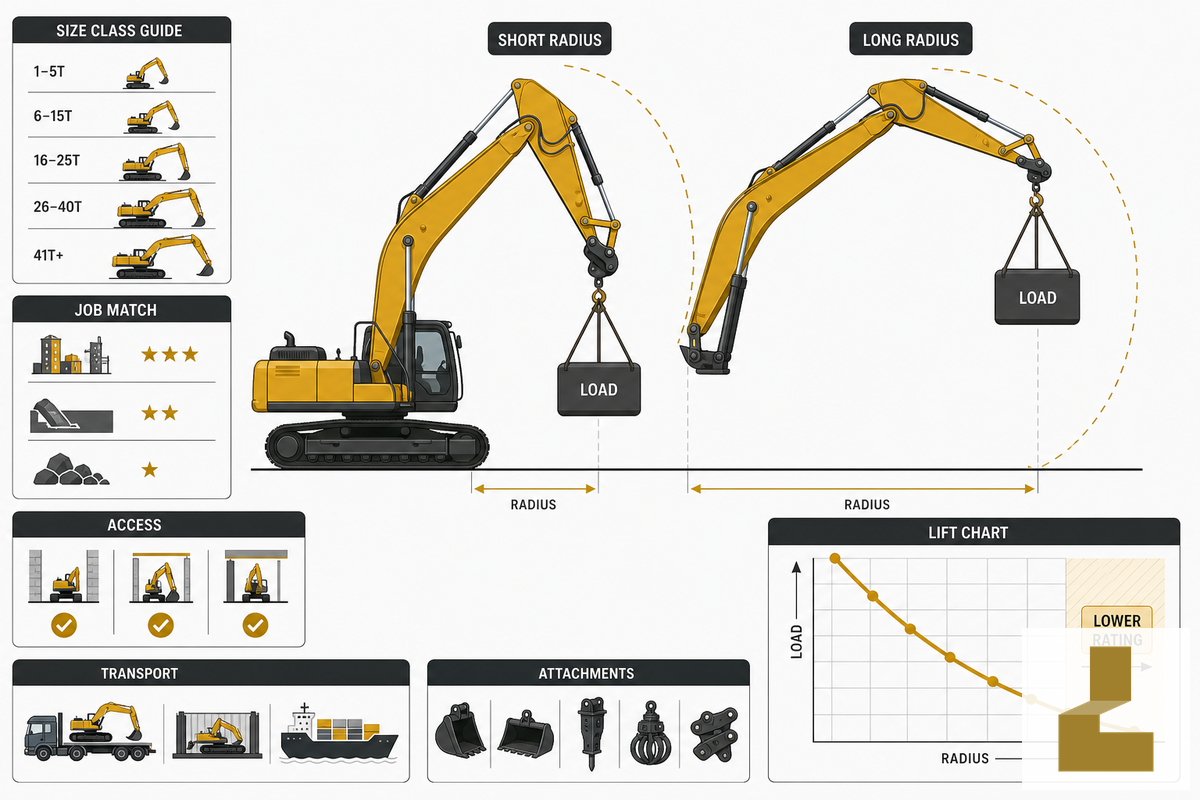
Lifting capacity is the second hurdle, and it’s the most commonly misunderstood by those unfamiliar with excavators. An excavator’s lift rating isn’t a static number — it’s a load chart that’s constantly declining the further the load moves away from the machine. You have to size for capacity at your real-working radius, not the eye-catching headline number published in a brochure.
Your slope, boom length, counterweight and attachments also modify that rating. As a rough illustration, one machine’s chart might read 3,000 lb at a 10 ft radius but only 1,500 lb at 20 ft — the same machine, half the capacity, purely from reaching farther out.
📐 Worked example
Lifting is all about load moment (weight times radius). 20,000 pounds at an 8-foot radius equals a 160,000-foot-pound load moment; 20,000 pounds at a 12-foot radius is a 240,000-foot-pound moment, or 50% more strain on machine stability, even though the load didn’t gain an ounce. That’s why every load chart dips as you move to the right. If the target radius of your work falls between two rows on the load chart, you’re operating in the lower rating of the two, not the higher one.
What size excavator do I need to lift 4,000 lbs?
To effectively lift 4,000 pounds, look at machines in the 8 to 14-ton size class, and verify the load chart capacity at the distance and height where you’ll place the load. Picture setting a trench box 15 ft out over the hole: that radius decides the machine, and guessing wrong is the mistake that strands a crew waiting on a bigger unit.
A mini can hold that load tight to the tracks but fail badly at maximum reach. If you’re placing pipe, a trench box or precast element at distance, size up a step to assure you’ve a safe margin above the chart capacity at that radius. Never size solely to the maximum capacity when close to the machine.
Site Access, Transport Width, and Ground Pressure
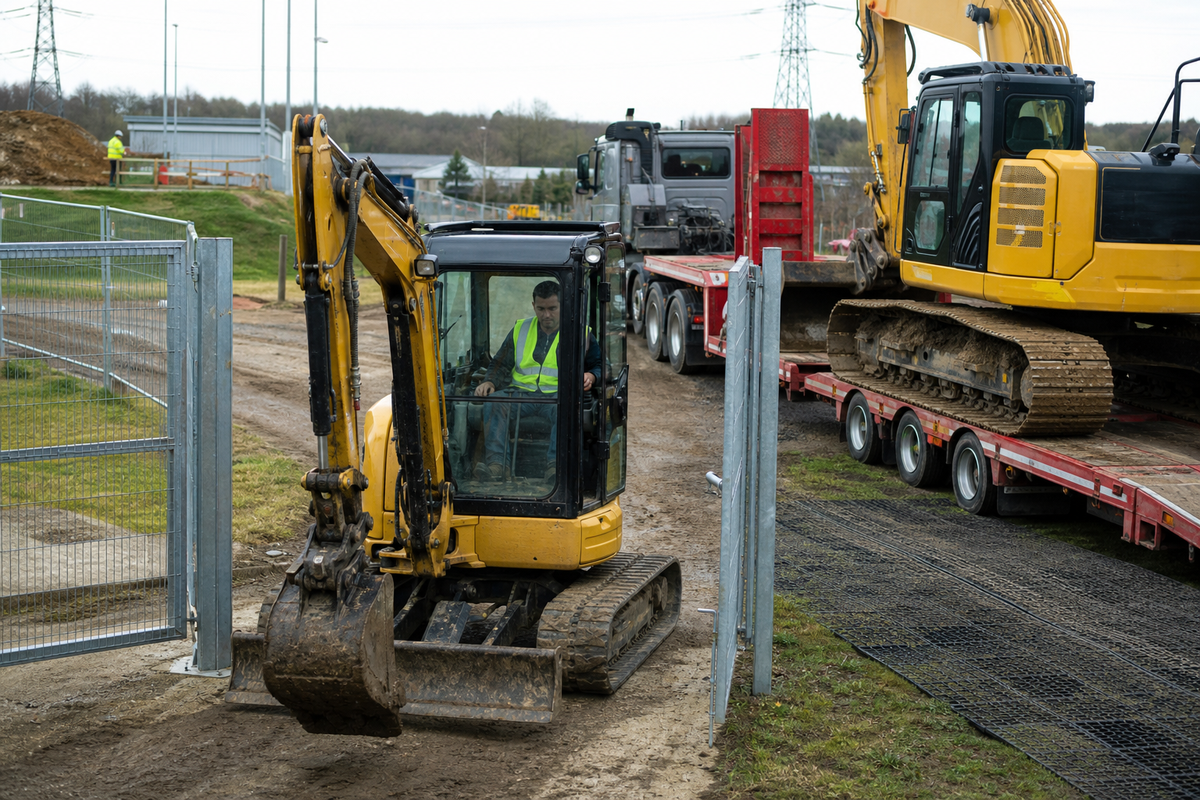
Those first two parameters will establish how large you “need” to go; however, site access and ground bearing pressure can quickly size you back down. Three checks will tell you if a machine that can perform the work can even get there and sit on it without trouble.
Access and tail swing. Figure the width of the narrowest gate, door, or space between buildings that your machine must traverse (the smallest Cat mini is just under 2’ 5” wide in its retractable-undercarriage configuration). If the work is near a wall or building, reduced-tail-swing (RTS) or zero-tail-swing (ZTS) units keep the counterweight within the tracks for tighter swing without knocking anything over.
Transport. How you’ll get the machine to the job site isn’t a secondary consideration, it’s a firm constraint. Under U.S. federal regulations, loads more than 8’ 6” wide, more than 80,000 pounds gross, more than 13.5’ high, or longer than 53’ require special permits. Minis ride on a Class 1 or 2 truck with minimal fuss; heavier machines need a lowboy and start to approach legal width and weight limits.
Ground bearing pressure. Here’s a surprising fact: heavier doesn’t always equal greater ground pressure. Wider tracks help large machines distribute their weight more widely. A ~9,000-lb CASE CX42D mini weighs in around 4.1 psi (28.2 kPa) on the ground, while a 77,400-lb CAT 330L has a ground pressure of approximately 7.6 psi, per a state equipment spec; a difference far less than what their respective weights would suggest. Pay close attention to this specification when working on soft, wet or finished ground (e.g., turf, pavers). Get it wrong and a machine chosen on weight alone sinks in mud or cracks a finished driveway — an expensive mistake, and one of the most common site-damage claims we hear from buyers who oversized.
Bucket Size and Attachments by Machine Size
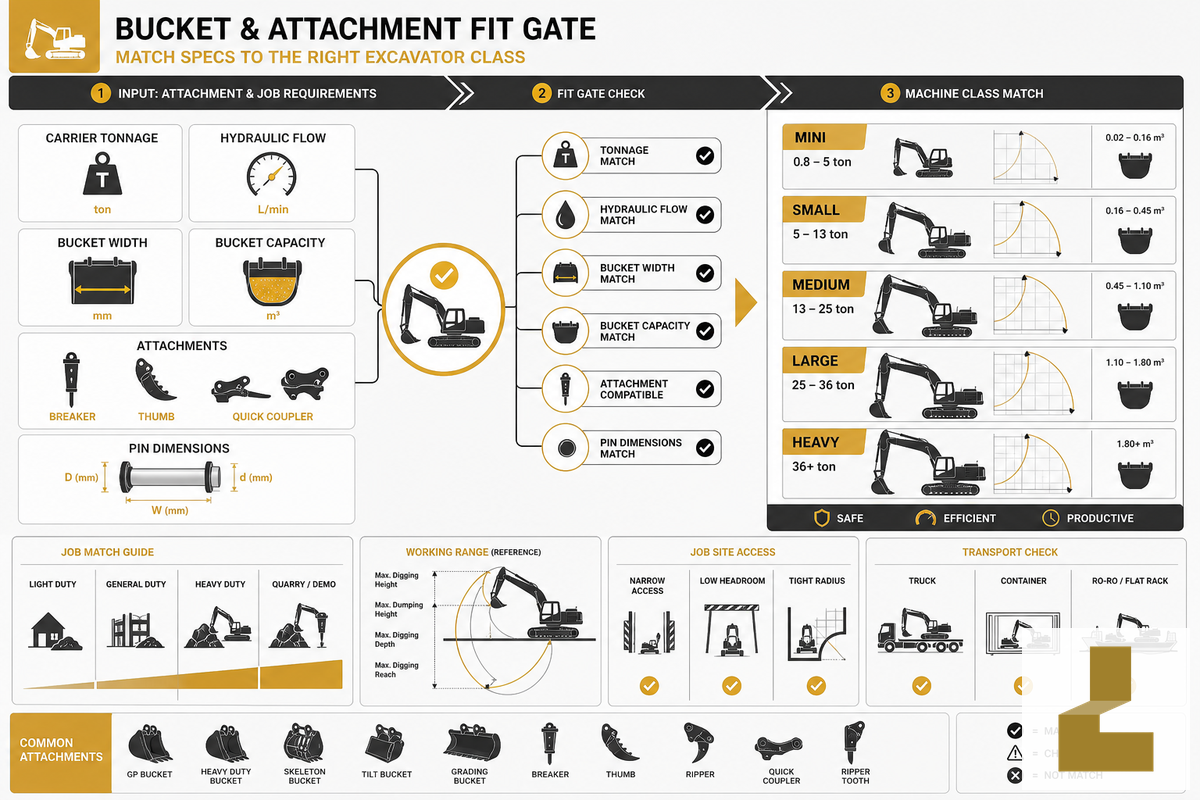
With the class narrowed, the bucket and attachments fine-tune productivity. Bucket width and capacity must match both the machine’s hydraulic flow and the task: a 12 in trenching bucket for a water line, a 24–36 in digging bucket for footings, or a 48–60 in grading bucket for cleanup. As a rule of thumb, a 3–8 ton mini runs buckets from about 12 in to 36 in wide, while a 20 ton standard machine carries 36–60 in buckets holding 0.5–1.5 cubic yards. Oversize the bucket and you starve the machine — it stalls or wears out early; undersize it and you burn extra passes. Bucket width also plays against the width of a mini excavator itself: on a sub-2 ton machine barely 3 ft wide, an over-wide bucket overhangs the tracks and hurts stability. When buying, picture a footing crew that grabs the widest bucket on the rack: the wrong bucket is a costly mistake that wears pins early and can tip a light machine — a defect we catch on inspection before any Liehuang machine and its tooling ship.
Attachments can also be a constraint in your size selection. Hydraulic breakers, thumbs, augers and shears each have their own requirements for hydraulic flow and carrier weight, so a job that needs a breaker or shear can force you up to a larger machine class. One quick coupler can let a machine switch tools without an additional crew on-site. Consult our excavator bucket sizing guide before settling on a class size.
The Cost of Getting the Size Wrong (Over- vs Under-Sizing)
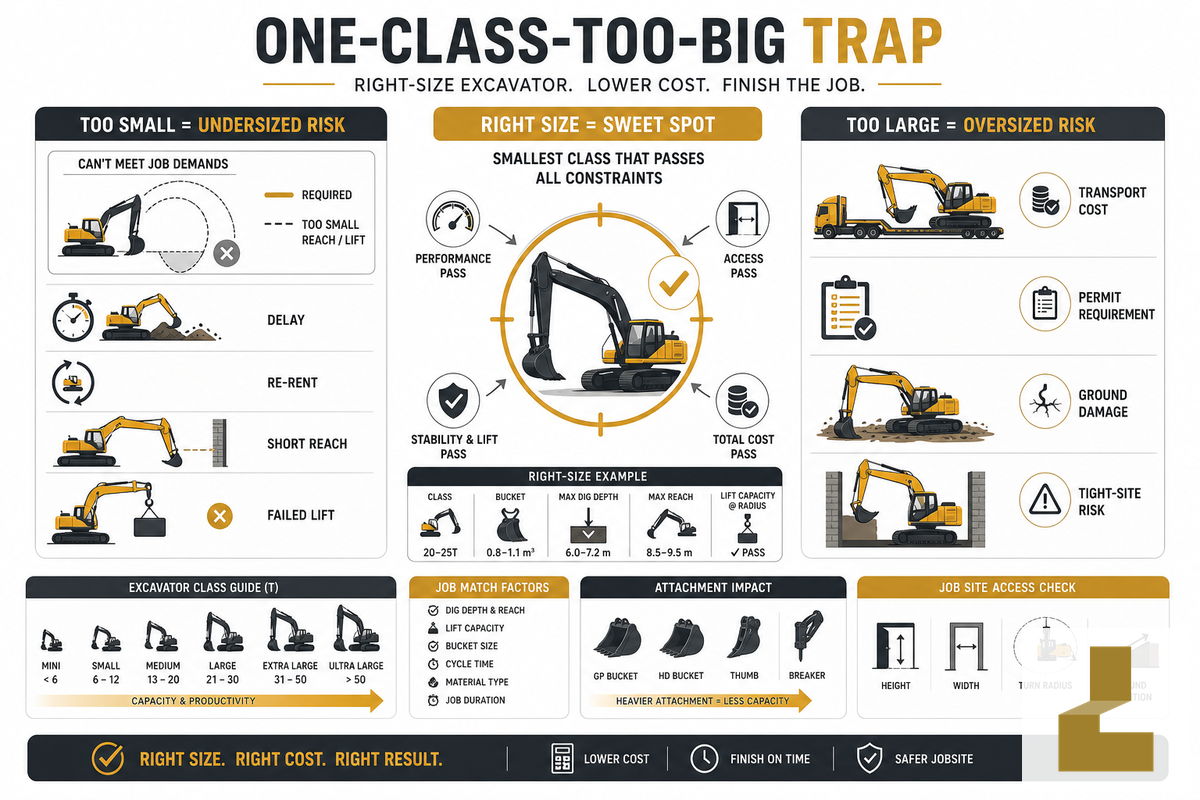
Moving up and down in size has its costs. Undersizing shows up as delays and re-rent costs: your machine can’t reach the required depth or lift the payload, so the job slows or stops. Oversizing is less noticeable in the immediate sense but can be more costly overall on smaller jobs, especially in the form of “The One-Class-Too-Big Trap.” That means you’re paying for capacity that isn’t used while footing the bill for a larger machine, heavier trailer, oversize permits and lost time maneuvering it around a tight site. Size isn’t the same as safety – a machine that’s out of scale with the site is a hazard.
“It has to be large enough to get the job done, but bigger isn’t necessarily better. How tight is the jobsite? Are there buildings close to one another?”
Peterson Cat, machine selection guidance
Costs scale rapidly with machine size on both sides of the rental or purchase equation. Renting a 1-5-ton mini costs $200-$425 per day, while a standard 6-15 ton model runs $500-$1,200; even a single move costs $150-$300 for a mini versus $600-$1,200+ for a large machine. Purchase costs climb equally fast with weight. Because we export used machines across the globe, we’ve established some price ranges on the FOB-by-Tonnage Reference Ladder:
| Class / example | Weight | Used FOB reference |
|---|---|---|
| Mini — Kubota U35 | 3.7–3.8 t | US$13,000–22,000 |
| Standard — Komatsu PC200 / CAT 320 | ~20 t | US$25,000–58,000 |
| Standard — Hitachi ZX210 | 22 t | US$25,000–52,000 |
| Large — Volvo EC480 | 48–50 t | US$55,000–95,000 |
Liehuang export inventory FOB reference ranges; price will vary based on hours, condition, and features.
6 Excavator Sizing Mistakes That Blow the Budget
- Sizing to the headline lift number instead of the load chart at your working radius.
- Forgetting trench-box and benching width, so the machine can’t reach across the opening.
- Ignoring transport – buying a machine you can’t legally trailer without a permit.
- Choosing on weight alone and crushing soft or finished ground (check ground pressure).
- Oversizing “to be safe” on a tight residential site (the One-Class-Too-Big Trap).
- Undersizing depth – picking a machine that stops a foot short of the footing.
Deciding whether to rent or buy at your chosen size? Weigh usage against ownership with our used vs new cost comparison and estimate delivery with the landed cost estimator.
Brand Size Lineups: Turning a Class Into Real Models
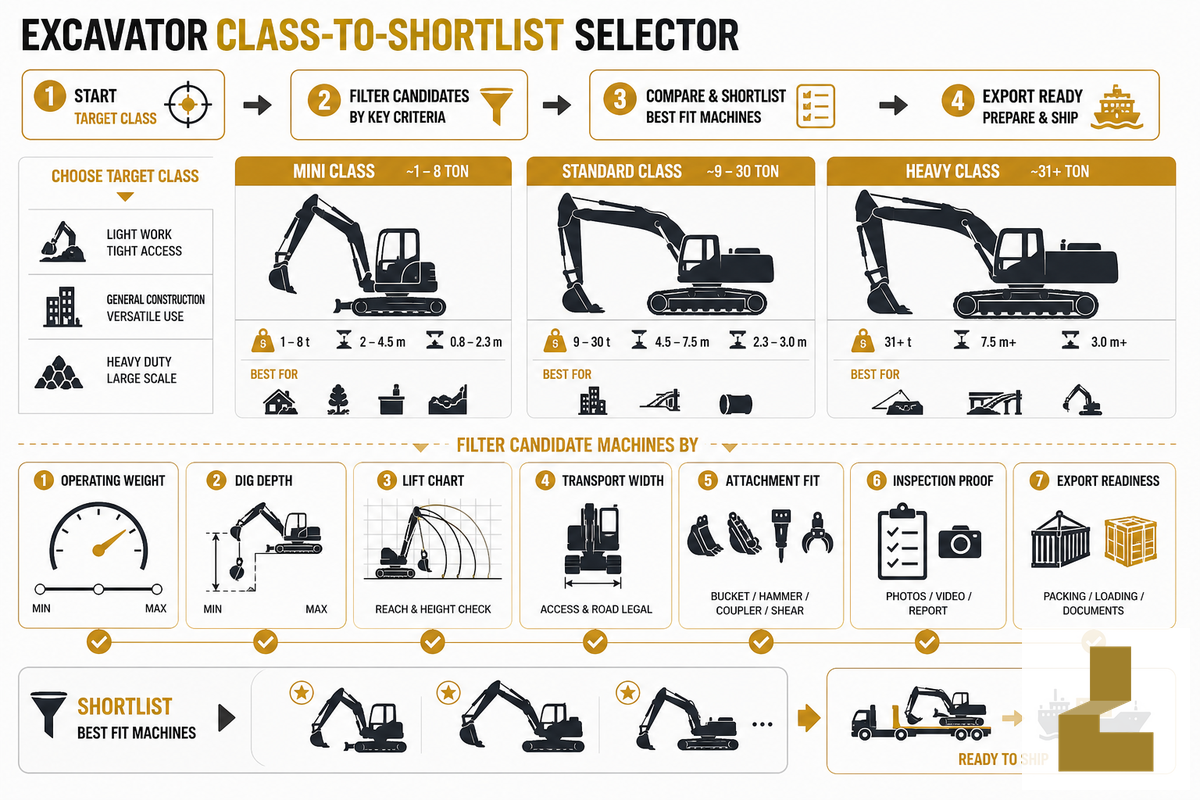
Once you’ve fixed a class and a dig-depth target, translate it into models. Major brands each ladder their range by tonnage, so “20-ton standard” quickly becomes a shortlist you can price and inspect:
- ✔Caterpillar: 305 (mini) → 320/325 (standard) → 336/395 (large)
- ✔Komatsu: PC35/PC55 (mini) → PC200/PC210 (standard) → PC360/PC400 (large)
- ✔Kubota: U17/U25/U35, a mini-class specialist
- ✔Volvo: EC55/EC60 (mini) → EC210 (standard) → EC480/EC750 (large)
- Hitachi / Hyundai / Sany / Doosan / Kobelco: full ladders from ~3 t to 50 t+ — every unit we export is inspected and condition-graded before it ships, so a class shortlist becomes real machines you can price
Not sure which model size class covers your dig depth and budget? Use our excavator tonnage selector, or browse the used excavators sorted by class. The used excavator buying guide walks through a complete pre-purchase workflow, including inspection and hours.
What’s Changing in Excavator Sizing (2026 Outlook)
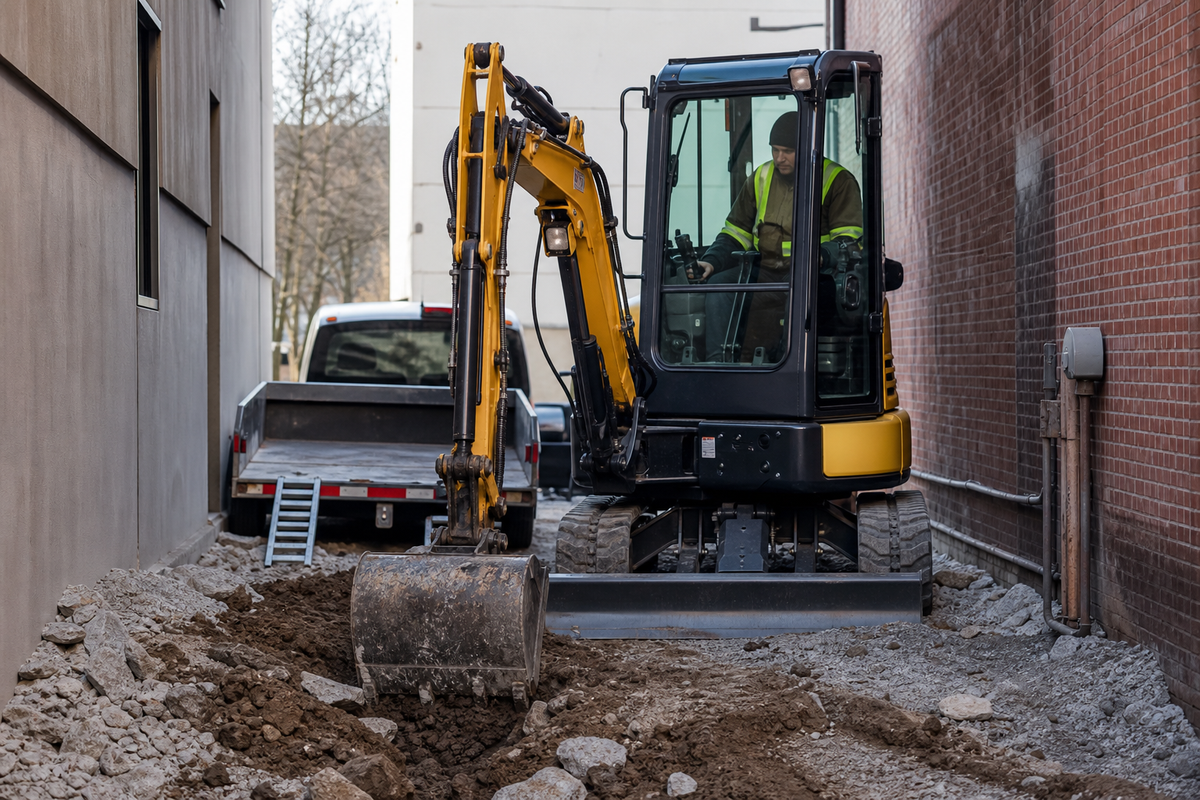
For buyers, a larger number on a class isn’t what’s most important – it’s that the class boundary is moving down. New reduced-tail-swing and zero-tail-swing designs, plus battery-electric minis, now allow access-constrained and indoor applications that previously used the next size up.
That broadens the scope of a mini or midi, and can save a trailer class and oversize permit on urban projects. For example, a landscaper who once trailered a 6-ton machine to dig between two houses can now do the same work with a 3.5-ton zero-tail-swing unit — no oversize permit, no siding clipped by a swinging counterweight. Buyers who oversized to a full 20-ton machine for a tight urban lot regret it when the oversize permit and low-loader bill arrive; take a real example from our export desk — a contractor who switched to an inspected zero-tail-swing mini cut both the permit and the site-damage claims. At CONEXPO 2026, all-electric and next-generation mini machines topped the manufacturer’s lineup, and the trend is noted in patents for zero-tail-swing versions (Google Patents CN105569102B, for example).
Market data remains informative, not definitive: the market for zero-tail-swing minis is forecast to rise at around 5.8% annually into the mid 2030s. One key takeaway in sizing today: for a job limited by access, double-check that current reduced-tail-swing models still clear the work before you overshoot your class – the answer has changed in the last couple of years.
Frequently Asked Questions
How do I determine what size excavator I need?
Determine size by working four constraints in order.
Always double-check the four constraints in order, then choose the smallest class that passes each: needed dig depth and reach, lifting power at your working radius, jobsite access and transport width, and maximum ground bearing pressure. Those first three determine the lower size limit; ground pressure determines whether soft ground demands a wider footprint. Identify the job type, then make sure the model you choose is certified to the spec sheet.
What size excavator do I need for a foundation or footings?
Most residential foundations suit a 5–8 ton machine.
Most residential foundations require an excavator weighing between 5 and 8 tons that can dig around 10-15 ft, covering footing depth and the frost line. If footing depth is shallow, a mini from 3 to 5 tons may be enough, but if your excavator weighs less than around 2 tons, it may not cut it on depth. Move up to a 10 to 13-ton midi to excavate full basements, heavy clay soils, or when there is a need for extra reach to move spoil away from the hole.
How deep can a mini excavator dig?
Roughly 6 to 15 ft, depending on the mini’s weight — about 6 ft on the smallest 1-ton units, up to 15 ft on the largest 8-10 ton machines, with a common 3-ton mini reaching around 8.5 to 9.5 ft.
Mini excavators dig anywhere from roughly 6 ft on the smallest 1-ton models up to 15 ft on the largest 8-10-ton units. Most 3-ton minis reach 8.5 to 9.5 ft. Always check the specific model maximum dig depth – and bear in mind OSHA rules for 5 ft protective systems and 4 ft safe exit.
What size excavator do I need for house demolition?
Most structure demolition needs a 20–35 ton machine.
Most residential and small commercial demolitions are performed with excavators in the 20-35-ton range, which provide the reach and hydraulic flow for breakers, shears, and grapples. Tiny outbuildings can be excavated with a large mini or midi, but larger buildings require standard-class power.
Is a bigger excavator always better?
No — oversizing often costs more and fits worse.
No. Any machine larger than required for the site costs more to rent, transport, and permit, and is less efficient to operate in tight situations – the One-Class-Too-Big Pitfall. Choose the smallest class that satisfies each of the four constraints.
What size excavator can I move on a standard trailer?
Generally up to a standard machine that stays under 8 ft 6 in wide and 80,000 lb gross; minis tow behind a 3/4-ton pickup, while anything wider or heavier becomes an oversize move that needs state permits.
Minis ride behind 3/4-ton pickups and usually do not require a CDL. But once you are 8’ 6” wide, need a road-travel permit, or have an 80,000 lb gross weight, it’s oversize and requires permits. Tonnage becomes irrelevant. Your limiting factor then becomes capacity on the trailer and machine transport width.
Why We Wrote This
Liehuang sells inspected, used excavators to importers throughout the world – from 3.7 ton mini excavators like this Kubota, up to 48 ton Volvo machines. We’ve seen plenty of costly errors made on buyer selection when the machine arrives in the buyer’s country. This FOB price range with the associated class notes is based on actual export records, inspection data, published spec sheets, and safety requirements from our own inventory.
Still not sure which class fits your project?
References & Sources
- ISO 6165, Earth-moving machinery: Basic types, identification and terms International Organization for Standardization
- OSHA 29 CFR 1926.651, Specific Excavation Requirements U.S. Occupational Safety and Health Administration
- 29 CFR Part 1926 Subpart P, Excavations (sloping, benching, protective systems) U.S. Electronic Code of Federal Regulations
- Typical Construction Vehicles and Equipment (ground pressure reference) New York State Department of Public Service
- Patent CN105569102B, Zero-tail-swing work machine Google Patents
Reviewed by the Liehuang Used Excavators technical team.

![Excavator Bucket Manufacturers: Buyer Evidence [Guide]](https://lhusedexcavator.com/wp-content/uploads/2026/08/excavator-bucket-manufacturers-r2-featured-768x512.png)