Get in Touch with Liehuang Company

Used SANY Excavators: How to Verify a Machine Before You Buy

Used SANY Excavators are pre-owned machines that should be judged by the evidence attached to one serial number, not by a brand reputation, a meter photo, or a short cold-start video. Before you accept a machine, connect its identity, hours, service history, previous work, warm-condition performance, unresolved gaps, and final documents. If one link fails, the buying decision should change.
This guide gives you a seven-link SANY Unit Evidence Chain. It is a purchase-evidence method, not a warranty, import clearance, safety certificate, or substitute for an independent inspection. Its purpose is simple: turn seller claims into proof and turn missing proof into one of three written outcomes—Accept, Conditional Accept, or Reject.
Updated August 2026. You can learn about Liehuang’s used-equipment export work.
The short version
- Bind every claim and file to the full machine serial number.
- Trace where the hour evidence originates; three screens can repeat one controller record.
- Grade service evidence by chronology and serial connection, not by document volume.
- Treat duty cycle as a bounded inference, not a complete reconstruction.
- Require continuous warm-operation proof and an independent check where risk warrants it.
- Write material evidence gaps into a decision register.
- Match the accepted machine, documents, attachments, repairs, and loading evidence before payment.
1. Confirm Identity and Test the Claimed Configuration
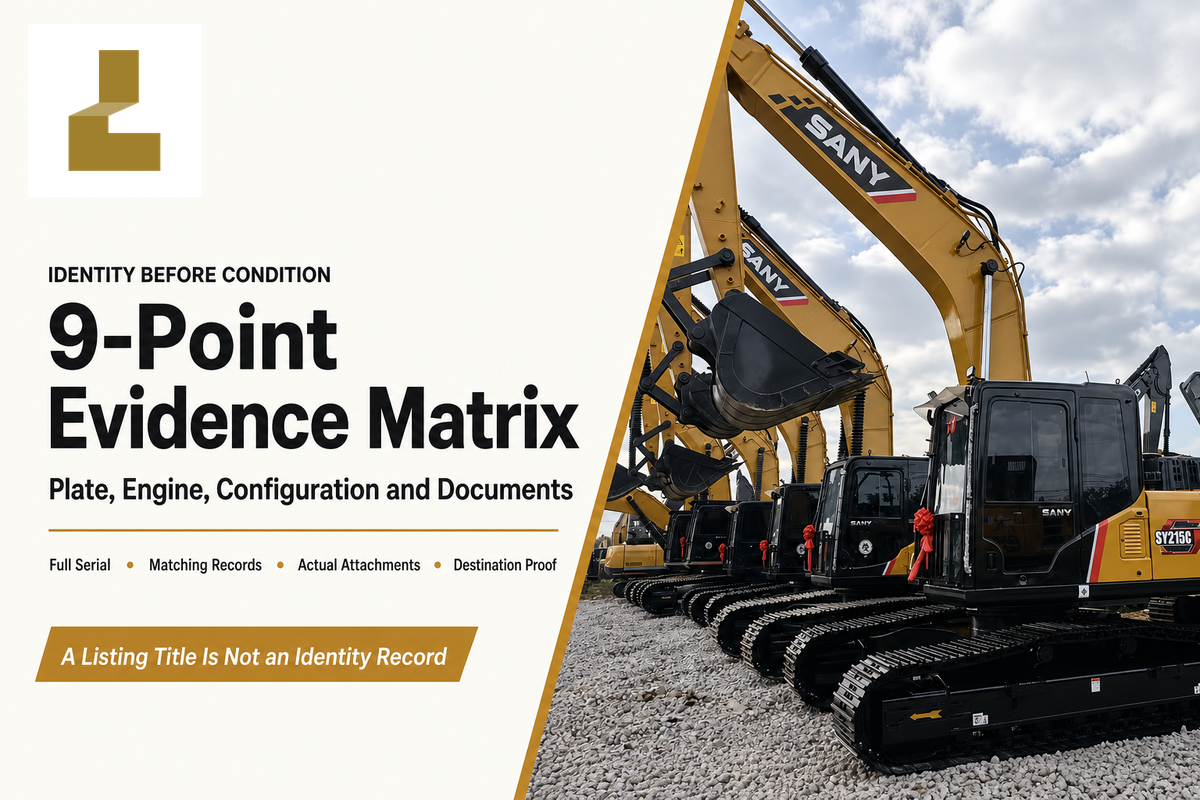
Listing titles aren’t identity records. “SANY excavator,” a painted model decal, or a seller-supplied specification sheet doesn’t establish the year, regional configuration, diesel engine package, boom, counterweight, auxiliary circuits, or attachments on the machine in front of you. Across eight current Liehuang SANY product pages, published operating weights span roughly 1,860 to 36,000 kg. SANY’s separate large-excavator class page publishes a broad 36–125 t, 205–567 kW, and 1.5–8 m³ range. For another regional illustration, the OEM model page lists examples such as 1,825 kg with 11.2 kW, 3,855 kg with 18.2 kW, 21,900 kg with 114 kW, and 34,300 kg with 190.5 kW. These published figures show why the phrase covers materially different machine classes; none proves the specification or condition of an offered serial.
Start a serial-bound identity record before you discuss condition. Ask for one continuous walkaround that shows the full product-identification plate, engine label, powered dashboard, major attachments, counterweight, boom and stick, track frame, cab, and the machine from all four corners. The serial on the plate should match the quotation, invoice, service records, inspection report, packing list, and any emissions or import document that names the machine.
9-Point Identity Evidence Matrix
| Evidence category | Minimum evidence | Mismatch response |
|---|---|---|
| Model, year, serial | Readable plate, dashboard context, matching sales documents | Pause until the seller explains and documents the conflict |
| Engine and market configuration | Engine label, emissions label, applicable manual or manufacturer confirmation | Do not infer compliance from a similar model |
| Attachments and circuits | Photos, part plates where present, hose routing, coupler and live function proof | List the exact included equipment in the acceptance terms |
| Published specification | Correct regional/model source plus actual-machine evidence | Treat web specifications as context, not serial proof |
| Hour display | Powered dashboard shown continuously with the machine plate | Trace controller origin and compare chronology and wear |
| Service chronology | Serial, date, recorded hours, work, parts and workshop identity | Mark uncovered periods and major repairs as open gaps |
| Safety equipment | Seat belt, brakes, horn, alarms, guards and coupler evidence where fitted | Escalate defects to a competent inspection and repair decision |
| Destination documents | Serial-bound engine, emissions, customs or conformity records required for the route | Confirm with the responsible authority or broker |
| Final handover | Loading evidence shows the accepted serial and included equipment | Stop payment release if the loaded asset differs |
If you’re comparing mini excavators, a compact excavator, financing terms, or price, keep that commercial shortlist separate from serial verification. Readers searching for used SANY excavators for sale or a used SANY mini excavator still need to verify the shortlisted serial, while a generic used SANY excavator review can’t establish that unit’s condition. Use the site tool to match a SANY model to the job, then apply the same evidence chain to the particular machine offered for sale.
2. Trace the Origins of the Hour Evidence
With serial identity established, test whether the hour story holds together.
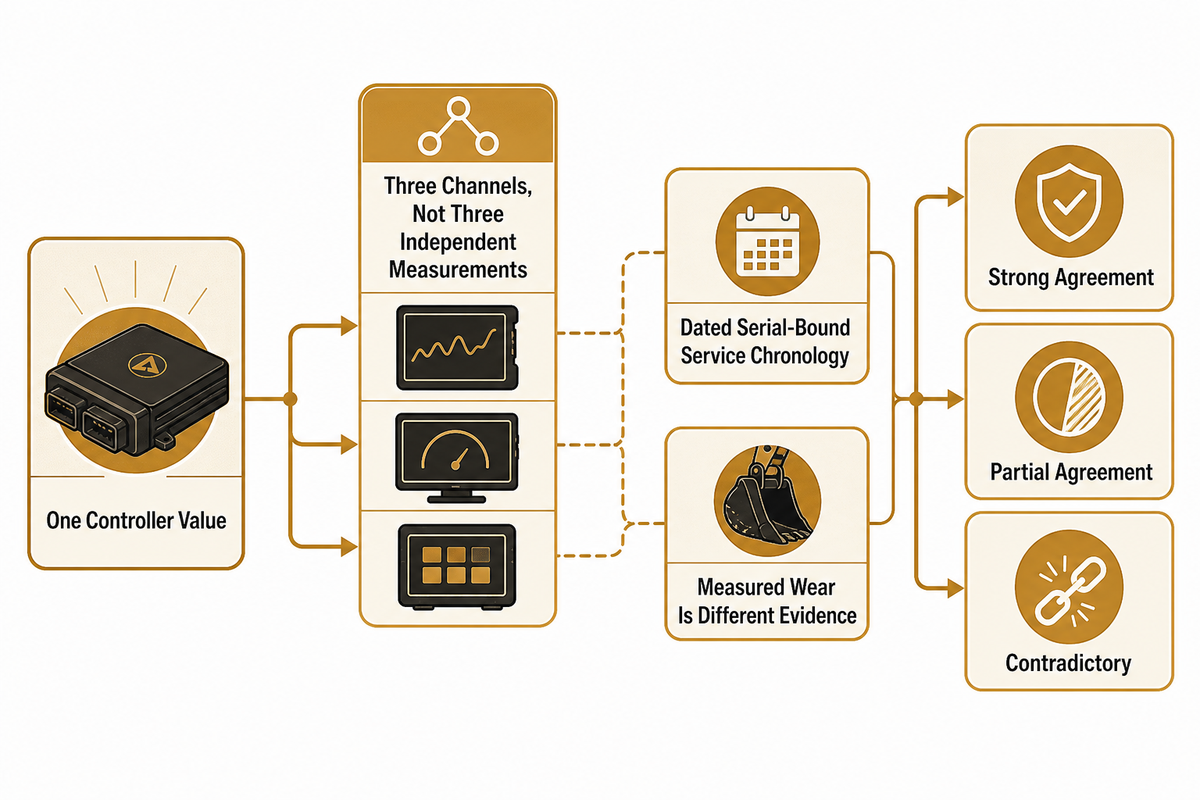
Displayed hours are evidence, but the number becomes meaningful only when you know where it came from and what agrees with it. Dashboard, diagnostic, and telematics screens can all inherit the same controller value. Three agreeing screens are therefore three channels, not automatically three independent measurements.
Build the comparison in layers. First, obtain a powered-on dashboard video that shows the hour display in the same continuous sequence as the plate and machine. Second, request a dated chronology of services, filter changes, fault events, major repairs, component rebuilds, workshop visits, and any diagnostic or telematics export. Third, compare the chronology with physical wear: controls and pedals, cab entry points, pins and bushings, slew behavior, undercarriage measurements, bucket interfaces, hose condition, and guarding.
Source origin matters. Ask whether a diagnostic hour value is read from the same controller as the dashboard. Ask how far back the telematics record extends and whether there are missing ownership or subscription periods. By contrast, a service invoice with a date, recorded hours, machine serial, and workshop identity is a different kind of evidence from another screen image. Measured wear is different again, although wear also varies with soil, attachments, travel, maintenance, and operator practice.
- Strong agreement: identity, chronology, diagnostics where available, and measured condition tell a coherent story.
- Partial agreement: the displayed number is plausible, but one material period or source is missing. Make closure of that gap a condition before payment.
- Contradictory: dates, serials, controller history, repair chronology, or physical wear can’t be reconciled. Don’t “average” the conflict into a comfortable answer.
There’s no defensible universal hour limit for a SANY excavator. A higher-hour unit with traceable maintenance, known duty, measured wear, and acceptable warm performance can present less uncertainty than a low-hour unit whose documents and condition disagree. For the broader framework, interpret hours with condition evidence.
3. Grade the Service Record, Not the Service Claim
That hour analysis depends on the service history behind it.
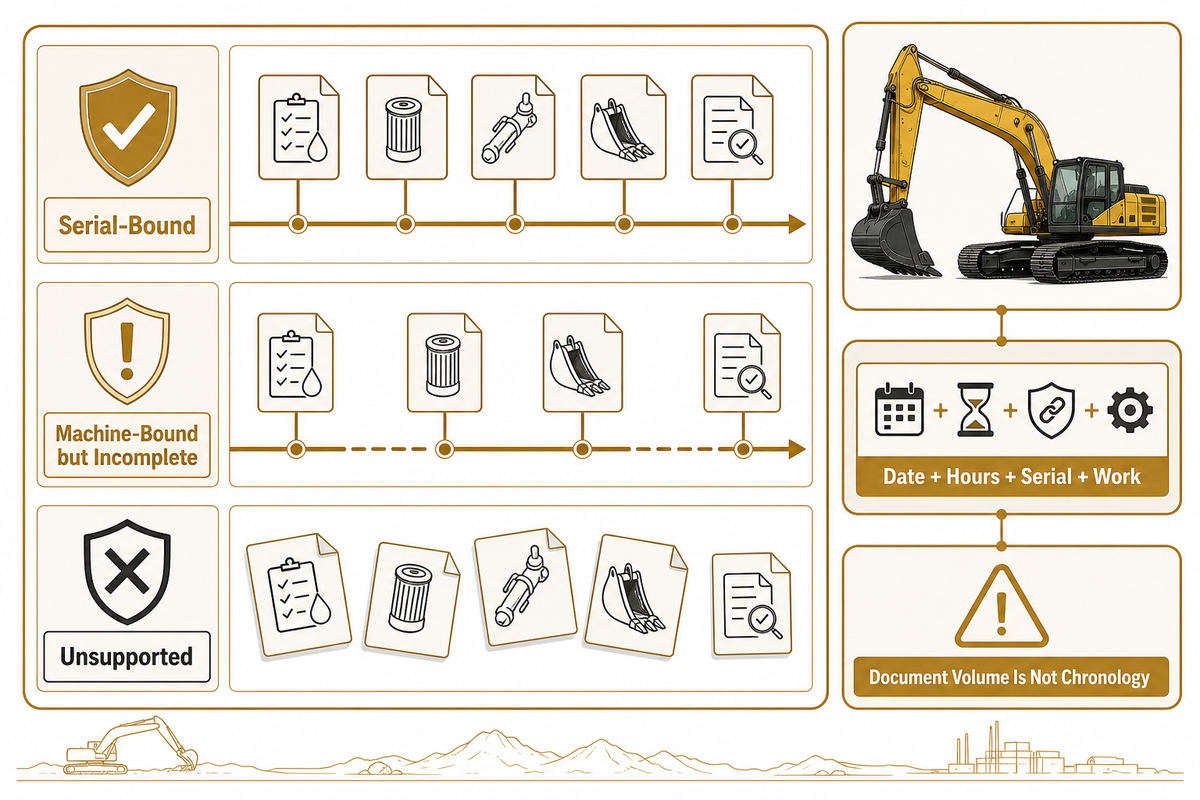
“Serviced regularly” is a claim. A usable service record is a chronology. The risk is a plausible-looking file that conceals a gap because its dates, recorded hours, or serial references don’t match. Each meaningful entry should identify the date, recorded hours, serial or machine reference, work performed, parts or fluids used, technician or workshop, fault codes, major repairs, rebuilds, and unresolved items. A stack of undated invoices for unnamed equipment isn’t equivalent to a serial-bound history.
Grade what you receive:
- Serial-bound: records consistently name the machine and form a plausible hour-and-date sequence.
- Machine-bound but incomplete: the serial or other strong identifier is present, but important periods, major events, or meter transitions are missing.
- Unsupported: the seller offers a verbal assurance, generic checklist, loose receipts, or photos that can’t be tied to the serial.
SANY’s current maintenance guidance covers fluids, filters, hydraulics, cooling, lubrication, and undercarriage. Those categories are useful for testing whether a chronology is plausible. Ask whether fuel or fluid contamination findings were documented when relevant. Exact intervals still depend on the model, manual, market, operating conditions, and fluid specification, so don’t convert a general web guide into a universal schedule.
Warranty claims need the same discipline. SANY America’s public warranty page states five years or 5,000 hours for every new excavator. The reviewed page doesn’t establish coverage for a used serial, second owner, exported machine, or another region. If warranty value affects your decision, require written confirmation for the exact serial from the responsible manufacturer entity or authorized dealer.
4. Read Previous Duty-Cycle Clues, Do Not Claim a Complete Reconstruction
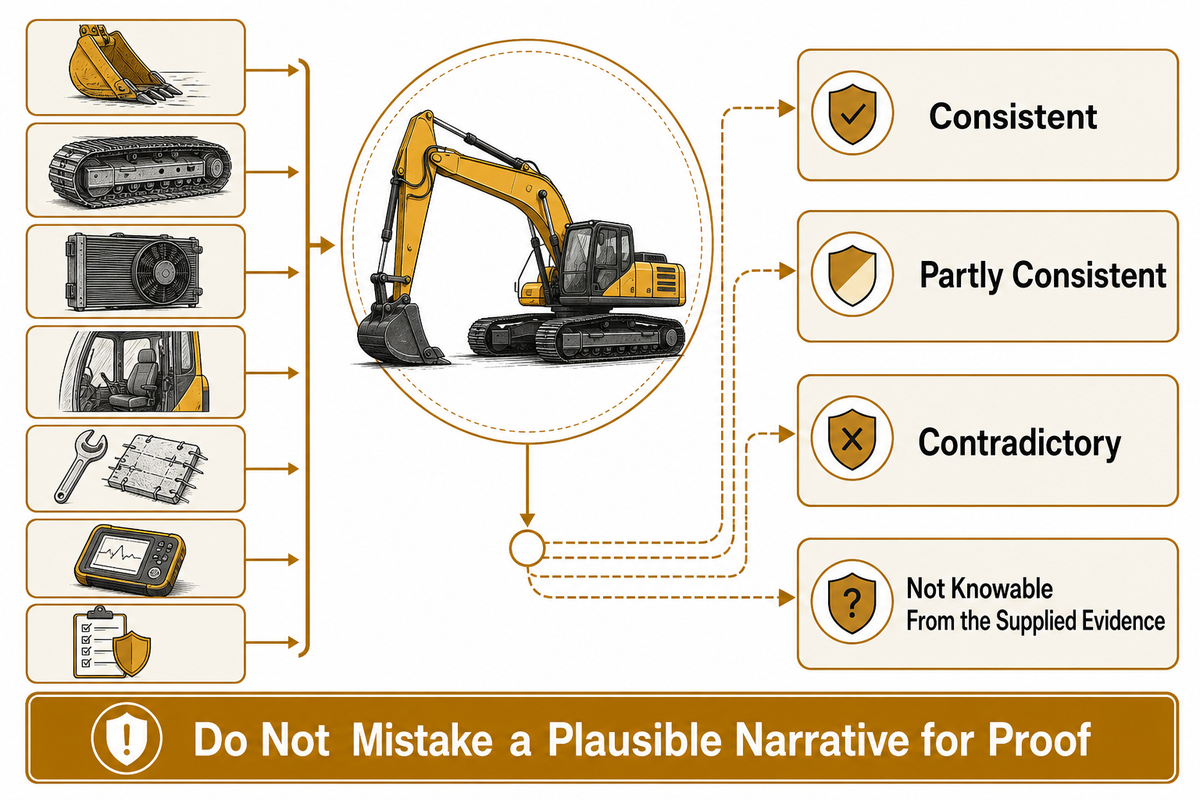
Two excavators with the same displayed hours can have very different histories. Repeated demolition handling, quarry travel, utility trenching, rental rotation, light landscaping, long idle periods, abrasive material, salt exposure, or poor cleaning can leave different evidence. The buyer’s job isn’t to guess a dramatic story; it’s to test whether the available clues agree with the seller’s account.
Compare former attachments and job descriptions with attachment-pin wear, guarding, undercarriage measurements, cooling-pack cleanliness, cab and control wear, travel components, hydraulic temperatures or fault chronology, repairs, and rebuilds. Where the machine supports diagnostics or telematics, ask for operating-mode, idle, temperature, and fault-history summaries. Then record the coverage period and the originating system. A standardized export format doesn’t prove that earlier onboard data were complete, continuously retained, or immune to gaps.
Use SANY’s maintenance guidance to test whether the claimed history covers expected service categories, not to reconstruct every operating cycle.
Use four labels: consistent, partly consistent, contradictory, or not knowable from the supplied evidence. That last label is valuable. It prevents a plausible narrative from being mistaken for proof.
Are SANY excavators any good?
Reliability is conditional. Brand reputation can’t establish the identity, prior duty, maintenance, local support, configuration, or current condition of one used unit. A specific SANY excavator becomes a credible heavy equipment candidate when its serial-bound evidence is coherent and its performance is acceptable for the intended job. It becomes less credible when the story depends on assumptions that the machine and documents can’t support.
5. Require Condition Proof Under Real Operation
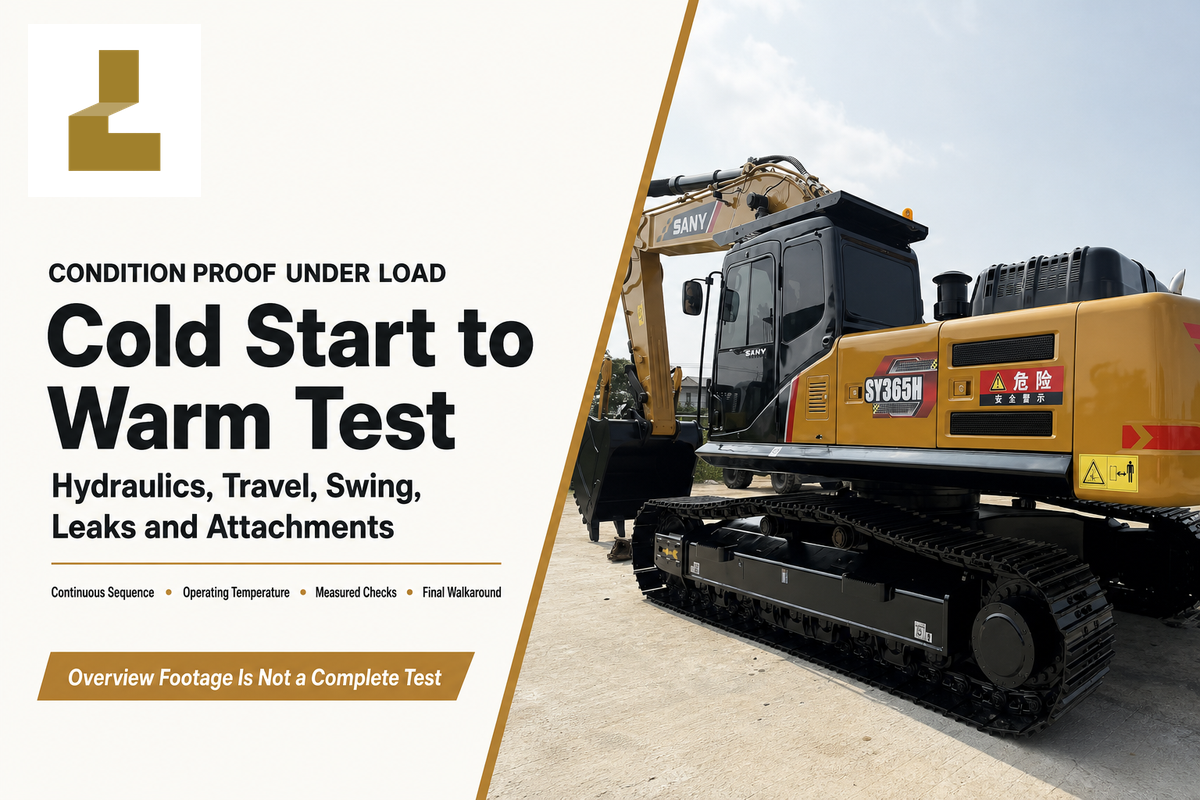
Clean walkaround footage and a cold start are opening evidence, not a complete condition test. Ask for a continuous evidence packet that establishes ambient context and a true cold start, then shows the machine reaching operating temperature and completing an agreed function cycle. Include boom, arm and bucket movements, swing, straight travel, steering response, simultaneous hydraulic functions, auxiliary circuit and coupler where fitted, dashboard warnings, visible leaks, abnormal smoke or noise, undercarriage views, and a second walkaround after warm operation.
Keep the core sequence continuous. Edits are acceptable for an overview, but not where they hide the transition between cold start, warm-up, repeated cycles, alarms, or a leak check. Ask for the dashboard and machine to appear together at key points. If diagnostic history or service codes are available, include the report and identify the machine and date.
“Loose pins and bushings are a key sign of how the machine has been treated.”
The same source recommends measurement-led checks, repeated hydraulic cycles, drift observations, and a final walkaround after the machine is warm. Caterpillar’s certified-used inspection method also illustrates why configuration, history, fluid results, service codes, components, and operational tests belong in one decision. It is a cross-brand methodology example; it does not certify a SANY machine.
Attachment testing has a safety boundary. The live page for NIOSH’s 2022 science bulletin recommends verifying coupler engagement and required locking components and performing the manufacturer-specified connection test, while keeping people clear of elevated attachments and the swing radius. Treat that bulletin as a safety boundary, not as a current instruction manual for every coupler. Do not improvise a connection test from this article; use the applicable machine and coupler instructions, current local requirements, and competent personnel.
A warm function test still does not certify fitness for every intended use. If the excavator will lift, operate with specialized attachments, or work under destination-specific safety rules, define that use before purchase and obtain the competent examination, safety devices, documentation, and local review required for it. For the physical procedure, run a full used-excavator inspection.
What are common problems with SANY excavators?
Use leaks, cooling performance, electronic or emissions alerts, hydraulic response, undercarriage wear, loose linkages, and attachment issues as inspection targets, not as universal SANY defects. Describe a problem as model-wide only when reliable model-specific evidence supports that conclusion. Otherwise, report what was actually observed on the offered serial, what test exposed it, and what remains unverified.
6. Turn Material Evidence Gaps Into a Written Decision
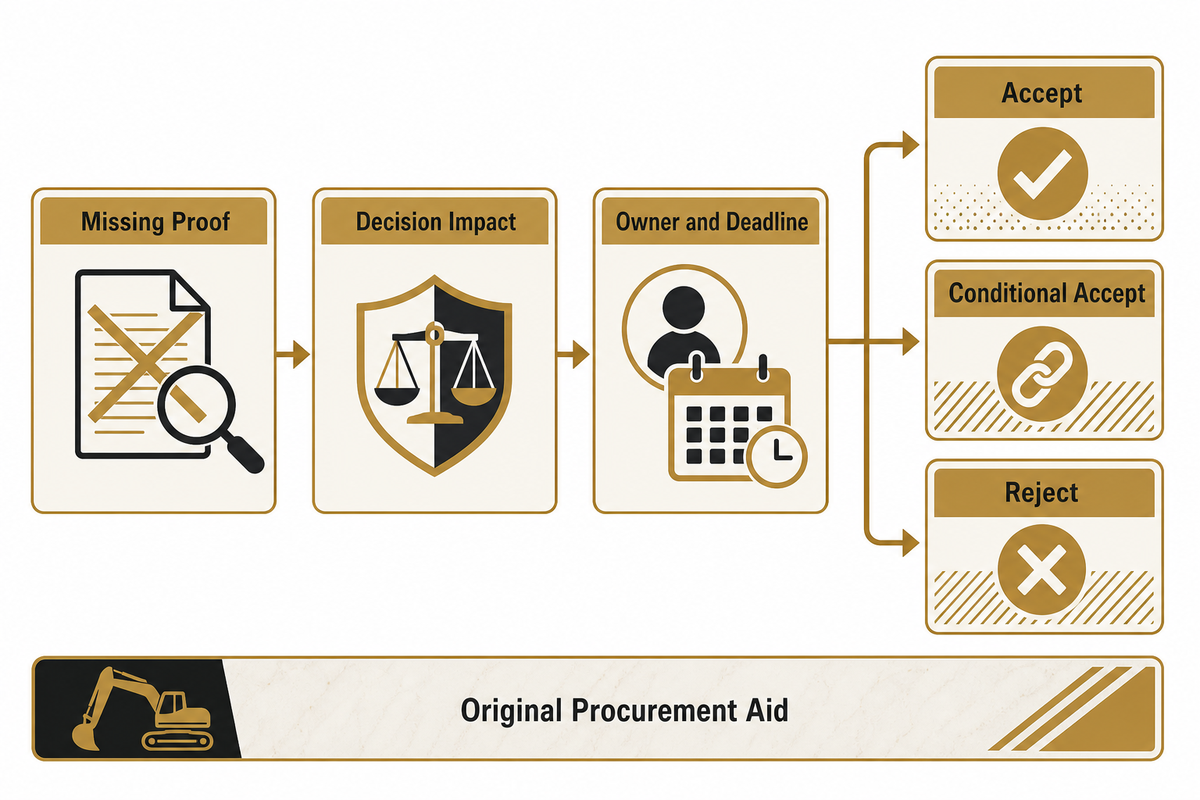
Missing evidence shouldn’t disappear into chat history. Put only decision-changing gaps into a Gap-to-Decision Register. This register is an original procurement aid, not a SANY standard or legal requirement. Its value comes from forcing a clear next action before money moves.
| Missing proof | Decision impact | Owner and deadline | Outcome |
|---|---|---|---|
| Diagnostic history does not name the serial | Hours and fault chronology remain unbound | Seller supplies serial-bound export before deposit milestone | Conditional Accept |
| Machine plate conflicts with invoice | Identity of the offered asset is unresolved | Seller resolves with verifiable original documents | Reject until resolved |
| Warm-cycle evidence is incomplete | Hydraulic and leak condition remains uncertain | Independent inspector repeats the agreed test | Conditional Accept |
| Major repair appears without supporting record | Repair scope and component history remain unknown | Seller supplies parts and workshop evidence before acceptance | Conditional Accept |
| Included attachment cannot be identified | Compatibility and included-equipment terms are uncertain | Seller identifies and function-tests the attachment | Conditional Accept |
| Required engine or emissions label is unreadable | Destination admissibility cannot be confirmed | Responsible authority or broker confirms acceptable serial-bound proof | Reject until resolved |
| Undercarriage measurements are missing | Wear and near-term cost exposure remain uncertain | Independent inspector records agreed measurements | Conditional Accept |
| Warranty claim lacks serial confirmation | The offer may overstate after-sale protection | Responsible SANY entity confirms terms in writing | Reprice or Conditional Accept |
| Loading proof is not tied to the accepted serial | The shipped asset or included equipment may differ | Seller supplies continuous serial-and-load evidence before release | Hold payment |
Use Accept when load-bearing claims are corroborated and the acceptance terms are clear. Use Conditional Accept when a defined gap can be closed by a named party before a deadline or payment milestone. Use Reject when identity conflicts, materially contradictory hour evidence, refusal of an agreed independent test, or undisclosed faults remove the basis for the offer.
Don’t turn the register into a hundred-line tick-box exercise. Record a gap only if it affects identity, condition, intended use, admissibility, cost exposure, included equipment, or the acceptance outcome. Don’t invent a universal repair reserve: parts, labor, freight, availability, model, market, and inspection findings all change the real exposure.
7. Bind the Acceptance File to the Serial Before Payment
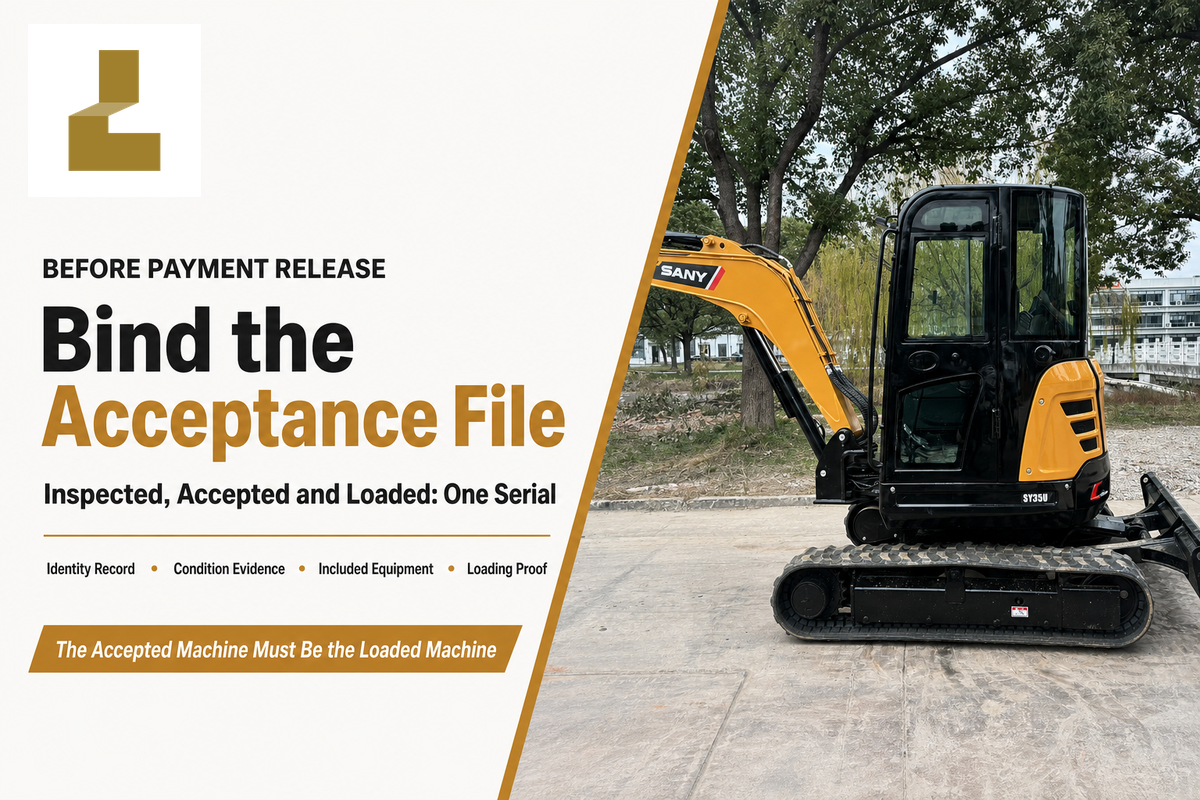
Conditions and deadlines from the previous register feed this file, which preserves the final outcome.
The final file should preserve the machine you inspected, the machine you accepted, and the machine that’s loaded. Bind the following to the same full serial number:
- identity record and configuration evidence;
- hour evidence and service chronology;
- condition report, diagnostics, photos, videos, and independent inspection;
- written repairs or corrections completed before acceptance;
- the exact attachments, coupler, buckets, accessories, and spare parts included;
- commercial documents and agreed acceptance criteria;
- destination-specific engine, emissions, customs, conformity, and intended-use documents;
- loading photos or video showing the serial and included equipment at handover.
This purchase-evidence file isn’t import clearance. For example, the current US EPA import page links the August 2024 Form 3520-21 for nonroad engines, including engines installed in equipment. Other countries and uses have different requirements. Confirm the actual destination, engine, age, route, documents, and intended operation with the responsible authorities and broker. You can also review the import process from China without treating a general guide as transaction-specific legal advice.
Apply the evidence standard to a real serial
Once your specification is clear, view current SANY inventory. Use that page for model selection; keep delivery terms and claims about trusted sellers separate from the serial-bound evidence test. For a shortlisted machine, request the same evidence package: identity, hours, service chronology, warm-condition proof, open gaps, and serial-bound acceptance documents.
Frequently Asked Questions
Are used SANY excavators reliable?
A used SANY excavator can be a credible purchase when the evidence for that exact serial agrees. Confirm the plate, engine and configuration; trace every hour record; review service and rebuild chronology; compare duty clues with measured wear; test the machine at operating temperature; and check local parts, diagnostics, and competent service for the model and destination. Put unresolved material points into the written register before a payment milestone. Brand reputation alone can’t prove remaining life.
It also can’t prove support availability, intended-use fitness, import admissibility, or the condition of an individual machine.
What is the lifespan of a SANY excavator?
There is no universal hour cutoff. Remaining-life confidence depends on maintenance, duty cycle, rebuild history, idle time, measured wear, hydraulic performance, structural condition, and the intended job. A coherent higher-hour machine may present less uncertainty than a low-hour machine with conflicting records and wear.
How can I verify the hours on a used SANY excavator?
Start with a continuous plate-and-dashboard video. Identify whether dashboard, diagnostics, and telematics share one controller source. Compare those readings with dated serial-bound service records, fault and repair chronology, and measured wear. Classify the result as strong agreement, partial agreement, or contradictory, then write the next action.
Does a SANY warranty transfer to a second owner or exported unit?
Do not assume it does. The SANY America warranty page describes coverage for new excavators but doesn’t establish used, second-owner, transferred, or export eligibility. Ask the SANY entity or authorized dealer for written confirmation that names the serial, owner, location, remaining term, exclusions, and service route. Until that confirmation arrives, evaluate the price and risk as if no transferable warranty exists. Identify who can diagnose faults, supply parts, authorize warranty work, and state whether freight or labor costs are excluded.
What must be in the acceptance file before payment?
Include the serial-bound identity record, hours and service chronology, condition and diagnostic evidence, agreed repairs, exact included attachments, commercial documents, acceptance criteria, loading evidence, and destination-specific documents. Every material file should point to the same machine and final agreed configuration.
References & Sources
Why We Write This
About Liehuang
Liehuang is a China-based used excavator supplier focused on verified machines, inspection records, and export-ready documentation. Our blog is written for buyers who need more than a model name and a low price before sending a deposit.
We publish practical guides on used excavator cost, machine hours, inspection points, import paperwork, attachments, and brand selection so contractors and equipment buyers can compare machines with fewer blind spots.
Inspection FirstEngine, hydraulics, undercarriage, serial-number photos, hour-meter photos, and machine video can be prepared before shipment.
9 Brands In StockCaterpillar, Komatsu, Volvo, Sany, Hyundai, Doosan, Kubota, Hitachi, and Kobelco excavators across common tonnage classes.
Export SupportContainer and RoRo shipping support with destination-focused quote details, Incoterm discussion, and paperwork coordination.
SYS.PROFILE
Contact Profile
NameLiehuang Used Excavators Team
CompanyHefei Liehuang Machinery Co., Ltd.
Product FocusUsed Excavators / Attachments / Export Supply
Buyer RequestInspection report, video, price, freight, and delivery timeline
Websitehttps://lhusedexcavator.com/

![Excavator Bucket Manufacturers: Buyer Evidence [Guide]](https://lhusedexcavator.com/wp-content/uploads/2026/08/excavator-bucket-manufacturers-r2-featured-768x512.png)

Payment protected by staged delivery proof
Pay the balance after machine proof, not on blind trust.
Used excavator buyers need more than a product photo. Liehuang uses a staged payment workflow: deposit to reserve the machine, inspection evidence before balance, and export documents plus shipment tracking before release.
Verified machine videoLoading and customs filesBalance paid after confirmation
Quote & machine selectionChoose the model, hours, attachments and export destination before we reserve stock.
Deposit to lock stockA deposit holds the exact machine while inspection media and documents are prepared.
Inspection proof sentReceive walkaround video, hour-meter photos, serial details and loading plan.
Balance after confirmationPay the remaining balance only after you confirm the machine condition and export evidence.
Shipment & customs trackingWe share loading photos, bill of lading progress and customs support until release.
For high-value used equipment, trust is built by evidence. Ask for the current stock list, payment schedule and export document sample before you decide.Request stock proof