Get in Touch with Liehuang Company
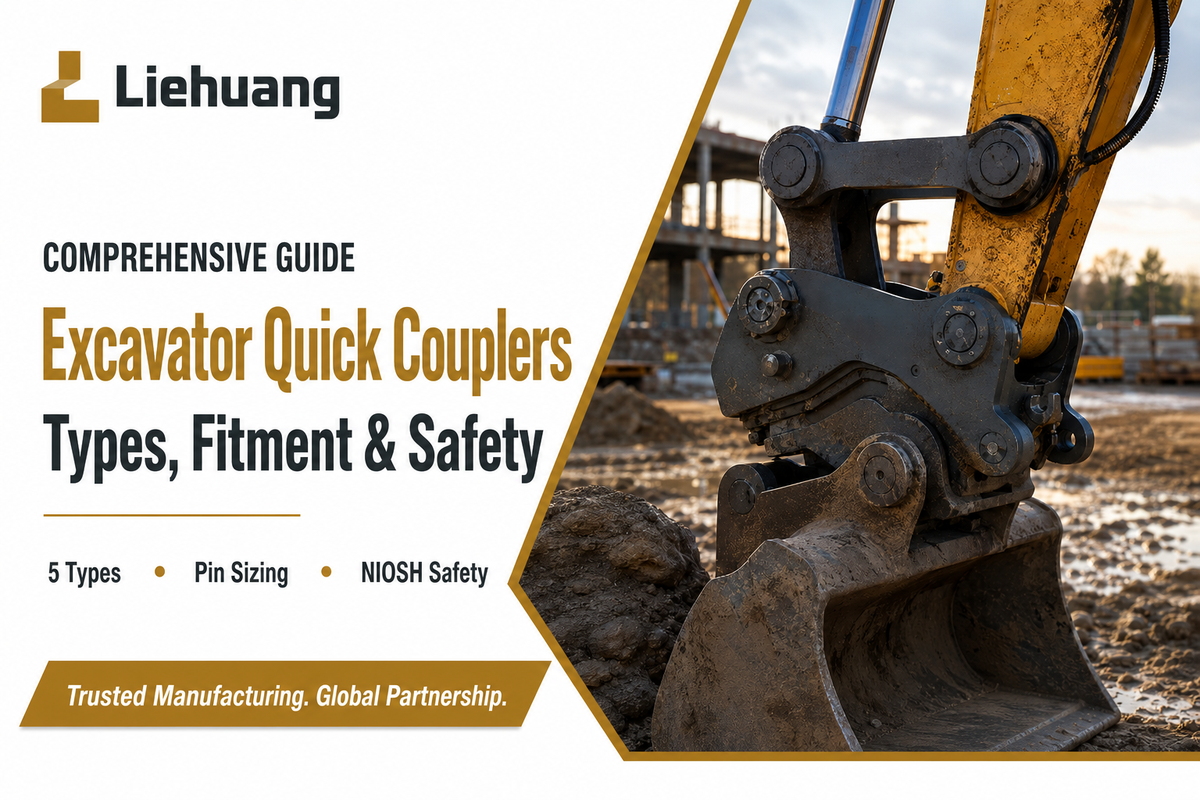

Excavator Quick Couplers are mechanical or hydraulic devices that connect a bucket or attachment to an excavator’s dipper arm, replacing a 15-to-30-minute manual pin-and-hammer swap with one lever pull or a single cab-mounted switch. One operator is now doing in seconds what two people previously did in as many as 30 minutes, all without leaving the seat. This guide details what a quick coupler actually is, the five types manufacturers build them around, how pin sizing and brand compatibility really work, the findings of three countries’ regulators regarding coupler safety, and where the industry is headed next.
An excavator quick coupler is a device that physically and/or mechanically attaches an excavator bucket or other tool to the dipper arm and allows an operator to switch between attachments in seconds rather than the 15 to 30 minutes a typical manual pin change involves. There are five primary types of quick couplers: manual (mechanical), semi-automatic hydraulic, fully automatic hydraulic, pin grabber, and wedge lock, each of which vary in cost, speed, and safety.
Key Points
- Quick coupler refers to the mechanism that connects and disconnects the bucket to the machine-and manually operated couplers, while not hydraulic, still fall into that category, albeit slower.
- A pin grabber type of coupler adds length to the connection point between the dipper stick’s pin and the bucket, thereby decreasing breakout force by a quantifiable amount, as documented in a 2025 SAE technical paper (rather than being mere marketing hype).
- UK regulatory body HSE mandated in 2008 that all major manufacturers cease supplying semi-automatic quick hitches following four deaths within the span of twelve months.
- Wrong pin diameter or centre distance is not just a fitment headache-Australian regulators have linked it directly to safety-lock failures.
- Manufacturers are moving toward a shared automatic-coupler standard (Open-S), which will matter more than price the next time you buy attachments across multiple brands.
Quick Specs
| Manual swap time | 10-30 minutes, 2 people |
| Hydraulic swap time | 10-45 seconds, 1 operator, no cab exit |
| Machine size range | 0.5 to 85+ tons depending on coupler class |
| Core safety standard | ISO 13031:2016 (Amendment 1:2025) + EN 474-1:2022 |
| Key spec numbers | Pin diameter, centre-to-centre distance, pin spread |
What Is an Excavator Quick Coupler, and Why Does It Matter?
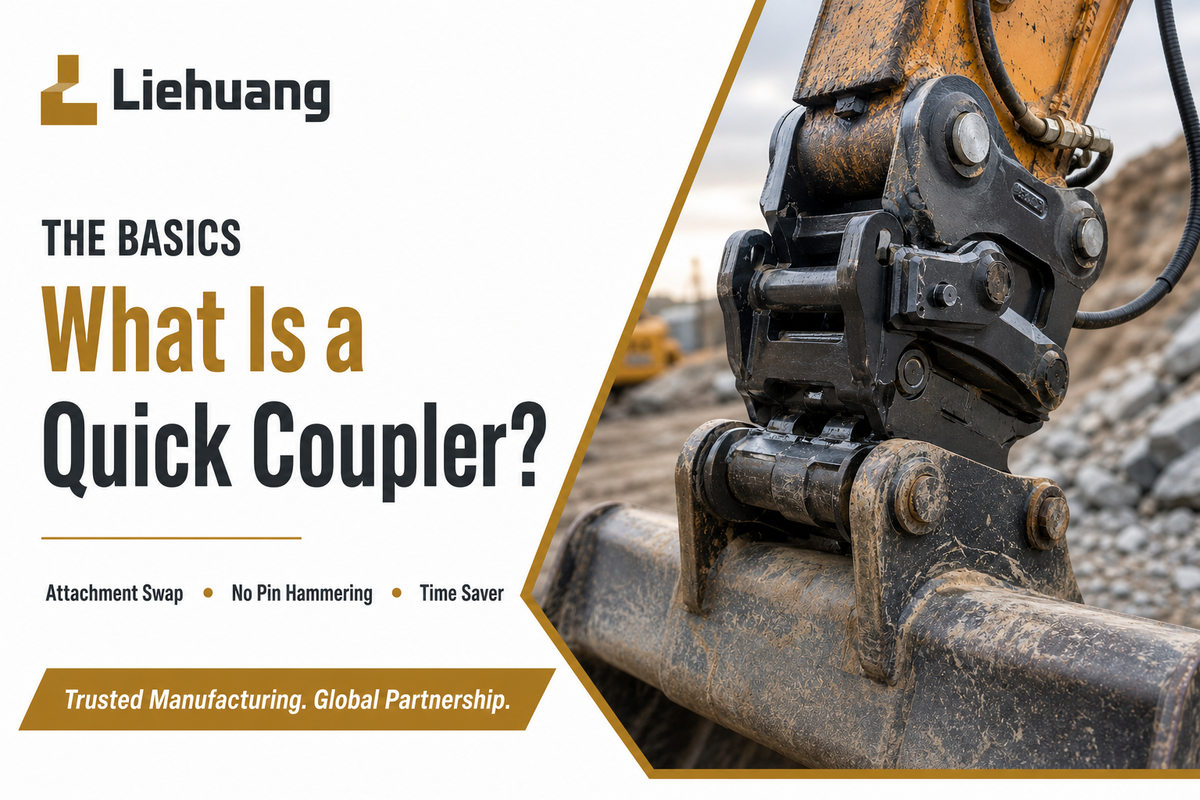
Prior to quick couplers, switching out a bucket entailed hammering two hefty pins, muscling the old attachment off, aligning the new one, and driving the pins back into place-a task that regularly took 10 to 30 minutes and typically needed a second person to position the attachment. A quick coupler collapses this into one connection: flick a switch or pull a lever, and the old attachment releases while the new one locks on.
According to Waste Today magazine, even a manual change under ideal conditions takes about 20 minutes-still far slower than the seconds a hydraulic switch requires.
Manufacturers of quick couplers engineer the systems with efficiency in mind because that’s the primary selling point. Time savings quickly add up. In an operator comparison profile put out by an entity that contrasted manual versus hydraulic quick couplers, changing out attachments went from being a 15-30 minute endeavor down to 45 seconds, recouping about 90 minutes (1.5 hr) of productive time daily. Jiangtu’s operator’s guide simplifies the switch with hydraulic couplers by stating that flipping the switch is around a ten-second job. Whether it’s ten seconds or forty-five, all sources agree on the order of magnitude difference-minutes for manual versus seconds for hydraulic.
But that’s a difference that matter for more than just ease of use. Every additional minute that a pin operator spends outside the cab trying to align pin and slot, and actually trying to connect those pins manually, is another minute that they’re operating next to an unsupported attachment and in close proximity to a pinching hazard – the very thing NIOSH wanted to tackle in its recent 2024 excavator quick coupler safety bulletin (see the safety section below). A quick coupler isn’t necessarily hydraulic, though. There are manual, lever-and-spring-loaded, non-hydraulically operated quick couplers (and as the Equipment World maintenance desk has found out first hand, those still are often mistakenly called hydraulics).
Liehuang’s own coupler range, built for machines from 1 to 85 tons, is available through the excavator quick coupler product line; this guide focuses on the mechanics, standards, and buying knowledge that apply regardless of which brand ends up on your machine.
💡 Key takeaway
A quick coupler is worth its weight in time, not convenience – and it is this saved time that regulations are aiming to protect, not eliminate.
Quick Coupler vs. Quick Hitch: Same Thing, Different Name
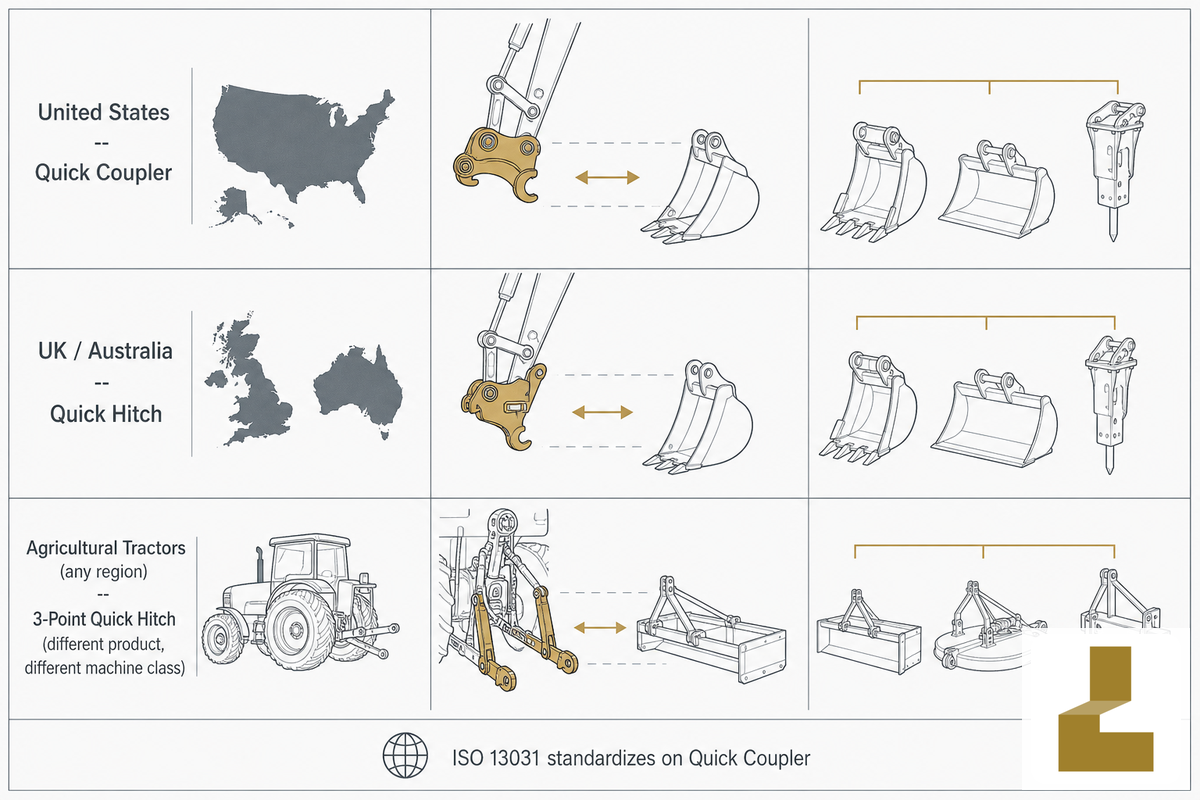
Ask three people in three countries what this part should be called, and they’ll each tell you a different thing – with one even steering you in the direction of the wrong component altogether. The Coupler-Hitch Terminology Split seems like an obvious issue once laid out, yet it befuddles enough shoppers to justify a primary role in Wikipedia’s quick coupler definition. Even ISO 13031, the formal safety standard for this device, settles on “quick coupler” as its defined term-sorting out the coupler/hitch naming question at the standards level, not just in casual usage.
| Region | Common term | Confusion risk |
|---|---|---|
| United States | Quick coupler | Low — matches product category pages |
| UK / Australia | Quick hitch | Medium — same part, different search habit |
| Agricultural tractors (any region) | 3-point quick hitch | High — completely different product, different machine class |
The third row there’s what’s really troublesome. Searching just for the phrase “quick hitch” by itself yields 3-point-hitch equipment – from manufacturers like John Deere and Land Pride. Excavator attachments simply aren’t there. If you’re trying to source a piece of equipment for your excavator, you want to search for “excavator quick hitch” or “excavator quick coupler”.
Should I Fit a Quick Hitch to My Excavator?
For most owners, yes-but which type depends on machine size and how often you swap attachments. Rhinox’s buyer guidance is blunt: smaller excavators on tighter budgets do fine with a manual quick hitch, while anything larger benefits enough from a hydraulic coupler that it is treated as close to mandatory.
What actually decides it is less the price tag and more how many times a week the machine changes tools-a bucket that stays on for a full week does not need the same coupler as one swapped four times a day.
The Types of Excavator Quick Couplers: Mechanical, Hydraulic, Pin Grabber, Wedge & Tilt
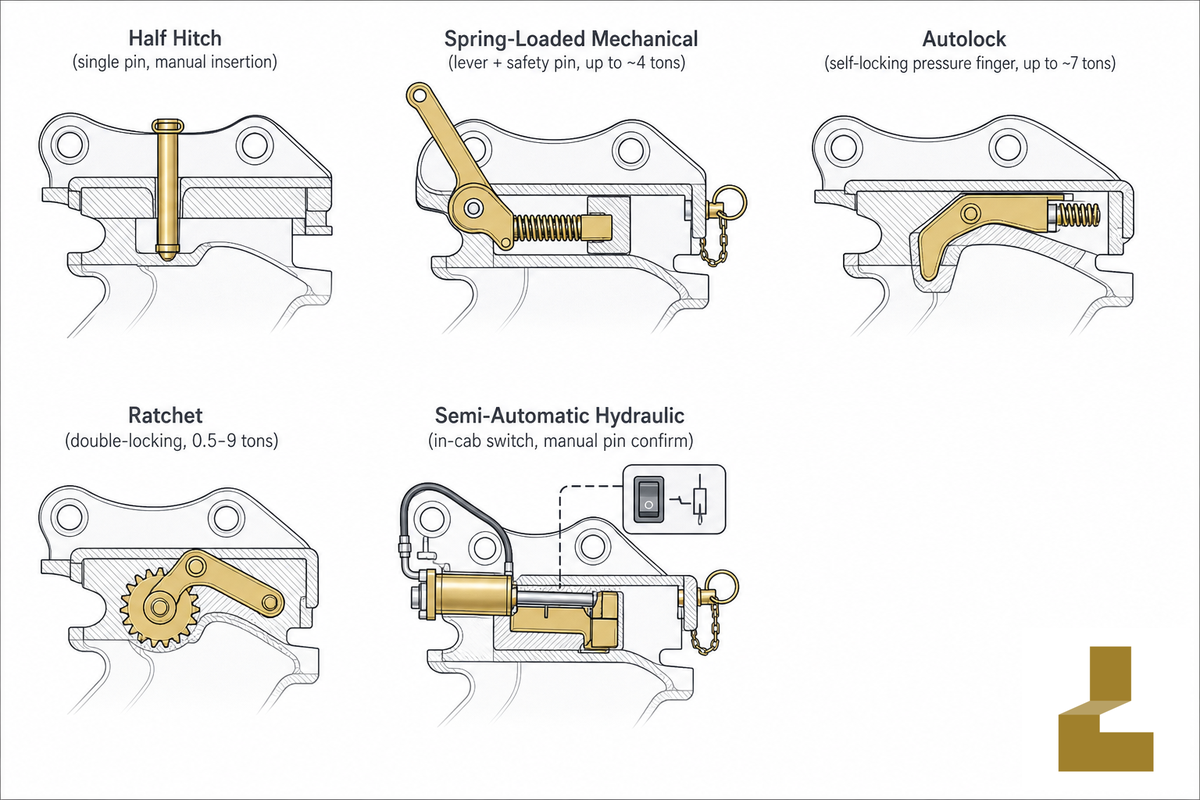
Every quick coupler you can find has been designed around one of five types of locking mechanisms for attachments (like buckets) that the manufacturers use across the construction equipment sector. Note these categories aren’t all mutually exclusive (most hydraulic quick couplers are also pin grabbers), but dissecting each dimension help decode the spec sheets a lot easier:
| Type | Operator effort | Typical machine class | Relative cost tier |
|---|---|---|---|
| Half hitch (single pin, no moving parts) | Highest — full manual pin insertion | Small / mini | Lowest (a few hundred dollars) |
| Spring-loaded mechanical quick coupler (lever + safety pin) | High — two cab exits per swap | Up to ~4 tons / 8,000 lb | Low |
| Autolock (self-locking pressure finger) | Medium — one cab exit, no loose safety pin | Up to ~7 tons / 14,000 lb | Low-medium |
| Ratchet (double-locking, no spring) | Medium | 0.5-9 tons / 1,000-18,000 lb | Low-medium |
| Toolless (integrated hanger, no separate tools) | Medium | 0.5-9 tons / 1,000-18,000 lb | Low-medium |
| Semi-automatic hydraulic | Low-medium — cab switch, but still needs a manual safety pin | Wide range | Medium |
| Fully automatic hydraulic quick coupler (standard) | Lowest — cab switch only, no pin, safely locked without leaving the cab | 0.5-45 tons / 1,000-90,000 lb | Medium-high |
| Tilting quick coupler (hydraulic) | Lowest, plus side-to-side tilt control | 1.5-26 tons / 3,000-52,000 lb | High |
| Tiltrotator (360° rotation + tilt) | Lowest, full multi-axis control | 1-33 tons / 2,000-66,000 lb | Highest (five figures) |
Machine size & cost-tier ranges collected from published manufacturer range pricing (Rhinox Group, 2026 Pricing Guide); this data should be used for direction only, not as a formal quote, as exact pricing depends on brand, location, and specific pin configuration. Another 2026 cost guide places a mini-excavator manual coupler, roughly one fifth of the 3-ton-class cost, just above $200,.
Manufacturing quality can vary significantly enough between brands that the difference between “semi-automatic” and “fully automatic” hydraulic couplers is much more than just a marketing designation, and it’s worth while to make this a clear distinction from the taxonomy above. Semi-automatics rely on the hydraulics to open and close the coupler, but require a physical pin insertion from the operator from outside the cab once the hydraulic latch is closed. This means you’ll still need to leave the cab, but fewer times than a full-manual setup. Fully automatic couplers eliminate the need for manual intervention entirely, as the locking mechanism is contained within the coupler itself. This difference of a single missing manual safety pin became significant enough that regulatory authorities in the United Kingdom took direct action to mitigate potential safety risks and liability – see the safety section.
Pin Grabber Couplers: Why This Term Is Trending
Interest in the term “pin grabber” has grown substantially over the last year, and for good reason:pin grabbers are the most versatile category of coupler, because they use the attachment’s existing OEM pins rather than requiring a custom lugging bracket. According to Gerry Kealy, Geith’s Global Sales Manager,a pin grab coupler with “variable pin centres and multi-pin pick-up … can quickly and easily pick up and inter-change over a vast array of OEM attachments, including a broad spectrum of pin sizes”- which explains their popularity with rental fleets and multi-brand operations.
“A pin grab design coupler [gives you] the ability to excavate against walls and under pipes, [a] standard feature… With a wedge-style coupler, you cannot reverse buckets.”
However, this versatility does come at a cost. Pin grabbers mount in between the stick pin and the attachment, thereby extending the working length of the arm.A 2025 research paper in the SAE Mobilus databaseexamines the exact tradeoff between breakout force and productivity, and onHeavy Equipment Forums, where owners of 20-40-ton class machines share their experience, the phenomenon is explained in clear terms: “the pin grabbers extend the distance from stick pin to the attachment’s cutting edges/lip giving a little bit less breakout force”. CE Attachments’ product manager Ron Peters succinctly explains the mechanical reasons behind this, stating that “the added length on a stick due to quick coupler addition will place the bucket or attachment farther away” as cited inFor Construction Pros. With independent evidence coming from a manufacturer, an academic paper, and an operator forum, there’s not much ambiguity in the physical consequences.
This is where that assumption fall apart, however. Just because they’re wedges, doesn’t mean they retain more breakout force than pin grabbers. Kealy counters with that the overall height and packaging of a coupler, not the choice of pin grab-or-wedge is what actually affects the breakout force lost-a low-profile pin grabber might hold more than a tall wedge-type model. A competitive coupler vendor, AlignAttach, flat out argues the exact opposite in the copy on its own product page-any hydraulic couple circuit repeated will lose ~10% of breakout force and lift capacity-plus lost fuel-no matter the family of the mechanism used. You should take that 10% figure as vendor-speak, not verified industry data, but it’s a useful reminder that quick couplers are mechanically not a free lunch, and that they trade some breakout capacity for the convenience and safety they provide, but how much they trade often is a question of design compactness rather than category.
✔ Advantages of hydraulic couplers
- No cab exit for a fully automatic unit
- Picks up a wider pin-size range via a travelling latch
- Available across almost the full machine-size spectrum (0.5-45 tons)
⚠ Limitations of hydraulic couplers
- Needs additional hydraulic lines run to the machine
- 3-4x the upfront cost of an equivalent manual coupler
- Semi-automatic variants still require a manual safety pin
If you already have a machine with the hydraulic lines run for an auxiliary circuit, a hydraulic coupler make sense as a second stage. If you swap out an attachment less often-the same bucket that’s used all day for days at a time-a manual or mechanical coupler is perfectly adequate, and saves the complexity and breakout loss of running a hydraulic circuit that rarely would be used.
Pin Sizing, Bucket Compatibility, and Brand Standards: How Fitment Actually Works
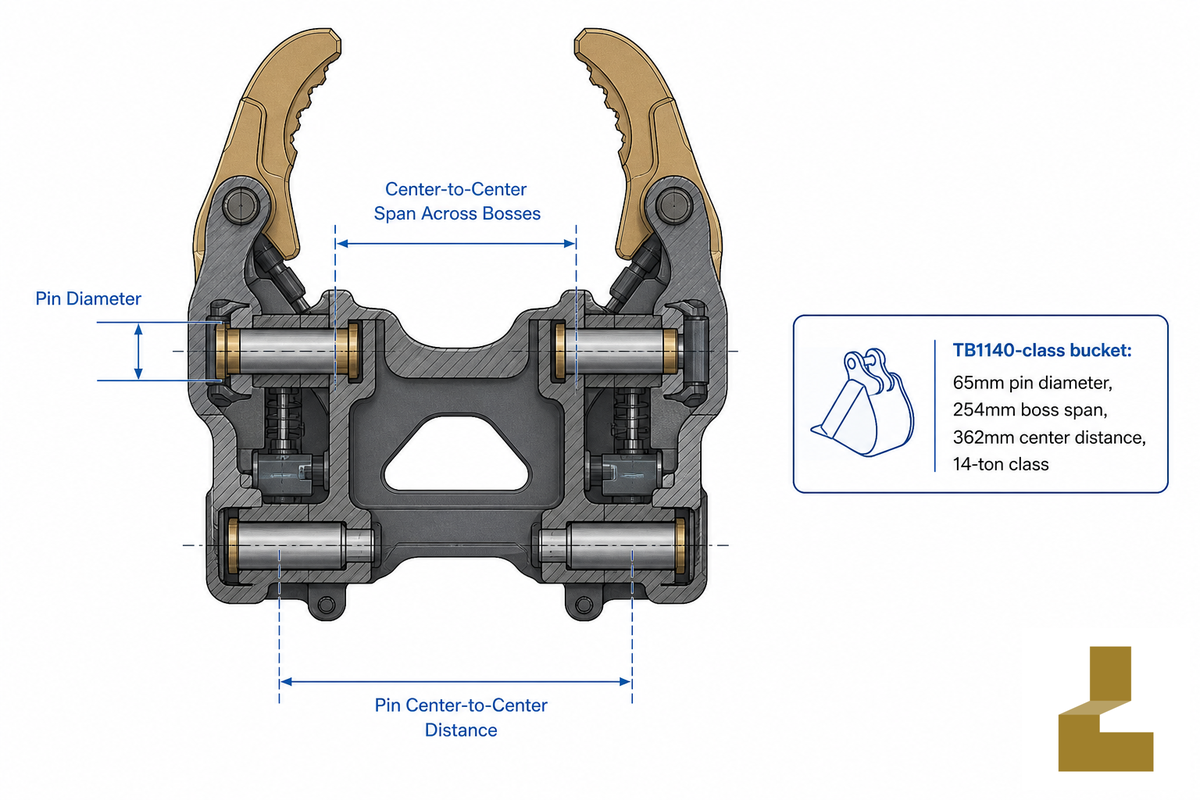
“Will it fit my machine?” This is by far the most commonly asked question, and the answer always depend on three numbers, not on the name on your machine. According to Hogan Engineering’s pin specification chart, “three measurements determine compatibility between an excavator bucket and a pin grabber-type quick coupler: pin diameter, center to center dimension of the pin bosses and pin center to center dimension across the outside diameter of the pin.” Get all three right and it will fit the bucket you want, no matter if it’s a CAT, John Deere or Kubota.
📐 Engineering Note
A real world spec example. An AttachmentCo product guide for a TB1140 class bucket specifies: a 65mm pin diameter, 254mm span across the bosses, and 362mm center distance between pins and says it uses 14-ton class machines with hydraulic pin grabber style couplers. This is the three measurements the company asking for quote on the coupler will request, not your brand or model.
Are Excavator Buckets Universal?
No, not automatically. A bucket becomes compatible with a given coupler only when its pin diameter, centre distance, and spread match what the coupler is built to grip. A pin grabber’s variable pin centres and multi-pin pickup solve exactly this, letting a fleet mix buckets from several OEM brands onto one machine.
Without that flexibility, “universal” fit only happens by coincidence, when two different brands happen to have specified the same pin dimensions.
Pin diameter mismatch is more than a simple inconvenience; it’s a safety issue, not merely a fitment one. Queensland’s workplace safety regulator has explicitly attributed failures of quick-hitch safety systems not latching correctly to issues of incorrect attachment pin diameter and centres-and this is covered more extensively below. If you’re uncertain whether a bucket’s pin specifications match your coupler’s range, check them before installing, not after.
Brand-to-brand variations exist at the standards level rather than being driven by proprietary locking tactics. While certain manufacturers now conform to the emerging Open-S symmetrical standard-discussed in the industry outlook-the majority maintain their unique pin geometry. That’s the primary driver of a coupler’s incompatibility between excavators, and it’s a documented, not mysterious, spec mismatch-a variation in bracket geometry between manufacturers of couplers for excavators, not a durability defect in either brand’s buckets and attachments.
Excavator Quick Coupler Safety: What NIOSH and Global Standards Say
The issue of coupler safety isn’t academic; it’s at the centre of a 2024 federal bulletin, a decade-old UK industry-wide product recall, and active safety alerts in two Australian states. NIOSH’s 2024 publication, “Preventing Excavator Quick Coupler Attachment Struck-by Fatalities and Injuries,” was necessitated by the fact that misconnected attachments can separate and injure or kill workers, a fatality pattern NIOSH’s California FACE program identified in an earlier bulletin from 2022.
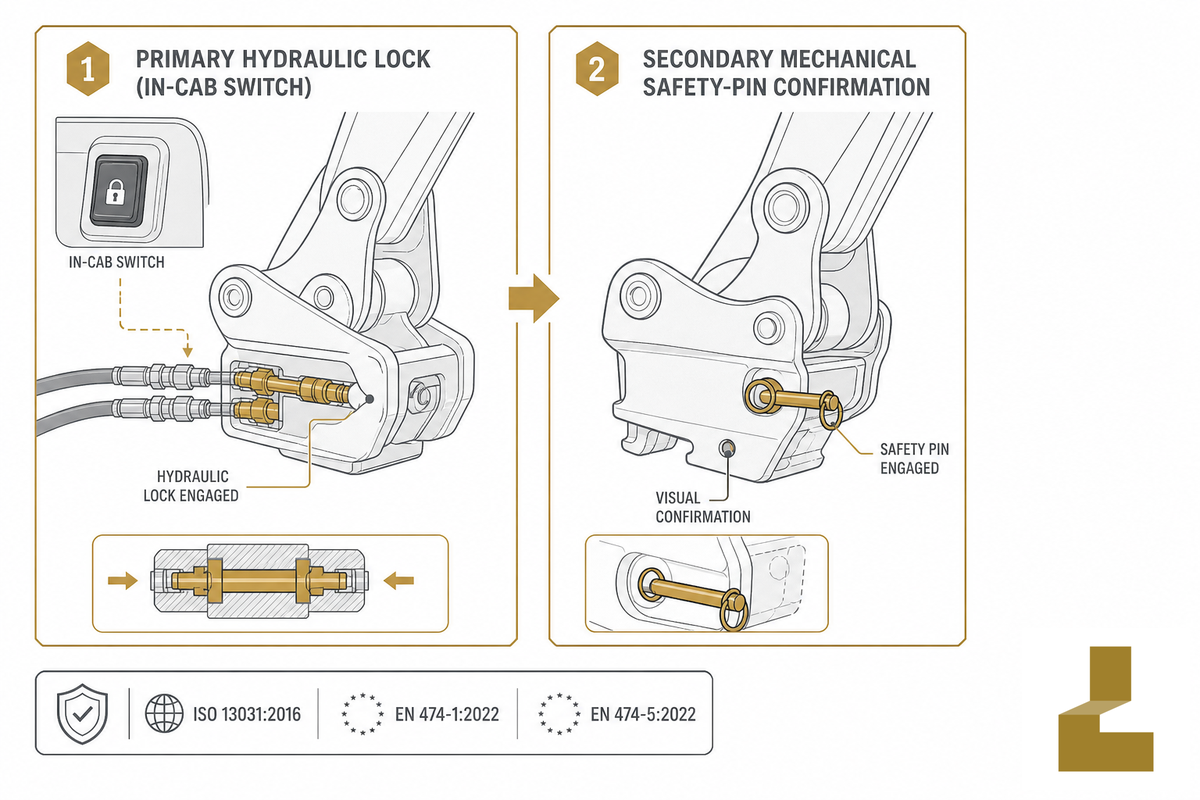
The core safety design standards governing coupler operation derive from ISO 13031:2016 (with the upcoming amendment, ISO 13031:2016/Amd 1:2025, effective from February 2025), which delineates safety requirements for quick couplers on earth-moving equipment, as specified in ISO 6165. In Europe, the general safety principles for earth-moving machinery are laid out in EN 474-1:2022, and EN 474-5:2022 further integrates the powered quick coupler definition from ISO 13031:2016 into the safety standards for hydraulic excavators. According to Tony McKeown, Engineering Manager at Geith, “The standard covers manually operated couplers, powered couplers and mixed couplers, for Excavators, Loaders and Telehandlers”-encompassing a broader spectrum than solely hydraulically powered units on excavators.
The most significant real-world coupler safety incident in history occurred in the United Kingdom. Following a series of four fatal accidents involving semi-automatic quick hitches between December 2006 and November 2007, the UK’s Health and Safety Executive negotiated with manufacturers, leading to a voluntary agreement for all major European producers to cease supplying semi-automatic quick hitches to the UK market effective 1 October 2008. HSE clearly articulated the reasoning behind this action: semi-automatic couplers employ a hydraulic ram to engage the latch, but they require the operator to dismount and install a manual safety pin. It was the omission or skipping of this pin, combined with variations in safety features across manufacturing batches, that caused the fatalities. Although existing semi-automatic hitches in use remained legal when operated correctly, the supply of this particular coupler class to the UK market was discontinued sixteen years ago.
⚠️ Important
Even Geith’s own website frankly states the failure mode. “A coupler with no front lock, in the event of a non-connected front attach is possible to drop off, if the attachment has not fully seated” The non-connected front attach scenario described above is the struck-by risk described in the NIOSH’s recent bulletin and is the reason why a dual-front-and-rear hydraulic coupler is now considered the standard.
They’ve also reported that from the other direction, too – through dimensions instead of a pin — exactly the same thing happened. WorkSafe in Queensland has looked at an incident involving a falling bucket that injured a worker at a construction site, and has bluntly noted that “an incorrect pin size and centre dimension could prevent an effective quick hitch lock, even if the quick hitch was operational.” The safety alert details exactly what happened: “the bucket abruptly released from its quick hitch, swing around about 1.5m, then fell to the ground, hitting a worker,” says Resources Safety & Health Queensland. The agency says its preference in the wake of these incidents is to require fully automatic, rather than semi-automatic, quick hitches for those who aren’t just having to place their own safety pin. And WorkSafe in Victoria offers similar advice after a worker was injured because someone forgot to insert the safety pin: on any semi-automatic coupler, be sure the pin’s there before starting.
Regs are not consistent, which matters if you buy new kit for operation on international railways: The UK basically banned new semi-auto couplers on new supply back in 2008; Australian regs allow semi-autos but expect strict pin discipline, and the implementation of ISO 13031 (AS 4772). Ensure the coupler class rules in the specific country match US, UK, Aussie rules if you operate in the countries concerned.
3 Safety Questions to Ask Before Buying or Renting Any Coupler
- Is it front & rear (dual lock) mechanism or just the front one.
- Does this fire completely automatically or still require manually pulling out the safety pin once the hydraulic lock has been secured?
- Before it’s mounted on the machine, have the bucket’s pin diameter and center distance been checked against the coupler’s stated rating, in writing?
How to Use and Install an Excavator Quick Coupler
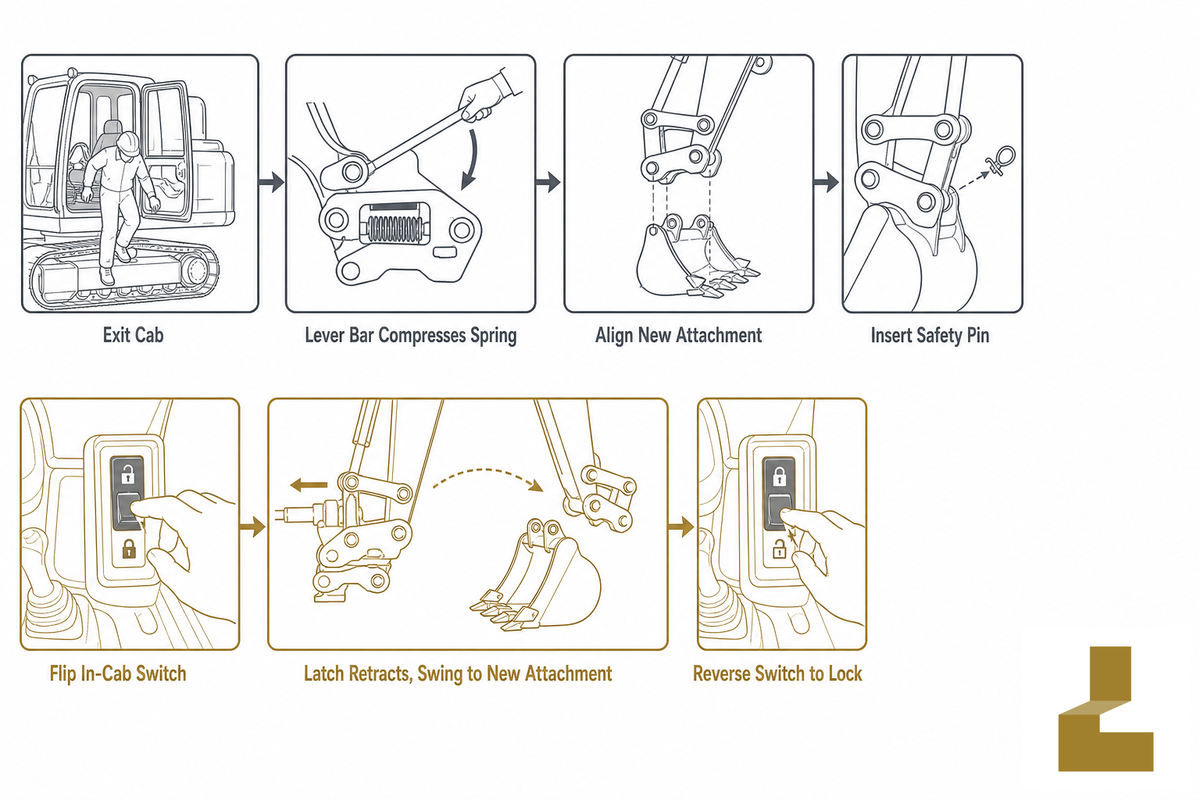
Day-to-day operation is very different between the two primary coupler families. On a manual or mechanical coupler rated under roughly 4-7 tons, the operator exits the cab, slides a lever bar into the latch, and pushes down to compress the internal spring, releasing the old attachment-generally two cab exits per change.
The operator then lines up the new attachment, attaches it, and reverses the process, manually inserting a safety pin on most manual styles to lock it in place.
How to Change a Digger Bucket on a Hydraulic Coupler
On a fully automatic hydraulic coupler, this is a simple flip of a switch in the cab: the operator activates the hydraulic circuit, the latch retracts, the old attachment falls away, and the operator swings the boom to the next attachment and reverses the switch to lock on. Cat’s own owner guidance for its pin grabber coupler describes exactly this cab-only workflow.
On a semi-automatic unit, the same switch operation closes the hydraulic latch, but the operator still needs to step out afterward to confirm and, on many models, physically insert the retaining safety pin — skipping that step is the specific failure mode covered in the safety section above, which NIOSH’s operational safety guidance is built around preventing.
Installation — fitting the coupler to the excavator itself rather than swapping an attachment onto an already-installed coupler — is a different job entirely for hydraulic units, since it means routing auxiliary hydraulic lines from the machine’s existing circuit to the coupler body. Manual couplers bolt on without any hydraulic work, which is one reason they remain the lower-cost, lower-complexity option for machines that will not benefit much from cab-only switching.
Common Excavator Quick Coupler Problems (and How to Avoid Them)
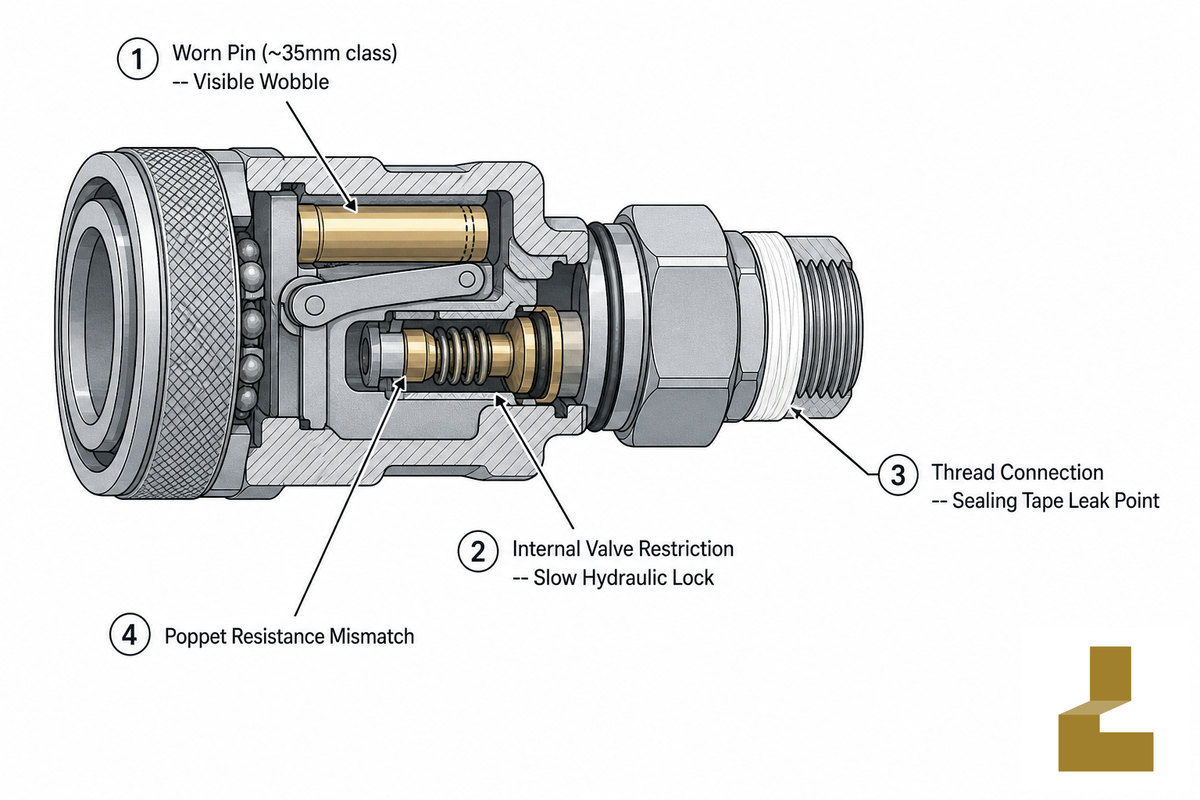
Coupler complaints tend to cluster around a small number of repeat causes, and unlike the types and sizing questions above, almost none of the major coupler brands publish dedicated troubleshooting content-this is a genuine information gap in the market, not just an oversight on our part, despite steady demand from owners comparing different, time-consuming types of failures across coupler manufacturers like Werk-Brau.
6 Warning Signs Your Quick Coupler Needs Attention
- Visible wobble on mounted attachments-often an undersized or worn pin, typically around the 35mm class, fitting too loosely into the jaw. A fitment mismatch, not normal wear.
- Slow or incomplete hydraulic lock and unlock. Fokca’s troubleshooting manual traces this to an internal valve that isn’t opening fully, debris preventing internal flow, or a coupler whose flow rate is insufficient for the excavator.
- Threads are leaking at the connections. Owners of backhoes and excavators discussing this online, including across different brands, have consistently traced these leaks to an incorrect application of pipe sealing tape or paste.
- Mismatched poppet resistance between the male and female halves-unequal spring tension on the two sides causes the poppet tips to clamp and collide on connection instead of seating cleanly.
- Reduced digging force after switching to a pin grabber-expected behavior, not a defect (see the breakout-force discussion in the Types section above).
- Front lock not engaging fully on connection-treat this as a stop-work issue, not a minor annoyance, since an unengaged front lock is the exact failure mode behind NIOSH’s struck-by warnings.
For the most part, none of these are major equipment-defeating issues, but rather preventable ones. Perform regular checks, confirm that your coupler is fully locked prior to the start of any work day, check the fit of your new pins to your coupler’s specs, and check thread seal on scheduled maintenance. Doing these few things catches 90% of field failures before they turn into downtime-or worse.
Industry Outlook: Where Excavator Coupler Standards Are Headed
Where this market is truly headed is most apparent not in a sales forecast, but rather it’s a battle of standards, and it already has a victor. North American attachment manufacturers have been pledging support for the Open-S Alliance, an industry project to establish a universal standard for automated quick couplers, as we’ve reported in Equipment World. This makes a significant difference for owners. Historically, a coupler conforming to one manufacturer’s closed- proprietary standard wouldn’t accept a attachment of another brand without a proprietary adapter. That calculation change if the standard is a common symmetrical design, and it’s starting to pop up organically in users’ conversations — as evidenced by an anonymous r/heavy equipment user casually recommending “a full pin grabber or Open-S” solution for a loose fitting coupler without being prompted by anything else on the thread.
And that’s, far and away, the most important single piece of info for someone thinking about buying a coupler to prepare for 2026 or 2027; more solid even than list prices, which fluctuate every day. Driving the auto-release evolution is the move toward standardization; Engcon, with its 2025 release of the fully automatic S70 that connects all of the hydraulic fluid between the machine and the attachment automatically, followed in 2026 with the S60 auto-release coupler, a more familiar configuration in size. In other words, the most relevant question a coupler buyer can ask a supplier is simply if their products are Open-S ready or have a roadmap to Open-S, rather than asking about what price will likely get them in 2027, as the cost of staying on a proprietary system is effective brand-lock.
Market-research estimates put the global excavator quick coupler market at roughly $1.28 billion in 2025, projected toward $1.9 billion by 2033 — background context only, since that kind of aggregate figure says little about which standard your next coupler purchase should be compatible with. The standardization trend above is the part of this outlook that should actually shape a buying decision.
For a used-excavator export business, standardization cuts both ways worth knowing about: machines and attachments built to an open standard are easier to re-pair across brands in secondary markets-a compact design choice that helps facilitate resale, and part of why Liehuang tracks pin geometry and coupler compatibility as closely as engine hours when evaluating machines for export — see the full coupler range for the specific tonnage classes currently available.
FAQ
Q: What is a quick coupler on an excavator?
View Answer
A quick coupler is mounted between the excavator’s dipper arm and the bucket or attachment, letting the operator disconnect and reconnect tools without hammering pins in and out by hand. Mechanical versions use a lever and spring latch; hydraulic versions use the excavator’s own hydraulic system via an in-cab switch. Either way, the goal is cutting a 15-to-30-minute manual swap down to seconds or a few minutes.
Q: What’s the difference between a pin grabber and a wedge-style coupler?
View Answer
A pin grabber grips an attachment’s original OEM pins and spans several pin diameters and centre distances, working better on mixed-brand fleets and reversing buckets to dig under pipes or against walls, unlike a wedge-style coupler. A wedge-style coupler locks onto a wedge-shaped bracket built into the attachment, limiting it to that specific wedge profile. The common claim that wedge-style retains more breakout force is not reliably true — coupler height and design compactness matter more than the pin-grab-vs-wedge choice.
Q: Should I fit a quick hitch to my excavator?
View Answer
For most owners, yes — cutting a 15-to-30-minute manual swap down to seconds or a couple of minutes generally justifies the cost within a normal replacement cycle. What matters more than machine size is how often it changes attachments: a bucket that stays mounted for days gets little benefit from a hydraulic coupler, while frequent swaps recover the extra cost quickly. Budget-conscious buyers on smaller machines typically start manual; larger or high-frequency operations lean hydraulic.
Q: What is the difference between a quick coupler and a quick hitch?
View Answer
No, they’re just two different names for the same thing. Quick coupler is the most common US name; quick hitch is most common in the UK and Australia. You do run the risk of getting it confused with the 3-point “quick hitch” for a tractor, but that is completely unrelated.
Q: How do I measure my excavator’s bucket pin dimensions?
View Answer
Three measurements matter: pin diameter, centre-to-centre distance (front pin centre to back pin centre), and pin spread or boss width. A tape measure or caliper across the bucket ears gives usable diameter and boss-width readings — common classes run 35mm, 40mm, 45mm, 50mm, 65mm, and 80mm. Several coupler manufacturers publish downloadable measurement forms; request one before ordering, since two machines in the same tonnage class can still ship with different factory pin specs.
Q: Are all excavator couplers compatible with all attachments?
View Answer
No, compatibility depends on matching pin diameters, centre-to-centre pin distances and pin spread of the coupler with that of the attachment, not the manufacturer’s brand name. Pin grabber with floating/variable pin centres offers maximum OEM attachment compatibility and range; other hydraulic couplers (wedge type or proprietary) typically only work on attachments made with that brand’s bracket configuration. Do not assume – before fitting an unfamiliar attachment, double-check the measurements as it can fit loosely, but not safely lock.
Q: How much does an excavator quick coupler cost?
View Answer
Costs vary dramatically depending on machine size and type of coupler – from around $200 for a basic half-hitch on a mini-excavator, about $1,050 for a 3-ton manual/autolock coupler, $3,000 for a standard hydraulic on a 4-6 ton machine, $8,000 for an automatic tilt, and roughly $44,000 or more for a 10-ton+ machine’s full tiltrotator, per published manufacturer ranges. (See Liehuang’s range for specific, tonnage-matching current pricing).
Q: Which type of coupler is right for my application?
View Answer
The right type depends on swap frequency, machine size, and whether your fleet mixes attachment brands — the type comparison table earlier in this guide is a good starting filter. Manual and mechanical couplers suit infrequent swaps on smaller machines; hydraulic and pin-grabber couplers suit larger machines or frequent, mixed-brand attachment changes. For a tonnage-matched recommendation against Liehuang’s current coupler range, request a quote directly.
Need to install the correct quick coupler for your excavator?
Why We Wrote This Guide
Liehuang exports inspected, refurbished used excavators and attachments, and a mismatched pin spec is one of the most common reasons a buyer’s existing bucket doesn’t fit a newly sourced machine. This guide is a general reference to quick-coupler mechanics, standards, and terminology, independent of any specific product line; our own coupler range, sized for 1 to 85 ton machines, and our export operation are covered separately. Reviewed by the Liehuang technical team.
References & Sources
- Preventing Excavator Quick Coupler Attachment Struck-by Fatalities and Injuries (2024-102) — NIOSH / U.S. CDC
- Preventing Struck-by Fatalities Related to Excavator Quick Couplers — NIOSH California FACE Program
- ISO 13031:2016, Earth-moving machinery, Quick couplers, Safety — International Organization for Standardization
- Industry Takes Action on Semi-Automatic Quick Hitches from 1 October 2008 — UK Health and Safety Executive
- Excavator Bucket Strikes Construction Worker — WorkSafe Queensland Incident Alert
- Semi-Automatic Quick Hitches on Excavators — WorkSafe Victoria Safety Alert
- Assessing Excavator Quick Couplers: A Customer-Centric Study to Application Suitability (2025-28-0268) — SAE Mobilus
- North American Companies Commit to Excavator Quick-Coupler Standard — Equipment World
- Coupler Alarm and Instructional Guide for an Excavator (WO2012085500A9) — USPTO / Google Patents
- Quick Coupler — Wikipedia
Related Articles
- Trackhoe for Sale: A Buyer’s Configuration Guide — sizing and classifying used trackhoes before you buy
- How to Inspect a Used Excavator Before You Buy — a field checklist that includes attachment-mount condition
- Used Excavator Buying Guide — inspection, hours, price, and import proof
- How Many Hours Is Too Many for an Excavator? — reading the meter before you commit
- Excavator Thumbs — another quick-swap attachment family worth pairing with a coupler upgrade

![Excavator Bucket Manufacturers: Buyer Evidence [Guide]](https://lhusedexcavator.com/wp-content/uploads/2026/08/excavator-bucket-manufacturers-r2-featured-768x512.png)