Get in Touch with Liehuang Company

By GW · Last updated: October 2026
The best electric excavator manufacturers for a shortlist include Bobcat for doorway access, CASE and JCB for compact fleets, LiuGong for heavy battery excavation, and Liebherr for cable-fed mining. Volvo, Wacker Neuson, Komatsu, Hitachi and SANY add distinct machine sizes and power arrangements. Choose the working package before choosing the badge.
Quick Picks
- Best for doorway access: Bobcat E10e.
- Best for compact charging options: JCB 19C-1E.
- Best for a US-listed electric mini: CASE CX15EV.
- Best for stationary plug-in mini work: Wacker Neuson EZ17e.
- Best for heavy battery excavation: LiuGong 924FE.
- Best for cable-fed mining: Liebherr R 9200 E.
How we selected these electric excavator manufacturers
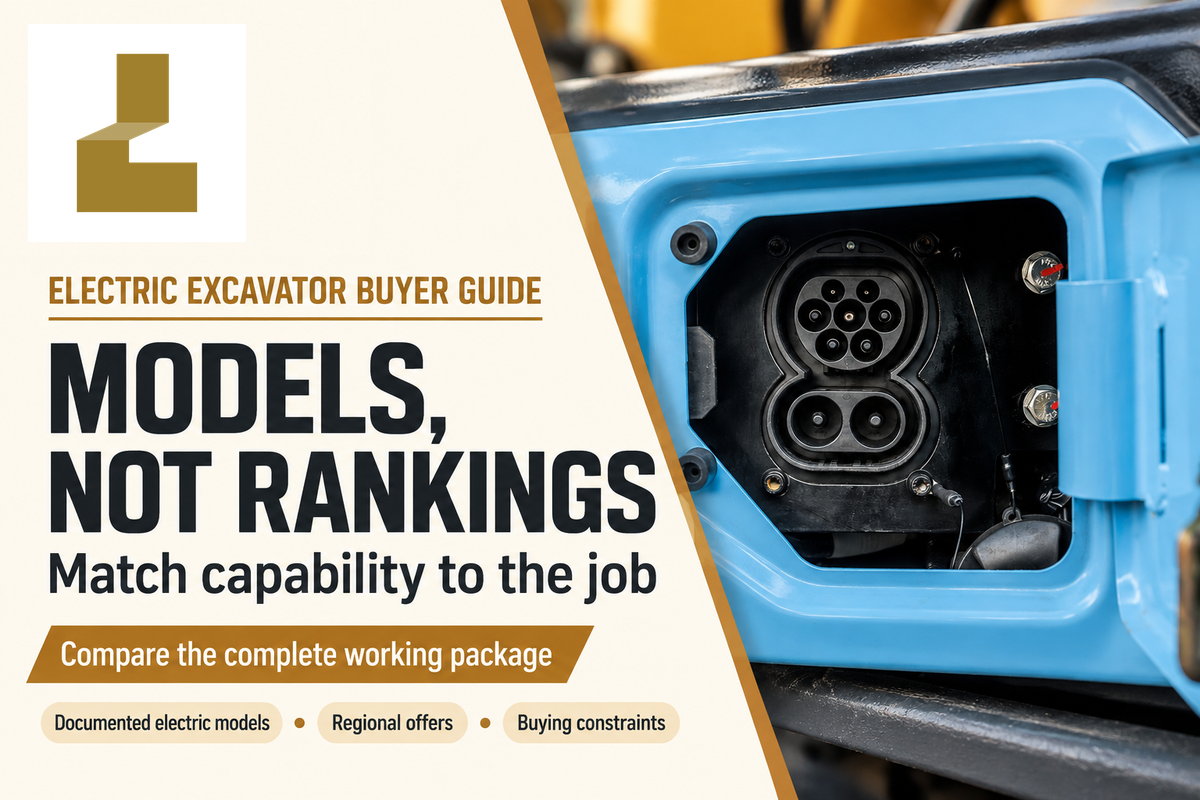
We chose companies that produce electric excavators with documented, model-specific capabilities, spanning compact construction equipment to heavy-duty mining machinery. Information on the companies was verified against their official websites and/or public sources in October 2026. We excluded traders; component and loader only suppliers; and prototype and/or pre-production only machine suppliers from our study. A backhoe loader belongs to a different class of machine. The list reflects regional offers and is organized by machine class rather than performance.
Electric excavator comparison: power and availability
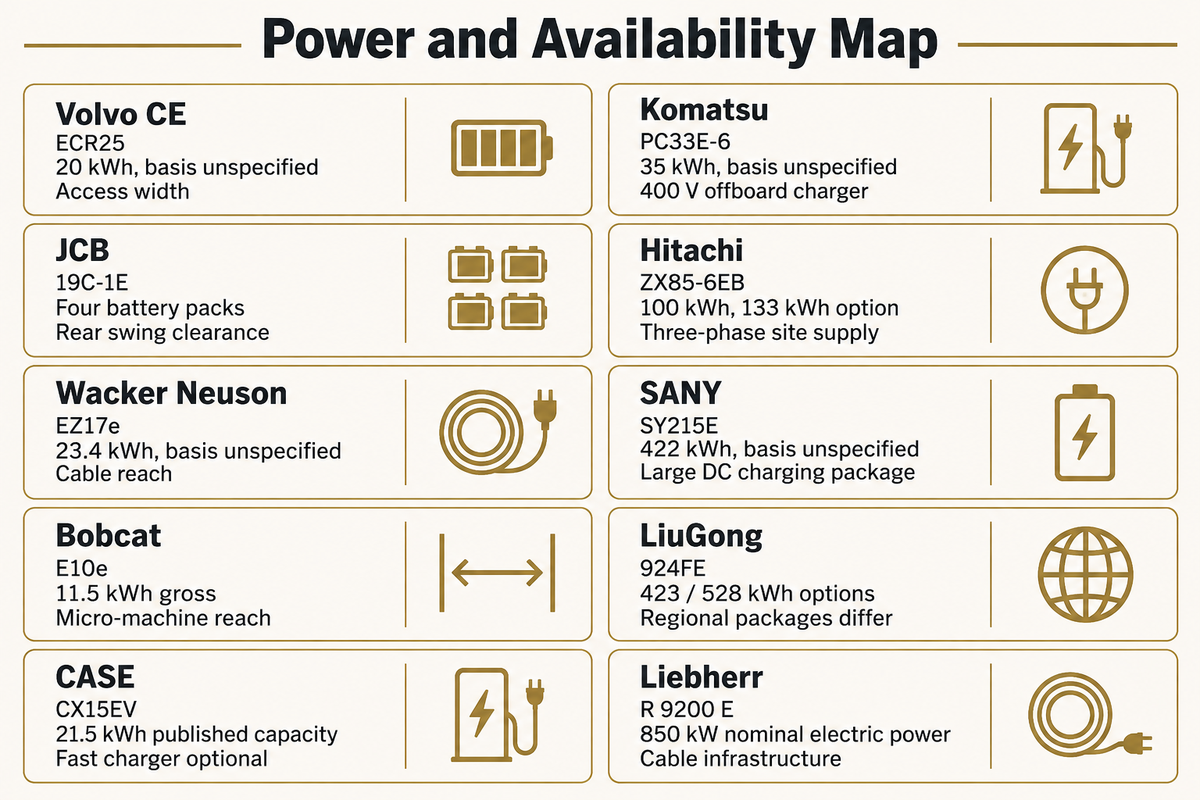
Electric Excavator Power and Availability Map
This map identifies the company’s representative machine, its working role, buying limitation and source of power.
Capacities of batteries in the machines remain as published. An unspecified battery capacity isn’t necessarily usable energy. The power of a motor isn’t the input power of the charger. The figures provided are by the manufacturers except in the case of the identified North American launch.
| No. | Manufacturer | Model / class | Battery / power | Best for | Buying limitation | Official website |
|---|---|---|---|---|---|---|
| 1 | Volvo CE | ECR25; compact | 20 kWh; basis unspecified | Short-radius digging | Wider than micro models | https://www.volvoce.com/ |
| 2 | JCB | 19C-1E; mini | Four battery packs | Charging options | Rear swing clearance | https://www.jcb.com/ |
| 3 | Wacker Neuson | EZ17e; mini | 23.4 kWh; basis unspecified | Stationary mains work | Cable reach | https://www.wackerneuson.com/ |
| 4 | Bobcat | E10e; micro | 11.5 kWh gross | Narrow access | Micro-machine reach | https://www.bobcat.com/ |
| 5 | CASE | CX15EV; mini | 21.5 kWh; published capacity | US compact fleets | Fast charger optional | https://www.casece.com/ |
| 6 | Komatsu | PC33E-6; compact | 35 kWh; basis unspecified | Larger compact tasks | 400 V offboard charger | https://www.komatsu.jp/ |
| 7 | Hitachi | ZX85-6EB | 100 kWh; 133 kWh option | Plugged-in excavation | Three-phase site supply | https://www.hitachicm.com/ |
| 8 | SANY | SY215E; 23-tonne class | 422 kWh; basis unspecified | Medium earthmoving | Large DC charging package | https://www.sanyglobal.com/ |
| 9 | LiuGong | 924FE; global configurations | 423 / 528 kWh options | Heavy battery work | Regional package differences | https://www.liugong.com/ |
| 10 | Liebherr | R 9200 E; mining | 850 kW nominal electric power | Fixed-site mining | Engineered cable infrastructure | https://www.liebherr.com/ |
Compact electric excavator manufacturers
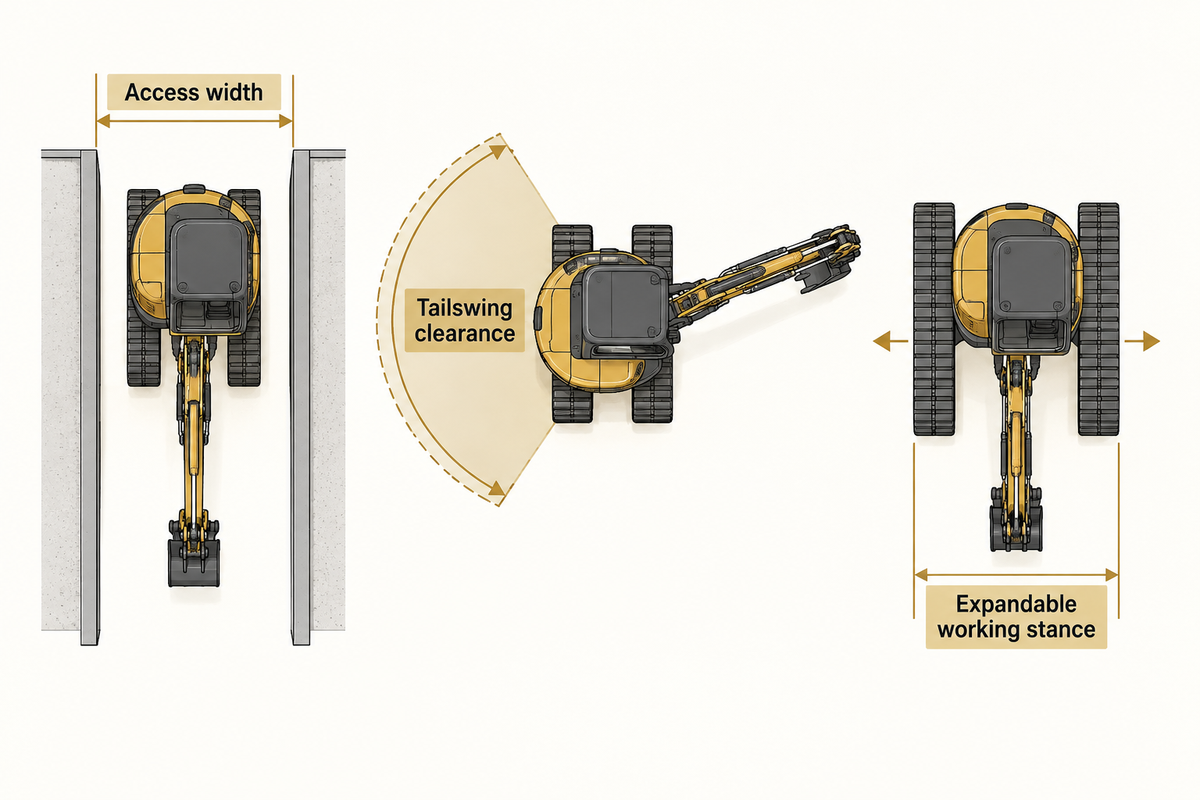
Compare an excavator designed for access and working envelope before considering battery size.
1. Volvo CE: Best for short-radius compact excavation
Headquarters: Eskilstuna, Sweden · Founded: 1832 roots · Type: construction equipment manufacturer
Official website: https://www.volvoce.com/
Main products: ECR25 Electric, compact and crawler excavators.
The Volvo ECR25 Electric excavator pairs a short-radius body with a 20 kWh, 48 V battery system. Its US listing gives an operating weight of 5,908–6,129 lb, making it a different size proposition from a micro excavator. The compact design suits work where rear clearance matters, while the electric motor drives familiar hydraulic functions. Its lithium-ion battery powers hydraulic excavation.
Buying limitation: at 5 ft 1 in wide, this machine needs more access space than doorway-class alternatives.
2. JCB: Best for compact charging options
Headquarters: Rocester, United Kingdom · Founded: 1945 · Type: construction machinery manufacturer
Official website: https://www.jcb.com/
Main products: 19C-1E electric mini excavator and construction machinery.
JCB lists five hours of standard-application runtime with four battery packs in the 19C-1E. The US model weighs 4,490 lb and offers 110 V, 220 V and 480 V charging options through the specified equipment. Familiar compact-machine controls ease fleet transitions to electric construction equipment. Low-noise operation can help on urban construction sites where engine sound affects neighboring occupants.
Buying limitation: conventional tailswing requires clearance behind the tracks.
3. Wacker Neuson: Best for stationary mains-powered mini work
Headquarters: Munich, Germany · Founded: 1848 Wacker roots; 2007 merger · Type: equipment manufacturer
Official website: https://www.wackerneuson.com/
Main products: EZ10e, EZ17e and EZ26e electric excavators.
Within this range of electric compact excavators, the EZ17e offers a useful distinction: stationary work from mains electricity while its battery charges. The regional product page lists 23.4 kWh and an undercarriage adjustable from 990 to 1,300 mm, with zero tailswing. That combination suits confined excavation near a usable electrical connection without relying solely on battery endurance. Charging options span specified inputs from 100 to 415 V.
Buying limitation: mains-supported work keeps the construction machine within reach of its cable, so relocation routes matter as much as the digging position.
4. Bobcat: Best for access through narrow openings
Headquarters: West Fargo, North Dakota, USA · Founded: 1947 Melroe roots · Type: compact equipment manufacturer
Official website: https://www.bobcat.com/
Main products: E10e electric compact excavator and compact equipment.
Retracted tracks bring the E10e down to 28 in wide, and zero tailswing helps the operator work inside restricted spaces. Bobcat publishes an 11.5 kWh gross battery capacity and 2,648 lb operating weight for the North American model. This fully electric mini excavator is a strong starting point for interior excavation where a larger machine can’t enter. Expandable tracks provide a wider working stance after access.
Buying limitation: a micro machine’s reach and lifting envelope remain small, making it a poor substitute for a heavier excavator on deep or demanding excavation.
5. CASE: Best for a factory-supported US electric mini
Headquarters: Racine, Wisconsin, USA, for the CASE brand · Founded: 1842 heritage · Type: construction equipment manufacturer; CNH brand
Official website: https://www.casece.com/
Main products: CX15EV and CX25EV electric mini excavators.
The current North American CX15EV page lists a 21.5 kWh battery and 3,186 lb operating weight. Standard equipment includes a 120 V AC onboard charger and electro-hydraulic proportional controls, giving US buyers a clearly specified compact starting point. Mechanical couplers and digging buckets appear among its options. CASE also publishes a full-machine limited warranty, with conditions handled through the dealer.
Buying limitation: faster charging requires the optional offboard fast charger; the standard onboard connection doesn’t include that capability.
6. Komatsu: Best for larger compact tasks with dedicated charging
Headquarters: Tokyo, Japan · Founded: 1921 · Type: construction and mining equipment manufacturer
Official website: https://www.komatsu.jp/
Main products: PC33E-6 electric mini excavator and construction machinery.
Komatsu’s European PC33E-6 listing specifies a 35 kWh battery, 17.4 kW electric motor and 3.62 t operating weight. Its short-tail design and proportional attachment control address compact jobs that need more machine than a doorway micro. The published bucket capacity is 0.03–0.1 m³, with attachment oil-flow adjustment offered as an option. Familiar controls support the move from a diesel machine without changing the basic excavation task.
Buying limitation: the offboard fast charger requires 400 V, making a suitable site supply part of the machine package.
Larger electric excavator manufacturers
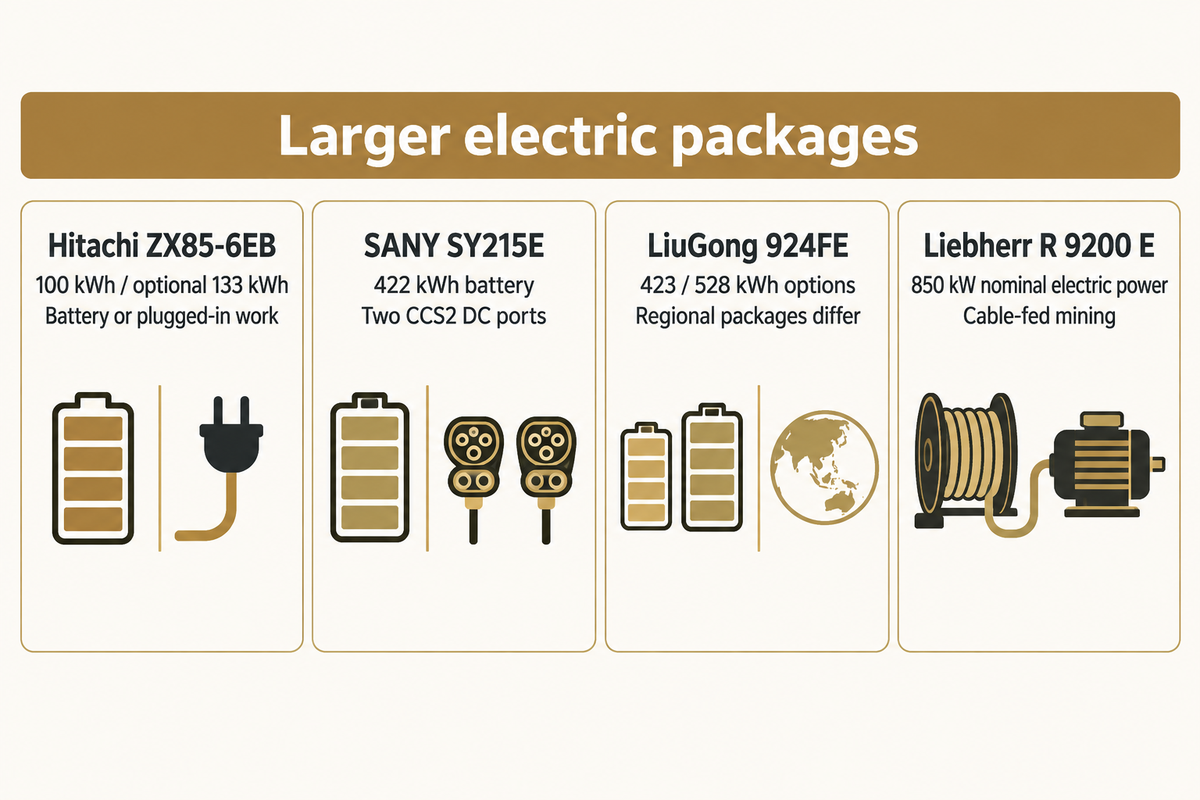
7. Hitachi Construction Machinery: Best for plugged-in excavation
Headquarters: Tokyo, Japan · Founded: 1970, Hitachi Construction Machinery · Type: construction equipment manufacturer
Official website: https://www.hitachicm.com/
Main products: ZX55U-6EB and ZX85-6EB battery excavators.
Hitachi’s European offering includes the ZX85-6EB with a 100 kWh battery and an optional 133 kWh version. The hydraulic excavator can also operate while connected to mains power and charging, which changes the planning problem for a long stationary task. Battery-only operation preserves freedom of movement when the cable is disconnected. This arrangement suits a construction project with an established power connection near the working area.
Buying limitation: simultaneous plugged-in operation requires CEE 400 V three-phase power and a protected cable route, rather than an ordinary domestic outlet.
8. SANY: Best for medium battery earthmoving
Headquarters: Beijing, China, for SANY Heavy Industry · Founded: 1986 predecessor roots · Type: construction equipment manufacturer
Official website: https://www.sanyglobal.com/
Main products: SY215E electric crawler excavator and construction machinery.
SANY’s European SY215E brochure lists 23,200 kg operating weight, a 422 kWh battery and a 150 kW motor. Its 1.1 m³ bucket places it in a different earthmoving category from the compact machines above. Two CCS2 DC charging ports form part of the published electrical package.
Buying limitation: moving and charging this size of electric-powered excavator demands substantial transport and electrical provision.
9. LiuGong: Best for heavy battery excavation
Headquarters: Liuzhou, Guangxi, China · Founded: 1958 · Type: construction equipment manufacturer
Official website: https://www.liugong.com/
Main products: 924FE electric excavator and construction machinery.
LiuGong’s global 924FE page lists a 115 kW motor and 423/528 kWh configurations, with reinforced boom and arm structures for demanding work. Auxiliary hydraulic circuits support attachment use. Equipment World reported its North American launch in August 2026, describing a 528 kWh package. These electric models broaden the heavy-equipment shortlist beyond minis.
Buying limitation: regional packages differ, so the battery and DC charging equipment belong in the same configuration-specific offer rather than mixing global and North American specifications.
10. Liebherr: Best for cable-fed mining
Headquarters: Bulle, Switzerland, for the group holding company · Founded: 1949, Liebherr Group · Type: equipment manufacturer
Official website: https://www.liebherr.com/
Main products: R 9200 E and electric hydraulic mining excavators.
Liebherr’s electric hydraulic range flyer lists the R 9200 E at 850 kW nominal power with a 12.5 m³ bucket. This electric mining excavator draws on cable-fed infrastructure rather than a compact traction-battery package. Its current R 9200 product page identifies an electric motor option, while the dedicated flyer distinguishes the electric rating. The mining equipment suits sustained fixed-site material movement.
Buying limitation: mining-scale electrical infrastructure and cable management make this a fundamentally different purchase from a mobile urban mini.
Electric excavators: battery versus cable power
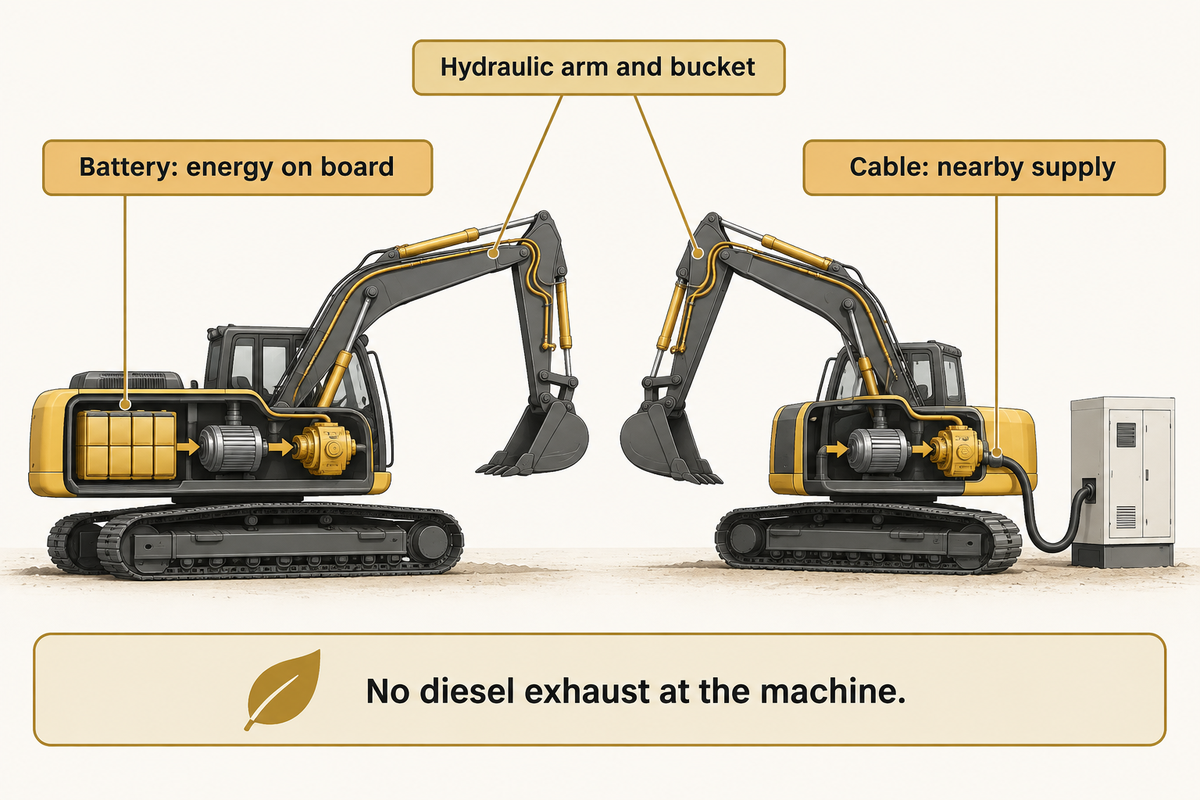
A battery excavator carries its energy; a cable machine needs a supply near the working area. Some machines bridge the two: Wacker Neuson’s EZ17e supports stationary mains work while charging. Electric machines still use a hydraulic system to move the arm and bucket. “Zero-emission” or “emission-free” operation refers here to exhaust at the machine, not lifecycle carbon neutrality.
Electric excavator runtime and charging requirements
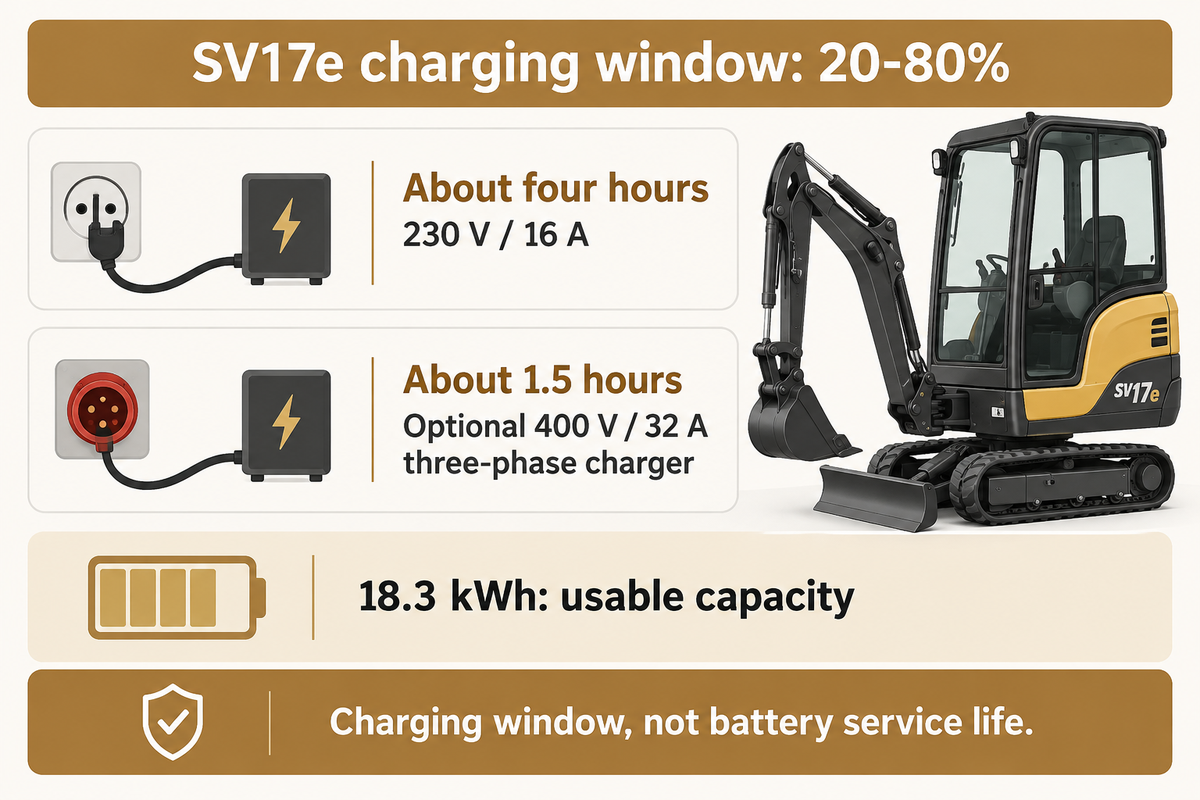
How long does the battery of an electric excavator last?
Yanmar lists 2.5 hours of continuous standard-mode work on a typical trenching site for the SV17e. Bobcat describes its electric compact family’s runtime as about four continuous hours, or six to eight hours with break charging. Working hours vary by model and duty cycle. Yanmar’s 18.3 kWh is usable capacity; Bobcat’s quoted capacity is gross. Nominal kWh alone can’t establish comparable hours of operation.
The SV17e charging table gives about four hours at 230 V/16 A or 1.5 hours with its optional 400 V/32 A three-phase charger, both from 20–80%. Those are charging windows, not battery service life.
Electric excavator prices and rental availability
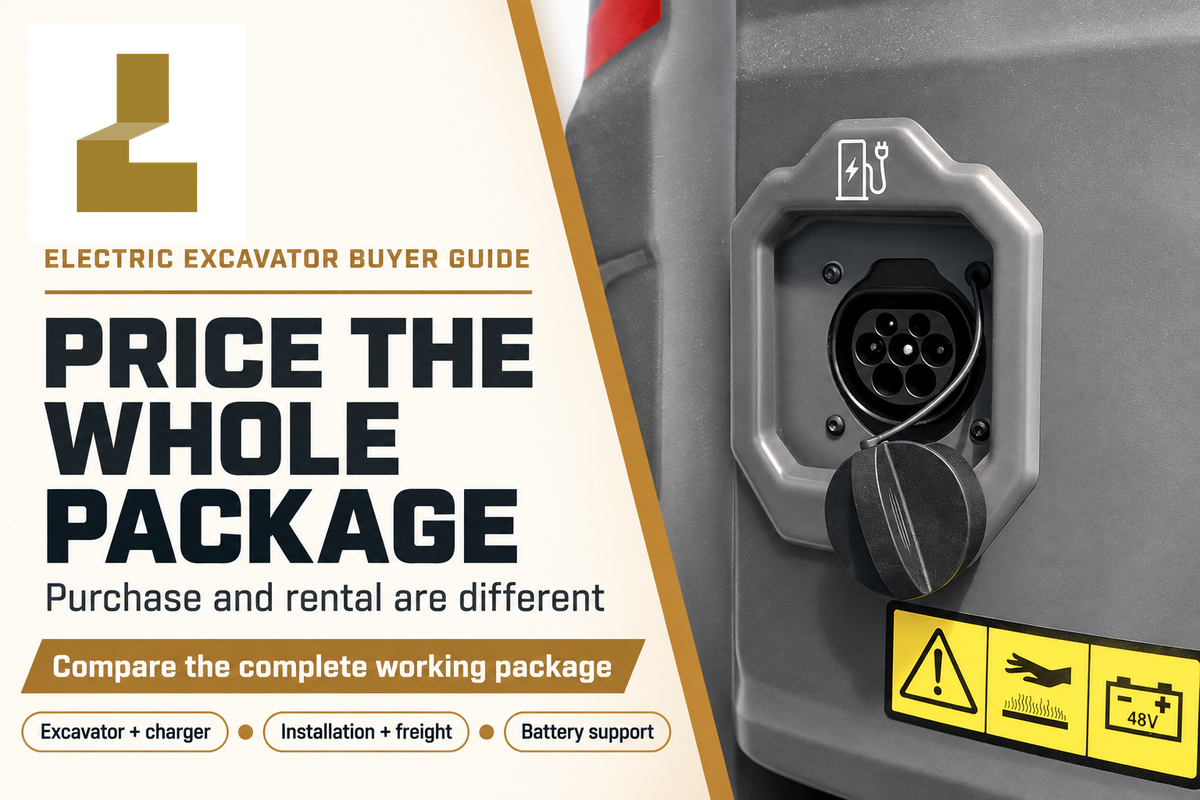
As of October 21, 2026, Rent1 USA lists standard JCB 19C-1E rental rates of $460 daily, $1,950 weekly and $4,900 monthly. Delivery, deposits and other charges are separate; rates can change. For purchase comparisons, request the excavator, charger, installation, freight and battery support together. A diesel counterpart’s advertised price isn’t an electric-machine quotation.
How to choose an electric excavator
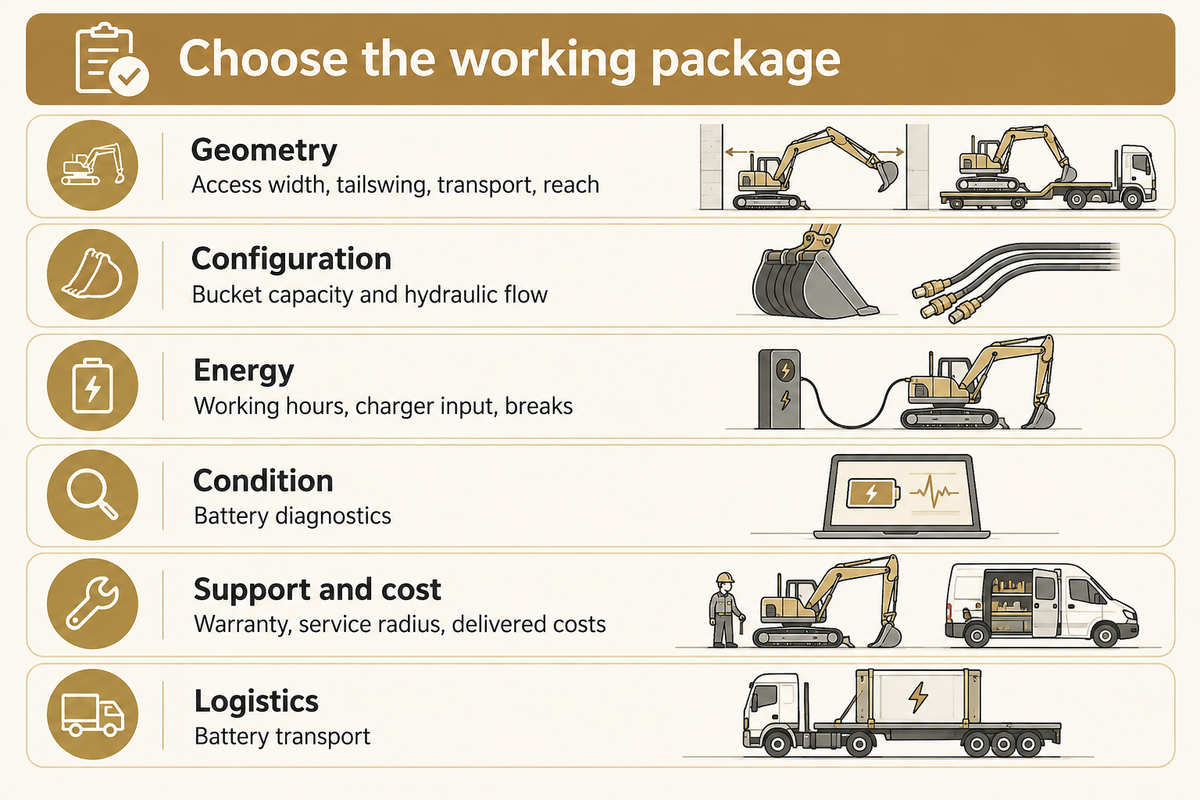
How do you know if an electric compact excavator is right for you?
An electric compact excavator can be considered if its digging and lifting envelope covers the working requirement, and if charging infrastructure matches the work schedule and local service supports the electrical system. The machine should be trialed with the expected attachment and the material to be handled. Judge power and versatility at the jobsite, including an operator’s efficiency and comfort during a normal working shift. The construction industry rewards different configurations; compare technical specifications before forecasting savings.
- Geometry: use the excavator size guide; compare access width, tailswing, transport and reach.
- Configuration: indicate crawler or wheeled excavator, bucket capacity and required hydraulic flow. The wide range of attachments sold for excavators still requires model-matched hydraulic flow and pressure.
- Energy: match working hours, charger input and break opportunities.
- Condition: add battery diagnostics to the used excavator inspection checklist.
- Support and cost: confirm warranty, service radius and delivered operating costs. Lower running costs don’t automatically mean increased productivity.
- Logistics: plan battery transport with the international excavator shipping guide.
Electric excavator FAQs
Who makes electric excavators?
Volvo, JCB, Wacker Neuson, Bobcat, CASE, Komatsu, Hitachi, SANY, LiuGong and Liebherr offer documented electric excavators.
The best shortlist groups manufacturers by the actual job. Bobcat and CASE have North American compact listings, while Komatsu’s PC33E-6 is documented in Europe. SANY and LiuGong cover heavier battery equipment, and Liebherr supplies mining-scale electric machines. Their products differ substantially in dimensions, energy supply and intended work; these names aren’t interchangeable purchase specifications.
Are electric excavators any good?
They can be effective for work where the machine’s capacity and available charging cover the duty cycle.
Electric excavators are well-suited for indoor excavation and noise-sensitive urban work, due to the electric drive removing diesel exhaust at the machine, and may help reduce noise from the engine. Choose the right digging depth and lifting capacity, and then use a rental trial to assess interruptions during a typical duty cycle, especially with breakers or other demanding attachments.
What are the advantages of electric excavators over diesel machines?
Electric excavators remove local diesel exhaust and can deliver lower noise levels with fewer engine-maintenance tasks.
A machine without a diesel engine doesn’t need the same engine-oil and coolant checks, as CASE’s CX15EV description explains. Hydraulic oil, tracks, pins and attachments still require maintenance. Higher efficiency at the drive doesn’t by itself establish project savings: electricity tariffs, utilization, charger installation and support determine whether the operating-cost advantage pays back.
Are electric excavators available in India?
Use an India-specific product offer to establish availability.
For Indian stock, an authorized local dealer is the starting point for model-specific price quotations and confirmation of charger compatibility, local warranty, delivery and support. Listings from the US, UK and Europe cover their respective regions.
What challenges come with using electric excavators?
Charging capacity, working endurance and service access are the main practical constraints.
One site may have electricity but lack the voltage or capacity required for the chosen fast charger. Weather, travel, attachment use and digging load also affect the work schedule. Cable fed equipment introduces routing and relocation constraints. Used machines may raise questions regarding battery condition. An imported regional variant may also require different support. When considering a new range of electric equipment, request the entire charging package and demonstrate the intended duty cycle.
How much more expensive is an electric compact excavator?
No single price premium covers this shortlist of different machine classes.
Compare the purchase price, charger and site installation, and then evaluate usage, electricity, maintenance and battery support for the projected ownership period.
Which Machine Package Fits Your Next Job?
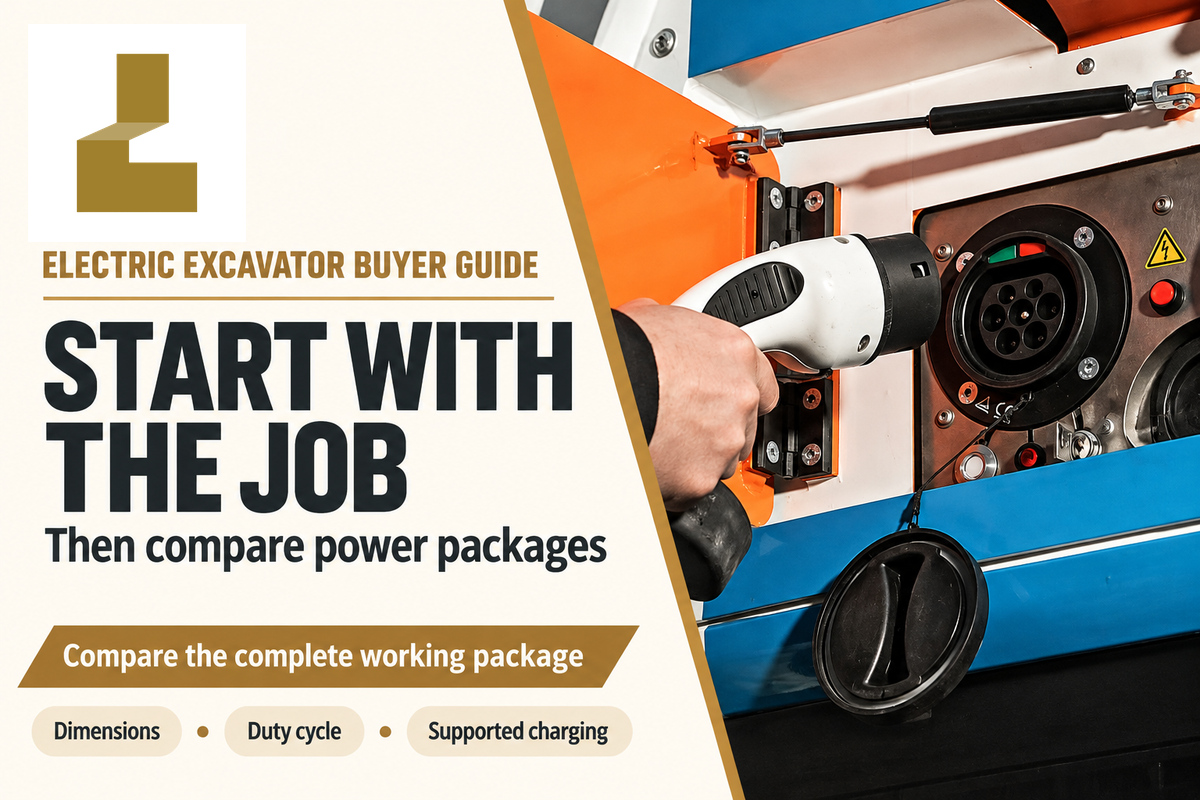
Consider size and duty cycle, then compare supported power packages. Check mini excavators for sale or send LH Used Excavator your project requirements. For a broader brand comparison, check our mini excavator manufacturer guide.
References & Sources
LiuGong Launches 27-Ton Electric Excavator, the 924FE, in North America Don McLoud, Equipment World, August 2026.