Get in Touch with Liehuang Company

20 Excavator Bucket Teeth Manufacturers for Global Buyers

Updated October 2026
Excavator bucket teeth manufacturers include Caterpillar for Advansys-equipped fleets, ESCO for integrated-lock construction systems, Hensley for construction and mining wear packages, and Aili for cast and forged replacements. The best starting point is the tooth system already on your bucket, followed by the ground conditions and the replacement support available to your fleet.
A tooth is the replaceable digging point at the front of the bucket. It has a cavity that fits a tooth adapter, and the pin or lock holds that connection. Choosing the right tooth requires the right cavity and retainer, as well as the correct working profile.
Publisher disclosure: Company profiles have been published by LH Used Excavator, a used equipment exporter and procurement service. Profiles aren’t a ranking of teeth systems in the market.
Quick Picks by Buying Need
- Cat fleet with Advansys adapters: Start with Caterpillar for matching tips and integrated retention components.
- Construction excavators with an integrated-lock system: Compare ESCO Ultralok for its two-piece arrangement and named point profiles.
- Large mining bucket packages: Compare Hensley, Bradken and CR by lip design, tooth system and machine class.
- Profile choice through a machine-parts channel: John Deere TK-Series separates general-purpose, penetration and abrasion applications.
- Cast-versus-forged sourcing: Aili and H&L make both routes available; Gold Forging specializes in forged products.
- Custom cast teeth from drawings: JC Casting, Huangzuan and ND offer different casting and finishing capabilities.
For an existing bucket, replacement teeth normally keep the same adapter family. System conversion changes the enquiry. Adapters and retention components join the tooth quotation, sometimes along with the wider lip package. Buyers who compare whole assemblies can also compare complete bucket manufacturers.
How We Selected These Bucket Teeth Manufacturers
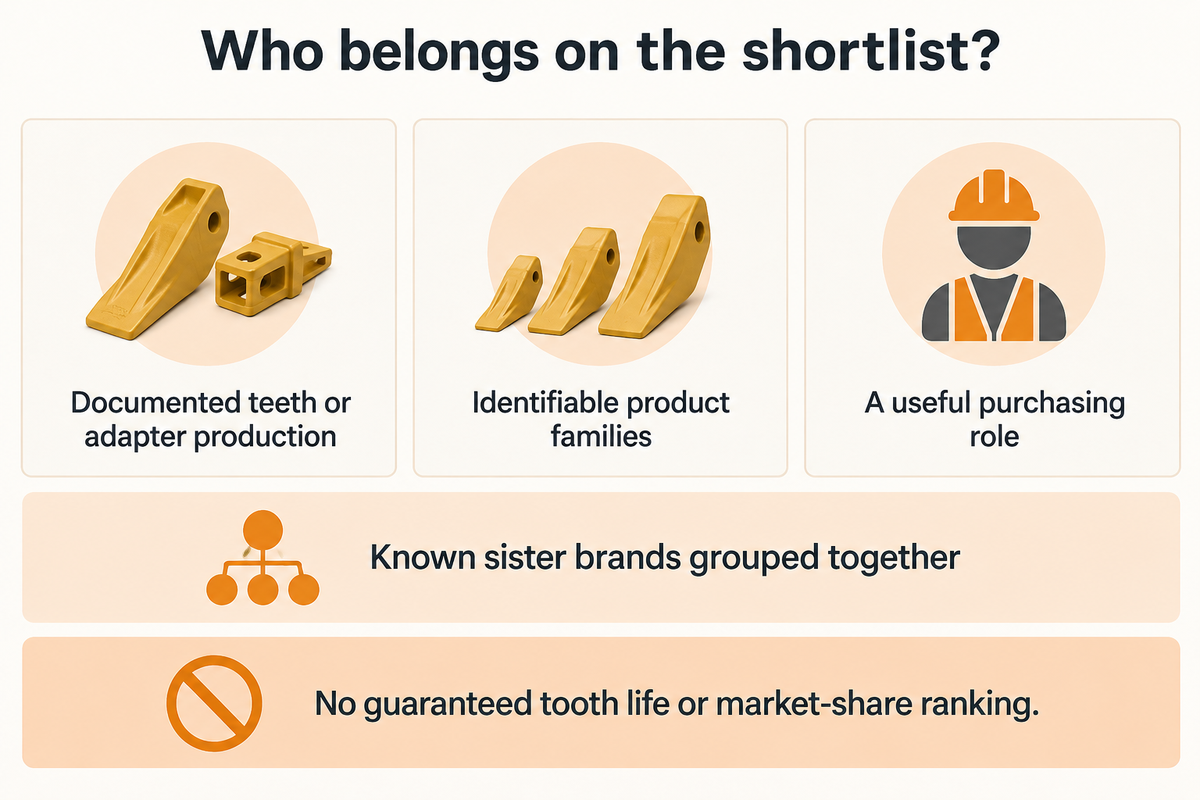
We selected manufacturers and proprietary tooth-system businesses with documented teeth or adapter production, identifiable product families and a useful purchasing role. Company data were verified with official websites and other corporate sources in October 2026. Dealer-only stores, directories and unverified trading listings were excluded, and known sister brands were grouped to avoid duplicate entries.
We evaluated OEMs, wear-part manufacturers, foundries and forging companies. These are different types of supplier, so a custom foundry is assessed by its production scope while a proprietary system business is assessed by the tooth family it supports. Relevant parent company holdings are indicated. Founding dates refer to the company or stated manufacturing roots, not necessarily the launch of its current tooth range.
“Best for” describes a supported buying use case rather than a laboratory performance evaluation. No private wear test, market-share calculation or guaranteed tooth life is used in this comparison.
20 Excavator Bucket Teeth Manufacturers Compared: Tooth-System Buying Map
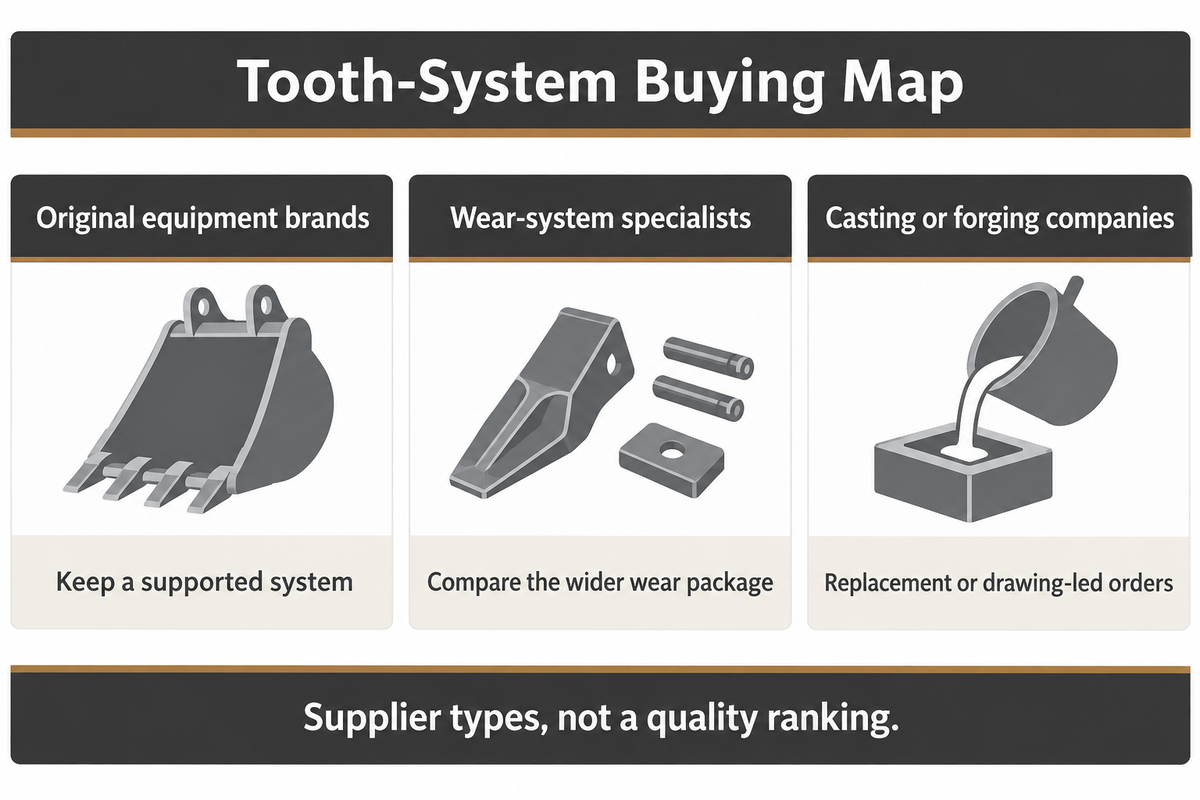
Use the Tooth-System Buying Map to short-list supplier types before examining individual parts. Original equipment brands suit heavy equipment fleets keeping a supported system, specialists address broader wear packages, and casting or forging companies can suit replacement or drawing-led orders. Numbers in the illustration don’t grade product quality.
| No. | Company | Headquarters / base | Founded | Best for | Main products | Key advantages | Potential disadvantages | Official website |
|---|---|---|---|---|---|---|---|---|
| 1 | Caterpillar | Irving, Texas, USA | 1925 | Cat fleets using Advansys hammerless teeth | Advansys tips, adapters and integrated retention components | Integrated retention; K-series installation footprint | Adapter conversion may be needed | https://www.cat.com/ |
| 2 | Liebherr | Bulle, Switzerland, group headquarters | 1949, group foundation | Mining excavators needing an integrated plate-lip tooth package | Z G3 teeth, adapters, wear caps and hammerless locking components | ZG3 mining plate-lip package | Mining range starts at 100 metric tons | https://www.liebherr.com/ |
| 3 | Volvo Construction Equipment | Eskilstuna, Sweden | 1832, company roots | Volvo bucket users needing matched teeth and wear protection | Volvo Tooth System, Endurance Teeth, adapters and wear caps | Endurance range from 5 to 95 tons | Third-party buckets need separate identification | https://www.volvoce.com/ |
| 4 | John Deere | Moline, Illinois, USA | 1837 | Deere-supported fleets choosing TK-Series profiles | TK-Series teeth and all-makes replacement teeth and adapters | Named TK-Series soil and rock profiles | TK-Series differs from all-makes lines | https://www.deere.com/ |
| 5 | ESCO | Portland, Oregon, USA | 1913 | Construction fleets needing an integrated-lock tooth system | Ultralok construction points and adapters; mining buckets and wear systems | Two-piece points with integrated lock | Requires Ultralok adapter family | https://www.global.weir/brands/esco/ |
| 6 | Hensley Industries | Dallas, Texas, USA | 1947 | Buyers wanting casting control and construction-to-mining coverage | GETpro construction and cast-lip systems, teeth, buckets and adapters | Own foundry operations and heat testing | Construction and mining systems differ | https://www.hensleyind.com/ |
| 7 | CR Powered by Epiroc | Brisbane, Australia | 1979, as CQMS | Large mining fleets pairing wear systems with lost-tooth monitoring | Cast lips, teeth, protective shrouds and GET Trakka | Engineered mining wear parts with loss monitoring | Engineered mining scope can exceed small orders | https://crmining.com/ |
| 8 | Bradken | Newcastle, Australia | 1922 | Mining operations comparing cast-lip and plate-lip packages | Eclipse cast-lip, Zenith and Twistlok plate-lip systems | Distinct Eclipse and Zenith mining systems | Large mining systems, not compact replacements | https://www.bradken.com/ |
| 9 | MTG | Barcelona, Spain | 1957 | Quarries and mines seeking a specialist tooth-system supplier | STARMET, KINGMET, PROMET, RIPMET and MTGtwist | Own foundry and matched wear protection | Series-specific interfaces | https://mtgcorp.com/ |
| 10 | Combi Wear Parts | Sweden; manufacturing base in Ljungby | Early 1930s, manufacturing roots | Excavator users seeking Swedish-made specialist wear systems | C-REX, ProTect and T-System wear products | Swedish foundry; dedicated excavation family | Dredging and excavation products differ | https://www.combiwearparts.com/ |
| 11 | Feurst | Feurs, France | 1992 | Buyers seeking French-made hammerless teeth and adapters | TURNKEY Rhino and Grizzly, ORCA and ORYX systems | Two TURNKEY retention families | Grizzly and Rhino locks differ | https://feurst.fr/en/ |
| 12 | BYG / FUTURA | Molins de Rei, Barcelona, Spain | 1967 | Mixed fleets comparing replacement teeth and hammerless options | BYG Classic replacement teeth and FUTURA wear systems | FUTURA system plus classic cast options | FUTURA conversion adds matching components | https://byg.com/en/ |
| 13 | Black Cat Wear Parts | Edmonton, Alberta, Canada | 1968 | Mixed-brand replacement teeth plus dedicated wear systems | Replacement excavator teeth, RV/RVJ systems and RVS shrouds | Own RV/RVJ ranges and replacement lines | RV/RVJ and replacement interfaces differ | https://www.blackcatwearparts.com/ |
| 14 | H&L Tooth Company | Tulsa, Oklahoma, USA | 1931 | Replacement buyers comparing forged, cast and fabricated teeth | Cast, forged and fabricated teeth, 156 Cobra and 230-series products | Cast, forged and fabricated tooth production | Series and pin designs must match | https://www.hltooth.com/ |
| 15 | Jiangxi Aili | Jing’an, Yichun, Jiangxi, China | 1980 | Buyers sourcing both cast and forged replacement teeth | Bucket teeth, adapters, ripper teeth, side cutters, pins and retainers | Cast and forged lines; material laboratory | Compare exact cast or forged reference | https://www.ailiparts.com/ |
| 16 | YASSIAN | Ningbo, China | 2002 | Buyers seeking replacement teeth with custom drawing support | Bucket teeth, adapters and other ground-engaging wear parts | Drawing-led casting and matched adapter references | XS50-related parts are application-specific | https://www.yassian.com/ |
| 17 | Gold Forging / HXMD | Quanzhou, Fujian, China, manufacturing base | 1990s factory roots; exact company incorporation date not given | Buyers specifically seeking forged replacement tooth packages | Forged bucket teeth, adapters, cutting edges and bucket assemblies | Forging and machining specialization | Forged-reference selection limits substitution | https://www.goldforging.com/ |
| 18 | JC Casting | China | Not publicly disclosed | Drawing-led custom cast bucket-tooth projects | Cast bucket teeth and custom metal castings | Casting, heat treatment and finished-part machining | New designs require tooling and samples | https://www.jccasting.com/ |
| 19 | Ningbo Huangzuan | Cixi, Ningbo, China | 2008 | Buyers sourcing investment-cast and coated-sand wear parts | Bucket teeth, adapters and side cutters | Investment and coated-sand casting | Custom drawings determine casting route | https://www.hzteeth.com/ |
| 20 | Ningbo Fenghua ND Machinery | Ningbo, China | 2005 | Buyers combining bucket teeth with other custom wear castings | Bucket teeth and adapters, dredger teeth, pins, cutting edges and special castings | Own FHND development and heat-treatment operations | Excavation, dredging and demolition ranges differ | https://www.fh-nd.com/ |
OEM Tooth Systems for Excavator Buckets
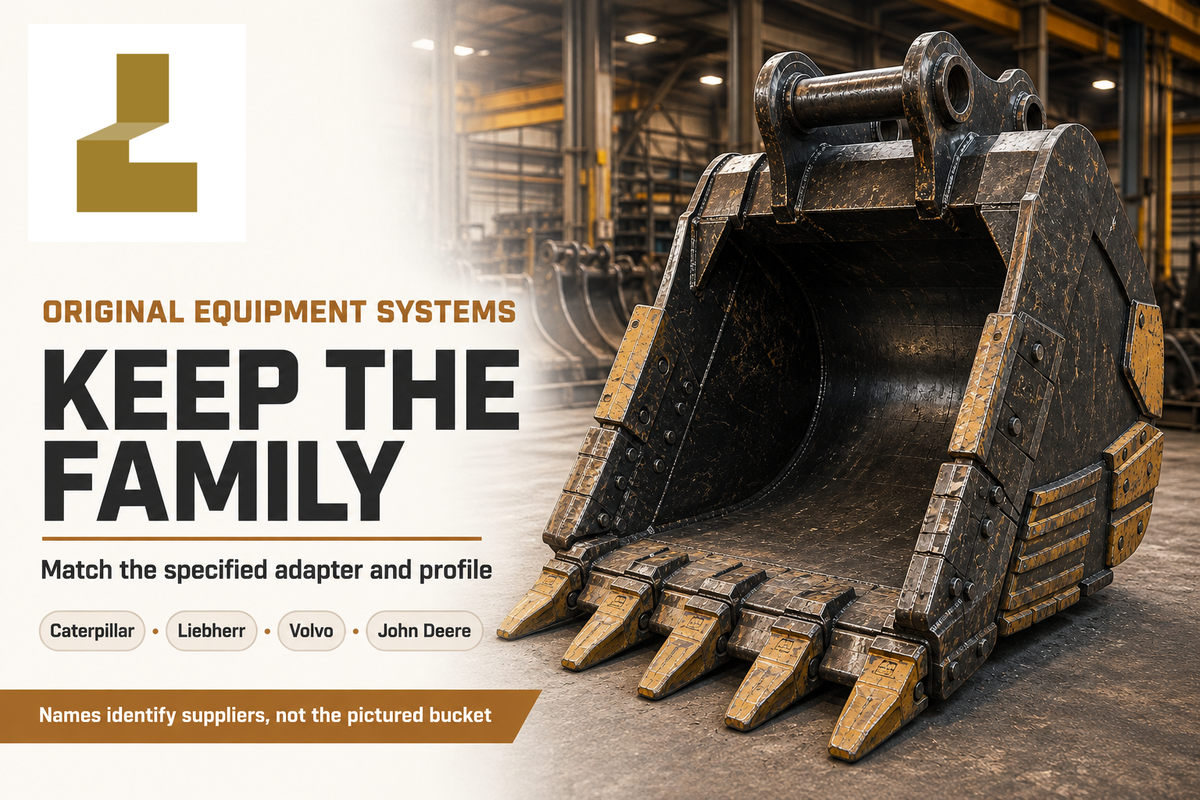
Caterpillar, Liebherr, Volvo and John Deere offer named tooth systems within their equipment and parts businesses. Keeping the machine and parts channel together can simplify sourcing, but the bucket fitted to a used excavator may have changed. The adapter and lock on that bucket remain the parts-identification reference.
1. Caterpillar: Best for Cat fleets using Advansys hammerless teeth
Headquarters / base: Irving, Texas, USA · Founded: 1925 · Type: Original equipment manufacturer and proprietary tooth-system designer
Official website: https://www.cat.com/
Main products: Advansys tips, adapters and integrated retention components
Manufacturing / system capability: Advansys 70–230 for demanding production applications; hammerless retention
Notable work: Advansys adapters occupy the K-series installation space; integrated retention simplifies the component set.
Advansys is a practical starting point for a Cat fleet that wants one supported tooth system across suitable digging and loading equipment. Integrated retention reduces the loose components handled during a tip change, while the adapter uses the K-series installation space for a system conversion. That distinction matters when an existing bucket is being rebuilt: a familiar installation footprint doesn’t mean that a new Advansys tip fits the old adapter nose. Choose the tip and adapter as one assembly when moving away from another system.
Buying limitation: Changing from a different nose system requires the corresponding Advansys adapter, not just a new tip.
2. Liebherr: Best for Mining excavators needing an integrated plate-lip tooth package
Headquarters / base: Bulle, Switzerland, group headquarters · Founded: 1949, group foundation · Type: Equipment manufacturer with an engineered mining tooth system
Official website: https://www.liebherr.com/
Main products: Z G3 teeth, adapters, wear caps and hammerless locking components
Manufacturing / system capability: Plate-lip system for 100–400-tonne hydraulic excavators
Certifications: Liebherr lists ISO 9001 certification for Liebherr-Mining Equipment Colmar, France.
Notable work: Z G3 combines a pre-installed retainer, wear indicator and slip-on adapter wear cap.
Liebherr’s ZG3 package suits large hydraulic excavators whose front-end wear parts are bought as an assembly. The plate-lip design combines the tooth with a preinstalled metal retainer, slip-on wear caps and a poka-yoke pin-hole arrangement that guides correct assembly. Wear indicators give maintenance staff a visible reference on the wear-cap components, and the self-sharpening tooth geometry addresses penetration as the tooth wears. Buyers operating smaller construction buckets will need a different product family from this 100–400-metric-ton mining range.
Buying limitation: The documented Z G3 plate-lip range is for 100–400-tonne hydraulic excavators, outside compact-machine duty.
3. Volvo Construction Equipment: Best for Volvo bucket users needing matched teeth and wear protection
Headquarters / base: Eskilstuna, Sweden · Founded: 1832, company roots · Type: Volvo Group construction-equipment manufacturer
Official website: https://www.volvoce.com/
Main products: Volvo Tooth System, Endurance Teeth, adapters and wear caps
Manufacturing / system capability: Endurance Teeth for 5–95-ton excavators; self-sharpening tooth designs
Certifications: Company lists ISO 9001, ISO 14001 and ISO 45001.
Notable work: Endurance Teeth offer a distinct general and heavy-duty option alongside the Volvo Tooth System.
Volvo’s own tooth system is a useful option for fleets that want teeth and wear parts through the same parts channel as the machine. Its Endurance Teeth range covers 5–95-ton excavators, so the family spans compact construction work and substantially larger digging applications. A Volvo excavator carrying an independently supplied bucket still needs the bucket’s fitted tooth system identified before parts are ordered.
Buying limitation: The system is presented for Volvo buckets; a Volvo machine fitted with another bucket still needs that bucket’s interface identified.
4. John Deere: Best for Deere-supported fleets choosing TK-Series profiles
Headquarters / base: Moline, Illinois, USA · Founded: 1837 · Type: Original equipment manufacturer and tooth-system designer
Official website: https://www.deere.com/
Main products: TK-Series teeth and all-makes replacement teeth and adapters
Manufacturing / system capability: Hammer-free TK-Series installation with Chisel, Fanggs, Flare, Severe-Duty, Tiger and Twin Tiger profiles
Notable work: Tiger targets compacted ground, while Flare suits softer soils and flat-bottomed cuts; loader profiles are identified separately.
John Deere gives buyers a clear starting point for tooth-profile selection within TK-Series. Tiger concentrates penetration in tightly compacted ground, Fanggs is a general-purpose curved shape, and Flare addresses softer soil and flat-bottomed cuts; the catalogue identifies loader bucket teeth separately. Hammer-free installation and the choice of named profiles make this range useful for a fleet that wants to change the working shape without treating every task as a new supplier search. Deere’s all-makes catalogue also contains other tooth designs, so TK-Series, horizontal flex-pin and other replacement configurations must remain separate stock items.
Buying limitation: TK-Series and all-makes replacement lines have different adapter and pin arrangements; a Deere machine name doesn’t identify the fitted system.
Specialist Tooth and Wear Part Manufacturers
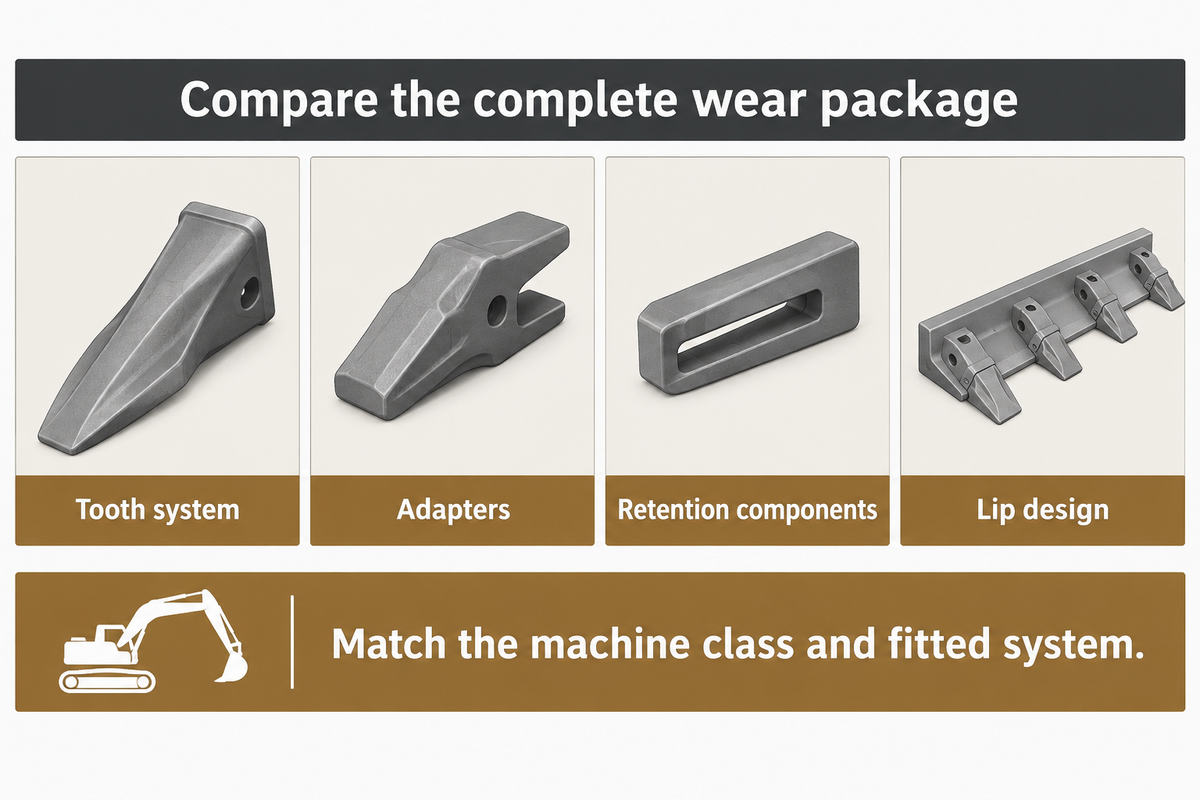
Specialist manufacturers are useful when the buying decision extends from the tooth to its adapter, lip and surrounding wear protection. ESCO and MTG cover construction systems, while CR and Bradken have substantial mining packages. Hensley, Combi, Feurst, BYG, Black Cat and H&L add different production and system choices.
5. ESCO: Best for Construction fleets needing an integrated-lock tooth system
Headquarters / base: Portland, Oregon, USA · Founded: 1913 · Type: Weir division designing and manufacturing wear systems
Official website: https://www.global.weir/brands/esco/
Main products: Ultralok construction points and adapters; mining buckets and wear systems
Manufacturing / system capability: Two-piece system with an integrated hammerless lock for 6–75 metric-ton excavators
Notable work: An integrated pin reduces the separate parts inventory, with eight named point profiles for construction.
ESCO Ultralok fits construction fleets that want a hammerless system with fewer separate retention pieces. The two-piece arrangement incorporates the lock into the point, while the profile range includes Standard, Chisel, Flare, Heavy, Pick, Rock, Clamshell and Twin Pick shapes. This gives a buyer a choice of penetration and wear-material distribution within the same named family rather than a comparison based only on tooth weight. Ultralok adapters are part of that choice: changing from another nose system entails the matching adapter as well as the replacement teeth.
Buying limitation: Ultralok points require Ultralok adapters; the cited construction range covers 6–75 metric-ton excavators.
6. Hensley Industries: Best for Buyers wanting casting control and construction-to-mining coverage
Headquarters / base: Dallas, Texas, USA · Founded: 1947 · Type: Komatsu-group ground-engaging-tool manufacturer
Official website: https://www.hensleyind.com/
Main products: GETpro construction and cast-lip systems, teeth, buckets and adapters
Manufacturing / system capability: Controls design, molds, steel pouring, aftercast and metallurgical testing
Certifications: Website publishes ISO 9001:2015 and ISO 14001:2015 certificates.
Notable work: Tests every heat of steel for composition and material tolerances.
Hensley is suitable when the purchasing discussion includes the bucket lip and its wear package, rather than a box of generic tips alone. The company describes its own pattern and mould work, pouring, after-casting operations and metallurgical checks, including testing each heat of steel. Construction GETpro products and three-piece cast-lip mining systems address different equipment duties, and Hensley’s Komatsu ownership gives the company a clear group identity. A buyer comparing those ranges must specify the lip design and working scale, because the mining arrangement isn’t an interchangeable construction-tooth package.
Buying limitation: GETpro construction and three-piece cast-lip mining systems are different assemblies, not interchangeable tooth choices.
7. CR Powered by Epiroc: Best for Large mining fleets pairing wear systems with lost-tooth monitoring
Headquarters / base: Brisbane, Australia · Founded: 1979, as CQMS · Type: Epiroc-owned mining wear-system and technology manufacturer
Official website: https://crmining.com/
Main products: Cast lips, teeth, protective shrouds and GET Trakka
Manufacturing / system capability: Surface and underground systems; manufacturing across Australia, China and Vietnam
Certifications: CR reports ISO 45001:2018 and ISO 14001:2015 certification for its integrated management system.
Notable work: GET Trakka detects lost ground-engaging components and complements CR’s physical wear systems.
CR is a strong candidate for mining operations that want engineered wear parts alongside tooth-loss or load-monitoring technology. Its history includes cast-lip development for large excavators, while GET Trakka detects lost ground-engaging tools and Titan addresses payload monitoring. Epiroc completed the acquisition in February 2023, so CR should be compared as an Epiroc business rather than an independent company with an unrelated support network. The scope is most useful for an engineered mine installation; a small fleet buying occasional standard teeth may need a simpler product and service package.
Buying limitation: Its offer is centered on integrated mining equipment and systems rather than a compact-excavator tooth assortment.
8. Bradken: Best for Mining operations comparing cast-lip and plate-lip packages
Headquarters / base: Newcastle, Australia · Founded: 1922 · Type: Hitachi Construction Machinery subsidiary manufacturing engineered wear solutions
Official website: https://www.bradken.com/
Main products: Eclipse cast-lip, Zenith and Twistlok plate-lip systems
Manufacturing / system capability: Eclipse for 350–800-tonne mining machines; Zenith plate-lip for machines under 300 tonnes
Certifications: Bradken reports ISO 9001 and ISO 14001:2015 certifications for its Xuzhou facility.
Notable work: Offers both cast and plate lips, with GETVision for component-loss and wear monitoring.
Bradken suits mine operators replacing or specifying a complete lip-and-tooth system for large excavators. Eclipse addresses cast lips on 350–800-metric-ton machines, whereas Zenith is a plate-lip system for machines below 300 metric tons, and the two shouldn’t be treated as adjacent sizes of one universal tooth. Twistlok retention and GETVision monitoring add options for maintenance planning within the relevant system. This is a mining-oriented choice whose value lies in the matched wear package, so it’s less directly comparable with a small excavator spare-parts order.
Buying limitation: Eclipse and Zenith serve defined mining machine classes, so they aren’t a general small-excavator replacement range.
9. MTG: Best for Quarries and mines seeking a specialist tooth-system supplier
Headquarters / base: Barcelona, Spain · Founded: 1957 · Type: Specialist ground-engaging-tool manufacturer
Official website: https://mtgcorp.com/
Main products: STARMET, KINGMET, PROMET, RIPMET and MTGtwist
Manufacturing / system capability: Own steel-development and manufacturing chain with a Monzón foundry
Certifications: Integrated management system: ISO 9001, ISO 14001 and ISO 45001.
Notable work: The Monzón foundry opened in 2012, linking system engineering to casting production.
MTG offers a specialist route for buyers who want the tooth, adapter and protective wear parts specified together. Its own foundry at Monzón supports a range that includes STARMET, KINGMET, PROMET and RIPMET, with MTGtwist retention in applicable systems. The combination is useful for a contractor standardizing a wear-parts family across buckets, provided the chosen series covers the operating duty. Different MTG families still have their own interfaces and applications, so a familiar brand name alone doesn’t make one system’s tooth a replacement for another.
Buying limitation: A move between its named system families is a system-selection decision, not a brand-only tip swap.
10. Combi Wear Parts: Best for Excavator users seeking Swedish-made specialist wear systems
Headquarters / base: Sweden; manufacturing base in Ljungby · Founded: Early 1930s, manufacturing roots · Type: Wear-system developer and foundry manufacturer
Official website: https://www.combiwearparts.com/
Main products: C-REX, ProTect and T-System wear products
Manufacturing / system capability: Develops patented systems and produces wear parts at its Ljungby foundry
Certifications: Website reports SS-EN ISO 14001 environmental certification.
Notable work: The Ljungby facility has supported development and production of wear parts since 2003.
Combi combines proprietary tooth-system development with manufacturing at its Ljungby foundry in Sweden. CREX addresses excavation, while the T System serves dredging and ProTect supplies protective wear components, giving buyers distinct routes for digging teeth and surrounding bucket protection. Its history reaches back to the early 1930s, but the current Ljungby foundry dates from 2003; those are different milestones. An excavation enquiry should name CREX and its matching parts rather than borrowing specifications from the company’s dredging range.
Buying limitation: Its T-System is a dredging range; excavator buyers should compare the C-REX family rather than treating every Combi product as equivalent.
11. Feurst: Best for Buyers seeking French-made hammerless teeth and adapters
Headquarters / base: Feurs, France · Founded: 1992 · Type: Safe Metal subsidiary manufacturing teeth and adapters
Official website: https://feurst.fr/en/
Main products: TURNKEY Rhino and Grizzly, ORCA and ORYX systems
Manufacturing / system capability: Electric-arc-furnace metallurgy and in-house design; range for 1–350-tonne machines
Notable work: Grizzly serves 8–50-tonne excavators with a single-use locking system; Rhino serves 29–350-tonne excavators with a different compression lock.
Feurst is worth shortlisting when a buyer wants to compare hammerless retention designs as well as tooth shapes. The company develops and produces wear parts at Feurs, with steelmaking and product-development work described as part of its operation. TURNKEY Grizzly covers 8–50-metric-ton excavators with a single-use conical rubber sleeve, whereas Rhino covers 29–350-metric-ton excavators with a different compression-locking arrangement. Those overlapping machine classes don’t make the locks interchangeable, and the chosen retention family needs to stay attached to the part number throughout purchasing.
Buying limitation: TURNKEY Grizzly and Rhino use different locks and serve different duty ranges; their retention parts aren’t a single common stock item.
12. BYG / FUTURA: Best for Mixed fleets comparing replacement teeth and hammerless options
Headquarters / base: Molins de Rei, Barcelona, Spain · Founded: 1967 · Type: Wear-parts manufacturer partnered with ITR USCO
Official website: https://byg.com/en/
Main products: BYG Classic replacement teeth and FUTURA wear systems
Manufacturing / system capability: Own engineering and R&D; cast-steel teeth and hammerless designs
Certifications: Company reports ISO 9001 certification.
Notable work: BYG’s FUTURA brand launched in 2004 and is counted within this single company entry.
BYG’s FUTURA range suits buyers seeking a named hammerless system alongside a broader replacement-parts catalogue. The company introduced FUTURA in 2004 and later formed its ITR USCO partnership, so BYG and the ITR group are represented here by one entry. Classic cast teeth and FUTURA serve different purchasing needs: keeping an existing conventional interface is a different job from converting a bucket to a proprietary system. Quotes should therefore separate the replacement-tooth option from the adapter and retention hardware needed for a system change.
Buying limitation: BYG Classic replacement styles and FUTURA systems differ in interface and retention; the brands aren’t one universal fit.
13. Black Cat Wear Parts: Best for Mixed-brand replacement teeth plus dedicated wear systems
Headquarters / base: Edmonton, Alberta, Canada · Founded: 1968 · Type: Wear-parts manufacturer with North American and Chinese production
Official website: https://www.blackcatwearparts.com/
Main products: Replacement excavator teeth, RV/RVJ systems and RVS shrouds
Manufacturing / system capability: Own foundry commissioned in Suzhou in 2012
Certifications: Distributor Wajax describes ISO-certified facilities.
Notable work: In addition to replacement ranges, Black Cat offers its own RV and RVJ teeth and adapters.
Black Cat is useful for fleets balancing its own RV or RVJ systems against replacement teeth for other established interfaces. The business began with wear parts in Edmonton and later added its own Suzhou foundry, giving the catalogue a manufacturing base as well as a brand identity. RV, RVJ and RVS shrouds cover different parts of the front-end wear package; a compatible-style listing should stay tied to its stated adapter family. Its proprietary systems and third-party replacement lines are separate choices, so a purchase order should identify which route the bucket already uses.
Buying limitation: Its third-party replacement products and own RV/RVJ systems are separate options; compatibility doesn’t mean OEM affiliation.
14. H&L Tooth Company: Best for Replacement buyers comparing forged, cast and fabricated teeth
Headquarters / base: Tulsa, Oklahoma, USA · Founded: 1931 · Type: Manufacturer of replacement teeth and associated wear parts
Official website: https://www.hltooth.com/
Main products: Cast, forged and fabricated teeth, 156 Cobra and 230-series products
Manufacturing / system capability: 200,000-square-foot manufacturing facility; forged 31ST design
Certifications: Homepage identifies the company as ISO 9001 certified.
Notable work: The 31ST forged tooth was introduced in 1963 as a heavier alternative to the 20ST.
H&L offers a long-established source for cast, forged and fabricated teeth, including familiar backhoe and compact-equipment applications. The Tulsa factory and the 156 Cobra and 230 families make it a useful company to investigate when a smaller bucket needs an identifiable replacement system. Its 31ST forged tooth, introduced in 1963 as a heavier development from 20ST, also shows why a process label needs a specific tooth model beside it. H&L’s own series should be matched by their dimensions and retention design, because similarly described teeth from another family can use a different fit.
Buying limitation: Legacy series have distinct geometries; a forged 31ST and a 156-series mini-excavator tooth are different selections.
Aftermarket Bucket Teeth Manufacturers
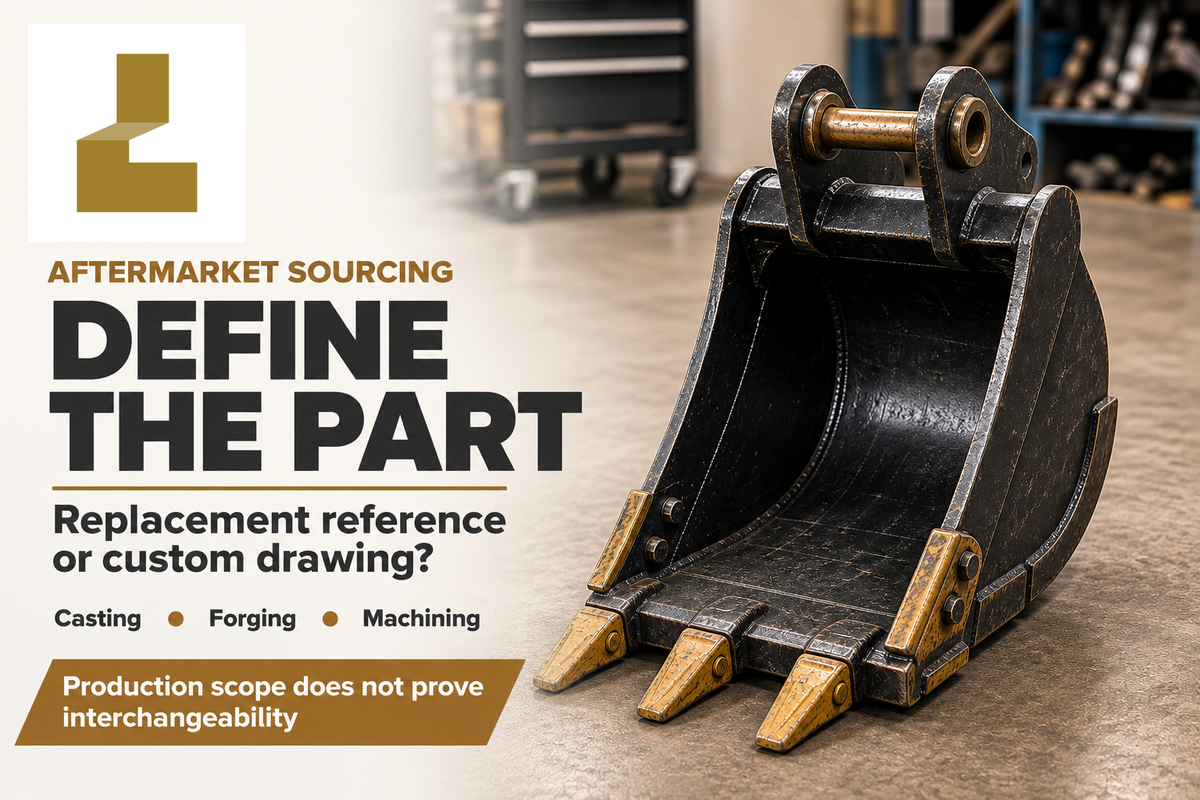
Aftermarket manufacturers suit buyers comparing established replacement references, forged options or custom cast parts. Aili, YASSIAN, Gold Forging, JC Casting, Huangzuan and ND have distinct production scopes. A stocked replacement part and a new drawing-based casting involve different approval work, so their quotations need the same finished-part requirements before comparison.
15. Jiangxi Aili: Best for Buyers sourcing both cast and forged replacement teeth
Headquarters / base: Jing’an, Yichun, Jiangxi, China · Founded: 1980 · Type: Casting and forging ground-engaging-tool manufacturer
Official website: https://www.ailiparts.com/
Main products: Bucket teeth, adapters, ripper teeth, side cutters, pins and retainers
Manufacturing / system capability: Materials R&D laboratory with spectrometer, impact and hardness testing
Certifications: Company states it holds ISO 9001 certification.
Notable work: Aili offers both casting and forging and runs its own materials-development laboratory.
Aili is a useful shortlist entry when the sourcing brief explicitly compares cast and forged teeth. The Jiangxi manufacturer describes both production routes and identifies a 1U3302RCX J300 forging product, giving buyers a concrete part family to discuss instead of an unspecified forged bucket tooth. Its published material-laboratory equipment includes spectroscopy, impact and hardness testing, which are relevant topics for an agreed quality-control plan. The cast and forged catalogues still need separate part-level comparisons; neither route by itself fixes the delivered tooth’s fit or service life.
Buying limitation: The catalogue spans many reference-number systems, so one machine brand doesn’t identify a single Aili tooth fit.
16. YASSIAN: Best for Buyers seeking replacement teeth with custom drawing support
Headquarters / base: Ningbo, China · Founded: 2002 · Type: Yasheng casting manufacturer of ground-engaging wear parts
Official website: https://www.yassian.com/
Main products: Bucket teeth, adapters and other ground-engaging wear parts
Manufacturing / system capability: Casting production and custom sizes to customer drawings
Certifications: Company reports ISO 9001.
Notable work: The catalogue identifies XS50-related teeth and a matching 1060MXS50 center adapter.
YASSIAN suits a buyer seeking a casting manufacturer for existing tooth references or drawing-based work. The Ningbo business identifies teeth and adapters as part of its wear-parts production and gives individual product references such as an XS50 tooth and a 1060MXS50 centre adapter. The XS50-related parts form a specific matching enquiry, so their dimensions should not be generalized to every tooth carrying a similar size description.
Buying limitation: Its XS-style products are replacement references; the matching adapter size remains part of the specified assembly.
17. Gold Forging / HXMD: Best for Buyers specifically seeking forged replacement tooth packages
Headquarters / base: Quanzhou, Fujian, China, manufacturing base · Founded: 1990s factory roots; exact company incorporation date not given · Type: Forging manufacturer operating the HXMD brand
Official website: https://www.goldforging.com/
Main products: Forged bucket teeth, adapters, cutting edges and bucket assemblies
Manufacturing / system capability: Own forging factory and machining facilities; custom specifications
Certifications: Company reports ISO 9001:2015 certification.
Notable work: The company describes in-house forging and machining rather than only reselling finished teeth.
Gold Forging’s HXMD range is most relevant to buyers deliberately sourcing forged teeth and related machined parts. The factory history describes roots in the 1990s and later company stages, while forged-tooth research dates from 2010; this is a manufacturing history rather than one simple incorporation date. According to its company profile, the manufacturing base is in Quanzhou, and the business describes its own forging and machining operations. That specialization narrows the enquiry to the available forged references or a defined custom design, rather than every cast replacement pattern in the market.
Buying limitation: Forged replacement parts are its focus; they don’t replace an engineered mining cast-lip package as a complete system.
18. JC Casting: Best for Drawing-led custom cast bucket-tooth projects
Headquarters / base: China · Founded: Not publicly disclosed · Type: Custom investment and sand-casting manufacturer
Official website: https://www.jccasting.com/
Main products: Cast bucket teeth and custom metal castings
Manufacturing / system capability: Foundry plus CNC machining, heat treatment and dimensional inspection
Certifications: Company states ISO 9001 and IATF 16949.
Notable work: Foundry and machining operations support drawing-based projects through heat treatment and finished-part inspection.
JC Casting is a fit for a drawing-led tooth project where casting, heat treatment and machining are part of the purchasing scope. The company describes sand and investment casting, CNC work and inspection capability, so the discussion can cover the finished steel bucket tooth rather than only a raw casting. This makes it a different sourcing route from ordering a stocked proprietary tooth system through a dealer. A new design introduces tooling and sample-approval work, which must be included in the delivery plan before comparing its unit price with an existing stocked part.
Buying limitation: Its offer is a custom casting and machining service, so tooling and approval scope belong in the quotation.
19. Ningbo Huangzuan: Best for Buyers sourcing investment-cast and coated-sand wear parts
Headquarters / base: Cixi, Ningbo, China · Founded: 2008 · Type: Manufacturer of cast construction-machinery wear parts
Official website: https://www.hzteeth.com/
Main products: Bucket teeth, adapters and side cutters
Manufacturing / system capability: Investment casting and coated-sand casting
Certifications: Homepage reports ISO 9001:2008; this is an earlier-edition company claim.
Notable work: Uses two casting routes, investment casting and coated-sand casting, for wear-part production.
Huangzuan provides an investment-casting and coated-sand-casting route from Cixi in Ningbo. Teeth, adapters and cutters share its product scope, which suits buyers consolidating several wear-part references with one casting supplier. For a custom order, the relevant production route and finished-part requirements belong to the specified drawing; a catalogue photograph alone leaves those choices open.
Buying limitation: Its replacement catalogue is organized by specific tooth and adapter references, rather than one proprietary universal system.
20. Ningbo Fenghua ND Machinery: Best for Buyers combining bucket teeth with other custom wear castings
Headquarters / base: Ningbo, China · Founded: 2005 · Type: Manufacturer developing its own N and FHND wear products
Official website: https://www.fh-nd.com/
Main products: Bucket teeth and adapters, dredger teeth, pins, cutting edges and special castings
Manufacturing / system capability: Wax injection, shelling, heat-treatment, coated-sand and CNC production equipment
Certifications: About page reports ISO 9001 certification.
Notable work: Own product development is backed by heat-treatment lines and CNC machining centers.
ND combines its FHND-branded tooth and adapter range with other cast wear parts for dredging and demolition equipment. The Fenghua operation describes wax injection, automatic shelling, heat-treatment lines and CNC machining centres, giving a buyer concrete production stages to discuss for a custom part. Own product development and several casting processes make it useful for enquiries that extend beyond one standard digging-tooth reference. The breadth also requires precise product identification: a dredger or demolition component shouldn’t be substituted for an excavator tooth merely because both appear in the same catalogue.
Buying limitation: The range includes demolition and dredging parts; those profiles are separate from excavator bucket-tooth selections.
Forged and Cast Bucket Teeth
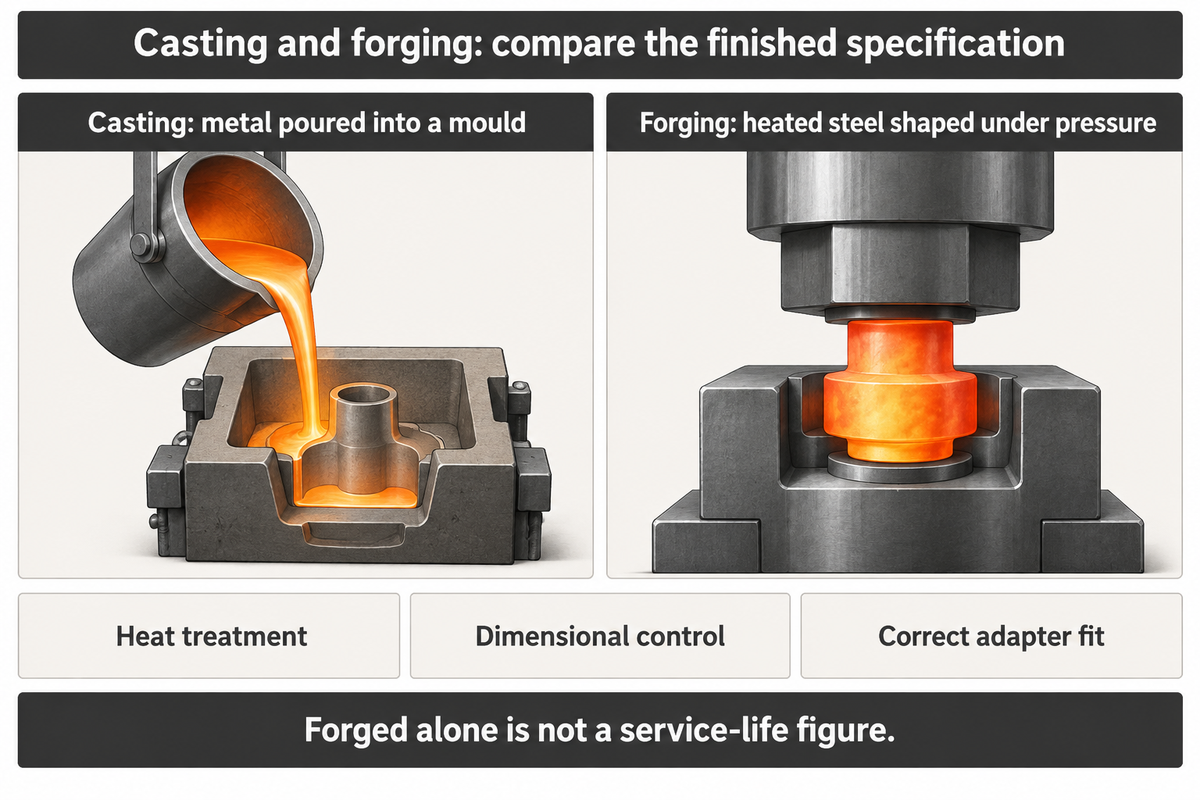
Both cast and forged teeth are available from established manufacturers, including H&L and Aili. Choose the exact tooth specification and fit before comparing the production route. An alloy steel bucket tooth needs suitable heat treatment and geometry for its duty; “forged” alone isn’t a service-life figure.
How does the production process affect bucket teeth quality?
Casting forms the tooth by pouring metal into a mould, while forging shapes heated steel under pressure. Each route produces a part that still needs the specified heat treatment and dimensional control. H&L manufactures cast, forged and fabricated teeth, and Aili lists separate casting and forging products, so the useful comparison is between named parts for the same job.
Cavity and pin-hole dimensions determine if the tooth seats on its adapter. For abrasive excavation, the material specification and heat treatment affect the intended wear resistance. Impact resistance also matters when a tooth engages hard rock or when there’s uneven loading. Therefore, a hardness test value should remain associated with its test scale and the manufacturer’s method of measurement, rather than acting as a quality measure in isolation.
A custom casting enquiry adds drawing approval and sample inspection to the purchase. JC Casting describes sand and investment casting with heat treatment and machining; Gold Forging describes forging and machining. Those capabilities help define who can produce the requested shape, but a finished part still needs an agreed tooth profile and adapter interface.
Existing replacement reference
- Identify the current tooth and adapter family.
- Compare the same profile and retention hardware.
- Order the specified cast or forged version.
Custom tooth design
- Define the drawing and finished dimensions.
- Agree material, heat treatment and inspection.
- Include tooling and sample approval in the schedule.
Tooth Shapes for Rock, Clay and Abrasive Ground
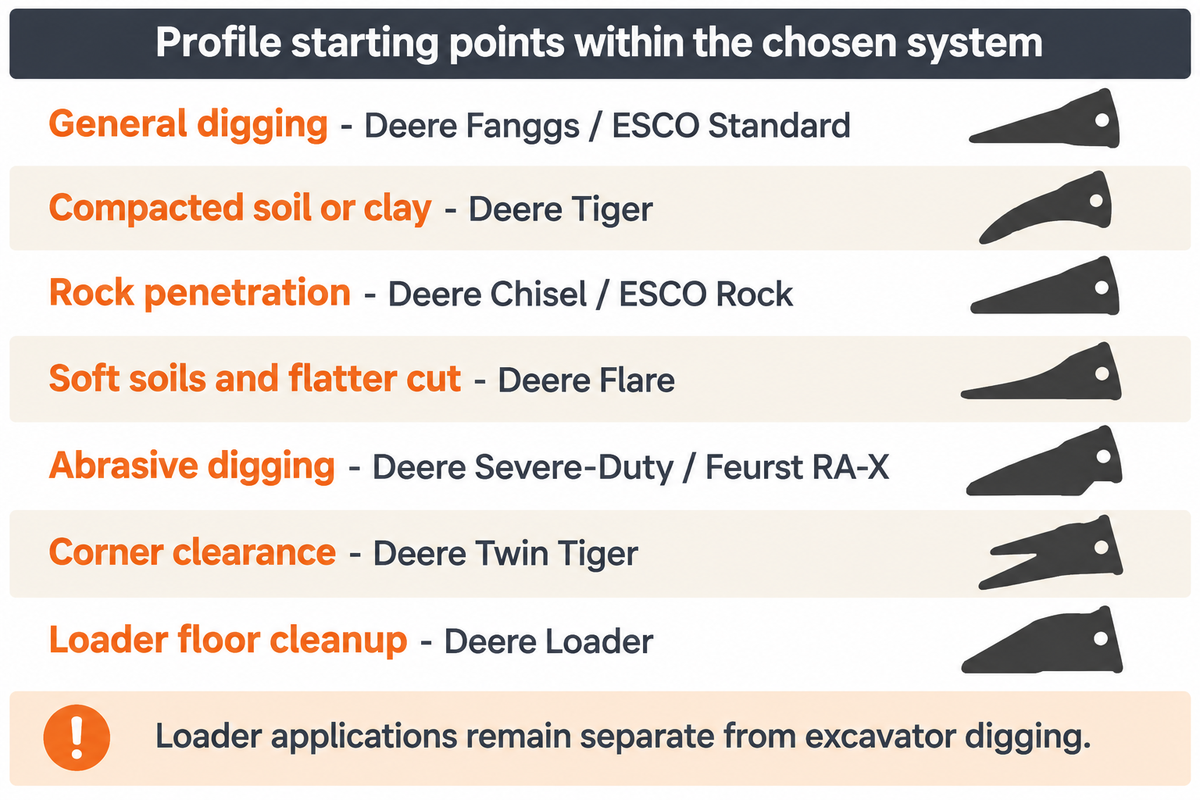
Start with a penetration profile for compacted ground, a rock profile for the specified rock duty, and an abrasion profile where wear material is being consumed quickly. Names for bucket tooth types vary between systems. John Deere’s TK-Series separates Tiger, Chisel, Flare and Severe-Duty teeth; ESCO Ultralok also offers named profiles for different construction applications.
Which bucket teeth are best for rock?
John Deere TK-Series Chisel and ESCO Ultralok Rock are direct starting points for rock applications within their respective systems. Narrow tiger teeth can help penetrate tightly compacted ground, including some rock, but their role differs from a reinforced or abrasion-focused profile. Choose within the adapter family fitted to the bucket, then match the profile to the observed digging and wear conditions.
Heavy-duty bucket teeth usually carry a different distribution of wear material from standard teeth. Extra steel is useful only where the working conditions consume it: a larger profile can also change penetration and the load needed to enter the material. John Deere’s loader teeth are designed for loader applications, with their own working profiles; they shouldn’t be substituted for excavator digging teeth simply because they look thicker.
| Working need | Example profile | Buying implication |
|---|---|---|
| General-purpose excavation | John Deere Fanggs; ESCO Standard | Use as the initial comparison for mixed digging duties within the chosen system. |
| Tightly compacted soil or clay | John Deere Tiger | Concentrated penetration; distinguish the point from a broad cleaning profile. |
| Rock penetration | John Deere Chisel; ESCO Rock | Select the manufacturer’s rock profile, with its matching adapter and lock. |
| Soft soils and a flatter cut | John Deere Flare | A broader working face suits a different excavation finish from a tiger point. |
| Highly abrasive digging | John Deere Severe-Duty; Feurst RA-X | Compare added wear material and its location on the tooth. |
| Corner clearance with penetration | John Deere Twin Tiger | Follow the system’s specified arrangement of TG and TT positions. |
| Loader floor cleanup | John Deere Loader | Its underside aligns with a level loader bucket; it is a loader application. |
The purpose of bucket attachment also defines tooth choice. A general digging bucket, rock bucket and cleanup bucket are not made interchangeable by fitting different points. The bucket selection guide covers the wider attachment choice when the existing assembly does not suit the work.
How to Choose Bucket Teeth and Match the Adapter
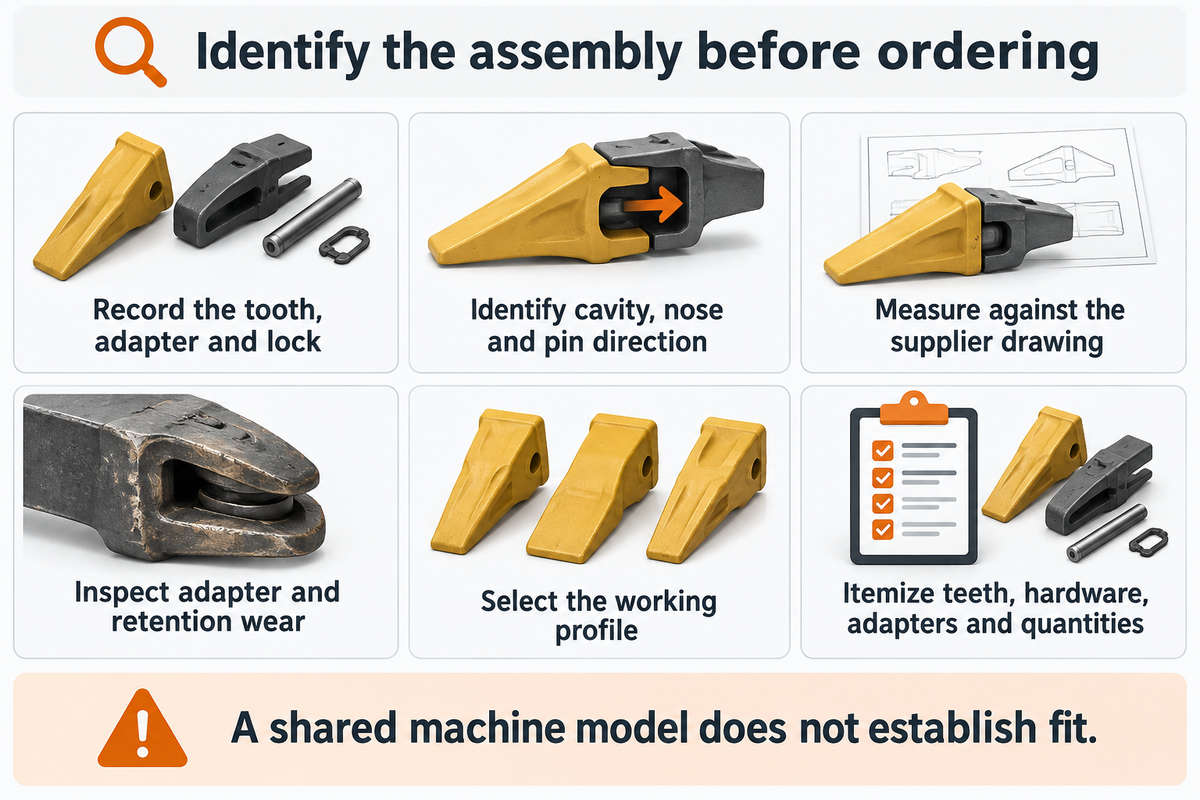
Match the tooth cavity, adapter nose and retention mechanism before considering a supplier. The excavator model and operating weight narrow the search, but don’t identify a rebuilt or replaced bucket. A useful parts inquiry includes readable part numbers, measured dimensions, and pictures of the fitted assembly.
How do I avoid buying the wrong replacement bucket teeth?
Start with the existing tooth and adapter numbers, then match the retention arrangement and dimensions. John Deere’s all-makes guidance distinguishes horizontal Cat-style pins, H&L flex pins and Hensley-style geometry; these descriptions refer to specific replacement families. A similar outline or a shared machine model isn’t a substitute for the correct tooth-to-adapter connection.
- Record the fitted parts: Photograph the tooth, adapter and lock, and copy readable OEM part numbers or aftermarket references before ordering.
- Identify the system: Match the cavity shape, adapter nose and pin direction to the appropriate catalogue.
- Measure the interface: Use the supplier’s drawing to compare the required cavity and pin dimensions.
- Check the mounting condition: Inspect the adapter and retention parts against the system’s wear and replacement instructions.
- Select the working profile: Choose the manufacturer’s profile for penetration, rock or abrasion duty.
- Confirm the supply scope: List teeth, pins or retainers, adapters and quantities separately on the quotation.
Part-number matching requires the suffix as well as the main reference. A standard tooth and a tiger bucket tooth can share a system size while having different working profiles. Oversized teeth may alter clearance or loading, while an undersized replacement can be unsuitable for the adapter or duty. These are dimensional and application decisions, not a reason to choose a part from a picture.
The adapter is part of the bucket wear inspection. Fitting new teeth does not repair a worn nose, damaged seating surface or retention hole that prevents the specified lock from seating. The bucket lip, side protection and other wear areas should be assessed with the fitted system’s instructions. For the complete system, compare the relevant excavator buckets before buying a conversion kit.
A bucket pin linking an attachment to a machine is different from a pin retaining a single tooth. Similarly, backhoe bucket teeth, skid steer attachment teeth, and ripper teeth also require application references. A supplier may sell all these machinery parts, but a large catalog doesn’t make parts interchangeable. The excavator parts guide helps locate a tooth assembly in a larger order for replacement parts.
For a first order, ask for the exact material grade or agreed specification, the heat-treatment requirements, inspection records and current certificate scope where certification is part of the purchase. The certificate holder and production site should match the intended supply route. For a named wear-resistant or carbide-equipped variant, retain that designation on the order rather than treating it as a generic description of all teeth from the brand.
Bucket Teeth Prices and Comparable Quotes
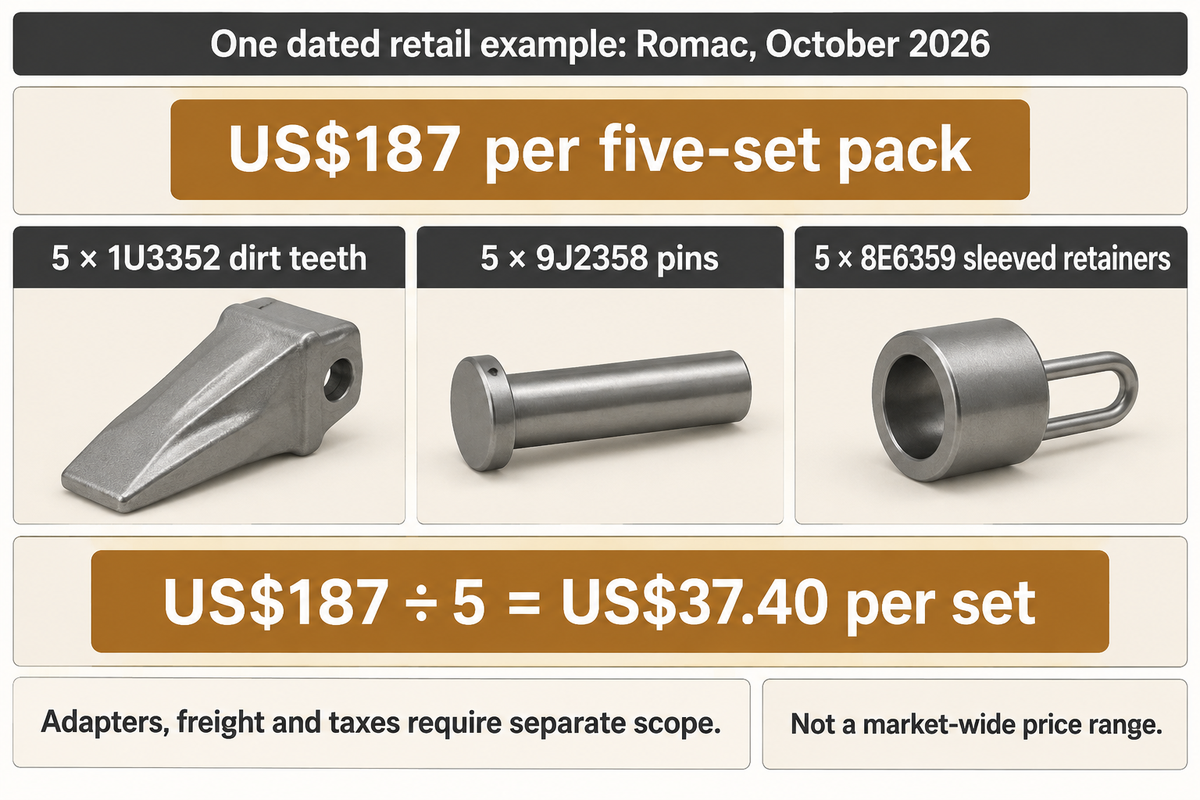
A checked retail example was US$187 for five matched tooth-and-hardware sets: Romac’s 1U3352 pack includes five dirt teeth, five 9J2358 pins and five 8E6359 sleeved retainers. That’s US$37.40 per set by division. It’s a dated product example from October 2026, not a price range for every tooth size or manufacturer.
A quoted tooth system with a defined starting point for comparison is available in the Romac five-pack listing. A quote for one loose tooth doesn’t include the hardware in that example and neither quote automatically includes a replacement adapter. Freight, tax, and any other charges must be listed separately before a comparison of landed prices can be made.
Send each shortlisted supplier the same tooth system, full part number, profile and quantity. Stipulate the delivery destination and whether the order requires pins, retainers or adapters. For custom teeth, provide the approved drawing and inspection requirements. A supplier-direct order may differ from a local retail order in minimum quantity, lead time and return conditions.
When considering costs of service, assess tooth replacement frequency along with purchase price. Note the installed tooth reference, operating hours and the material being excavated, and then evaluate wear life for similar duties. If teeth wear faster after a job change, keep the new ground conditions separate in that comparison. A low unit price combined with frequent changes can increase downtime; a more expensive tooth is worthwhile only if its fit, working performance or availability improves the result on that job.
Bucket Teeth FAQ
Are excavator bucket teeth universal?
No. Bucket teeth are specific to an adapter and retention system.
The tooth cavity must fit the adapter nose, and the pin or lock must match the retention design. Two teeth sold for the same excavator class can be incompatible. Begin with the fitted part number and adapter family, then compare the manufacturer’s dimensions and application information. The machine badge alone doesn’t identify an independently supplied bucket.
Are aftermarket teeth as good as OEM teeth?
Aftermarket teeth can be suitable when the exact fit, material specification and working profile match the job.
Compare a named aftermarket part with the original system, including the pin and retainer. An equivalent-looking shape isn’t enough. Availability, replacement frequency and any adapter-conversion work affect value alongside the unit price. Quality and performance should be compared under similar excavation conditions, with the delivered part specification recorded rather than an assumption that one supplier category always lasts longer.
Should I replace pins and retainers with bucket teeth?
Replace single-use hardware and components outside the manufacturer’s wear limits; reuse only where that system permits it.
Retention designs differ. Feurst’s Grizzly uses a single-use conical rubber sleeve, while other systems have their own lock inspection and replacement requirements. Inspect the adapter and retention components during a tooth change, following the installed system’s instructions. Ordering the appropriate hardware with the teeth avoids receiving points that can’t be fitted with the parts available on site.
When should I use tiger bucket teeth?
Use a tiger profile when concentrated penetration is the priority in compacted ground.
John Deere identifies its TK-Series Tiger for tightly compacted soil, clay and rock. Select the corresponding system size and application profile. If tooth wear is dominated by abrasion, compare the manufacturer’s abrasion-focused alternative rather than assuming that a sharper point will provide longer service life.
How often should I really replace bucket teeth?
Replace teeth at the installed system’s wear limit or when damage requires replacement, rather than at one universal hourly interval.
Ground conditions, impact and tooth position change wear rates. Record replacement dates and operating hours so teeth working in similar material can be compared. Inspect retention components and the adapter as well as the point; a new tooth can’t correct a damaged mounting surface or a lock that won’t seat.
What’s the actual hardness I should be looking for?
Use the hardness specification for the exact tooth series and duty, together with its test scale and measurement location.
A higher headline number isn’t a complete tooth-quality specification. Heat treatment, alloy and geometry also matter for wear and impact behaviour. Compare the manufacturer’s stated requirements for the selected part rather than translating an unrelated bucket-plate hardness into a tooth requirement.
Find Compatible Excavator Attachments
LH Used Excavator assists in sourcing used machinery and excavator attachments. For any enquiries on buckets or teeth, send your machine and bucket details, including pictures of the tooth and adapter and retention parts. LH assists in the export and procurement of the equipment; the manufacturers mentioned retain responsibility for their own product systems and published specifications.
References & Sources
Company profile sources are the official sites shown in each card, with corporate history and ownership statements checked during selection. The technical comparison also draws on John Deere’s tooth-profile and all-makes guidance, ESCO’s Ultralok product description and Feurst’s TURNKEY product families. Company certifications and performance statements remain attributed to their stated sources.
Why We Write This
About Liehuang
Liehuang is a China-based used excavator supplier focused on verified machines, inspection records, and export-ready documentation. Our blog is written for buyers who need more than a model name and a low price before sending a deposit.
We publish practical guides on used excavator cost, machine hours, inspection points, import paperwork, attachments, and brand selection so contractors and equipment buyers can compare machines with fewer blind spots.
Inspection FirstEngine, hydraulics, undercarriage, serial-number photos, hour-meter photos, and machine video can be prepared before shipment.
9 Brands In StockCaterpillar, Komatsu, Volvo, Sany, Hyundai, Doosan, Kubota, Hitachi, and Kobelco excavators across common tonnage classes.
Export SupportContainer and RoRo shipping support with destination-focused quote details, Incoterm discussion, and paperwork coordination.
SYS.PROFILE
Contact Profile
NameLiehuang Used Excavators Team
CompanyHefei Liehuang Machinery Co., Ltd.
Product FocusUsed Excavators / Attachments / Export Supply
Buyer RequestInspection report, video, price, freight, and delivery timeline
Websitehttps://lhusedexcavator.com/
Payment protected by staged delivery proof
Pay the balance after machine proof, not on blind trust.
Used excavator buyers need more than a product photo. Liehuang uses a staged payment workflow: deposit to reserve the machine, inspection evidence before balance, and export documents plus shipment tracking before release.
Verified machine videoLoading and customs filesBalance paid after confirmation
Quote & machine selectionChoose the model, hours, attachments and export destination before we reserve stock.
Deposit to lock stockA deposit holds the exact machine while inspection media and documents are prepared.
Inspection proof sentReceive walkaround video, hour-meter photos, serial details and loading plan.
Balance after confirmationPay the remaining balance only after you confirm the machine condition and export evidence.
Shipment & customs trackingWe share loading photos, bill of lading progress and customs support until release.
For high-value used equipment, trust is built by evidence. Ask for the current stock list, payment schedule and export document sample before you decide.Request stock proof