Get in Touch with Liehuang Company

Excavator Depreciation Rate: A Used Buyer Guide to Real Machine Value

Used excavator valuation guide
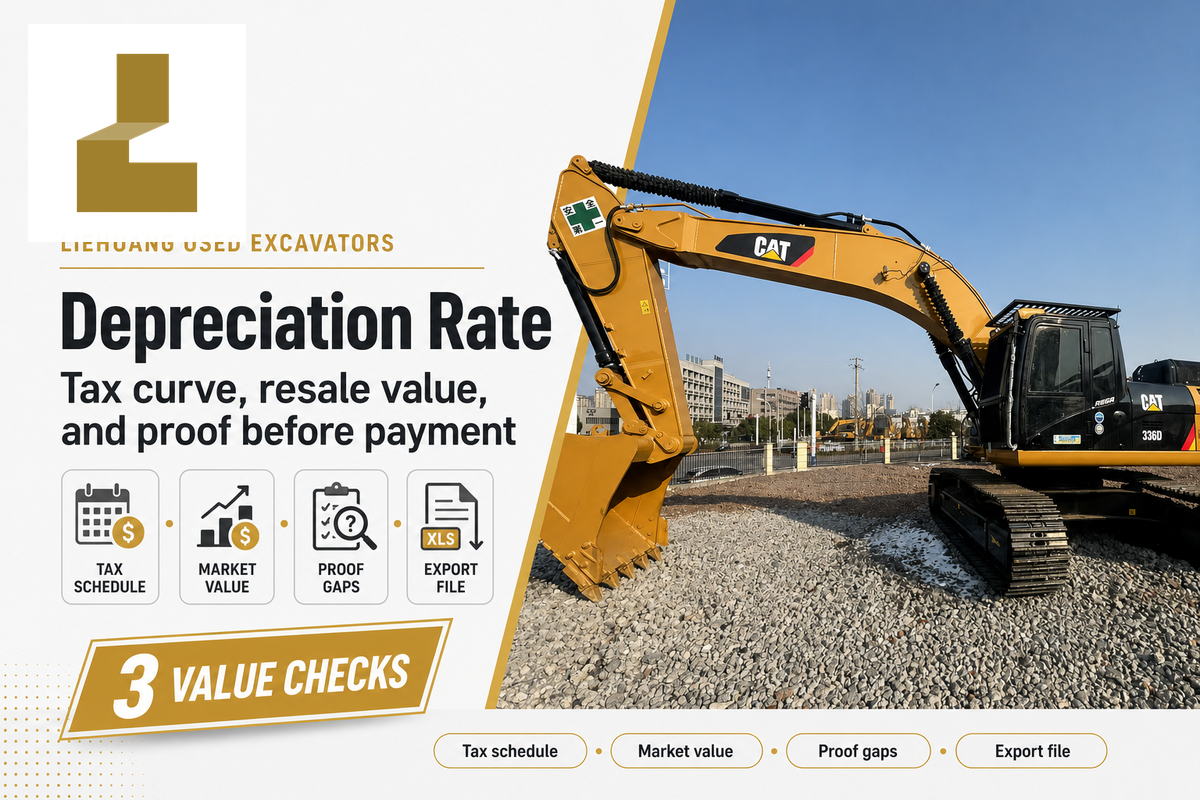
Excavator Depreciation Rate refers to how quickly an excavator loses value across tax records, resale markets, and proof-adjusted buyer risk. There is no single rate for every machine. For a used buyer, the practical question is which value curve is being used: tax schedule, market residual value, or condition proof.
Quick Take: Tax depreciation methods stem from IRS code, including MACRS, Section 179, and bonus depreciation. For offers, market price reflects hours, model year, size, brand demand, condition, and proof quality. Accounting uses its own depreciation curve, but it cannot substitute for an hour-meter photo, undercarriage photos, hydraulic tests, engine service proof, serial details, or shipping papers.
What is the excavator depreciation rate?
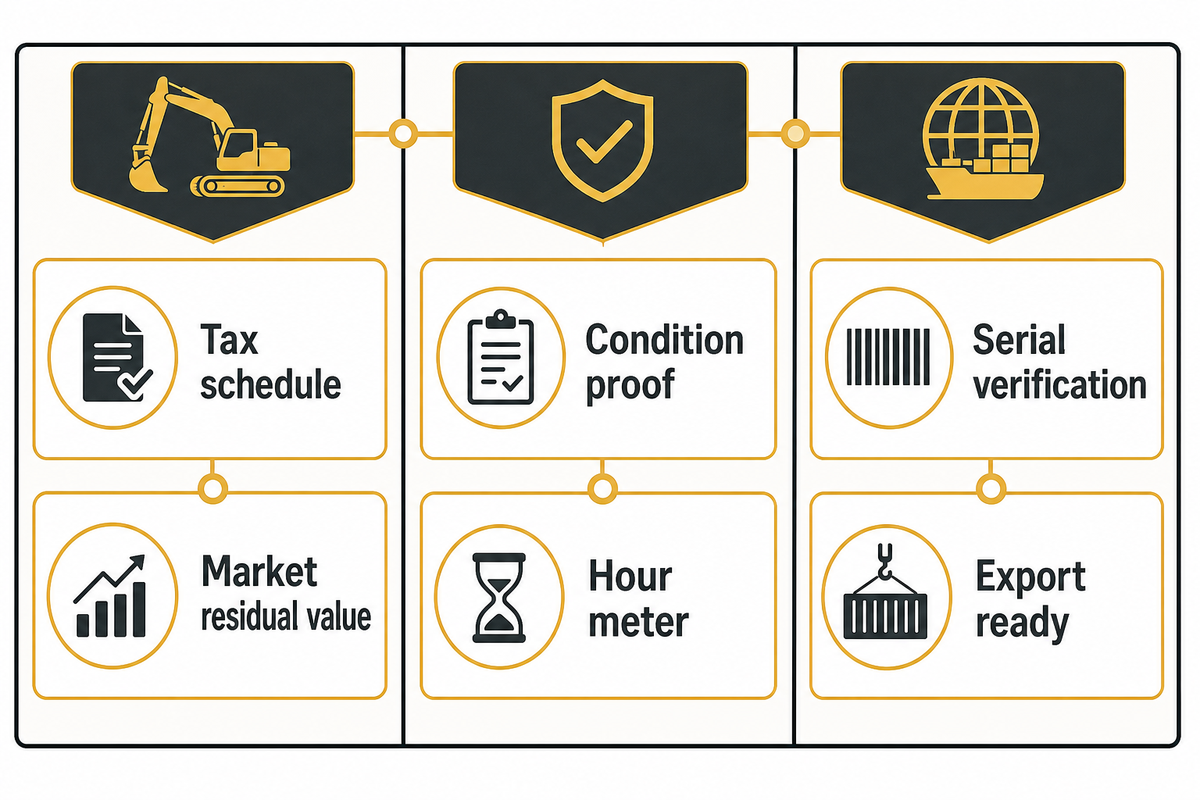
“Depreciation” can have three distinct implications. Your finance department may care about tax schedules. A fleet owner might care about how much book value has decreased from the purchase price. And a purchaser may wonder how much resale value they should shave off a used excavator offer because there’s missing proof.
A published CONEXPO-CON/AGG lifecycle-cost benchmark, including a cited 32% drop in years 1-3 and another 23% from years 3-7, is useful as a reference point, but it still needs machine-specific proof before a buyer turns it into an offer. While you’ll find broad depreciation rates online, consider them a starting point, not a rule. New excavators tend to depreciate sharply initially and then follow a flatter curve over the machine’s lifespan. A quality used excavator with extensive proof may have a higher market value than a lower-priced machine with hidden risks in the engine, hydraulics or undercarriage. Offering value shifts dramatically after proof is introduced.
When buying Liehuang used excavators, think about depreciation in two steps. First, consider the typical market and tax narratives. Next, factor in the proof of equipment status – the hour meter, videos, serial number verification, specific wear points, service history, attachment fitment, loading plan and if the equipment is ready for export.
Tax depreciation vs. market resale value
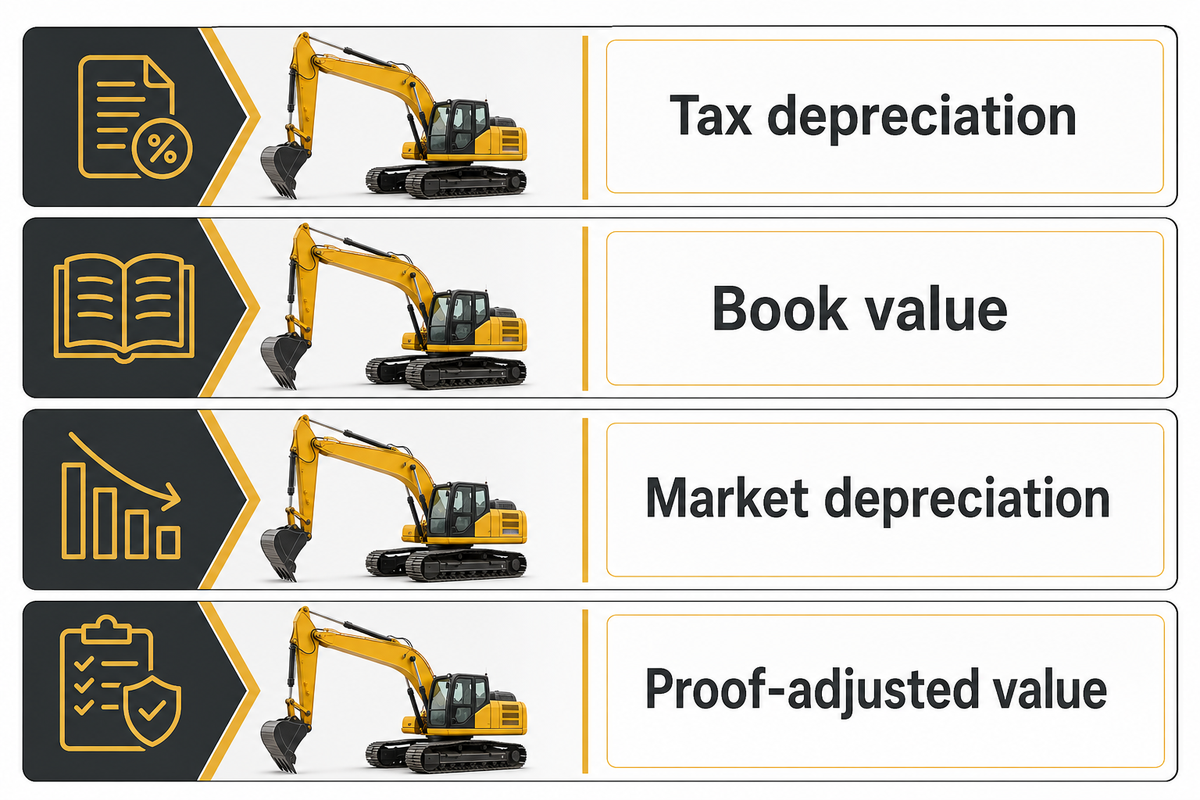
Tax depreciation applies to a filing question: What’s the dollar amount a business can expense over a year? Resale market value answers a buyer’s question: What’s a piece of machinery worth if its ownership changes hands? The values found in used equipment marketplaces won’t always align perfectly with the depreciation guidelines for tax purposes. A low book value could still command a strong resale price due to high market demand and the availability of thorough proof.
IRS Publication 946 explains depreciation deductions for business or income-producing property, including MACRS, Section 179, and special depreciation allowance. IRS Form 4562 instructions give the filing context for Section 179 and other basis reductions. These sources are useful for tax planning. They do not say what a buyer should pay for a used excavator.
| Value question | What it measures | Good source | Buyer risk if confused |
|---|---|---|---|
| Tax depreciation | Deduction timing for business property | IRS Publication 946 and Form 4562 | Buyer treats a tax write-off as a market discount |
| Book value | Accounting value after recorded depreciation | Company accounting records | Buyer misses a machine that still works well |
| Market depreciation | Resale value change in the used equipment market | Recent listings, auction data, dealer quotes | Buyer ignores demand, season, and brand support |
| Proof-adjusted value | Risk deduction after inspection evidence | Photos, videos, serial details, test results | Buyer pays for a clean story without proof |
3-Curve Excavator Depreciation Map
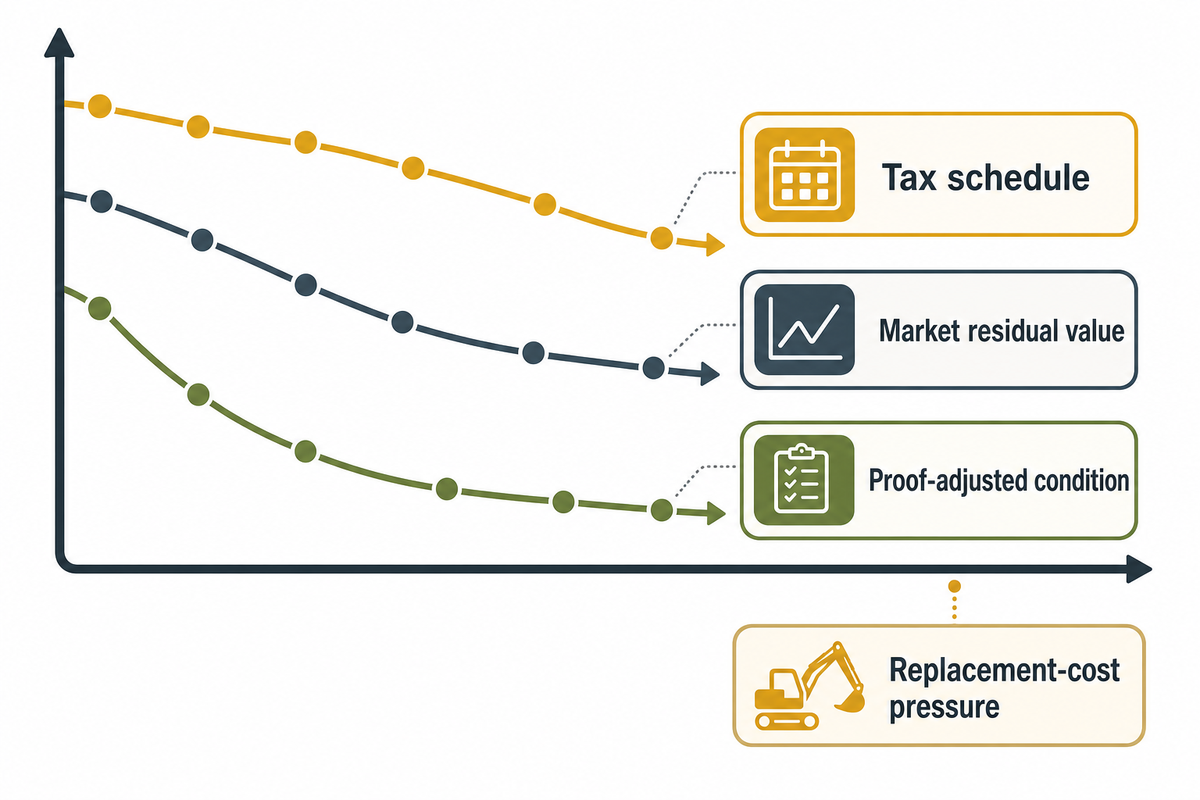
An easier approach to avoid using one rate for all decisions is the 3-Curve Excavator Depreciation Map, which places the tax depreciation schedule, resale market residual values, and the proof-adjusted residual value on distinct paths, empowering you to ask the right questions to the right specialists – your accountant, appraiser, fleet manager, or supplier.
Price indexes need a lane of their own, too. FRED WPU112 series, sourced from the U.S. Bureau of Labor Statistics, tracks construction machinery and equipment producer prices; the latest observation found during this workflow was June 2026 at 324.493, index 1982=100, not seasonally adjusted. The BLS WPU112 table lists the same figure for June 2026. That is a clue that replacement-cost pressure may be high. It is not proof that one excavator avoided service hours.
| Curve | Question it answers | Best evidence | Decision output |
|---|---|---|---|
| 1. Tax schedule | How should the equipment cost be treated for tax purposes? | IRS guidance, accountant review, placed-in-service date | Deduction plan and filing position |
| 2. Market residual value | What are similar excavators selling for now? | Recent resale listings, model demand, auction data, supply pressure | Offer range before inspection adjustment |
| 3. Proof-adjusted condition | What risk remains after proof is reviewed? | Walkaround video, hydraulic test, undercarriage proof, serial details, export plan | Final negotiation points before deposit or balance |
Hours-to-Residual Value Ledger
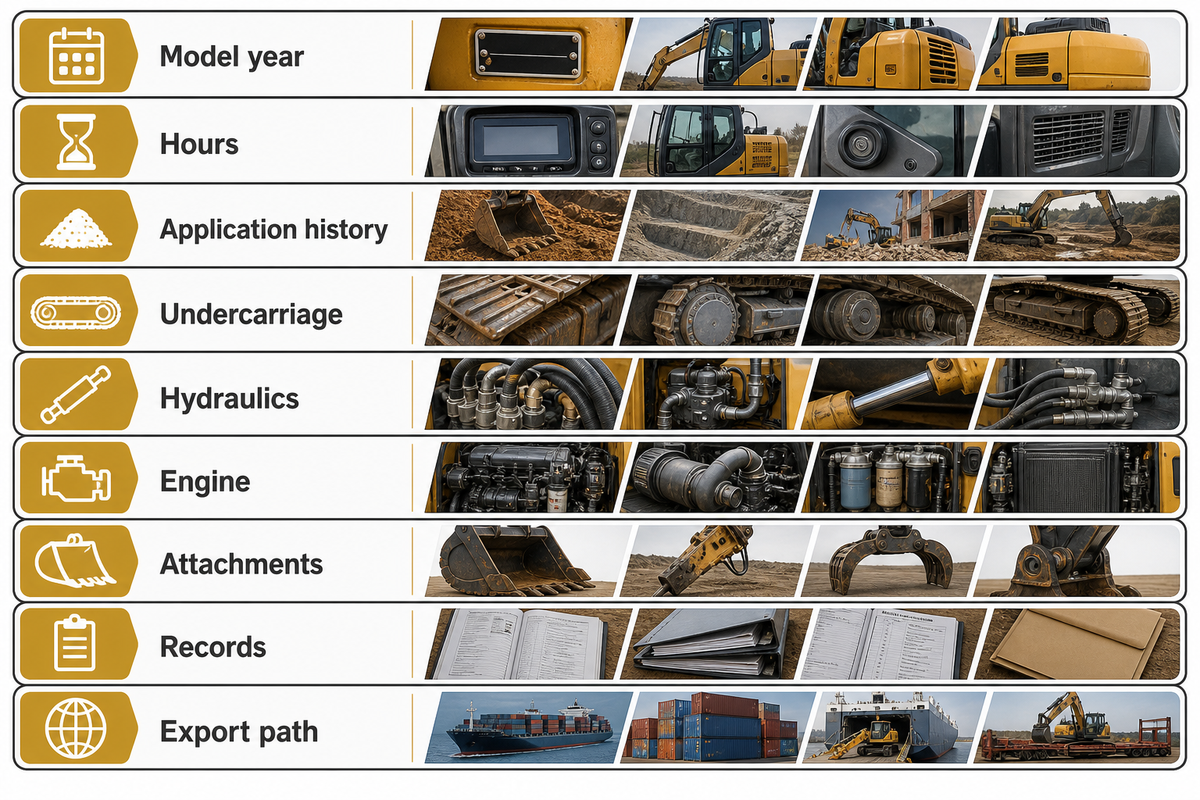
Hours matter because they represent work already taken from the asset. Still, the hour meter is only one field. Hours cannot show whether the machine spent its service life in trenching, quarry loading, demolition, wet soil, rental fleet work, or light farm use. Hours also cannot show whether maintenance was skipped.
Construction Equipment reported that contractors take the average hydraulic excavator out of primary production at about 6 years or 9,800 hours, with about 14,500 hours by year 10 in the cited economic-life analysis. Use that as a checkpoint. Never treat that benchmark as a rule that every machine at 9,800 hours is bad, or that every 4,000-hour machine is safe.
Equipment World reported that used excavator sales rose 5.3% year over year in 2025, with 12,548 used excavators financed and an average used-excavator age rising from 7.1 years to 7.7 years in the cited period. The same article described a 4.1% decline in new excavator sales and a 419,468-listing EquipmentWatch database, both useful as market context rather than quote guarantees. If older machines are selling, proof quality becomes even more valuable.
| Ledger field | What to record | What the buyer learns | Action before quote |
|---|---|---|---|
| 1. Model year | Year, model, serial number | Age and parts support baseline | Ask for serial photo |
| 2. Hours | Hour-meter photo plus video | Use intensity and resale value range | Match meter to serial record |
| 3. Application history | Digging, quarry, demolition, utility, rental, agricultural equipment use | Whether normal value loss may be steeper | Ask where the machine worked |
| 4. Undercarriage | Track chain, rollers, sprockets, idlers, pads | High-cost wear risk that can affect resale value | Request close photos and wear notes |
| 5. Hydraulics | Pumps, cylinders, hoses, swing, boom response | Repair risk hidden by low hours | Request video under load |
| 6. Engine | Cold start, smoke, leaks, idle, fault codes | Service life and near-term replacement risk | Ask for start and idle video |
| 7. Attachments | Bucket, breaker, quick coupler, auxiliary lines | Whether a machine fits paid work on day one | Match attachment to job and carrier size |
| 8. Records | Maintenance notes, inspection sheet, repair history | Whether tracking depreciation is backed by facts | Price missing records as uncertainty |
| 9. Export path | Loading plan, customs support, bill of lading progress | Whether value is protected before release | Hold balance until proof is clear |
Proof-Adjusted Depreciation Sheet
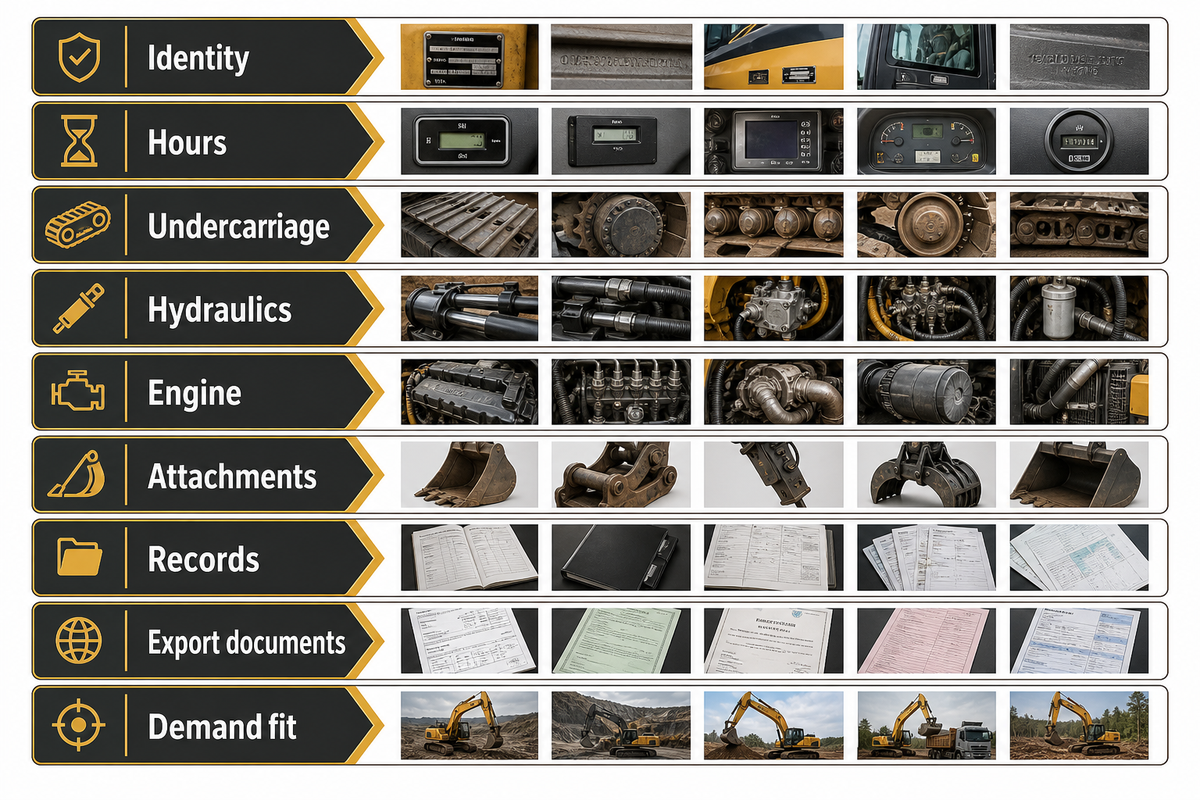
The Proof-Adjusted Depreciation Sheet converts machine proof into buyer action. This sheet does not replace a formal appraisal. Instead, it gives the buyer a disciplined way to ask for evidence and separate real value from sales talk.
According to Liehuang Used Excavators, its process checks the engine, hydraulics, undercarriage, and attachments, then provides inspection video, hour-meter photos, serial details, and a loading plan before balance payment. That process gives the buyer raw material for a proof-adjusted offer.
| Proof item | Acceptable evidence | If proof is strong | If proof is missing |
|---|---|---|---|
| 1. Identity | Serial plate and model photo | Quote can refer to exact machine | Do not compare price yet |
| 2. Hours | Clear meter photo plus video | Use hours in the residual value ledger | Ask for re-shot proof |
| 3. Undercarriage | Track-frame and wear-surface photos | Lower uncertainty on near-term equipment cost | Hold price reserve for parts |
| 4. Hydraulics | Boom, arm, bucket and swing test video | Condition supports the resale price | Ask for test under load |
| 5. Engine | Cold start, idle, exhaust, leak check | Service-life claim has evidence | Add repair-risk questions |
| 6. Attachments | Bucket or tool photos and fit details | Used equipment is closer to job-ready | Separate carrier price from attachment price |
| 7. Records | Maintenance and repair notes when available | Market value can hold value better | Do not overpay for a clean story |
| 8. Export documents | Invoice, packing or loading plan, shipment steps | Finance can release payment with less blind trust | Keep balance pending |
| 9. Demand fit | Brand, size class, parts supply, project fit | Machine may depreciate slower in active demand | Check alternatives before deposit |
Need a proof-based valuation packet? Send Liehuang the model, target hours, job application, attachment needs, destination port, and preferred proof items. The team can respond with machine evidence before you make a balance-payment decision.
Hidden Bottleneck: Proof Gaps That Distort Depreciation
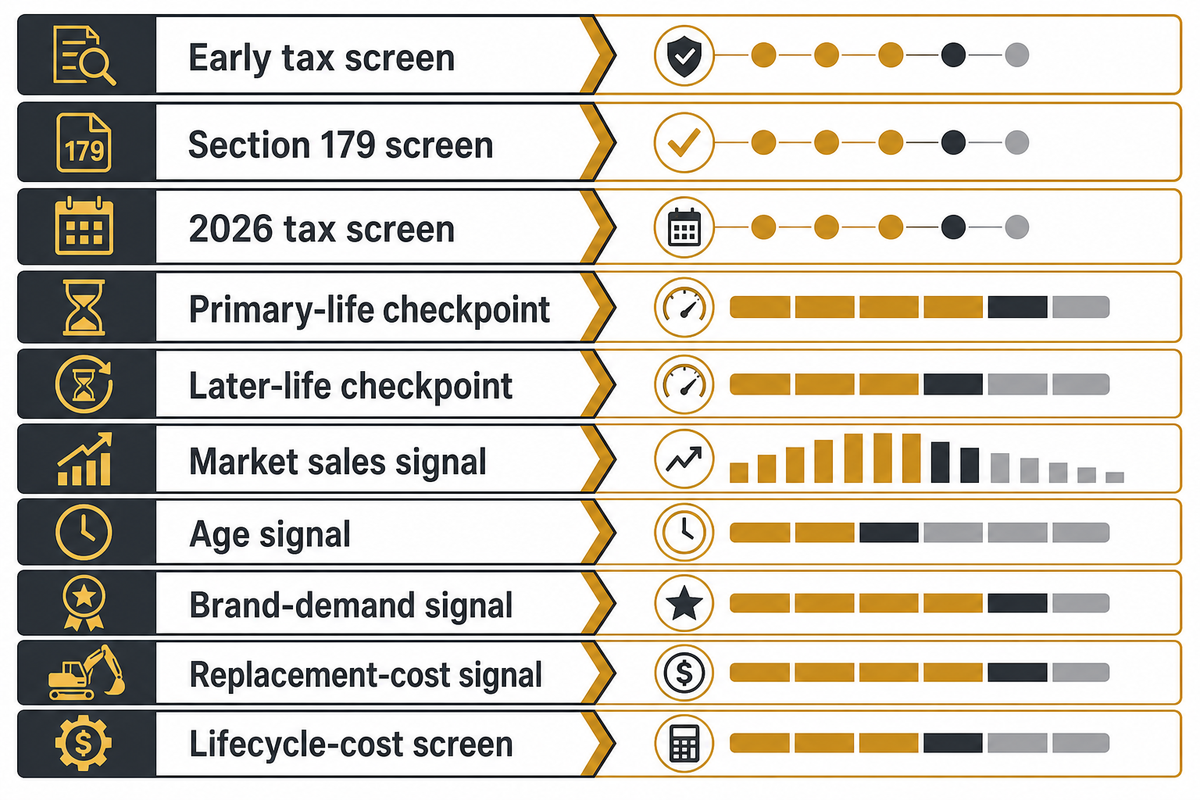
The hidden bottleneck is not the formula. Missing evidence creates the real bottleneck. Spreadsheets can calculate depreciation, annual depreciation amount, salvage value, straight-line depreciation, accelerated depreciation, or declining-balance depreciation. No formula can tell you whether a used excavator has weak pumps, worn rollers, a mismatched breaker, or an export hold.
Below, the role-based check turns the hidden bottleneck into specific payment and inspection decisions. Liehuang describes engine, hydraulics, undercarriage, attachment, inspection-video, serial-detail, loading-plan, and export-document checks on its company process page. By splitting roles, the owner, fleet manager, finance team, procurement buyer, and operator stop arguing about one rate when they are really asking different questions.
10-Point Rate Sanity Check
For equipment owners, heavy equipment depreciation should be separated from general equipment depreciation language. The estimated useful life of an excavator for accounting and its useful life in field work can diverge. Track equipment value over time, not only equipment in the year it is bought. Missing proof, hammer work, poor undercarriage condition, or thin maintenance records are factors that accelerate depreciation and can create steeper depreciation than a clean average.
Use one calculation lane at a time. To calculate equipment depreciation for accounting, finance may estimate annual depreciation amount from purchase price, useful life, and salvage value, then compare straight-line depreciation with accelerated depreciation or declining-balance depreciation. To determine the best depreciation method, use accountant review. To judge resale risk, ask whether the machine is likely to lose value quickly after the first year of ownership because repair evidence is missing.
| Check | Number to compare | Why it matters |
|---|---|---|
| 1. Early tax screen | 5 years or 7 years | Tax recovery period may differ from buyer value. |
| 2. Section 179 screen | IRS annual limit for the filing year | Deduction limit is not a resale value rule. |
| 3. 2026 tax screen | IRS inflation-adjusted limit | Tax planning must use the correct year. |
| 4. Primary-life checkpoint | 6 years or 9,800 hours | Use as a question trigger, not a rejection line. |
| 5. Later-life checkpoint | 10 years or 14,500 hours | Ask harder undercarriage and engine questions. |
| 6. Market sales signal | 5.3% used-sales rise | Demand can support residual value. |
| 7. Age signal | 7.1 to 7.7 years | Older financed units make proof quality more important. |
| 8. Brand-demand signal | Top five seller list | Brand support can help residual value. |
| 9. Replacement-cost signal | WPU112 at 324.493 | New-equipment pressure can affect used prices. |
| 10. Lifecycle-cost screen | Early-life and later-life benchmark | Use as a benchmark, then adjust for proof. |
Tax rules buyers should discuss with an accountant
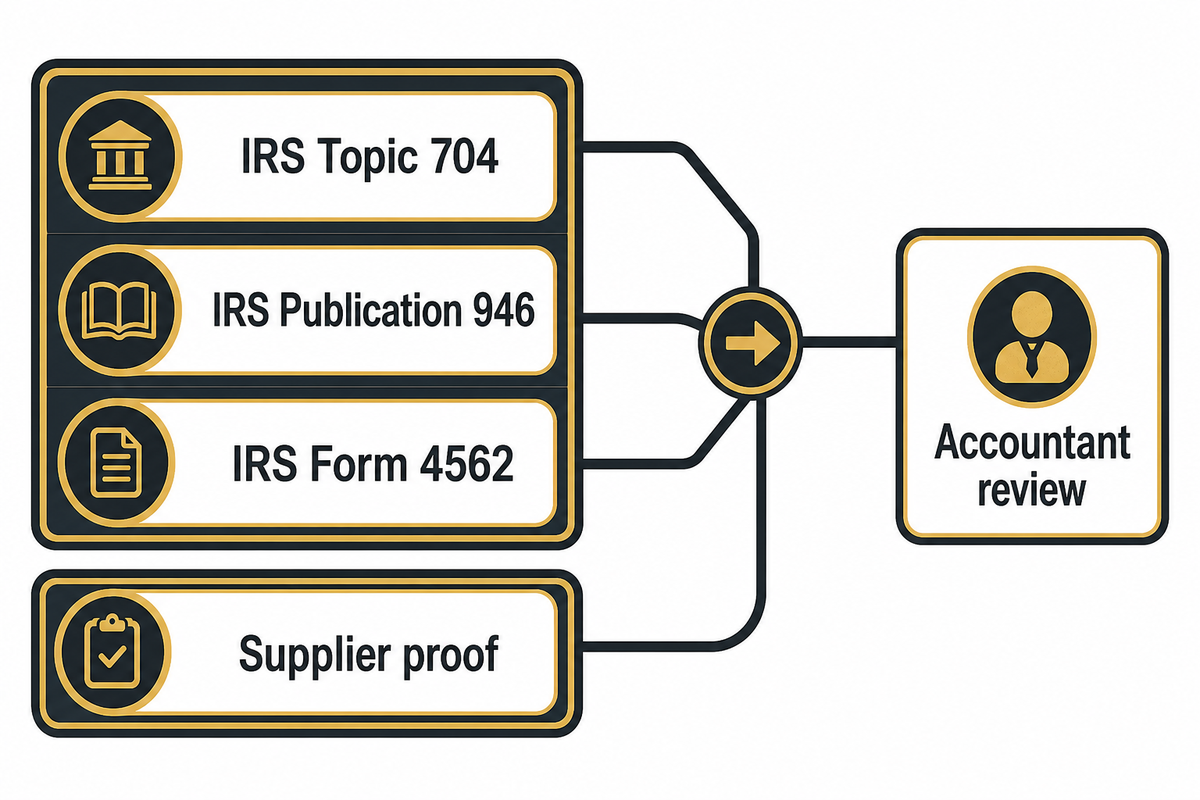
In situations in which a business owns the machine, the IRS context is particularly relevant. IRS Topic 704 explains that depreciation lets a taxpayer recover the cost of certain property used in a business or income-producing activity. IRS Publication 946 and IRS Form 4562 instructions state that the Section 179 maximum is $2,500,000 for 2025, with phaseout beginning at $4,000,000. For 2026, IRS Publication 946 lists a Section 179 maximum of $2,560,000 and a phaseout beginning at $4,090,000.
That does not mean every buyer should claim the maximum deduction. Nor does it mean a machine with a low book value is worth little in the market. Ask an accountant to determine the best depreciation method for the business, then ask the supplier for proof that supports the market value. Those two reviews protect different risks.
Mini, medium, and heavy excavators by value risk
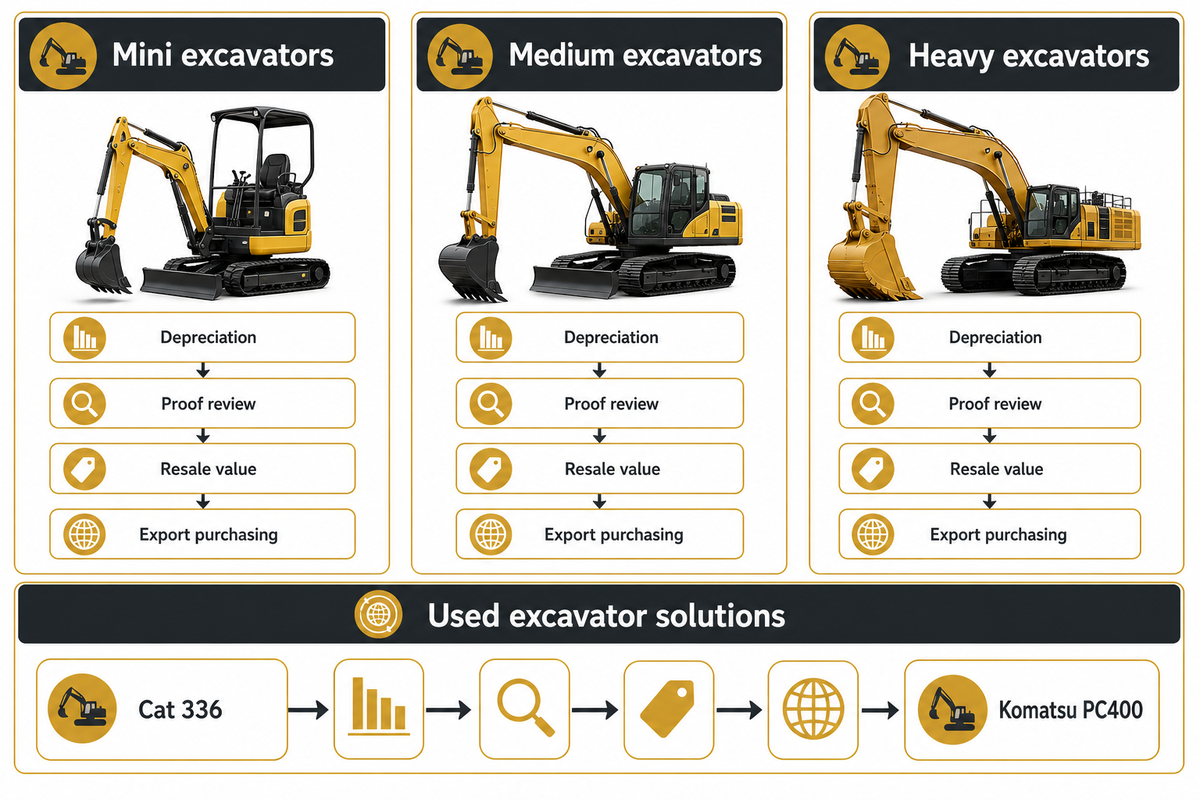
Machine size changes how value loss feels. Mini excavators can have strong demand because they fit landscaping, utility, rental, and small contractor work. Medium excavators often sit in the broadest job range, so clean machines with common parts and attachments may hold value well. Heavy excavators can carry higher repair exposure, but they can also retain value when mining, quarry, and infrastructure demand is active.
Use size as a risk lens, not as a fixed depreciation curve. Rising new equipment prices may support used prices in one size class. Weak local job markets may push the same class down. High hours in abrasive work, missing service records, poor undercarriage life, weak hydraulic response, non-standard attachments, and limited parts access can all push depreciation beyond the normal range.
The Liehuang website organization, including used excavator solutions, Cat 336 Excavator, and Komatsu PC400 Excavator pages, gives online buyers a way to compare machine sizes and brands before committing to a specific quote inquiry.
When used excavators hold value better
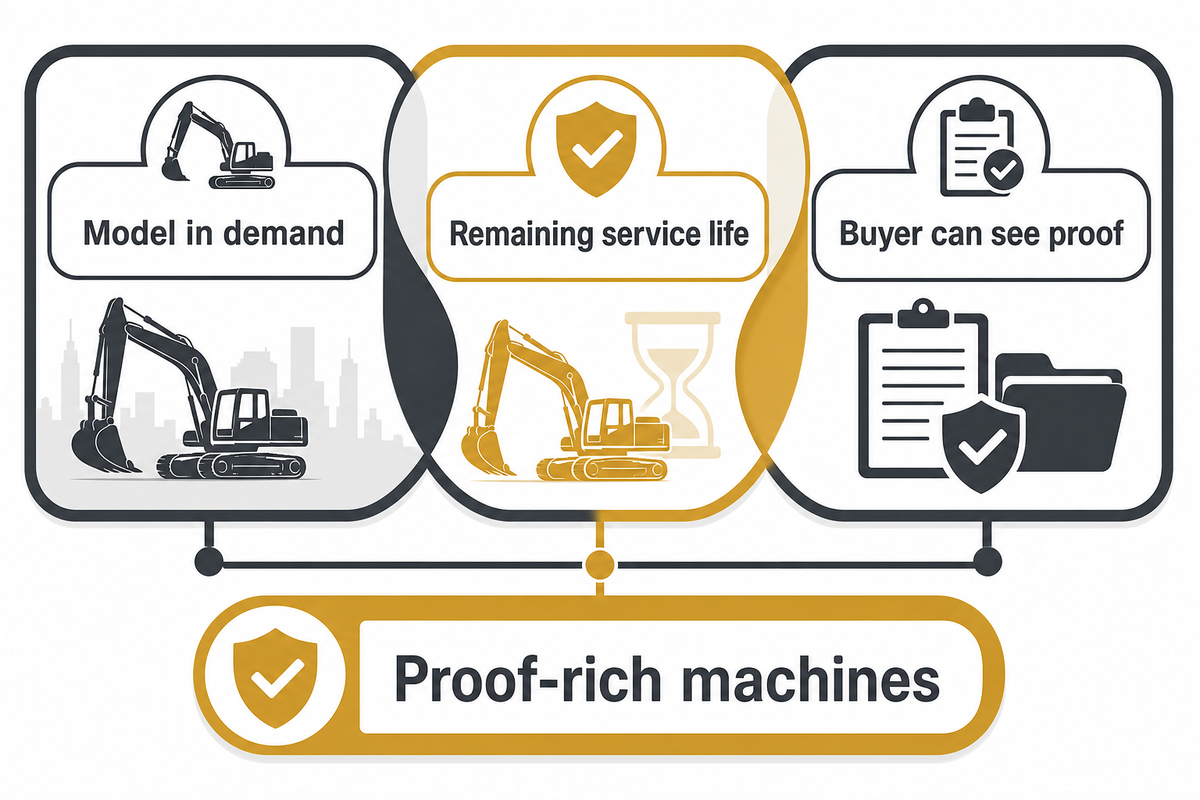
Used excavators hold value when three conditions overlap: the model is in demand, the machine has enough remaining service life, and the buyer can see proof. Cat, Komatsu, Deere, Volvo, and other major brands often keep resale support because buyers know the parts and service networks. Common attachments can also help a machine retain more utility than a bare unit that needs extra spending before work starts.
Equipment World reported that Caterpillar, Deere, Komatsu, Volvo CE, and Case CE were the top five sellers of used financed excavators in 2025, and that used prices slowly strengthened until mid-year before easing in the fourth quarter. That pattern supports a buyer rule: check current market evidence before assuming a fixed annual rate.
CONEXPO-CON/AGG published a lifecycle-cost article stating that a typical crawler excavator depreciates 32% in years 1-3 and another 23% from years 3-7. Use that published benchmark to question an offer, not as the only answer. Proof-rich machines can hold value better. Low-price machines with missing proof can lose value faster after the buyer discovers repair needs.
Export proof before balance payment
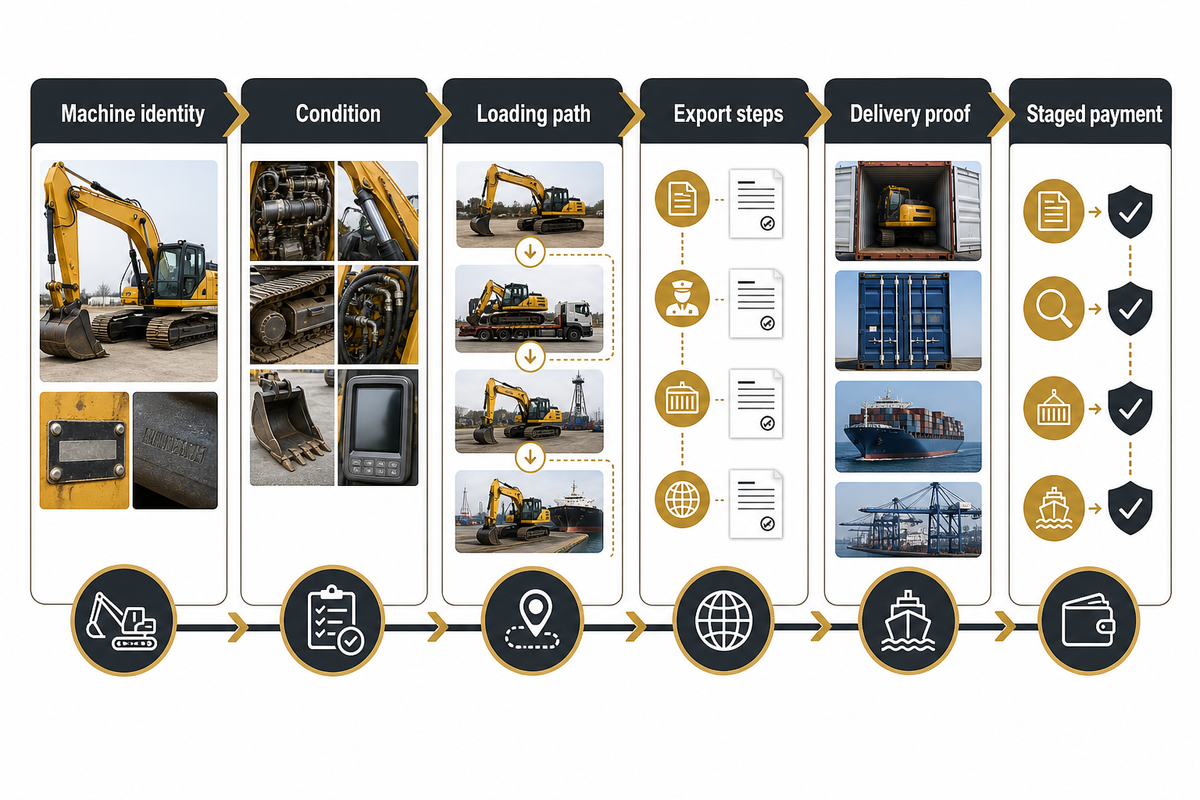
International used-equipment buyers face one more layer: delivery proof. Market value is not fully protected if the buyer pays before the machine identity, condition, loading path, and export steps are clear. Staged payment can reduce blind-trust risk.
Liehuang says its workflow uses a deposit to reserve the exact machine, inspection evidence before balance payment, and export documents plus shipment tracking before release. Buyers can also review its company process, used excavator buying guide, used excavator inspection guide, and excavator attachments guide before building a request.
Buyer checklist before requesting a quote
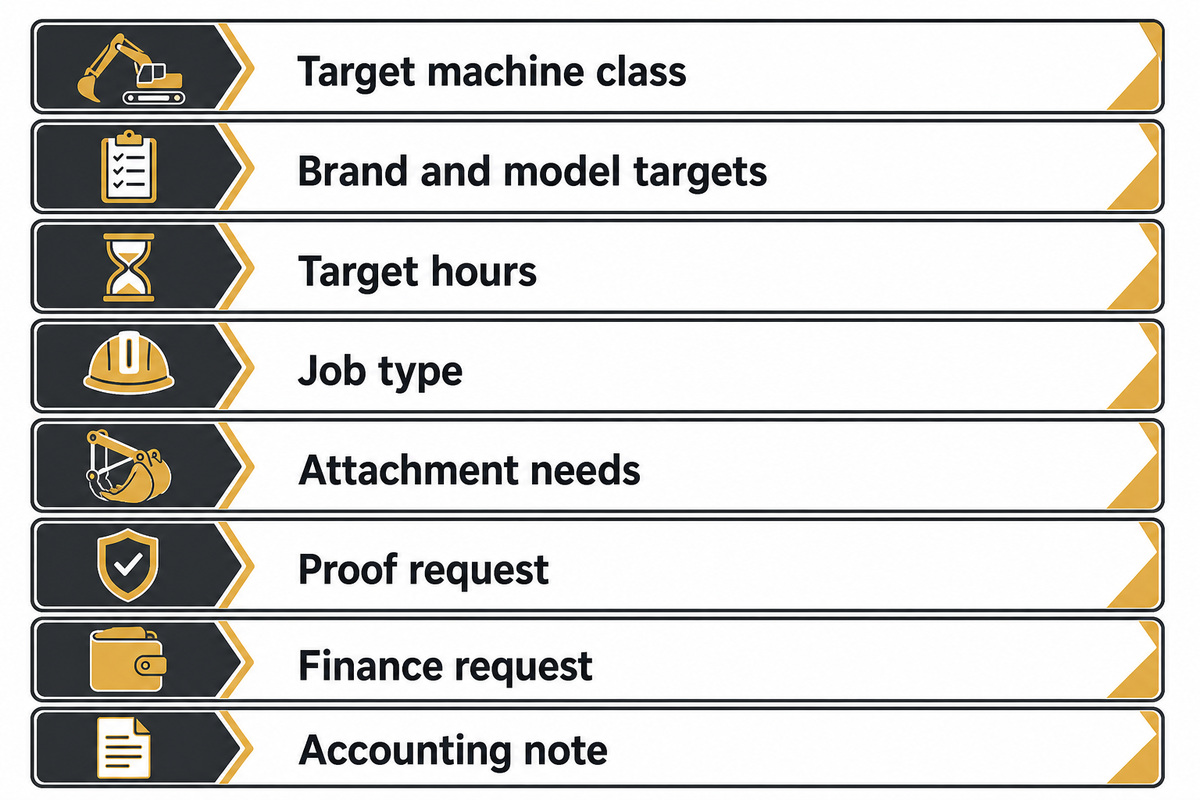
Before asking for price, write the valuation request as a proof packet. Clear requests save time for the supplier and give the buyer a better basis for negotiation. Clear structure also helps finance avoid mixing equipment depreciation, tax depreciation, and market value in one line.
- Target machine class: mini, medium, or heavy excavator.
- Brand and model targets, such as Cat 336 or Komatsu PC400.
- Target hours and maximum acceptable model year.
- Job type: trenching, earthmoving, demolition, quarry, roadwork, farm, or utility work.
- Attachment needs: bucket, breaker, quick coupler, auxiliary lines, or other tools from the excavator attachments category.
- Proof request: hour-meter photo, serial details, walkaround video, undercarriage photos, hydraulic function video, engine start video, and loading plan.
- Finance request: invoice terms, staged payment steps, export document timing, and destination port.
- Accounting note: ask your tax adviser whether Section 179, MACRS, bonus depreciation percentage, straight-line depreciation, or another depreciation method fits the business.
Frequently asked questions
What is a normal depreciation rate for an excavator?
No single normal rate works for every excavator because tax depreciation, market resale value, and proof-adjusted value answer different questions. Use broad market figures only as a first screen. Then check machine class, model year, hours, service life, undercarriage condition, hydraulic response, engine proof, attachment fit, current demand, and export proof before accepting a price.
Is machinery 5-year or 7-year property for tax depreciation?
Some machinery may fall into 5-year or 7-year MACRS property classes, but the correct recovery period depends on the asset and tax use. Do not classify an excavator based only on a blog article. IRS Publication 946 and Form 4562 instructions give the tax framework, while an accountant should review the placed-in-service date, ownership structure, business use, and whether any Section 179 or bonus depreciation treatment applies. Tax review should also cover whether equipment in the year it enters service meets the business-use and placed-in-service tests.
How do I calculate depreciation before buying a used excavator?
Start with the purchase price and compare similar resale listings for the same model, size class, year, and hours. Next, build a proof adjustment. Strong proof may include serial details, hour-meter photo, walkaround video, hydraulic function video, engine start video, undercarriage photos, attachment details, service records, loading plan, export document timing, and destination port. If you need an accounting number, calculate depreciation with your finance team after the equipment is purchased and placed in service. If you need a buying number, use proof gaps to adjust the offer before deposit or balance payment. This distinction keeps tax planning, market value, and field risk from being forced into one annual rate.
Can a used excavator hold value better than a new excavator?
Yes. New equipment can face the steepest depreciation early because the first owner absorbs the initial value loss. Used excavators that have already passed that early drop may depreciate more slowly if they have buyer demand, common parts, good maintenance records, and clear proof. Hidden wear can still make a machine lose value faster after purchase, so proof should come before the balance payment.
References and sources
- IRS Publication 946, How To Depreciate Property
- IRS Instructions for Form 4562
- IRS Topic 704, Depreciation
- U. S. Bureau of Labor Statistics WPU112 table
- FRED WPU112 Producer Price Index for Construction Machinery and Equipment
- Construction Equipment economic-life analysis for hydraulic excavators
- Equipment World 2025 excavator sales trends
- CONEXPO-CON/AGG construction equipment lifecycle-cost article
Why We Write This
About Liehuang
Liehuang is a China-based used excavator supplier focused on verified machines, inspection records, and export-ready documentation. Our blog is written for buyers who need more than a model name and a low price before sending a deposit.
We publish practical guides on used excavator cost, machine hours, inspection points, import paperwork, attachments, and brand selection so contractors and equipment buyers can compare machines with fewer blind spots.
Inspection FirstEngine, hydraulics, undercarriage, serial-number photos, hour-meter photos, and machine video can be prepared before shipment.
9 Brands In StockCaterpillar, Komatsu, Volvo, Sany, Hyundai, Doosan, Kubota, Hitachi, and Kobelco excavators across common tonnage classes.
Export SupportContainer and RoRo shipping support with destination-focused quote details, Incoterm discussion, and paperwork coordination.
SYS.PROFILE
Contact Profile
NameLiehuang Used Excavators Team
CompanyHefei Liehuang Machinery Co., Ltd.
Product FocusUsed Excavators / Attachments / Export Supply
Buyer RequestInspection report, video, price, freight, and delivery timeline
Websitehttps://lhusedexcavator.com/

Payment protected by staged delivery proof
Pay the balance after machine proof, not on blind trust.
Used excavator buyers need more than a product photo. Liehuang uses a staged payment workflow: deposit to reserve the machine, inspection evidence before balance, and export documents plus shipment tracking before release.
Verified machine videoLoading and customs filesBalance paid after confirmation
Quote & machine selectionChoose the model, hours, attachments and export destination before we reserve stock.
Deposit to lock stockA deposit holds the exact machine while inspection media and documents are prepared.
Inspection proof sentReceive walkaround video, hour-meter photos, serial details and loading plan.
Balance after confirmationPay the remaining balance only after you confirm the machine condition and export evidence.
Shipment & customs trackingWe share loading photos, bill of lading progress and customs support until release.
For high-value used equipment, trust is built by evidence. Ask for the current stock list, payment schedule and export document sample before you decide.Request stock proof