Get in Touch with Liehuang Company
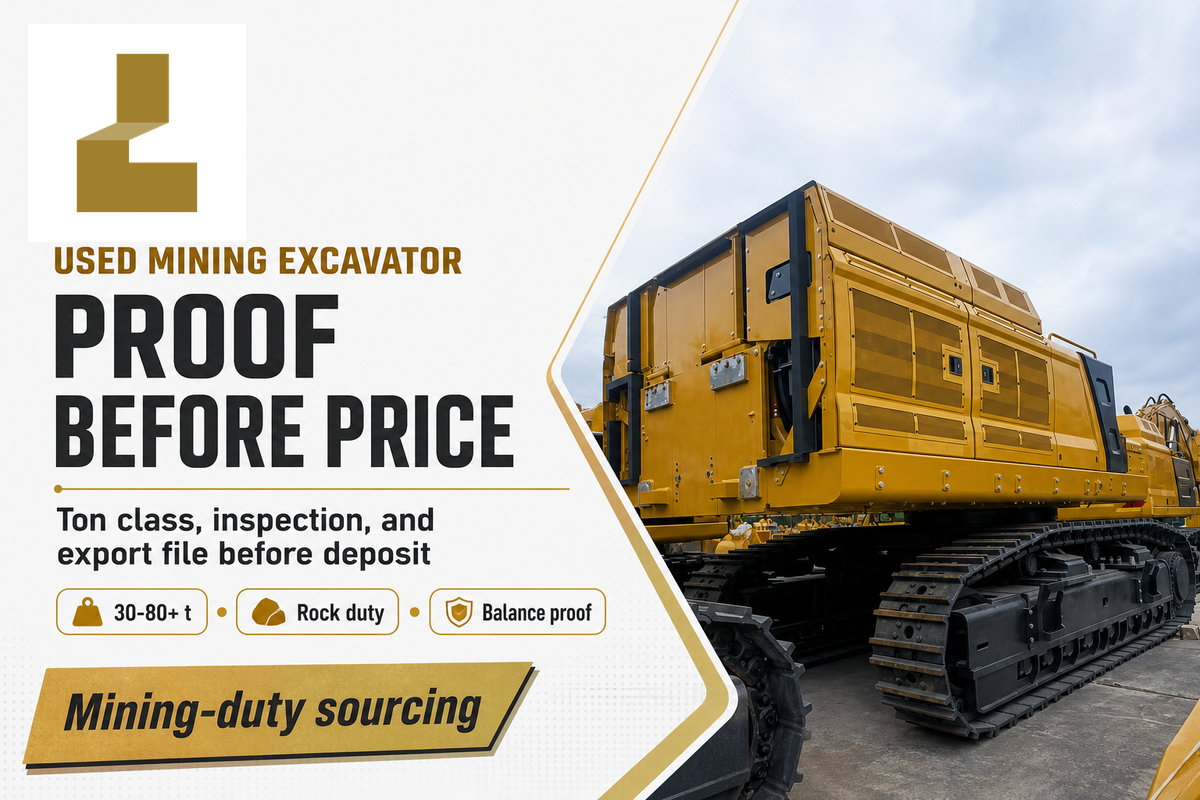

Excavator for Mining is a heavy-equipment selection problem: the machine must match rock duty, bench access, truck loading, condition proof, and export handling before price matters. For most second-hand import buyers, that usually means a 30 tons to 80 tons crawler band.
Updated August 2026. Reviewed for Liehuang Used Excavators.
Quick Specs: Mine-Duty Buyer Snapshot
| Buyer scope | 30-80+ ton used heavy machines for quarry, overburden, truck loading, and mine-support work; ultra-class hydraulic shovels sit above this import-buyer band. |
| Core specs | Operating weight, engine power, bucket capacity, digging reach, undercarriage wear, hydraulic system condition, boom and arm history. |
| Proof before balance | Hour meter photo, serial plate, cold start, walkaround video, bucket and quick-coupler closeups, loading plan, export documents. |
| Risk areas | Undercarriage chain and sprockets, pumps, cylinders, swing bearing, final drives, bucket teeth, pin bosses, welded repairs. |
| Best next step | Send task, ton class, preferred brand, destination port, and proof needs before asking for the final quote. |
The buying decision is not about size alone. The buyer is buying a production match, an inspection risk, and an export file that must survive customs and site acceptance. This guide turns the phrase into a used-equipment buying rule for the quarry owner, contractor, and open-pit mining support team.
Liehuang Used Excavators sells second-hand heavy equipment from China with a practical buyer focus: compare used heavy excavators for mining and quarry work, confirm whether the class fits the work, demand proof before payment, and understand where a low headline price can hide repair costs.
Concise answer: a cheap excavator for mining will often be a heavy crawler or hydraulic shovel suited to rock, bench access, truck loading, and long work cycle, then confirmed through condition proof before buying. For second-hand import machines, the more cautious decision begins with ton class and proof pack, and not with brand alone.
What this guide adds beyond OEM product pages
- Buyers working in proven mining ground still need a proof matrix, because a new-machine spec sheet does not show current wear, export readiness, or staged payment proof.
- One 30 ton quarry excavator and an 800 ton electric shovel can appear under the same mining search terms, yet they solve very different jobs.
- Bucket and quick-coupler inspections belong in the purchase file, not only in the safety briefing, because attachment release has documented fatality history.
- Electric-drive headlines are a useful background, but present used-machine worth still depends on site power, parts support, and inspection proof.
What Is an Excavator for Mining?
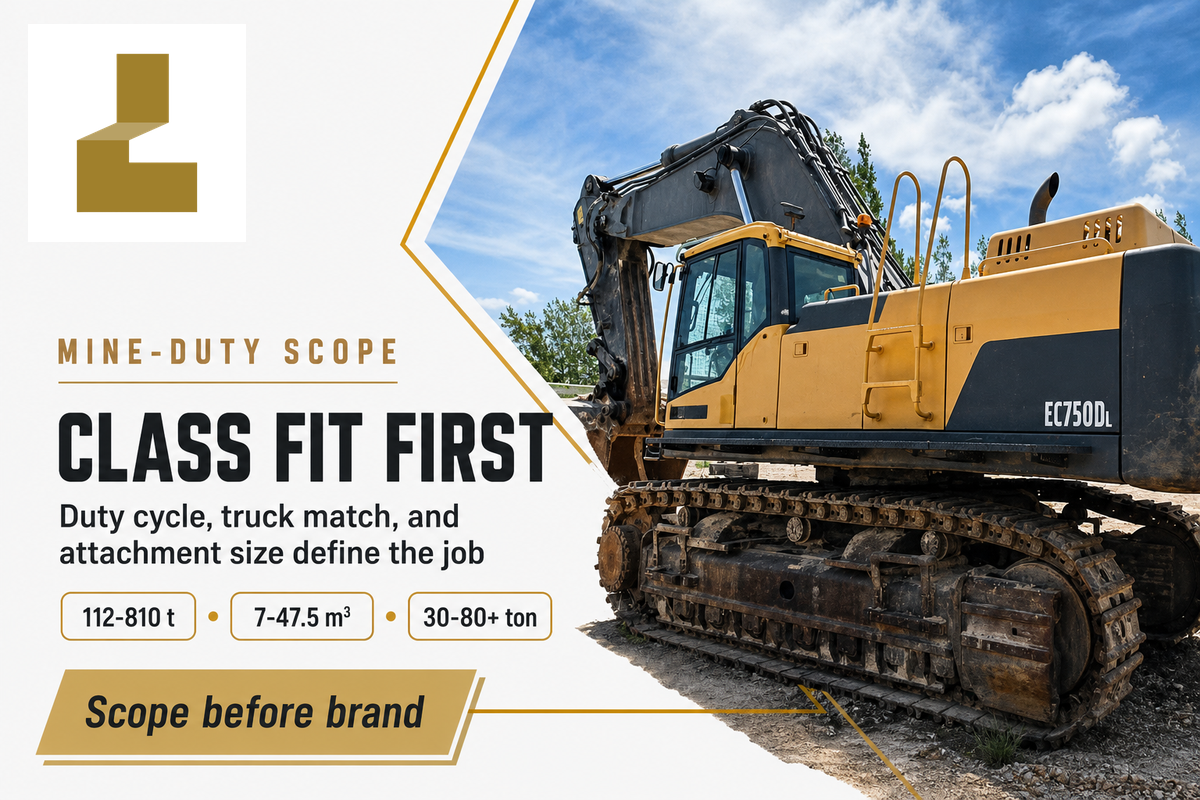
Mining excavators are heavy duty digging and loading machines used around surface mines, quarries, overburden removal, and ore or aggregate handling, with the correct class defined by duty cycle, ground condition, attachment size, and truck match rather than by the word mining alone. From that proof-first buyer view, the next question is what class of mine machine the job actually needs.
Within product catalogs, the category can extend into very large hydraulic shovel class. Komatsu surface-mine model pages list machines far above normal construction size, while Liebherr source data runs from 112 to 810 tons and from 7 to 47.5 cubic meters of bucket capacity. The source data shows the range: Komatsu PC2000-11 lists 780 kW and 201,930-207,258 kg, and Hitachi EX1200-7B lists 567 kW and 117,000-120,000 kg. As a buyer shortcut, those public benchmarks translate to about 118-207 t and 567-780 kW before the much larger 112-810 t Liebherr range is considered. However second-hand import buyers might be shopping in a crawler class of 30, 40, 50, or 70 ton machine for mine-support and bench work.
What excavator is used in mining?
Surface mining generally employs wheel loaders, face shovels, backhoe pattern hydraulic shovels, bucket wheel machines, and crawler excavators. The simple reality for many used equipment buyers is a crawler hydraulic excavator or heavy excavator with a rock bucket, not a bucket wheel machine intended for huge continuous mining systems.
30-80+ tused buyer band for quarry and mine-support work
112-810 tpublished Liebherr mining line class range
7-47.5 m3published Liebherr bucket capacity range
Match Ton Class to Bench Height, Truck Size, and Rock Duty
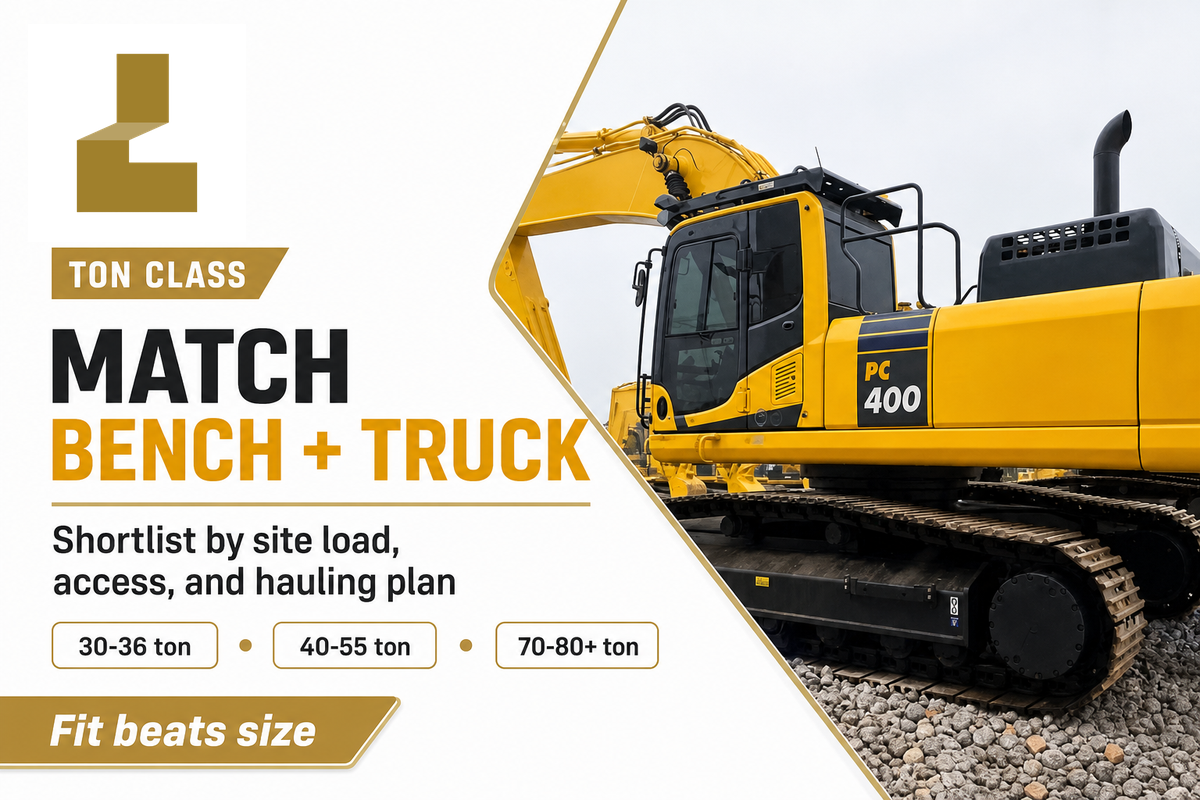
Ton class should be selected according to the job; bench height, truck size, rock density, haul distance, and bucket fill rate determine the required operating weight and breakout force before spec brand comes into the mix.
If the task is too heavy, a smaller machine may be pushed to full load factor all day. Oversizing raises shipping, operator, ground-pressure, and maintenance costs. Before requesting a budget quote, move step by step from site analysis to match plan to the ton-class application selector.
| Decision point | 30-36 ton class | 40-55 ton class | 70-80+ ton class | Limitations / not suitable for |
|---|---|---|---|---|
| Main task | quarry support, trenching, secondary loading | rock loading, overburden, medium benches | large faces, high daily output | not a substitute for ultra-class shovels |
| Truck match | small dump trucks, site trucks | mid-size rigid or articulated trucks | larger quarry trucks | poor match wastes cycles |
| Bucket capacity | modest rock bucket | larger rock bucket | high-volume bucket | oversized buckets damage structures |
| Engine power | lower fuel burn | balanced output and logistics | high fuel and cooling needs | weak cooling hurts hot pits |
| Transport | easier break-down and container support | flat-rack or bulk logistics | route survey often needed | port limits may decide class |
| Undercarriage reserve | moderate parts cost | wear proof needed | high reserve needed | worn rails erase price savings |
| Bench access | tight sites | general quarry benches | wide benches | narrow haul roads limit swing |
| Buyer risk | condition often easier to inspect | best balance for many buyers | few low-risk bargains | rare parts delay repairs |
| Best proof | work video plus hours | hydraulic test and undercarriage photos | inspection report plus transport plan | no proof, no balance payment |
Small jobs begin with the 30-ton heavy excavator guide; don’t buy by generic search. Heavy faces start when truck match and access become definite. For RFQ sorting, keep the shortlist in one of three bands: 30-36 ton, 40-55 ton, or 70-80+ ton.
Crawler or Hydraulic Shovel: Where Each Wins
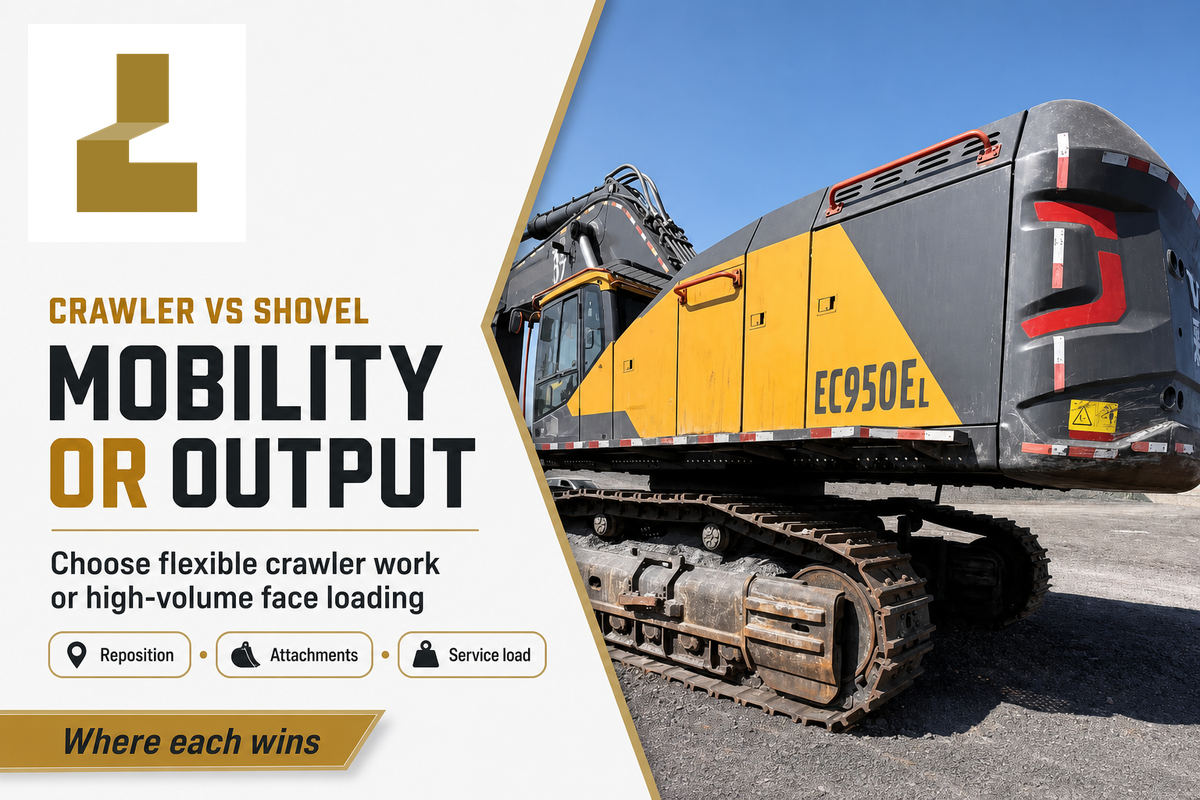
A crawler excavator fits mining work when mobility and attachment options matter more than peak face-loading output. It offers better movement between tasks, wider resale potential, and a broader range of tools. Hydraulic shovels win where continuous face loading supports ultra-large trucks and high production volume justifies higher transport, parts, and service demands.
Which excavator is best for mining?
For most import buyers, the best machine is the one that fits the job without overloading the budget, haul roads, or repair reserve. Crawler excavators are often export-friendly because they can dig, load, break, and reposition during the same shift. Ultra-class shovels fit large mines, but they bring heavy transport, parts, and service demands.
Crawler excavator
- Moves between benches, stockpiles, and road cuts.
- Accepts rock buckets, breakers, rippers, and grapples.
- Resale pool is wider in many export markets.
- Inspection centers on undercarriage, cylinders, pumps, and swing.
Hydraulic shovel
- Loads from the face into larger haul trucks.
- Fits high daily tonnage and stable benches.
- Parts, transport, and site setup need more planning.
- Inspection must prove structure, pumps, and duty history.
Bucket-wheel excavators often pop up on search lists because, well, they’re what people think of as ‘big digging mining machines.’ We look at their inclusion as a definition marker on our lists, and not something a quarry contractor can actually source from China without creating new problems.
Used Mine-Duty Buying Path
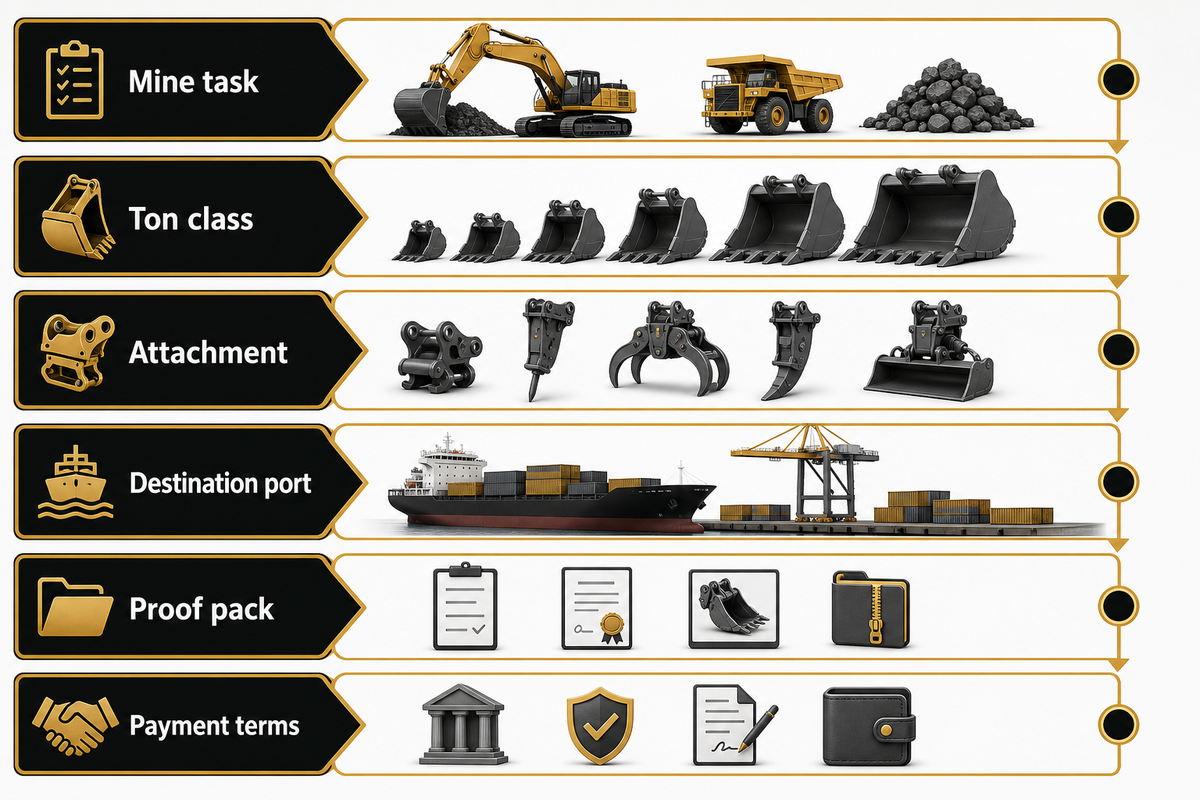
A good search process starts with the mining task and then moves to the right heavy machinery type, not the other way around. Moving through classes keeps screening efficient and accurate. Only after the class and individual candidate are vetted should the buyer move into pricing, payment terms, shipping, and export paperwork.
Vague requests, such as “just send me your cheapest Cat,” force suppliers to guess. Stronger inquiries include the target pit, site overview, projected output, truck capacity, destination port, inspection requirements, and attachment needs. That gives Liehuang enough detail to filter relevant machines instead of sending random listings.
RFQ checklist, copy these into your quote request:
| Parameter | Recommended range | Why it matters | How to verify |
|---|---|---|---|
| Task | digging, loading, breaking, support | sets boom, arm, and bucket needs | send site photos and material notes |
| Ton class | 30-80+ t | sets shipping and truck match | compare operating weight plate |
| Hours | no universal cutoff | hours mean little without service proof | hour meter photo plus start video |
| Attachment | rock bucket, breaker, ripper | affects pins and hydraulic lines | request closeups and measurements |
| Port | destination and discharge limits | sets CIF quote and loading plan | confirm route and port equipment |
| Proof pack | photo, video, docs, loading | protects payment stage | hold balance until evidence arrives |
If you have difficulty identifying the right machine class, start with Liehuang’s used mining excavators category and narrow the request by ton weight.
Inspection Proof Before You Pay the Balance
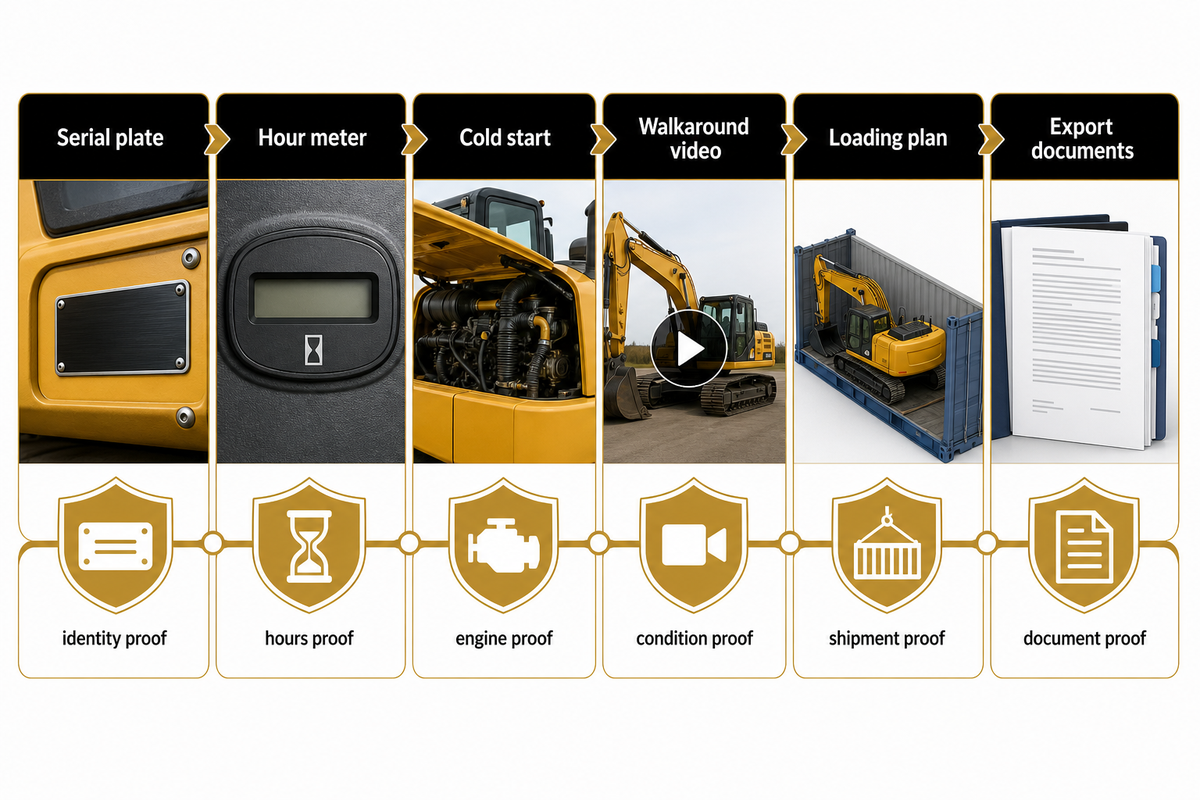
Inspection evidence must prove the machine identity, working condition, attachment fit, loading preparation, and export document file before the buyer releases final payment. After the buying path narrows tonnage and class, this proof step ties the candidate machine to the file.
7-Point Mine-Duty Used Excavator Proof Matrix
The 7-Point Mine-Duty Used Excavator Proof Matrix matches each major risk to positive evidence the buyer can see in the machine file.
When reviewing a used mining heavy excavator, the proof file should show the basics clearly: plate number, hour-meter display, cold start, walkaround inspection, working video, loading activity, and any visible fluid or mechanical leaks.
What should buyers inspect before buying a used mining excavator?
Verify the machine title, serial plate, hours, undercarriage age, pumps, cylinders, engine start at low and high speed, boom and arm movement, weld condition, bucket teeth, bucket closing action, quick hitch, hydraulic lines, cab controls, and loading demonstration. Photos and video should show the same serial number as the machine being quoted.
| Proof point | Evidence to request | Risk reduced | Buyer decision |
|---|---|---|---|
| Machine identity | serial plate and model plate photo | wrong model or swapped listing | match documents before payment |
| Hours | hour meter photo plus dashboard video | unsupported low-hour claim | treat hours as one clue |
| Engine | cold start, smoke, idle, throttle response | warm-start masking | ask for first-start clip |
| Hydraulics | boom, arm, bucket, travel, swing test | weak pump or cylinder bypass | watch for slow drift |
| Undercarriage | track chain, pads, rollers, sprocket photos | large repair reserve | price repair into offer |
| Structure | boom and arm weld, pin boss, frame photos | hidden crack repair | reject if welds are unexplained |
| Export file | invoice, packing details, loading plan, export documents | port delay or customs issue | release balance after file review |
For used heavy-duty excavators, hours matter, but inspection results matter just as much. Keep the proof file for at least 90 days after the machine arrives in your country in case a warranty or service claim appears. Do not judge a high-hour unit by the meter alone; undercarriage, pumps, hydraulics, and cooling condition decide whether the machine can still work under mining demand.
Bucket, Teeth, and Hydraulic Line Fit for Rock Work
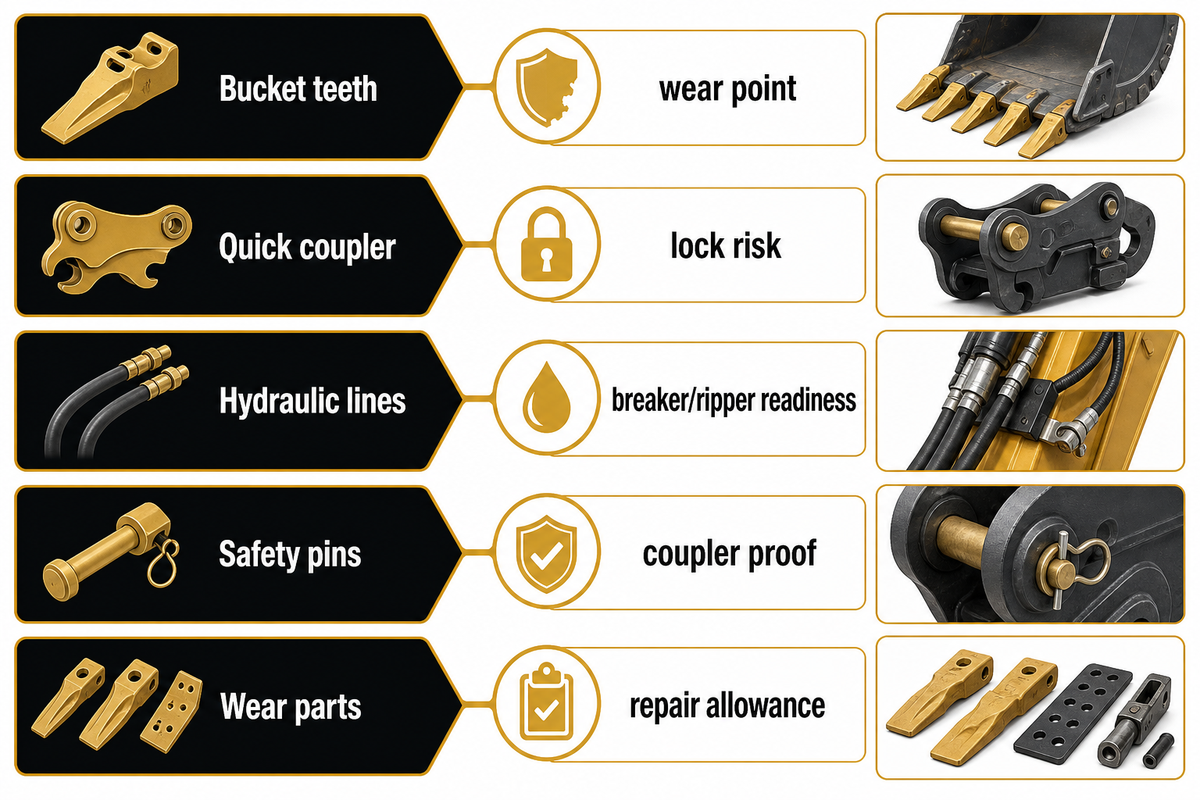
Attachment and bucket fit are critical for any used excavator that will work in mining. Rock work stresses bucket pins, teeth, adapters, quick couplers, auxiliary hydraulic lines, cylinders, boom structure, and the mounting points that hold the attachment together.
Official safety material reinforces this warning. The OSHA bulletin on quick-coupler safety cites 15 unexpected bucket-release events since January 1998, resulting in eight fatalities. CDC/NIOSH also warns about sudden bucket release risks tied to attachment problems and quick couplers.
Do
- Ask for bucket side, bottom, lip, and teeth photos.
- Match pin diameter, center distance, and width before shipping.
- Check auxiliary hydraulic lines if a breaker or ripper is planned.
- Review quick-coupler lock condition and safety pins.
Don’t
- Accept a bucket only because it is attached in the listing photo.
- Ignore cracks near ears, adapters, and weld repairs.
- Buy worn bucket teeth as if they are a minor cosmetic item.
- Assume one used bucket fits every machine in the same ton class.
At basalt mining sites, poor bucket selection can waste more time than a slightly older machine. Even a unit that looks fine in a yard video may struggle in blasted rock if the bucket teeth are worn or wrong for the material. Confirm bucket condition first, then add wear parts and pin repair pricing to the quote.
Brand and Model Shortlist Without OEM Bias
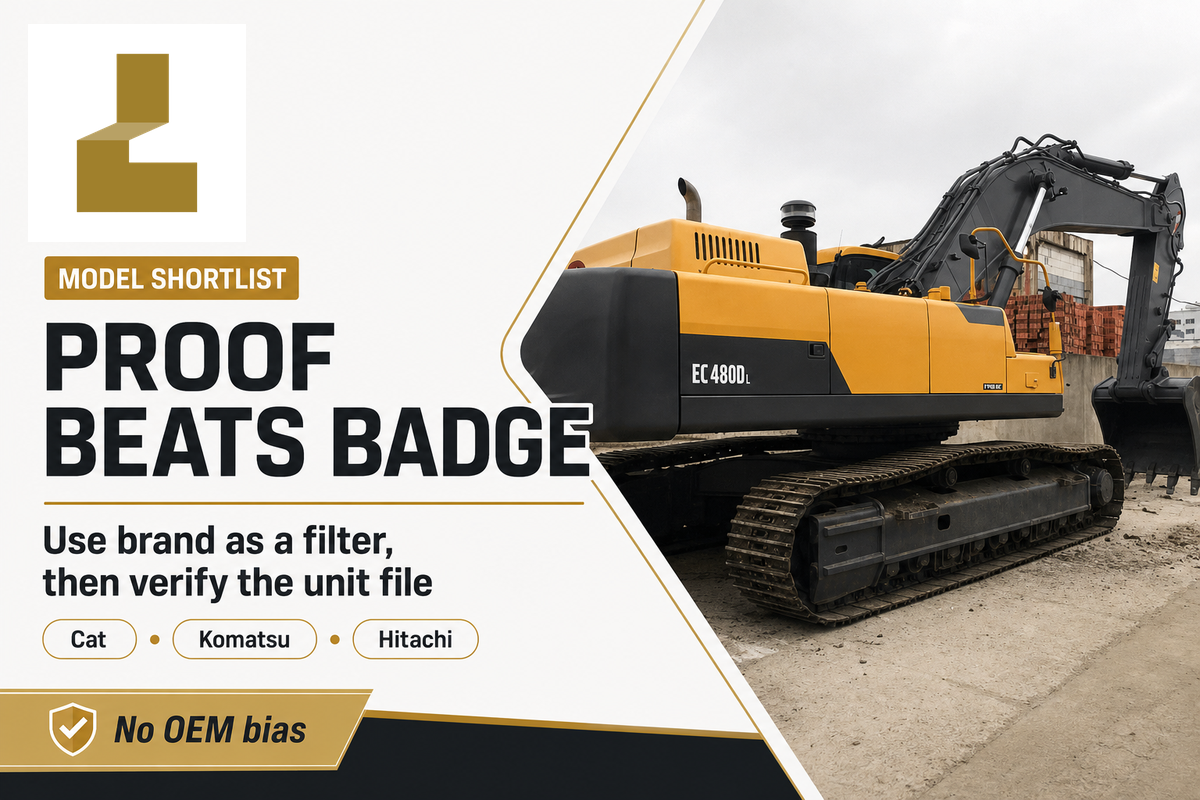
Brand helps compare work class and parts networks, but a used mining machine purchase still depends on machine class, proof quality, condition, transport fit, and local service support more than one model badge.
Caterpillar, Komatsu, Hitachi, and Liebherr mining excavators tend to draw higher search demand. For search comparison, treat a Cat mining excavator, Komatsu mining excavator, or Hitachi mining excavator as a separate evidence trail, not an automatic purchase choice. Liehuang can also quote Volvo EC750 equipment or similar heavy machines when stock and specifications fit the buyer brief. Because inventory changes, never plan a deposit around a model name alone. Confirm the serial plate, working video, and inspection report first.
| Model family signal | Buyer reads it as | Condition proof to ask for | Limitations / not suitable for |
|---|---|---|---|
| Cat 374 class | large quarry crawler | hydraulic and undercarriage test | brand premium can mask wear |
| Cat 390 class | upper heavy crawler | boom, arm, bucket, pump proof | shipping needs planning |
| Cat 6090 FS | ultra-class reference | specialist inspection only | outside most used import budgets |
| Komatsu PC2000-11 | surface mining class | published spec check and full function video | not needed for small pits |
| Hitachi EX1200-7B | large mine-class benchmark | serial, hours, pumps, cooling | condition matters more than name |
| Liebherr R9800 | giant mining reference | special transport and service review | not a normal quarry import target |
| Volvo EC750 | 70 ton class crawler option | undercarriage and bucket video | local parts access varies |
| Komatsu PC450 class | medium quarry support | hours, final drive, bucket pins | low output for large benches |
| Hitachi ZX470 class | 40-50 ton crawler role | pump, swing, frame, track photos | not a giant mine shovel |
Use brand and work class as initial filters, then evaluate each candidate against the same performance and proof standards. Even a well-known Komatsu with weak history evidence is still risky. By contrast, a less familiar model with a clean file may fit the workload better.
Cost Stack: Machine Price, Repair Reserve, and Shipping
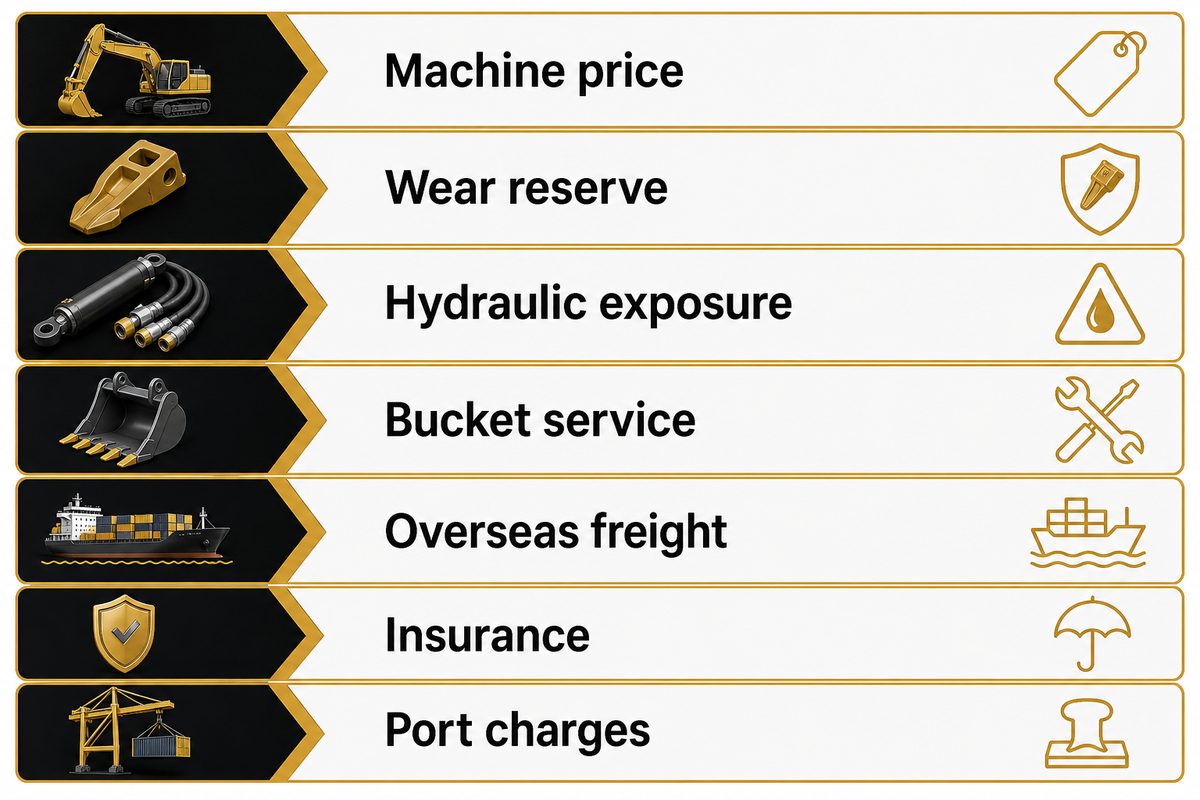
Heavy construction equipment pricing should be reviewed as a stack: machine price, wear reserve, hydraulic exposure, bucket service, local delivery, overseas freight, insurance, port charges, and export or import fees. Once brand and model are only filters, the quote has to price each candidate’s proof and wear risk.
How much does a mining excavator cost?
New ultra-class models fall outside the budget of many construction companies. Used crawler and heavy equipment excavator prices depend on class, manufacturer, hours, condition, and market timing. For import buyers, a quote sheet that separates machine value from wear and shipping exposure is more useful than a single headline price.
Landed-cost stack to review before deposit:
| Cost item | Used 30-36 ton crawler | Used 40-55 ton crawler | Used 70-80+ ton crawler |
|---|---|---|---|
| Machine price | quote per serial | quote per serial | quote per serial |
| Inspection reserve | hours and service check | hydraulic test matters | third-party review advised |
| Undercarriage work | moderate reserve | higher reserve | large reserve |
| Bucket and teeth | wear parts check | rock bucket check | custom handling may apply |
| Shipping and port | easier route | port plan needed | route survey likely |
| Payment protection | proof before balance | proof before balance | proof plus loading evidence |
Worked example: if two machines differ by $12,000 in quoted price, but the cheaper unit needs $18,000 of track work, $4,000 in bucket wear, and $3,000 in added handling, the apparent saving becomes a $13,000 disadvantage before downtime is counted.
Use the CIF landed-cost estimator to separate machine price from inland transport, sea freight, insurance, and port expenses. Public demand data can help with market context, but it cannot serve as a price list for used mining machines.
When NOT to Buy a Used Mine-Duty Excavator
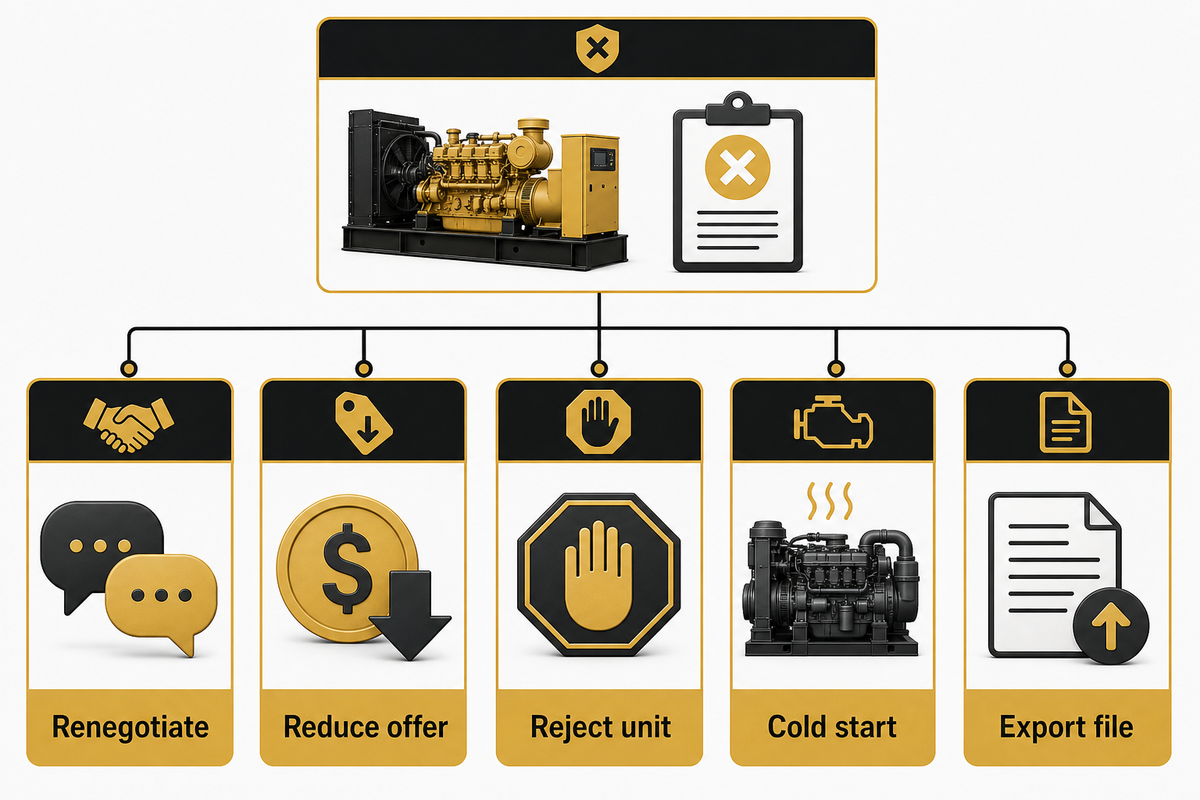
Before final payment, the seller should link the serial plate, operating hours, working video, attachment evidence, export file, and loading plan to the same identified machine. If the proof does not tie back to one machine, the buyer should renegotiate, reduce the offer, or reject the unit.
Ask three questions before committing funds. First, is a pre-delivery demonstration included, and does the machine start from cold without warm-up? Second, do the undercarriage photos clearly show rails, sprockets, idlers, carrier rollers, and final drives? Third, is the export document package complete before the dealer asks for full payment?
Mining sites test assumptions. Repaired booms might suit light lifting but not rock duty. Yard-clean buckets may still have worn teeth or loose pins. Hydraulic systems that lift and reach in one clip may still leak down under load. The buyer’s job is not to mistrust every used machine; it is to put each risk in the price, the contract, or the rejection file.
Industry Outlook: Electrification Is a Spec Signal, Not a Used-Buyer Shortcut
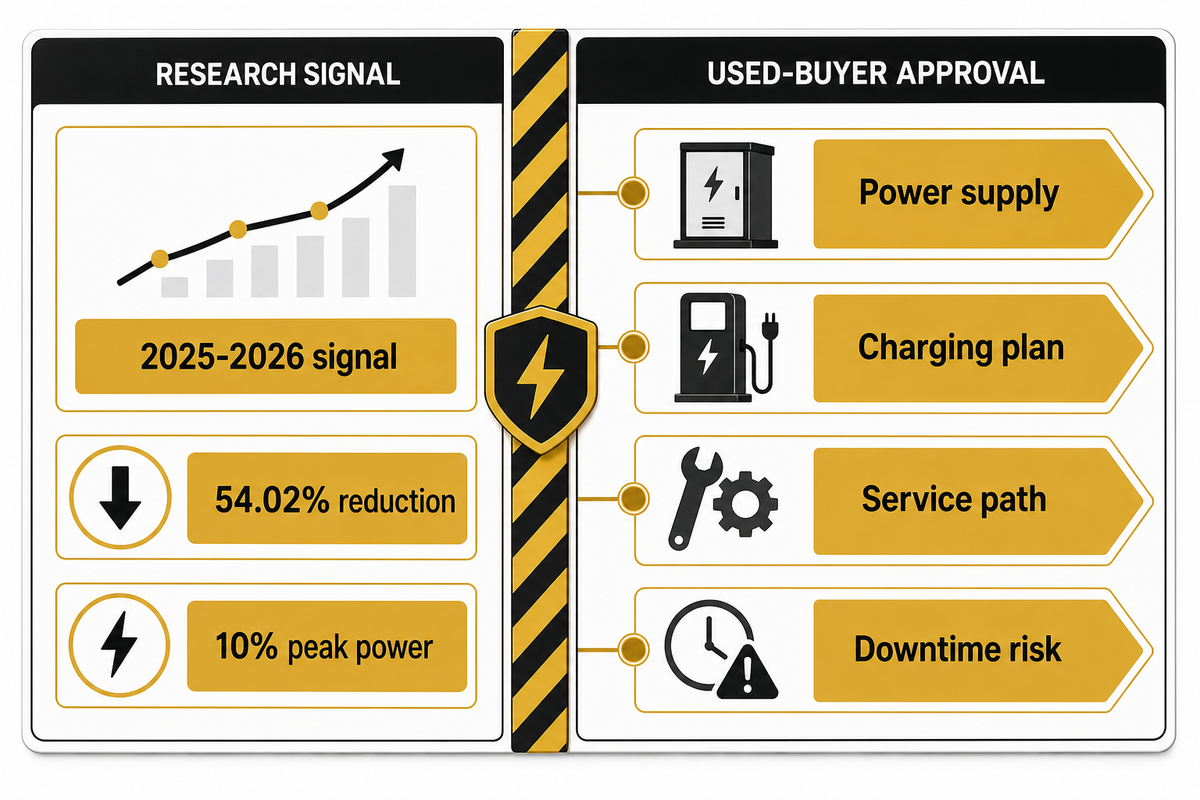
Electric-drive mine-machine research is a real 2025-2026 signal, but used buyers should treat it as future-spec context unless the machine, mine power supply, charging plan, service path, and downtime risk are all proven.
In 2025, a Chinese Journal of Mechanical Engineering open-access paper presented power management for an all-electric mining hydraulic excavator. The research setup achieved a 54.02% reduction in operating costs and a 10% reduction in peak power consumption, while also identifying power fluctuation and outage issues. That is useful engineering context, not a blanket reason to buy any used electric unit.
For 2026, the best procurement approach is to keep electric and hybrid specs in the spec file and ask the same difficult questions: Is there local service? Can the mine handle the charging or tethering load? Are batteries, control modules, and cooling parts available? Is the seller proving the actual unit, not just citing market growth?
Key takeaway
Electric-drive mine-machine data belongs in the risk review, but the used-buyer decision still turns on condition proof, parts support, site power, and export readiness.
RFQ Checklist for Liehuang Used Excavators
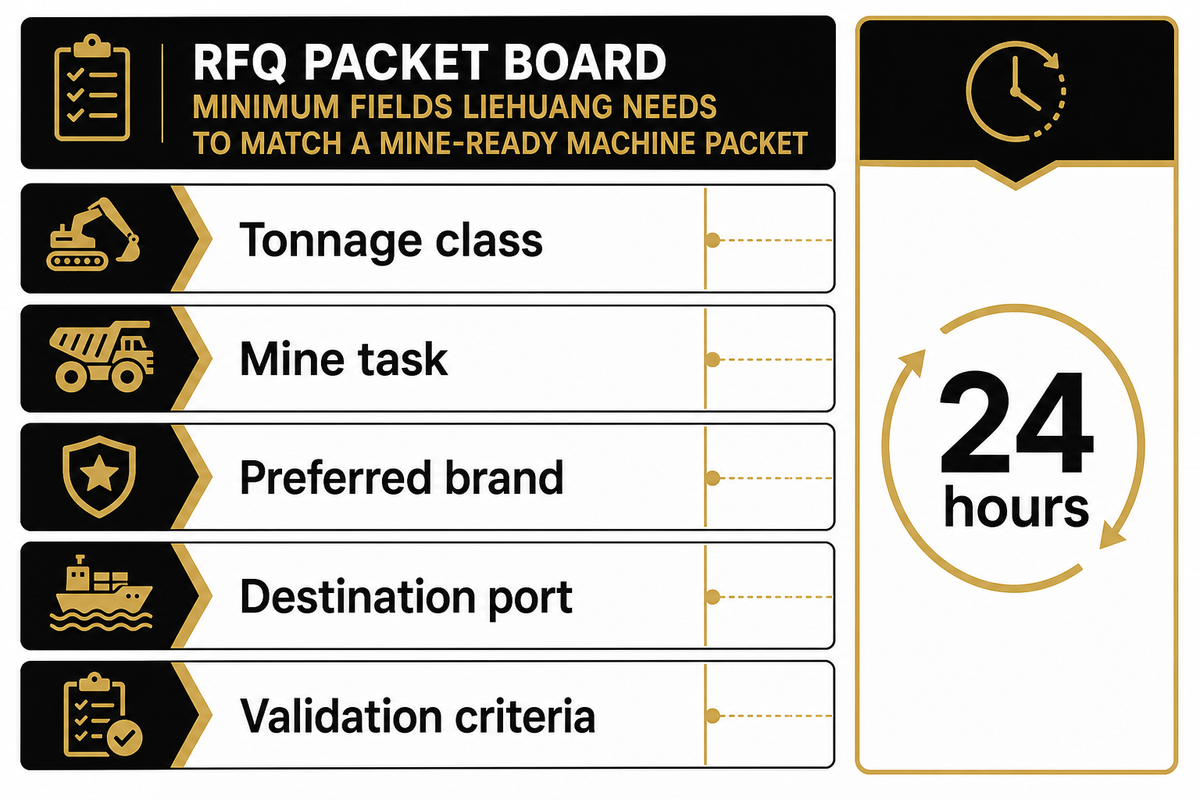
A strong RFQ tells Liehuang Used Excavators the task, ton class, ideal model family, desired attachment, destination port, validation expectations, and payment schedule so the team can match equipment instead of sending loose specs. After the electric and hybrid outlook, the same proof language belongs in the request, not only in the spec file.
Send the mine or quarry task first: loading blasted rock, digging overburden, handling aggregate, breaking, or jackleg support work. Then send the loaded ton or yard weight range, bucket capacity requirement, truck tonnage, preferred brand, delivery port, and whether a ripper, breaker, or rock bucket is desired. Request the hour meter, serial number, walkaround video, loading plan, export documents, and loading photos within 24 hours of the request.
Liehuang can then confirm whether the machine matches the actual work instead of sending a list that only matches a keyword. That is the difference between asking for a used excavator and asking for a mine-ready machine packet.
Send a mining-duty RFQ
Send tonnage class, mine task, preferred brand, destination port, and validation criteria. Liehuang Used Excavators will locate available heavy equipment and validate the inspection packet before final transaction.
FAQ
What size excavator is usually used in mining?
Short answer
Mining can use anything from 30 ton support machines to ultra-class hydraulic shovels, but used import buyers often focus on 30-80+ ton crawler excavators for quarry and open-pit support work. Use the RFQ checklist first, then read the size answer against the stated task, port, and proof needs. Right size depends on bench height, truck match, material density, daily cycle target, transport route, and repair budget. Larger machines are not safer if the site cannot load, move, service, or ship them.
Is a crawler excavator good for quarry work?
Short answer
A crawler excavator is often a good quarry choice because it can dig, load, break, and move across rough ground without needing a fixed face-loading setup. The buyer still has to check the undercarriage, ground-pressure fit, boom and arm condition, and bucket match. Rock work is harsh; the crawler frame is helpful only when the wear proof is strong enough to support the asking price.
What proof should I request before buying a used mining excavator?
Short answer
Request a serial plate photo, hour meter photo, cold-start video, full walkaround video, undercarriage closeups, hydraulic function test, boom and arm photos, bucket and quick-coupler closeups, loading plan, invoice details, and export documents. Ask the supplier to tie every item to the same serial number. Balance payment should wait until the proof file answers the main risks, not just the machine price.
How much does a mining excavator cost after shipping?
Short answer
There is no fixed landed price because used-machine cost changes with class, brand, hours, wear, attachment, port, inland haulage, and freight market. Ask for a quote that separates machine price, repair reserve, loading, sea freight, insurance, port charges, and document fees. That structure shows whether a lower sticker price still wins after undercarriage, hydraulic, bucket, and shipping exposure are counted.
Can Liehuang help with loading and export documents?
Short answer
Yes. The RFQ should state the destination port and any local import needs, then Liehuang can confirm loading details and export documents for the selected machine.
Which brands are common for heavy mining excavators?
Short answer
Common search and specification references include Caterpillar, Komatsu, Hitachi, Liebherr, and Volvo. Brand familiarity helps with parts and resale, but it shouldn’t outrank condition proof. Clean inspection files, available parts paths, bucket match, and realistic shipping plans can matter more than a famous badge on a worn machine.
Transparent sourcing note
This article uses government safety definitions, peer-reviewed engineering research, public patent documents, OEM specification pages, market-report context, and Liehuang’s used-machine validation process. OEM pages are used for public class examples; they are not evidence for any specific used unit.
References & Sources
- OSHA Safety and Health Information Bulletin on excavator quick couplers – U. S. Department of Labor.
- NIOSH bulletin on struck-by injuries from attachments – Centers for Disease Control and Prevention.
- 29 CFR 1926.602 earthmoving equipment rules – Occupational Safety and Health Administration.
- Final rule on safety programs for surface mobile equipment – Mine Safety and Health Administration.
- 2025 paper on pure electric-driven mining hydraulic excavators – Chinese Journal of Mechanical Engineering, SpringerOpen.
- US6422805B1 excavator bucket patent record – Google Patents public patent record.
- Mining equipment market report context – MarkNtel Advisors, used here only as market background, not as machine-price evidence.
![Excavator Bucket Manufacturers: Buyer Evidence [Guide]](https://lhusedexcavator.com/wp-content/uploads/2026/08/excavator-bucket-manufacturers-r2-featured-768x512.png)