Get in Touch with Liehuang Company

Top 20 Hydraulic Breaker Manufacturers in the World

Note: Except for LH Used Excavator, which is listed first as requested, the remaining companies are presented in no particular order.
Hydraulic breaker manufacturers are companies that engineer and produce carrier-mounted hydraulic hammers; branded suppliers, dealers, and equipment integrators may sell them without making the power cell.
Choosing among hydraulic breaker manufacturers is not a simple brand-ranking exercise. A breaker can have an excellent reputation and still be the wrong purchase if its oil-flow window, operating pressure, back-pressure limit, bracket geometry, tool diameter, or service network does not match the carrier and jobsite. This guide compares 20 original manufacturers, excavator attachment makers, branded equipment suppliers, and sourcing companies from a procurement perspective.
LH Used Excavator is listed first because the article was commissioned for its website. It is accurately identified as a used-equipment and attachment supplier, not as the original factory behind every breaker it sells. Founding dates, headquarters, and product statements below use current public company information. When warranty, minimum order quantity, lead time, impact energy, or another commercial field is not publicly disclosed, buyers should obtain it in a signed quotation.
Searches for “top 10 hydraulic breaker manufacturers,” “hydraulic hammer sales,” or “excavator hydraulic hammer” often mix factories, dealers, product ranges, and legacy brand names. This list uses 20 companies because that is the requested scope, but it applies the same identity test to each one.
How We Evaluated Hydraulic Breaker Manufacturers and Suppliers
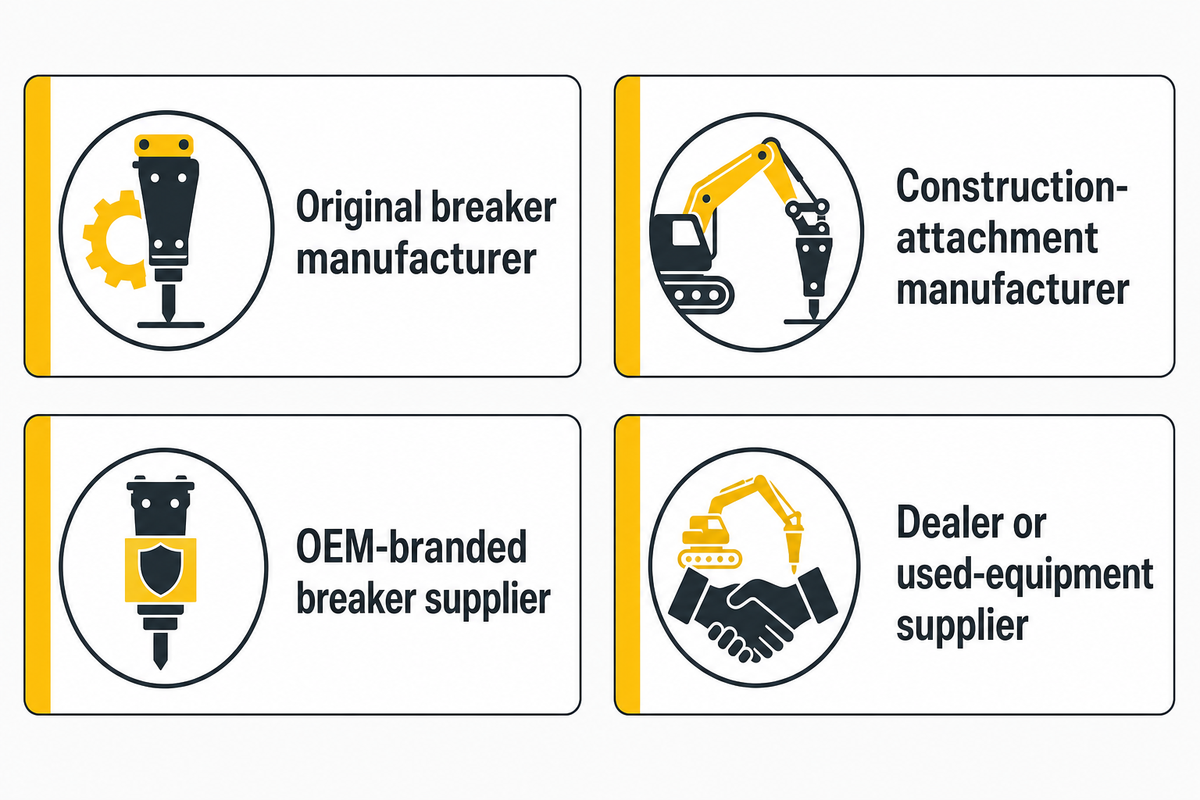
We first classified each company by role: original hydraulic-breaker manufacturer, broader construction-attachment manufacturer, excavator manufacturer with an OEM-branded breaker range, or dealer/used-equipment supplier. These roles are not equivalent, and the numbered discovery list does not imply identical manufacturing capability for procurement. The list counts brands and operating companies, not 20 independent ownership groups; current parent relationships are disclosed where they affect buyer interpretation.
We then checked official histories and current product information for company age, location, carrier coverage, operating requirements, body styles, tools, spare parts, service, and regional availability, using the ISO 16417 hydraulic-breaker terminology and commercial-specification framework as an independent reference. A company is not called a breaker factory unless its own current materials support that identity.
Our Breaker Maker-to-Support Audit Lens compares eight evidence fields: carrier operating weight; auxiliary oil flow; working and relief pressure; return-line and back-pressure limits; impact frequency and any verifiable energy rating; bracket, pins, quick-coupler interface and positive-lock procedure; side/top/box body design plus measured noise, vibration, dust-control and work-environment needs; and lifecycle support covering chisels, seal kits, bushes, warranty, commissioning, and local parts stock.
Quick Comparison of 20 Hydraulic Breaker Companies
| # | Company | Founded | Country / headquarters | Verified role |
|---|---|---|---|---|
| 1 | LH Used Excavator | Not publicly disclosed | China | Used-equipment and attachment supplier/exporter |
| 2 | Epiroc | 2018; shared Atlas history from 1873 | Stockholm, Sweden | Original breaker manufacturer |
| 3 | Rammer (Sandvik) | 1978 | Finland / Sandvik Group | Original breaker manufacturer |
| 4 | Montabert (Komatsu Group) | 1921 | Saint-Priest, France | Original breaker and drilling-equipment manufacturer; Komatsu Group brand |
| 5 | Furukawa Rock Drill | 1961; current name from 2005 | Tokyo, Japan | Original rock-drill and breaker manufacturer |
| 6 | Indeco | 1976 | Italy | Original breaker and demolition-attachment manufacturer |
| 7 | NPK Construction Equipment | 1985 | Ohio, USA | Attachment manufacturer / NPK joint venture |
| 8 | Soosan | 1984 | South Korea | Original breaker and attachment manufacturer |
| 9 | Daemo Engineering | 1989 | Siheung, South Korea | Original breaker and attachment manufacturer |
| 10 | TOKU Group | Manufacturing roots from 1937; sales company established in 1955 | Japan; sales company in Fukuoka | Breaker manufacturing and sales group with separate legal entities |
| 11 | Okada Aiyon | Founded 1938; established 1960 | Osaka, Japan | Original breaker and demolition-attachment manufacturer |
| 12 | Hyundai Everdigm | 1994 | Jincheon, South Korea | Attachment and multi-equipment manufacturer |
| 13 | Komatsu | 1921 | Tokyo, Japan | Excavator manufacturer and branded attachment supplier |
| 14 | Caterpillar | 1925 | Irving, Texas, USA | Excavator manufacturer and branded attachment supplier |
| 15 | Bobcat | 1958 product/brand roots | West Fargo, USA | Compact-equipment manufacturer and branded attachment supplier |
| 16 | JCB | 1945 | Rocester, UK | Construction-equipment manufacturer and OEM-branded supplier |
| 17 | Rotair | Roots from 1946; Rotair Caragliese formed in 1970; Rotair S.p.A. in 1980 | Caraglio, Italy | Original breaker and industrial-equipment manufacturer |
| 18 | JAB | 2003 | Siheung, South Korea | Original breaker and attachment manufacturer |
| 19 | GB Industries | 1998 | Siheung, South Korea | Original breaker and attachment manufacturer |
| 20 | Beilite | 2002 | Zhejiang, China | Original breaker manufacturer |
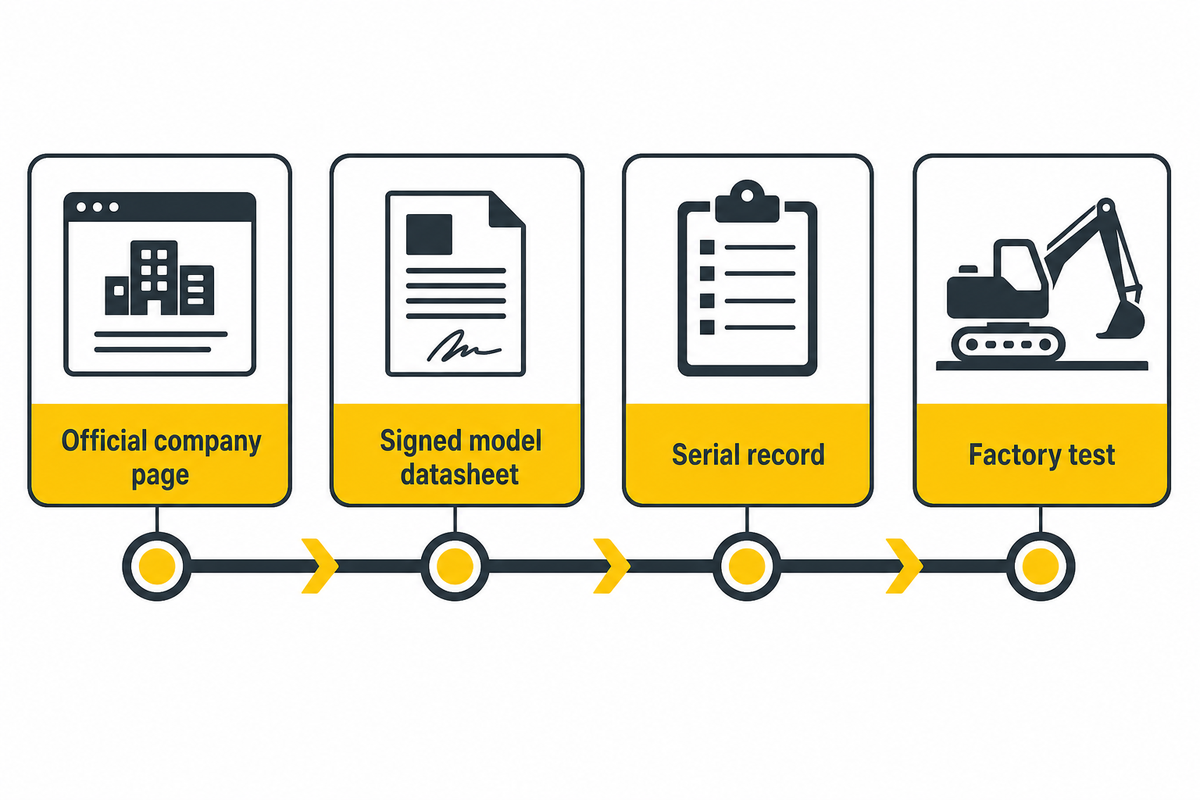
This 20-company table is a screening map, not proof of a factory audit. A role mismatch creates procurement risk because a branded supplier or used-equipment integrator may not manufacture the power cell. Cross-reference each candidate’s official page, signed model datasheet, serial record, and factory test before approving a 20-ton carrier package; ISO 16417 provides an independent vocabulary for comparing commercial breaker specifications.
Hydraulic Breaker Manufacturers and Suppliers: Companies 1–5
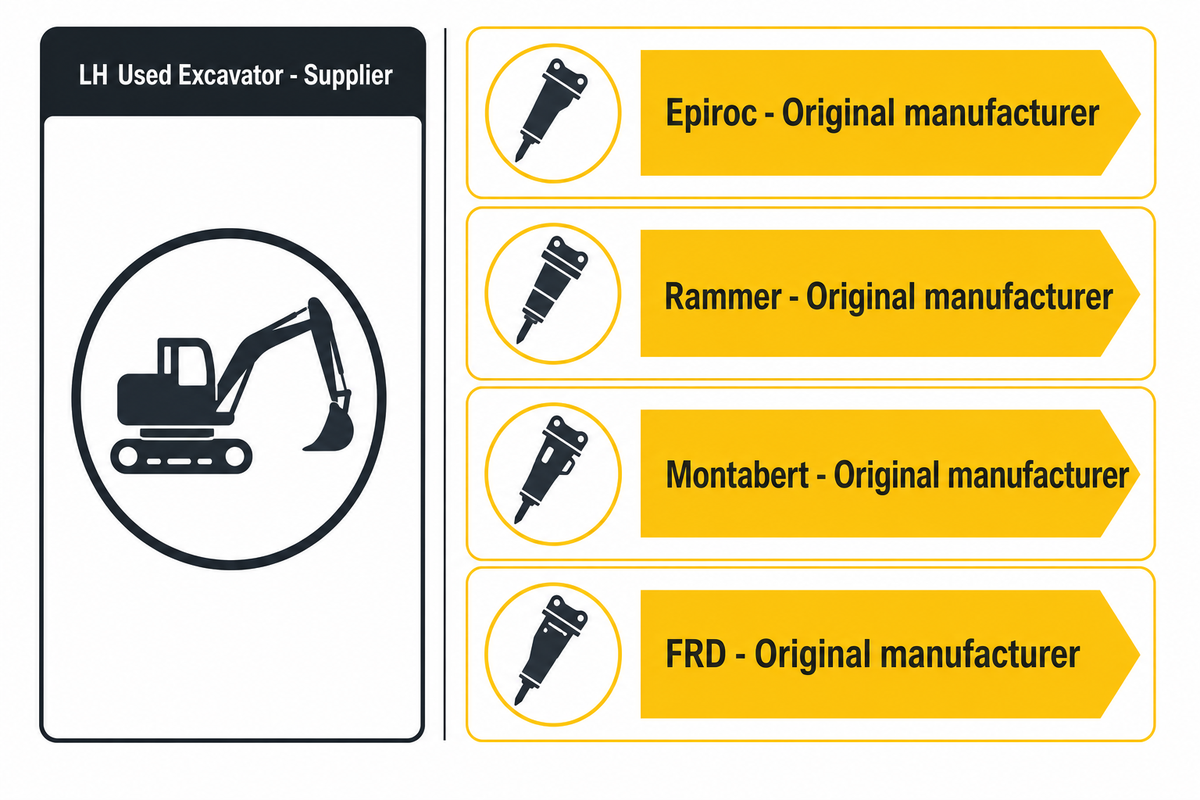
1. LH Used Excavator
- Founded
- Not publicly disclosed
- Headquarters / country
- China
- Company type
- Used-excavator and attachment supplier/exporter; not an original hydraulic-breaker manufacturer
Hefei Liehuang Machinery Co., Ltd. supplies used excavators and attachments for export. Its public hydraulic breaker range covers new or inspected used breakers matched to roughly 1–45 tonne carriers, alongside buckets, grapples, quick couplers, mounting brackets, tools, and spare packages.
LH Used Excavator advantages: Buyers can consolidate a multi-brand excavator, breaker, bracket, tools, and export documents in one shipment. This can be useful when a purchaser needs a matched used machine-and-attachment package rather than a breaker alone.
LH Used Excavator purchasing considerations: LH is the sourcing and integration party, not automatically the breaker factory. Ask for the actual brand, model, serial number, condition evidence, required flow and pressure, bracket drawing, included chisels and seals, warranty, minimum order quantity, and delivery date. Standard warranty, minimum order quantity, and lead time are not publicly disclosed.
LH Used Excavator official website: https://lhusedexcavator.com/
2. Epiroc
- Founded
- 2018 as an independent company; shared Atlas history from 1873
- Headquarters
- Stockholm, Sweden
- Company type
- Original hydraulic-breaker manufacturer
Epiroc’s Tools & Attachments business continues the Krupp and Atlas Copco hydraulic-breaker lineage. Its current portfolio includes SB solid-body, EC essential, MB medium, and HB heavy breakers, plus working tools, lubrication systems, hoses, and service kits.
Epiroc advantages: The range spans compact machines to very large excavators, with model manuals supplying flow, pressure, weight, and blow-rate limits. Selected models add automatic lubrication, noise and vibration control, and blank-firing protection. A broad global service organization supports professional fleets.
Epiroc purchasing considerations: Initial price and genuine-parts costs can be premium. Do not transfer an older Atlas Copco fit assumption to a current Epiroc model without confirming the bracket and hydraulic window. Impact energy, warranty, local parts stock, and delivery time should be checked for the quoted model and country.
Epiroc official website: https://www.epiroc.com/
3. Rammer (Sandvik)
- Founded
- 1978
- Headquarters / country
- Finland; part of Sandvik Group
- Company type
- Original hydraulic-breaker manufacturer
Rammer has specialized in hydraulic hammers since 1978. Its Performance and Excellence lines cover mini-carrier breakers through large demolition and mining models, supported by working tools, parts, breaker booms, and selected digital monitoring systems.
Rammer (Sandvik) advantages: Official model pages publish carrier range, oil flow, operating weight, tool diameter, and blow rate. Sandvik backing, a dealer network in more than 60 countries, genuine tools, and options such as RD Guard or SAM monitoring strengthen lifecycle support.
Rammer (Sandvik) purchasing considerations: Monitoring, automatic lubrication, underwater equipment, sound suppression, mounting brackets, and warranty coverage are not identical across every line or market. Treat them as model-level options and request an itemized quotation.
Rammer (Sandvik) official website: https://www.rammer.com/
4. Montabert (Komatsu Group)
- Founded
- 1921
- Headquarters
- Saint-Priest (Lyon), France
- Company type
- Original hydraulic-breaker and drilling-equipment manufacturer; Komatsu Group brand
Montabert designs and manufactures hydraulic demolition and drilling equipment in France. The company introduced an excavator-mounted hydraulic rock breaker in 1969, and Komatsu Mining Corp. acquired Montabert in 2017. It now operates within the Komatsu brand family and offers SD compact, medium, heavy, XL, and variable-energy breaker ranges.
Montabert advantages: Montabert provides unusually detailed public data for carrier range, oil flow, maximum pressure, back pressure, impact frequency, and noise. Variable-energy models, soundproof versions, working tools, and maintenance packages serve applications from compact construction to quarry work.
Montabert purchasing considerations: Montabert and Komatsu are listed separately here as a specialist breaker brand and a carrier/OEM-branded supplier, not as independent ownership groups. Its ranges do not all use the same operating principle or support package. Ask the local channel to define the accumulator, grease system, tool, bracket, hose, seal-kit scope, minimum order quantity, and production lead time.
Montabert official website: https://www.montabert.com/
5. Furukawa Rock Drill (FRD)
- Founded
- 1961 as the rock-drill sales entity; current company name adopted in 2005
- Headquarters
- Tokyo, Japan
- Company type
- Original rock-drill and hydraulic-breaker manufacturer
FRD combines production and sales of rock drills, hydraulic breakers, and other rock-excavation equipment within the Furukawa group. Its offering includes Fx/FxJ and F-series breakers, pneumatic breakers, drill rigs, tools, demolition attachments, and genuine parts.
Furukawa Rock Drill (FRD) advantages: Deep hard-rock experience, quarry and mining channels, broad tools coverage, and a genuine-parts program suit buyers who value field support and proven rock-working applications.
Furukawa Rock Drill (FRD) purchasing considerations: Do not confuse Furukawa Co.’s older 1875 roots, early rock-drill milestones, or a regional subsidiary date with the current FRD company date. Model names and carrier classes vary between Japan, North America, and other regions; verify the regional catalog, pressure/flow limits, and distributor stock.
Furukawa Rock Drill (FRD) official website: https://www.furukawa-rockdrill.com/
Companies 6–10
6. Indeco
- Founded
- 1976
- Headquarters / country
- Italy
- Company type
- Original hydraulic-breaker and demolition-attachment manufacturer
Indeco started with spare parts and custom hydraulic hammers and now manufactures HP breakers, compactors, pulverizers, shears, multi-processors, grapples, boom systems, and mulching heads. The published breaker range covers approximately 0.5–140 tonne excavators.
Indeco advantages: Wide carrier coverage, international subsidiaries, attachment specialization, and selected variable-hydraulic, anti-blank-firing, remote-monitoring, and fuel-saving functions support professional demolition fleets.
Indeco purchasing considerations: Intelligent-hammer and fuel-saving claims are configuration-specific. Confirm the precise carrier range, flow, pressure, back-pressure limit, monitoring requirements, and local stock of tools, bushes, diaphragms, and seal kits.
Indeco official website: https://indeco.it/
7. NPK Construction Equipment
- Founded
- 1985
- Headquarters
- Walton Hills, Ohio, USA
- Company type
- Construction-attachment manufacturer; North American NPK joint-venture company
NPK Construction Equipment was established with Japan’s Nippon Pneumatic Mfg. Co., Ltd. Its current range includes PH, GHD, and GH hydraulic hammers, compactors, crushers, shears, pedestal booms, accessories, genuine parts, and refurbished equipment.
NPK Construction Equipment advantages: Its current hammer brochure publishes carrier weight, oil flow, pressure, blow rate, tool size, and impact-energy class. North American manufacturing/service, dealer specialists, warranty documents, and remote troubleshooting make the support structure relatively transparent.
NPK Construction Equipment purchasing considerations: NPK explicitly says impact-energy class is a marketing rating, not measured impact energy. Do not compare that number directly with a tested joule value. Read the exact warranty form because non-genuine parts and maintenance practices can affect coverage.
NPK Construction Equipment official website: https://www.npkce.com/
8. Soosan
- Founded
- 1984
- Headquarters / country
- South Korea
- Company type
- Original hydraulic-breaker and attachment manufacturer
Soosan develops hydraulic breakers, compactors, crawler drills, pulverizers, augers, and related attachments. Its US operation describes a 200–15,000 ft-lb-class breaker range, factory pressure testing, parts inventory, and ISO 9001 and ISO 14001 systems.
Soosan advantages: More than four decades of breaker production, controlled machining and heat treatment, final hydraulic testing, export reach, and parts/service operations make Soosan relevant to distributors and larger fleets.
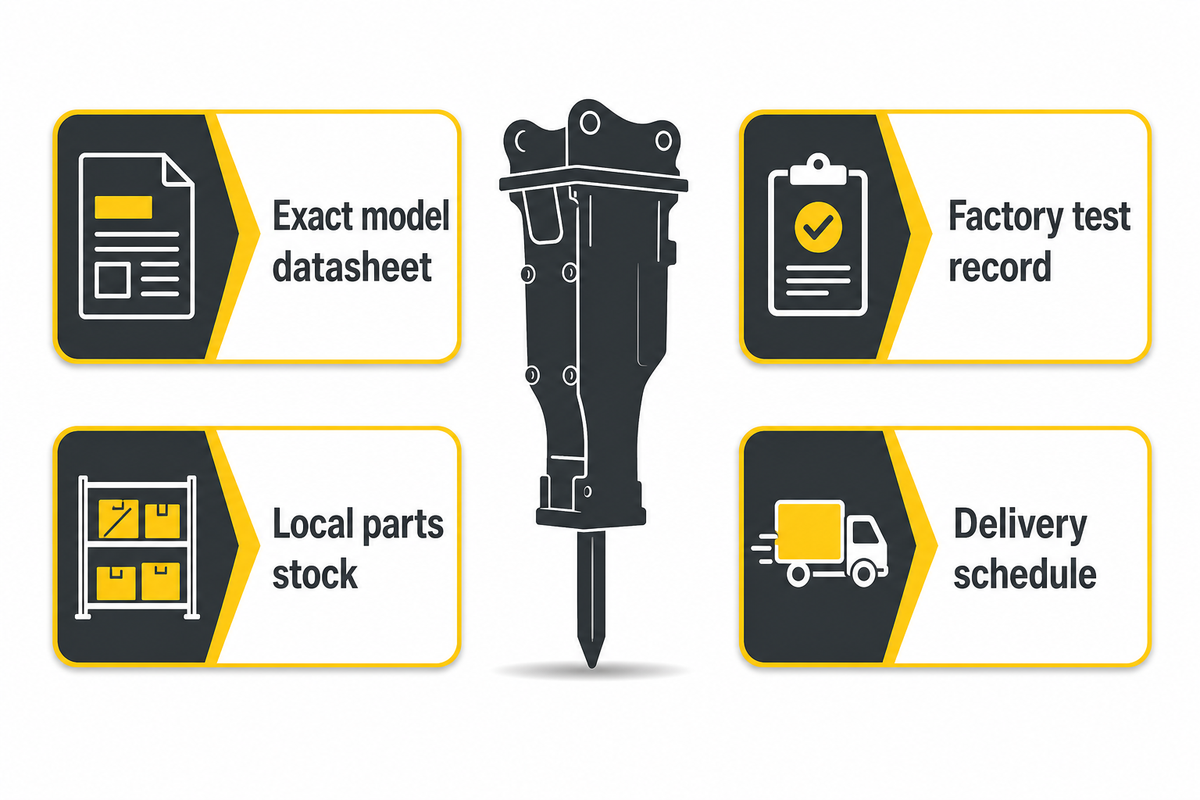
Soosan purchasing considerations: North American stock does not prove the same availability in every country. Ask the destination-market distributor for its model brochure, measured acceptance test, warranty terms, chisel and seal stock, and realistic delivery schedule.
Soosan official website: https://soosanmachinery.com/
9. Daemo Engineering
- Founded
- 1989
- Headquarters
- Siheung, Gyeonggi-do, South Korea
- Company type
- Original hydraulic-breaker and excavator-attachment manufacturer
Daemo manufactures hydraulic attachments and special-purpose construction machines. Its breaker platforms include SM Smart, B Alicon, E Eureka, and G Demolex, complemented by crushers, shears, quick couplers, grapples, and special machines.
Daemo Engineering advantages: Attachment-focused engineering, several breaker architectures, a smart-factory program, a broad demolition portfolio, and international subsidiaries and dealers support complex attachment requirements.
Daemo Engineering purchasing considerations: A company-level patent count does not prove that a quoted model includes a patented function. Request the exact datasheet, patent or certification reference where relevant, factory test record, warranty, spare-parts list, minimum order quantity, and delivery time.
Daemo Engineering official website: https://www.daemo.co.kr/eng/
10. TOKU Group (Toku Pneumatic / Toku Pneumatic Tool Mfg.)
- Founded
- Manufacturing roots from 1937; sales company established in 1955
- Headquarters / country
- Japan; Toku Pneumatic sales company in Fukuoka
- Company type
- Breaker manufacturing and sales group with separate legal entities
TOKU’s manufacturing roots trace to Toku Pneumatic Tool Mfg. Co., Ltd. in 1937. Toku Pneumatic Co., Ltd. was established as the sales company in 1955, and the official history records complete separation of manufacturing and sales in 1973. The manufacturing company makes the hydraulic breakers, while the sales company handles sales and export. TNB small, medium, and large breakers include silenced, anti-vibration, and special versions alongside pneumatic tools.
TOKU Group advantages: Official pages publish carrier, flow, and pressure ranges. Many TNB models use an accumulator-free design with only two moving parts, supporting straightforward service. Japanese production and published noise/vibration development are additional strengths.
TOKU Group purchasing considerations: Confirm which legal entity manufactures, invoices, warrants, and exports the quoted breaker. Also verify whether silent, underwater, or tunnel versions are available in the buyer’s region and which brackets, tools, and hoses are included.
TOKU Group official website: https://www.toku-net.co.jp/en/
Companies 11–15
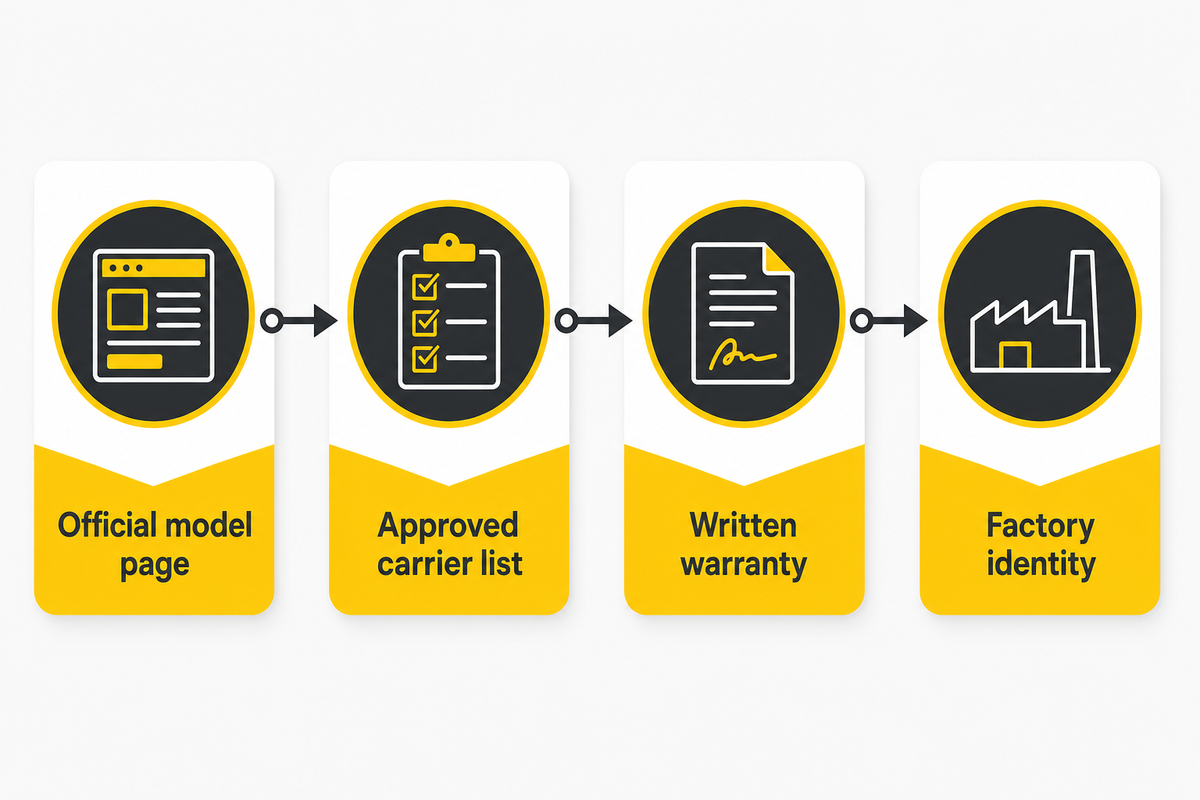
This group presents a distinct buyer risk: two original attachment manufacturers sit beside three excavator brands with branded breaker ranges. Because a familiar carrier badge does not prove power-cell origin, procurement teams should compare the official model page, approved carrier list, written warranty, and factory identity before placing a purchase order.
11. Okada Aiyon
- Founded
- Founded in 1938; company established in 1960
- Headquarters
- Osaka, Japan
- Company type
- Original hydraulic-breaker and demolition-attachment manufacturer
Okada Aiyon manufactures, sells, and repairs construction and forestry attachments. Its portfolio covers hydraulic breakers, concrete crushers, pulverizers, shears, grapples, and attachments for excavators, backhoes, and skid steers.
Okada Aiyon advantages: A long Japanese attachment history, manufacturing and repair capability, domestic service branches, demolition expertise, and international sales channels support buyers who prioritize established after-sales structure.
Okada Aiyon purchasing considerations: Corporate materials distinguish the 1938 founding from the 1960 legal establishment. Current English technical data can be limited, so obtain the local model catalog and written flow, pressure, carrier, warranty, parts, and delivery details.
Okada Aiyon official website: https://okada-aiyon.com/
12. Hyundai Everdigm
- Founded
- 1994
- Headquarters
- Jincheon, South Korea
- Company type
- Construction-attachment and multi-equipment manufacturer
Hyundai Everdigm began as a used-equipment trading company, entered attachment manufacturing in 1995, and has been an affiliate of Hyundai Department Store Group since 2015. It now produces hydraulic breakers, crushers, pulverizers, shears, compactors, couplers, rock tools, drill rigs, concrete pumps, and special vehicles; it is distinct from HD Hyundai Construction Equipment.
Hyundai Everdigm advantages: An attachment reliability center, broad export network, multi-product engineering, and the ability to support contractors buying breakers plus other equipment distinguish it from a breaker-only supplier.
Hyundai Everdigm purchasing considerations: Its breadth means local breaker specialization must be verified. Confirm that the regional seller stocks the relevant breaker parts and that the proposed unit is Hyundai Everdigm manufacture rather than a bundled third-party item. Model warranty, minimum order quantity, and lead time require confirmation.
Hyundai Everdigm official website: https://everdigm.com/eng/
13. Komatsu
- Founded
- 1921
- Headquarters
- Tokyo, Japan
- Company type
- Excavator manufacturer and branded attachment supplier; breaker power-cell origin should be confirmed
Komatsu is a global construction and mining equipment manufacturer offering branded JMHB H- and V-series hydraulic breakers for compact through large excavators. Regional official pages publish operating weight, required flow, pressure, blow rate, and recommended Komatsu carriers.
Komatsu advantages: Carrier-to-attachment integration, detailed fit guidance, dealer support, genuine parts, and a single service channel make the range attractive to a Komatsu fleet.
Komatsu purchasing considerations: An OEM-branded range does not by itself disclose who manufactures every breaker power cell. Model availability and specifications vary by region. Confirm country of origin, warranty, installed price, and written approval before using the breaker on another carrier brand.
Komatsu official website: https://www.komatsu.com/
14. Caterpillar
- Founded
- 1925
- Headquarters
- Irving, Texas, USA
- Company type
- Excavator manufacturer and branded attachment supplier; breaker power-cell origin should be confirmed
Caterpillar supplies Cat GC and Performance hydraulic hammers for skid steers, backhoes, and excavators, with silenced options, working tools, and maintenance kits. The official selector exposes energy class, maximum blows per minute, carrier type, and sound-suppression filters.
Caterpillar advantages: Strong carrier integration, a broad dealer network, familiar fleet service, maintenance kits, and coverage from compact loaders to large excavators reduce coordination for Cat owners.
Caterpillar purchasing considerations: Dealer price, options, warranty, and stock vary. Confirm the breaker’s manufacturing origin if required by procurement policy. Compare the installed cost, including hanger, pins, hydraulic lines, tools, commissioning, and operator training—not only the bare attachment price. For carrier-generation context, review the Caterpillar vs. Komatsu excavator comparison.
Caterpillar official website: https://www.cat.com/
15. Bobcat
- Founded
- 1958 product/brand roots
- Headquarters
- West Fargo, North Dakota, USA
- Company type
- Compact-equipment manufacturer and branded attachment supplier; breaker power-cell origin should be confirmed
Bobcat offers HB hydraulic and NB nitrogen breakers for loaders, compact excavators, and other Bobcat carriers, together with bits, mounting systems, drop hammers, and selected water kits. Official pages highlight shock isolation, automatic pressure regulation, and low-part-count service designs.
Bobcat advantages: Compact-carrier integration, Bob-Tach and X-Change mounting options, vibration isolation, and dealer access suit mixed Bobcat fleets and urban or rental work.
Bobcat purchasing considerations: The public product page does not establish original manufacture of every power cell. Bits may be priced separately. Match both the carrier model and auxiliary-flow setting, and confirm the required mount, hose kit, and warranty before ordering.
Bobcat official website: https://www.bobcat.com/
Companies 16–20
16. JCB
- Founded
- 1945
- Headquarters
- Rocester, United Kingdom
- Company type
- Construction-equipment manufacturer and OEM-branded breaker supplier
JCB offers contractor, professional, site, and handheld breaker ranges for its own and selected third-party carriers. Product pages publish operating weight, impact energy, carrier compatibility, and selected warranty information; sound-suppressed professional models are available.
JCB advantages: Ready-to-work packages, detailed public specifications, tested JCB fit, multiple duty tiers, and one dealer for carrier and attachment can simplify commissioning. Selected site breakers publicly carry a 12-month warranty.
JCB purchasing considerations: Warranty differs by model and market. Confirm whether the quote includes a universal mount or JCB hanger, hoses, tools, and commissioning. A non-JCB carrier needs written flow and pressure approval.
JCB official website: https://www.jcb.com/
17. Rotair
- Founded
- Roots documented from 1946; Rotair Caragliese formed in 1970; Rotair S.p.A. formed in 1980
- Headquarters
- Caraglio, Italy
- Company type
- Original hydraulic-breaker and industrial-equipment manufacturer
Rotair’s official history documents roots from 1946, formation of Rotair Caragliese in 1970, and formation of Rotair S.p.A. in 1980; a separate product page uses “Since 1961,” so buyers should not treat 1961 as an unqualified legal founding year. Rotair designs and manufactures hydraulic breakers, portable compressors, and mini dumpers and has belonged to ELGi since 2012. Its light and heavy breaker ranges include Ecosilent and Vibro-Silence variants.
Rotair advantages: Italian manufacturing, approximately 50–2,200 kg breaker coverage, low-noise enclosures, energy-recovery concepts, accessible maintenance, and an international industrial parent make Rotair relevant to compact and mid-size fleets.
Rotair purchasing considerations: Standard warranty, minimum order quantity, and lead time are not publicly disclosed. Ask for the exact pressure/flow table, regional dealer stock, service kits, and written clarification of whether proposed customization applies to the breaker model.
Rotair official website: https://www.rotairspa.com/
18. JAB
- Founded
- 2003
- Headquarters
- Siheung, Gyeonggi-do, South Korea
- Company type
- Original hydraulic-breaker and attachment manufacturer
JAB manufactures gas-type, internal/external-valve, and fully hydraulic breakers. Its JBN, JB, and RB series cover excavators, skid steers, and backhoe loaders, while the wider range includes compactors, couplers, crushers, shears, pulverizers, and grapples.
JAB advantages: Breaker-focused Korean production, several operating architectures, skid-steer and backhoe options, Korean steel and heat-treatment controls, and ISO 9001/CE history support export buyers seeking factory-direct options.
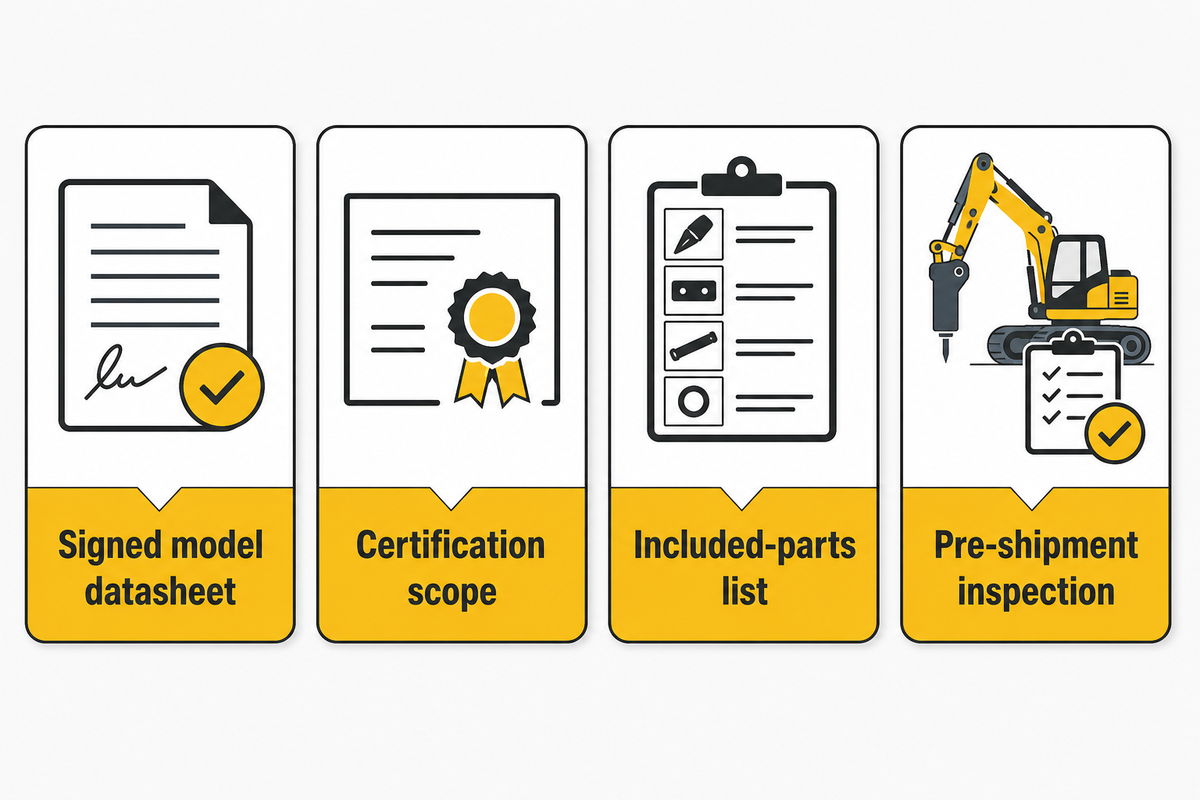
JAB purchasing considerations: Current English commercial and technical data are fragmented across product pages. Obtain a signed model datasheet, certification scope, warranty, parts list, minimum order quantity, and delivery schedule.
JAB official website: https://jabkor.co.kr/
19. GB Industries (General Breaker)
- Founded
- 1998
- Headquarters
- Siheung, Gyeonggi-do, South Korea
- Company type
- Original hydraulic-breaker and attachment manufacturer
GB Industries specializes in hydraulic hammers and excavator attachments and reports exports through a network covering more than 75 countries. Its range includes GBN and fully hydraulic breakers, skid-steer breakers, crushers, grapples, and working tools.
GB Industries (General Breaker) advantages: A breaker-focused Korean manufacturing identity, export experience, excavator and skid-steer configurations, and a wider attachment range can suit distributors building a multi-product line.
GB Industries (General Breaker) purchasing considerations: Complete current public technical tables are limited. Require a signed flow/pressure/carrier datasheet, acceptance test, bill-of-materials scope, warranty, minimum order quantity, tools and spare-parts list, and lead time before comparing the offer.
GB Industries (General Breaker) official website: https://www.gbhammer.com/
20. Beilite
- Founded
- 2002
- Headquarters / country
- Zhejiang, China
- Company type
- Original hydraulic-breaker manufacturer
Beilite focuses on hydraulic-breaker research, production, and service. Its BLT/BLTB families include sound-suppressed box, top-mounted, side-mounted, backhoe-loader, skid-steer, heavy-duty, and underwater configurations.
Beilite advantages: Broad body-style choice, Chinese factory positioning, export activity, application-specific variants, and breaker-focused production give distributors many configuration options. The company also reports management-system certifications and participation in Chinese breaker-standard drafting.
Beilite purchasing considerations: Treat performance, patent, and market-leadership statements as manufacturer claims until independently verified. Request model-specific certificates, test standards, customer references, parts stock, warranty, minimum order quantity, production lead time, and pre-shipment inspection criteria.
Beilite official website: https://www.beilite.com/
Manufacturer Data That Determines Carrier Match
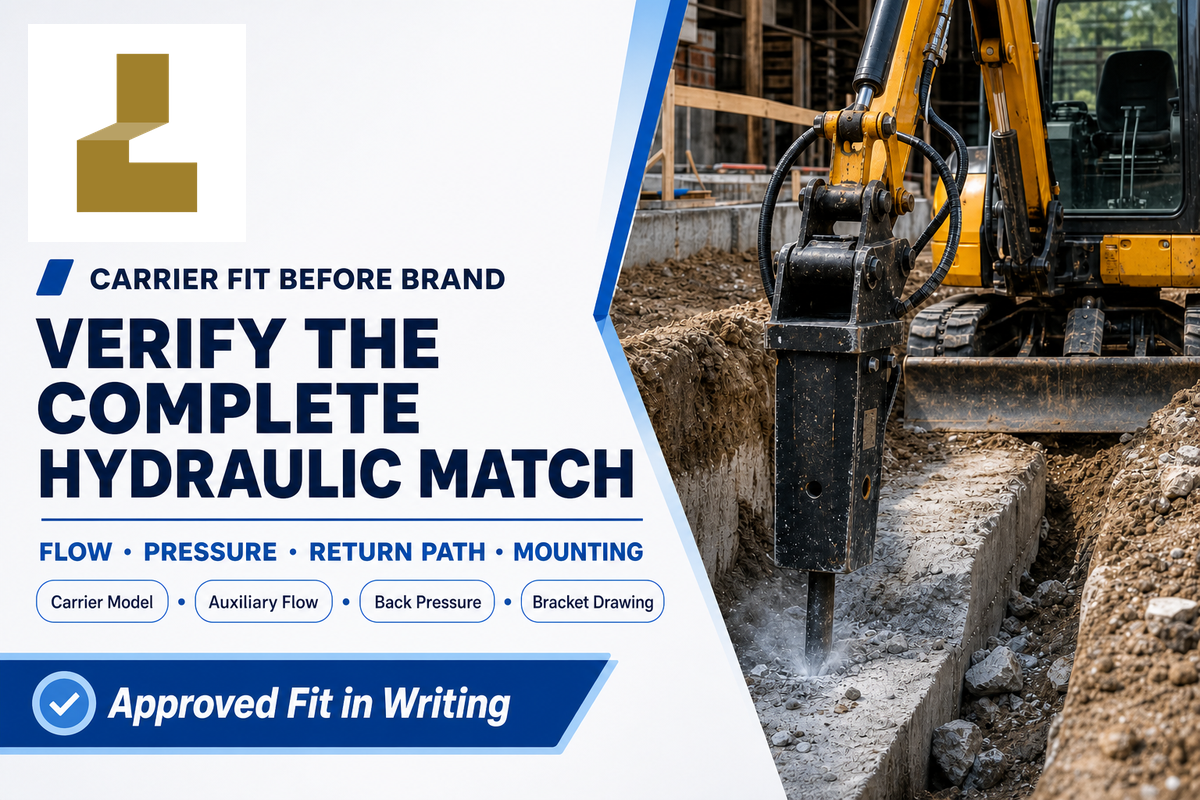
Carrier weight is only the first filter. Ask the excavator manufacturer or qualified hydraulic technician for continuous auxiliary flow, maximum relief pressure, return-line restriction, acceptable oil temperature, and whether a case drain or unrestricted return to tank is required. The breaker supplier should then approve the exact carrier model and hydraulic configuration in writing. For operating principles, sizing fundamentals, and maintenance detail beyond manufacturer comparison, use the hydraulic breaker operation, sizing, and maintenance guide.
To choose the right hydraulic attachment and right breaker size, compare the carrier’s auxiliary hydraulic circuit with the breaker’s valve, cylinder, piston, hoses and return path. The right breaker must work within the complete hydraulic system, not merely share a weight class. This applies to mini carriers, heavy excavators and high-impact breaking applications in rock or concrete. A manufacturer of hydraulic components is not automatically a breaker original manufacturer.
Attachment fit also has a safety layer. NIOSH’s 2024 quick-coupler guidance identifies misconnection and mechanical or hydraulic failure as potential causes of attachment release. Confirm the coupler model, pin pickup, positive-lock method, connection test, and safe changeover procedure; LH’s excavator coupler fitment and pin checker helps buyers collect the required dimensions. For work that fractures silica-containing concrete or rock, the job plan may also need enclosed-cab, water-spray, ventilation, respiratory, or exclusion-zone controls under the destination’s occupational rules. A “silenced” housing does not replace a measured noise comparison or site exposure assessment.
| Evidence field | What to request | Why it matters |
|---|---|---|
| Carrier range | Minimum and maximum operating weight plus approved carrier models | An oversized hammer can destabilize or damage the carrier; an undersized unit may be unproductive. |
| Oil flow | Required continuous liters/minute or gallons/minute at the breaker | Excess flow raises impact rate and heat; insufficient flow reduces performance. |
| Pressure and return | Working range, relief setting, back-pressure limit, case-drain requirement | Incorrect pressure can damage seals, hoses, accumulator components, or the carrier pump. |
| Impact performance | Blows/minute, test method, energy unit and whether the value is measured or a class | Marketing energy classes are not directly comparable with measured impact energy. |
| Mounting | Bracket drawing, pin diameters, pin centers, dipper width and hydraulic connections | “Fits 20-ton excavators” does not prove that the hanger fits a specific machine. |
| Interface safety | Quick-coupler model, positive lock, visual/functional test and changeover procedure | An attachment can match hydraulically yet remain unsafe if the connection is mis-engaged or incompatible. |
| Work environment | Measured sound condition, dust-control options, cab/exclusion requirements and indoor/underwater configuration | Breaking material and nearby-worker exposure can change the equipment and control package required. |
| Lifecycle support | Tool types, bushes, seals, diaphragms, nitrogen kit, grease system and local inventory | Low purchase price loses value when a small wear part creates weeks of downtime. |
The excavator size guide and buyer checklist explains why mini excavators and skid steers need special attention to auxiliary-flow packages, coupler geometry, attachment weight, and machine stability. Large quarry breakers need confirmation of continuous-duty cooling, return pressure, carrier structure, tool choice, and service access. Impact energy is useful only when the manufacturer identifies a repeatable test method; otherwise, compare verified productivity in the buyer’s actual material.
Why Body Style Changes Supplier Comparison
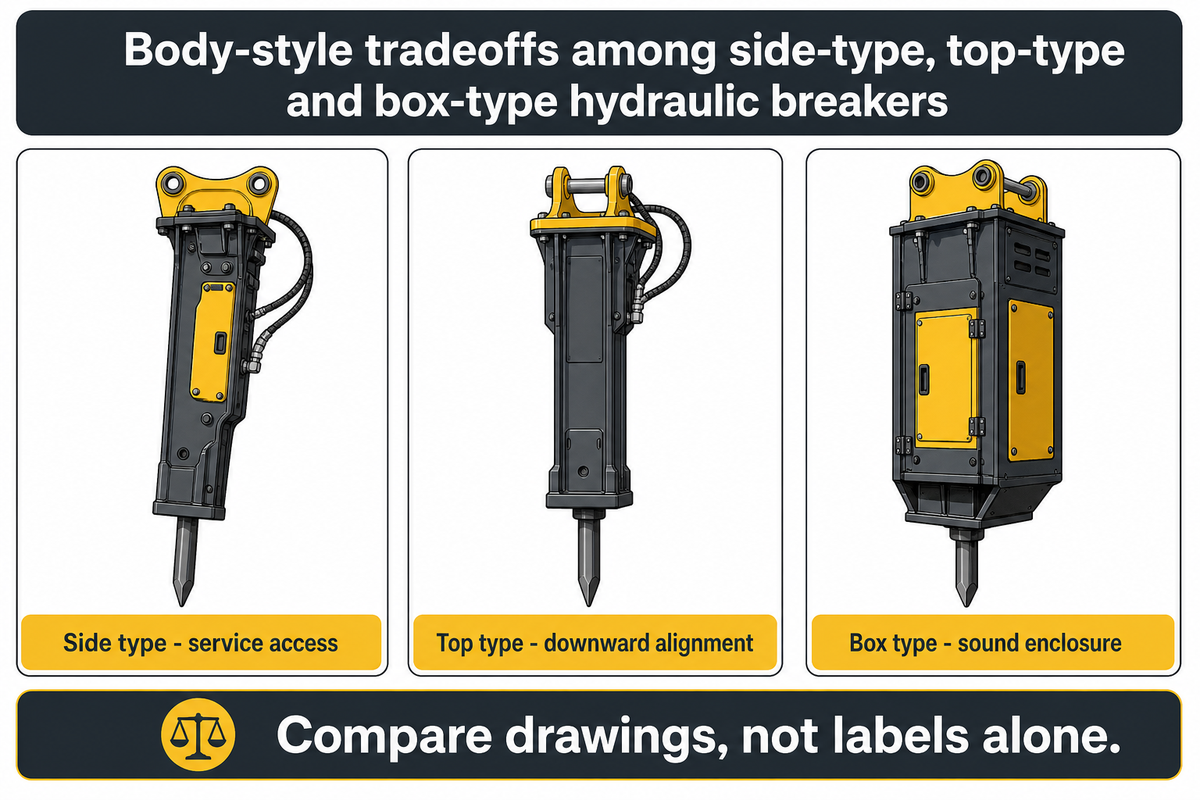
Side-type breakers expose more of the power cell and are often easier to inspect and service. They can be cost-effective for general excavation, but hose routing, side clearance, noise, and exposure to debris deserve attention. They are practical when fast visual inspection and simple field access matter.
Top-type breakers use a vertical or open top-mount arrangement. Suppliers often position them for direct downward breaking and easier tool alignment. The terms “top type” and “side type” are common in Asian export catalogs but are not perfectly standardized, so compare bracket drawings rather than labels alone.
Box-type or silenced breakers place the power cell inside an enclosure with damping material. A well-engineered housing can reduce transmitted vibration and sound, protect components, and suit urban demolition. It also adds weight and can make inspection less direct. Ask for an actual sound test condition and service procedure instead of accepting “silent” as an absolute claim. The UK Health and Safety Executive’s mounted-breaker noise guidance also recommends comparing equipment noise data and controlling bystander exposure.
Search inventories may also surface Chicago Pneumatic, BTI, Bretec, Teledyne, and model strings such as HM 400. They are not added as extra ranked companies here because the list is capped at 20 and current ownership, product status and manufacturing identity must be verified before inclusion. Pneumatic breakers powered by compressed air also sit outside this carrier-mounted hydraulic comparison.
Hydraulic Breaker RFQ and Supplier Due-Diligence Checklist
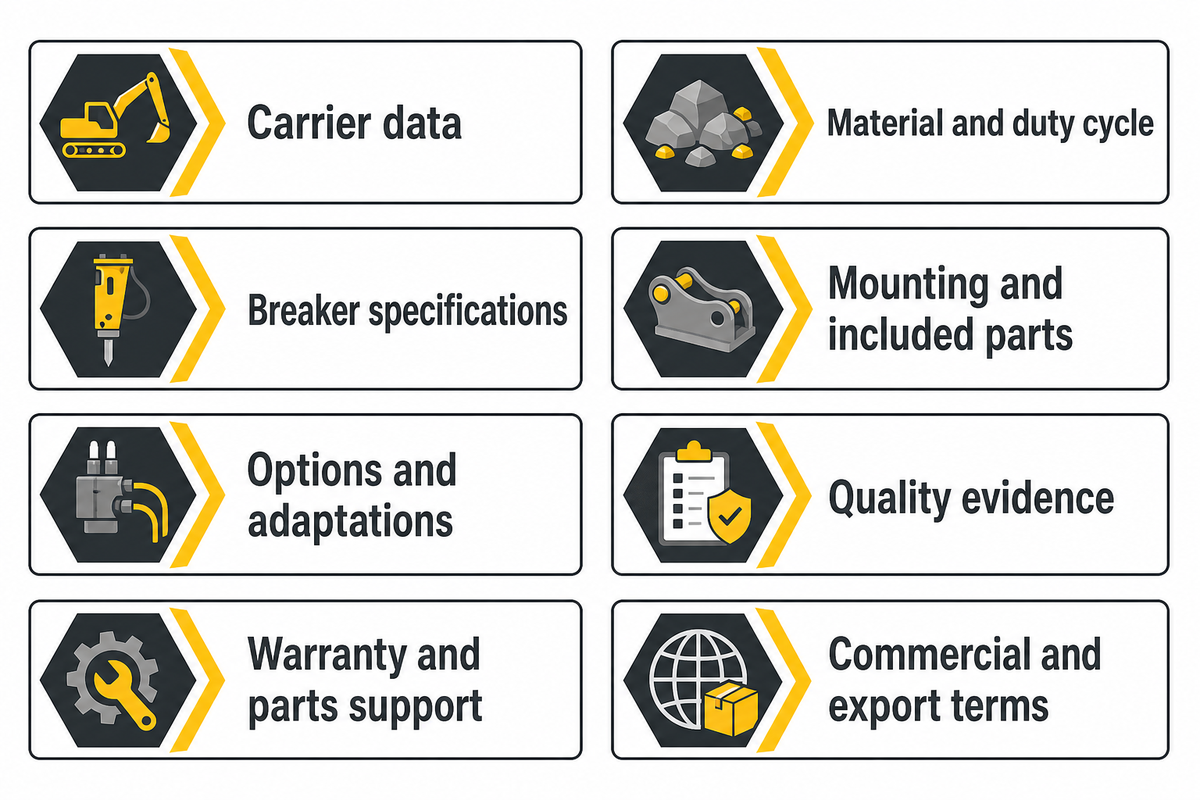
- State the carrier brand, model, serial range, operating weight, auxiliary-flow setting, relief pressure, and quick-coupler type.
- Describe the material, work environment and duty cycle: concrete demolition, trenching, oversize rock, quarry primary breaking, indoor or underwater work, nearby-worker exposure, or occasional rental use.
- Request the breaker model, serial-number format, country of manufacture, net and shipping weight, flow, pressure, back-pressure, blow rate, tool diameter, and verifiable impact-energy method.
- Obtain the bracket and quick-coupler drawings, positive-lock/test procedure, and a complete included-parts list covering pins, hoses, adapters, chisels, nitrogen kit, grease, bushes, seals, diaphragm, and toolbox.
- Ask whether anti-blank-firing, automatic lubrication, underwater adaptation, measured sound data, dust-suppression interfaces, or monitoring is standard, optional, or unavailable.
- Define quality evidence: material certificate, heat-treatment record, dimensional check, hydraulic-fluid cleanliness/inspection method, pressure and leakage tests, no-load test, paint/packing inspection, and serial-number photos.
- Put warranty term, exclusions, claim procedure, response time, spare-parts stocking point, and technical-support language in the purchase contract.
- Confirm minimum order quantity, production or preparation lead time, delivery term, packing dimensions, gross weight, export documents, technical file, instructions, declaration and destination certification needs. For European Union deliveries, verify which requirements apply on the actual market-placement date because Regulation (EU) 2023/1230 becomes mandatory on 20 January 2027.
A quote should separate the breaker, bracket, hydraulic lines, tool bits, replacement parts, commissioning and freight. Ask whether hydraulic hammer repairs, a scheduled rebuild, and quality parts are available locally. If you buy new, compare factory warranty and lead time; if you buy used, compare inspection and condition evidence. “Competitive pricing,” “leading provider,” “high-quality OEM,” “dependable,” and “personalized support” are not evidence unless the supplier defines the measurable service behind each phrase. The goal is to maximize uptime, not to select the lowest bare breaker price.
For a used breaker, add tool wear, lower-bush clearance, tie-rod condition, housing cracks, oil leakage, accumulator or diaphragm history, serial-number plate, and a running test under a compatible carrier. A fresh paint job is not condition evidence.
Frequently Asked Questions
Who makes the best hydraulic breakers?
There is no defensible universal winner. Epiroc, Rammer, Montabert, FRD, Indeco, NPK, Soosan, and other established manufacturers offer strong ranges, but the best purchase is the model that matches the carrier’s flow, pressure, mounting, duty cycle, local parts stock, and service response. A famous brand without local parts or correct carrier fit can be a weaker buy than a properly supported alternative.
Who are the main hydraulic rock breaker manufacturers?
Original manufacturers or manufacturing groups in this guide include Epiroc, Rammer, Montabert, Furukawa Rock Drill, Indeco, Soosan, Daemo, the TOKU Group, Okada Aiyon, Rotair, JAB, GB Industries, and Beilite. NPK Construction Equipment and Hyundai Everdigm are broader attachment manufacturers. Komatsu, Caterpillar, Bobcat, and JCB sell branded breaker ranges alongside carrier machines. Montabert is a Komatsu Group brand, and LH Used Excavator is a sourcing and integration supplier rather than an original breaker factory.
How long do hydraulic breakers last?
Public manufacturers rarely give one universal service-life figure because life depends on carrier setup, material, working angle, blank firing, lubrication, oil temperature, contamination, tool wear, and maintenance. Ask for overhaul intervals and wear limits for the exact model, then track hours, bush clearance, tool condition, and hydraulic performance.
Is higher impact energy or a faster blow rate always better?
No. Impact energy and impact frequency interact with oil flow, pressure pulsation, tool size, material, and durability. First confirm whether a published number is measured energy, calculated energy, or only an energy class, then compare performance in the intended material without exceeding the carrier or breaker’s approved hydraulic limits. Measured results also depend on the test method, working tool, material, carrier settings, and whether the published value is verified impact energy or merely an energy class.
A government-funded, industry-coauthored case study—with two authors affiliated with Soosan Heavy Industries R&D—reported that earlier commercial-product studies often showed an energy/frequency tradeoff, while its own optimized prototype increased both metrics under the tested conditions. The result remains design- and condition-specific, not a universal performance rule. Suppliers should identify the test method, tool, material, carrier settings, and measurement conditions in writing.
What is a hydraulic breaker?
A hydraulic breaker is a carrier-mounted attachment that converts hydraulic power into repeated blows through a chisel or other working tool. It breaks rock, reinforced concrete, pavement, frozen ground, and similar hard material. “Hydraulic hammer” and “rock breaker” are common alternative names.
Can one breaker be used on different excavator brands?
Often yes, but carrier weight alone is insufficient. Confirm auxiliary oil flow, relief pressure, return-line pressure, mount geometry, machine stability, hose connections, and attachment controls. A new bracket or hydraulic setting may be required, and both suppliers should approve the combination.
What should an international buyer confirm before paying a deposit?
Confirm the legal seller, factory or supplier role, breaker brand and model, serial number, carrier fit, technical datasheet, included-parts list, warranty, minimum order quantity, lead time, inspection plan, packing, shipping term, export documents, spare-parts quotation, and after-sales contact in writing.
Ask for the bracket drawing and the approved flow, pressure, back-pressure and connection test for the named carrier. Define who pays if those values or mounting dimensions are wrong. For used equipment, add running video, tool and bush wear, leakage, repair history and serial-plate evidence. Put every material promise in the proforma invoice or purchase contract, including the remedy for delay or failed inspection.
Final Buying Recommendation
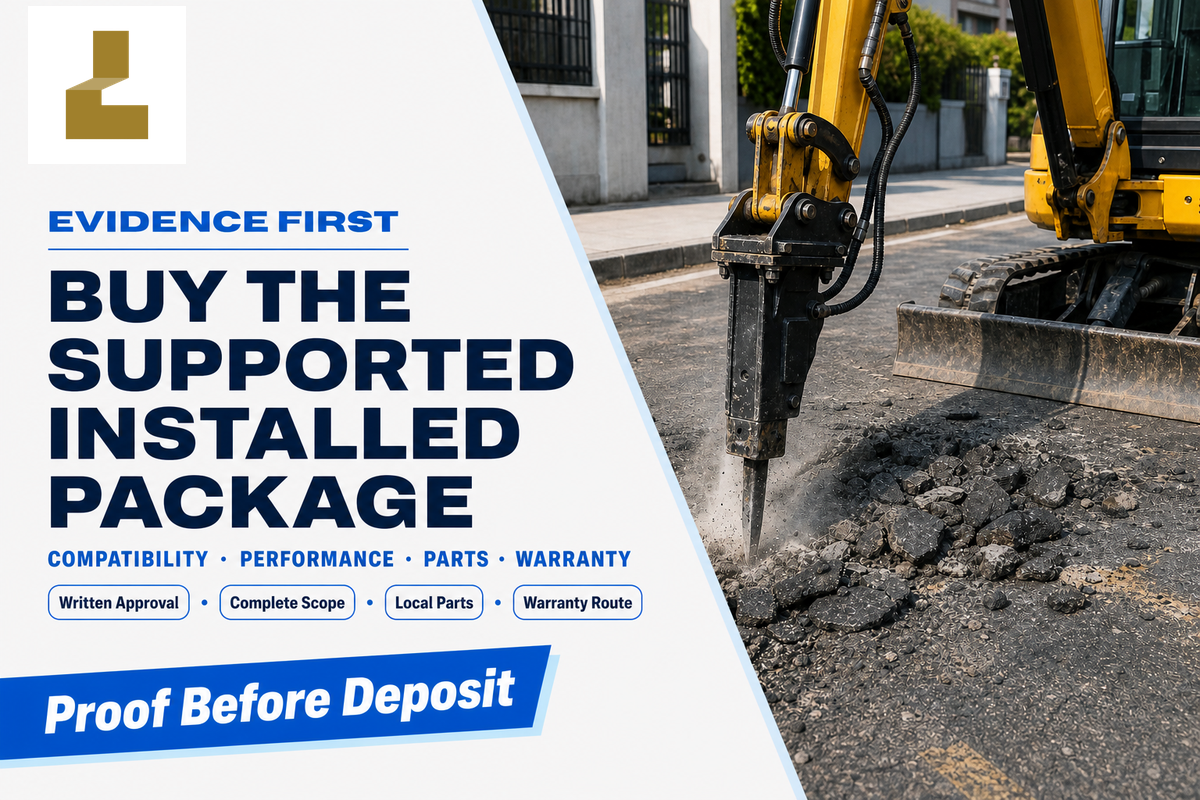
Use this list to build a shortlist, not to skip technical due diligence. Original hydraulic breaker manufacturers usually provide deeper model engineering and factory parts support. Equipment manufacturers can offer convenient carrier integration. Dealers and used-equipment suppliers can consolidate brands, inspect used units, and simplify export logistics. Each route transfers a different combination of price, warranty, origin, and support risk to the buyer.
Before comparing quotations, normalize them against the Breaker Maker-to-Support Audit Lens and the safety principles in ISO 4413 for hydraulic systems. The strongest offer is the one that proves carrier compatibility, documents its performance basis, prices the complete installed package, and commits to parts and warranty support in writing.
References & Sources
Why We Write This
About Liehuang
Liehuang is a China-based used excavator supplier focused on verified machines, inspection records, and export-ready documentation. Our blog is written for buyers who need more than a model name and a low price before sending a deposit.
We publish practical guides on used excavator cost, machine hours, inspection points, import paperwork, attachments, and brand selection so contractors and equipment buyers can compare machines with fewer blind spots.
Inspection FirstEngine, hydraulics, undercarriage, serial-number photos, hour-meter photos, and machine video can be prepared before shipment.
9 Brands In StockCaterpillar, Komatsu, Volvo, Sany, Hyundai, Doosan, Kubota, Hitachi, and Kobelco excavators across common tonnage classes.
Export SupportContainer and RoRo shipping support with destination-focused quote details, Incoterm discussion, and paperwork coordination.
SYS.PROFILE
Contact Profile
NameLiehuang Used Excavators Team
CompanyHefei Liehuang Machinery Co., Ltd.
Product FocusUsed Excavators / Attachments / Export Supply
Buyer RequestInspection report, video, price, freight, and delivery timeline
Websitehttps://lhusedexcavator.com/
![Excavator Bucket Manufacturers: Buyer Evidence [Guide]](https://lhusedexcavator.com/wp-content/uploads/2026/08/excavator-bucket-manufacturers-r2-featured-768x512.png)
Payment protected by staged delivery proof
Pay the balance after machine proof, not on blind trust.
Used excavator buyers need more than a product photo. Liehuang uses a staged payment workflow: deposit to reserve the machine, inspection evidence before balance, and export documents plus shipment tracking before release.
Verified machine videoLoading and customs filesBalance paid after confirmation
Quote & machine selectionChoose the model, hours, attachments and export destination before we reserve stock.
Deposit to lock stockA deposit holds the exact machine while inspection media and documents are prepared.
Inspection proof sentReceive walkaround video, hour-meter photos, serial details and loading plan.
Balance after confirmationPay the remaining balance only after you confirm the machine condition and export evidence.
Shipment & customs trackingWe share loading photos, bill of lading progress and customs support until release.
For high-value used equipment, trust is built by evidence. Ask for the current stock list, payment schedule and export document sample before you decide.Request stock proof